Marketing Attribution Challenges for Golf Clubs

Better tracking won't, on its own, tell a golf club which marketing spend created a member. A dashboard can show clicks, form completions and platform-reported conversions, yet still fail to connect those interactions to a golfer who called reception, attended an open day, booked a trial round and joined several weeks later.
That makes marketing attribution challenges a revenue reconciliation problem, not just a tracking problem. The practical question for a committee-led club is not “which advert got the last click?” It's “which combination of activity produced profitable members, and what evidence should guide next quarter's budget?”
A fast e-commerce purchase can appear comparatively simple because the path from advert to payment is short and digital. Golf membership rarely works that way. The consideration period can include several devices, conversations with staff, visits to the course, recommendations from existing members and decisions made away from the website.
Industry tracking cited in a UK digital advertising market analysis found that advertiser confidence and preparedness for third-party cookie deprecation fell from 78% in 2022 to 60%, a decline of 18 percentage points, while 72% identified cross-platform measurement as a priority. Confidence in partner-data accuracy fluctuated between 52% and 59%. Those figures reflect the wider measurement problem, but the commercial consequence for clubs is specific: the data used to defend acquisition spend is becoming less complete. The event ROI measurement guide from EventUploader is useful background for clubs measuring open days, member events and other activities where the commercial outcome happens after the initial interaction.
Why Member Acquisition ROI Is Harder to Prove Than It Looks
A club can usually identify its advertising cost. It may know what was spent on Google Ads, paid social, email software or a local campaign. The difficult part is matching that spend to the complete revenue record, including the enquiry, the visit, the joining decision, the first-year contribution, the renewal and any cancellation.
The dashboard shows activity, not necessarily causation
Suppose a golfer sees a social advert on a mobile phone, searches for the club later, calls reception from a work phone and attends a trial round after speaking to a friend who is already a member. The eventual application might arrive through a branded search on a laptop. A last-click report can make branded search look like the source of the member, even though it may have captured demand created elsewhere.
That doesn't make the platform report useless. It makes it incomplete. Platform reporting is good at showing what happened inside a defined environment, but it isn't designed to reconcile every online and offline event with membership revenue.
Commercial test: If the reported conversions from every advertising platform are added together, do they reconcile to the number of unique enquiries and signed memberships in the club's own records?
If they don't, the club has a measurement issue before it has a media optimisation issue. More tags may improve visibility of some interactions, but they won't automatically identify the same person across devices or record a conversation at reception.
Clubs need confidence, not false precision
The practical output of attribution shouldn't be a perfectly explained customer journey. That standard is unrealistic under current privacy and identity constraints. The output should be decision-grade evidence that helps a club decide whether to maintain, reduce, test or increase spend.
GolfRep approaches this through the full commercial sequence, ATTRACT → NURTURE → CONVERT → RETAIN. Marketing activity creates opportunities, but the club must connect those opportunities to sales stages and recurring value. A channel with fewer enquiries may deserve more budget if its prospects book visits, join and renew at stronger rates.
That definition changes the management conversation. Instead of asking which source generated the most leads, the committee can ask which source produced the most suitable members at an acceptable payback period.
The Three Structural Attribution Problems Clubs Face
A single composite journey exposes why club attribution breaks. Consider a golfer called Alex, who lives locally and is considering joining a private club.
First, one person can appear as several records
Alex sees a Facebook advert on a mobile phone, reads the membership page on a laptop and books a tour from a tablet. If Alex doesn't authenticate across those devices, the website and advertising systems may record separate visitors. The club may see several sessions, multiple campaign interactions and one eventual booking without being able to prove they belong to one prospect.
This is cross-device fragmentation. It affects both identity and timing. A channel can appear to generate a new lead when it really influenced someone already known to the club, while another channel may receive no visible credit because the final form was submitted elsewhere.
Second, important decisions happen offline
Alex calls reception to ask about joining fees, attends an open day, speaks with a PGA professional and takes a trial round. A printed flyer, course signage, a society day or a recommendation from an existing member may have created the original interest. None of those touchpoints is reliably captured by a website pixel.
The answer isn't to force every interaction into a digital model. It's to give staff a simple way to record meaningful offline events against the prospect's enquiry record. The source may remain uncertain, but the visit, conversation and outcome can still be recorded.
Third, several channels can influence one membership
Alex may first see paid social, return through organic search, receive an email invitation, attend the open day, search the club's name and then submit an application. Each channel contributed something different. The advert created awareness, organic search supported research, email encouraged attendance and branded search captured existing intent.
The wider UK advertising market reflects this pressure. Advertisers increasingly need cross-platform measurement while identifiers become less dependable, so clubs should treat platform credit as one input rather than a complete commercial verdict. This comparison of attribution tracking and measurement challenges provides context for why cross-platform figures rarely align neatly.
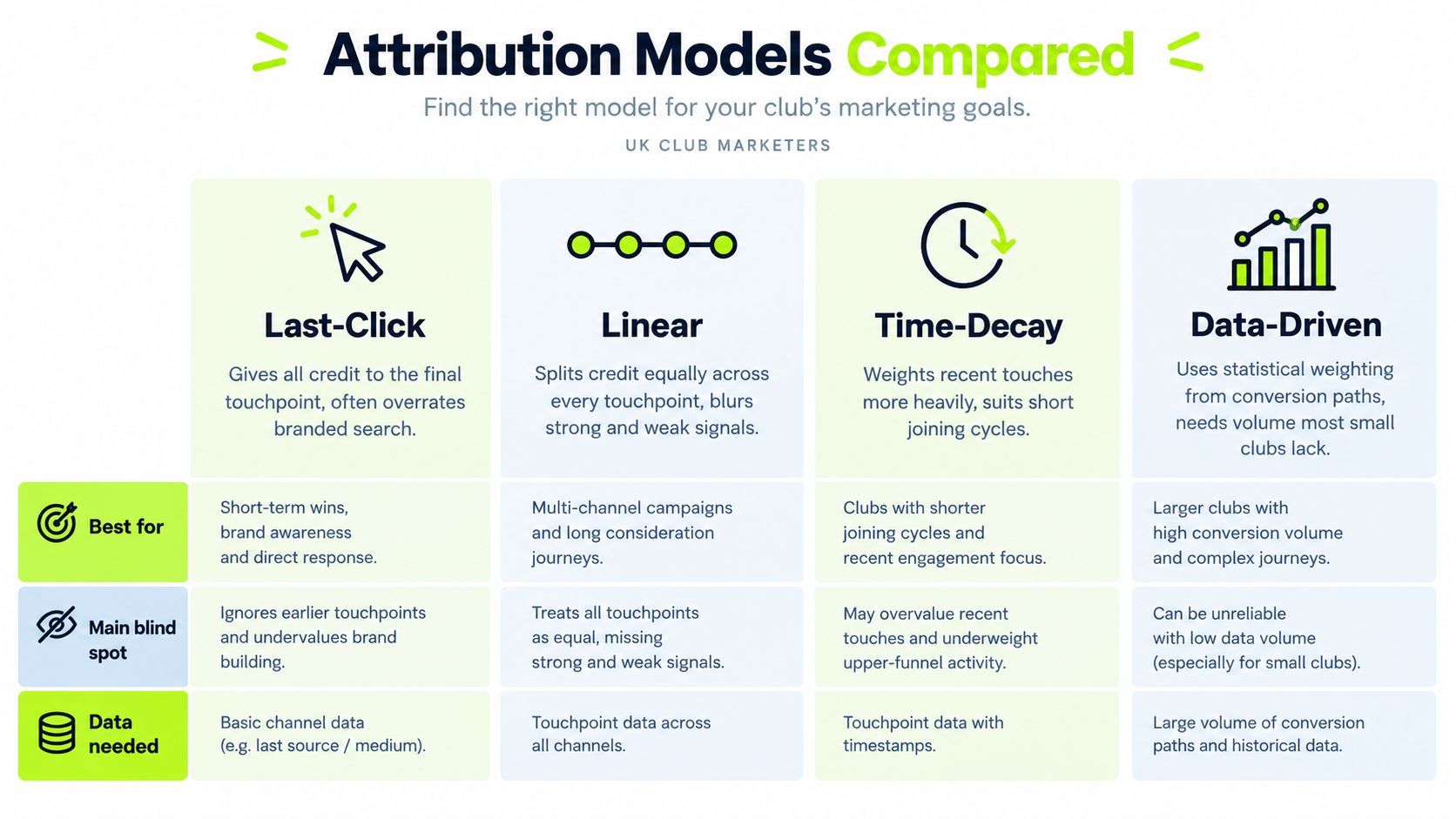
A club should diagnose these three problems separately:
- Device separation: Can the club connect visits, enquiries and applications when a prospect changes device?
- Offline influence: Are calls, tours, open days, trial rounds and referrals recorded consistently?
- Multiple influence: Can reporting show the wider journey without pretending that every touchpoint caused the join?
Those answers reveal whether the immediate constraint is data capture, staff process, model selection or genuinely weak demand.
Attribution Models and What Each One Gets Wrong
Attribution models don't discover an objective truth. They apply a rule to the interactions that have been recorded. The right model therefore depends on the decision the club is making and the bias it can tolerate.
Take Alex's journey: a paid social impression, an organic membership-page visit, an open-day attendance, a branded search, a trial-round booking and a completed membership payment.
Last-click gives all conversion credit to the final interaction, usually branded search or the application form. It's easy to understand and useful for monitoring direct response, but it ignores the activity that created consideration.
Linear attribution shares credit evenly across recorded touchpoints. It acknowledges that several interactions appeared in the journey, but it treats a brief page visit and a meaningful open-day attendance as equivalent if both are recorded.
Time-decay attribution gives more weight to interactions closer to conversion. That may suit a short joining cycle, but it can undervalue early demand creation in a club where golfers take time to compare venues.
Data-driven attribution uses modelling to estimate contribution from observed conversion paths. It can be more flexible, but it still depends on the completeness and quality of the signals available. Missing consent, offline interactions and unlinked devices remain missing, whatever the sophistication of the model.
As summarised in this explanation of marketing attribution models, last-click assigns all credit to the final interaction, linear spreads credit across recorded touchpoints, time-decay weights later interactions more heavily and data-driven approaches estimate contribution through modelling. None removes missing-data problems.
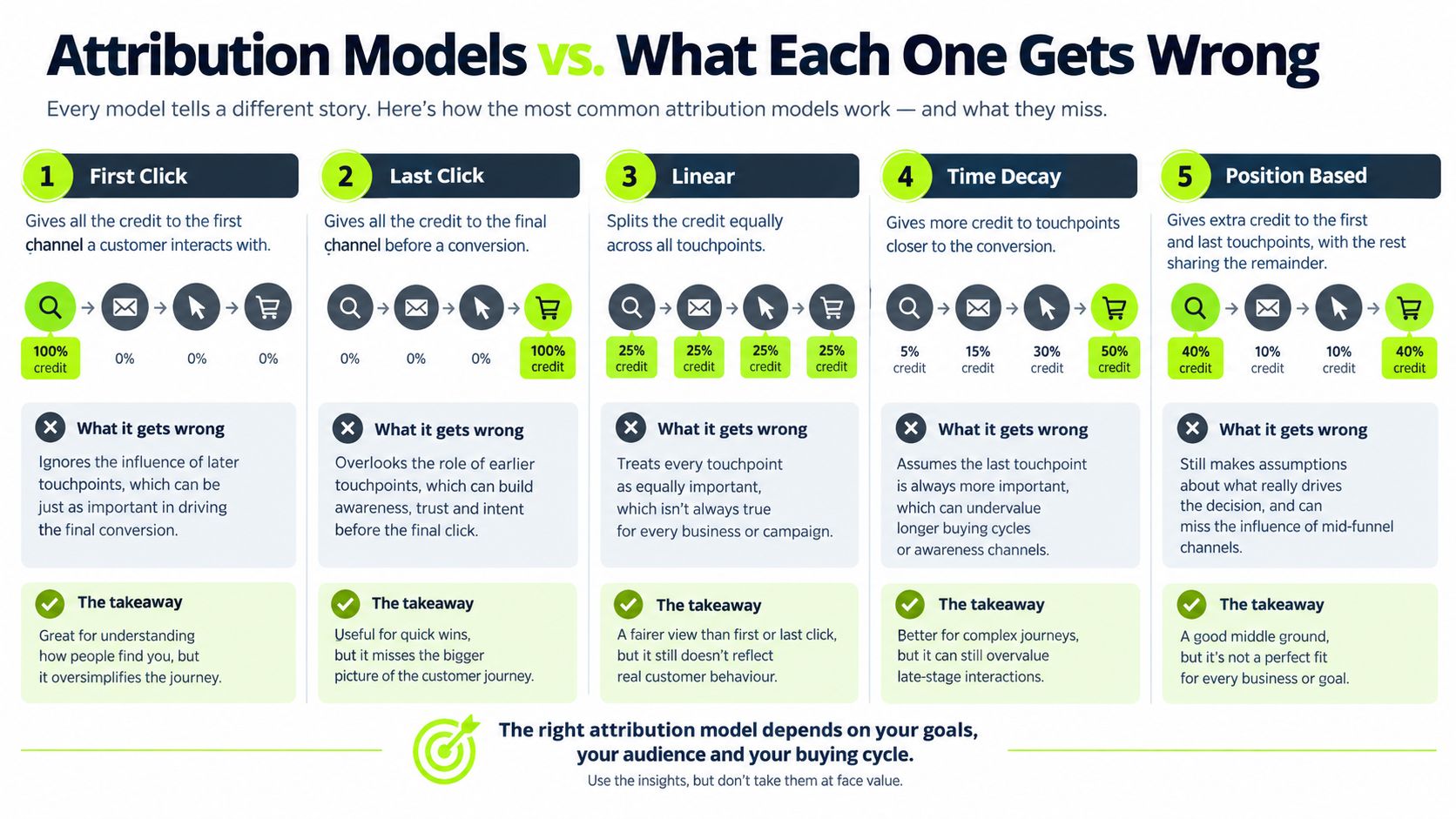
| Model | What it credits | What it ignores | Risk to the club |
|---|---|---|---|
| Last-click | The final recorded interaction | Earlier advertising, referrals, open days and research | Branded search receives too much credit |
| Linear | Every recorded touchpoint equally | Different levels of influence | Weak signals look as important as strong ones |
| Time-decay | Interactions nearest to joining | Earlier awareness and consideration | Longer-cycle activity looks less valuable |
| Data-driven | Modelled contribution from observed paths | Unobserved, offline and consent-limited activity | Apparent precision hides incomplete data |
A committee should avoid changing models as though the new model will solve the commercial problem. The useful question is whether the model supports a specific decision. For tactical paid-search management, last-click can provide a narrow signal. For quarterly budget allocation, it should be combined with CRM outcomes, retention and controlled tests.
For a practical explanation of how attribution rules affect marketing decisions, see GolfRep's guide to attribution rules. The key principle is simple: model selection is a choice about bias, not a switch that turns partial data into certainty.
Building a CRM That Connects Spend to Membership Revenue
The club's own CRM should be the reconciliation layer. Advertising platforms can report interactions, but the club owns the records that determine whether someone became a qualified prospect, attended a visit, joined, renewed or cancelled.
Start with fields that reflect the sales process
At minimum, create consistent fields for:
- Source history: Original source, latest source and campaign.
- Enquiry status: Enquiry date, qualified status and current pipeline stage.
- Commercial milestones: Visit date, trial-round date, application date and membership start date.
- Revenue and retention: First-year contribution margin, renewal status and cancellation reason.
The exact software matters less than the definitions and staff discipline. “Lead” shouldn't mean a form submission in one report and a qualified phone conversation in another.
Reconcile every route into one enquiry record
Website forms, phone calls, walk-ins, email replies and open-day sign-ins should create or update the same prospect record. Reception needs a short process for asking how the golfer heard about the club, while preserving “unknown” when the answer isn't reliable.
Deduplication matters. A golfer who submits two forms and calls reception is one commercial opportunity, not three leads. Use a practical matching rule based on contact details and staff review, then preserve the original source rather than overwriting it with the latest interaction.

Different advertising platforms use their own attribution rules. As this analysis of paid-media attribution explains, adding platform-reported conversions can inflate the apparent number of enquiries or memberships. The CRM should therefore be the source for unique prospects and signed members, not the sum of Google, Meta and email dashboards.
Report from membership backwards
A useful monthly report starts with signed memberships and traces back to source, campaign and observable touchpoints. It should show:
- Unique enquiries by original source.
- Qualified enquiries by source.
- Booked visits and completed visits.
- Applications and signed memberships.
- First-year contribution margin.
- Renewal and cancellation outcomes.
GolfRep's CRM guidance for golf clubs covers the operational importance of connecting source, follow-up and sales stages. The commercial rule is to evaluate spend against members and retained value, while using platform data for optimisation within each channel.
GolfRep can fit into this approach as one option where a club needs a shared data layer connecting advertising sources, follow-up conversations, booking activity and membership status. It shouldn't replace agreed definitions or staff process. Technology can enforce a workflow, but it can't decide whether a visit was truly qualified or whether a cancellation reason was recorded accurately.
Incrementality Testing for Clubs Without a Data Team
A committee doesn't need another dashboard to answer the most important budget question. It needs to know whether a campaign created additional qualified demand that wouldn't otherwise have appeared.
That's the purpose of incrementality testing. The club compares outcomes in an exposed group with outcomes in a comparable holdout group, then examines qualified enquiries, booked visits and completed memberships rather than clicks alone.
Use a geographic holdout
For a local membership campaign, select comparable postcode areas. Keep advertising active in one group and pause or withhold the campaign in another for a defined period. Match the areas as closely as possible on prior enquiry volume, distance from the club and local golfer profile.
Don't judge the test on impressions. Record:
- Qualified enquiries.
- Booked and completed visits.
- Trial rounds.
- Applications.
- Signed memberships.
- Early retention where the timing allows it.
Use a time-based comparison when geography is impractical
A club can alternate campaign periods, provided the periods are comparable and other major activity is documented. Avoid running the active period during an open day while the comparison period has no equivalent event. Weather, course conditions, pricing changes and major competitions can all affect demand.
The CMA distinguishes advert delivery, attribution and effectiveness measurement. Proving that an advert was served doesn't prove that it caused a conversion, which is why comparable geographic or time-based tests are valuable. The CMA's measurement framework supports that separation.
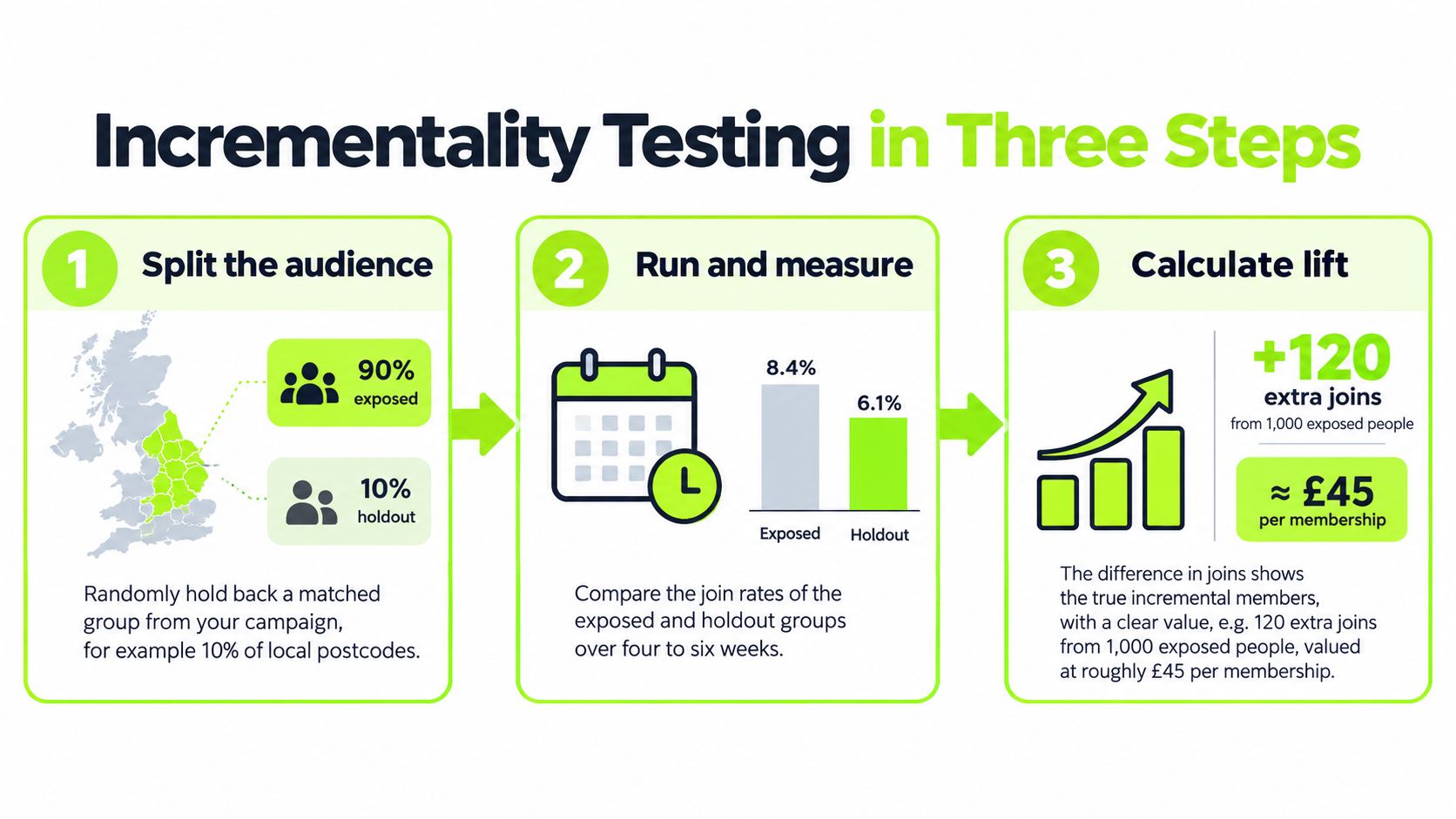
Committee decision rule: Scale only when the exposed group produces stronger commercial outcomes than the holdout, the comparison is credible and the additional member value supports the cost.
A small club won't produce laboratory-grade evidence. It can still produce better evidence than a platform dashboard claiming credit for every observable conversion. Write the test plan before launch, keep the audience definition fixed, record operational changes and agree the decision rule in advance.
Privacy, Consent and the New Measurement Reality in the UK
Privacy compliance changes the amount of data a club can observe. Under PECR, storing or accessing information for advertising measurement, user-level tracking, profiling or cross-site attribution generally requires freely given, specific, informed and unambiguous consent. The ICO distinguishes ordinary aggregated service-improvement analytics from individual monitoring and advertising-related measurement, with the latter generally outside the analytics exception. The ICO's guidance on cookies and similar technologies sets out that distinction.
The consequence is practical. A golfer may see an advert, decline analytics consent, return later, phone the club and eventually join. The original campaign may not appear in the user-level report, even though it influenced the journey. Last-click reporting should therefore be treated as a lower-bound estimate, not a complete account of demand.
Cookie data no longer provides a dependable foundation
A UK Business Data Survey reported that only 12% of UK businesses that handle personal data and operate a website said they acquired personal data using cookies in 2025–26. The fieldwork ran between October 2025 and January 2026 and covered 4,450 businesses. The finding doesn't mean that only 12% of marketing activity is trackable, but it demonstrates how constrained cookie-based collection has become. The survey summary on UK cookie consent statistics provides the relevant context.
Clubs shouldn't respond by trying to identify people who haven't consented. They should separate what is known from what is inferred:
- Consented user-level data: Form submissions, booking activity and CRM records where the prospect has supplied details lawfully.
- Aggregated channel data: Spend, impressions, clicks and reported conversions, used directionally.
- Operational outcomes: Calls, tours, open-day attendance and reception notes.
- Business outcomes: Applications, memberships, renewals and cancellations.
- Causal evidence: Periodic geographic or time-based experiments.
This is triangulation. It accepts that no single source sees the full journey, then combines sources that answer different questions. A club can make a defensible spend decision without pretending that every conversion belongs to one identifiable advert.
For implementation detail, GolfRep's conversion tracking setup guide is a useful reference for connecting campaigns to CRM stages and revenue outcomes while keeping consent boundaries clear.
Channel Scorecard Built for Member Lifetime Value
Cost per lead is easy to report and often weak as a membership decision metric. A cheap lead that never visits the club can be less valuable than a more expensive prospect who joins, renews and uses the facility regularly.
A UK-focused survey reported that only 34% of UK B2B marketers agreed their data was proven in pipeline. The same research found that 49% updated campaigns across channels only occasionally using performance data, while 38% prioritised frequent optimisation. The figures aren't golf-specific, but they illustrate how rarely marketing data is connected to commercial outcomes. The survey report covered by Yahoo Finance provides the source.
| KPI | What it measures | Why it matters more than CPL |
|---|---|---|
| Qualified enquiry rate | The share of enquiries meeting the club's fit criteria | Separates genuine prospects from low-intent volume |
| Booked visit rate | The share of qualified prospects booking a visit or trial | Shows movement from interest to consideration |
| Joining rate | The share of qualified prospects who become members | Connects marketing to the commercial outcome |
| First-year contribution margin | Revenue after relevant service and delivery costs | Shows whether the acquired member is economically useful |
| Renewal rate at month twelve | The share renewing after the first membership period | Tests member fit and acquisition quality |
| Predicted lifetime value | Expected value across joining and future retention | Supports budget decisions beyond the first payment |
| Payback period | Time required to recover acquisition cost | Protects cash flow and committee confidence |
Compare channels using the same definitions and time window. A channel producing fewer enquiries may win if its prospects attend visits, join at a healthy margin and renew more reliably. Another may generate impressive lead volume while creating low conversion and high administrative workload.
When a committee compares agencies or content suppliers, it should apply the same commercial discipline. A useful guide to compare content marketing services can help structure that evaluation, but the club should still judge any supplier against qualified visits, memberships and retained value rather than activity alone.
A Practical 90-Day Plan to Rebuild Your Attribution
Days 1 to 30: Audit the CRM, standardise original-source and latest-source fields, define qualified enquiry, booked visit and signed membership, then baseline current reporting.
Days 31 to 60: Run one geographic or time-based incrementality test, add phone and open-day outcomes to enquiry records and replace the committee's CPL view with the lifetime-value scorecard. For broader measurement reading, these influencer marketing analytics metrics show how channel reporting can be tied to defined outcomes rather than surface activity.
Days 61 to 90: Review the test, retire or hold the weakest channel, scale the strongest evidence-backed activity and schedule a quarterly reconciliation of spend, memberships and retention.
The aim isn't perfect attribution. It's a repeatable process that makes uncertainty visible and budget decisions more defensible.
GolfRep helps golf clubs connect acquisition spend with enquiries, visits, applications, memberships and retention through practical CRM and revenue-measurement systems. If your committee needs a clearer view of which activity produces profitable members, visit GolfRep to discuss mapping the commercial journey and rebuilding the reporting around decisions that matter.
Ready to tap into our proven growth system?