Vwo Conversion Rate Optimization

A membership landing page can look busy all day and still fail commercially. A general manager may see plenty of visits in the analytics, while the membership team receives forms from people who only wanted a price, a brochure, or a quick look at the course. The website reports a lift, but the club doesn't gain enough booked visits, completed applications, or new members to justify the change.
That is the central issue with VWO conversion rate optimisation for golf clubs. A winning variation isn't automatically a commercial win. The useful test is the one that improves the quality and value of the customer journey, from the first visit through to a joining decision and, where possible, longer-term membership value.
Setting Realistic Expectations for Club Traffic
Golf clubs rarely have the traffic volume of a large online retailer. That makes the testing strategy different from the outset. A minor change to a button shade may be easy to launch in VWO, but it can take a long time to produce enough evidence, and any apparent improvement may just reflect normal variation in local demand.
The first task is to establish a property-specific baseline. Record visits, enquiry starts, completed enquiries, booked visits, trials, applications and joins. Then split those figures by device, source, geography and new versus returning visitor. A blended conversion rate can conceal the fact that paid search visitors behave differently from members sharing a page locally, or that mobile visitors abandon the form more often than desktop users.
UK online retail provides useful context for the importance of digital journeys. Internet sales represented 8.3% of total UK retail sales in 2011, rising to 19.2% in 2019, 28.1% in 2020, 30.7% in 2021, 27.1% in 2024 and 27.5% in 2025, according to the Office for National Statistics retail sales series. The figures aren't golf-club benchmarks, but they show why a club website now carries a persistent share of the commercial journey.
Start with the largest commercial constraint
Before opening VWO, ask where prospective members are dropping out:
- Proposition: Can a visitor understand who the membership suits, what it includes and how to take the next step?
- Evidence: Are fees, joining information, course access, playing opportunities and member experiences explained clearly?
- Action: Does the page offer a specific route such as booking a visit or discussing membership?
- Friction: Can a visitor complete the action comfortably on a phone without unnecessary fields or confusing errors?
- Follow-through: Does the club record what happened after the form was submitted?
A practical measurable path to conversion helps the team connect page behaviour with a real commercial outcome. For a deeper acquisition context, compare the funnel with GolfRep's guide to generating golf membership enquiries.
Practical rule: Low traffic doesn't make CRO impossible. It makes weak hypotheses expensive.
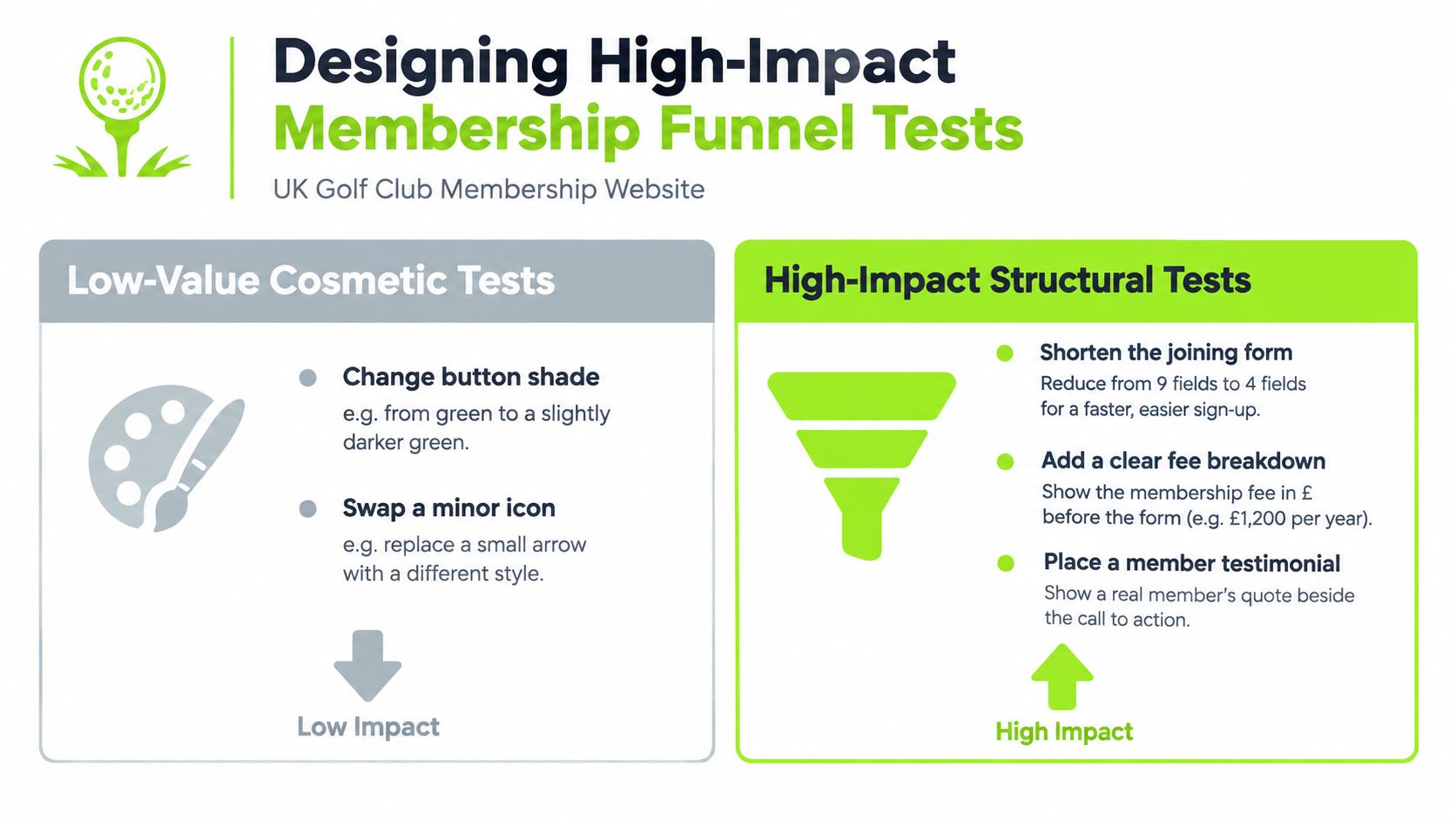
A club with modest traffic should prioritise structural changes, not decorative ones. Test the joining proposition, form length, fee transparency, trust evidence, tour booking route and mobile usability. Those changes can influence a decision. A slightly different shade of green usually can't.
Defining Qualified Conversions and Sample Sizes
VWO should reflect the club's commercial definition of success. A brochure download can show interest, but it is not the same as a qualified membership enquiry. A form submission from outside the club's catchment area may be less valuable than a local golfer who books a visit and arrives ready to discuss membership.
Set one primary business conversion before creating variations. For many clubs, that means a qualified enquiry or a booked club visit. Supporting events can include viewing membership fees, starting an enquiry, calling the club, downloading a membership pack or selecting a trial option. Keep these actions visible in reporting, while preventing them from replacing the outcome the membership team must convert.
Build the measurement layer before the experiment
Set up a short funnel that connects website behaviour to revenue:
- Landing visit: Record the page, campaign and audience that brought the visitor.
- Intent signal: Capture meaningful actions, such as viewing membership options or starting an enquiry.
- Primary conversion: Record the qualified enquiry, booked visit, paid trial or application.
- Sales progression: Pass the source and VWO variation into the CRM.
- Commercial outcome: Track attendance, application progress, join status and later value where available.
A conversion tracking setup for golf clubs can help the team connect these stages without reconciling disconnected platform reports.
Plan the test around baseline conversion rate, the minimum improvement worth detecting, the number of variations and the share of visitors included. In a UK ecommerce A/B testing analysis, only 17.4% of 2,408 tests produced a statistically significant winning variant.
The same analysis estimated a median requirement of 14,800 sessions per variation to detect a 5% minimum detectable effect from a 3% baseline conversion rate, using 95% confidence and 80% power. For a golf club, this is a planning warning rather than a traffic target. A test that produces more unqualified enquiries can look successful in VWO while creating extra work and little membership revenue.
Use the Sprints & Sneakers testing guide to align the team on sample size, test duration and stopping rules. If available traffic cannot support a clean result, choose a larger commercial change, reduce the number of variations and judge the outcome against CRM quality as well as form volume.
Designing High-Impact Membership Funnel Tests
A golf club can increase membership enquiries without improving membership sales. A test that attracts poorly qualified leads may raise VWO conversion rates while overwhelming the membership team and producing fewer visits, applications or joins. Design each experiment around the commercial decision you need to improve, not only the page element you can change.
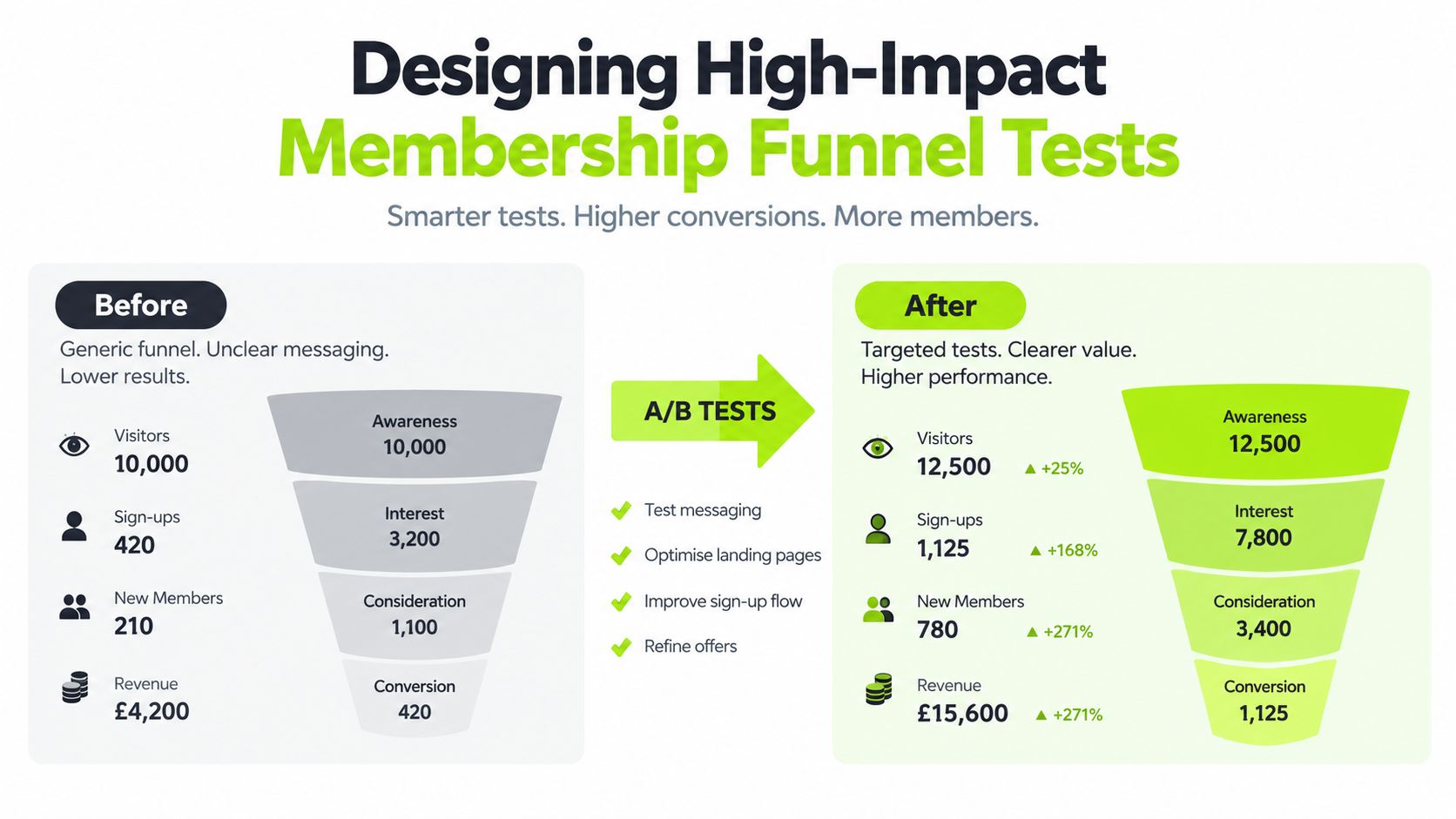
Consider two possible experiments. Version A changes the button colour on a membership page. Version B replaces a long legacy form with a shorter route, explains why each requested detail is needed, and lets visitors choose between booking a visit and requesting a call. Version B tests the proposition and the next action, while also giving the club information about which route leads to stronger conversations. Teams can audit funnels and prioritize tests using analytics, recordings, staff feedback and CRM outcomes before committing traffic.
Compare the trade-offs
| Test idea | Likely learning | Commercial risk |
|---|---|---|
| Change button shade | Whether attention changes slightly | Low impact and slow evidence |
| Change minor icon | Whether a visual detail affects interaction | Often too small to isolate |
| Simplify the joining form | Whether unnecessary effort suppresses enquiries | A shorter form may remove useful qualification |
| Add clear fee information | Whether uncertainty is stopping the next step | May deter price-sensitive visitors, which can be useful |
| Replace “Contact us” with “Book a club visit” | Whether a specific action creates stronger intent | Requires staff and diary capacity |
| Add a member testimonial beside the CTA | Whether trust improves action | Evidence must be relevant and credible |
A shorter form is not automatically a better form. If the membership team needs playing preferences, age category or preferred contact method to route an enquiry, removing every field just shifts the work into follow-up. Test the smallest field set that lets staff qualify the opportunity and move it towards a visit or conversation.
The same trade-off applies to calls to action. “Contact us” leaves the visitor to decide what happens next. “Book a membership visit” describes a clearer action, but it depends on accurate availability, prompt confirmation and staff capacity. A stronger call to action can expose an operational weakness rather than solve one.
Test the proposition, not just the interface
Membership decisions involve trust, identity and practical fit. Test messages that clarify competition access, social golf, coaching, flexible options, junior pathways or the experience of joining a particular club. Match the wording to the audience. A junior membership page should not make the same case as a flexible membership page for an occasional player.
For the full journey structure, see GolfRep's guide to the golf club membership funnel before selecting a test. Set guardrails before launch. If a variation increases form starts but reduces booked visits or produces weaker conversations, it has not created a commercial improvement. Define the primary outcome, lead-quality measures and follow-up capacity before sending traffic to either version.
Segmenting Results by Device and Audience Type
An overall winner can hide a failing experience. A desktop uplift may compensate for a mobile decline, or a strong result from existing members may disguise weak performance among new prospects. VWO results should be reviewed through the way golfers arrive and make decisions.
Start with device. Adobe's UK Digital Economy research reported that £16.5 billion was spent on mobile devices during the 2025 holiday period, representing 61.5% of total online spend and a 14.1% increase on 2024, as reported in its UK digital economy analysis. Retail behaviour isn't identical to golf membership behaviour, but it reinforces a practical point. A club's mobile page deserves primary attention, not a late desktop adaptation.
Use a consistent segmentation framework
Review each test across:
- Device: Mobile, desktop and tablet where volume justifies it.
- Visitor status: New versus returning visitor.
- Source: Organic search, paid search, social, email, referral and direct.
- Geography: Local catchment, wider region and visitors outside the normal membership area.
- Audience: Full members, flexible or iGolf prospects, juniors, women, visitors and resort guests.
- Intent: Membership research, visit booking, trial enquiry, coaching or visitor golf.
Don't create tiny segments just because the platform allows it. Start with groups that reflect different commercial propositions or different user experiences. For example, a junior parent may need safeguarding reassurance and coaching information, while an experienced local golfer may want fees, playing rights and a visit quickly.
On mobile, inspect the full journey manually. Check whether the main CTA appears without excessive scrolling, whether fields are easy to select, whether the keyboard obscures the next step, and whether error messages explain what needs correcting. Review page speed and image weight as well. A large course photograph can support persuasion, but not if it delays the information a visitor needs to decide.
The right question is not “Which version won?” It is “Which version won for the audience and action the club actually values?”
Report results in a small matrix showing variation, device, audience, primary conversion and downstream quality. If a variant wins overall but performs poorly on mobile, don't roll it out blindly. Adapt the experience or run a focused mobile test after identifying the specific friction.
Validating Test Winners Against CRM Outcomes
A form submission is an event, not a member. This distinction is where many CRO programmes lose commercial discipline. A page can produce more enquiries by making the offer vague, hiding fees or reducing qualification, while the membership team receives more conversations with less chance of a join.
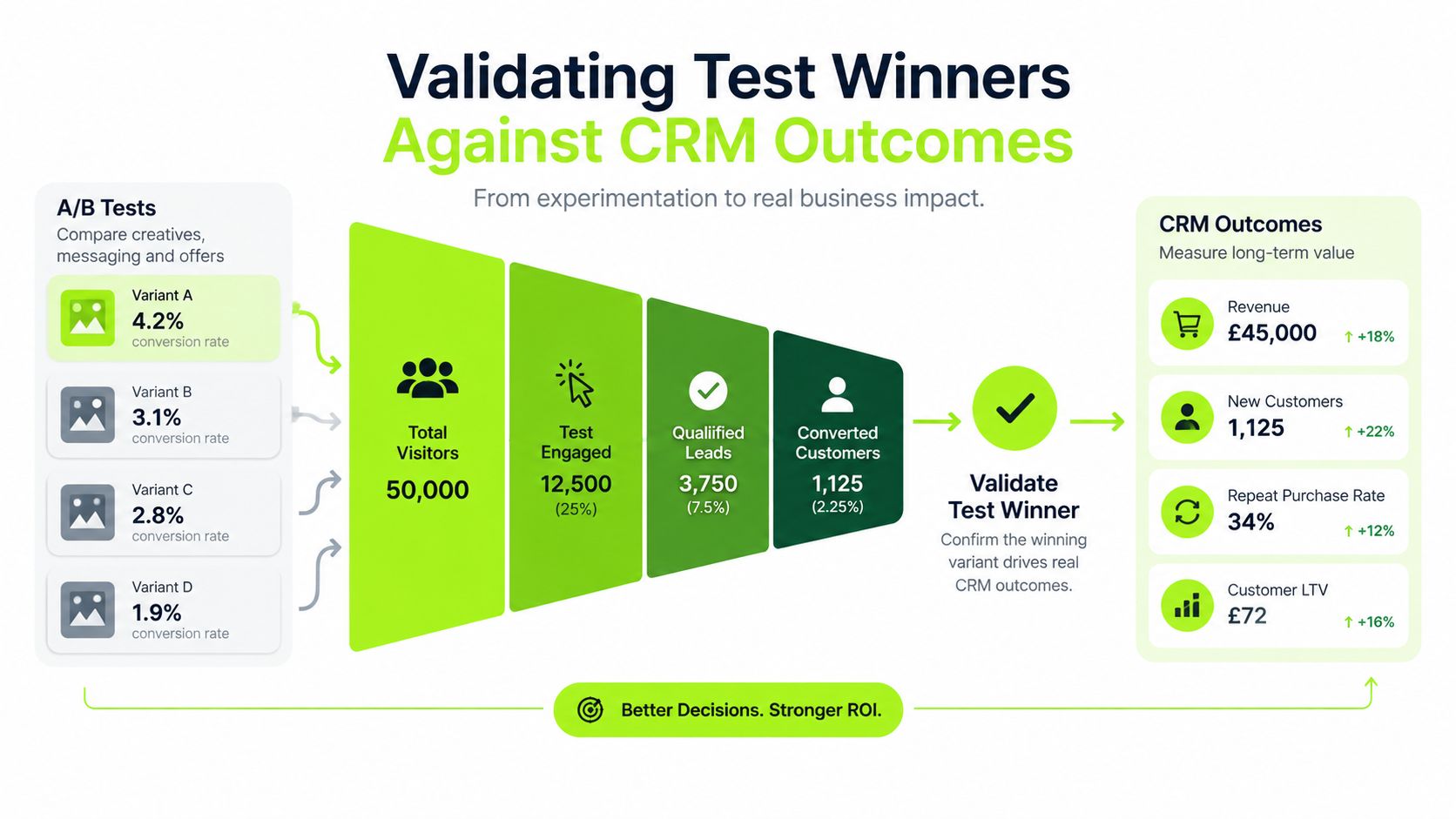
The club should connect the VWO variation to the CRM record. At minimum, pass the experiment identifier and variation into the enquiry record, alongside source, device and landing page. The membership team can then compare not only the number of leads, but also what happens next.
Use downstream measures as guardrails
A useful validation report might include:
- Qualified enquiry rate: Did the visitor meet the club's location, audience or membership criteria?
- Booked-visit rate: Did the enquiry progress to a tour, meeting or club visit?
- Attendance rate: Did the prospect attend the booked appointment?
- Application completion: Did the visitor progress beyond initial interest?
- Join rate: Did the prospect become a member?
- Membership value: What revenue or contribution does the resulting cohort create?
- Renewal behaviour: Where data is available, did the member remain engaged and renew?
England recorded 750,071 affiliated club members in 2025, up 2.66% year on year, while junior membership rose from 46,028 to 61,483, according to the Hillier Hopkins Golf Clubs Survey Report. Those figures illustrate why a single blended membership audience is commercially weak. A variation that appeals to juniors may need different messaging, staff routing and value assessment from one aimed at full adult membership.
Payment and application friction also deserves a complete-journey review. PayPal's UK research reports that 66% of UK consumers have abandoned an online purchase or payment because of avoidable issues such as lengthy forms, security concerns or missing preferred payment options, as described in its UK conversion guidance. A golf club may encounter the same friction in a membership application, lesson booking, visitor purchase or deposit journey.
Commercial test rule: A variation wins only when the improvement survives contact with the CRM.
Don't discard a statistically inconclusive test without learning from it. It may show that the proposed change wasn't large enough, the audience was poorly defined, or the primary metric was too far from the actual decision. Record the hypothesis, result, segment differences and next action so the club builds knowledge instead of repeating the same idea.
Building a Continuous Experimentation Workflow
CRO becomes useful when the club treats it as a commercial operating routine, not a one-off website redesign. A test should address a defined constraint, attract the right prospective members and produce evidence that the membership team can act on.
Use this workflow:
- Audit: Review analytics, recordings, form data, staff feedback and CRM stages. Identify where enquiries stall or arrive without a realistic membership fit.
- Prioritise: Rank opportunities by likely commercial impact, implementation effort and evidence of friction.
- Define: Set the primary conversion, guardrails, audience, baseline, minimum detectable improvement and stopping rule. Include downstream measures such as booked visits, applications and joins.
- Build: Change one major experience, such as the form, CTA route, fee explanation or trust section.
- Run: Give the test enough representative demand to cover at least two full weekend booking cycles. Golf demand often peaks around weekends, paydays, weather changes and club events, so retail testing habits may not fit the membership journey. Account for those conditions before judging the result, as discussed in the UK A/B testing analysis.
- Validate: Compare qualified enquiries with booked visits, applications, joins and cohort quality. A higher form completion rate has little value if staff receive leads they cannot convert.
- Decide: Roll out, iterate, hold or reject the change. Record the reason and the next test.
Avoid stopping after a strong day or reacting to every fluctuation. VWO's duration and sample requirements depend on traffic, baseline conversion, variation count and visitor allocation. A club with limited traffic may need to test a larger change, monitor the wider funnel and reserve formal experiments for decisions capable of producing useful evidence.
GolfRep can support acquisition, CRM attribution, follow-up and membership outcomes, connecting VWO experiment design with the wider commercial journey. Visit GolfRep to discuss a practical route from website tests to measurable membership and revenue outcomes.
Ready to tap into our proven growth system?