How to Grow Membership at a Golf Club in 2026

A committee meeting ends with a familiar conclusion: the club is “full” because Saturday mornings have a waiting list, so there's no reason to invest in membership growth. Then the month-end report arrives. More members have left than joined, weekday play remains light, and the enquiry figures tell a different story from the tee sheet.
That contradiction is common. A club can have pressure at one part of the week, spare capacity elsewhere and a shrinking membership base at the same time. The answer to how to grow membership isn't automatically more advertising. It's to identify the constraint that's limiting profitable growth, then fix that constraint without damaging the member experience.
A Quiet Tee Sheet and a Full Waiting List
Consider a private club with strong Saturday demand, a short peak-time waiting list and an ageing membership. The committee sees the list and assumes the club has solved acquisition. The general manager sees empty weekday slots, unanswered questions about flexible access and a steady stream of members not renewing.
Both views contain part of the truth. The club has demand, but it hasn't converted that demand into the type of membership it needs. A peak-time waiting list might reflect limited tee capacity, while the wider business still needs weekday players, younger adults, women, families or social members.
This is why a waiting list should be managed as a commercial asset, not treated as proof that every growth problem has disappeared. Clubs need to record who is waiting, what they want to play, when they want to play and whether the club can serve them profitably. A transparent process also protects the relationship with prospects who can't join immediately. The principles in this guide to managing a golf club waiting list are useful here, particularly the distinction between demand and available capacity.
Map the constraint, not the fashion
The club down the road may be running an open day. Another may be advertising a discounted category. Neither tells you what your club should do next.
Start with four questions:
- Are enough qualified golfers making enquiries?
- Are enquiries becoming tours, taster rounds or booked visits?
- Are visits becoming the right type of membership?
- Are new members still active after their first few months?
Each question points to a different intervention. More advertising won't repair a poor joining experience. A polished sales process won't help if nobody in the catchment knows the club exists. A successful joining campaign can still fail if new members don't find playing partners or understand how to use their membership.
Commercial rule: Don't approve a membership-growth budget until you can name the current constraint, the owner responsible for it and the metric that will show whether it has improved.
Diagnose the Real Constraint Before Spending Anything
England's market provides a healthy backdrop, but a healthy market doesn't remove the need for diagnosis. England Golf reported 750,071 club members in 2025, up 2.66% from 730,602 in 2024 and the highest figure for at least 13 years, against a wider pool of around 4.2 million adult golfers in England (England Golf membership report). The opportunity exists. Your club still has to convert local demand into a suitable, retained membership.

The four constraints
| Constraint | Signal in your data | First lever to pull |
|---|---|---|
| Weak enquiry volume | Few qualified prospects from the realistic catchment | Improve local positioning and targeted acquisition |
| Poor enquiry-to-visit conversion | Enquiries exist, but tours or playing visits are scarce | Set ownership, response standards and booking options |
| Poor visit-to-join conversion | Prospects visit but don't select a category | Improve the proposition, packaging and joining experience |
| Poor 90-day retention | New members join but fail to play or engage | Build structured onboarding and early intervention |
Measure the first constraint using a clean monthly view of qualified enquiries, not social reach or general website traffic. Record the source, location, playing need and membership category requested. If the club receives plenty of enquiries but few visits, audit response time, contact attempts, availability and the clarity of the next step.
The visit stage needs its own review. Speak to staff who host tours, inspect the information given to prospects and record why people decide not to join. “Too expensive” may really mean the prospect didn't understand access, couldn't find a playing group or was offered a category that didn't fit their routine.
Use cohorts to expose the hidden leak
Retention diagnosis requires a different view. Take recent joiners and inspect their first-round booking, second visit, playing frequency and engagement with club activities. A payment report will tell you who joined. It won't tell you who is becoming a member in the practical sense.
The decision rule is simple. If enquiry volume is weak, build demand. If visits are weak, fix the sales process. If joins are weak, redesign the proposition. If early activity is weak, improve onboarding before buying another lead.
Building a Steady Pipeline of Qualified Enquiries
Once a club confirms that demand is the constraint, it needs a repeatable local pipeline rather than a single burst of promotion. The catchment matters more than broad visibility. A golfer who lives too far away, wants access the club can't provide or only plays at the busiest time may create activity without creating a viable membership.
A practical acquisition mix should include several routes, each with a clear audience and a defined next step:
- Local paid media: Target golfers within a realistic drive-time radius, with separate messages for weekday players, younger adults, families and women.
- Member referrals: Ask active members to invite a named friend to a taster round or open event. Recognition, guest access or a playing experience can be more suitable than a blanket price incentive.
- Local partnerships: Approach employers, leisure operators, schools, accommodation providers and community groups whose audiences already live near the club.
- Open days and tasters: Measure booked visits and subsequent applications, not attendance alone.
- Managed waiting lists: Keep prospects informed about availability, suitable categories and likely next steps rather than allowing interest to go cold.
A club should also make its proposition visible in search. Useful content can answer questions about membership categories, playing access, coaching, family participation and joining fees. A practical digital marketing lead generation playbook can help commercial teams think through channel selection and lead quality, but the golf club still has to adapt the process to its catchment and capacity.

Set an example target without worshipping the number
For a club with around 400 members, management might set a monthly target for qualified enquiries based on its required net growth, expected leavers and observed conversion rates. The target should be built backwards from capacity and retention, not copied from another club.
For example, the club can ask:
- How many members do we need to add after expected leavers?
- How many of those should be full, flexible, junior or family members?
- How many visits are required to produce that number of joins?
- How many qualified enquiries usually produce those visits?
- Which channels can supply those enquiries at the required quality?
Those figures belong in the club's own CRM and finance model. Don't publish a generic target as if it applies to every facility. The useful output is a tested local assumption, reviewed monthly against actual enquiry quality and available tee time.
The GolfRep guide to golf club lead generation is relevant when the club has identified a genuine demand gap and needs to connect acquisition activity to measurable commercial outcomes.
Turning Enquiries Into Booked Visits and Joiners
A qualified enquiry should move through a defined process. If responsibility sits vaguely with “the office”, prospects receive inconsistent answers and managers can't tell whether the problem is demand, capacity or execution.
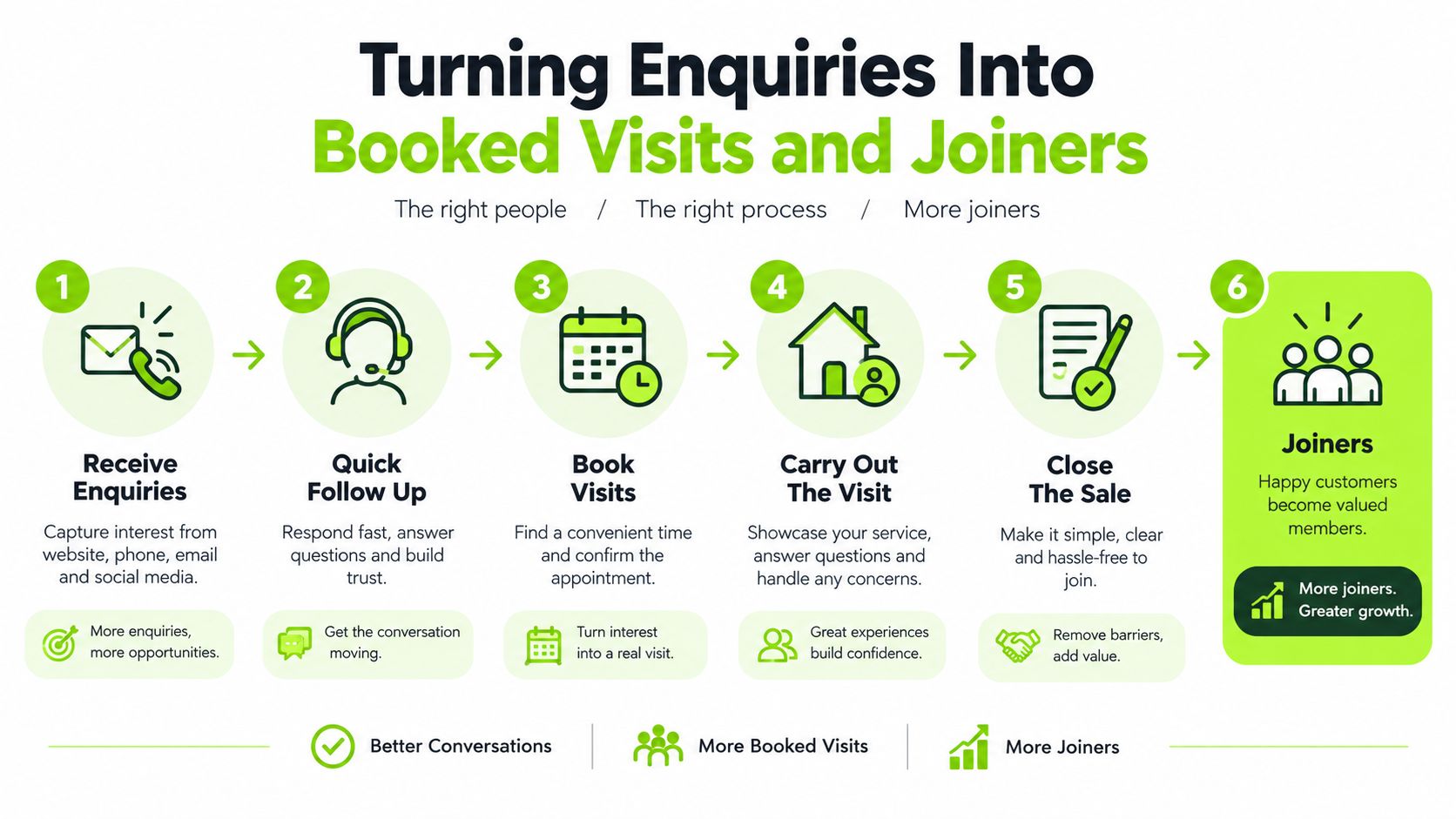
Use this five-stage operating process:
- Capture every enquiry in a CRM. The membership manager or nominated administrator records source, location, playing pattern, preferred category and next action. The metric is complete records, not a crowded inbox.
- Respond quickly with qualification questions. The owner asks when the golfer plays, what access they need, who else may join and whether they're interested in a tour, taster or coaching session. The aim is to understand fit, not deliver a generic brochure.
- Offer a booked visit. Give two practical options, such as a clubhouse tour or a playing visit with a member. The metric is enquiry-to-visit conversion, with the booking date visible in the CRM.
- Send a custom proposal within 24 hours. Summarise the relevant category, access, joining process and next step. The membership manager owns the proposal, while the PGA professional or club secretary can add detail where appropriate.
- Follow up on a fixed cadence. Contact undecided prospects after 14, 30 and 60 days, with each message reflecting their original need. The metric is reactivation, decision outcome and stated reason for loss.
A club should distinguish between a member who has paid and a member who has started using the club. The first-round booking, second visit and introduction to playing partners tell you more about the quality of the conversion than payment alone.
UK golf-club survey evidence shows that clubs welcomed an average of 94 new members in 2023, while only 24% of members' clubs reported more leavers than joiners, indicating that demand often coexists with weak internal handling (UK golf-club membership survey). For teams reviewing messaging and search demand, keyword research for education marketers offers a useful reminder to organise content around the questions real prospects ask, even though a golf club's audience and buying journey are different.
Protect capacity while you convert
Don't solve a peak-time capacity problem by accepting every prospect into the same category. Explain access rules before the visit, maintain a transparent waiting list and offer suitable flexible or introductory routes where they fit. Review lost leads weekly by reason, including price, access, timing, eligibility, no response and club experience.
The GolfRep approach to golf club enquiry conversion is built around this operational distinction. A club needs both demand and a controlled path from interest to a membership that can be served well.
Pricing, Packaging and Entry Pathways That Convert
Price is often blamed for weak joining figures when the actual issue is poor packaging. A golfer who wants weekday access, coaching and social play may reject a premium annual category because it doesn't match how they intend to use the club. Cutting the price of the wrong product won't improve that fit.
Build categories around playing need, geography and life stage. A flexible member may value access at quieter times. A family may need connected benefits and simple junior progression. A newer golfer may need coaching, introductions and reassurance before committing to a full category.
England's participation mix reinforces the need for separate pathways. Junior membership rose by more than 34%, from 46,028 to 61,483, while the average proportion of members aged over 50 increased from 57% in 2012 to 65% in 2024 (England golf participation and membership data). Those groups won't respond to the same proposition, and they shouldn't receive the same onboarding.
Design the path before setting the price
A strong structure might move a prospect through:
- Introduction: A taster, coaching-led session or guided visit that reduces uncertainty.
- Progression: A flexible, weekday, junior or trial category with clear access conditions.
- Full membership: An upgrade triggered by usage, playing confidence and a demonstrated need for broader access.
- Advocacy: A member who understands the club well enough to invite others.
Make each step explicit. State what the category includes, when the golfer can play, how competitions work, whether coaching is included and what happens at the end of a trial. Ambiguity creates objections that staff then try to overcome with discounts.
Joining fees need the same treatment. Golfshake's findings show that 39% of clubs charged a joining fee, up from 37% in 2024 (Golfshake's 2025 golf-club membership survey). Whether a fee is appropriate depends on the club's proposition and capacity, but it should be explained as part of access, standards and member value rather than introduced late as an unpleasant surprise.
The same thinking applies to non-traditional facilities. Operators considering team building with racing simulators can learn from the wider principle, package the experience around the customer's intended use instead of forcing every buyer into one premium format.
Onboarding, Retention and the Cohort View of Growth
A new member's payment is an administrative event. The commercial result appears later, when that person plays, builds relationships, spends beyond the subscription, renews and recommends the club.
England's affiliated membership grew from 730,602 in 2024 to 750,071 in 2025, a 2.66% annual rise, while membership has grown by more than 100,000 since 2021 (membership growth context from Glenmuir). That market growth makes acquisition attractive, but headline sign-ups can conceal weak early engagement.
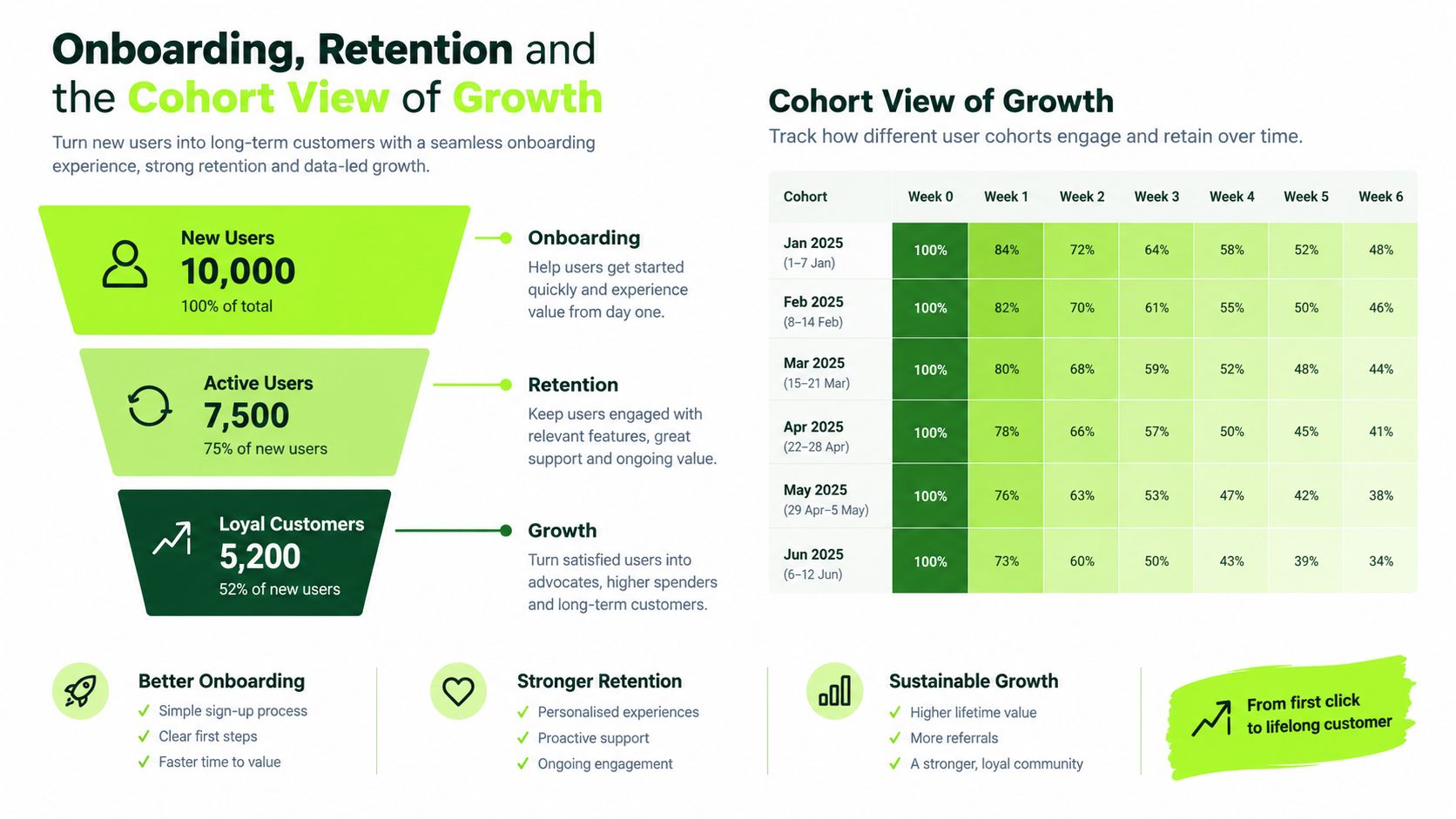
Review members by tenure
Segment members into four cohorts:
- 0 to 3 months: Has the member booked a first round, returned for a second visit and met a playing contact?
- 4 to 12 months: Is activity becoming habitual, and does the member understand competitions, groups and club communication?
- 13 to 24 months: Is the member renewing, referring others and using suitable facilities?
- 25 months and beyond: Is the club protecting loyalty while identifying lapsed or declining engagement?
For each cohort, report monthly gross retention, net retention, playing frequency, secondary spend, referral rate and time to second visit. The board doesn't need a decorative dashboard. It needs to know which cohort is weakening and which category is producing durable members.
Make onboarding an owned process
A documented onboarding journey should include:
- Immediate confirmation and a clear welcome.
- A named club contact who answers practical questions.
- A first-round booking target.
- An introduction to a playing group, buddy or suitable event.
- Engagement reviews at 30, 60 and 90 days.
Assign each action to a person. The membership manager may own contact and reporting, while the PGA professional introduces playing opportunities and the captain or member volunteer supports social integration. Use different journeys for juniors, lapsed golfers, trial members and full members. A teenager approaching university needs a different retention conversation from an established golfer who has stopped booking tee times.
Common mistakes are predictable. Clubs treat payment as conversion, fail to record the second visit and send one generic sequence to every category. The correction is equally clear: measure behaviour after joining, intervene early and report retention by cohort rather than relying on the total membership figure.
A 90-Day Plan to Grow Membership This Quarter
A committee can approve this work without launching five campaigns at once. Sequence the changes so the club solves one constraint before adding pressure to the next part of the system.
Weeks 1 to 2
Name one owner for the diagnostic. Export recent enquiries, visits, joins and leavers, then classify each record by source, category, outcome and lost-lead reason. Review capacity by day and time, including where the club has demand pressure and where it can accept more play.
Deliverable: a one-page constraint map.
Metric: a complete baseline for enquiry volume, enquiry-to-visit conversion, visit-to-join conversion and early retention.
Weeks 3 to 6
Repair the conversion process. Put every enquiry into a CRM, define the response standard, add qualification questions and create booked-visit options. Rewrite joining proposals around the prospect's playing need, then install the 14-, 30- and 60-day follow-up sequence.
Deliverable: an owned sales process and revised category presentation.
Metric: stage-level conversion, response time and lost-lead reasons.
Weeks 7 to 10
Only after the process works should the club increase demand. Select a small number of routes, such as local paid media, member referrals, a partnership and a taster event. Set capacity rules before promotion begins, and keep unsuitable or deferred prospects on a managed waiting list.
Golfshake reported that the average members' club waiting list more than doubled from 53 people in 2024 to 122 in 2025, while 39% of clubs charged a joining fee, up from 37% in 2024 (Golfshake survey findings). That makes controlled growth a management responsibility, not a reason to stop selling.
Weeks 11 to 12
Install the cohort dashboard. Review new members by tenure, category, source and first-90-day activity. Keep the reporting simple enough for the board to understand and detailed enough for staff to act on.
Deliverable: a monthly commercial dashboard with named owners.
Metric: net membership growth after leavers, early activity and retention by cohort.
Membership growth is a system, not a campaign. The club that maps its constraint, fixes the relevant stage and protects capacity will make better decisions than the club that just spends more on advertising.
GolfRep helps UK golf clubs improve the full commercial journey, from local demand generation and lead qualification to booked visits, joining decisions and cohort-based retention. If you want to identify the constraint limiting growth at your club, visit GolfRep to discuss a practical membership and revenue plan.
Ready to tap into our proven growth system?