Attribution Rules for Golf Clubs: A Practical Guide

A club secretary is looking at an advertising dashboard showing twelve new members from a Facebook campaign. The CRM tells a different story. Several people mentioned a recommendation from an existing member, others attended an open day, and the general manager remembers taking phone calls that never carried a campaign reference.
Nobody is necessarily being dishonest. The advertising platform and the club are applying different attribution rules to the same buying journeys. One is counting a measurable digital interaction. The other is looking at what happened before membership was agreed.
For a golf club, reliable attribution must connect online campaign signals with offline conversations, visits, referrals and joining decisions. It also needs to account for UK consent requirements. The practical question isn't “which platform is right?” It's “which rule are we using, what does it capture, and can we apply it consistently from advert to recurring revenue?”
Why Your Ad Report and Your Membership List Disagree
The disagreement usually becomes visible at the monthly board meeting. The marketing report credits a campaign with new members, while the membership list contains names that nobody can confidently connect to the advert. A member may have seen a promotion, spoken to a friend, visited during an open day and then called the office weeks later.
The platform sees the click or form submission. The club sees the conversation, tour and application. Both records can be useful, but they answer different commercial questions.
The practical issue: an attributed conversion is not automatically the same thing as a membership caused by one advert.
A paid platform may count a person because they interacted with an advert within its chosen attribution window. The CRM may record the original source as “member referral”, because that was what the prospect told reception. If the club compares those figures without documenting the rules, it can double count the same person or dismiss valuable offline influence.
What the club needs to decide
Start by separating three questions:
- What created awareness? This might be an advert, search result, open day or recommendation.
- What helped the prospect decide? A course tour, conversation with a PGA professional or trial round may matter more than the first click.
- What completed the sale? The final call, application form or office visit may be the conversion channel.
The answer shouldn't be forced into one number before these stages are recorded. A useful guide to measuring marketing effectiveness can help clubs establish the difference between activity, response and commercial outcome.
By the end of this process, a club should know which attribution rule it uses, how that rule is configured in advertising platforms, how source information enters the CRM, and where consent or missing offline data limits the conclusion. The aim isn't perfect certainty. It's a reporting system that supports sensible decisions about budget, staffing and the member journey.
Attribution Rules Explained in Plain English
Think of a new member's journey as a hole played by several people. A Facebook advert may start the conversation, the website may provide the detail, an open day may build confidence and a phone call may secure the application. Which touch deserves the credit for the joining fee?
The answer depends on the model.
Three ways to score the same journey
Suppose a golfer sees a Facebook advert, visits the membership page through Google, attends an open day and phones the club before joining.
First-click attribution gives the credit to the first recorded interaction, the Facebook advert. This helps answer, “Which activity introduced the club to this prospect?” It gives demand generation a fair hearing, but it may overlook the open day or staff conversation that made the decision possible.
Last-click attribution gives credit to the final measurable interaction before the conversion, perhaps the phone call if call tracking is configured, or the membership form if it isn't. This is simple and often useful for short visitor promotions, but it can undervalue the activities that created consideration.
Multi-touch attribution distributes credit across the recorded journey. A club might assign shares to the advert, website visit, open day and call. That reflects a longer decision process more closely, but it depends on complete data and a rule that doesn't change whenever the result looks inconvenient.
The same joining decision therefore produces different reports under each model. None is automatically “true”. Each describes a different part of the journey.
The terms that affect the result
An attribution window is the period in which an interaction can receive credit. A conversion action is the event being measured, such as a membership enquiry, application or booked visit. These must be defined before the campaign starts.
Don't group every response under “lead”. A lead may only be a form submission. A qualified enquiry has a plausible fit and genuine interest. A booked visit means the prospect has committed to a tour, trial or open day. A joined member is the commercial outcome that matters to the club.
A helpful external explanation of how organisations can structure measurement is Tagada's ecommerce OS approach. The principle transfers well to golf, provided the club connects digital records to offline outcomes rather than stopping at the click.
Choosing the Right Attribution Rule for a Golf Club
The right model depends on the buying journey and the decision the report needs to support. A visitor promotion with a short path from advert to tee time doesn't need the same treatment as a membership campaign involving tours, committee conversations and delayed applications.
| Attribution Rule | Best Suited To | Main Strength | Main Weakness |
|---|---|---|---|
| First click | Membership awareness and new audience development | Shows which activity created initial demand | Can ignore the interactions that built confidence |
| Last click | Short-cycle visitor offers and direct bookings | Easy to read and implement | Often undervalues earlier campaign and referral influence |
| Multi-touch | Always-on membership and cross-channel campaigns | Reflects several recorded interactions | More difficult to configure and explain |
| Defined blended rule | Clubs combining digital, events and offline sales | Creates a consistent view across channels | Requires disciplined source capture and governance |
A last-click rule can be perfectly sensible for a paid green-fee promotion where the booking happens soon after the advert. It becomes less useful when the membership decision includes a course visit, a conversation with the professional and a later phone call.
First click is more informative when the commercial question is whether advertising is generating new demand. It shows which campaigns introduce prospects to the club, even if another channel completes the application.
Consistency beats cleverness
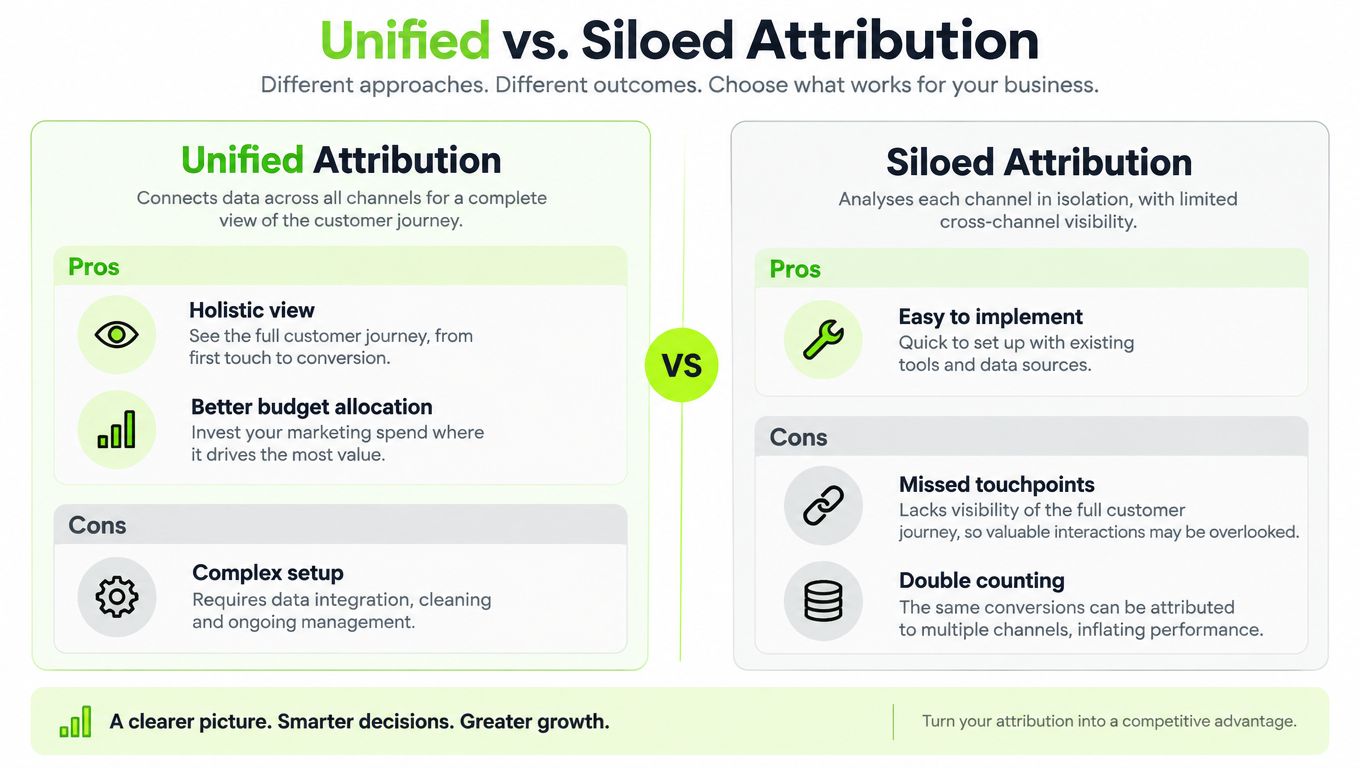
A multi-touch model sounds more detailed, but detail doesn't compensate for poor source data. If staff don't ask how a prospect heard about the club, if phone calls aren't logged, or if open-day attendees aren't matched to later applications, the model is sharing incomplete information.
Decision rule: choose the simplest attribution rule that answers the management question, then keep it stable long enough to compare like with like.
A defined blended rule often works well for a club running membership advertising, open days, referrals and follow-up calls together. It might record a primary acquisition source, an assisting influence and a conversion channel. The important point is not whether the club uses an advanced platform. It's whether the same definitions appear in the ad account, enquiry form, CRM and monthly report.
Implementing Attribution Rules in Ad Platforms and Your CRM
Implementation should be treated as a commercial process, not a tracking exercise left entirely to a web developer. The club needs to decide what counts, capture it at the point of enquiry and carry it through to the eventual outcome.
Build the measurement path
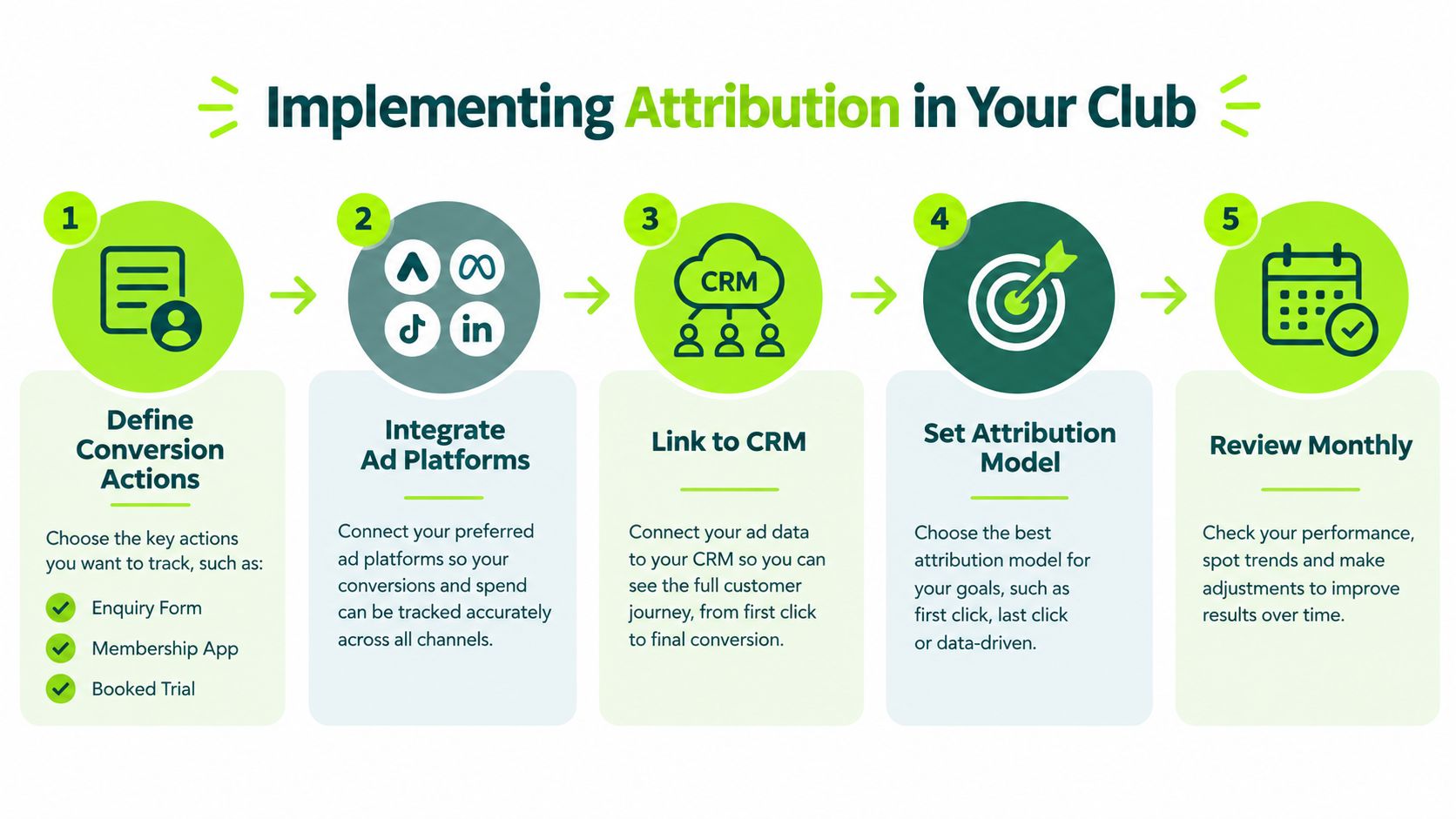
1. Define conversion actions. Track an enquiry form, membership application, booked visit and completed joining decision separately. A page view can show interest, but it shouldn't be reported as a commercial conversion.
2. Set the rule and window. Configure the chosen attribution model in each advertising platform. Record the setting, because a report becomes difficult to interpret when one platform uses a different window or conversion definition from another.
3. Capture source at enquiry. Store campaign, advert and referral fields on the form. Keep the original source rather than allowing later visits to overwrite it. Ask reception and professional staff to record the source when a prospect phones or walks in.
4. Import offline outcomes. Add tour attendance, trial completion, application and membership status to the CRM, connecting a digital signal to a real commercial result.
5. Report the complete funnel. Separate leads, qualified enquiries, booked visits, joined members and recognised recurring revenue. Each stage answers a different question and should have its own count.
A club might therefore report that a membership campaign generated enquiries, a smaller group became qualified, some booked visits, and a defined number later joined. If the CRM records a member referral as the primary source while the ad platform records an earlier advert interaction, the report should show both roles rather than selecting whichever figure looks more favourable.
Keep ownership clear
Assign one person to maintain conversion definitions and source fields. The marketing supplier may configure the platforms, but the club owns the commercial interpretation. A CRM system such as GolfRep can capture lead sources and connect advertising or other touchpoints with enquiries, visits, membership status and later outcomes, including phone-led conversations when campaign association and call outcomes are recorded.
For wider implementation detail, use GolfRep's conversion tracking setup guide alongside a written measurement specification.
Consent Rules That Affect What You Can Measure
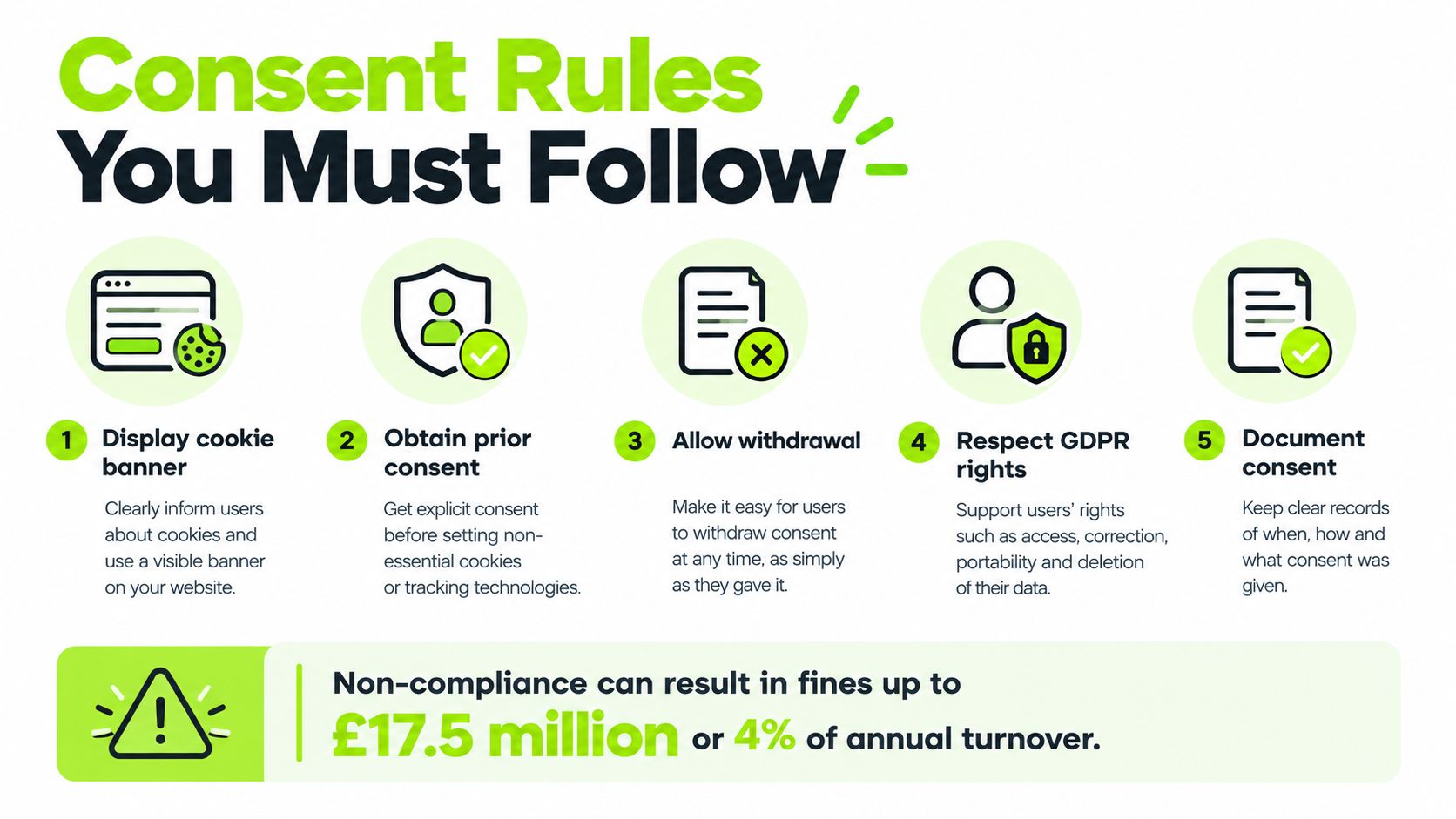
UK clubs can't treat every tracking tag as a neutral measuring instrument. Under the Privacy and Electronic Communications Regulations 2003, cookies and similar technologies used to measure campaign effectiveness generally require prior consent. The Information Commissioner's Office guidance on cookies and similar technologies states that analytics cookies aren't automatically exempt, continued browsing isn't positive opt-in, and placing pixels through a tag manager doesn't remove the consent requirement.
That means attribution tags should be blocked until valid consent is recorded. The consent status should travel with the measurement record into analytics and the CRM, so the club can distinguish observed conversions from journeys it couldn't lawfully or technically measure.
What consent changes in the report
A visitor who refuses non-essential tracking may still enquire and join. The club may record the membership in its CRM, but the advertising platform won't necessarily connect it to the campaign. Platform totals can therefore be incomplete, while CRM totals can contain outcomes that lack a digital source.
This isn't a reason to abandon measurement. It is a reason to label the limitation. A report should state whether it covers all known memberships, only consented digital journeys, or an attributed subset of conversions.
Aggregated service analytics can often be more defensible than user-level advertising measurement. Monthly enquiry volume, campaign-level acquisition cost and booking totals reduce the need to follow an identifiable golfer across websites, platforms and CRM records. User-level tracking, behavioural profiling and cross-site attribution require a more careful consent basis and clear disclosure.
Reporting discipline: don't present consented and non-consented traffic as though they were measured under identical conditions.
Consent requests should be prominent, written in plain language and separate from general privacy information. They should explain the purpose, identify who relies on the consent and make withdrawal as easy as acceptance. A tag manager is an implementation tool, not a compliance solution.
Clubs considering broader outbound communication should also distinguish website measurement from messaging permissions. For context on outbound TCPA compliance options, the same underlying lesson applies: permission needs a defined purpose and an auditable record. For UK SMS activity, document the relevant consent and opt-out controls alongside the golf club SMS marketing process.
Giving Credit to Referrals and Offline Influence
Golf clubs have a measurement blind spot that paid media dashboards rarely solve. A prospect may join because a member recommended the club, a committee member invited them to an event, or a professional gave them confidence during a visit. Those influences don't always produce a click ID.
The UK Members' and Proprietary Golf Clubs' Survey 2025/26 reports that member referrals were the most successful marketing activity for 55% of members' clubs, up from 53% in 2024. That makes referral capture a commercial reporting issue, not just a marketing preference.
Avoid two lazy conclusions
The first mistake is giving the referral 100% of the credit because staff recorded it first. The prospect may also have responded to an open-day campaign, read the website and attended a targeted event.
The second mistake is excluding the referral because it lacks a digital identifier. That rewards what is easiest to track rather than what influenced the decision.
A workable middle ground uses three fields:
- Primary acquisition source: the first credible origin, such as member referral, paid social, organic search or open day.
- Assisting influence: an event, advert, tour, professional conversation or recommendation that helped the prospect progress.
- Conversion channel: the action that completed the decision, such as a phone call, application or office visit.
Staff should ask the source question at first contact and use consistent event or open-day codes. The CRM can then compare qualified enquiries, booked visits and recurring membership revenue by primary source, while retaining assisting influence separately.
Make the hierarchy explicit
Don't allow every team member to create their own version of “source”. Write the hierarchy into the reporting specification. A referral can be the primary acquisition source, an advert can be an assisting influence and a phone call can be the conversion channel. The same member then appears once in the acquisition report, rather than being counted as a referral conversion and a paid-media conversion.
The report should also show data quality. If the club has a high number of memberships with no recorded source, that isn't evidence that referrals are weak or advertising is strong. It is evidence that the first-contact process needs attention.
Common Attribution Pitfalls and How to Avoid Them
Most attribution errors are ordinary operational mistakes. A platform uses one default rule, an agency report uses another, and the CRM stores only the final source. The club then compares totals that were never designed to match.
The errors that distort decisions
- Double counting: Two platforms claim the same member because both recorded an interaction. Deduplicate against the CRM membership record.
- Changing the window: A campaign begins with one attribution window and is later reported under another. Record the setting at launch and keep it visible.
- Confusing association with causation: A platform screenshot shows an attributed conversion, but not necessarily that the advert independently caused the membership.
- Counting leads as members: A form submission is not a joined member. Report each funnel stage separately.
- Ignoring consent loss: Refused tracking can remove valid conversions from platform reporting. State that limitation rather than treating the platform total as complete.
A defensible report names the campaign, conversion definition, attribution window, exclusions, CRM status and membership outcome. It also says what the evidence cannot prove.
The Advertising Standards Authority guidance on claims in testimonials and endorsements says marketers must hold evidence for objective claims consumers are likely to regard as factual, and that testimonials alone don't substantiate direct or implied claims.
So, “this campaign produced 42 new members” requires underlying records that support the figure. If the available evidence only shows that an advert was associated with an enquiry, the report should say exactly that.
A Reporting Routine You Can Actually Maintain
Reliable attribution doesn't require a perfect data warehouse. It requires one documented rule, consistent source capture and a report that follows the golfer beyond the click.
At each monthly review, check:
- Source quality: Are new enquiries carrying a primary source and campaign where available?
- Referral capture: Did reception, the professional team and event staff ask how prospects heard about the club?
- Platform reconciliation: Can attributed conversions be matched to CRM records without double counting?
- Funnel movement: How many records progressed from enquiry to qualified enquiry, booked visit, application and joined member?
- Revenue evidence: Which memberships are confirmed, and which revenue figures are recognised rather than merely forecast?
- Measurement limits: What did consent refusal, missing phone data or offline influence prevent the club from observing?
Add a short note to every report explaining what the chosen rule captures and what it misses. That note protects the committee from treating a clean-looking dashboard as a complete account of demand.
Attribution is a decision-making tool, not a vanity exercise. It should help a club decide where to invest, which events to repeat, whether staff are recording sources properly and how digital activity contributes to membership and revenue.
GolfRep works with clubs to build measurement and reporting systems across membership, visitors, societies and events.
GolfRep helps golf clubs connect advertising, CRM activity, offline sales conversations and membership outcomes into a practical reporting system. If your Facebook report and membership list disagree, visit GolfRep to map the rules, data gaps and commercial decisions behind the numbers.
Ready to tap into our proven growth system?