Ad Yield Optimization for Golf Clubs: A 2026 Guide

How can a campaign that produces a cheap membership enquiry still destroy advertising value?
Because ad yield optimisation for a golf club isn't a publisher exercise. It isn't about filling banner inventory, raising CPM or celebrating a low cost per click. It is about deciding which advertising pound is most likely to produce a suitable member, then measuring what happens after the advert has done its job.
That distinction matters in a market where digital advertising dominates. UK advertising reached £42.6 billion in 2024, with online formats accounting for approximately four in every five pounds spent. Search advertising reached £16.9 billion, while online display, including social and retail media, reached £16.7 billion (IAB UK market data). Golf clubs are competing in a complex auction, but many still judge campaigns by clicks and form completions.
The commercial question is simpler: which campaign creates the highest expected recurring membership revenue after qualification, visits, joining decisions and retention?
Why Ad Yield Matters More Than Lead Volume
More leads don't automatically create more members. A campaign can fill a CRM with enquiries while producing little useful sales activity, especially when targeting is broad, the offer is vague or the club can't process demand properly.
A private club doesn't earn revenue when someone clicks an advert. It earns revenue when a suitable golfer joins, pays the relevant fees, uses the club and remains a member. Ad yield optimisation therefore means improving the value generated from available media spend, not merely reducing the price of traffic.

The wrong scoreboard
A committee may see a campaign report showing impressions, clicks and cost per lead. Those figures can look healthy while the membership pipeline remains weak. A low-cost enquiry from outside the club's practical catchment, for an unavailable category or from someone seeking a price the club doesn't offer, has limited commercial value.
The better question is whether the campaign creates qualified opportunities. That means a prospect who fits the club's geography, playing needs, membership eligibility and likely capacity to join. A more expensive lead can be the better purchase if it produces a booked visit and a joined member.
England Golf recorded 750,071 club members in 2025, compared with 730,602 in 2024, representing year-on-year growth of 2.66% (England Golf membership figures). National growth doesn't make every lead valuable. It makes accurate local acquisition and disciplined commercial measurement more important.
Commercial rule: Never optimise a golf club campaign to the cheapest lead. Optimise it to the most valuable qualified opportunity the club can actually convert and retain.
What yield means for a club
A useful reporting chain looks like this:
- Media cost: What did the club spend by channel, campaign and audience?
- Qualified enquiry: Did the prospect meet the club's basic criteria?
- Booked visit: Did the prospect agree to tour the course or clubhouse?
- Application: Did they take a formal step towards joining?
- Joined member: Did the club receive recurring membership revenue?
- Retained value: Did the member remain active and renew?
The last stage changes the economics. A campaign aimed at a discounted short-term response may appear productive, yet attract members poorly matched to the club. A campaign that communicates the course, culture, access and expectations clearly may produce fewer enquiries but better long-term fit.
That is why the strongest club marketing decisions often require agreement between the general manager, membership team, PGA professional, finance lead and committee. Advertising creates the opportunity, but the club decides what an economically attractive member looks like.
Beyond Clicks, The Membership Yield Funnel
Traditional reporting treats the advert as the main event. Full-funnel yield reporting treats it as the first measurable step in a commercial journey.
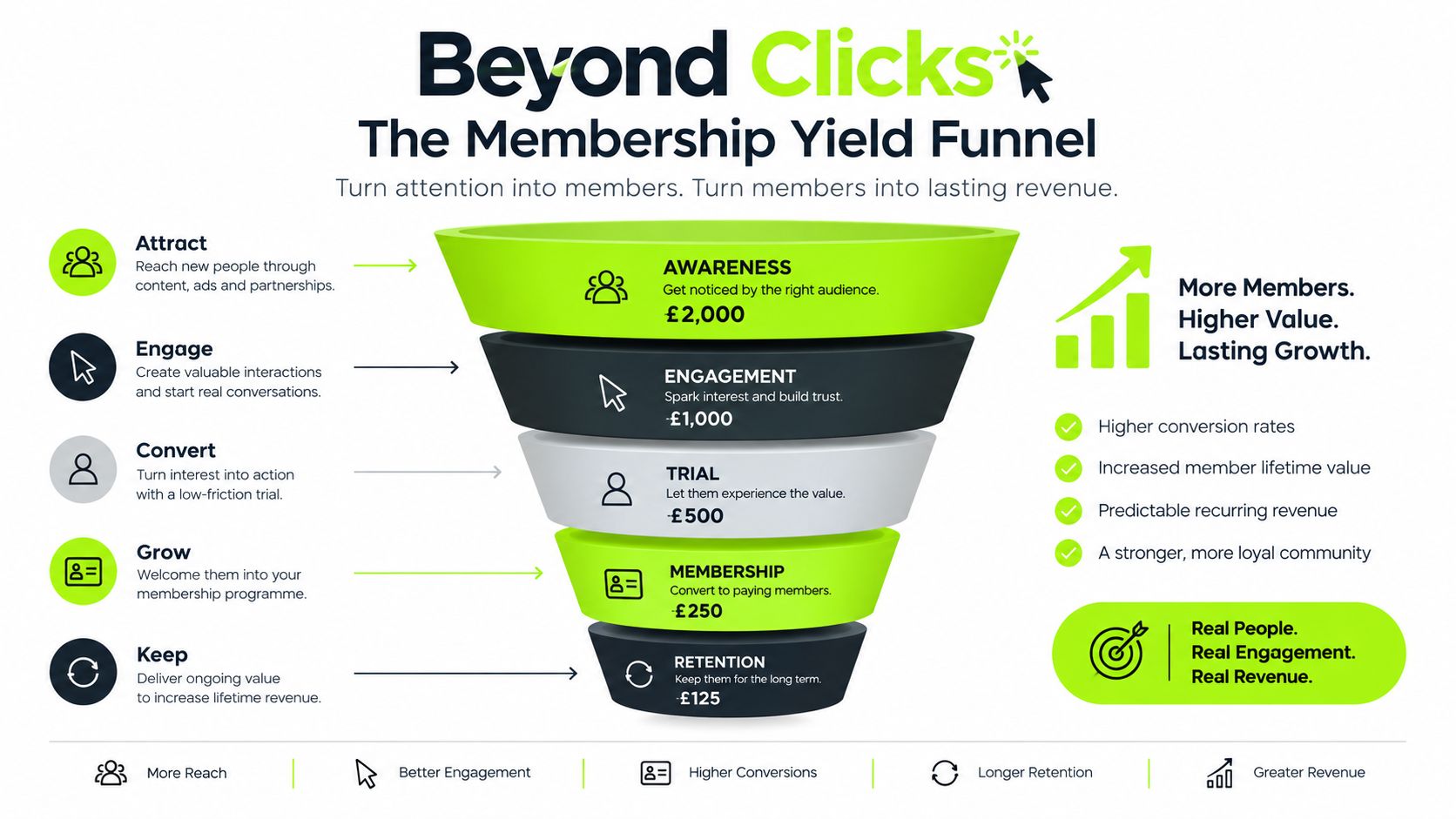
A click tells you that somebody responded to a message. It doesn't tell you whether the person wants a private club, can travel to the course, understands the joining terms or will book a visit. Cost per lead is useful for diagnosing media efficiency, but it can't carry the whole commercial decision.
A membership yield funnel should connect each stage to a decision and an owner.
From attention to action
Awareness is where display, video and social can introduce the club to golfers who aren't actively searching. The creative needs to communicate the club's identity, course experience and member proposition rather than just show a generic course photo.
Consideration begins when a golfer visits the membership page, watches a course video, compares categories or returns through remarketing. At this stage, the landing page must answer practical questions about access, playing opportunities, joining requirements and what happens next. Clear page structure and friction reduction principles are covered in this useful Operosus conversion guide.
Enquiry is the point at which the club captures identifiable demand. The form should collect enough information to route the prospect properly, without turning the first interaction into an unnecessarily long application.
Visit is often the most important intermediate action. A booked tour allows the club to demonstrate the course, clubhouse and social fit. It also gives staff a chance to qualify expectations before an application is made.
Application and joining are the commercial outcomes that should feed back into advertising decisions. If one audience produces plenty of enquiries but few applications, the club should review the promise, qualification criteria or sales process before increasing spend.
A practical measurement model
Set up the CRM so every opportunity carries:
- Source and campaign: Record the original channel, audience and creative.
- Qualification status: Mark location, preferred category, playing needs and eligibility.
- Sales progression: Track contact, tour booking, application and joining decision.
- Value estimate: Record expected recurring revenue and relevant joining income.
- Retention outcome: Connect later renewal or cancellation information to the original source where consent and systems allow.
This creates a sharper comparison than a channel leaderboard. Search may produce direct demand from golfers already looking for membership, while social and video may create awareness that converts later through remarketing or direct contact. Comparing them only on immediate cost per lead penalises channels that assist consideration and rewards channels that generate volume without quality.
The correct test is revenue per qualified opportunity and revenue per advertising pound, segmented by membership product and local catchment. That is the difference between buying traffic and managing yield.
Audience Targeting for High-Intent Golfers
Golf clubs don't have one audience. They have golfers at different stages of participation, with different reasons for considering membership and different levels of readiness.
England's participation pathways show why demographic targeting alone is too blunt. 12.6 million adults played some form of golf in the latest reported period, including 7.3 million on a 9- or 18-hole course and 5.3 million through off-course formats such as ranges, simulators and adventure golf (National Club Golfer coverage of England Golf participation). Those groups shouldn't receive identical adverts or the same next step.
Segment by behaviour and fit
An active club member considering a move needs a different message from an independent golfer who plays occasionally. A flexible-access prospect may respond to practical playing options, while an established golfer may care more about competition, course quality, social life and reciprocal benefits.
iGolf, England Golf's independent-golfer programme, reached more than 72,800 subscribers, and more than 24,000 iGolf users had progressed into club membership since launch, including 9,600 during 2025 (England Golf participation update). That pathway supports a clear commercial lesson. Some prospects need a lower-friction route into the club before they're ready to commit to full membership.
World Handicap System activity can provide another useful signal. England recorded more than 5.75 million score submissions during the first six months of 2025, a 29% year-on-year increase (GCMA participation reporting). Score activity doesn't prove membership intent, but it can help clubs think beyond static age and income profiles. Recent playing behaviour, handicap engagement, lesson activity and interest in flexible access can all inform audience design.
For a broader explanation of how to structure and interpret audience groups, this guide to audience analysis provides useful planning context.
Build the local catchment properly
A club should define its practical catchment before spending heavily. Use postcodes from existing members, visitors and joined prospects to identify where the club already wins. Then separate campaigns by membership category, because a full seven-day member, flexible golfer, junior family and country member may have different geographic and commercial logic.
Use the Google Ads guide for golf clubs when structuring search campaigns around explicit intent. Keep search terms close to the action the club can support, such as membership enquiries, tours, trial rounds or category-specific information.
Audience exclusions matter too. Remove existing members from acquisition campaigns where the objective is new membership. Exclude areas that consistently create unworkable travel expectations. Suppress prospects who have already joined, and create separate nurture audiences for people who need more information rather than repeated acquisition adverts.
Bidding Strategies and Budget Allocation
Bidding should follow the club's evidence quality. If the account records only clicks and form submissions, automated bidding will optimise towards those shallow signals. If the CRM imports qualified enquiries, booked visits and joined memberships, the platform has a far better commercial target.
Start with a clean campaign structure. Separate high-intent search from awareness and retargeting activity, then assign each campaign a clear role. UK digital advertising reached £35.5 billion in 2024, with search representing 47% of total digital spend, while video display grew 20% to £8.3 billion (IAB Europe AdEx reference). The allocation lesson is straightforward: search captures existing demand, while video and social can create and revisit demand earlier in the decision.
Use a controlled allocation process
Protect proven intent. Fund search campaigns that generate qualified membership actions before expanding into broader audiences.
Test demand creation. Use social, display or video to explain the club proposition, then measure assisted visits and later enquiries rather than judging the activity only by immediate form volume.
Choose bidding inputs carefully. Maximise conversions can work when conversion tracking is reliable. Target cost per acquisition becomes more useful when the account has a stable definition of a valuable acquisition, not just a completed form.
Review by commercial stage. Compare cost per qualified enquiry, cost per booked visit and cost per joined member. A campaign with a higher lead cost may deserve more budget if its downstream rate is stronger.
Keep capacity visible. If the club has limited tours, staff availability or spaces in a category, don't increase spend just because the campaign can produce more leads. Yield includes the value of scarce operational capacity.
A committee report should show spend, qualified opportunities, visits, applications, joined members and expected recurring revenue by channel. Include a short explanation of changes made, what evidence supported them and what will be tested next. That keeps budget decisions commercial instead of political.
Creative Testing and Message Resonance
A golfer doesn't join a club because an advert is attractive. They respond because the message reflects a real reason to consider that club now.
Traditional membership messaging often overuses broad claims about a great course and friendly members. Those statements may be true, but they don't distinguish one audience from another. A younger golfer may need flexibility and playing access. A family may need clarity about availability and cost. An established member considering a move may care about competition, standards and the social environment.

Test the proposition, not just the colour
A useful test changes one meaningful variable at a time:
- Audience promise: Compare flexible access with competitive golf or social membership.
- Proof point: Compare course imagery with a clear explanation of member experience.
- Call to action: Test a membership conversation, course visit or category guide.
- Landing-page match: Ensure the page continues the exact promise made in the advert.
The result should be judged on qualified action, not just engagement. A dramatic headline can attract attention while creating unrealistic expectations. A quieter message may produce fewer clicks but better-fit visitors.
Use the ad copy optimisation guide to keep the message focused on a specific commercial response. For teams formalising test design, Web Mage's A/B testing tool guide offers useful context on selecting and managing experiments.
Let operations influence creative
Creative and sales handling are connected. If an advert promises a personal membership consultation but the club responds with a generic email several days later, the campaign has created an expectation the operation can't meet. If staff can offer prompt tours on certain days, the advert can make that availability part of the proposition.
Document each test with the audience, message, landing page, conversion event and decision date. Keep winning variants live only while they continue to produce suitable opportunities. Seasonal conditions, course availability and committee decisions can change which message carries the best commercial value.
Measuring Yield Through Conversion Speed and Data
A UK golf marketing benchmark reports an average membership-enquiry response time of 47 hours and 32 minutes, and cites a 98% increase in conversion rates when responses occur within five minutes. It also reports that a 30-minute delay can reduce conversion odds by up to 100 times compared with that five-minute window (GolfRep response-time benchmark). These figures make response speed a media variable, not merely an administrative detail.
Consider a private club running two campaigns. Campaign A produces inexpensive enquiries from a broad local audience, but staff receive incomplete details and respond when time allows. Campaign B costs more per enquiry, but the form captures preferred membership type, playing frequency, location and availability for a visit. The second campaign sends high-intent prospects into an immediate confirmation and routes suitable prospects to a member of staff for a booking conversation.
The campaign report should show what happened after the click:
| Stage | What to record |
|---|---|
| Enquiry | Timestamp, source, campaign and initial details |
| Qualification | Location, membership fit, playing needs and status |
| Response | Automated acknowledgement and first human contact |
| Visit | Booking date, attendance and staff outcome |
| Decision | Application, joining decision and expected value |
| Retention | Renewal or cancellation linked to the original source |
Build the feedback loop
Use CRM fields that staff can complete quickly. A complicated system becomes unreliable if the team avoids it. The minimum useful record should identify the source, ownership, response time, qualification result, next action and outcome.
Import meaningful offline conversions into the advertising platform where the consent model and technical setup support it. A completed membership application or joined member is more useful for optimisation than a page view. The conversion tracking setup guide provides a practical reference for connecting website activity with later commercial outcomes.
Review performance by channel, campaign, membership category and catchment. Look for the point at which value falls away. If enquiries are strong but visits are weak, review qualification and booking. If visits happen but applications remain low, inspect the proposition, tour experience and joining process. If joined members cancel quickly, acquisition may be targeting the wrong fit or the onboarding experience may be failing.
Advertising yield improves through a repeated cycle: record the full journey, identify the constraint, test one change, protect data quality and reallocate spend according to joined-member value. That approach gives committees a defensible basis for decisions and gives staff a clearer commercial priority.
GolfRep helps golf clubs connect advertising spend to qualified enquiries, booked visits, joined memberships and recurring revenue through data-led acquisition, CRM systems and structured nurture. If you want to identify where your club is losing yield and build a clearer path from first click to retained member, visit GolfRep.
Ready to tap into our proven growth system?