Lead Qualification Process for Golf Clubs

It's 10.30 on a Wednesday morning. The receptionist is answering a phone call about a society day, a website form has arrived from a local golfer asking about membership, and someone who used to belong to the club has walked into the Pro shop asking whether there's still a route back. All three are opportunities, but they're not the same opportunity, and they shouldn't enter the same follow-up queue.
A lead qualification process gives the team a practical way to decide who needs a call now, who needs useful information first, and who should be recorded for future reactivation. That matters at a golf club because staff are often serving members, managing the tee sheet, dealing with visitors and covering events at the same time. A process that works only when someone is sitting at a desk will fail when the course is busy.
What Lead Qualification Actually Means for a Golf Club
The membership form deserves attention, but it shouldn't automatically receive priority over the society organiser or the former member. The membership prospect may be ready to visit and join, the organiser may be making a commercial booking decision, and the lapsed member may already understand the club but need a reason to return. Treating all three as “new leads” removes the context that should shape the next action.
A qualified golf club lead is a person or organisation that fits a relevant commercial proposition, has a credible need, has shown meaningful intent, and can be moved towards a clear next step. That next step might be a membership visit, a call about a society package, a trial round, an event meeting or a reactivation conversation.
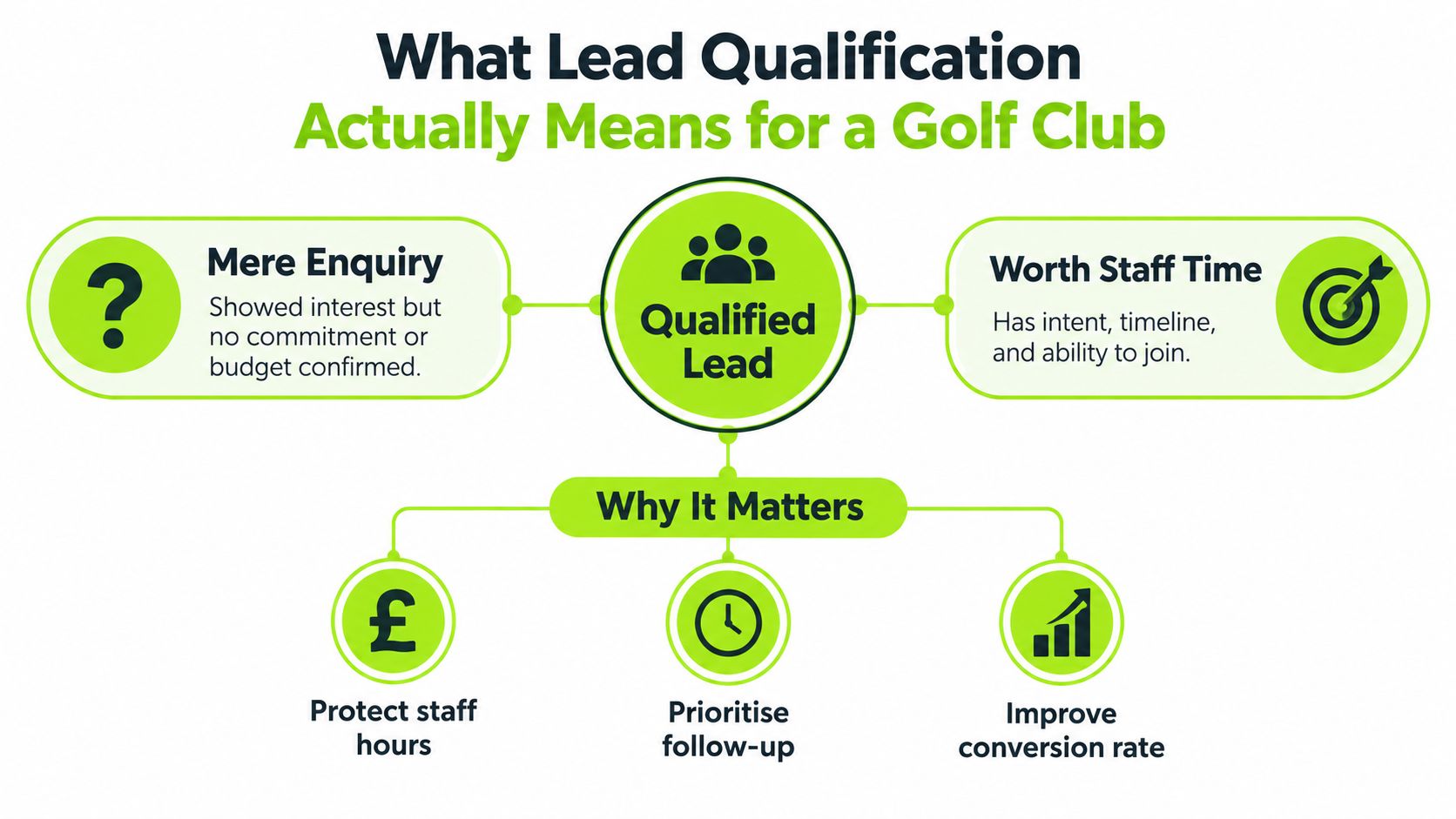
Four checks before staff time is committed
Fit asks whether the enquiry matches something the club can sensibly provide. For a membership prospect, that may involve location, preferred category, playing frequency and capacity. For a society organiser, it may involve group size, preferred date, catering requirements and the type of package being considered.
Need asks why the person has contacted the club now. “I'd like more information” is a starting point, not evidence of a defined need. A stronger signal might be wanting to leave an existing club, finding regular playing opportunities, arranging an annual society day or returning after a period away.
Intent is visible in behaviour. Someone who asks for current fees, replies to a message, requests a tour or suggests a joining date has given the team more to work with than someone who downloads a brochure and disappears.
Next action prevents the record from becoming a vague name in a spreadsheet. The lead should have an owner, a date and an outcome such as booked visit, call required, nurture, reactivation or not suitable.
Practical rule: A form submission is an enquiry. It becomes qualified when the club can explain why it fits, what the prospect wants and what happens next.
The commercial distinction is important. A UK-focused CRM Impact Report found that 54% of marketing-generated sales leads were considered poorly qualified or underqualified, while 27% were never followed up. Those figures identify two separate leaks, poor alignment between activity and sales readiness, and a failure to act on leads that have already been generated. The UK CRM lead-response guidance provides the context for treating qualification as an owned process rather than an informal hand-off.
Capturing Every Enquiry in One Place
The first control is simple: every enquiry needs a record at the moment it appears. Website forms, phone calls, Facebook messages, open-day conversations, Pro shop visits and member referrals should not sit in separate personal inboxes or rely on someone remembering a conversation after a busy shift.
Start with one central CRM pipeline and make the source mandatory. Useful source options include membership page, paid campaign, organic search, member referral, open day, phone, walk-in, visitor booking, society enquiry and former member. The source should describe where the enquiry came from, not what a staff member thinks of its quality.
The fields that create a usable record
Capture these fields before the record can be scored:
- Contact details: Name, preferred contact method, telephone number and email address.
- Enquiry type: Membership, visitor, society, event, coaching, indoor golf or reactivation.
- Preferred membership category: Full, flexible, junior, family, intermediate or another category the club sells.
- Playing frequency: Occasional, monthly, weekly or another useful description that reflects the club's offer.
- Location: Postcode or broad travel area, with travel tolerance discussed where it affects fit.
- Household decision-makers: Whether the person is deciding alone, with a partner or as part of a family decision.
- Current club status: Existing member elsewhere, former member, independent golfer, beginner or off-course participant.
- Budget: A range or willingness to discuss available categories, rather than forcing an uncomfortable demand for an exact figure.
- Desired start date: Immediate, this season, a future date or undecided.
- Visit readiness: Whether the golfer wants a tour, a call first or written information.
The form should collect low-friction information such as contact details, enquiry type, preferred category and desired contact method. A human conversation should handle sensitive or nuanced questions, especially budget, current club status, household decision-making and barriers to joining.
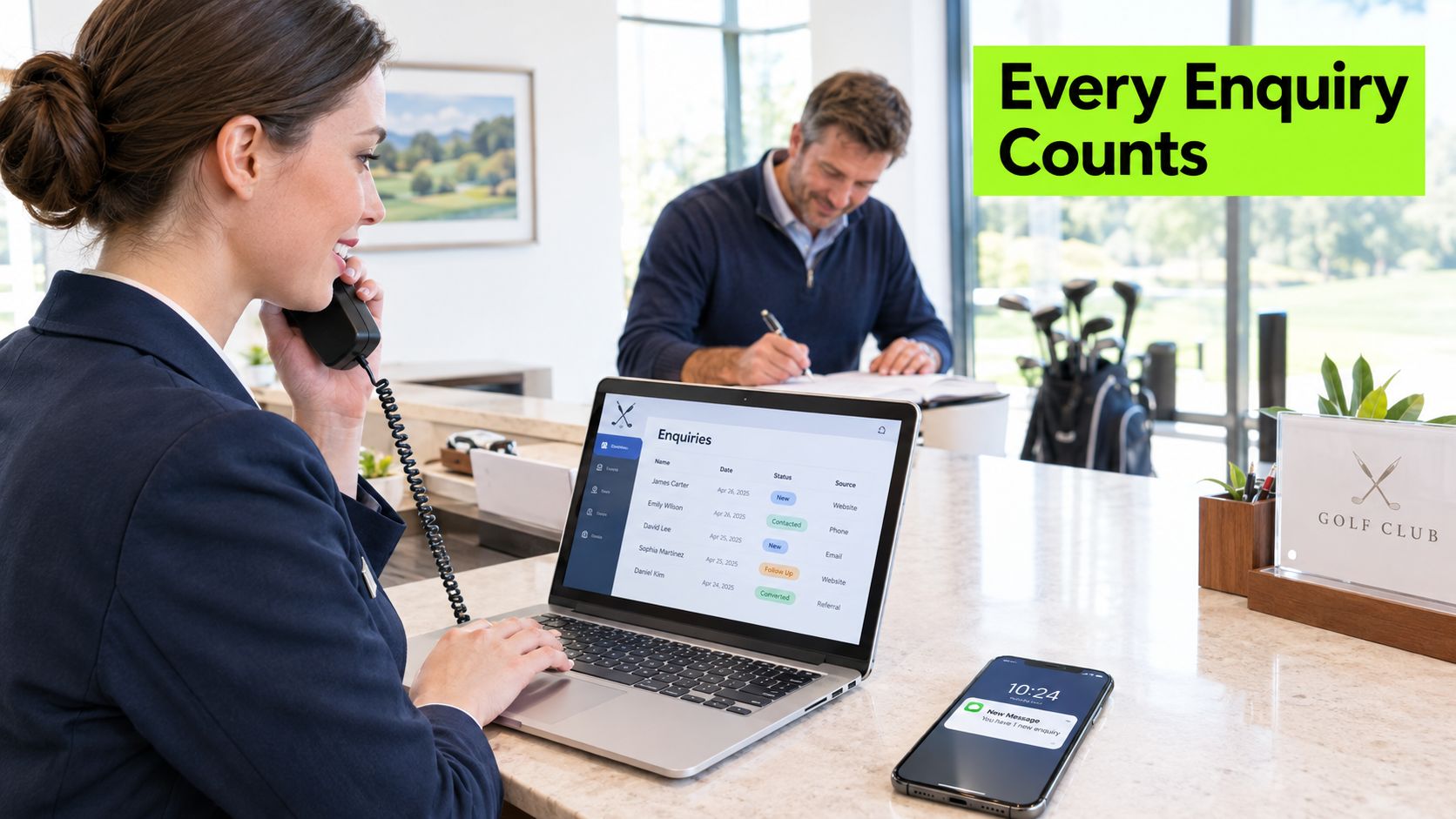
Build the record at the point of contact
A receptionist who answers a call should create the record before moving to the next task. A PGA professional who has a conversation after a lesson should log the opportunity rather than assume membership will come up again. An owner-manager can use a mobile CRM form for walk-ins, provided it takes seconds to create the initial record and allows the fuller fields to be completed later.
A practical form should include a free-text note for the person's own words. “Wants to play more regularly but currently works shifts” is more valuable to the membership lead than “interested in joining”. If you need a starting point for the fields and layout, this lead capture form template offers a useful structure that can be adapted for golf enquiries.
The CRM record should show the original message, every contact attempt, the person responsible and the next due action. Clubs reviewing their wider operating model can also use this lead tracking system guide to think through ownership and reporting.
Scoring Intent and Fit to Drive the Next Action
A single score often hides the reason a lead has been prioritised. A local golfer may be a strong fit but show little urgency, while an enthusiastic prospect may live too far away or want a category the club can't currently offer. Use two dimensions instead: intent and fit.
Intent reflects behaviour and timing. Requesting fees, asking about joining dates, replying to a message or booking a tour should increase priority. Fit reflects whether the club can realistically serve the opportunity, based on geography, eligibility, available capacity, product match and current status.
The scores don't need to look mathematically complex. They need to produce consistent decisions. A simple low, medium and high scale is often easier for reception, the Pro shop and management to use than a complicated model nobody trusts.
A workable decision model
A high-intent, high-fit lead should receive human attention quickly, with the club aiming for review within 15 minutes during staffed hours. A medium-intent or uncertain-fit lead belongs in a personalised nurture sequence, with a clear date for review. A low-fit enquiry should be closed politely with a coded reason, not left open indefinitely.
That last point matters. “Not suitable” is not an adequate outcome. Choose a reason such as outside travel area, category unavailable, timing too early, budget mismatch, no response, visitor-only interest or joined elsewhere. These reasons help the club distinguish a proposition problem from a follow-up problem.
| Enquiry type | Intent signals | Fit signals | Score band | Next action |
|---|---|---|---|---|
| Local golfer requesting fees and a tour | Asked for current fees, replied quickly, selected a visit slot | Lives within the club's normal catchment, wants an available category | High intent, high fit | Immediate human call and visit confirmation |
| Former member asking about options next season | Interested in returning, but no joining date confirmed | Knows the club, previous relationship, timing is uncertain | Medium intent, high fit | Personal reactivation conversation and dated nurture |
| Distant golfer asking for a brochure | One information request, no reply to follow-up | Travel distance makes regular play difficult | Low intent, low fit | Send useful information, record reason and close or nurture |
A society organiser should be scored against a different fit model from a membership prospect. The club may need to ask about date flexibility, group size, catering and decision timing rather than membership category or household decision-makers. A visitor enquiry can be qualified for tee-sheet revenue without being treated as a membership lead.
External frameworks can help with discipline, but they should be adapted to the club's buying journey. RealtyAI's lead qualification playbook provides broader context on using fit and intent signals together, while a golf club should keep its own model tied to visits, bookings and membership conversations.
UK golf-sector reporting places enquiry-to-membership conversion commonly in the 15% to 30% range, according to GolfRep's golf membership marketing analysis. That range should not become a target copied blindly from another club. It's a reminder to measure each stage separately, because an apparently weak conversion rate may result from poor visit attendance, slow responses or an unsuitable source mix.
Automating Speed-to-Lead Without Losing the Human Touch
Automation should remove repetitive delay, not remove the club's personality. A prospect can receive an immediate confirmation without being pushed into a cold sequence of generic messages. The useful distinction is between instant acknowledgement and automated selling.
UK lead-response research reported an average response time of 47 hours, with only 7% of companies responding within five minutes. The same analysis reported that companies responding within one hour were seven times more likely to qualify leads than those waiting two hours, and that qualification probability was 60 times higher than when the response took at least 24 hours. These figures are reported in UK lead-response sales research, and they show why a club shouldn't wait for the membership manager to return from the course before confirming receipt.
Configure the workflow in practical stages
Acknowledge immediately. Send an email and, where consent allows, an SMS confirming that the enquiry has arrived. Include the club name, the relevant enquiry type and a realistic indication of when a person will respond.
Offer a calendar option. A membership prospect who wants a tour should be able to select an appropriate slot without exchanging several messages. Keep the booking options aligned with actual staff availability.
Route by priority. High-fit, high-intent records should alert the membership lead, GM or PGA professional. A society enquiry should go to the person who understands packages and event delivery, not automatically to membership.
Start useful nurture. Lower-intent prospects can receive relevant information about categories, playing pathways, coaching, visitor options or upcoming events. The content should answer the reason they contacted the club, not repeat a sales message.
Run an SLA timer. The club should aim for automated contact immediately, human review within 15 minutes during staffed hours, and at least three structured follow-up attempts across different channels before moving the record to nurture.
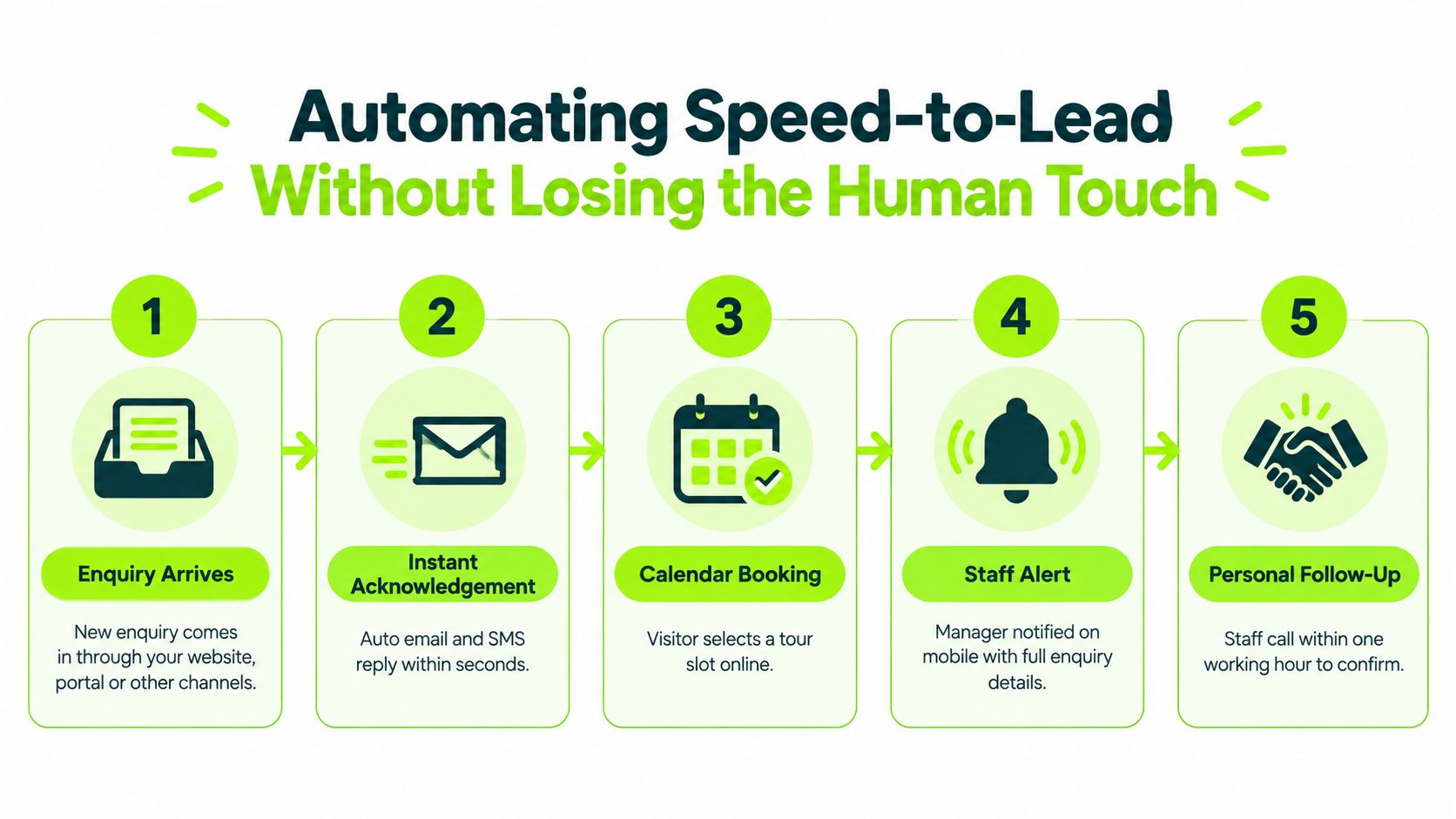
The first message should sound like the club. “Thanks for getting in touch with [club name]. We've received your membership enquiry and a member of the team will review it shortly. If you'd like to arrange a visit, you can choose a suitable time here” feels more credible than a corporate sequence.
Use behavioural triggers carefully. A prospect who clicks membership fees, opens a follow-up and then books a tour should move into a personal task queue. Someone who hasn't engaged should not receive increasingly frequent messages just because the system can send them.
The GolfRep guide to lead qualification automation is relevant for clubs mapping these routing, alert and nurture rules. The principle is straightforward: automate the first response and the reminders, but make the meaningful conversation human.
Handoff to the Membership Lead or General Manager
A handoff fails when the next person receives only a name and a telephone number. The membership lead, GM or PGA professional should know why the prospect matters before making contact, otherwise the golfer has to repeat the entire conversation and confidence drops.
The handoff record should contain:
- Lead type and score: Membership, visitor, society, event or reactivation, with separate intent and fit ratings.
- Source and campaign: The page, referral, open day or campaign that generated the enquiry.
- Key answers: Preferred category, playing frequency, location, current club status, timing and visit readiness.
- Last touchpoint: The latest message, call, form response or booking activity.
- Recommended opening question: A natural question based on the person's stated need.
For example, a membership lead who said they want to play regularly but work shifts shouldn't receive a generic “Are you still interested?” call. The opening question could be, “You mentioned that your working pattern changes week to week. Would it help to look at the membership options that give you more flexibility?”
Make the visit a sales conversation
The visit should have an owner. That person needs the correct membership information, current category availability, joining process, payment details and answers to practical questions about playing rights, competitions, practice facilities and member introduction.
A PGA professional may be the right person for an experienced golfer concerned about course access and playing standards. A membership lead may be better placed to explain categories and onboarding. A GM may need to join when the prospect has specific questions about the club's direction, facilities or commercial arrangements.
Record the outcome before the day ends. Use a defined status such as visit booked, visit attended, application expected, nurture, not suitable, no response or joined. Add the next action and date, even when the answer is “give the golfer time to discuss it at home”.
Smaller clubs don't need separate departments to apply this discipline. One owner-manager can still create the record, use the score, prepare before the call and log the outcome immediately. The role may be shared, but ownership cannot be vague.
Metrics That Show Whether the Process Is Working
Reporting enquiry volume alone can make a weak pipeline look healthy. A club can receive plenty of forms while failing to respond, qualifying the wrong people or converting visits poorly. The useful report follows the movement from first contact to commercial outcome.
Track these six measures:
- Median response time. Measure the time from enquiry to first meaningful response, not merely the time when an automated email was sent.
- Percentage contacted within one hour. Separate automation from human contact so the club knows whether staff are meeting the service standard.
- Qualification rate. Measure the share of enquiries that meet the club's defined fit and intent criteria.
- Booked-visit rate. Show how many qualified membership leads progress to a tour, meeting or trial visit.
- Visit-to-membership rate. Track the proportion of attended visits that progress to membership, with the stage and time period clearly defined.
- Lost-lead reason by source and campaign. Code why opportunities stop, and compare the pattern across channels.
The figures should be segmented by enquiry type. A visitor booking, society request and membership enquiry don't share the same outcome, so combining them produces an unusable average.
Find the actual constraint
A slow median response time points to staffing, routing or ownership. A healthy response rate paired with a low qualification rate suggests the club is attracting poor-fit enquiries or has unclear criteria. Strong qualification but weak visit bookings may indicate that the offer, booking process or sales conversation needs attention.
A healthy visit rate with weak membership progression moves the investigation to the visit itself. Review how the club explains value, handles objections, introduces the member experience and follows up after the tour. GolfRep's lead generation tracking guidance provides a useful way to connect channel reporting with pipeline stages.
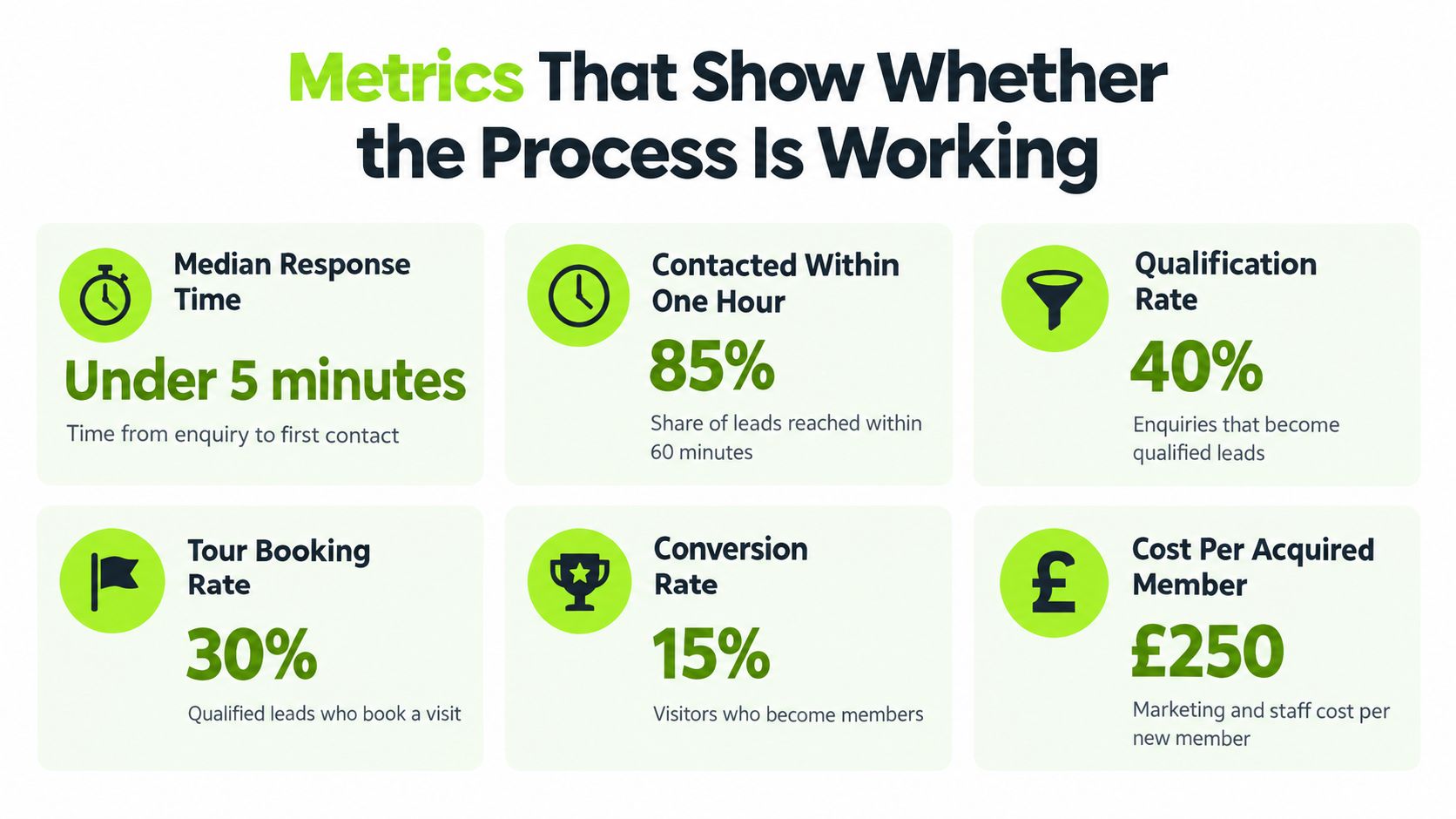
Report the operational measures weekly to the people handling enquiries. Provide the owner, committee or board with a concise monthly view showing volume by source, stage progression, lost reasons, response performance and revenue outcomes. Don't present targets such as “more leads” without the stage evidence that explains what happened to them.
Audit a sample of qualified and disqualified records monthly. Compare the score band with actual outcomes, then adjust the threshold when high-scoring records don't progress more reliably than lower-scoring records. The process should become more accurate through use, not remain frozen because the original spreadsheet looked tidy.
Tightening the System Beats Adding More Leads
Buying more traffic is an easy response to a disappointing membership month. It's also often the wrong first move. If the club can't distinguish a serious membership prospect from a casual information request, more enquiries create more sorting work without necessarily creating more visits.
The stronger commercial position is to fix the leak that sits closest to the current bottleneck. If the club has plenty of well-matched prospects but slow contact, improve routing and ownership. If staff respond quickly but few people fit the offer, change the targeting or proposition. If visits happen but applications don't follow, inspect the visit and post-visit conversation.
A smaller pool handled carefully can outperform a larger pool handled inconsistently. That doesn't mean demand generation is unimportant. GolfRep's model is ATTRACT, NURTURE, CONVERT and RETAIN, because a club needs enough demand and a system that turns suitable demand into lasting commercial relationships.
Within a week, take last month's enquiries and audit them manually. Record the source, enquiry type, fit, intent, response time, next action and final outcome. Then ask three questions:
- Which opportunities deserved a faster human response?
- Which enquiries were never suitable for the proposition?
- Which lost leads could have progressed with a different next action?
That exercise will show whether the club needs more demand, better qualification, faster handling or a stronger membership conversation. The answer should determine the next investment, not the size of the enquiry total.
GolfRep works with golf clubs to map lead qualification, CRM ownership, automated nurture and progression from enquiry to booked visit or membership conversation. To identify the biggest commercial constraint in your club and build a clearer path from demand to revenue, visit GolfRep.
Ready to tap into our proven growth system?