Lead Tracking System for Golf Clubs: A Practical Guide

More enquiries won't automatically create more members. For most UK golf clubs, the commercial leak appears after the form is submitted, the phone call ends, or a visitor says they'll come back next week.
A lead tracking system is often treated as a software purchase. That's the wrong starting point. The useful system is an accountability layer that makes ownership, response times, follow-up stages and conversion results visible to the people responsible for membership growth.
GolfRep works with clubs where enquiries arrive through websites, reception desks, professional shops, social media, referrals and open days. The recurring problem isn't always a lack of interest. It's a missed call, an unassigned form, an unrecorded visit or a prospect who receives one reply and then disappears into someone's inbox.
UK CRM adoption reflects how mainstream structured customer management has become. A UK business-directory summary reported that 49% of UK-based businesses implemented new CRM software in the past year, while a UK-focused market analysis projected the UK CRM lead-management market to grow from USD 10.58 billion in 2024 to USD 24.81 billion by 2033. The source describes a projected 9.9% CAGR from 2026 to 2033. (UK CRM market analysis)
For a golf club, the question isn't whether a platform has an impressive dashboard. It's whether every enquiry has a named owner, a next action and a clear route towards a visit, trial or membership decision.
Why Enquiries Are Not the Problem Most Golf Clubs Have
The popular advice is simple: generate more leads. Committees hear that recommendation when membership numbers soften, so they approve another campaign, refresh the website or increase advertising spend. That can create activity without fixing the point where prospective members get lost.
A web form submitted on a Friday evening might sit until Monday. A phone enquiry may be written on a scrap of paper at reception. A trial round might be discussed by the professional and never recorded for the membership secretary. By the time somebody follows up, the prospect has either cooled off or spoken to another club.
The pattern of golf-club enquiry losses is usually operational, not creative. More traffic feeds the same broken handover process unless the club can see what arrived, who owns it and what should happen next.
The practical test: if a committee can't identify the owner and next action for every live enquiry, buying more leads is premature.
This matters even more in clubs run by volunteers or part-time staff. A marketing manager can't enforce a process that nobody owns, and a membership secretary can't manage enquiries that never reach one shared pipeline. People work from memory, calendars and disconnected email accounts, then report only the memberships that eventually appeared.
That approach hides the performance problem. The club may believe its advertising generates weak prospects when the actual issue is a delayed response or an incomplete follow-up sequence.
The better starting point is post-enquiry accountability. Before changing channels, define how an enquiry enters the club, who receives it, when somebody replies, how visits are recorded and how the final joining decision is attributed. A lead tracking system becomes valuable at that point because it turns invisible gaps into visible work.
What a Lead Tracking System Actually Is
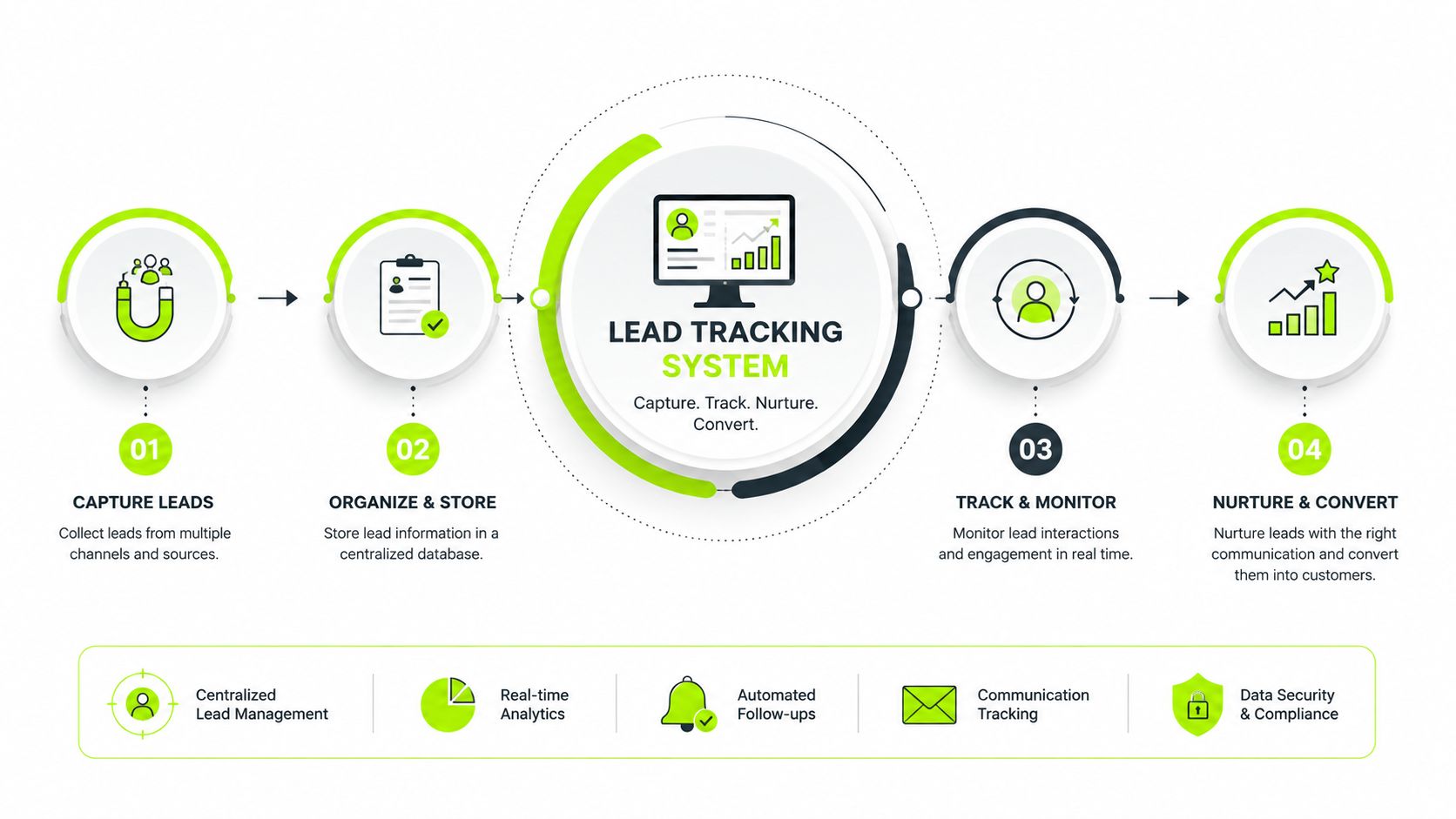
A lead tracking system records every prospective member and moves that person through agreed stages. It should show the enquiry source, contact details, relevant membership interests, conversation history, current owner, next action and outcome.
The core stages might be:
- New: The club has received the enquiry, but nobody has made substantive contact.
- Contacted: A member of the team has replied or spoken with the prospect.
- Visited: The prospect has attended the club or met a representative.
- Trial: A trial round, taster session or other next step is booked or completed.
- Joined: The prospect has become a member.
- Lost: The opportunity has closed, with a recorded reason where possible.
Think of it as tee-sheet management for membership enquiries. A tee sheet gives every booking a time, a player and a status. A functioning lead tracking system gives every prospect an owner, a stage and a follow-up action. Nobody asks which member of staff was supposed to notice an empty tee-time booking. The same clarity should apply to a serious membership enquiry.
The system comes before the software
A spreadsheet can hold the basic information. A shared inbox can receive messages. A CRM can automate assignments and reports. None of those tools creates accountability by itself.
The rules must come first:
- Every enquiry enters one shared pipeline.
- Every enquiry has one current owner.
- Every stage has a defined next action.
- Response-time expectations match the club's staffing pattern.
- Every outcome is recorded, including lost opportunities.
A CRM in isolation is just a database. A marketing platform may capture forms but fail to manage visits and membership outcomes. A spreadsheet may work initially, but it becomes unreliable when several people edit it without agreed fields or review habits.
Clubs also need to distinguish source tracking from visitor behaviour. A visitor analytics resource such as the Smarcomms visitor analytics tool can help teams understand activity around tracked links, but that insight still needs to connect to a named enquiry and a follow-up process.
For a more detailed look at how the database layer fits into club operations, see this guide to a golf club CRM system. The principle remains straightforward: software supports the process, but the process determines whether the club responds consistently.
The Five Core Components Every Club Needs
A useful system has five connected parts. Leave one out and the pipeline becomes less trustworthy.
| Component | What It Does | Golf Club Example |
|---|---|---|
| Capture | Brings enquiries from every relevant channel into one record | A website “Join Us” form creates a new pipeline entry, while reception logs a phone or walk-in enquiry |
| Scoring | Helps the team prioritise attention | A membership manager marks an enquiry hot, warm or cold based on fit and intent |
| Attribution | Records where the enquiry originated | The club tags a prospect as referral, open day, local search, social or website |
| CRM integration | Connects the enquiry with contact and membership history | The lead record links with the club's existing customer or membership database |
| Automations | Creates immediate actions and reminders | The prospect receives an acknowledgement, while the responsible staff member receives a task |
Capture must include the informal channels
Website forms are only one entry point. A receptionist, PGA professional, bar employee, committee member or existing member may receive the first question. If that information stays in a personal inbox or notebook, the central pipeline is already incomplete.
Make the capture form short. Name, contact details, membership interest, preferred contact method and source are usually more useful than a long questionnaire that discourages completion. Staff should have a simple method for adding phone, walk-in and referral enquiries immediately.
Scoring should help people decide what to do
Scoring doesn't need to look like a complex algorithm. A club can begin with fit signals such as location, preferred playing format, handicap, age category, group size and joining timeline.
A prospect who lives locally, asks about a specific membership category and wants to visit soon should receive a different priority from somebody making a general information request. The score should guide attention, not replace judgement.
Attribution needs to survive the journey
Record the original source when the enquiry arrives. Use consistent options, and add campaign tags to website links where appropriate. The source must remain attached when the prospect books a visit, completes a trial or joins.
Without that continuity, committees judge advertising by clicks and enquiries rather than memberships. That's how clubs end up funding visible activity while underinvesting in channels that produce committed members.
Integration prevents duplicate administration
The contact record should hold the conversation history and current status. Where the club uses separate membership, tee-sheet or communication tools, the team should decide what information needs to move between systems and who checks it.
Integration doesn't mean connecting every platform available. It means removing the double entry that causes staff to stop updating records.
Automations protect the first response and the next action
An acknowledgement can confirm that the enquiry arrived. A task can tell the owner to call. A reminder can flag a prospect who visited but hasn't received a follow-up.
A simple automated workflow is more valuable than a complicated one that nobody trusts. Capture without scoring creates noise. Scoring without attribution hides what works. Attribution without integration returns the club to spreadsheets, and none of it survives without regular follow-up automation.
Why Speed to Lead Changes the Conversion Maths
A membership enquiry has a short period of active intent. The prospect may be comparing clubs, checking availability, discussing the decision with a partner or deciding whether to visit at all. A slow reply gives competing clubs time to become the easier option.
UK small-business guidance cites research showing that leads contacted within 5 minutes are 2.6 times more likely to convert, while average businesses take 47 hours to reply and half of all leads are never contacted. (UK CRM lead-response guidance)
Another UK lead-response study reports that new enquiry leads are 10 times less likely to respond after 5 minutes, with conversion rates 98% higher when follow-up happens within that 5-minute window. (UK enquiry response research)
| Response window | Relative qualification likelihood | Notes for clubs |
|---|---|---|
| Within 5 minutes | 2.6 times more likely to convert, according to UK small-business guidance (source) | Use instant routing, an acknowledgement and a clear human follow-up owner |
| Within 1 hour | UK survey data reports that more than 46% of firms responded within an hour (UK lead-response survey) | Treat the hour as a competitive operating benchmark during staffed periods |
| After 24 hours | A UK government-backed analysis estimates conversion potential falls to 2% to 5% after 24 hours (UK SME lead-response analysis) | Escalate overdue enquiries instead of allowing them to sit in an inbox |
The same government-backed analysis reports that 78% of customers purchase from the first company to respond, while only 7% of UK businesses achieve sub-5-minute responses. (UK SME lead-response analysis)
Golf clubs don't need to promise an impossible 24-hour sales operation. They do need to define what happens when an enquiry arrives outside office hours. An automated acknowledgement, weekend rota and escalation rule will outperform a vague instruction to “reply quickly”.
The golf-club speed-to-lead guidance is useful because it treats response time as an operating process rather than a marketing metric. A lead tracking system should show when the enquiry arrived, when the first reply happened and who was responsible for the delay.
A dashboard reports slow response. A system prevents it by assigning the work.
That distinction matters. Clubs don't need another report explaining that follow-up is late. They need routing, alerts, ownership and a next action that somebody can see.
Attribution That Tells You Where Members Really Come From
Attribution is often treated as a feature that appears once a club buys the right CRM. It isn't. Attribution is a discipline of recording the source at capture, preserving it through the pipeline and reconciling the outcome against the membership record.
A first-touch view answers, “How did this person first discover the club?” That might be local search, a website article, social media or a member referral. A last-touch view answers, “What prompted the person to submit the joining enquiry?” That might be an open day, a conversation with a friend or a follow-up email.
Neither view tells the whole story. A referral may create trust, while a well-structured open day creates the final action. If the committee only reviews the last touch, it may undervalue the channel that introduced the prospect. If it only reviews the first touch, it may miss the event or conversation that moved the decision.
Use one practical reconciliation routine
At capture, record:
- Original source: member referral, local search, social, website, open day or county affiliation.
- Campaign detail: the event, advert, page or link where relevant.
- Intent: the membership category, playing format or question raised.
- Outcome: visit, trial, joined or lost.
Keep the original source fixed. Add later interactions as separate touchpoints rather than overwriting the first entry. At month-end, compare the pipeline with new member records and investigate any joined member whose source is missing.
The UK CRM lead-management market is projected to rise from USD 10.58 billion in 2024 to USD 24.81 billion by 2033, according to a UK-focused market analysis. (UK CRM market analysis) That expansion signals stronger adoption of CRM infrastructure, but it doesn't guarantee that clubs will measure channel performance properly.
Don't buy advanced attribution tooling before the basic fields are complete. A consistent source list and a monthly reconciliation are more useful than a model fed by missing data.
Implementing a Lead Tracking System in a Volunteer-Run Club
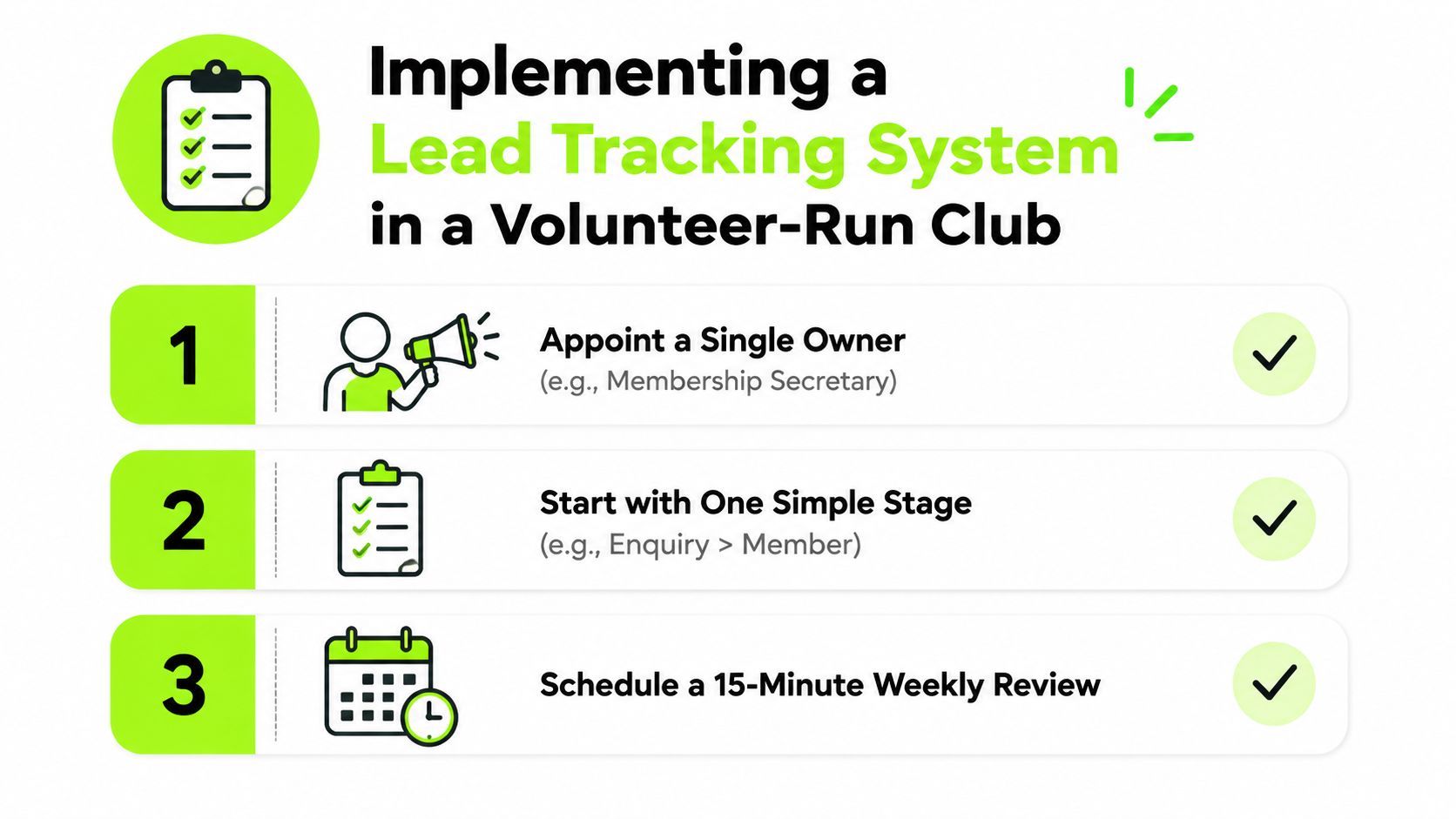
Volunteer-led clubs need a process that survives holidays, committee changes and uneven staffing. The first appointment isn't a software administrator. It's the person who owns the pipeline.
That person might be the membership secretary, club manager or a marketing volunteer. Other people can answer calls and conduct visits, but one person must be able to see every open enquiry, chase overdue actions and report what happened.
Start with ownership and service levels
Set expectations that match the club's real availability:
- Weekday acknowledgement: Confirm receipt on the same day for enquiries received during staffed hours.
- Substantive reply: Aim for the first useful human response within four working hours.
- Weekend cover: Publish a documented rota so Saturday and Sunday enquiries don't depend on chance.
- Escalation: Send an overdue alert to the pipeline owner when the agreed response window expires.
These are operating rules, not promises that every volunteer must answer immediately. If the club can't provide live cover, the automated acknowledgement should explain when a person will reply and the rota should make that commitment credible.
Choose the lightest tool that people will use
A shared inbox and disciplined spreadsheet can work for a club with modest enquiry volume. The spreadsheet needs fixed fields, dropdown stages, an owner column, a last-contact date and a next-action date. The pipeline owner should review it routinely rather than wait for a committee meeting.
A dedicated CRM earns its place when manual tracking can no longer provide reliable visibility. Look for automatic capture, assignment, reminders, communication history and source reporting. Don't select a platform because it offers more features than the club can maintain.
Brief every person who might receive an enquiry, including coaches, PGA professionals, reception staff, bar staff and committee members. Give them one route for logging it. A system fails when the person who hears the enquiry first assumes somebody else will pass it on.
Implementation rule: appoint the owner before you choose the platform.
Common Pitfalls That Stop Lead Tracking From Working
Most failed systems don't collapse because the software lacks a feature. They fail because the club never turns the feature into a shared habit.
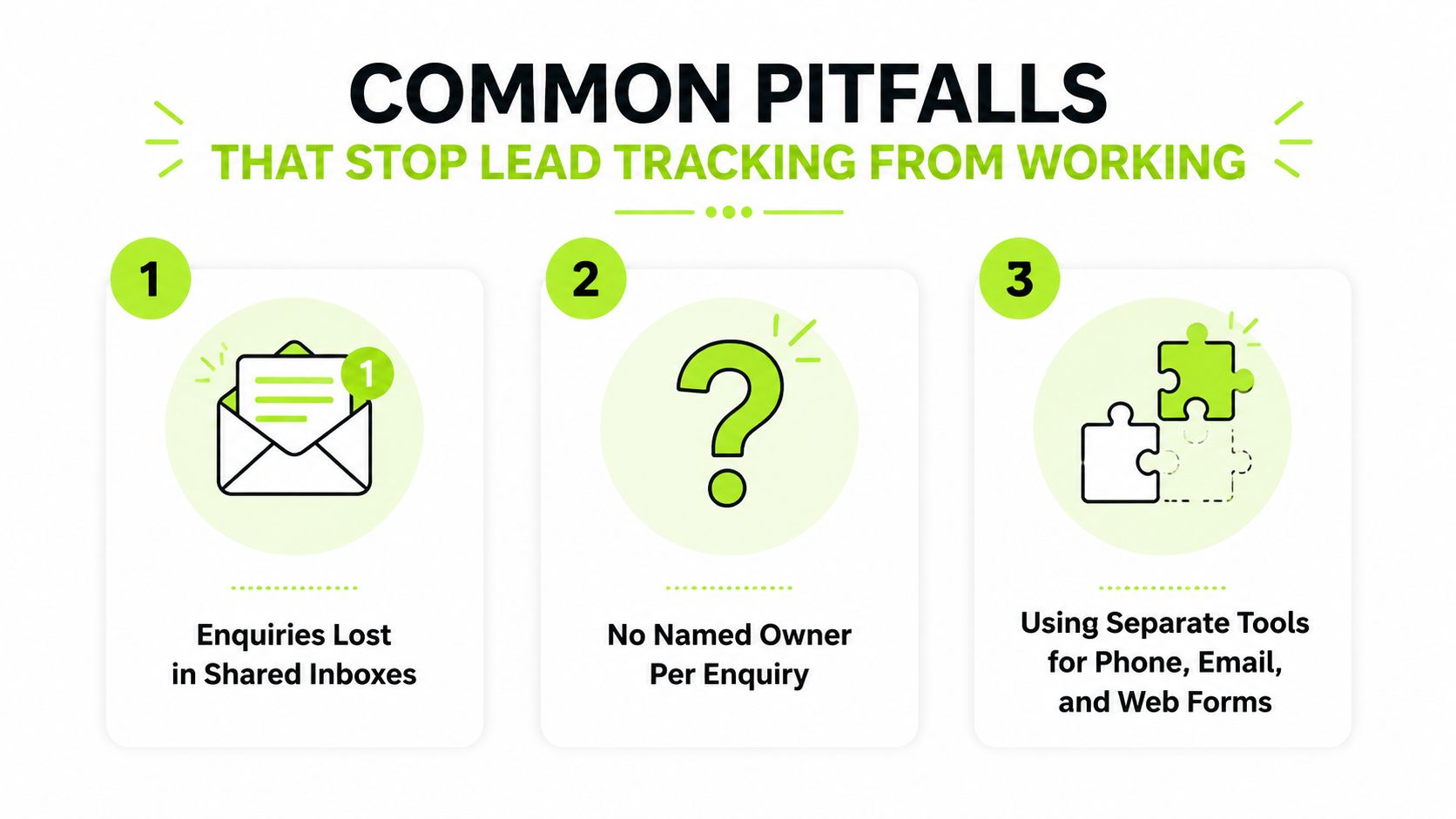
The first warning sign is an enquiry sitting in a shared inbox with no person responsible for it. A second is a pipeline full of names but no next-action dates. A third is a handover from website form to secretary to membership director where nobody carries the full context.
The recurring operational failures
- Unread inboxes: Website enquiries land in an address that nobody checks consistently.
- Shared responsibility: Several people can respond, so no one person is accountable.
- Unrealistic SLAs: The club sets an expectation that volunteers can't meet, then stops monitoring it.
- Disconnected channels: Phone notes, social messages, emails and walk-ins live in separate places.
- Inconsistent records: Staff capture different information, so the pipeline can't support useful decisions.
- Unreviewed lost leads: The club records “lost” without checking whether the reason was price, timing, fit or poor follow-up.
Scoring and behavioural triggers won't rescue a process that people don't follow. A rule can prioritise an enquiry, but it can't make a volunteer open the task or record the outcome.
Write the process in plain English. Assign one owner for each stage. Agree the minimum fields. Review a sample of lost enquiries every month, not to blame individuals but to identify where the handover failed. The system should be visible enough for a committee member to understand and simple enough for a receptionist to use without training from a software consultant.
The best process is deliberately unglamorous. It works because people can remember it, see it and challenge missed actions.
A Short Evaluation Checklist for Club Decision-Makers
Before approving a lead tracking system, test it against the club's actual working environment. Ask the supplier to demonstrate the journey from a website enquiry to a joined member using your stages, your staffing pattern and your existing records.
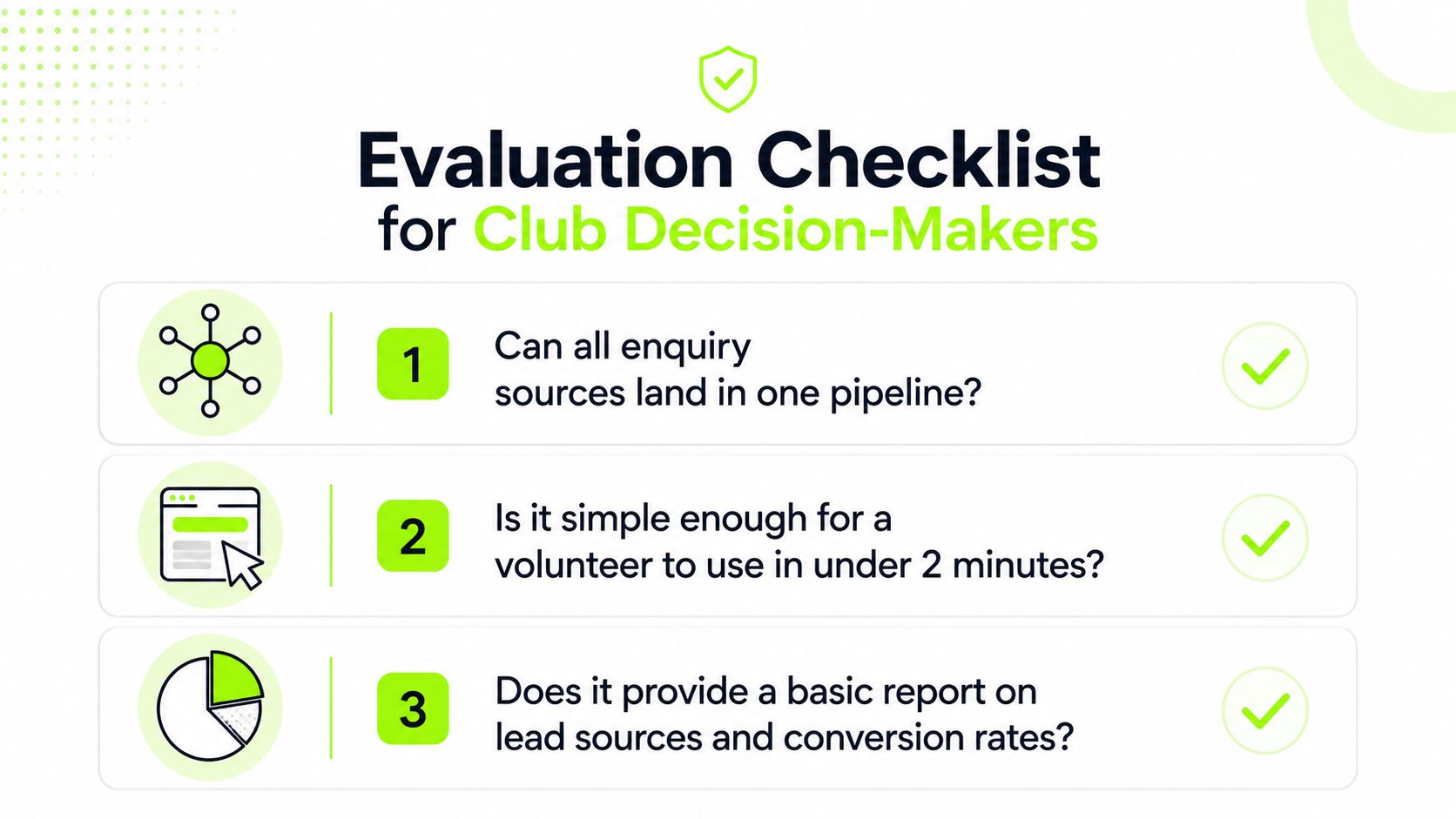
Use these five questions:
- Can every enquiry enter one pipeline? Include website forms, phone calls, emails, walk-ins, social messages, open days and referrals. The owner should be visible without searching through personal inboxes.
- Can the club configure practical response rules? Alerts should support a part-time team and expose overdue work without creating a culture of blame.
- Can staff adjust the scoring model? The system should account for fit, location, membership format and joining timeline, as well as engagement behaviour. The people who understand the club should be able to change the criteria.
- Can the club connect source to membership? Referrals and events must be as easy to record as website enquiries. Reports should distinguish enquiries from visits, trials and joined members.
- Can it integrate with existing records? Check the club CRM, tee-sheet and membership database. If staff must re-enter the same details repeatedly, adoption will suffer.
Judge the system by work removed
A supplier should show how a new enquiry is routed, how an acknowledgement is sent, how a task is created and how an overdue action is escalated. It should also show how a manager reviews response time, source performance and conversion outcomes without assembling a report by hand.
GolfRepOS is one option designed for this operating model, with lead visibility, communication history, pipeline management and reporting for response time and conversion rate. The product choice matters less than whether the club can maintain the underlying rules.
Reject any system that adds an admin layer without removing another one. A platform that looks impressive during a demonstration but depends on perfect data entry will be abandoned. The right lead tracking system gives the club a shared view of responsibility, from the first enquiry to the joining decision.
GolfRep helps UK golf clubs build predictable enquiry pipelines by combining lead generation with structured follow-up, CRM visibility and practical nurture systems. If your club is losing opportunities after the enquiry arrives, visit GolfRep to discuss how a clearer ownership and conversion process could work in your club.
Ready to tap into our proven growth system?