Indoor Golf Membership Pricing: What Clubs Should Charge

You are staring at a draft price sheet before the committee meeting, and the only number anyone will argue about is the monthly fee. One director thinks £10 is too cheap. Another thinks £40 will put people off. Neither figure tells you what a member pays, or what a bay hour earns, once they book the way they really book.
Indoor golf membership pricing only makes sense when you add the fee, the hours they use, and the booking rights they get. The headline subscription is the smallest part of that sum.
Typical Indoor Golf Membership Tiers
A golfer who books a bay twice a month may value a lower hourly rate. Someone who books popular evening slots may care more about reserving ahead. Indoor golf memberships commonly combine a monthly fee with reduced session prices, booking privileges, or both. The right tier depends on which benefit matches actual use.
| Option | Monthly fee | Hourly rate | Advance booking |
|---|---|---|---|
| Pay and play | £0 | Varies by venue | Standard booking access |
| Entry tier | Varies by venue | May be discounted | May include earlier access |
| Middle tier | Varies by venue | May be discounted further | May extend the booking window |
| Top tier | Varies by venue | May offer the lowest rate | May provide the longest booking window |
Treat each benefit as a separate part of the offer. A reduced hourly rate matters when members book enough hours to recover the fee. Earlier access matters when members regularly want busy slots. Club hire or refreshments add value only for members who use them.
A tier with a higher fee and a lower hourly rate is designed for more frequent play. A higher fee for booking priority instead sells access to the diary. Those are different propositions, and the price should make that distinction clear.
The billing cycle also shapes how members judge the commitment. How billing cycles affect churn can help clubs consider how payment frequency affects cancellations. Set out the fee, session rate, included benefits, and booking rules together so customers can compare the total offer.
Working Out Your Break-Even Usage
A £45 monthly fee against a £20 casual hourly rate means the member must use at least 2.25 hours' worth of play to match the pay-as-you-go cost. Ultimate Indoor Golf's membership and session prices make it possible to compare that threshold with the hours each plan includes.
| Plan | Monthly fee | Included hours | Break-even at £20 per hour |
|---|---|---|---|
| Basic | £45 | 3 | 2.25 one-hour sessions |
| Middle | £75 | 6 | 3.75 one-hour sessions |
| Top | £100 | 8 | 5 one-hour sessions |
The middle plan reaches its fee at 3.75 hours; the top plan at five. These are cost-equivalence points, not guarantees of savings. If a member pays for six included hours but plays only three, the effective fee per played hour is £25. Unused allowance makes the headline rate misleading.
Start with the member's actual booking pattern. Divide the monthly fee by the casual hourly rate, then compare the result with hours played, not hours available. Someone who visits twice a month may fall short of the basic threshold; a weekly player is more likely to use enough hours to justify a membership.
Check four patterns: occasional winter visits, weekly play, lesson-focused use, and group bookings. Each can produce a different break-even point, so a single average usage assumption can conceal who benefits and who overpays.
A simulator session may be used for swing analysis, a lesson, or a social visit rather than a full round. The relevant test is whether the member can use the included hours at times that suit them. A lower annual price has little value if bookings are too irregular to use the allowance.
For shared bookings, calculate the cost per bay first, then divide it among the people using it. The result depends on the venue's pricing and how many players usually share a session. The arithmetic for golf simulator bay pricing helps separate the venue's hourly revenue from each player's share.
Set each tier against the booking habits of the members most likely to buy it. If those members cannot reach its break-even threshold, the price needs reconsidering.
Benefits That Justify the Monthly Fee
The hourly discount is easy to print. The harder job is pricing what sits beside it, because that is where a fee either feels fair or feels invented.
Booking priority is the inclusion members notice first. Weekend mornings and winter evenings fill. A member who can see the diary 28 days out is buying certainty, not a cheaper hour. Value it as the full-rate revenue you would have taken from that slot if a walk-in had paid it, not as a token gesture.
Club hire and free hot drinks cost the venue little if you already own the sets and the kettle. Value them at what the member would pay elsewhere for the same thing. If almost nobody takes a set of clubs, stop advertising hire as a reason to join.
Coaching and simulator data are different. A lesson hour has a coach's time in it, and data only helps if someone reads it with the player. Price those sessions as a paid add-on inside a higher tier, not as a freebie on every plan. A small discount on extra hours suits the member who already uses their allowance. It does nothing for the member who does not.
Leagues, competition entry, and off-peak access hold people who want a reason to come back on a Tuesday. They also move price-sensitive play away from the slots you can sell at full rate. That is useful only if those members would otherwise have taken a peak bay.
A member who books peak time every week will pay for the right to get in. They will not pay much for a few pounds off an hour they can already secure.
Count three things before you keep an inclusion: which benefits members use, which cost the venue least, and which they would miss if you took them away. Unused perks add cost and do not hold anyone. How those choices show up in repeat visits is the subject of indoor golf customer retention.
Benchmarking Against Home Simulator Costs
Some readers of your price sheet are also costing a garage bay. Home simulator spend runs from a low annual software subscription to a high-end hardware setup in five figures.
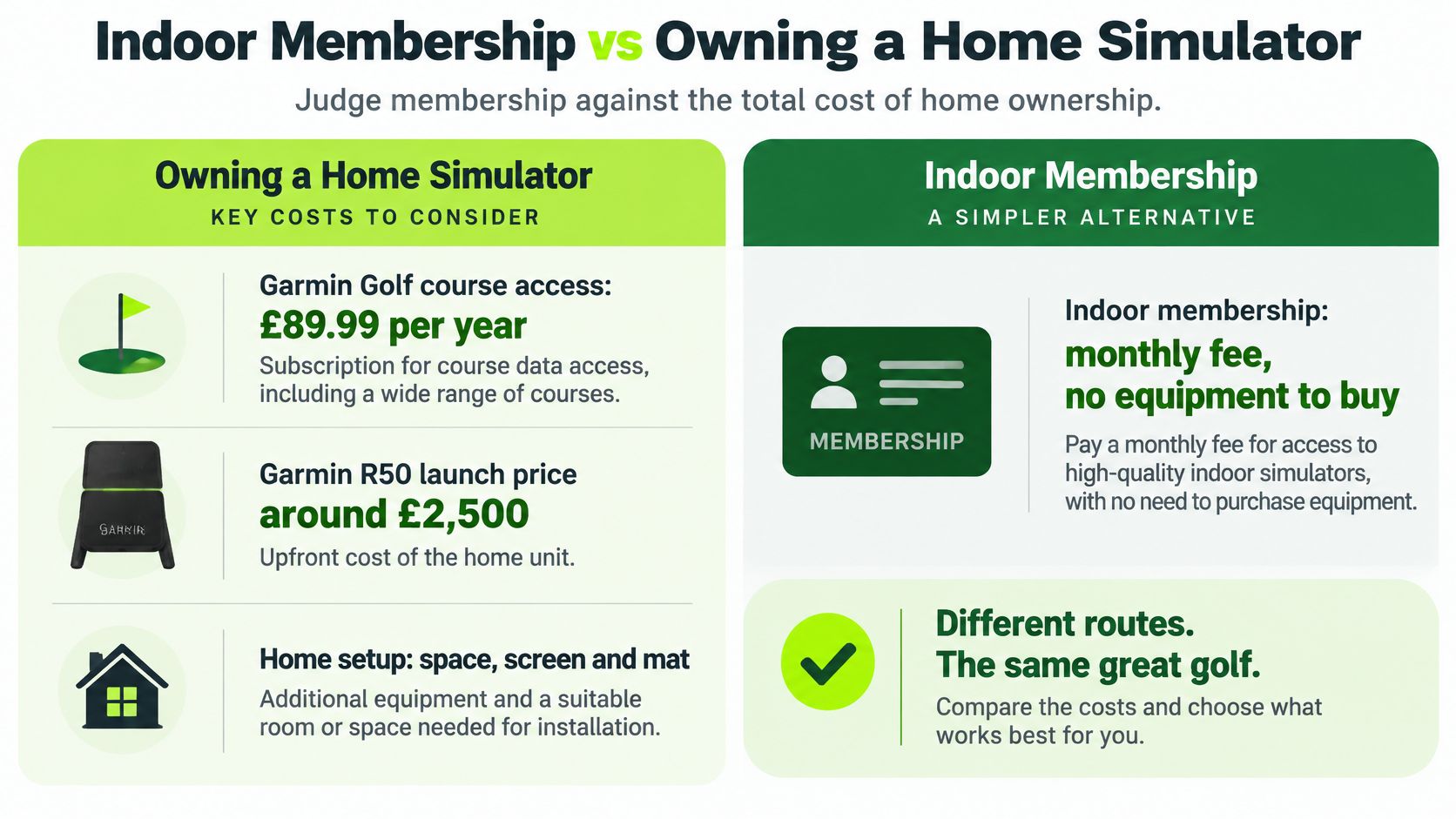
That spread sets the comparison. Annual course software can sit well below a few months of a mid-tier fee. A full home build can run high enough that the owner stops booking a commercial bay. Judge the membership by total monthly cost and the hours they play, not by the headline fee.
What included hours actually yield
A £75 monthly membership is £900 a year. Give that member 12 one-hour sessions a month and the nominal yield is £6.25 per included hour, before staffing, rent, software, maintenance, and card fees. You cannot run a bay on that number.
Booking habits change the sum. Four used hours turn £75 into £18.75 a visit, which can look dear beside a simulator already in the garage. Twelve hours, mostly at peak, take slots you could have sold at full rate. The cheap headline only holds if the hours they play sit where the bay would otherwise be empty.
Cap the monthly hours. Put the cheaper fee on off-peak only. Sell extra hours at a member discount that still clears your variable cost. Peak bays stay open to pay-and-play and to members who will pay for them. The recurring fee then sits beside a home subscription as a known sum for a known amount of golf. Break-even is the hours they use, not the hours printed on the card.
If you cannot name what those used hours buy that a home simulator does not, members will judge you on the hourly rate alone, and a capped home setup will win that comparison.
Indoor Membership as an Entry Point
It is tempting to sell an indoor plan as a cheaper substitute for the club. The participation picture does not support that.
BBC Sport reports that 82% of traditional on-course golfers in Britain and Ireland have used an alternative format such as a simulator, while 2025 recorded an estimated 90 million full rounds in Great Britain, the highest level in five years. People are doing both. Indoor time is not, on those figures, emptying the tee sheet.

Treat the indoor plan as a trial product with a recorded next step, not as a separate entertainment subscription. Before you print the price, answer four operational questions.
- What brings a non-member in. A first bay hour, a lesson, or a winter league are different products and should not share one fee.
- What credit, if any, moves to the course. A fixed credit against a green fee makes the upgrade visible. An open-ended discount does not.
- Whether winter bay access holds summer members. If it does, the indoor plan is a retention tool for the months the course is quiet.
- How family and junior rates change the decision. A household price can convert a curious parent. A single adult rate often will not.
Link each simulator booking to a later course visit, a lesson, a society day, or an outdoor membership, and track the share that takes the next step.
If few indoor members ever play the course, price the offer as a standalone subscription and stop implying it leads somewhere. If many do, put the upgrade on the price sheet in plain figures: what they pay now, what they pay next, and what credit carries across.
Presenting a Price Your Club Can Defend
A customer comparing indoor golf memberships needs to see more than the headline fee. They need to know what access costs over the full commitment and how much use makes that price worthwhile. Carnoustie Golf Links sets different rates for Season Ticket holders and the public, with monthly, winter and annual options.
| Commitment | Season Ticket holders | Public |
|---|---|---|
| Monthly | £45 | £60 |
| Winter, 1 November 2026 to 31 March 2027 | £175 | £250 |
| Annual | £360 | £480 |
At the annual rate, a public member pays an average of £40 a month, compared with £60 on a rolling monthly membership. The winter option averages £50 a month across its five-month term. Those comparisons make the commitment saving clear, while the separate Season Ticket rate shows how existing golf customers are priced differently.
The club should be able to defend each tier with its own arithmetic:
- Calculate contribution per member. Add the membership fee and any paid top-up hours. Subtract the cost of bay time included in the plan, software licensing and variable operating costs. A low contribution may mean the access allowance is too generous.
- Give each tier a clear purpose. Off-peak access can serve price-sensitive players; unrestricted access suits those who want a wider choice of hours; coaching or data can form a separate offer. Clear differences help customers judge whether a higher fee fits their habits.
- Show commitment savings beside the rolling rate. Annual and winter prices are easier to assess when the monthly alternative appears on the same page.
- Publish the practical terms with the price. State the rate, booking window and inclusions together, so customers can compare the offer without having to ask for missing details.
A wider golf club pricing strategy still needs to fit the club's brand and the fee it is prepared to stand behind. GolfRep builds campaigns around a club's brand, pricing and goals. The published offer should make clear who pays, what access they receive and what the club earns.
A price is defensible when the club can explain those three points to its committee using the same figures shown to customers. If the arithmetic does not hold, revise the tier before publishing it.
GolfRep works with UK golf clubs and indoor facilities on membership pricing and the commercial case for each offer. To assess how a proposed tier fits your booking patterns, visit GolfRep.
Ready to tap into our proven growth system?