Indoor Golf Customer Retention: A Practical Guide

Your monthly takings look healthy, the evening bays are busy, and the regulars keep booking. But look down the customer list and a different picture emerges: recent first-timers haven't returned, package holders have unused credits, and the same players account for more of your available hours.
Indoor golf customer retention isn't only about keeping bays busy. At GolfRep, we treat it as a commercial question: which customers return profitably, what keeps them playing, and what should the team do when their activity slips? A frequent player who occupies discounted peak-time slots isn't automatically more valuable than someone who practises off-peak, takes lessons and brings friends.
Measuring Indoor Golf Retention by Cohort
Healthy takings can conceal a shrinking customer base. Established regulars might spend more while newer customers disappear, leaving the venue increasingly dependent on a narrow group.
A single annual churn figure won't show where that happened. Cohort retention means grouping customers by when they started, then comparing their behaviour over the same period. Split those groups by package as well, so an intake of casual visitors isn't judged against annual members.
Start with 30-day repeat rate, 90-day retention and renewal rate by cohort. These answer distinct questions: did the customer return, did they stay active, and did they buy again?
Core indoor golf retention metrics
| Metric | How to calculate it | What it tells you |
|---|---|---|
| 30-day repeat rate | First-time customers who book a second visit within 30 days, divided by all first-time customers in the same month | Whether the first visit leads to a habit |
| 90-day retention | Customers active between days 60 and 90 after joining, divided by customers who joined in that cohort | The early health of each intake |
| First-to-second booking conversion | Second bookings divided by first bookings, split by acquisition source | Which channels bring players who return |
| Visits per active customer | Total visits divided by customers with at least one visit in the month | Frequency trend across the active base |
| Package utilisation | Sessions used divided by sessions purchased | Early warning for unused credits and weak renewal |
| Days since last booking | Today's date minus the date of the most recent visit | Trigger point for reactivation |
| Renewal rate by cohort | Renewals divided by customers due to renew in the period, split by joining month and package | Whether retention is improving over time |
Use unique customer records rather than booking names typed differently at reception. Record completed visits separately from future reservations and cancellations, and keep your definitions consistent. Only compare cohorts once they've had enough time to complete the measurement window.
Build a report that leads to decisions
Keep the monthly cohort report to a page, in this order:
- Early retention: 30-day repeat rate and 90-day retention by joining month.
- Usage: Package utilisation and credits at risk.
- Interventions: Triggers fired and the share that led to a booking.
- Renewals: Renewal rate by package type.
- Customer value: Visits per active customer and revenue per active customer.
Revenue per active customer is recognised customer revenue divided by active customers for the period. Keep package cash receipts separate from revenue attributed to delivered sessions, otherwise advance payments can make weak usage look commercially healthy.
As a working review schedule, check first-visit and 90-day figures monthly, package utilisation fortnightly, and the full set at the 90-day mark. GolfRep also recommends reviewing stage-by-stage conversion, speed-to-lead, visit-to-join performance and source-level revenue at that point.
Decision rule: Fix the weakest stage, not whichever metric attracts the loudest discussion in the management meeting.
If 30-day repeat is weakest, investigate the first-session experience. If 90-day retention is weakest, change the engagement formats. If renewal is weakest, examine package fit and the renewal conversation. Work on that constraint for a full quarter, measure the change, then choose the next priority.
Start operationally with the handover from sale to first session. Pass on the player's goals, experience, package entitlement and any promises made. GolfRep's position is straightforward: a clean transfer from the membership conversation to the member experience protects retention and makes the original sale feel professionally managed.
Where Indoor Golfers Drop Off in the First Year
A player can enjoy a first simulator session and still fail to book a second. The retention task is to give each customer a relevant reason to return, then act when their behaviour suggests they are drifting.
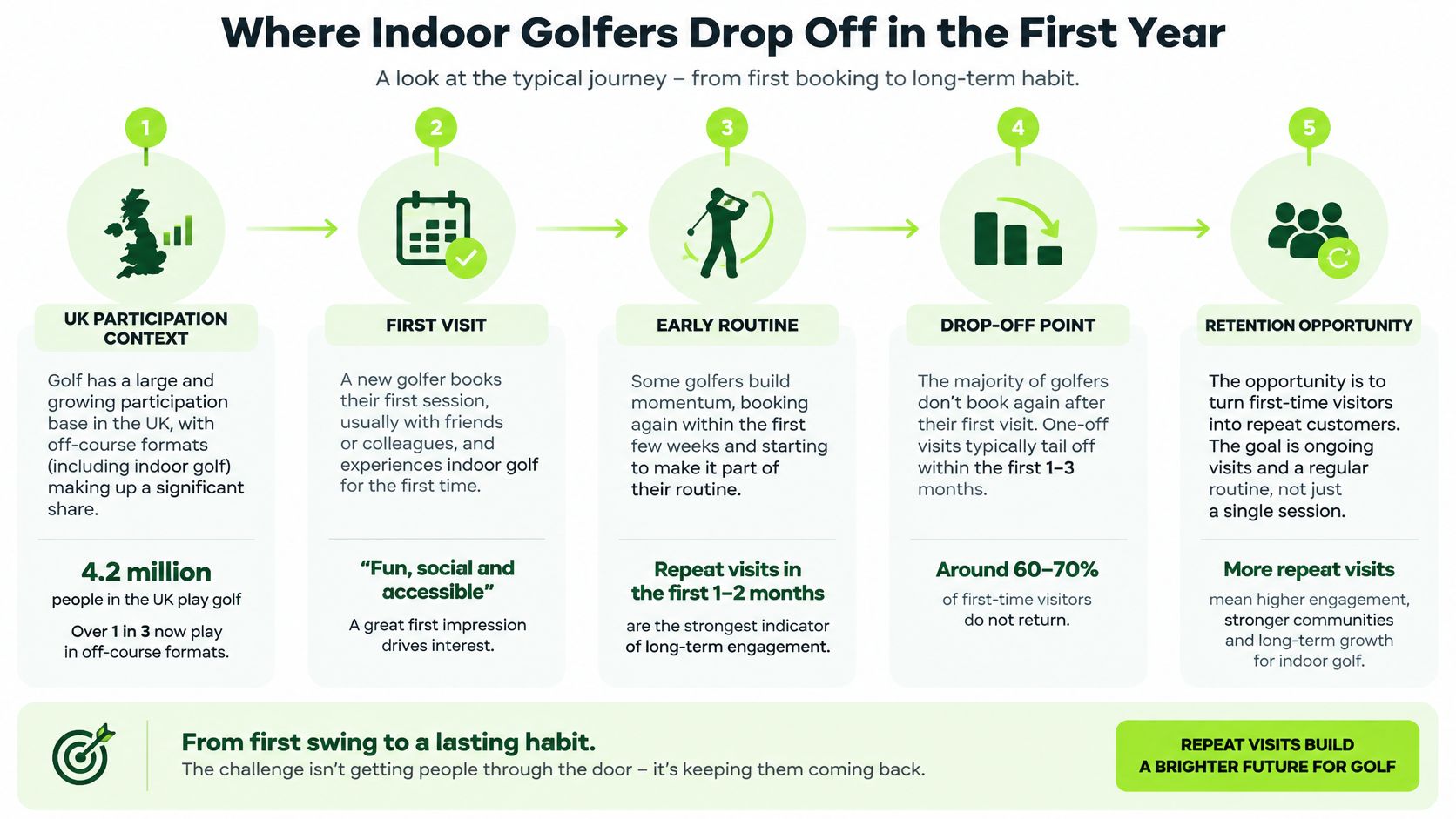
Customer journey stages and retention risks
Use these timings as operating windows to test against your own booking patterns, not as industry benchmarks.
| Stage | Typical timing | Main retention risk |
|---|---|---|
| First visit | Day 0 to 1 | Unclear next step after the session |
| Early repeat | Days 2 to 30 | No second booking, so a routine never forms |
| Habit building | Months 2 to 3 | Package remains unused and play has no social element |
| Established | Months 4 to 12 | Visits become less frequent or summer disrupts the routine |
| Renewal | 60 to 30 days before renewal | Package no longer feels suited to the player's needs |
At the first visit, find out whether the player wants entertainment, practice or coaching. End with a suitable next step, such as another session or a coaching option, rather than a generic membership pitch.
For players who have not booked again within the first month, send a relevant suggestion and make it easy to choose a date. During months two and three, give regular play a purpose: a practice plan, a coach review or a place in a group. Established players may need a lighter summer routine that fits around outdoor golf.
Recognise risk before renewal
Start the value conversation 60 days before expiry. Ask whether the player used the package as intended, then address problems with access or suitability before asking them to renew. A busy player is not automatically your most profitable one: track visits alongside revenue per active customer to see which packages support valuable repeat play.
Traditional club membership findings offer context, but they are not indoor-golf retention forecasts. Membership expectations vary by tenure and age, so assess newer and younger customers separately in your own booking records. Use changes in visit frequency and package use to decide when to follow up, rather than treating another sector's figures as targets.
Experience Factors That Bring Players Back
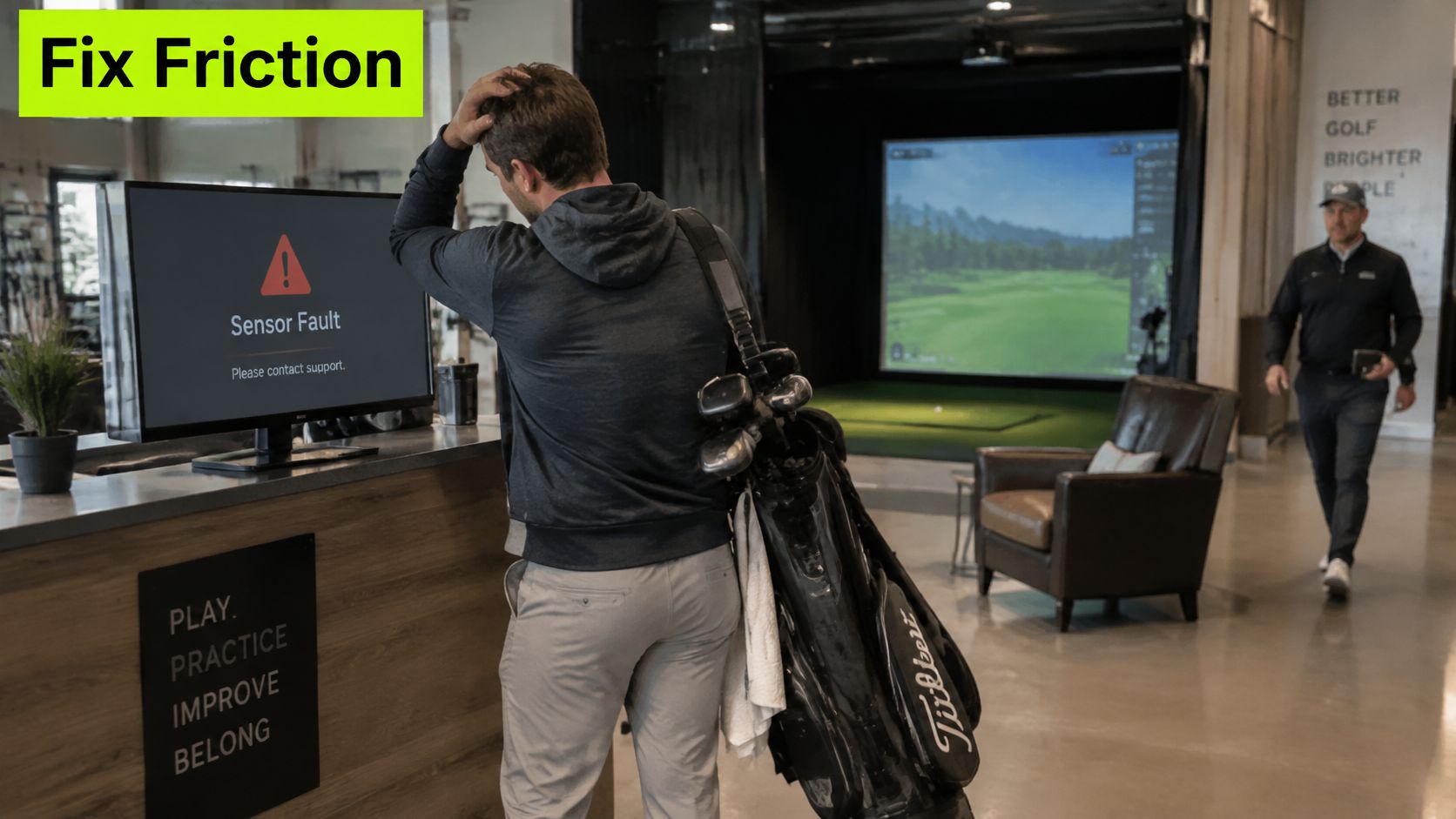
Say a player books online, arrives to find a faulty bay sensor, then waits for a coach who hasn't checked the diary. They finish the session frustrated and never book again. A discounted return offer doesn't address what went wrong.
Repair the experience before promoting another visit. A short post-session survey should identify the operational problem and give somebody responsibility for fixing it.
Ask questions staff can act on
Use a recommended one-to-five scale, with the lowest score meaning poor and the highest meaning excellent. Include a not-applicable option, particularly for coaching and food service.
| Experience factor | Question after the first session | Operational fix |
|---|---|---|
| Booking friction | How easy was it to find availability and reserve your bay? | Show live availability, full prices and equipment options before checkout |
| Equipment and software | How reliably did the simulator work? | Run opening checks and keep a fault log with an escalation owner |
| Orientation | How confident were you using the simulator after your introduction? | Demonstrate setup, game selection and how to summon help |
| Staff and coaches | How well did the team understand what you wanted from the session? | Brief the host from booking notes and confirm coaching appointments |
| Cleanliness and comfort | How comfortable and well-presented was your bay? | Add seating, temperature and cleanliness checks to the turnaround routine |
| Food and drink | How easy was it to order and receive refreshments? | Make ordering clear and allocate responsibility for bay service |
| Playing partners | How easy was it to find a suitable person or group to play with? | Offer hosted sessions and introductions matched to ability |
England Golf's Players 1st programme collected more than 28,000 member-experience responses, with an average response rate of 59%, according to Golf Business News. For an indoor operator, the practical lesson is to connect feedback with booking behaviour, rather than filing survey results separately.
Resolve dissatisfaction personally
Ask for a short comment alongside the scores. A low equipment score could mean inaccurate shot readings, confusing software or a complete failure, each requiring a different response.
As a recommended service rule, define a low score as one or two. If a customer scores two or more factors low, have the duty manager make a personal call within 48 hours, rather than sending another automated email.
Acknowledge the specific failure, explain the remedy and record whether the customer accepts it. Don't ask the front desk to rescue a relationship while the same unresolved fault remains in the bay.
Building Engagement Between Visits
An indoor golfer who plays frequently is not automatically your most profitable customer. A regular booking that fills a peak-time bay at a low rate may contribute less than a less frequent player who brings a group, buys refreshments or returns for coaching. Track what each activity leads to, not just how many people attend.
Many members feel their clubs rarely ask for feedback. Regular messages alone do not show that a venue understands what customers want. Give each engagement format a clear next step, then judge it by whether players return and what they book.
Give each format a clear route forward
| Format | Customer journey | Booking rule | Measure |
|---|---|---|---|
| Winter leagues | Casual player joins a team, attends fixtures, then enters the next competition | Publish fixtures and substitution rules before payment | Registrations, weekly attendance, food-and-drink spend and re-entry |
| Beginner and taster sessions | Newcomer tries the format, gains confidence, then joins coached practice | Group by experience and reserve a follow-on session | Attendance, follow-on bookings and coaching uptake |
| Junior and family sessions | Family attends an introduction, then adopts a suitable recurring slot | State supervision, age suitability and equipment arrangements clearly | Returning households and progression into junior coaching |
| Corporate and society bookings | Organiser brings a group, then considers another event | Agree deposits, group size and organiser responsibilities in advance | Event contribution, organiser rebooking and individual return visits |
| Coaching blocks | Player identifies a goal, completes lessons and practises between them | Link lessons to bookable practice availability | Completion, practice attendance and continued coaching |
| Social competitions | Solo visitor joins a hosted event and meets potential playing partners | Explain the format and provide partner matching | Attendance, subsequent group bookings and guest conversion |
Use these indoor golf league ideas to choose a format that suits your players, including newcomers who may not understand established competition formats.
Choose participation over programme volume
Start with formats your team can run consistently. A crowded calendar can strain staffing and leave customers unsure which sessions will go ahead. The Golf Club Managers Association's membership guidance discusses broader leisure experiences, including practice, fitness and family-friendly events. For an indoor venue, choose activities that fit your customers and facilities rather than adding unrelated events.
A programme earns its place when customers attend, return and generate enough contribution to justify staffing, prizes and occupied bay time.
Assign each format a named owner and review its results at the end of each season. If attendance is strong but repeat bookings are weak, revise the follow-on offer. If the activity fills bays but makes little contribution, adjust the format or schedule before expanding it.
Using CRM Follow-Up to Trigger Repeat Visits
A customer receives a generic booking email on day three, ignores it, then gets an offer for a package they already own. That's not relevant follow-up. It's a sign that the message sequence doesn't reflect the customer record.
Trigger follow-up from behaviour and entitlement, not the calendar alone. Your CRM, the customer relationship management system, should show completed visits, future bookings, package ownership, credit balance, feedback and the next action due.
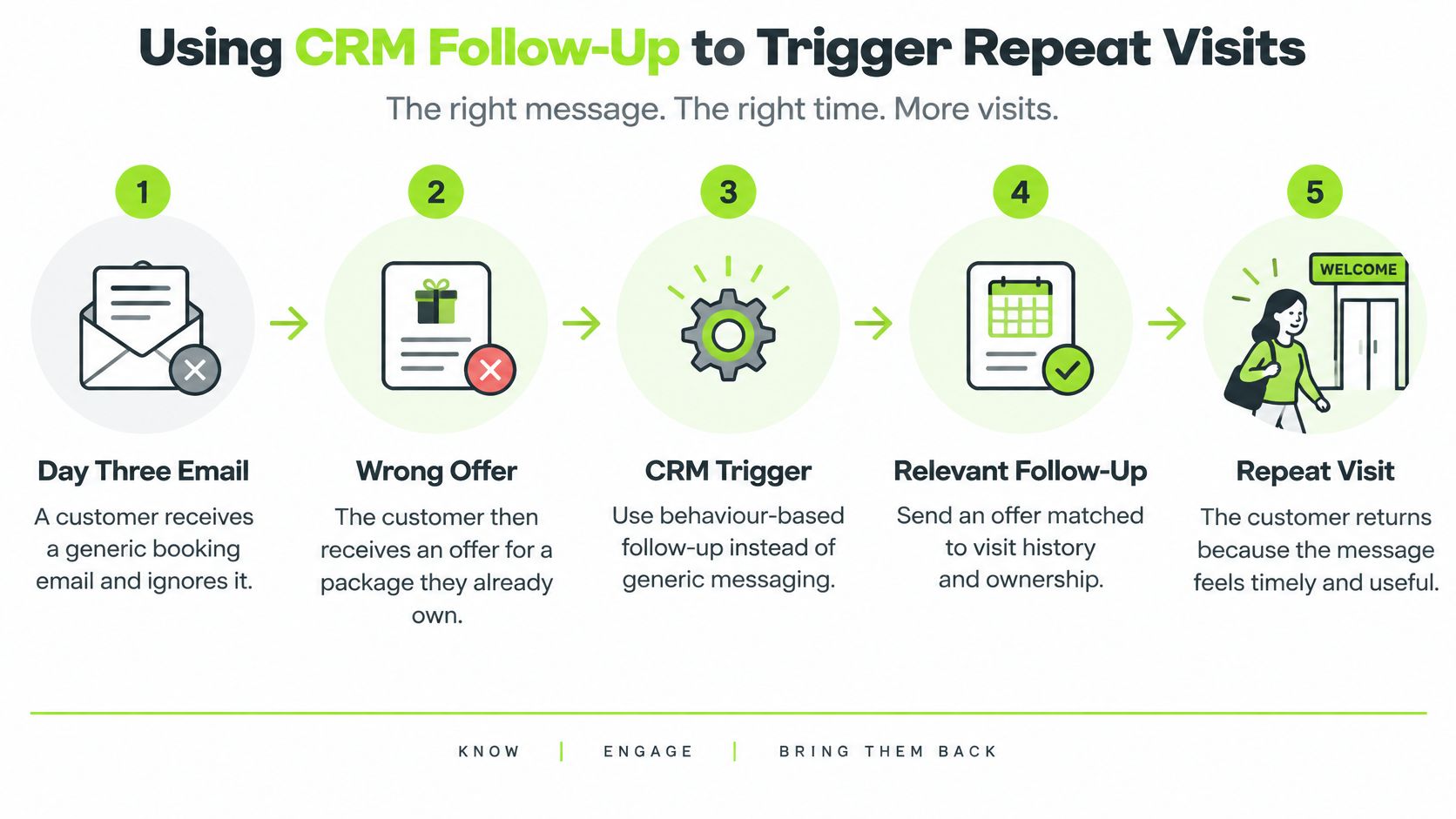
CRM follow-up triggers for indoor golf
Use these as starting rules to test against your venue's customers, not proven industry timings.
| Trigger | Timing | Action | Owner |
|---|---|---|---|
| No second booking | 14 days after first visit | Taster or beginner session offer | Front desk |
| Credits under-used | Less than half of credits used with 6 weeks left | Reminder with two suggested dates | Front desk |
| Lapsed customer | 30 days without a visit | Personal message from a coach with a booking prompt | Coaching team |
| League under-registered | 2 weeks before league start | Invitation with partner matching | Events lead |
| Renewal approaching | 60 days before renewal date | Usage summary and renewal offer | Membership manager |
| Expired membership | 14 days after expiry | Win-back offer and a reason-for-leaving question | Membership manager |
Match the action to the person. The beginner offer suits a nervous newcomer, but an experienced golfer may need a practice challenge instead. An under-used package reminder should link to sessions the customer can book, not unavailable evening slots.
League invitations should go to suitable players, with ability, preferred times and existing commitments considered. Renewal messages should explain actual usage and relevant options, while win-back contact should distinguish dissatisfaction from a temporary change in circumstances.
Prevent duplicate and irrelevant contact
Before sending anything, suppress customers who already have a suitable booking, have renewed or are awaiting resolution of a complaint. Respect communication preferences and stop a sequence when the customer responds.
As a general recommendation, allow no more than two automated prompts before personal contact. Give each customer record one named owner, even when another team member delivers the coaching or event.
The record should contain:
- Next action date: When somebody must act.
- Current stage: First visit, repeat, active package, renewal or lapsed.
- Stalled reason: Availability, confidence, service issue, price or unknown.
- Outcome: Booked, declined, unresolved or no response.
GolfRep's approach is to make the due action and stalled stage visible, rather than leaving staff to search email histories. Our retention marketing guide explains the wider role of relevant ongoing contact.
Measure bookings after each trigger, but don't assume every subsequent booking was caused by the message. Where practical, compare contacted customers with a similar group receiving the usual service before expanding an automated journey.
Package Design That Keeps Customers Renewing
Is the cheapest package the best way to fill quiet weekday bays? Only if it attracts suitable demand without giving existing customers a cheaper route to sessions they'd already buy.
Package fit matters more than headline generosity. Sell access that matches how the customer can realistically play, then check whether that usage is commercially worthwhile.
Indoor golf package models compared
| Model | Suits | Retention strength | Main risk |
|---|---|---|---|
| Pay-as-you-go | Occasional players and visitors | Low commitment and easy entry | Little habit formed and high churn |
| Session bundle | Players who want to practise regularly | Visible progress against credits | Unused sessions cause disappointment |
| Off-peak monthly credits | Retirees and shift workers | Affordable routine | Off-peak demand must be managed |
| Unlimited monthly membership | Frequent solo players | High usage and simple to understand | Heavy users can erode margin |
| League or group membership | Social players and beginners | Fixed appointments and community | Needs organiser time to run well |
| Annual membership | Committed players | Predictable revenue | Renewal moment carries the most risk |
England Golf research involving 55 successful clubs identified flexible packages and a friendly environment where members could find playing partners as recurring factors, according to Golf Business News. That's club evidence, not a comparison of indoor package performance, but it supports testing flexibility alongside social access.
Protect margin as well as usage
Compare contribution per customer and per occupied bay hour. Subtract the directly attributable costs of delivering sessions, benefits and promotions from the revenue allocated to that customer, then divide by their occupied hours for the hourly measure.
Review peak and off-peak usage separately. A heavily discounted frequent player can displace a full-price group at a busy time, while an off-peak player may use capacity that would otherwise remain empty.
Commercial test: Reward profitable frequency, not simply the greatest number of bookings.
Use clear rollover limits, transferable guest credits and expiry notices to reduce wasted value for irregular players. Make peak-time restrictions and advance-booking allowances visible before purchase, particularly for unlimited memberships.
Keep acquisition promises aligned with the access you can deliver; our indoor golf marketing ideas offer broader ways to present the venue's different playing options.
Pilot one new model with a single cohort before changing the whole range. Judge it on renewal, contribution, availability and customer feedback together, not occupancy alone.
GolfRep helps golf facilities improve commercial performance across acquisition, sales processes, CRM, conversion and retention. If you'd like to identify which customer cohorts are slipping and build practical actions around profitable repeat play, visit GolfRep to discuss your venue's retention priorities.
Ready to tap into our proven growth system?