Https://thebackninegolf.com/
UK golf-club analysis shows that venues take an average of 47 hours and 32 minutes to answer a membership enquiry. A lead answered within one hour is five times more likely to convert than one left for 24 hours. The lesson for managers is practical: the club's front door can matter as much as its facilities.
Indoor golf changes the comparison. A traditional club is no longer judged only against nearby courses. Golfers may compare its enquiry process with instant booking, flexible hours, and a clear digital journey. Slow replies and unclear next steps can make a strong course feel difficult to access.
TheBackNineGolf provides a useful example. Its UK-facing site offers 24/7 access, online bay booking, and access to over 250 Trackman golf courses (TheBackNineGolf). That model shows how convenience can bring people into golf, including those not yet ready for membership.
For clubs, the simulator is not the whole lesson. It is a reminder to organise enquiries, record follow-ups, and respond promptly. A well-run CRM works like a reliable reception desk, making sure interest receives a clear next step rather than sitting unattended.
Why a Simulator Brand Matters to UK Clubs in 2026
Indoor golf isn't automatically a replacement for a traditional member club. It represents a change in customer expectations. Golfers can practise or play indoors, outside normal club hours, without waiting for daylight, checking course conditions, or committing to a conventional membership before trying the experience.
That matters most to time-poor adults, families, returning golfers, and people who aren't yet ready to identify as club members. A venue such as TheBackNineGolf allows a customer to book a bay, show up, and play on their schedule, as the brand's own site puts it. A traditional club may offer greater depth, but it often asks a prospect to complete more steps before experiencing the value.
The response-time benchmark
The response gap deserves attention because it exposes a weakness that technology alone won't fix. The relevant comparison is:
| Response Time | Average UK Golf Venue | Conversion Likelihood |
|---|---|---|
| Around 47 hours and 32 minutes | Reported average response time to a membership enquiry | Lower than a lead answered within one hour |
| Within one hour | Faster than the reported average | Five times more likely to convert than a lead left for 24 hours |
The response-time figures and conversion comparison come from GolfRep's analysis of golf-club enquiry handling. The lesson isn't that every club must copy an indoor venue's operating model. It's that a slow reply can make a well-generated enquiry less valuable before a salesperson has had a proper conversation.
Treat the brand as a market signal
A club operating near an indoor venue should study the customer journey before deciding whether to compete, partner, or ignore it. Look at the booking process, the clarity of the offer, the opening hours, and the way the venue captures customer information.
Retail positioning offers a useful parallel. A resource on winning strategy for retail store identity explains why a business's identity must be clear at the point where customers decide whether to enter. Golf clubs face the same practical challenge. The front door needs to communicate who the club is for, what happens next, and why a prospect should respond now.
Clubs can also learn from the commercial logic behind PlaySport golf range, where the customer journey begins with an accessible experience rather than a complex membership decision. Indoor golf should therefore be viewed as a context shift. It makes convenience visible, measurable, and easy for golfers to compare.
What TheBackNineGolf Actually Offers
TheBackNineGolf is positioned as a UK indoor golf venue brand built around Trackman simulator systems, online booking, and access throughout the day and night. Its main site states that players can use the venue 24/7, book a bay, and access more than 250 Trackman golf courses (TheBackNineGolf's course information).
That proposition is different from joining a traditional golf club. A member club sells access to land, a maintained course, organised competitions, and a continuing social community. An indoor venue sells time, technology, flexibility, and controlled access. The customer usually makes a specific booking for a bay, a practice session, a social round, coaching, or an event.
The customer journey is deliberately simple
A prospective customer doesn't need to understand the technical infrastructure before booking. They need to know:
- What they can do: Play virtual courses, practise, analyse shots, or spend time with friends.
- When they can do it: The brand promotes 24/7 access, which supports early, late, and weather-independent sessions.
- What they can access: The venue advertises more than 250 Trackman golf courses.
- How they start: The stated journey is to book a bay, arrive, and play on the customer's schedule.
That simplicity can be attractive to golfers who find a club's membership structure unfamiliar. It also helps explain why indoor venues can appeal to people who aren't yet looking for a permanent club identity.
The technology is part of the product
Trackman is not merely a screen showing a virtual course. The UK-facing material describes Trackman as offering exceptional accuracy through a 360-degree rotation of the ball, creating a tracking environment suited to practice and shot analysis. A club assessing its local competition should therefore compare the whole experience, not just the hourly bay cost.
The relevant benchmark might include the booking interface, availability, coaching support, course selection, hospitality, and the quality of the first visit. Clubs researching how immersive technology is presented can also review practical LAD VR app solutions to understand how digital interfaces influence a customer's sense of control.
TheBackNineGolf isn't a traditional members-only club, and it shouldn't be judged as one. Its commercial strength lies in making golf easier to access. Traditional clubs retain advantages that indoor venues don't reproduce, but they need to make those advantages clear early in the enquiry journey.
Inside the Indoor Golf Operating Model
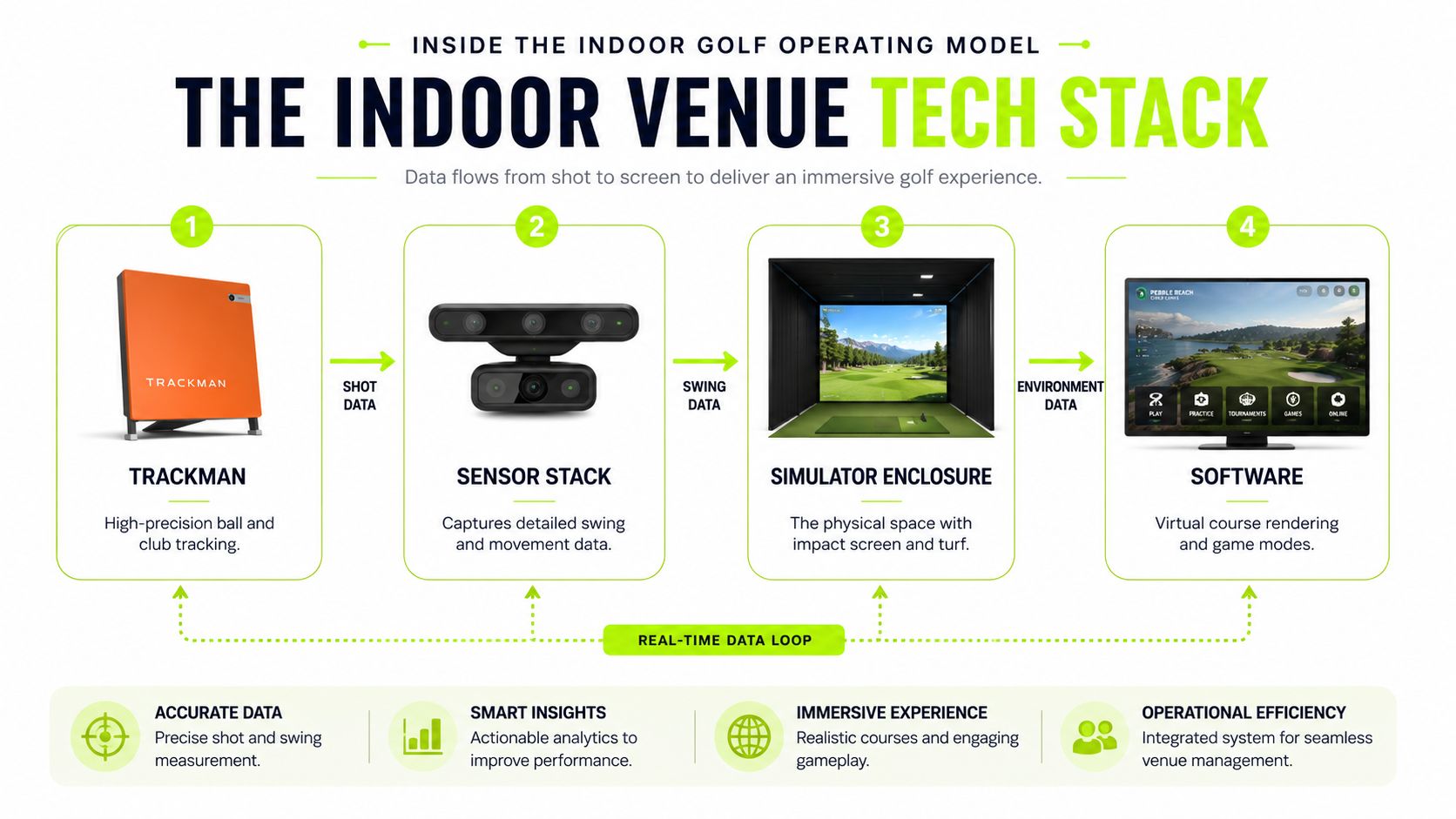
An indoor venue works as a connected technology and service stack. The customer sees a bay, a screen, and a booking page. Behind that experience sits a combination of tracking hardware, software, physical infrastructure, staff, and data.
The core components
Trackman and the sensor stack capture information about the ball and club. That data supports feedback on shot behaviour and helps the golfer understand what happened after impact. The technology matters because an indoor session needs to feel useful, not merely visual.
The simulator enclosure and impact screen create the physical playing area. They contain the shot, protect the surroundings, and provide the surface on which virtual golf is displayed. Space planning, safety, maintenance, and equipment reliability all affect how many usable sessions a venue can deliver.
The software platform and course library turn tracked shots into a playable experience. TheBackNineGolf promotes access to more than 250 Trackman golf courses, giving customers variety without the venue needing to maintain multiple physical layouts.
Booking and membership systems control access, payment, availability, and customer records. Indoor operators often have a direct view of customer behaviour. A booking can reveal who attended, what time they prefer, what they bought, and whether they return.
Revenue comes from time and usage
A traditional club's core proposition is linked to the course and membership year. An indoor venue can generate revenue through bay hire, coaching, leagues, social bookings, events, packages, and related hospitality or retail activity.
The operating risks are different too. A club manages agronomy, weather, drainage, staffing across a large site, and the long-term condition of the course. An indoor operator manages equipment uptime, software, space utilisation, customer service, and the quality of every booked session.
That difference explains why the models can coexist. Clubs offer depth and place. Indoor venues offer controlled access and repeatable convenience. Managers looking at this category can find related operational thinking in growing indoor golf membership, particularly around how a technology-led venue turns visits into an ongoing relationship.
Operating lesson: The simulator is only one part of the product. Booking, service, follow-up, and customer visibility determine whether the venue captures repeat demand.
Indoor Golf Venues vs Traditional Member Clubs
The clearest comparison is operational rather than ideological. Indoor golf and traditional clubs solve different customer problems, although their audiences overlap.
| Dimension | Indoor Venue | Traditional Club |
|---|---|---|
| Seasonality | Less exposed to rain, cold, and limited daylight | More dependent on course conditions and daylight |
| Accessibility | Designed around booked bay access and flexible sessions | Usually shaped by membership, tee times, and club policies |
| Pricing model | Customers pay for bay time, sessions, packages, or events | Members typically pay for continuing access to the course and club |
| Dress code | Often informal and social | May include established standards for course and clubhouse use |
| Tee-time availability | Bay availability can support evening and off-peak play | Course capacity and competition schedules influence access |
| Social format | Small-group, corporate, coaching, and entertainment-led sessions | Competitions, societies, leagues, and established member groups |
| Conversion mechanics | Booking can create a customer record at the point of payment | Enquiries can remain open across visits, calls, and committee decisions |
Indoor venues have a strong answer to bad weather and inconvenient hours. They can make a short practice session or social round easier to arrange, particularly when players don't want to plan around a full day at a course.
Traditional clubs have different strengths. They provide turf, outdoor playing conditions, structured competition, long-term friendships, junior pathways, and a sense of belonging that a single bay booking cannot fully reproduce. A club also offers the experience of learning how to manage a course, play with different groups, and participate in a local sporting community.
The front door is the strategic difference
The most important distinction for growth is often not technology or facilities. It's lead visibility. An indoor booking system is usually designed to record the customer as part of the transaction. A club enquiry may arrive through email, social media, a website form, a phone call, or a personal referral, then move between several people without one shared record.
That creates a practical opportunity. Clubs don't need to imitate every feature of an indoor venue. They should adopt the parts that reduce friction, especially clear next steps, fast acknowledgement, consistent availability information, and a reliable record of every conversation.
Neither model is complete on its own. Indoor venues expose the value of convenience, while traditional clubs demonstrate the value of place, community, and continuity. The strongest operators will learn from the other model without pretending the two experiences are identical.
Where New UK Golfers Are Entering the Game
England's membership figures show that traditional golf still has considerable strength. English club membership reached 750,071 in 2025, an increase of 2.66% year on year, described as the highest level in at least 13 years. Junior membership rose from 46,028 to 61,483, according to The Golf Business.
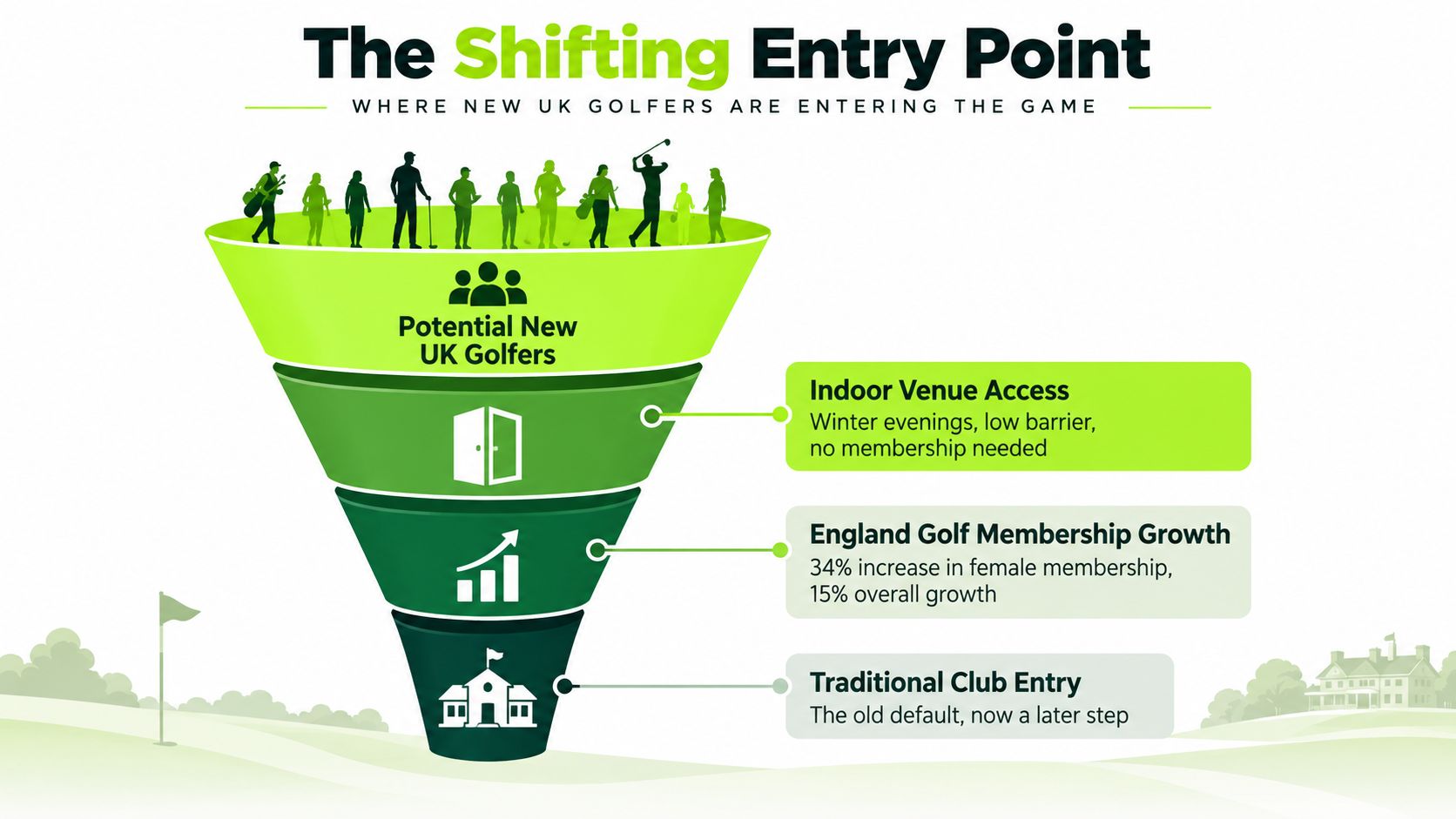
Those figures don't support a simple story in which indoor golf replaces clubs. They point to a more useful conclusion. People are still joining clubs, but they may encounter golf through several routes before they decide where long-term participation belongs.
The entry path is becoming less linear
A new golfer might first experience the game through a social indoor booking. A lapsed player might return because a simulator makes practice easier to fit around work. A company might organise an indoor event before anyone in the group feels ready to join a club. A family might introduce a junior to golf in a controlled environment before arranging outdoor coaching.
In each case, the first venue owns the first relationship. That venue learns what the customer enjoys, what times suit them, and whether they want practice, competition, instruction, or social play.
Traditional clubs still become the natural next step for golfers who want outdoor rounds, competitions, handicap development, junior structures, and a wider community. But the club needs to earn that second visit. A prospect may have already formed a view about golf's accessibility before speaking to a membership team.
Membership growth creates a shared opportunity
The membership data shows that clubs have an expanding market to serve, including a notable rise in junior participation. Indoor venues can help widen the top of that market by lowering the initial commitment, while clubs can provide the progression that a simulator alone can't deliver.
That suggests a feeder relationship rather than a rival-only relationship. Clubs could consider taster sessions for indoor customers, referral arrangements, shared coaching pathways, or clear explanations of what outdoor membership adds.
The practical challenge is ownership of the lead. If an indoor venue captures the booking but the club receives no consented contact record, no timing information, and no agreed follow-up process, the potential feeder channel remains informal. Managers should therefore ask not only where golfers first play, but who is responsible for the next useful conversation.
The Conversion Problem Most Clubs Underestimate
Membership growth depends on more than generating enquiries. It also depends on what happens immediately after one arrives. The gap between receipt and ownership is a controllable part of the member journey, much like the difference between a visitor reaching the clubhouse door and finding nobody there to greet them.
A UK golf-club analysis reports an average membership-enquiry response time of 47 hours and 32 minutes. It also found that a lead answered within one hour is five times more likely to convert than one left for 24 hours, as noted earlier in the article. A club can invest in awareness and still lose a prospective member through silence. (GolfRep's enquiry-response analysis)
Why replies take days
The causes are usually ordinary operating gaps:
- Shared inboxes: Everyone can see the message, so nobody clearly owns it.
- No response rota: Enquiries arriving at weekends or in the evening wait until the next working day.
- Scattered channels: Website forms, social messages, phone notes, and personal emails remain separate.
- Competing duties: Managers handle prospects between coaching, visitors, events, and course issues.
- No visibility: Senior staff cannot see which leads are new, overdue, active, or stalled.
An indoor bay booking often ends with a completed transaction. A membership enquiry starts an open conversation. It may require an answer, a short qualification, a visit, and follow-up before the golfer decides. The simulator attracts attention, but the response process determines whether that attention becomes a club relationship.
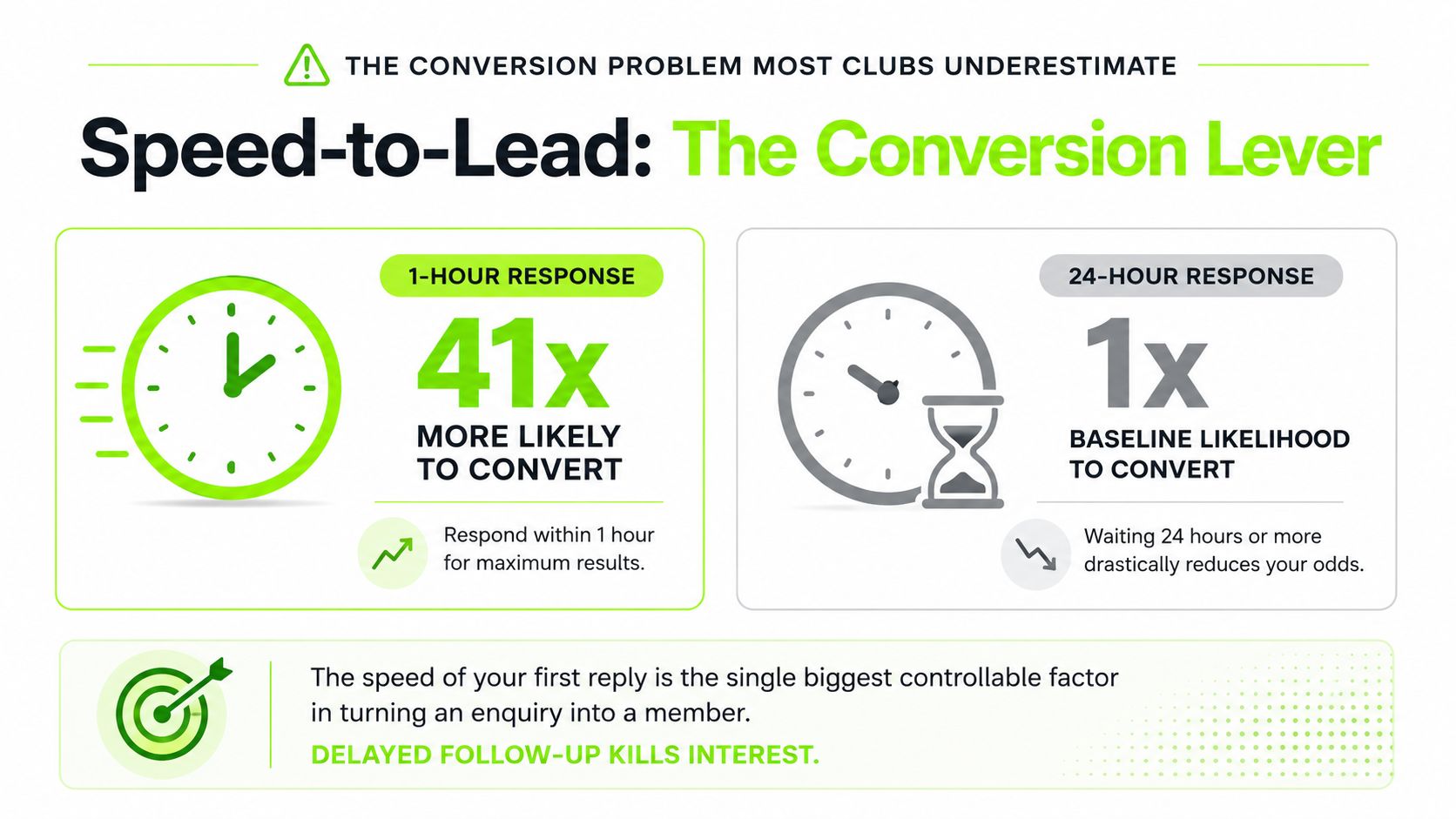
The supplied visual uses a 41 times claim, which conflicts with the verified five-times comparison used here. Clubs should treat the visual as an asset requiring correction before publication and rely on the verified benchmark, rather than present both figures to prospective members or staff.
Commercial reality: Each delay gives the prospect more time to book elsewhere, lose interest, or conclude that the club will be slow to respond after joining.
The answer may not be more advertising. A named owner, automatic acknowledgement, shared CRM view, and agreed follow-up routine can keep an interested golfer progressing from first enquiry to a useful conversation.
A Practical Enquiry Handling Sequence
A club can apply the same enquiry process whether a golfer arrives through a website form, social message, simulator taster, or referral. The channel changes, but the front door still needs to work in the same order: acknowledge the interest, understand the golfer's aim, suggest a relevant next step, and record the outcome. The simulator may create the first spark. The response process determines whether it becomes a club relationship.
Golf-club follow-up guidance centres on instant acknowledgement, named ownership, a personal call, value-based follow-up, a reminder, and final re-engagement (GolfRep's lead-conversion guidance). Clubs can also use this practical enquiry-handling guidance when turning that principle into a repeatable routine.
Five steps for a reliable response
Acknowledge the enquiry within five minutes. Confirm receipt, state when a person will reply, and make clear that an automated message is only an acknowledgement. This protects the first impression while the team prepares a personal response.
Assign a named owner. Put the lead in a shared CRM view and give one person responsibility. Ask only useful opening questions, such as playing history, household size, preferred days, and budget band. A first reply should feel like a conversation, not an application form.
Show relevant value. Link the answer to the reason for enquiring. A returning golfer may want a low-pressure way back into the game. A parent may need junior coaching information. Someone arriving from an indoor venue may benefit from a clear outdoor progression, such as a course taster or a conversation with the PGA professional.
Book a specific next step. Offer a call, visit, coaching conversation, or taster at a defined time. If the golfer does not reply, follow up on day one, day three, day seven, and day fourteen, using their preferred channel where known.
Log every touchpoint and nurture appropriately. Record calls, messages, visits, objections, and outcomes. Managers should be able to see which leads have stalled without searching several personal inboxes.
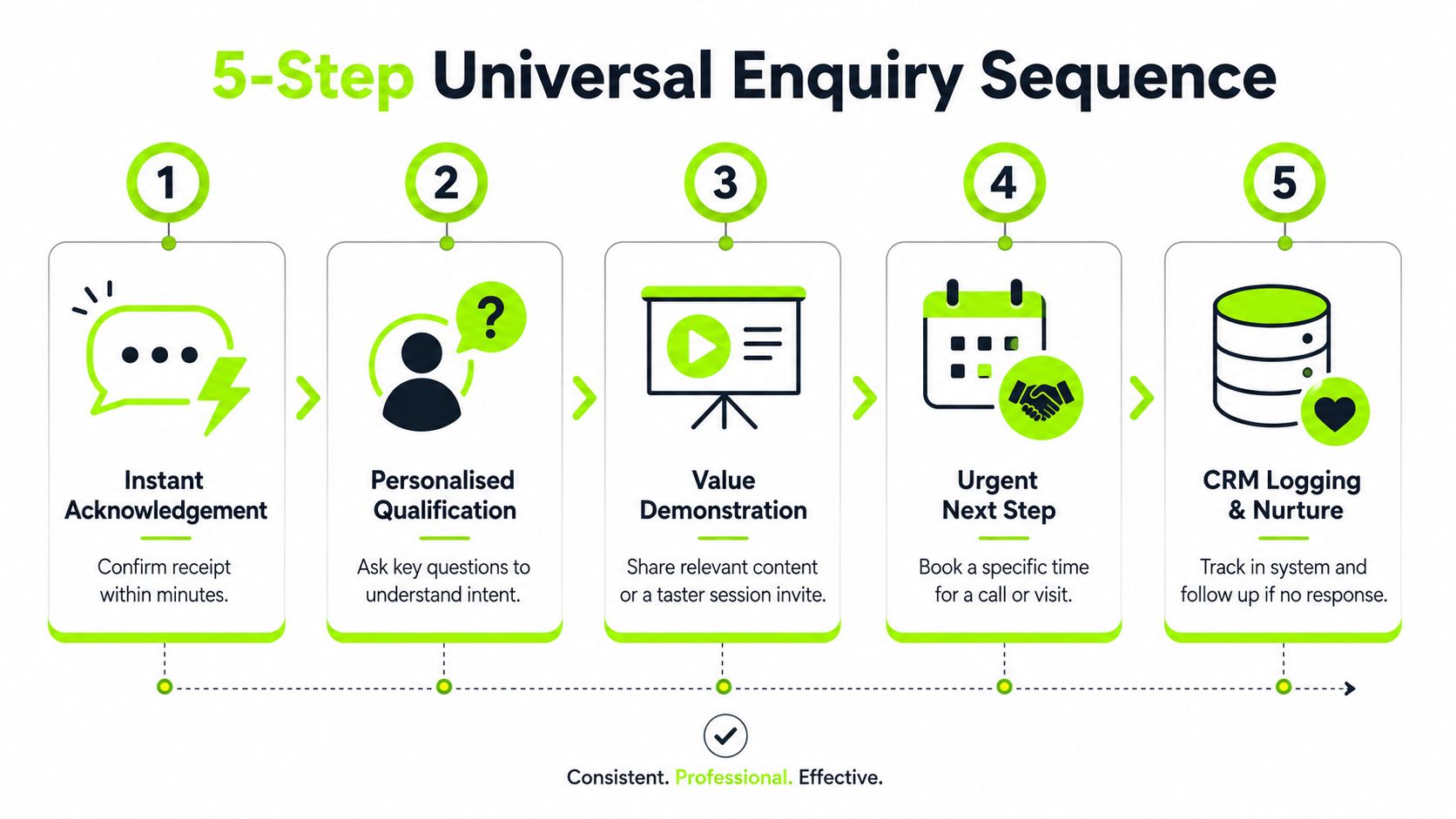
The timing may differ by venue. A 24/7 simulator can offer an evening booking immediately, while a traditional club may work within daylight hours and scheduled visitor periods. The operating hours change, not the discipline. A club still needs to acknowledge, qualify, assign, invite, and track each enquiry.
What This Means for Club Growth Decisions
The indoor golf shift doesn't require every traditional club to install simulators or copy a pay-per-bay model. It does require committees and managers to examine whether their membership journey feels harder to enter than the alternatives available locally.
England's recent membership growth shows that demand for club golf hasn't disappeared. The presence of indoor venues shows that golfers also value flexible access, weather-proof sessions, and simple booking. These facts can coexist, and they create a more useful strategic question: can a club make its own value clear quickly enough after a prospect raises a hand?
Audit the front door before the next budget cycle
Start with three operational checks:
- Measure enquiry response time: Review the time between submission and the first human reply, including evenings and weekends.
- Test CRM follow-up consistency: Check whether every enquiry has an owner, a next action, and a visible outcome.
- Track taster-to-visit movement: If a club works with an indoor venue, record how many simulator tasters progress to a club visit, coaching session, or membership conversation.
A partnership can help only when both organisations agree how the handover works. The club needs a clear consented contact record, an agreed owner, and a defined next step. Otherwise, “partnership” becomes an informal referral that nobody can measure.
Choose systems before construction
New facilities may have a role, but they shouldn't distract from basic conversion discipline. A club with slow replies and inconsistent follow-up won't solve its membership problem by just adding another asset. The first investment should be in the habits and systems that make existing demand visible.
Practical rule: Invest in systems and habits first, partnerships second, and new build projects last.
GolfRep works with golf clubs on lead generation, automated follow-up, CRM organisation, and revenue tracking, helping teams connect initial enquiries with booked visits and membership conversations. If your club wants to compare its front-door process with the expectations created by indoor golf, visit GolfRep to discuss a practical audit and a structured growth system.
Ready to tap into our proven growth system?