How to Market a Golf Club on Facebook in 2026
Most advice on how to market a golf club on Facebook starts in the wrong place. It starts with posts, giveaways, boosted content, and ideas for getting more attention.
That sounds sensible, but it misses the true commercial problem.
For most golf clubs, Facebook isn't failing because the club can't generate interest. It fails because interest isn't turned into booked visits, membership conversations, and signed direct debits. A campaign can produce enquiries and still lose money if nobody sees those enquiries quickly, nobody qualifies them properly, and nobody follows up in a structured way.
That gap matters even more for membership marketing. As Hampton Golf's guidance on social media strategies for golf club membership points out, clubs often focus on awareness while missing the operational question managers care about: how to attract serious prospects without discounting the brand or filling the inbox with poor-fit leads.
The Real Facebook Challenge for Golf Clubs
A golf club manager usually doesn't need more noise. They need a predictable conversion system.
That means the benchmark for Facebook shouldn't be likes, comments, or whether a boosted post “did well”. It should be simpler than that. Did the campaign create the right kind of enquiry, did the club respond fast enough, and did that person move to a visit, trial, or membership conversation?
More enquiries can create more problems
A lot of clubs assume volume solves everything. It doesn't.
If a club runs Facebook ads and sends every response into a shared inbox, a paper notebook, or one member of staff's head, the campaign can become a burden. The pro shop sees some leads. The secretary sees others. A committee member promises to call someone back. Nobody has a clear view of what happened next.
Practical rule: Facebook only works commercially when lead generation and follow-up are designed as one system.
This is why broad advice around boosted posts often disappoints. It produces activity without building process. If you want the short version of that problem, this piece on why boosting Facebook posts doesn't grow golf clubs captures it well.
What good clubs do differently
The clubs that get consistent value from Facebook usually treat it less like social media and more like a local acquisition channel.
They ask better questions:
- Who exactly are we trying to reach? Local golfers, lapsed visitors, trial prospects, corporate leads, or full members.
- What action do we want? Book a visit, request a membership pack, enquire about a category, or message the club.
- What happens next? Instant acknowledgement, staff alert, qualification, follow-up, and a booked next step.
That final part is where campaigns are won or lost.
A club can have strong creative, a sensible budget, and the right audience, then still underperform because no one owns the post-enquiry journey. From GolfRep's perspective, that's the central issue. Facebook is rarely the bottleneck. The bottleneck is what happens after someone raises their hand.
Building Your Digital Clubhouse Foundations
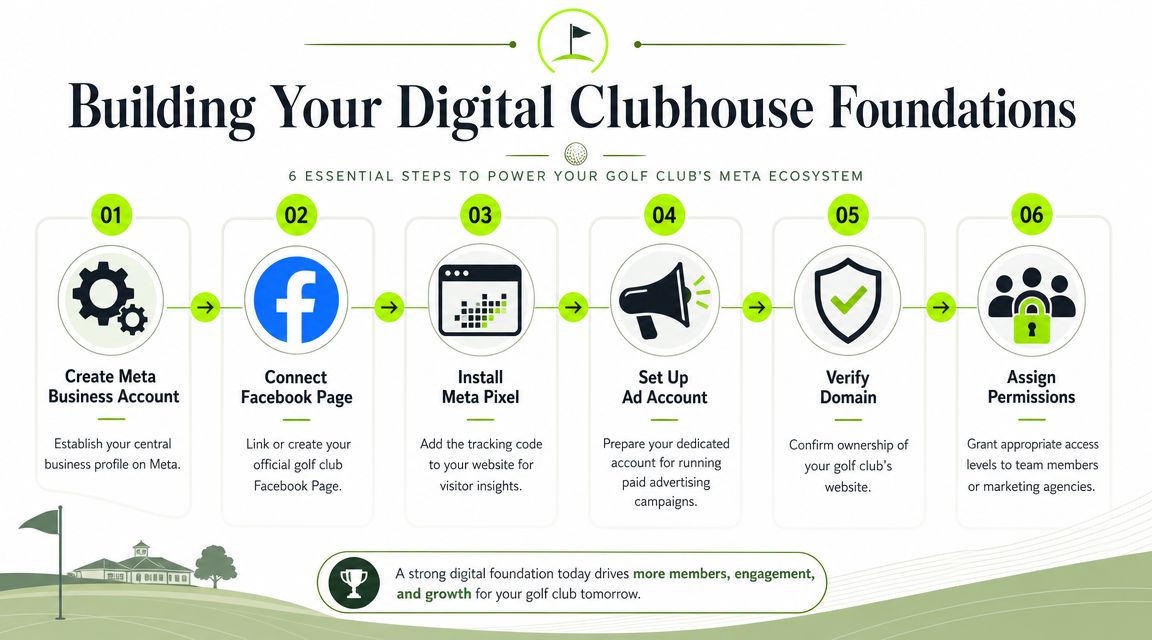
Before any ad goes live, the club needs the right Meta setup. Without that, you're guessing. You might still get traffic and messages, but you won't have a clean way to track what happened or build audiences properly.
This is the minimum standard for a golf club that wants reliable results from Facebook.
Start with the proper business assets
The first job is simple. Use a Facebook Business Page, not a personal profile acting as the club page.
That sounds obvious, but clubs still inherit messy setups where an old captain, staff member, or volunteer controls the page. That creates risk straight away. Access becomes unclear, handovers are awkward, and ad permissions get tied to personal logins instead of the club.
The practical playbook is well established in Caddie Marketing's Facebook guidance for golf clubs. Build the page correctly, add a clear call to action like Book Now or Sign Up, keep the About section updated, and treat the page as a proper business asset. The same guidance also notes that posts with images perform 2.3x better than text-only posts.
The setup checklist that clubs skip
A workable foundation usually includes these six items:
Meta Business account
This is the control centre. It's where the club manages the page, ad account, audiences, and tracking assets.Connected Facebook Page
The page should show current contact details, brand imagery, club information, and a relevant CTA button.Ad account ownership
The club should own the ad account. Don't leave it inside a freelancer's or former supplier's business manager.Domain verification
This helps Meta trust the connection between the ads and the website the club is sending people to.Role permissions
Give the secretary, manager, marketing contact, or external partner the right level of access. Not everyone needs admin rights.Tracking installed on the website
This is what allows the club to see which visitors came from Facebook and what they did next.
A golf club without proper tracking can still spend money on Facebook. It just can't judge the spend properly.
Why the Meta Pixel matters
The most overlooked technical step is installing the Meta Pixel on the club website and, where possible, the tee booking or enquiry journey.
That single step changes Facebook from a posting platform into a measurable channel. It lets the club build audiences from website visitors, understand what pages people viewed, and connect campaigns to real actions such as enquiry submissions or booking intent.
Without it, optimisation becomes shallow. The club sees clicks and reach, but not much else. With it, the club can start building retargeting audiences, measure conversion paths, and improve campaigns using actual behaviour.
This is also where operations matter. If the club is trying to manage content manually across several people and several tasks, useful workflow planning can help. A practical overview of social media automation strategies from Stepper is worth reading, especially for clubs trying to create consistency without adding admin.
Foundations are about control, not just presentation
A polished page helps. Good course photography helps. Active posting helps.
But the main reason to build these foundations is control. The club needs control over data, permissions, tracking, and response pathways. If those basics aren't in place, the rest of the Facebook strategy sits on weak ground.
Finding Your Future Members with Smart Targeting
Most wasted Facebook spend comes from poor audience choices, not bad intentions.
Golf clubs don't need national visibility. They need the right local golfers, in the right catchment, seeing the right message at the right stage of intent. That makes targeting one of the biggest commercial levers in the whole account.
Start local, then tighten the audience
A club should begin with a clear local market, then layer in relevance.
In practice, that usually means building audiences around:
Geography
Focus on the club's realistic travel area, not an abstract county-wide audience.Demographics
Age and gender filters can be useful when tied to actual membership categories and pricing structure.Interests
Golf-related interests can help, but they're rarely enough on their own.Intent signals
Website visitors, previous enquirers, and people who have already engaged with the club are usually stronger prospects than cold audiences.
The mistake is treating all of these as equal. They're not.
A cold local audience might be useful for awareness or event promotion. It's usually much weaker for serious membership acquisition than a warm audience built from the club's own data.
Your CRM list is the highest-value audience asset
The strongest targeting asset most clubs already have is their own database.
As Lightspeed's golf course marketing guidance notes, the most effective method for UK golf clubs is to build a first-party Custom Audience from a CRM email list. Uploading that list allows the club to run warm retargeting campaigns and create lookalike audiences for acquisition. For private clubs in particular, that audience hygiene matters because every converted lead carries high value.
That matters for three reasons.
First, it lets the club re-engage people who already know the venue. That could include prior visitors, event attendees, lapsed members, membership enquirers, and corporate contacts.
Second, it helps Meta find similar people through lookalike modelling. The club isn't asking Facebook to guess from scratch. It's giving the platform a profile of the kind of people already connected to the club.
Third, it reduces budget waste. When the audience is built from real club data, spend is less likely to drift into low-intent traffic.
A golf club's audience strategy should get narrower as the value of the action goes up.
A practical audience structure
For membership-focused campaigns, a sensible account often separates audiences into groups rather than blending everything together.
Warm audiences
These include known prospects and known visitors.
Examples might include recent website visitors, people who viewed membership pages, or contacts already inside the club CRM. These audiences are useful for reminder campaigns, lead forms, and invitation-based offers such as member for a day experiences or club tours.
Lookalike acquisition
Here, the club uses its own list as the seed.
The purpose isn't to chase volume. It's to find local users who resemble the club's existing enquirers, visitors, or members closely enough to justify a more direct acquisition message.
Local awareness
This audience is broader and should be treated differently.
It suits visual storytelling, event promotion, open days, clubhouse hospitality, or seasonal activity designed to create familiarity in the surrounding area. It's less precise than CRM-based targeting, so the message needs to match that lower-intent context.
What doesn't work well
Some targeting choices look tidy on paper but underperform in real club environments.
Common examples include:
Broad interest targeting only
“People interested in golf” sounds relevant but often lacks purchase intent.Sending every audience to the same homepage
A private membership ad and an event ad shouldn't land in the same place.Mixing warm and cold audiences in one campaign
The club loses clarity on what message worked and where the demand came from.
The best targeting plans are usually built from the club's real commercial priorities. If memberships are the priority, start with known signals and CRM-backed audiences. If awareness is the priority, widen the net carefully and judge success accordingly.
Designing Campaigns That Drive Action
Good Facebook campaigns are structured around a commercial objective, not a content idea.
That's the major shift in golf marketing. Clubs used to post casually, boost what looked interesting, and hope enough people noticed. The more effective model is a repeatable paid-social system built around visual content, event promotion, retargeting, and measurable outcomes, as outlined in Your Golf Marketing's guidance on social media for golf clubs.
Match the objective to the club goal
A common reason campaigns stall is simple mismatch. The club wants membership leads but runs a vague awareness campaign. Or it wants open day sign-ups but sends traffic to a general page with no clear next step.
This table keeps the decision-making practical.
| Club Goal | Recommended Campaign Objective | Primary Use Case |
|---|---|---|
| Local brand visibility | Reach | Keep the club visible within the surrounding area |
| Open day or event attendance | Traffic | Send people to a dedicated event page with clear signup details |
| Membership enquiries | Lead Generation | Capture details directly inside Facebook with a clear enquiry form |
| Re-engaging previous website visitors | Retargeting campaign | Bring warm prospects back to membership or booking pages |
| Club messages and conversation starts | Click-to-message | Prompt direct contact for high-intent questions |
Creative that fits golf clubs
Golf is a visual sale. The course, clubhouse, practice facilities, member atmosphere, and lifestyle all matter. Generic stock graphics usually underperform because they don't answer the prospect's real question, which is whether this specific club feels right.
That's why the strongest campaigns usually rely on assets like:
Course photography
Real images of the course in good condition, not generic golf imagery.Member experience content
Competition days, social events, mixed use of course and clubhouse, and moments that show how the club feels.Short-form video
A concise walk-through, welcome from the manager, or event invitation can reduce distance and build trust.Direct response copy
Clear copy that tells people what to do next. Enquire. Book a visit. Request details. Message the team.
If the ad looks nice but doesn't make the next step obvious, it's acting like a brochure, not a campaign.
Don't confuse posting advice with campaign strategy
Posting regularly still matters. Timing matters too, especially when clubs rely on a small internal team to manage content and replies. For clubs trying to build a more consistent schedule, this Scheduler.social article on the best time to post on Facebook is a useful planning reference.
But timing alone won't rescue a weak campaign structure.
The campaign needs to answer four questions clearly:
- Who is this for?
- Why should they care now?
- What action should they take?
- Where does that action lead?
If any one of those is vague, performance usually drifts.
What to avoid
A lot of clubs burn budget on ideas that feel active but don't move the pipeline.
Examples include:
Boosted posts with no defined follow-up path
These can create reach but often create little sales clarity.Giveaways as the default lead strategy
These tend to attract attention from people who want the prize, not the membership. This matters enough that we've written separately about the trade-offs of a golf club giveaway on Facebook.One ad for every audience
A returning visitor, a local non-member, and a previous enquirer shouldn't all see identical messaging.Sending traffic to cluttered pages
If the page has no clear CTA, the campaign has no finish line.
A campaign should feel like a guided journey, not a poster pinned to a digital noticeboard.
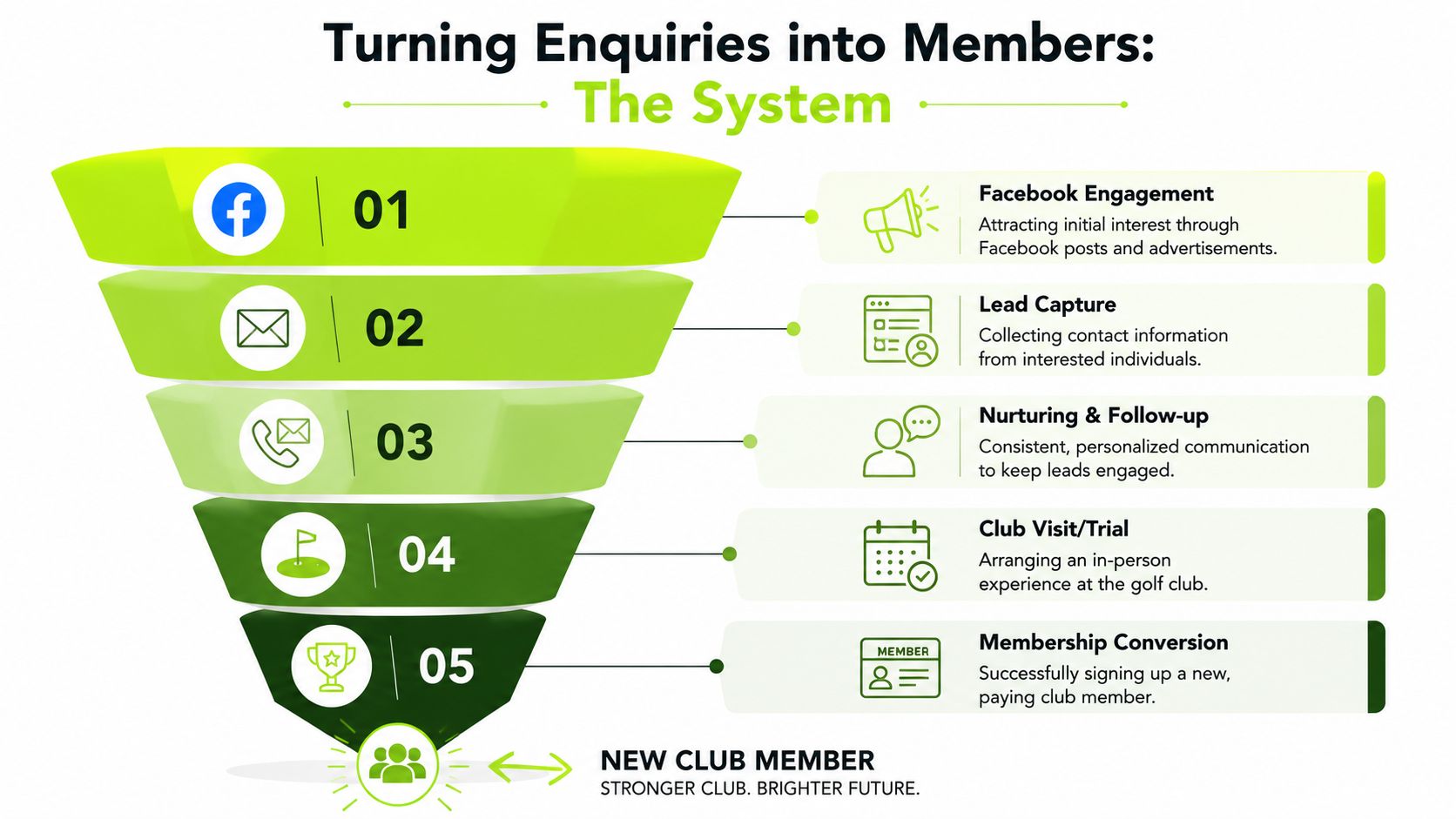
Turning Enquiries into Members The System
The enquiry is not the result. It's the hand-raise.
Most golf clubs lose the value they've already paid to create. This occurs when the ad works, the prospect responds, and then the club's internal process breaks down. The lead sits in Facebook. Or lands in email. Or gets forwarded manually. Or receives a reply too late and goes cold.
Lead capture is only half the job
Facebook gives clubs more than one way to collect interest.
Lead Ads reduce friction because the form opens inside Facebook. That can work well for initial membership enquiries, event registrations, and trial interest. The downside is that low-friction forms can also attract weaker intent if the form asks too little.
A landing page creates more friction, but that isn't always bad. If the page explains the membership category, the benefits, and the next step clearly, it can improve lead quality because the prospect has to make a more deliberate choice.
The right answer depends on the club's sales process. Private clubs often benefit from adding qualification questions or a stronger next-step filter. Public or flexible membership products may prefer lower-friction capture.
What happens immediately after submission
This is the part most guides ignore.
A useful post-enquiry system should include:
Instant acknowledgement
The prospect should know their enquiry has been received.Internal visibility
Staff should see the lead in one place, not across disconnected inboxes.Ownership
Someone needs responsibility for the next action.Structured follow-up
The prospect should move towards a call, visit, trial, or meeting.Tracking
The club needs to know which leads progressed and which stalled.
Clubs rarely struggle to generate all interest. They struggle to see every enquiry, respond consistently, and move the right people forward.
CRM is what makes Facebook predictable
Without a CRM, follow-up becomes memory-based. That's fragile.
With a CRM, the club can route new Facebook leads into a visible pipeline, trigger an immediate response, assign tasks, and build nurture sequences that keep the prospect warm until a human conversation happens. That's especially important for committee-led clubs and multi-site operators, where response can otherwise become inconsistent.
A club evaluating this seriously should think about the CRM before thinking about the next advert. We've covered the operational side of that in more detail in this guide to a golf club CRM system.
One option in this space is GolfRep, which combines Facebook lead generation with CRM-enabled follow-up and automated nurture flows for golf clubs. The wider point is bigger than any one platform. The club needs a system where every enquiry is captured, qualified, visible, and progressed.
Nurture beats hope
Many prospects aren't ready to join the moment they enquire. They may need to discuss cost, compare clubs, arrange a visit, or wait for the right time in the season.
That doesn't make them a bad lead. It means the club needs a nurture process.
A sensible nurture flow might include a confirmation message, a follow-up from the club, an invitation to visit, and useful information about membership categories or club life. The point isn't to automate everything. It's to stop serious prospects disappearing because no one followed through properly.
Measuring What Matters and Optimising for Growth
Most clubs can tell you how many likes a post got. Fewer can tell you which Facebook campaign produced qualified membership conversations.
That's the difference between social activity and commercial management.
The useful numbers are the ones tied to movement through the pipeline: cost per enquiry, cost per booking, lead-to-visit rate, and member conversion rate. Those are the figures that show whether Facebook is creating value or just attention.
Focus on business outcomes
A healthy review process usually asks:
- Which audience produced the strongest enquiries?
- Which campaign objective led to booked visits or serious calls?
- Where are leads dropping out after the initial response?
- Which landing pages or forms create quality, not just quantity?
That's also where tooling can help. If a club wants a broader view of platforms built to improve campaign decision-making, this overview of Facebook ad optimization tools offers a useful starting point.
The right feedback loop
The strongest Facebook strategy for a golf club is rarely the most creative. It's the most organised.
The club builds the assets properly, targets the right local audience, runs campaigns with a clear purpose, and then tracks what happens after the enquiry. Once that loop is in place, optimisation becomes straightforward. Keep what drives qualified demand. Fix the points where prospects stall. Remove spend from activity that looks busy but doesn't convert.
That's how Facebook becomes a growth channel rather than a publishing platform.
If your club wants a clearer system for turning Facebook enquiries into booked visits and memberships, GolfRep helps clubs build that pipeline with lead capture, CRM visibility, and structured follow-up that goes beyond the advert itself.
Ready to tap into our proven growth system?