Giveaway on Facebook: A Golf Club's Guide to Growth
The most popular advice about a giveaway on facebook is also the least useful for a golf club. Get more likes. Ask people to share. Chase comments. Hope the algorithm helps.
That mindset misses the commercial point.
A golf club doesn't need a noisy promotion that fills the page with low-intent activity for a few days. It needs a reliable way to attract local golfers, capture their details properly, respond fast, and move them towards a visit, a trial, or a membership conversation. If the giveaway stops at social engagement, it hasn't done its job.
The clubs that get value from Facebook giveaways treat them as part of a wider membership pipeline. The post is only the front end. The core work sits behind it in the form, the CRM, the follow-up flow, and the reporting. That's where revenue is won or lost.
Beyond Likes and Shares Why Your Giveaway Needs a Purpose
A Facebook giveaway with no commercial purpose usually produces a familiar result. A brief spike in attention, a spreadsheet full of weak leads, and no clear path to revenue.

That happens because clubs often judge the campaign by what is easiest to see on the post. Likes, comments, reach, and shares. Those numbers can help diagnose performance, but they do not tell you whether the campaign brought in golfers who live nearby, fit your membership profile, and can be moved into a sales process.
A giveaway on facebook only works for a golf club when the campaign is built around a defined business outcome and a follow-up system. If entry data goes nowhere, the campaign was a branding exercise, not a growth channel.
Start with the business outcome
A common mistake is to choose the prize first and work out the objective later. That usually creates a mismatch between who enters and what the club wants to sell.
Set one clear commercial objective before writing the post, building the form, or allocating ad spend. For most clubs, that means choosing one of these:
- Membership pipeline growth by collecting details from local golfers with realistic joining potential
- Trial demand by pushing interest towards an open day, flexible pass, or limited membership offer
- Off-peak utilisation by attracting golfers who can fill quieter tee times
- Database growth with intent by adding qualified prospects to a nurture flow for membership, lessons, or visitor packages
Trying to force several goals into one giveaway usually weakens the message. One campaign should do one job well.
This is also where club teams need more discipline in their social planning. A giveaway should sit inside a broader social media strategy for golf clubs, not operate as a one-off promotion that no one follows up properly.
Prize relevance matters more than broad appeal
The prize shapes lead quality from day one.
A generic prize, such as a tablet or shopping voucher, attracts people who want free stuff. Many will never visit the club, never answer a sales call, and never fit your catchment area. A golf-specific prize does some of the filtering for you before the lead even hits your system.
For golf clubs, the best prizes usually mirror the experience you want to sell later. That could be a three-month trial, a lesson package with the club professional, a fitting session, or a hosted member-for-a-day experience. Each option attracts a different type of prospect, so the right choice depends on your actual objective.
Perceived value still matters, but relevance matters more. A smaller golf-specific prize often outperforms a broader consumer prize because it draws entrants with genuine intent.
Practical rule: If the prize would not appeal to someone who could realistically become a member, it is the wrong prize.
Define the post-entry action before launch
The campaign does not start with the post. It starts with what should happen after someone enters.
That point gets missed all the time. Clubs spend days discussing artwork, wording, and the prize, then leave the entry handling vague. No owner. No CRM tags. No follow-up timing. No next step for the prospect.
Before launch, answer these questions:
| Question | Why it matters |
|---|---|
| Who should enter? | It keeps targeting focused on local, relevant golfers |
| What should happen after entry? | It links the campaign to a visit, call, tour, or nurture sequence |
| What information do we need? | It determines the form fields and CRM setup |
| Who owns follow-up? | It stops leads sitting in an inbox or spreadsheet |
| What counts as success? | It keeps the team focused on enquiries, visits, and sales conversations |
A busy giveaway post can still be commercially weak. That is the trade-off clubs need to understand. Broad reach often lowers lead quality, while tighter targeting can reduce volume but improve conversion. I would take fewer qualified local entrants over a large pool of low-intent names every time.
The purpose of the giveaway is simple. Create a steady flow of relevant prospects your club can capture, segment, follow up, and convert. If the campaign cannot do that, it does not need more engagement. It needs a better plan.
Navigating Facebook's Rules and UK Competition Law
A giveaway can fail before it starts if the rules are sloppy.
That usually happens in two places. First, the club asks people to enter in ways Facebook doesn't allow. Second, the club publishes a promotion without the legal basics required in the UK. Neither issue is complicated, but both are common.
What Facebook allows and what it doesn't
Facebook promotions need simple mechanics. Keep that in mind when planning entry.
You can usually work with actions such as liking a post or commenting on it. What causes problems is trying to force actions tied to personal timelines or friend networks. If the entry method depends on behaviour Facebook doesn't support for promotions, the campaign becomes harder to manage and harder to defend if challenged.
That matters for golf clubs because committee-led teams often copy what they see other pages doing. Unfortunately, common practice isn't the same as compliant practice.
If your promotion rules can't be explained clearly in one short paragraph, they're probably too messy to run well.
The UK issues clubs often miss
The legal side matters just as much as platform policy. UK golf clubs running legitimate Facebook giveaways for membership growth often overlook compliance with the Gambling Act 2005 and CAP Code. A 2024 ASA ruling upheld complaints against 15 UK brands for non-compliant social promotions, and a cited ASA Q1 2026 report says golf-related promotions had a 35% higher rejection rate than average leisure sectors because of missing no purchase necessary disclaimers specific to UK law, as noted in this compliance-focused summary.
For a club, the practical risk isn't abstract. Ads can be disapproved. Campaigns can be paused mid-run. Reputation can take a hit with members and prospects.
The minimum standard for a safe promotion
A professionally run giveaway on facebook should include:
- Clear eligibility terms such as who can enter, any age limit, and whether entry is restricted geographically
- Start and end dates so nobody is left guessing when the draw closes
- A defined winner selection process with language that explains how the draw will happen
- A no-purchase route so the promotion doesn't drift into the wrong legal category
- A visible terms and conditions link placed in the post or the landing page
- A Facebook disclaimer making clear the promotion is not sponsored or administered by Facebook
Clubs also need to think carefully about the difference between a prize draw and anything that could be interpreted as a lottery. If entry requires payment and chance decides the winner, you've created a much bigger compliance problem. The cleanest route is usually a free-entry promotion with transparent rules.
For managers who want a broader view of how clubs should handle social activity professionally, GolfRep has also written about social media for golf clubs.
Keep admin simple enough to execute properly
The legal side isn't where clubs win members, but poor admin can stop the whole campaign.
The best working rule is this: if your operations team can't confidently answer "Who can enter, how do they enter, when does it close, and how is the winner chosen?" without checking five documents, the setup is too loose.
That discipline also helps commercially. Clear rules attract better entrants. Confusing campaigns attract complaints, low trust, and avoidable friction.
Designing a High-Performing Giveaway Campaign
A Facebook giveaway does not fail because the post looked weak. It fails because the campaign was built to get attention instead of future members.
For a golf club, campaign design should start with one question. Which prize, message, and entry route will bring in local golfers your team would want to speak to next week?
Build the offer before you build the post
The prize decides the quality of the lead pool.
A free fourball, a coaching assessment, a short membership trial, or a structured "member for a month" experience will usually outperform a generic retail prize if the primary objective is membership growth. Generic prizes can inflate reach, but they also attract people with no realistic path to join. That creates admin, weak follow-up conversations, and poor return on ad spend.
The best offers create a natural next step for non-winners as well. A trial membership, a playing lesson, or a visitor package gives your team something relevant to offer after the draw closes. That is the difference between a giveaway that generates names and one that feeds a sales process.
Write copy that qualifies people quickly
Good giveaway copy does two jobs at once. It gets the right golfer to stop scrolling, and it filters out the wrong one.
Keep the structure tight:
- Lead with the prize so the value is clear immediately
- Name the audience such as local golfers within your catchment
- Explain the entry step in one instruction
- State the closing date so there is a clear decision point
- Link to the terms so the promotion feels organised and credible
Clarity matters more than cleverness. Facebook users skim fast. If the post takes effort to understand, response drops and question volume rises.
Choose entry mechanics based on the outcome you want
Clubs frequently make their biggest design mistake. They choose entry mechanics that create activity on Facebook, then wonder why the campaign produced little sales value.
If the goal is visibility, social actions such as comments and tags can help distribution. If the goal is lead generation, the post should send entrants to a form. Comments do not sit neatly in a pipeline. Form submissions do.
The trade-off is straightforward. Lower-friction social engagement can produce more surface-level interaction. A form-based entry usually produces fewer entries, but better data and a cleaner handoff into your CRM. For clubs serious about growth, that second route is usually stronger. It also supports proper golf club lead management processes, which matter far more than inflated post engagement.
Operational insight: If your membership team cannot follow up from the data collected, the campaign design was wrong from the start.
Use visuals that match the standard of the club
Creative quality affects lead quality.
A generic "WIN NOW" graphic often attracts low-intent entrants because it looks like every other giveaway in the feed. Better-performing visuals for clubs tend to show the actual experience. That could be the course at its best, members on site, a strong prize image, or a short video that makes the club feel welcoming and credible.
Use the visual to reinforce the positioning of the offer:
| Visual type | When it works best |
|---|---|
| Prize image | Best when the prize is tangible and easy to understand |
| Course photography | Strong for clubs selling atmosphere, setting, and playing conditions |
| Short on-site video | Useful when the aim is to build trust and show the club in use |
| Membership-style montage | Strong fit for trial-based or experience-led prizes |
The standard matters. Poor creative does not just reduce response. It lowers perceived club quality before your team speaks to the lead.
Paid promotion should stay tight
Organic reach is unpredictable. Clubs that want consistent lead flow usually need paid support.
Keep targeting close to commercial reality. Focus on your catchment area, sensible age ranges, and interests or behaviours that line up with golf participation. A broad audience can make the campaign look busy while filling the database with people who will never visit the club.
Budget discipline matters here. It is better to reach fewer golfers who live nearby and can afford to join than a larger audience with no realistic sales path.
What usually works, and what usually wastes budget
Patterns show up quickly once you have run a few of these.
Usually works
- Golf-relevant prizes tied to membership, coaching, or club experience
- Clear copy that can be understood in seconds
- Visuals from the actual club rather than generic giveaway graphics
- Tight geographic targeting based on realistic travel distance
- A form-based entry route that supports follow-up and sales tracking
Usually wastes budget
- Broad consumer prizes with no link to joining the club
- Posts built around likes, tags, and shares alone
- Creative that looks cheap or generic
- Targeting that stretches far beyond the club's catchment
- Campaigns launched without a follow-up offer for non-winners
The post is only the front end. The actual performance comes from how well the campaign attracts the right entrant and prepares them for what happens after the draw.
The Engine Room Capturing and Managing Leads Systematically
A Facebook giveaway does not fail because the prize is weak or the creative underperforms. It usually fails because the club has no reliable way to capture, sort, and act on interest once people respond.
That is the part many clubs underestimate.
A comment thread is not lead capture. A spreadsheet passed between admin and the membership team is not lead management. If entries sit in Facebook until somebody remembers to export them, the campaign is running on hope, not process.
Landing page versus Facebook Lead Ad
Clubs usually have two practical options. Send people to a landing page on the club website, or collect details inside Facebook with a Lead Ad.
Both can work. The better choice depends on how much control the club needs, how quickly the team can respond, and whether the lead data can be pushed straight into the CRM.
| Option | Strengths | Trade-offs |
|---|---|---|
| Landing page | More control over branding, copy, fields, consent wording, and tracking | More steps for the user, so the page has to be clear and fast |
| Facebook Lead Ad | Faster entry because Facebook can pre-fill details | Less control over the experience, and weaker context if the offer needs explanation |
Landing pages often perform well for giveaways because they give the club more room to frame the offer properly. That matters if the prize is tied to membership, coaching, or a trial experience rather than a simple consumer freebie. Facebook Lead Ads reduce friction, which helps when the club needs speed and does not have much website flexibility.
The wrong way to make this decision is to ask which tool gets the cheapest lead. The right question is which setup gives the team usable data and a clean handoff into follow-up.
When a landing page is the better choice
A dedicated landing page usually earns its place when the club needs to qualify interest instead of collecting a name and hoping for the best.
That tends to apply in a few situations:
- The prize is linked to joining, such as a trial membership, a lesson series, or a playing package
- The club wants better qualification, such as preferred membership type, playing frequency, or postcode
- The team needs proper tracking across ad click, page visit, form completion, and sales outcome
- The brand experience matters, especially for higher-fee private or premium clubs
I usually favour a landing page when the club already has a CRM and clear sales process. The extra control is worth the extra click if it helps the team separate casual entrants from genuine prospects.
When a Lead Ad makes more sense
Facebook Lead Ads are useful when speed matters more than depth.
They suit clubs that need to get a campaign live quickly, have limited support on the website side, or want to reduce drop-off from mobile users. That convenience has one condition. The lead data needs to move into the club's system straight away.
If staff are downloading CSV files once a day, the speed benefit is gone. A fast form with slow handling still produces stale leads.
What the form should actually ask
Clubs often get greedy or lazy. They either ask for almost nothing, which creates weak follow-up, or they ask for too much, which cuts response.
A good giveaway form collects enough information to support the next sales step and no more. For most clubs, that means:
- Name
- Mobile number
- Postcode
- Consent to marketing follow-up
- One or two intent fields, such as interest in membership, lessons, flexible golf, or visitor play
Those last fields matter more than many clubs realise. They shape the offer people receive later, they help staff prioritise leads, and they make reporting far more useful. GolfRep explains the operational side of this well in its guide to golf club lead management.
CRM integration turns entries into a working pipeline
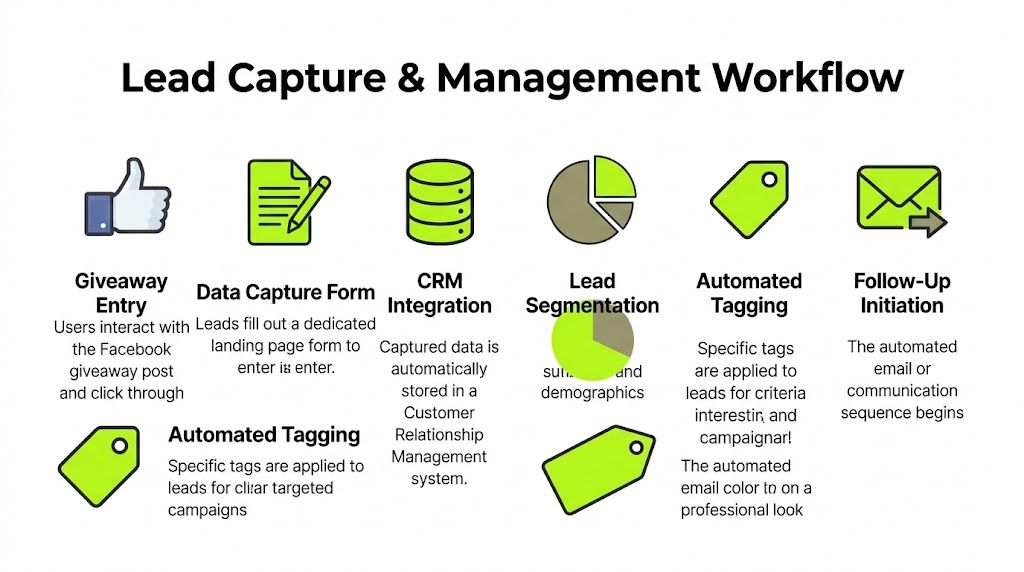
A CRM should do more than store contact details. It should tell the team what came in, where it came from, who owns it, and what happens next.
At minimum, every giveaway entry should trigger:
- A new contact record
- Source tagging for the specific Facebook giveaway
- Basic segmentation by interest, location, or membership fit
- Assignment to the right staff member or queue
- Lead status tracking from new entry to outcome
That structure gives the club visibility. Without it, there is no clean way to measure response times, contact rates, visit bookings, membership conversations, or revenue tied back to the campaign.
Many clubs lose commercial value. The giveaway may generate attention, but the team cannot tell which entrants were contacted, which ones wanted lessons rather than membership, or which ad set produced people who live within the catchment.
The common failure pattern
The pattern is familiar.
A club launches the campaign. Entries come in quickly. Staff are busy with visitors, phone calls, and member admin. Leads are exported later, some are contacted, some are missed, and nobody has a reliable view of what the giveaway produced beyond reach and engagement.
That is not a marketing problem. It is a systems problem.
The clubs that get real value from a Facebook giveaway build the engine room first. Capture method, form fields, CRM rules, ownership, and tagging all need to be set before the ad goes live. If that work is skipped, the campaign creates activity without creating a dependable path to revenue.
From Entrant to Member The Automated Follow-Up System
The winner is not the only person who matters.
That sounds obvious, but many clubs still build their giveaway process around a single prize draw and almost nothing else. They announce the winner, thank everyone for taking part, and leave a valuable pool of local interest untouched. From a growth perspective, that's the biggest waste in the whole exercise.

Immediate response changes the value of the lead
A giveaway entrant is paying attention at the moment they submit their details. That window doesn't stay open for long.
In the UK, social media giveaways can generate 700% more email sign-ups, and 79% of recipients research the brand post-giveaway, according to this ShortStack case study reference. The same source notes that Facebook giveaway posts receive 3.5x more likes and 64x more comments than regular content. That's a strong signal of attention, but attention decays quickly if the club doesn't act.
That is why follow-up has to start instantly, not when someone gets around to it.
The manual approach breaks under pressure
A manual process sounds manageable when a club imagines a modest number of entries. In reality, even a decent local campaign can create enough inbound interest to overwhelm ad hoc handling.
Typical signs of trouble include:
- Enquiries sitting in inboxes because nobody has clear ownership
- Inconsistent replies because different staff members send different messages
- No prioritisation between colder entrants and warmer prospects
- No visibility into who has been contacted and who hasn't
Clubs lose commercial value in these situations. The issue isn't that the campaign failed to generate interest. The issue is that the club failed to process interest consistently.
A simple automated sequence works better
An automated follow-up system doesn't need to be complicated. It needs to be timely, structured, and relevant.
A practical sequence often looks like this:
Instant confirmation
Send an immediate email or SMS confirming entry and setting expectations on timing and winner selection.Early value message
Follow with a short message that introduces the club properly. Not a brochure dump. A concise explanation of what makes the experience worthwhile.Non-winner nurture
Most entrants won't win, so a substantial conversion opportunity resides here. Send a respectful message that acknowledges the result and offers a next step such as an open day, a guest round, a flexible package, or a conversation about trial membership.Sales-triggered follow-up
If someone clicks, replies, or books, the CRM should change their status and trigger the next communication or task.Longer nurture
Keep interested golfers in a structured sequence rather than dropping them after one email.
Key judgement: The giveaway attracts attention. The nurture system converts intent.
The message after the draw matters most
Clubs often treat the non-winner email as an afterthought. It should be one of the strongest assets in the campaign.
Why? Because the entrant has already raised their hand. They know the club name. They've shown interest in a golf-related offer. The best response isn't a generic "better luck next time". It's a useful invitation linked to a realistic next action.
That could mean:
- booking a club visit
- attending a taster event
- trying a flexible membership route
- speaking to the membership team
- claiming a follow-up offer with a clear expiry
The key is relevance, not pressure.
For clubs that need a more structured process for handling this stage, GolfRep's guide to a golf club follow-up system covers the operational side in more detail.
Automation creates consistency, not impersonality
Some club managers worry that automation feels cold. In practice, poor manual follow-up feels colder.
A fast, well-written confirmation message is more professional than silence. A scheduled nurture sequence is more reliable than hoping someone remembers to call. A CRM-triggered task is more accountable than an inbox flag.
Automation should handle the timing, tagging, and consistency. Staff should handle the human conversations when a lead shows intent.
That split is what makes the system scalable. The club doesn't need to choose between personal service and operational control. It needs both.
Measuring What Matters to Drive Predictable Growth
A Facebook giveaway is easy to misread.
The post gets attention, the comments roll in, the team feels momentum, and everyone assumes the campaign worked. For a golf club, that is a weak standard. Attention has value only if it turns into booked visits, sales conversations, trial activity, and memberships that hold up over time.
That is why reporting needs to start with a commercial question. Did this giveaway produce future members, or did it produce a busy admin week?
Start with lead quality, not social noise
Lead volume matters, but raw entry numbers can hide a bad campaign. A club can generate plenty of form fills from people outside its catchment, outside its price point, or with no realistic intent to join.
Track the leads you can use. That means valid contact details, a realistic location, and a profile that matches the type of member the club wants more of.
Egretia's giveaway analysis offers a useful starting benchmark with its Really Simple Success Metric, or RSSM, calculated as entries divided by fans, with a suggested target above 25%. The same analysis also points to average lead conversion rates for UK Facebook giveaways and highlights how weak follow-up reduces the value of the leads generated. Useful context, but only as an early filter. A club still needs to measure what happened after the entry.
The numbers that actually guide decisions
A good reporting stack is short and tied to revenue. If the team needs ten slides to explain the result, the tracking is too loose.
| Metric | What it tells you |
|---|---|
| Total leads generated | Whether the campaign created enough opportunity to justify the spend |
| Valid leads | Whether the audience and prize attracted the right people |
| Lead-to-visit rate | Whether the follow-up process is converting interest into real conversations |
| Lead-to-member rate | Whether the campaign is producing paying members |
| Cost per lead | Whether acquisition is efficient enough to repeat |
| Cost per member acquired | Whether the giveaway supports profitable growth |
I would also separate reporting by source if paid ads were involved. Organic entrants, paid entrants, and existing followers often behave differently once follow-up starts. If they convert at different rates, the club needs to know that before repeating the same budget split next time.
Review the campaign like an operator, not a promoter
Post-campaign reviews should be blunt.
- Did the prize attract likely members or low-intent entrants chasing any free offer?
- Which audiences produced the highest-quality leads, not just the cheapest ones?
- How quickly did staff act on new leads once they entered the CRM?
- How many entrants reached a real sales step, such as a visit, call, or trial?
- How many became members, and what did it cost to acquire them?
- What should change next time: the prize, targeting, form, timing, or follow-up offer?
Many clubs often make a fundamental error. They review the creative, talk about engagement, and skip the handoff into sales. If membership growth is the goal, the campaign should be judged the same way as any other acquisition channel.
A giveaway becomes predictable when the club can trace a clear path from entry to revenue.
Once that discipline is in place, improvement gets easier. The club can see whether the problem sat in the audience, the prize, the form, the CRM workflow, or the sales follow-up. That is how a Facebook giveaway stops being a one-off promotion and starts working as a repeatable membership growth channel.
If your club wants more than short-term engagement, GolfRep helps build the full system behind campaigns like this. That means lead capture, CRM visibility, structured follow-up, and clear conversion tracking so enquiries don't get lost and membership growth becomes more predictable.
Ready to tap into our proven growth system?