How to Increase Golf Club Membership Without Discounting

Most golf clubs don't have an enquiry problem. They have a conversion problem.
Committees often respond to slow membership growth by increasing advertising, publishing more social posts, or introducing a cheaper joining offer. That can produce more names, but it won't create predictable recurring revenue if enquiries sit in inboxes, ownership is unclear, and follow-up depends on someone remembering to call.
England's market already contains substantial demand. England Golf reported 750,071 club members in 2025, up from 730,602 in 2024, while 12.6 million adults played some form of golf in the previous 12 months. That audience includes people playing full rounds, visiting driving ranges, using simulators, and taking part in adventure golf, as reported in England Golf membership coverage.
The question, then, isn't how to increase golf club membership by generating more enquiries. It's how to turn existing interest into visits, applications, renewals, and referrals without weakening your pricing.
Why More Enquiries Alone Will Not Grow Membership
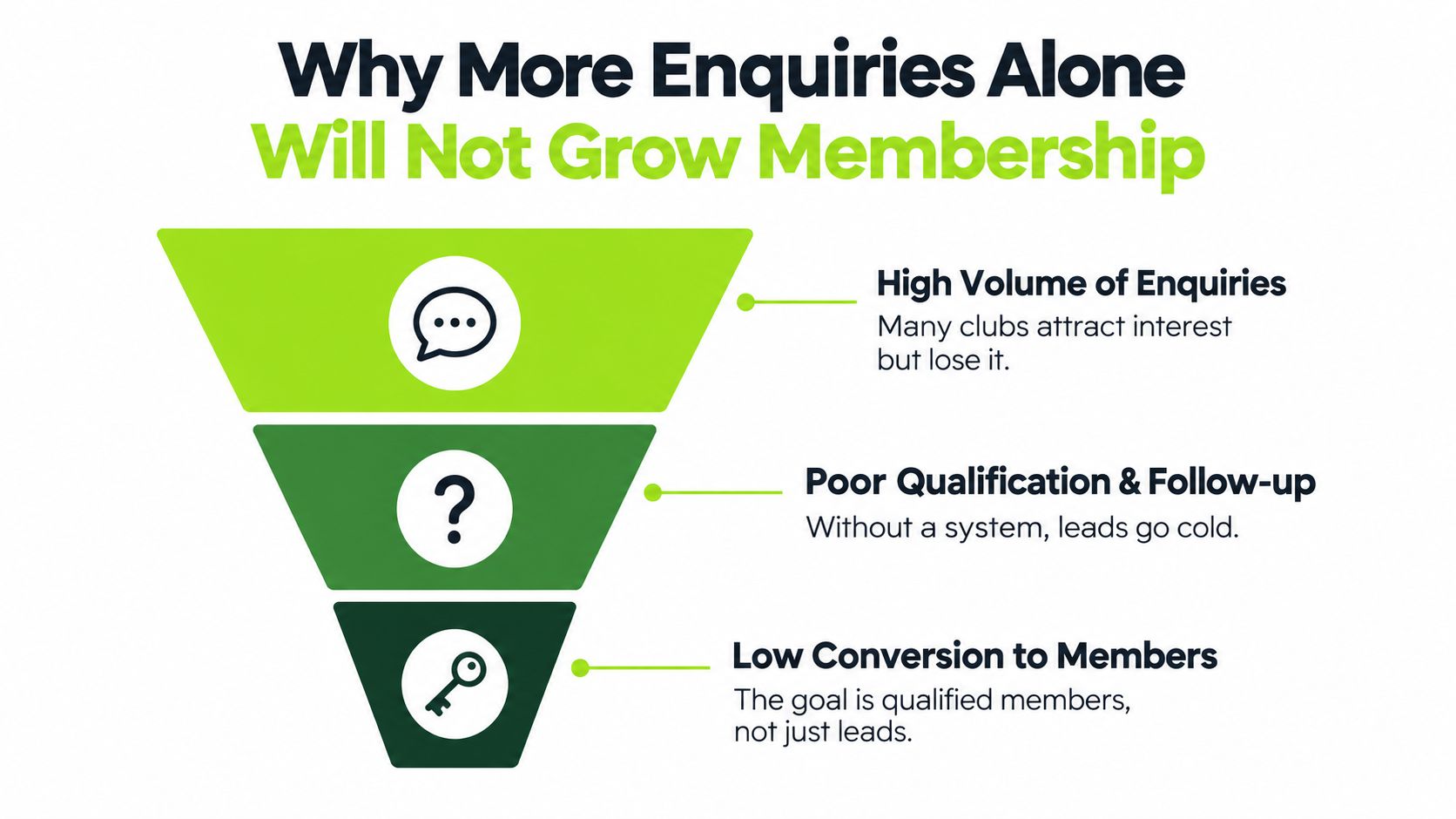
More enquiries can disguise poor commercial performance. A club might celebrate a busy campaign while losing prospects through delayed replies, incomplete records, weak qualification, or inconsistent invitations to visit. The committee sees activity. The membership manager inherits a leaking pipeline.
GolfRep's published UK analysis puts the average response time to a golf club membership enquiry at 47 hours and 32 minutes. The same analysis states that a lead answered within one hour is five times more likely to convert than one left for 24 hours, as shown in GolfRep's golf club membership marketing analysis. Speed isn't a minor operational detail. It shapes whether a prospect speaks to your club while their interest is still active.
Replace memory with a visible pipeline
Manual handling creates predictable weaknesses:
- Unclear ownership: Nobody knows whether the secretary, professional, membership director, or volunteer is responsible for the next contact.
- Hidden inactivity: A prospect can remain in an inbox without anyone seeing that the conversation has stopped.
- Inconsistent qualification: One person records playing preferences, another records nothing, and the club can't compare prospects properly.
- Weak reporting: Enquiry totals look healthy, but managers can't connect the original source to a visit or membership outcome.
A CRM doesn't replace personal contact. It makes personal contact more reliable. Each enquiry should have a source, an owner, a current stage, a next action, and a clear outcome. The club needs to know whether a prospect is new, contacted, qualified, invited to visit, attending a trial, applying, joining, undecided, or lost.
Practical rule: If a manager can't see the next action for every active enquiry, the club doesn't have a membership pipeline. It has a collection of conversations.
GolfRep's own UK-focused pipeline guidance uses 90% or above as a benchmark for the New to Contacted stage and identifies 15% to 30% as a commonly assessed enquiry-to-membership conversion range. Those figures appear in GolfRep's guidance on getting more golf club members. Use them as process checks, not promises. A club should measure its own performance by source, audience, response time, visit attendance, joiners, leavers, and renewal behaviour.
The right response to weak growth is usually not “buy more leads”. First, audit how quickly the club responds, who follows up, what prospects receive next, and where conversations disappear. Fix the system before increasing volume.
Define Who You Want and What Growth Looks Like
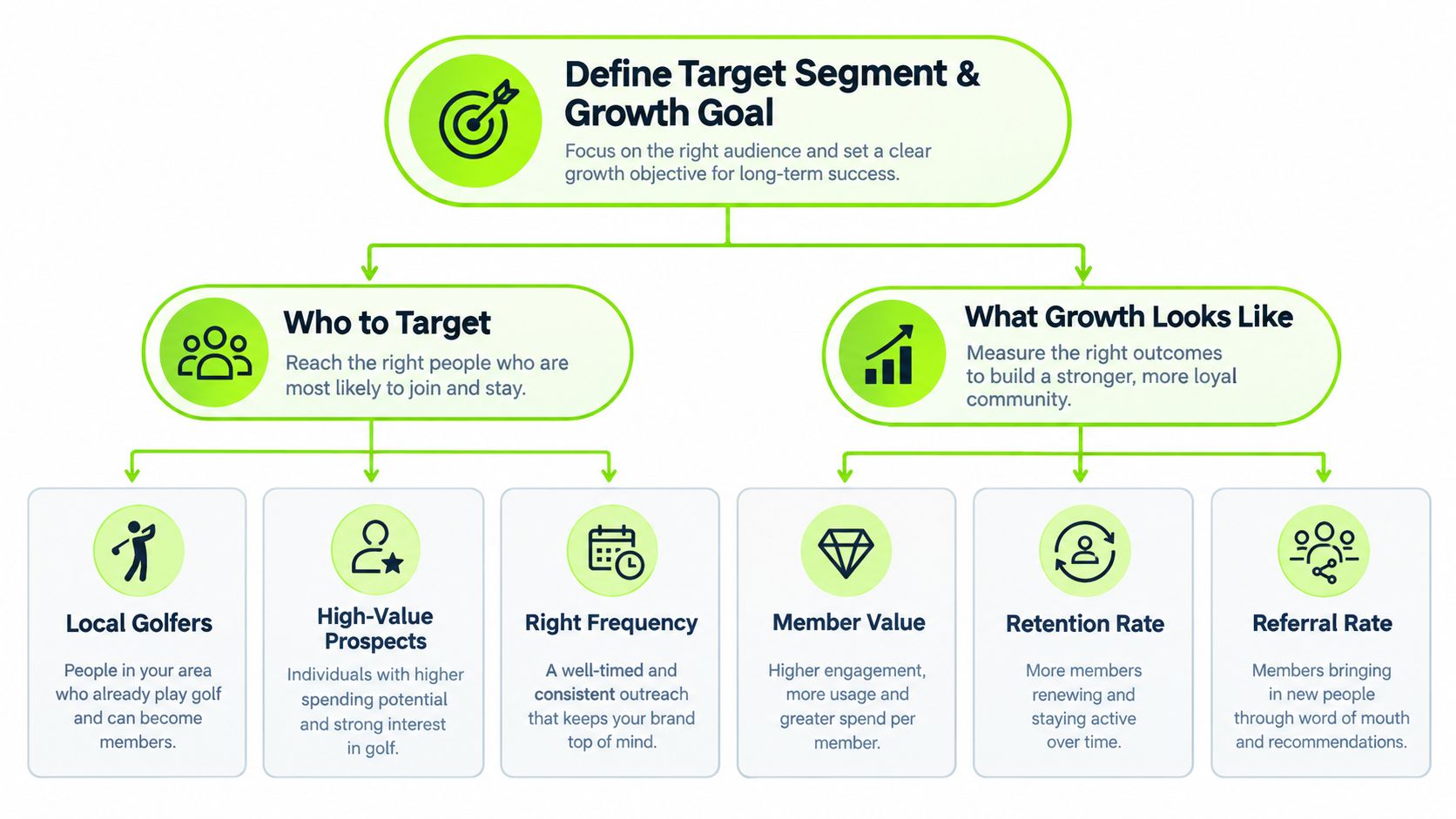
A growth plan becomes useful when it describes the member the club wants to attract and the result it needs to achieve. “More members” is too broad to guide advertising, staff activity, or committee decisions.
Start with the club's local opportunity. England has 1,735 golf clubs and more than 730,000 club members, according to England Golf membership and club figures. That's a substantial market, but it's also competitive. Your club needs a sharper proposition than a generic invitation to join.
Segment the people behind the enquiry
Don't put juniors, women, under-40s, families, frequent golfers, and full members into one audience. Their reasons for joining, barriers to action, preferred communication, and likely value to the club can differ significantly.
Use a simple segmentation exercise:
- Review current members. Identify which categories play regularly, renew, attend events, introduce guests, or progress into broader membership.
- Define the prospect's situation. A junior may need a welcoming pathway for their family. An under-40 prospect may need flexibility around work and social commitments. A frequent recreational golfer may need a clear reason to move from casual play to a club relationship.
- Match the message to the segment. Don't lead with the same offer for every person. Show the experience, access, community, coaching, competitions, or family value that matters to that audience.
- Create a separate follow-up path. The CRM should record segment, playing frequency, preferred times, household context, and the next relevant invitation.
Clubs can use market segmentation for golf membership planning to organise these audiences without making the process unnecessarily technical.
Set a net growth target
A headline enquiry target is not a membership target. The club needs to track joiners against leavers, then examine the cohorts behind those figures. If ten people join and ten leave, the acquisition campaign hasn't produced growth. If new members join but leave early, the club may be acquiring the wrong audience or onboarding them poorly.
The Hillier Hopkins survey reported that 75% of members' clubs reported growth in 2024/25, with growth ranging from 2% to 18% and averaging 8%. It also found that 23% of clubs were flat and 3% shrank, which reinforces the need to monitor retention alongside acquisition in the 2024/25 golf clubs report.
Choose a target that your operations can support. Then split it by segment and source. Review monthly joiners, leavers, reactivations, referrals, visits, and applications. That gives the committee a useful picture of progress rather than a flattering view of enquiry volume.
Attract High Value Local Golfers Without Discounting
Discounting is often used because it's easy to communicate. It can also teach prospects to wait for a cheaper price and make existing members question the value of their commitment. Clubs should sell a better-fitting membership experience before reducing the price.
The local audience is wider than traditional club marketing suggests. The R&A's UK satellite account recorded around 889,000 registered club members, 5.356 million adult participants, and 2.357 million adults playing at least once every four weeks. It also recorded registered membership at 3.3% of Scotland's population, compared with 1.1% in England, as shown in The R&A's UK golf satellite account.
Frequent golfers are an obvious audience because they already demonstrate the habit a membership supports. Recreational and off-course golfers also deserve attention, particularly when the club can show a simple route from an occasional experience to regular play.

Build campaigns around relevance
A strong campaign answers a specific question: why should this person consider your club now?
- For frequent golfers: Focus on regular access, competitions, playing partners, organised activity, and a dependable home for their golf.
- For juniors and families: Show coaching, progression, welcoming staff, junior activity, and the way parents can become part of the club.
- For women and newer golfers: Reduce uncertainty with clear information about how beginners are welcomed, how playing partners are found, and what happens after an initial enquiry.
- For under-40s: Explain how the club fits around working life, social plans, and changing availability without making unsupported promises about price or flexibility.
England Golf's 2025 reporting showed junior membership growing by 34%, from 46,028 to 61,483, making the junior-to-family pathway a particularly important strategic opportunity. The figures appear in England Golf's report on record membership. Treat juniors as a route into household membership, not as a narrow youth campaign.
Advertising should lead to a focused landing page, not a generic contact page. State who the membership suits, what the next step involves, and how quickly the club will respond. For a practical view of this approach, see GolfRep's guide to golf lead generation in the UK.
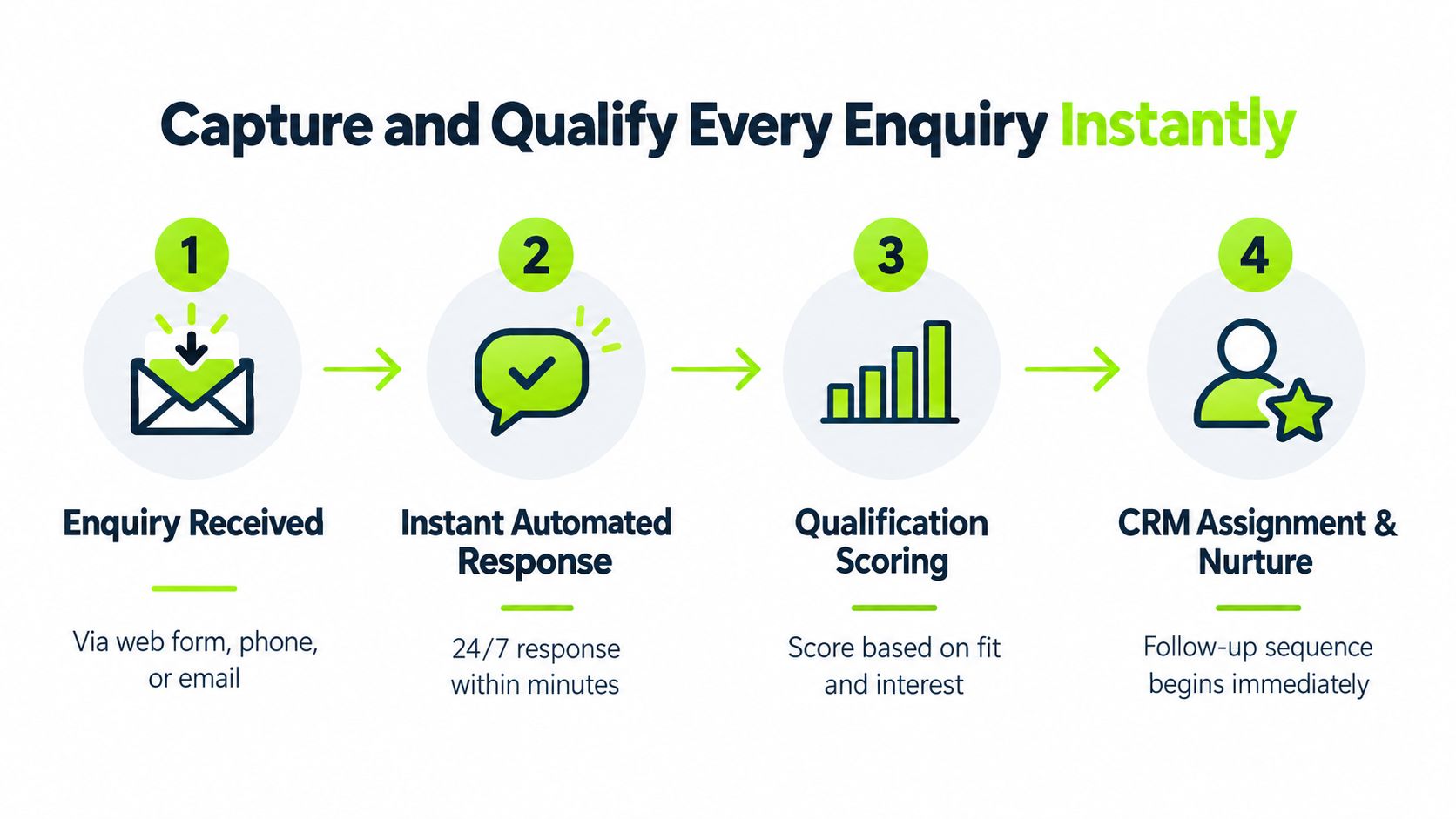
Capture and Qualify Every Enquiry Instantly
The first contact should create a record, not another loose message for someone to process later. Whether an enquiry arrives through a web form, phone call, email, social media response, or an open day, the club needs one visible operating process.
GolfRep's recommended workflow is straightforward:
- Capture the enquiry. Record contact details, source, membership interest, playing frequency, preferred times, and any relevant family or category information.
- Send an immediate acknowledgement. Confirm that the enquiry has arrived, explain what happens next, and provide a useful answer rather than a generic receipt.
- Assign responsibility. Give the enquiry to a named person with a due date and a defined next action.
- Qualify and nurture. Score fit and intent, then place the prospect into the right follow-up sequence.
Make the process work outside office hours
A club can't assume that prospects enquire during staffed hours. An automated response can acknowledge interest immediately, answer common questions, collect missing information, and notify the right team member. It shouldn't pretend to replace a conversation with the club. It should protect the time between enquiry and human contact.
A useful golf club chatbot approach can help qualify visitors, route questions, and capture contact details while staff are unavailable. The important point is not the technology itself. The important point is that every prospect enters the same controlled process.
Audit the current workflow by asking:
- Where are enquiries stored? Can the manager see every open opportunity in one place?
- Who owns each lead? Is responsibility explicit, or does the team rely on shared inboxes?
- What happens after the first reply? Does the system schedule follow-up, or does the prospect have to chase?
- Can the club report outcomes? Can staff identify which source produced a visit, application, or membership?
- What happens when someone doesn't respond? Is there a planned sequence, or does the record become dormant?
Track stages, not just names
A CRM pipeline should make stalled enquiries obvious. Use stages such as New, Contacted, Qualified, Visit Booked, Visit Completed, Application, Joined, Nurture, and Lost. Keep the stages consistent so managers can compare campaigns and spot operational bottlenecks.
Speed matters, but speed without relevance won't convert well. Ask enough to understand the prospect, then move quickly to a useful conversation or visit. A system should make that action easier, not bury staff in administration.
Convert Enquiries Into Visits and Members With Structured Nurture
The best membership journey doesn't force a prospect to make a decision from an advert. It gives them a sequence of reasons to take the next step, starting with a relevant reply and progressing towards a conversation, visit, trial, application, and membership.
A practical nurture sequence might include:
- An immediate acknowledgement that answers the original question.
- A personal follow-up from the named club contact.
- A clear invitation to tour the facilities or meet a professional.
- Relevant information for the prospect's segment, such as junior activity, women's sessions, competitions, or family participation.
- A reminder after the visit, with a direct route to the application.
- A reactivation message when the prospect goes quiet.
The club should make each message do one job. Don't send a long brochure when the prospect needs a visit time. Don't send a discount when the main objection is uncertainty about fitting in. A useful conversion resource such as Samba's conversion optimisation advice can help teams improve clarity, friction, and calls to action across the journey.
Treat seasonal intent as a signal
Golf demand changes through the year, and clubs should use participation behaviour to time follow-up. England Golf reported 11.83 million WHS scores in 2025, a 16% rise on 2024. The first half of 2025 produced 5.75 million scores, up 29% year on year, while April 2025 was up 98% compared with April 2024, according to England Golf's 2025 participation reporting.
That pattern supports a practical approach. Increase contact when golfers are showing active intent, but don't abandon quieter prospects. Use the CRM to distinguish a prospect who needs a timely invitation from one who needs longer education.
Onboard members before uncertainty becomes churn
Conversion doesn't end at payment. A new member needs to know how to book, play, meet people, enter competitions, access coaching, and ask for help. Assign an internal owner for the early membership experience and schedule useful contact rather than waiting for complaints.
Renewal deserves the same discipline. Golfshake's 2025 survey found that 77% of golfers planned to renew, while 19% were undecided. That undecided group should receive personal attention before renewal deadlines, with staff identifying whether the issue involves usage, value, playing partners, communication, or an unresolved service problem.
Protect pricing by improving fit and experience. A clear trial-to-member route, useful visits, and strong onboarding are more sustainable than blanket discounts.
Measure What Matters and Keep Growth Predictable
A committee can't manage predictable growth from an enquiry count alone. The useful question is where each opportunity came from, how quickly the club responded, what happened next, and whether the resulting member stayed.
Build reporting around the complete path:
| Stage | What to measure | Why it matters |
|---|---|---|
| Acquisition | Source and segment | Shows which audiences and channels create relevant demand |
| Response | Time to first contact and contact rate | Exposes operational delay |
| Qualification | Fit, intent, and next action | Separates viable prospects from unstructured interest |
| Visit | Bookings, attendance, and follow-up | Shows whether the club creates a persuasive experience |
| Conversion | Applications and memberships | Connects activity to commercial outcomes |
| Retention | Joiners, leavers, renewals, and reactivations | Shows whether growth is net and sustainable |
Find the leak before buying more traffic
If enquiries are plentiful but contacted rates are weak, fix response ownership. If contact is strong but visits are low, improve the message and the invitation. If visits happen but applications don't, review the experience, membership explanation, objection handling, and next-step process.
If applications convert but members leave early, acquisition isn't the main problem. Examine onboarding, integration into club life, access, communication, and whether the prospect was correctly matched to the category.
The Hillier Hopkins benchmark provides useful market context, but your club should still establish its own baseline. Track cohort-level data by segment, source, joining month, membership category, and renewal outcome. This gives managers evidence when deciding whether to change creative, adjust follow-up, improve the visit, or address retention.
Make reporting useful to decision-makers
A committee report should show movement and action, not a long list of platform metrics. Include active opportunities, overdue actions, response performance, visits booked, memberships joined, members at renewal risk, and the next operational priority.
GolfRep's GolfRepOS connects lead generation, CRM records, automated follow-up, pipeline management, and reporting, allowing clubs to track a prospect from first click through to membership outcome. Use a system of this kind only when the club agrees the stages, owners, definitions, and review rhythm. Technology can expose a process, but it can't create accountability on its own.
The most valuable improvement is usually the one that keeps working after the campaign ends. Faster response, clearer ownership, relevant nurture, better visits, and disciplined onboarding compound over time. That's how to increase golf club membership without making price the centre of the conversation.
GolfRep helps UK golf clubs combine targeted demand generation, immediate enquiry handling, CRM visibility, and structured nurture into a measurable membership pipeline. Visit GolfRep to see how your club can turn more existing interest into booked visits, joined members, and recurring revenue without relying on blanket discounts.
Ready to tap into our proven growth system?