Golf Club Membership Growth That Converts Enquiries
More enquiries won't automatically produce more members. A club can increase advertising, fill an inbox and still see little movement in its membership if nobody responds quickly, records the conversation or follows up with purpose.
That's the uncomfortable reality of golf club membership growth. The clubs making steady progress usually aren't the ones shouting loudest. They're the ones that know which enquiries matter, respond while interest is fresh, give each prospect a clear next step and measure what happens afterwards.
England Golf's national figures show how quickly demand can move when the market accelerates. Affiliated club membership rose from 647,224 in February 2021 to 737,021 in 2022, an increase of 89,797 members, or 13.9% in one year. England Golf also described this as the third consecutive year of membership growth, with the total more than 100,000 higher than before the pandemic, as reported by Fairways Mixed Golf.
The opportunity is real. The weak point is often the operating system between first enquiry and signed membership.
Why Most Golf Clubs Struggle to Grow Membership
The most popular advice is to generate more leads. That advice is incomplete. If your team can't see every enquiry, contact prospects promptly, or manage follow-up consistently, extra volume creates more opportunities to lose people.
Many clubs still rely on a shared inbox, a spreadsheet and someone's memory. A secretary replies when time allows. A membership director makes a note after a phone call. A committee member assumes somebody else is handling the prospect who visited last week. Nothing looks broken from the outside, yet the club can't answer basic questions: how many active enquiries exist, which source produced them, who needs a call today or why a promising prospect didn't join.
Hillier Hopkins' 2023/24 UK golf-club survey found that only 24% of members' clubs reported more leavers than joiners, while clubs welcomed an average of 94 new members in 2023. Waiting lists averaged 51 people and existed in 46% of clubs, which shows that demand and capacity can coexist with weak internal conversion processes. The figures are set out in the Hillier Hopkins Golf Clubs Report 2023/24.
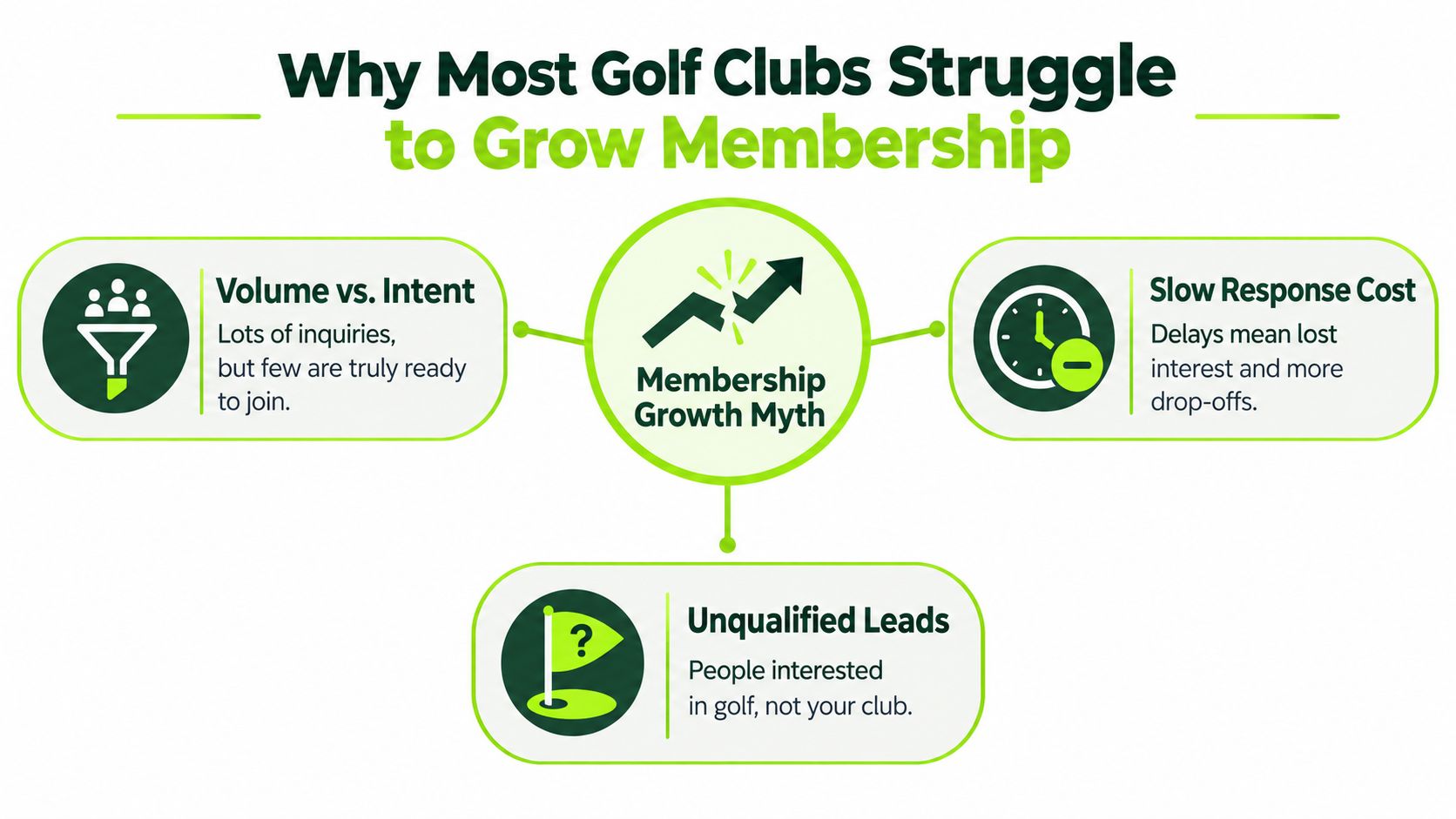
Volume is not the same as intent
A golfer who asks about membership fees, playing rights and a tour is not equivalent to someone who downloads a brochure. Treating both as identical leads to poor prioritisation and unhelpful reporting.
Your club needs a simple distinction between interest captured and opportunity progressing. An enquiry becomes valuable when a named person takes ownership, qualifies the golfer's situation and moves the conversation towards a visit, trial or application.
That's why lead generation should sit alongside a visible CRM process. GolfRep's guidance on how golf clubs lose enquiries without realising reflects the operational issue directly: clubs don't necessarily lack demand, but they often lack a reliable way to manage it.
Practical rule: Never approve more lead spend until you can account for every existing enquiry and its next action.
The committee test
Ask three questions at the next management meeting:
- Ownership: Who is responsible for each open enquiry?
- Timing: How quickly did the club make first contact?
- Progress: What stage is each prospect in now?
If the answers depend on searching emails or asking around, your growth problem is structural. Fix visibility and follow-up first. Then increase acquisition where the evidence shows a genuine gap.
Attracting the Right Golfers Through Focused Acquisition
Acquisition should bring the right local golfers into a process your team can handle. That means choosing channels according to intent, not popularity.
Start with the membership you want to build. A private members' club may prioritise golfers looking for belonging, regular competitions and a stable playing community. A resort or hotel group may need a different message, centred on access, flexibility and wider leisure facilities. Younger golfers, trial users and established players shouldn't receive the same advert or landing page.

Build acquisition around intent
Use your club's location, offer and capacity to define a narrow audience before choosing channels.
Search activity can capture golfers already looking for membership, joining information or a club nearby. The landing page should answer practical questions quickly, including access, playing arrangements, facilities, visitor policy and the next step.
Social advertising can create awareness among local golfers who haven't yet considered joining. It works best when the creative gives people a reason to enquire, such as a guided visit, a trial opportunity or a clear explanation of the member experience. Don't use it just to collect names.
Existing member referrals can provide highly relevant introductions because members understand the club's culture. Make the process easy for them, but don't turn every referral into a discount. A personal invitation to visit can protect the club's positioning better than a price-led incentive.
On-site and local activity still matters. Open events, coaching sessions and partnerships with nearby businesses can help prospects experience the club before they make a decision. Capture every conversation in the same system as a digital enquiry.
Qualify before the office gets overwhelmed
A useful enquiry form asks enough to support a relevant reply without becoming an application form. Consider playing frequency, current membership status, preferred category and what prompted the enquiry. The purpose isn't to reject people. It's to decide what information and follow-up will help them progress.
Measure acquisition by downstream outcomes, not lead count. A channel that produces fewer enquiries but more booked visits may be doing a better job than one that fills the CRM with unqualified names.
The GolfRep guide to golf club member acquisition takes the same practical position. Acquisition is only useful when it feeds a pipeline with enough context for the club to act.
Keep the promise consistent
Your advertising, website and membership conversation must describe the same club. Don't use a discount-heavy advert if the club's real appeal is quality, community and dependable access. Don't promise flexibility if the membership terms are restrictive.
A focused acquisition system protects the office from unnecessary work and gives serious prospects a clearer reason to take the next step.
Turning Enquiries Into Bookings With Speed and Systems
Golf clubs rarely lose growth because they lack enquiries. They lose it between the enquiry and the first meaningful conversation. A golfer who has just made contact is comparing options, checking availability and judging how easy the club is to deal with. Slow replies make another club look more organised.
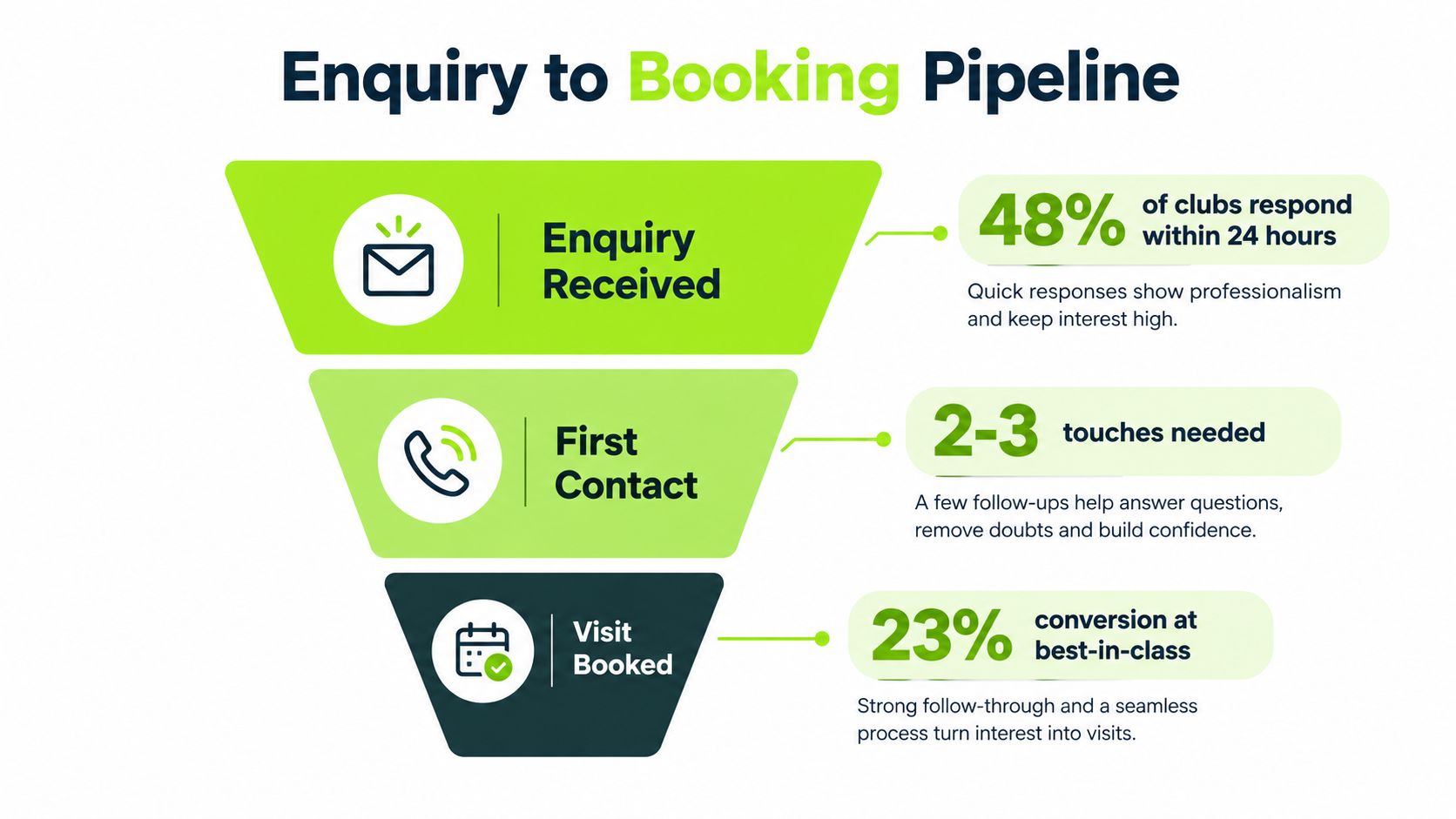
One GolfRep analysis reports an average UK golf-club membership-enquiry response time of 47 hours and 32 minutes. It also says a lead answered within one hour is five times more likely to convert than one left for 24 hours, as detailed in GolfRep's golf-club CRM analysis.
Design for the first minutes
The first reply should confirm receipt, build confidence and set a clear next action. It does not need to answer every membership question. A short, personal message can acknowledge the enquiry, include one relevant detail and offer a call or visit.
GolfRep's lead-management guidance identifies five minutes as the “golden window” for responding to a new enquiry. It also cites a UK lead-response study in which nearly 10% of firms replied within five minutes and more than 46% replied within one hour, according to the GolfRep lead-management guide. Use this speed to lead guidance to set the club's response standard.
Staff will not always be at a desk. Set automation to acknowledge and qualify the enquiry, then pass it to a named team member who can build the relationship.
Replace inbox chasing with ownership
A workable system should answer four questions immediately:
- Who is the prospect? Capture contact details, source and stated interest.
- What happens next? Assign a call, email, tour or trial.
- Who owns the task? Give responsibility to a named person, not “the team”.
- When is it due? Set a clear deadline visible to the manager.
A spreadsheet stores information, but it rarely creates consistent follow-up. A CRM can show open tasks, overdue actions, source performance and stage movement together. Managers can then intervene before an enquiry disappears.
Some clubs manage paid trials, coaching introductions or prepaid experiences alongside membership enquiries. A dedicated resource such as prepaid class pack software can organise those transactions separately, provided the hand-off into the CRM remains clear.
Make availability visible
A tour request should lead to a straightforward booking process. Give staff current availability, use standard booking links where suitable and send reminders before the appointment. If a prospect misses the visit, create a follow-up task rather than returning the enquiry to an unowned inbox.
Fast responses do not replace human contact. They keep the opportunity active until the right person can provide it.
Nurture and Conversion Flows That Move Prospects to Joining
Speed creates the first opportunity. Nurture turns that opportunity into a decision.
Golfers often need more than a fee sheet. They may want to understand the club's culture, see the course, compare categories, discuss playing frequency or involve another decision-maker. A follow-up flow should answer those questions without forcing every staff member to reinvent the process.
GolfRep recommends treating enquiry management as a tracked workflow with stages including new enquiry, contacted, qualified, booked visit, visited, pending decision, joined and lost. That sequence appears in GolfRep's membership-marketing guidance.
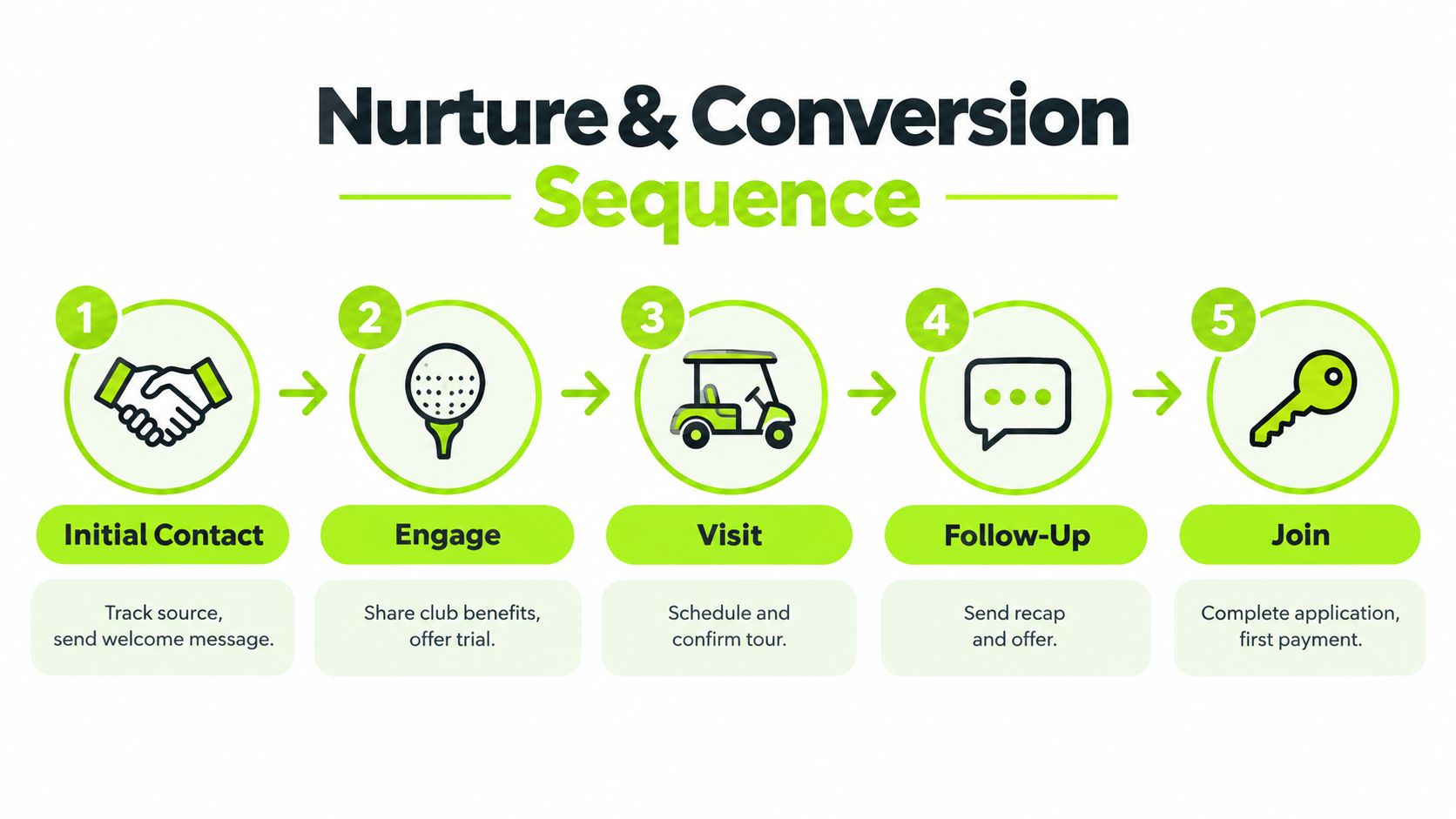
Give every stage a job
New enquiry is the point for acknowledgement and basic qualification. Don't send a generic brochure and assume the prospect will return.
Contacted means a real conversation has happened or a meaningful reply has been received. Record what matters, such as preferred playing times, category interest and concerns.
Qualified means the club understands whether the prospect is suitable for the available membership and what might help them decide. Qualification isn't about making the journey difficult. It stops staff from sending irrelevant information.
Booked visit deserves practical support. Confirm the time, explain where to meet and tell the prospect what the visit will include. Reduce uncertainty before they arrive.
Visited is where the club should connect the experience to the golfer's original motivation. Follow up with a concise recap, answer unanswered questions and make the joining process obvious.
Pending decision needs a reason to continue the conversation. That might be clarification on category rules, payment arrangements or playing access. Don't rely on repeated “just checking in” messages.
Joined should trigger a clean handover into onboarding. Lost should include a reason where possible, such as price, timing, location, capacity or a change of circumstances.
Automate repetition, protect judgement
Automation should handle confirmations, reminders and sensible follow-up prompts. It shouldn't pretend to understand a nuanced concern or replace a conversation about whether the club is the right fit.
A manager should be able to open the pipeline and see where prospects stall. If many people reach a visit but don't progress, improve the tour, clarify the offer or review the follow-up. If enquiries remain stuck before contact, fix ownership and response rules.
No-shows need their own recovery path. Send a courteous message, offer another appointment and record the outcome. A no-show isn't automatically a lost lead, but it becomes one when nobody follows up.
This approach gives committees something better than a monthly lead total. It shows how many people are moving, where decisions slow down and which actions deserve attention.
Pricing Packaging and Retention for Sustainable Growth
Membership growth isn't sustainable if the club wins new joiners and loses existing members through poor fit, unclear value or weak renewal communication.
Pricing should reflect the experience the club intends to deliver. Use categories and packages to create relevant entry points, not to make the club look cheap. A trial option can help a golfer test the environment. A flexible category may suit someone with irregular playing patterns. A family or younger-member pathway can make the club easier to enter without weakening the core offer.
England Golf's affiliated club membership reached 750,071 in 2025, up from 730,602 in 2024, a year-on-year increase of 2.66%. The pathway also included 72,921 iGolf participants and 12,562 iPlay participants, showing that clubs and the governing body are dealing with more than one route into golf participation, as reported by The Golf Business.
Match the package to the life stage
A new golfer may need confidence and a simple route into regular play. An experienced golfer may care more about competition, tee access and reciprocal arrangements. A younger prospect may respond to social connection and flexibility, while an established member may value consistency and service.
Hillier Hopkins' 2023/24 report states that 43% of members were over 61 and 16% were under 30. Those figures make lifecycle planning essential. A club that only protects its traditional offer may retain today's members but struggle to replace them over time.
Retention starts well before renewal. Communicate the value of membership throughout the year, introduce newer members to people and activities, and make it easy to ask questions. A last-minute renewal email can't repair a year of weak engagement.
Watch the quality of growth
Reported growth doesn't guarantee renewal certainty. A UK membership survey found that 77.9% of current members planned to renew for 2026, while 18.3% were undecided and 3.8% did not plan to renew. The same source reported that 57.4% of clubs said membership was growing, but only 51.58% said junior membership was growing and 30.63% said under-40 membership was growing, as covered by Golfshake's 2025 membership analysis.
Growth is stronger when the club measures who is joining, who is staying and which categories are becoming fragile.
Review leavers and joiners by category, not only as a total. If a waiting list exists, manage expectations and onboarding capacity carefully. Filling the pipeline beyond what the club can serve will damage the experience that supports retention.
Measuring Optimising and Implementing Your Growth Playbook
Predictable growth requires a shared scorecard. Lead volume belongs on it, but it shouldn't dominate it.
Managers and committees need visibility from acquisition through recurring membership. That means recording the source of each enquiry, the response time, the current stage, the next task, the visit outcome and the final decision. Without those fields, the club can't distinguish a weak channel from weak follow-up.
Hillier Hopkins' 2024/25 survey found that 75% of members' clubs reported membership growth, up from 73% in 2023. Among clubs reporting growth, the average rate was 8% over the previous 12 months, with reported increases ranging from 2% to 18%. The survey also found that 59% of members' clubs had more than 600 playing members, up from 56% in 2023, according to the Hillier Hopkins Golf Clubs Report 2024/25.
Use a practical scorecard
Track the measures that expose decisions and bottlenecks:
- Lead visibility: Confirm that every enquiry has a source, owner, stage and next action.
- Response performance: Review how quickly staff make first contact, then investigate delays rather than accepting them.
- Stage conversion: Compare movement from enquiry to contact, visit, decision and joiner.
- Capacity control: Monitor available membership spaces, waiting lists and onboarding workload.
- Retention health: Review renewals, leavers and undecided members by category and life stage.
- Source quality: Judge channels by joined members and retained value, not enquiries alone.
Implement in the right order
Begin with one pipeline. Define the stages, assign ownership and agree what counts as a completed action. Clean existing data before adding new campaigns.
Next, introduce instant acknowledgement, task reminders and a clear escalation route for unanswered enquiries. Then review the pipeline regularly with the people who handle membership, because a system that ignores their working day won't last.
Only after that should you expand acquisition. Test one focused audience and one clear offer, then compare the quality of resulting visits and joiners. Keep the club's brand and pricing intact while you improve the process around them.
GolfRep's model combines advertising, automated follow-up and CRM visibility so clubs can track prospects from initial interest through to membership. Use that kind of system, or build an equivalent process with tools your team can maintain. The important point isn't the software label. It's whether the club can see every opportunity and act before it goes cold.
A committee should be able to review the pipeline and make a decision from evidence, not anecdotes. That's the standard that turns membership activity into a repeatable growth discipline.
GolfRep helps UK golf clubs build structured membership pipelines by combining targeted acquisition, prompt automated follow-up and CRM tracking from enquiry to joining. Visit GolfRep to discuss how your club can improve response time, conversion visibility and sustainable membership growth.
Ready to tap into our proven growth system?