Golf Club Membership Marketing That Converts Enquiries

More enquiries won't automatically produce more members. A club can increase advertising, improve its website and run a successful open day, yet still see little net growth if enquiries sit in an inbox, a spreadsheet or someone's memory.
That's the uncomfortable truth about golf club membership marketing. The constraint is often not awareness. It's the gap between a golfer asking for information and somebody taking ownership of the next step.
England has a substantial market to work with. England Golf reports more than 730,000 club members across 1,735 affiliated clubs, while the average club-member age has fallen from 56.18 to 54.99 overall, with the figures for both men and women also declining (England Golf membership data). That points to a broad, multi-generation audience. It also means clubs need relevant offers and reliable conversion systems, not just louder promotion.
The UK participation gap makes the opportunity larger still. The R&A reports 5.356 million adults playing golf at least once a year, including 2.357 million playing at least every four weeks, compared with 889,000 club members (The R&A's UK golf satellite account). The largest marketing opportunity isn't reaching every golfer with the same “join now” message. It's identifying which golfers are close to joining, then giving them a clear reason and easy route to visit.
Key takeaway: A predictable membership pipeline comes from matching the right offer with fast response, visible ownership and structured follow-up.
Before increasing spend, managers and committees should audit what happens after an enquiry arrives. This review of how golf clubs lose enquiries is a useful starting point, but the practical test is simple: can your team show every active prospect, their last contact, their next action and their likely joining route?
Introduction Why Enquiry Handling Matters More Than Lead Volume
More leads will not fix a club that handles enquiries inconsistently. A prospect may submit a form in the evening, send a social message at the weekend or speak to a staff member who does not manage membership. If that contact is not recorded centrally, its context disappears before the conversation begins.
Manual follow-up creates gaps. Staff reply when time allows, different people provide different answers, and promising prospects receive one response instead of a planned sequence. Committees then blame advertising, although the failure is often the missing journey from enquiry to visit.
Audit the gap before buying more traffic
Review every route into membership. Website forms, phone calls, emails, social messages, referrals, open days and walk-ins should feed one visible process. Every enquiry needs a source, an owner, a status and a next action.
Use pipeline stages that anyone involved in membership can understand:
- New enquiry: Contact has arrived but has not been qualified.
- Qualified prospect: The club understands the golfer's playing pattern, preferred format and likely timescale.
- Visit proposed: A tour, trial round or open-day invitation has been offered.
- Visit booked: The prospect has committed to a specific appointment.
- Joining decision: The club is handling an application, payment or clear objection.
- Nurture: The golfer is not ready yet, but remains visible for future follow-up.
A shared pipeline gives managers the evidence to diagnose the problem. If enquiries are plentiful but visits are scarce, the club can examine response speed, ownership and follow-up before increasing media spend. GolfRep's guide to how golf clubs lose enquiries without realising provides a useful audit prompt, but the practical test is straightforward: can the team show every active prospect, their last contact, their next action and their likely joining route?
Treat speed as part of the member experience
A quick acknowledgement confirms that the enquiry reached the club. It should explain what happens next, answer the obvious question and offer a direct route to speak with someone or book a visit. It does not need to force a sale.
The personal response must then add useful context. Ask how often the golfer plays, whether they want full, flexible, social or junior membership, and what matters most locally. Do not make a prospect complete a lengthy interrogation before seeing the course.
Automation and personal contact work best together. Automation protects the first response and routine reminders. Staff supply judgement, reassurance and local knowledge, turning initial interest into confidence. This process creates a more predictable pipeline without relying on discounts or ever-increasing lead volume.
Positioning Pricing and Membership Design That Attracts the Right Golfers
Membership marketing starts with the product, not the advert. “Membership available” is an announcement, not a proposition. It gives a golfer no clear reason to choose your club over another nearby option, and it creates weak enquiries that staff must later qualify.
Define the audience before setting the message. Frequent golfers usually want dependable access, competition and a reliable playing environment. Social members may value community, events and a lighter commitment. Families need clear participation options across age groups, while juniors need an offer that feels welcoming rather than a cheaper version of adult membership.
England Golf's membership analysis points to a wider opportunity across the club lifecycle (England Golf's membership analysis). Build routes that serve younger entrants, families and golfers progressing towards fuller access, alongside offers for established members. The point is not to chase one age group. It is to make the path from first involvement to long-term membership easy to understand.
Build an offer architecture
Use a small number of clearly different routes rather than a tariff sheet that leaves prospects uncertain. A practical structure could include:
- Full membership: Position it around access, competition and belonging.
- Flexible membership: State exactly how access works, including restrictions, booking rules and the golfer it suits.
- Social or lifestyle membership: Lead with clubhouse use, events and community.
- Family and junior routes: Show how different generations can participate together.
- Trial or introductory route: Reduce uncertainty through a defined experience, not an indiscriminate price cut.
Flexible products are becoming more common. Hillier Hopkins reports that 40% of members' clubs and 64% of proprietary clubs offered flexible membership options, up from 34% and 55% respectively in the previous year (Hillier Hopkins golf clubs survey reporting). Treat that finding as a prompt for local product design, not a reason to copy another club. Flexibility should solve a real access, time or lifestyle problem, with the rules explained before the golfer enquires.
Frame value without weakening the club
Price matters, but price-led marketing attracts bargain-led enquiries and teaches prospects to wait for reductions. Show what the fee provides, how members use the club and what happens after joining. A tour, sample fixture calendar, member introduction or trial round can communicate value more effectively than a “limited-time offer” banner.
Affordability pressure remains real. Golfshake's survey found the share paying under £1,000 a year fell from 47% in 2024 to 41% in 2025, while 39% reported a joining fee and 30% reported a waiting list (Golfshake's 2025 membership survey). Test access, convenience and fit alongside price. Those messages qualify prospects before the first conversation.
Your membership page must make four points obvious: who the product suits, what access it provides, how joining works and what the prospect should do next. Explain the fee structure through this guide to golf club membership fees, then make the enquiry form record the route under consideration. That information gives staff a clearer starting point for follow-up and exposes which offers create genuine buying intent.
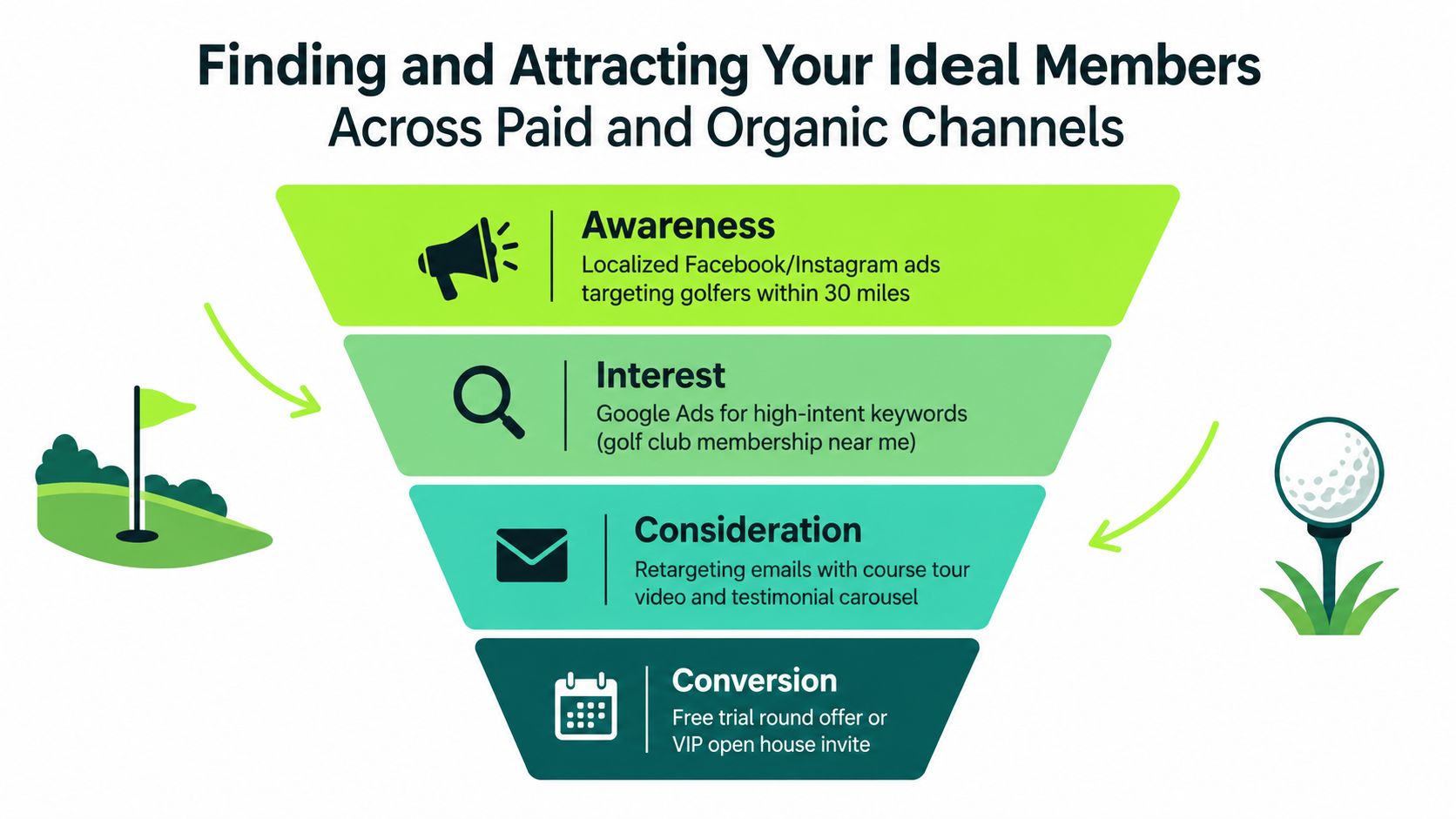
Finding and Attracting Your Ideal Members Across Paid and Organic Channels
Lead volume is a weak measure of marketing performance. A club needs enquiries from the right golfers, followed by a clear route into a conversation, visit and membership decision. Paid and organic channels support that process in different ways, so give each a defined job.
Use paid search to capture existing intent. A golfer searching for membership nearby is closer to action than someone who has only watched a course video on social media. Send that search to a focused landing page showing the relevant membership route and one clear next step, such as booking a tour or requesting a call.
Paid social creates awareness among golfers who are not actively searching. Localised Facebook and Instagram campaigns should show the club experience, including the course, clubhouse, junior activity, competitions and member stories. State the offer and eligibility plainly. A strong advert earns attention, but the follow-up system determines whether that attention becomes a visit.
Match the message to the golfer
Use participation levels to shape both targeting and the next offer. The R&A figures show a much larger group of people playing golf than holding club membership (The R&A's UK golf participation account). That gap is a segmentation opportunity, not a reason to run one generic campaign.
Build separate journeys for:
- Casual golfers: Use introductory content, beginner-friendly visits and simple explanations. Promote a low-friction first conversation rather than a full membership pitch.
- Regular non-members: Lead with access, convenience and the practical value of belonging. Invite them to a tour or a visit where staff can discuss how they play.
- Families and juniors: Show participation across generations, explain the joining process and make the appropriate contact route obvious.
- Lapsed or inactive contacts: Use a relevant reason to return, based on their previous interest or playing pattern. Do not send the same acquisition advert to every old contact.
Record the audience, message, offer and source for each campaign. Staff can then see which groups produce useful enquiries, not just which advert generates the most forms.
Combine demand capture with demand creation
Organic activity builds trust by showing the club in context. Keep local membership pages accurate, maintain the Google Business Profile, answer practical questions about fees and eligibility, and encourage natural member referrals. Each page or post should point to a trackable enquiry route.
Open days and local partnerships can turn an abstract promise into a real visit. Work with nearby employers, schools, community groups and complementary businesses where the relationship fits. The aim is a conversation the club can own and record, not a list of unworked names.
Every channel must send clean data into the same pipeline. If social leads, referrals and walk-ins sit in separate places, managers cannot compare quality, assign follow-up or see where prospective members stop progressing.
Turning Enquiries Into Booked Visits With Automation and CRM Nurture
A membership enquiry should never depend on one person remembering to reply. Staff may be busy with competitions, visitors, course operations or member issues. The system must protect the prospect while leaving room for a personal conversation.
Capture every enquiry centrally
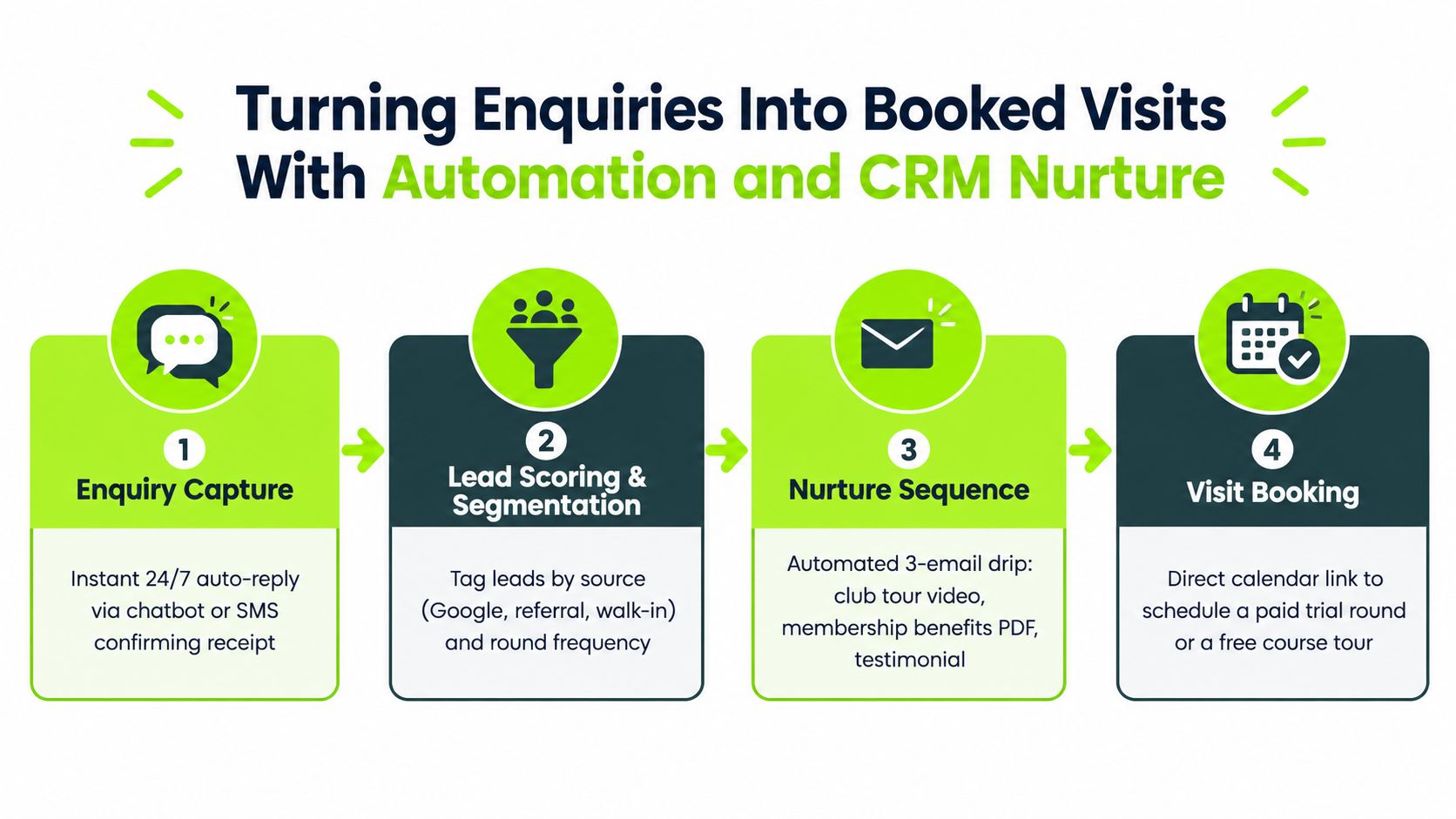
Connect website forms, social lead forms, email and relevant booking routes to one record. Keep the initial fields practical. Name, contact details, preferred membership type, playing frequency and source are often enough to start a useful conversation.
Assign ownership immediately. The record should show who is responsible, what has happened and what must happen next. A shared inbox can receive messages, but it doesn't provide the same visibility as a pipeline with clear stages and reminders.
Use an immediate acknowledgement outside office hours. It should confirm receipt, set an expectation for personal contact and provide a useful next action. A calendar link can work for prospects who are ready to book, while others may prefer a call or a short tour.
Qualify by fit, not by assumptions
Qualification isn't a barrier. It helps the club recommend the right route and prevents staff from treating every enquiry as identical.
Ask questions that influence the decision:
- Playing pattern: How often does the golfer currently play?
- Access needs: Are weekends, midweek times or flexible access most important?
- Household context: Is the enquiry for one golfer, a family or a junior?
- Timing: Is the prospect ready to join, comparing clubs or planning for a later date?
- Main hesitation: Is the concern price, access, playing partners, facilities or the joining process?
Group prospects into useful value cohorts, then tailor the next communication. A regular player may need a clear access explanation. A social prospect may respond better to events and introductions. A family may need one concise explanation of the available routes.
Nurture until the prospect chooses
A single follow-up email is not a process. Use a planned sequence across email, SMS and calls, with each contact adding something useful. The sequence can include a course tour video, a membership benefits document, answers to common questions, a testimonial, an invitation to visit and a direct booking option.
Keep the messages connected to the original enquiry. Don't send a generic newsletter and assume the prospect will work out what to do next. Every message should either remove an objection, demonstrate fit or make the next action easier.
A unified publishing approach can help teams keep campaign messages consistent across the channels where prospects encounter the club. The principle matters more than the platform. A prospect should receive one coherent explanation of the club, not disconnected messages from separate tools.
GolfRep provides one example of a sector-specific approach, combining advertising, automated acknowledgement, qualification, CRM-style lead capture and revenue tracking for golf clubs. Clubs can also build this process with suitable CRM software, booking tools and disciplined internal ownership. The important point is that the workflow must be visible, repeatable and measured. This guide to golf club automation covers the operational questions managers should ask before systemising follow-up.
Practical rule: Automation should guarantee the next contact. It shouldn't pretend to replace the relationship.
Retention belongs in the same system. The benchmark data shows why gross acquisition can mislead. In 2023/24, 24% of UK members' clubs reported more leavers than joiners, even though average joiners rose from 70 in 2022 to 73 in 2023, while average leavers rose from 48 to 56 (Hillier Hopkins Golf Clubs Report 2023/24). Track new members after joining, confirm they can access the experience they expected and intervene before renewal when engagement weakens.
Measuring What Matters and Optimising Your Membership Pipeline
A committee should judge membership marketing by progression, not enquiry volume. Enquiries are only the starting point. The commercial result depends on response, qualification, visits, joining decisions and renewal.
Start with operational visibility. Every prospect needs a source, current stage, owner, last contact and next action. If staff must search several systems to answer those questions, the club cannot manage conversion reliably. A shared CRM view turns follow-up from individual memory into an accountable process.
Use a simple pipeline dashboard
| Stage | KPI to Track | What Good Looks Like |
|---|---|---|
| Enquiry | Enquiry response time | New contacts receive a prompt acknowledgement, with personal ownership visible |
| Qualification | Lead visibility | Every enquiry has a source, segment, status and next action |
| Visit | Visit booking rate | The club sees how many qualified prospects receive and accept a visit invitation |
| Decision | Visit to sign-up rate | Managers understand which offers and objections influence joining decisions |
| Membership | Net growth | Monthly joiners are reviewed alongside leavers, not in isolation |
| Waiting list | Waiting-list conversion | The club tracks who progresses, who declines and why |
| Renewal | Retention activity | At-risk members receive relevant contact before renewal |
Earlier Hillier Hopkins reporting found that 77% of clubs reported membership as stable or increasing, while 23% reported more leavers than joiners. Clubs welcomed an average of 70 new members in 2022, rising to 94 in 2023, while the share with waiting lists fell from 52% to 46% (Hillier Hopkins survey reporting). The lesson is straightforward. Acquisition reporting without retention reporting can make weak net growth look healthy.
Measure the movement, then improve one constraint
Review the pipeline monthly and choose the largest visible constraint. If enquiries are healthy but visits are scarce, examine response time, qualification and the clarity of the invitation. If visits happen but joining decisions stall, review the offer, the tour experience and the objections staff record. If joining is strong but net growth remains weak, retention needs more management attention.
Waiting lists also require active handling. The average waiting-list size was 51 people, compared with 61 in 2022, in the Hillier Hopkins reporting (Hillier Hopkins waiting-list findings). A list creates value only when the club communicates clearly, manages expectations and contacts suitable prospects when availability changes. Track each person's status and reason for declining, rather than treating the list as proof of demand.
England Golf reported membership rising from 730,602 in 2024 to 750,071 in 2025, a 2.66% year-on-year increase, while junior membership rose 34% to 61,483 (England Golf membership growth reporting). The market is active, but results vary between audiences and clubs. Your dashboard should show which sources and offers produce members who stay, not just which campaigns generate the most enquiries.
Your Practical Playbook Checklist and Next Steps for Predictable Growth
Predictable growth doesn't require a complicated technology project. It requires the club to put the decisions in the right order and make ownership clear.
Start with the product. Define the members you want, the playing and lifestyle needs you serve, and the routes that make sense for them. Then make the membership page and enquiry process match that positioning.
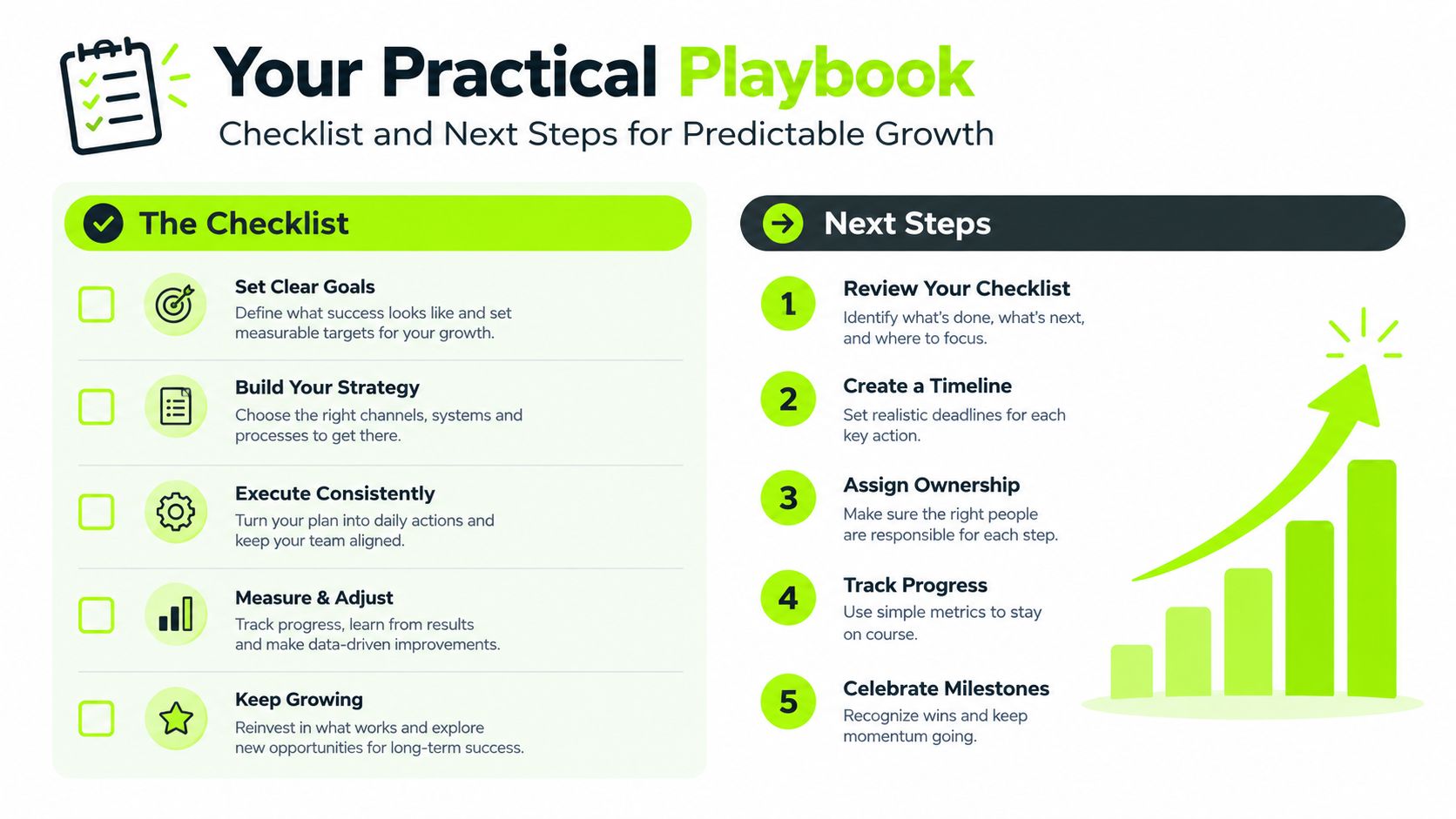
Put the operating sequence in place
- Clarify the offer: Create distinct full, flexible, social, family or junior routes where local demand supports them.
- Choose the channel: Use search for active intent, social for local awareness, organic content for trust and referrals or events for personal experience.
- Capture centrally: Send every enquiry into a shared system with a source, owner and next action.
- Respond consistently: Acknowledge immediately, then follow up personally with relevant answers and a visit invitation.
- Nurture properly: Use planned email, SMS and call tasks for prospects who aren't ready to decide immediately.
- Measure net performance: Review response, visits, sign-ups, joiners, leavers, waiting-list movement and renewals together.
The common pitfalls are straightforward. Don't count gross joiners while ignoring leavers. Don't rely on a waiting list as proof that demand will convert. Don't send every prospect the same message. Don't leave ownership unclear because “someone at the club” will follow up.
A smaller club can begin with a shared pipeline, defined response standards and a weekly review. A larger group may need centralised CRM ownership, automated routing and consistent reporting across sites. The principle stays the same: systemise the repeatable work, then let staff spend their time on conversations where judgement matters.
A full pipeline is not the same as a healthy pipeline. The club needs to know what moves prospects forward and what keeps members engaged.
GolfRep works with UK golf clubs to combine targeted acquisition, automated follow-up and CRM visibility so managers can see the path from enquiry to booked visit and membership decision. Visit GolfRep to discuss a practical membership growth system built around your club's offer, team capacity and local market.
Ready to tap into our proven growth system?