Golf Club Chatbot: How

Golf clubs in GolfRep's analysis take an average of 47 hours and 32 minutes to respond to a membership enquiry, long enough for a prospect to lose interest or join another club. (GolfRep's golf-club sales process analysis) That figure changes the golf club chatbot conversation. The central problem isn't whether a website can answer questions. It's whether the club can acknowledge, qualify, assign, and follow up with every serious enquiry before the opportunity disappears.
A chatbot can help, but only when it acts as the front door to a properly managed pipeline. On its own, a chat window won't fix an unattended inbox, unclear ownership, poor CRM records, or a membership team that doesn't know which lead needs attention first. The technology matters, but the process behind it matters more.
Why Most Golf Clubs Lose Enquiries Before They Start
Many clubs still treat membership enquiries as routine administration. A visitor completes a website form, the message lands in a shared inbox, and someone replies when the membership secretary, general manager, or office team has time. That process may feel manageable during quiet periods, but it breaks as soon as several enquiries arrive together or a prospect submits a form outside office hours.
The first five minutes are the golden window for responding to an enquiry, according to GolfRep's guidance on golf-club lead management. A slow response doesn't just delay a conversation. It gives the prospect time to compare other clubs, forget why they enquired, or decide that the club isn't organised enough to join.
Practical rule: Treat every enquiry as a live sales conversation until somebody has qualified it and recorded the next action.
The problem isn't a lack of demand. The UK's post-lockdown golf rebound created a large audience comfortable with online booking and automated communication. BRS Golf reported 100,000 new registrations after UK courses reopened, while England Golf reported 20,000 new members joining English clubs after golf returned on 13 May 2020. (The Golf Business) Those figures describe a substantial cohort of digitally active golfers, not a temporary preference for online forms.
The response gap is a process problem
A chatbot can acknowledge an enquiry immediately, but it can't compensate for a membership team that never follows up. Clubs should first map what happens after a prospect submits a form:
- Capture: Is the source recorded, including the relevant campaign or landing page?
- Qualification: Does the club know the prospect's membership interest, playing needs, and location?
- Assignment: Is one person responsible for the next conversation?
- Follow-up: Is there a defined sequence rather than a single generic email?
- Tracking: Can the club see whether the enquiry became a visit, trial round, application, or member?
A useful review of the current process is how most golf clubs lose enquiries without realising. The key lesson is simple. A club doesn't need more leads if it can't reliably respond to the ones already arriving.
| Response Time | Conversion Rate | Lead Status |
|---|---|---|
| Immediate acknowledgement | Higher likelihood of continued engagement | Active and reachable |
| Within the first hour | Strong opportunity for a personal follow-up | Warm and actionable |
| After office hours or the next day | Interest may have weakened | At risk |
| After several days | Prospect may have disengaged or joined elsewhere | Stale |
The table is an operational framework, not a promise of a fixed conversion rate. Clubs should measure their own response time, contact rate, booked visits, and membership outcomes before and after changing the process.
What a Golf Club Chatbot Actually Does
A golf club chatbot is a conversational interface on the club's website that engages visitors, asks useful qualifying questions, and routes the enquiry with context. It isn't a frequently asked questions page with a speech bubble attached.
A membership conversation might begin with a visitor asking about joining. Instead of displaying a long page of categories, the chatbot can ask whether they're interested in individual, family, or corporate membership. It can then collect their name, email address, handicap, preferred playing pattern, and any relevant timing, before offering a taster round or a conversation with the membership manager.
Four practical jobs for the bot
A useful chatbot should move the visitor towards a clear next step.
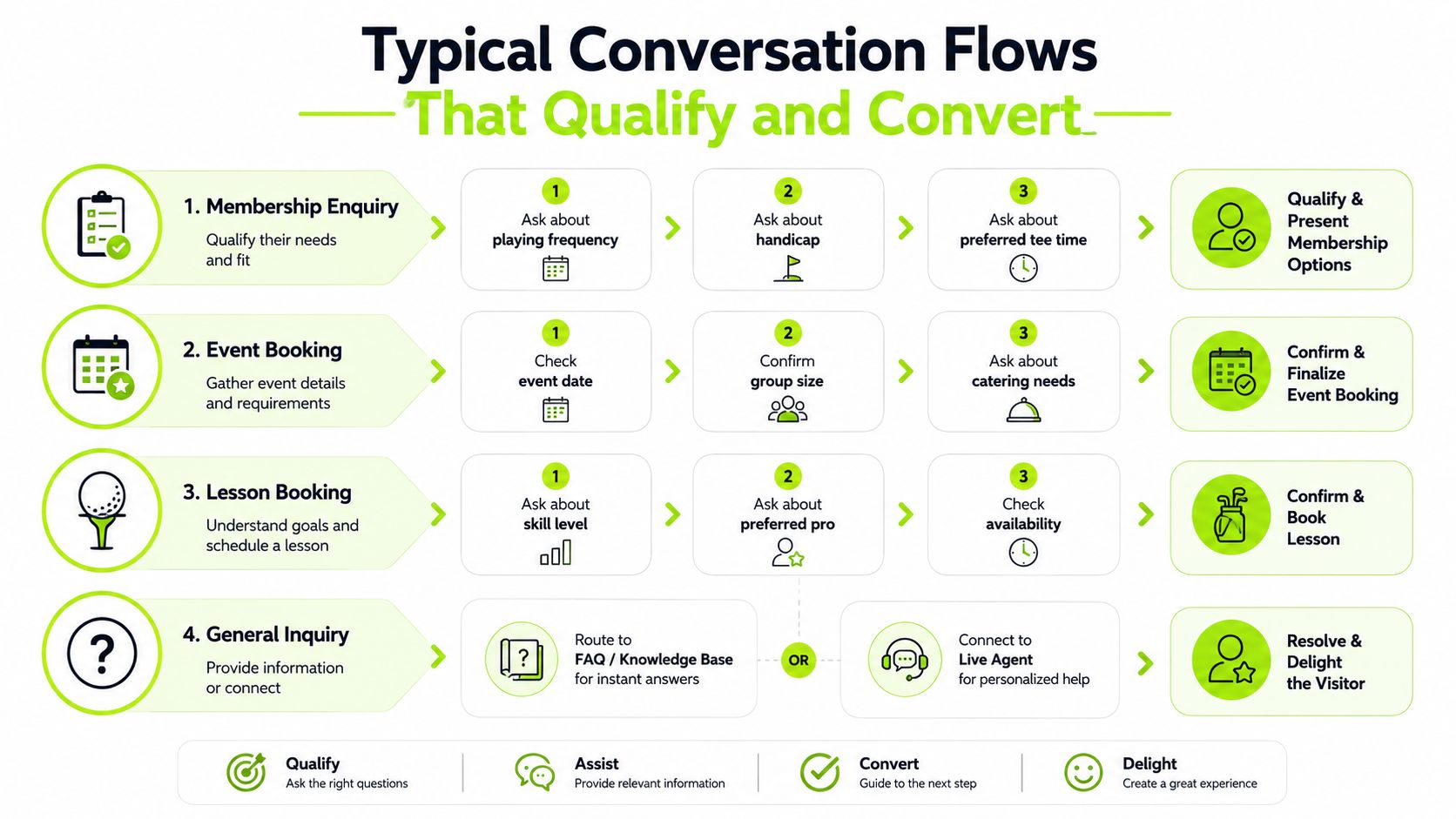
- Membership: Ask what the prospect wants from membership, collect contact details, and present a relevant route such as a visit, trial round, or application.
- Visitor golf: Check available tee times where the booking system supports it, then direct the golfer to a bookable slot.
- Lessons: Capture playing level, preferred professional, and availability before passing the request to the coaching team.
- Events: Collect dates, group size, catering needs, and event type so the events team receives a usable brief rather than a vague message.
The value comes from removing unnecessary back-and-forth. A prospect browsing at 10pm on a Sunday receives a structured response instead of a promise that somebody will reply during office hours. The club also receives information it can use, rather than an email that says only, “Please send me membership details.”
Automation should guide, not trap
The chatbot needs clear escape routes. A visitor asking about disability access, a corporate arrangement, a complex society booking, or a complaint should be offered a human handover. The aim isn't to keep people inside automation. It's to collect enough context for the right person to take over efficiently.
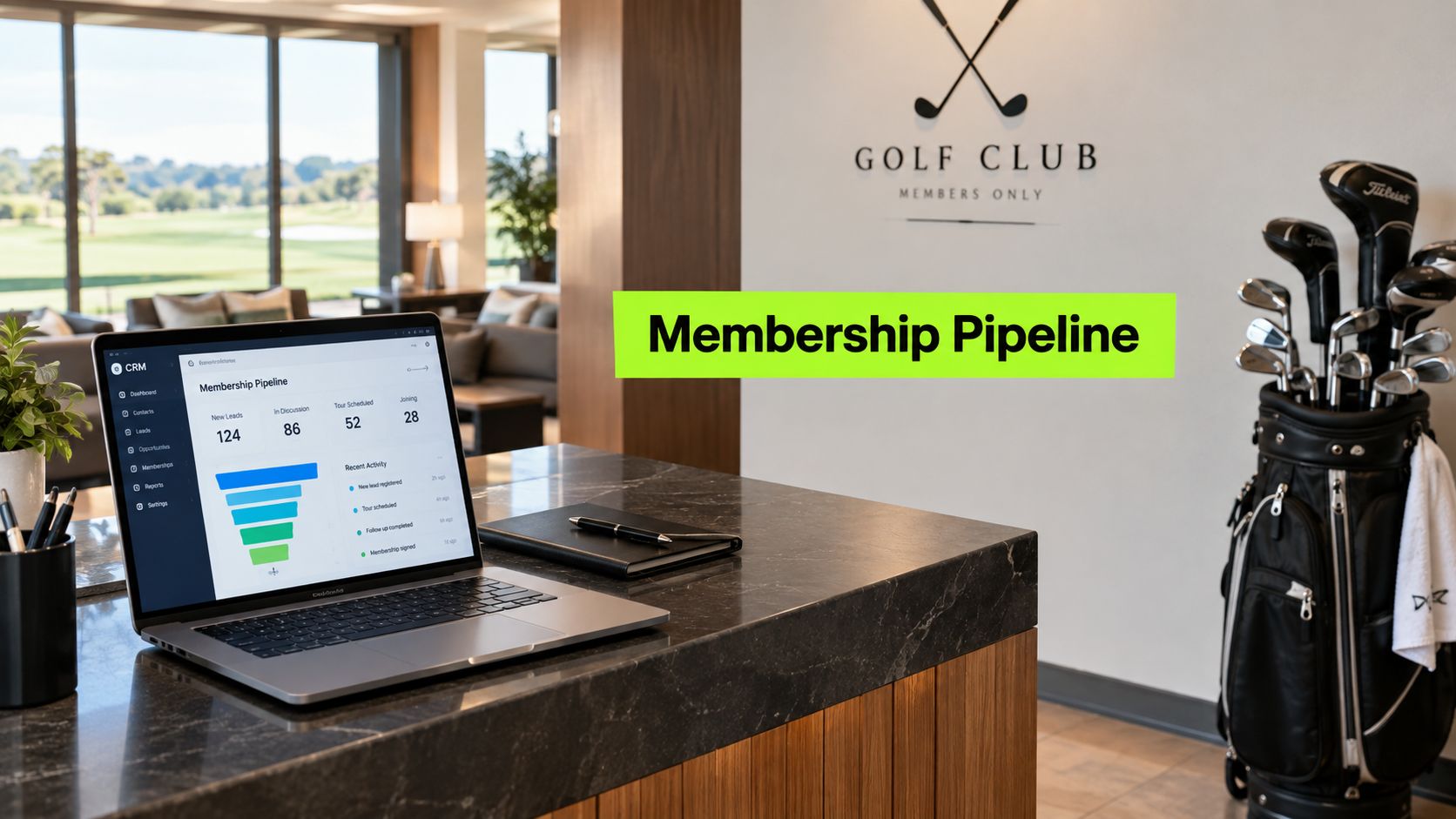
The strongest setups combine the bot with a CRM, appointment booking, email nurture, and clear staff ownership. That turns the chatbot from a standalone widget into an entry point for a structured conversion system.
Measurable Benefits and KPIs for Private and Resort Clubs
A response-time improvement matters only if it produces progress. Measure what happens after the chatbot captures an enquiry, from the quality of the record through to the next action and eventual outcome. Chat volume, conversation length, and chat opens provide context, but they do not show whether the club is creating better opportunities or following them up consistently.
Start with enquiry capture rate: the share of relevant website visitors who engage and provide usable contact details. Review it alongside qualification quality. A high capture rate can give staff more incomplete records to process.
The more revealing test is whether enquiries move through the pipeline:
- Qualification rate: How many captured prospects meet the club's basic membership criteria?
- Visit or taster-round bookings: How many qualified prospects agree to a practical next step?
- Pipeline velocity: How long does an enquiry take to progress from first contact to visit, application, and decision?
- Follow-up completion: Did the named staff member complete the promised action within the agreed timeframe?
- Source-to-member attribution: Which channel generated the enquiry, and what happened after capture?
GolfRep's sales-process guidance puts the average journey from first enquiry to signed membership at 47 days. A single-response metric therefore gives an incomplete picture. Private clubs need to see stalled prospects, overdue tasks, repeated contacts, and missed handovers across that period. The chatbot is the front door, while CRM ownership determines whether the opportunity advances.
For resorts and pay-and-play facilities, the commercial measures differ. Track visitor rounds linked to chatbot interactions, completed bookings, event enquiries captured, and the value of opportunities passed to the events team. If a golfer gets an answer but does not reach a booking option or a clear staff handover, the system is operating as an information service rather than a conversion process.
| KPI | Private Club Target | Resort Club Target |
|---|---|---|
| Enquiry capture | Usable membership records | Bookable visitor and event enquiries |
| Qualification | Clear membership fit and intent | Group, date, playing, or event requirements |
| Next-step conversion | Visit, taster round, or application | Tee time, package, lesson, or event discussion |
| Staff efficiency | Less repetitive membership administration | More time for guest service and revenue opportunities |
| Attribution | Source through to membership outcome | Campaign through to booking or event value |
Targets should follow a baseline, not precede one. Compare chatbot-assisted enquiries with existing forms, phone calls, and email workflows. Then inspect response times, qualification rates, and follow-up completion before changing the flow. The best questions are those staff can act on without making the conversation feel like an application form.
Typical Conversation Flows That Qualify and Convert
The most effective chatbot conversations feel like guided service, not interrogation. Each question should help the visitor reach a decision or help the club decide who should respond.
Membership enquiries
A prospect selects “membership” and sees a small number of relevant options. The chatbot asks about playing frequency, handicap, preferred membership type, and location, then offers a visit or conversation with the membership manager.
The handover record should include the transcript, answers, source, contact details, and requested next step. A manager shouldn't need to ask the same questions again. For a deeper explanation of how conversational systems preserve context across several exchanges, this guide to multi turn conversations is a useful reference.
The club's approach to AI lead qualification for golf clubs should also reflect the club's actual membership rules. If the club has different categories for age, access, playing frequency, or joining times, those distinctions need to be built into the flow.
Tee time bookings
A tee-time conversation needs a live connection to availability. The golfer selects a date, number of players, and preferred time, then receives available options from the booking system. Payment, booking confirmation, cancellation information, and reminders should remain within the approved booking process rather than being improvised by the bot.
If the tee sheet isn't connected, the chatbot should be honest. It can collect the request and route it to the pro shop, but it shouldn't imply that a slot is reserved.
Visitor rounds and events
For visitor golf, location and group size help the club recommend a suitable route. The bot may also identify interest in buggy hire or clubhouse dining, but any add-on should be presented as an option, not forced into the conversation.
Event bookings need a more careful handover. The chatbot can ask for a preferred date, flexibility, group size, room or course requirements, and catering preferences. It should escalate when the request involves unusual access needs, corporate negotiations, complex menus, or dates that require operational approval.
A good flow ends with a definite action. That might be a booking, a calendar invitation, a personal call, or a clearly assigned follow-up. “We'll be in touch” is not a process.
Integration and Data Requirements for a Connected System
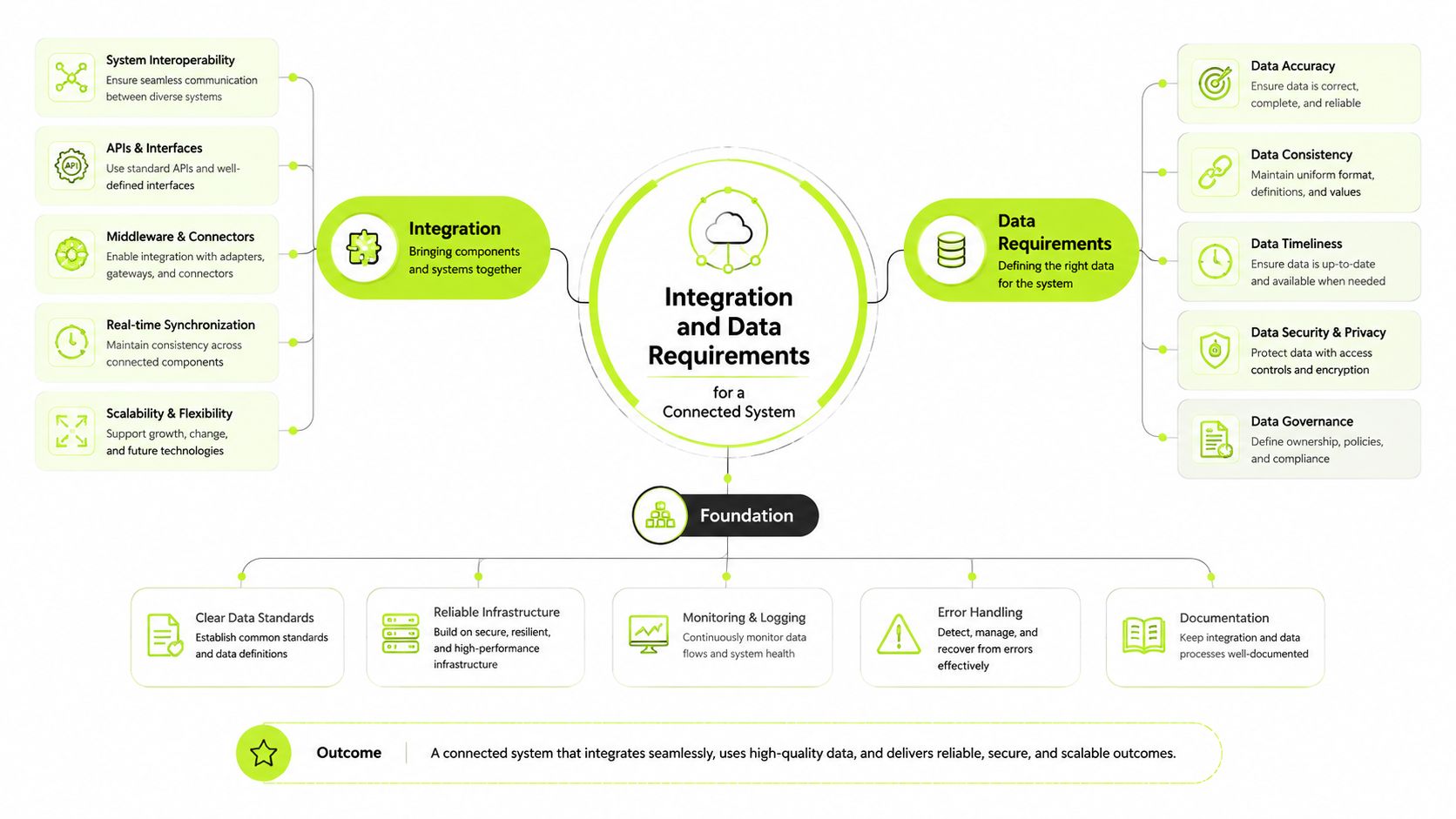
Response speed matters only when the follow-up is recorded and owned. A chatbot that works alone creates another inbox, leaving staff unsure where an enquiry came from, what the visitor requested, or whether someone has replied.
The CRM should hold the enquiry record. Capture the source, contact details, playing interests, location, membership status, transcript, and next action. A UK golf-club CRM implementation case study shows how logging sales communications against customer profiles can support membership responses and follow-up tasks.
Connect the systems before scaling traffic
Start by mapping the path from first message to completed outcome:
- CRM: Create or update the contact, save the transcript, apply tags, assign an owner, and trigger the next task.
- Booking system: Display current tee-time availability and confirm bookings without manual reconciliation.
- Advertising platforms: Preserve campaign and source data from Google Ads, Facebook, and Instagram.
- Email and SMS: Begin the correct nurture or reminder sequence after consent and contact details are recorded.
- Reporting: Link the first interaction with visits, applications, bookings, and revenue outcomes.
Keep the record practical. Store the timestamp, channel, transcript, qualification status, assigned staff member, and next action. A simple, consistent structure beats a larger database that staff cannot search or maintain. If a conversation disappears after the chat ends, it cannot support follow-up or reporting.
Clubs assessing broader automation can review integrations for AI agents, then test each proposed connection against their existing booking, membership, and communication tools. The question is not how many systems an agent can access. It is whether the right data reaches the right person quickly.
A golf club CRM should reduce fragmentation rather than add another dashboard. Prioritise reliable connections to golf-specific platforms such as BRS Golf, ClubV1, or Members 1st. If every change needs custom development, maintenance becomes an ongoing operational risk. Assign ownership for data quality, routing rules, and failed integrations before launch.
Implementation Checklist and Vendor Selection Criteria
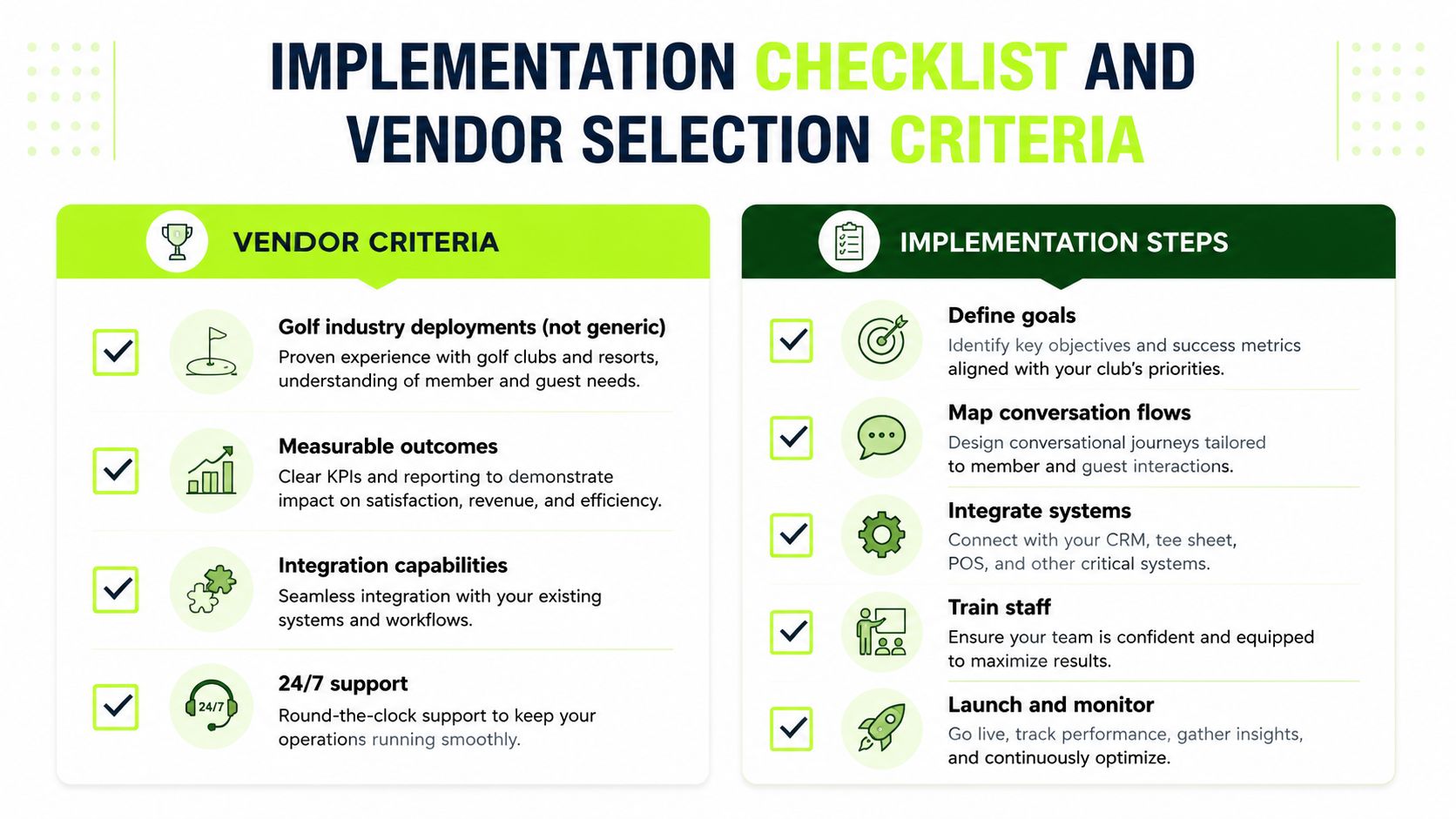
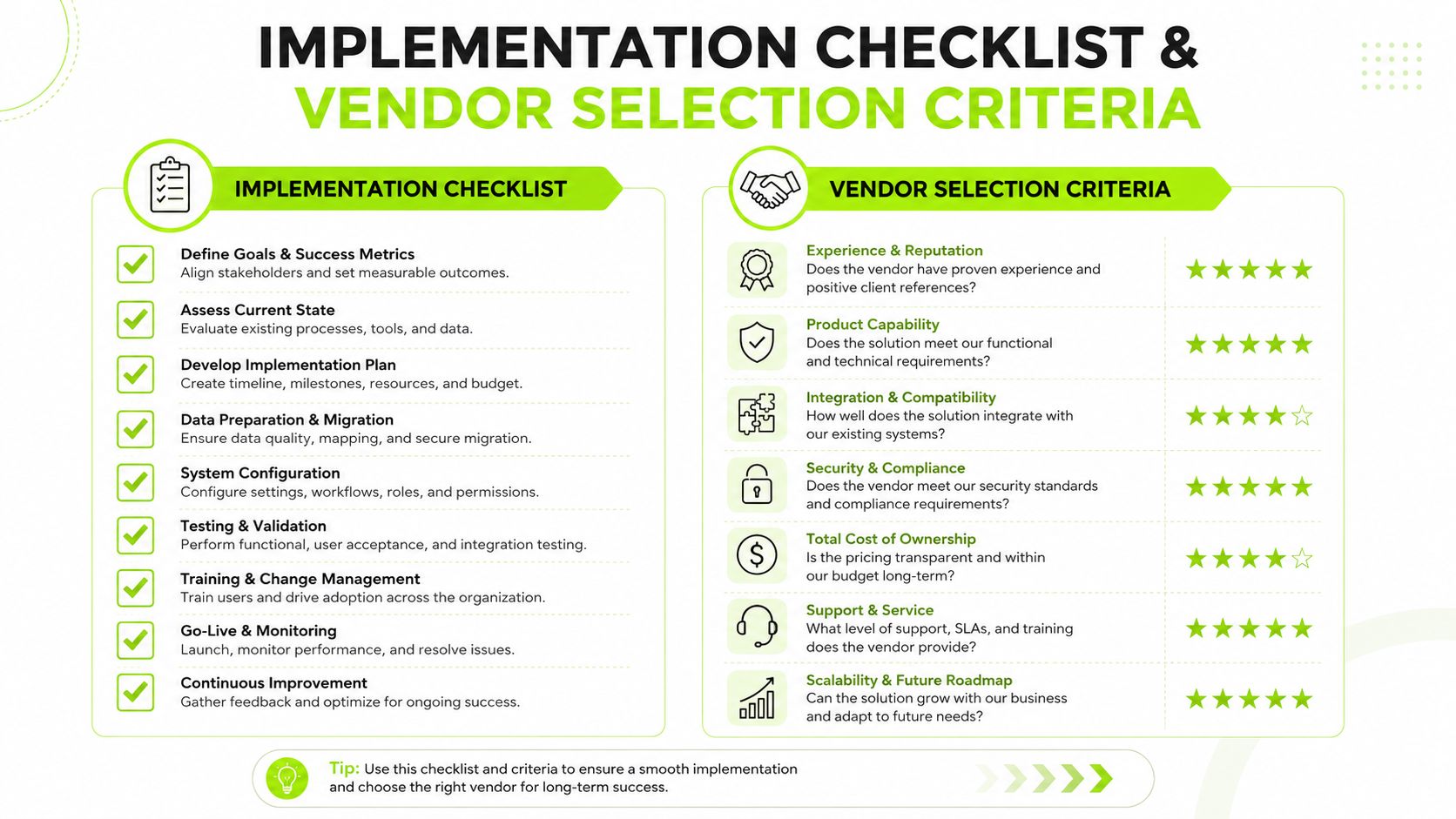
A chatbot earns its place when it improves response time and follow-up discipline, not when its demonstration looks polished. Test it with real club enquiries: membership categories, society bookings, stableford questions, winter rules, pricing changes, and requests that need a person. Ask the vendor to show how each conversation is captured, assigned, monitored, and recovered if nobody acts.
Request evidence from comparable golf operations. A retail or general hospitality case study may show technical ability, but it does not prove the vendor understands the handover between the pro shop, membership office, events team, and reception.
Test the operating model before the software
Use a live evaluation rather than relying on a feature list. Give each vendor the same scenarios and score the results against:
- Golf relevance: Can the vendor demonstrate work with golf clubs or explain the relevant operating processes?
- Conversation control: Can staff change questions, answers, and routing rules without developer support?
- Integration depth: Does the system pass useful records into the CRM and booking engine?
- Language accuracy: Does it understand the terminology members and visitors use?
- Support: Who investigates a misrouted enquiry or failed booking connection?
- Data arrangements: Where are records hosted, how are they protected, and can the club export them?
- Commercial flexibility: What happens if the club changes provider or reduces the scope?
The exit route deserves the same attention as the initial setup. Confirm how the club retrieves conversation records, pauses a flow, removes outdated answers, and transfers ownership if the supplier relationship ends.
Start with one high-value journey, usually membership enquiries. Define the response target, qualification fields, staff owner, and follow-up task before launch. After the club can see whether enquiries are being captured and contacted, extend the system to tee bookings, lessons, or events.
Give one internal owner authority to maintain the workflow. That person should review conversations, record recurring questions, check missed follow-ups, and coordinate changes to pricing or policy information. A phased rollout lets staff learn where qualified leads appear and what action follows, before more complex journeys are added.
Privacy Consent and Staffing Handover Best Practices
Visitors decide whether to trust the club while they are sharing personal information. Consent must therefore match the purpose of collection. Explain what the chatbot requests, why it is needed, how the club will use it, and whether the visitor is requesting a reply or agreeing to marketing.
Collect only information the team can use. Protect conversation records, set retention rules, and restrict access to staff responsible for membership, bookings, events, or customer service. Make the retention decision explicit rather than leaving it to the software's default settings.
Put ownership into the workflow
A handover fails when a conversation reaches a shared inbox without a person responsible for the next action. Define these rules before launch:
- Escalation point: Which questions or situations require human input?
- Destination: Does the context create a CRM record, shared-inbox item, or task?
- Ownership: Which named role accepts the enquiry?
- Priority: Which answers indicate a high-intent prospect?
- Recovery: Who is alerted when the assigned lead remains untouched?
A qualified enquiry left unreviewed for 48 hours should trigger escalation. The target can reflect staffing capacity, but the team must see and measure it. Review missed handovers weekly, identify the cause, and change routing, staffing, or question logic.
The chatbot can accelerate the first response. Only a person-owned process can convert the opportunity.
Tell visitors when automation is handling the conversation and offer a clear route to a staff member. The chatbot should state when it cannot confirm availability, policy, or pricing, then pass the context to the right owner. Transparency protects trust, while disciplined handover prevents captured enquiries from becoming forgotten records.
Real-World Outcomes From UK Golf Clubs
A chatbot's value becomes clear in the operating details. The strongest outcomes come when clubs reduce the time between enquiry and acknowledgement, ask questions that help staff prioritise, and connect every conversation to a CRM record. The weakest outcomes come from installing the same technology without deciding who owns the follow-up.
The wider UK market is already moving towards connected digital operations. A 2026 Golf Business News report citing the Golf Genius Golf Club Software Technology 2025 Report said 72% of UK golf clubs prioritise cloud-based management solutions and 68% say mobile booking is the primary way members interact with facilities. It also reported that clubs using fully integrated software can see a 25% increase in operational efficiency. (Golf Business News) Those figures support an integrated approach, but they don't remove the need for sensible ownership and measurement.
What clubs should measure first
Avoid inventing a success story before collecting a baseline. Record the current response time, contact rate, qualification quality, booked visits, booking completions, and follow-up completion. Then compare chatbot-assisted enquiries with the club's existing routes.
| Club Type | Avg Response Time Before | Avg Response Time After | Membership Tours Booked Monthly | Visitor Rounds Captured from Ads |
|---|---|---|---|---|
| Private member club | Establish from CRM and inbox records | Measure after launch | Track chatbot-attributed bookings | Track only where relevant |
| Resort or hotel group | Establish across each site | Compare by location | Track where membership is offered | Attribute through campaign and booking data |
| Pay-and-play club | Establish from website and phone logs | Measure by enquiry type | Track only where relevant | Compare chatbot-assisted and direct bookings |
The figures in this table are measurement fields, not supplied industry averages. A credible deployment should fill them with the club's own records rather than borrow performance claims from another sector. Readers comparing approaches can also review cxconnect.ai case studies for examples of how automation projects are typically assessed through workflows and outcomes.
A sensible starting configuration is one membership flow, a small set of accurate answers, CRM capture, named ownership, and a defined follow-up sequence. Once staff can manage that reliably, the club can expand into visitor bookings and events without overwhelming the team.
GolfRep works with clubs on lead generation, AI-driven qualification, CRM capture, and structured nurture, so the chatbot supports a predictable pipeline rather than operating as a standalone website feature. Visit GolfRep to discuss an enquiry-handling system built around your club's booking tools, staffing capacity, and membership goals.
Ready to tap into our proven growth system?