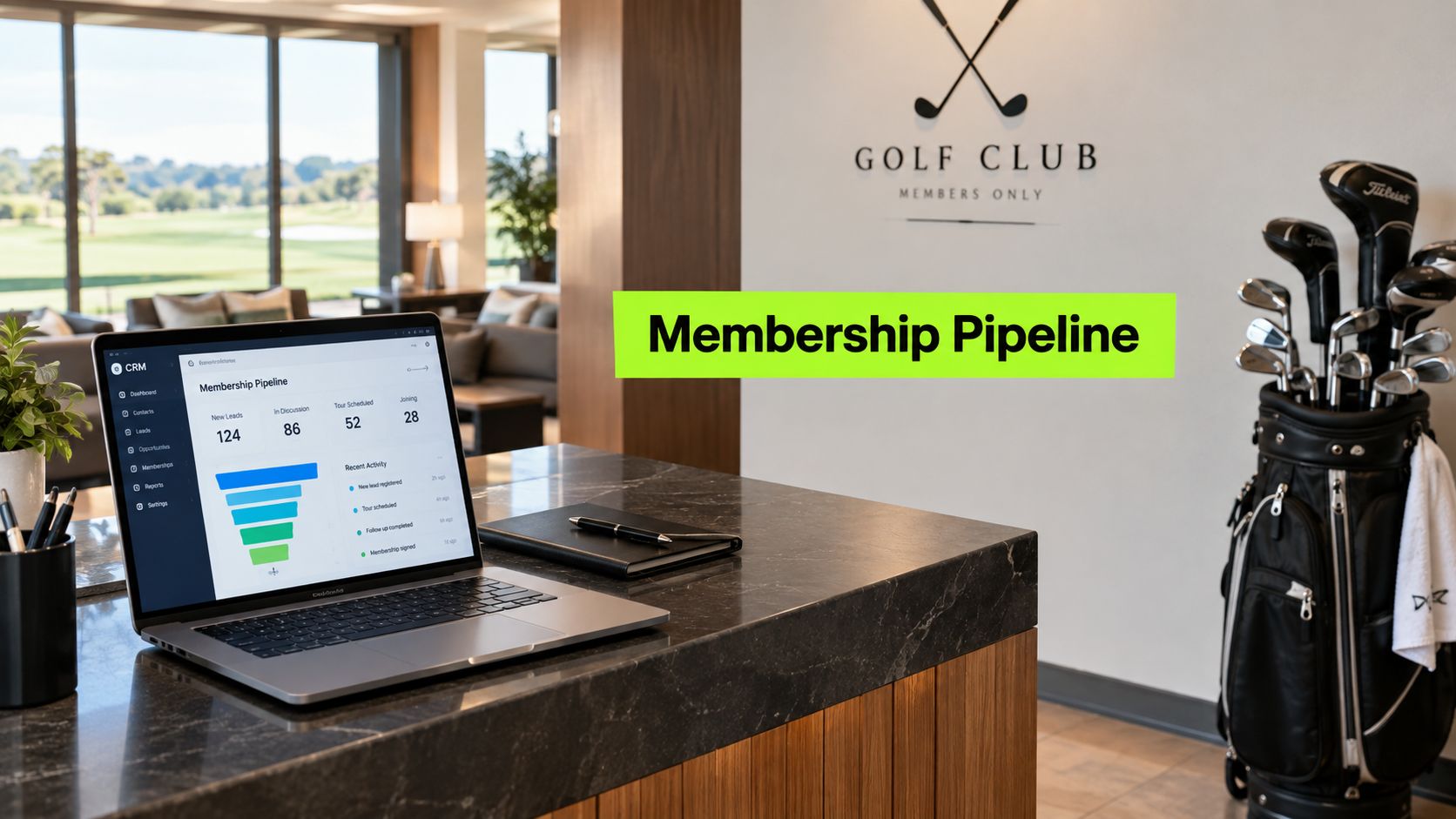
Data Driven Golf Marketing: A Club's Playbook for 2026

The most repeated advice in golf club marketing is also the least useful. Get more leads.
That sounds sensible until you look at what happens inside most clubs. Enquiries arrive through the website, email inbox, phone, social media, or a contact form on a membership page. One gets answered quickly. Another waits until tomorrow because the office is busy. A third never reaches the right person. By the time someone follows up, the golfer has already booked a visit elsewhere.
That isn't a traffic problem. It's a system problem.
Data driven golf marketing matters because it forces a club to stop guessing where demand comes from, which enquiries are worth attention, and what happens after first contact. It replaces scattered admin with a process that can be tracked from first click to booked visit to signed membership.
For most private clubs, the fastest route to better results isn't pouring more budget into ads. It's fixing the conversion path for the interest you already generate. When follow-up is inconsistent, every extra enquiry adds more waste.
Why Most Golf Marketing Fails And It’s Not a Lack of Leads
More enquiries do not fix a weak conversion process. They usually expose it.
Many clubs already have enough demand to grow. The constraint is what happens between first contact and a booked visit. If that path is unclear, slow, or owned by nobody, marketing gets blamed for a sales handling problem.
A membership campaign can drive clicks. A Facebook post can prompt messages. A referral push can bring in calls. None of that helps if the club cannot answer a few basic questions at any point in the week:
- Where did this enquiry come from
- Who owns the follow-up
- How quickly did we respond
- Did the prospect book a visit
- Did they join, pause, or go quiet
Without that visibility, decisions get made on guesswork. Budget gets cut because the campaign "didn't work" when the issue was that the enquiry sat in an inbox for two days or never reached the right person.

The hidden leak in most clubs
The pattern is familiar. A prospect fills in a form on Tuesday. The office is covering visitor bookings, societies, and member queries. Someone plans to reply later. Later becomes tomorrow. By then, the prospect has spoken to another club, or the initial intent has cooled.
Manual follow-up often breaks first for this reason.
It works when enquiry volume is low and one person is unusually organised. It breaks when demand rises, staff are stretched, and the club relies on memory instead of process. More often, the lead just needs structured follow-up.
The common failure points are operational, not creative:
- Inbox dependency: Enquiries sit in shared mailboxes with no clear owner.
- Slow response times: Staff reply around operational work instead of through a set process.
- No nurture sequence: Prospects who are interested but not ready this week get ignored.
- No status tracking: The club cannot tell open enquiries from dead ones.
- No source-to-sale view: Spend gets judged on clicks or feelings, not joins.
Practical rule: If your club cannot see every enquiry, owner, status, and next action in one place, marketing will look weaker than it is.
Why a system beats a campaign
A campaign creates attention. The club still needs a way to capture, route, follow up, and measure every enquiry that attention produces.
That is why a data led growth system matters more than one-off promotion planning. The point is not to collect more names. The point is to build a reliable process that turns interest into conversations, visits, and signed memberships without depending on whoever happens to be free that day.
The trade-off is simple. Ad hoc handling feels flexible because the team can respond however they like. In practice, it creates slow replies, inconsistent messaging, and no clean record of what happened. A structured system takes a bit more setup, but it gives the club speed, accountability, and a way to improve over time.
That shift is what separates clubs that keep "trying marketing" from clubs that build repeatable growth. For a broader view of that model, see these golf club growth strategies built around conversion systems.
What works better than what most clubs do now
The usual setup splits marketing from sales handling. One side generates enquiries. The other side tries to manage them manually around daily club operations.
That handoff is where value gets lost.
A better model is operationally simple:
- Generate qualified interest
- Capture every enquiry in one place
- Assign ownership immediately
- Follow up fast
- Nurture consistently until the prospect decides
- Track outcomes by source, message, and staff action
This is not about adding complexity. It is about removing avoidable failure points.
When a club builds that internal system first, each new enquiry becomes easier to manage and more likely to convert. When it does not, extra marketing spend just feeds a process that leaks.
Building Your Growth Foundation
Most golf marketing problems start before a campaign goes live.
If the club hasn't agreed what counts as a good lead, where enquiry data should live, and how success will be measured, then the campaign result will be hard to trust. You might get attention, but you won't get clarity.
Start with business goals, not vague marketing goals
"More members" isn't specific enough to guide action.
A useful target has to reflect the kind of growth the club wants. That might mean stronger 5-day membership, younger local joiners, more member referrals, better conversion from visitor databases, or stronger winter retention. The point is to set a target that a team can act on.
Good planning usually answers four questions:
- Which membership category matters most
- Which postcode areas matter most
- What counts as a qualified enquiry
- What action should happen next after capture
Those answers shape everything else, from advertising audiences to follow-up timing.
Decide what to measure before you spend
Most clubs look at the easiest numbers first. Clicks, impressions, web traffic, social engagement.
Those figures can be useful, but they don't tell a manager whether the club is building revenue. The metrics that matter sit closer to the sales process.
A practical dashboard often starts with measures like:
- Enquiry volume: How many new prospects entered the system
- Qualified enquiry rate: How many fit the type of golfer you're trying to attract
- Enquiry-to-visit rate: How many progressed to a tour, trial, or meeting
- Visit-to-join rate: How well in-person sales converts
- Response time: How fast the club replies after first contact
- Source quality: Which channels produce joiners, not just clicks
That shift changes behaviour. Staff stop celebrating noise and start managing movement through the pipeline.
Fast replies matter, but so does structured follow-up after the first reply. A quick email with no next step still leaves the lead drifting.
Fix data capture first
A surprising number of clubs still collect incomplete information at the point of enquiry or booking. That weakens every part of the process that comes after.
A 2025 UK Golf Industry Report notes that 68% of private clubs collect less than 40% of guest contact details during bookings, which limits lead qualification and nurture automation and makes it harder to track high-value traffic from first click to revenue (JJ Keegan on the clouded crystal ball).
If a visitor books, plays, likes the course, and leaves with no usable contact record, the club has lost more than a data point. It has lost future sales opportunity.
The CRM isn't optional
Spreadsheets, inbox folders, and handwritten notes don't create a growth system. They create delay.
A centralised CRM gives the club one place to see every enquiry, assign ownership, record actions taken, and trigger follow-up. It becomes the operating layer between marketing and membership sales.
Without that central record, common issues appear quickly:
| Problem | What usually happens |
|---|---|
| Enquiries come through multiple channels | Staff miss or duplicate responses |
| Different people handle leads | Tone and next steps vary wildly |
| No central history | Prospects repeat themselves and lose trust |
| No source tracking | Budget decisions rely on opinion |
Clubs that want practical examples of how this thinking applies at a strategic level can review golf club growth strategies.
Keep the setup plain and usable
The best data driven golf marketing setup isn't the most technical one. It's the one staff will use every day.
That usually means:
- Simple forms that collect the details needed for follow-up.
- Source tracking so each enquiry carries campaign and channel information.
- Clear pipeline stages such as new enquiry, qualified, visit booked, visited, proposal sent, joined, lost.
- Automatic task creation when a lead needs human follow-up.
- Basic reporting that managers can read without specialist help.
Clubs often overcomplicate things here. They try to build a perfect marketing machine and end up using none of it. Better to create a disciplined, visible process that fits how the club operates.
What not to do
A weak foundation usually comes from one of these habits:
- Collecting too little data: The club can't segment or follow up properly.
- Collecting too much data: Long forms reduce submissions and create admin burden.
- Leaving ownership unclear: Everyone assumes someone else replied.
- Treating CRM as storage only: A record system without actions won't improve conversion.
The foundation is boring compared with advertising. It's also where most profitable growth starts. If the club can track every enquiry, respond with consistency, and see where leads stall, the rest of the marketing effort becomes far easier to improve.
Attracting and Capturing High-Value Enquiries
More enquiries rarely fix a golf club's growth problem. Better-fit enquiries do.
A club gets stronger results when its marketing attracts golfers the team can convert. That means people who are local enough to visit, financially aligned with the offer, and at the right stage to consider joining. Volume without fit creates admin, slows response times, and clogs the pipeline with names that never had a real chance of converting.
Build targeting from the members you want more of
Useful targeting starts inside the club.
Review the members who stay, spend, and use the club in ways that support long-term value. In one club, that might be younger professionals who play before work and want flexible access. In another, it might be established full members who bring guests, use the bar, and take part in competitions. Some clubs also find opportunity in recent visitors, academy players, or past enquiries who match the right profile but never booked a visit.
The point is simple. Target from evidence already in your system, not from broad assumptions inside an ad platform.
Useful signals include:
- Postcode proximity
- Membership type
- Playing frequency
- Seasonal engagement
- Visitor to member pathways
- Response to previous offers
That approach improves lead quality before the enquiry is even submitted. It also gives the club a better chance of matching the follow-up to the golfer's likely intent.
Good messaging filters for fit
Clubs often write ads to sound impressive. That usually brings clicks from people who like the idea of the club, not people ready to take the next step.
Stronger campaigns make the offer easy to self-qualify against. A flexible membership ad should help a busy working golfer decide if the structure fits their week. A member guest campaign should make the path from visit to enquiry obvious. An off-peak offer should speak to players who value weekday access, not attract complaints from people who only want peak times.
Clear messaging does part of the sales job early. It screens in the right prospects and reduces wasted follow-up.
Better enquiries come from clearer positioning, not broader appeal.
Campaigns work better when each one has a narrow job
One generic membership advert usually produces mixed intent. Clubs get cleaner data and better follow-up outcomes when campaigns are split by audience and objective.
Formats that tend to work include:
- Membership consideration campaigns: For local golfers actively comparing clubs.
- Trial or visitor-to-member campaigns: For players who already know the course and need a reason to return.
- Category-specific campaigns: For flexible, 5-day, academy, or family membership routes.
- Dormant enquiry reactivation: For people who showed interest before but never booked a visit.
That structure matters because it improves what happens after capture. If the club knows which message triggered the enquiry, staff can reply with more relevance, qualify faster, and avoid treating every lead the same.
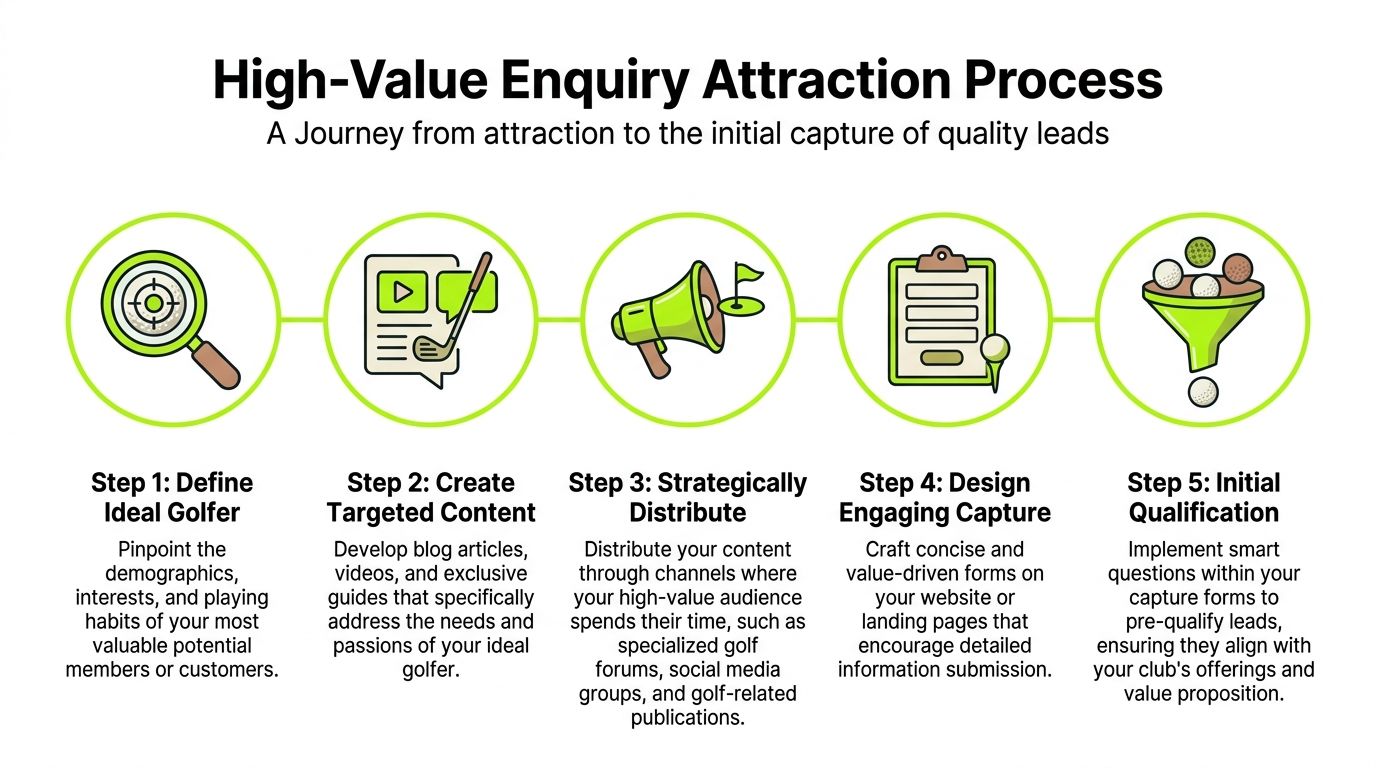
The landing page should prepare the handover, not just collect a form
Many clubs lose quality at the point of capture. The advert is specific, then the click goes to a generic page full of competing paths, long copy, and a form that asks either too much or too little.
A good capture page does four things well:
Presents one clear offer
Keep membership, green fees, society bookings, and events on separate paths where possible.Collects useful information
Name, contact details, membership interest, and one or two qualifiers are usually enough for an informed first response.Sets the next step
Tell the golfer what happens after submission. A call, an email, a visit invitation, or a choice of times all work if the promise is clear.Feeds the club's system directly
Manual copying from inbox to spreadsheet to CRM creates delays and missing context.
Clubs often mistake lead capture for lead readiness. A form submission is only valuable if it arrives with enough context for someone to act on it properly.
Add light qualification so staff know how to respond
A short form should still help the club sort urgency and fit.
Useful prompts include whether the golfer has played the course before, what type of membership they are considering, and when they hope to join. Those details help the club decide who needs a call today, who should be invited for a visit, and who belongs in a longer nurture track. For clubs reviewing their wider process, this guide to golf club marketing automation shows how capture and follow-up work better when they are designed together.
An integrated option like GolfRep can sit alongside the club's own CRM and campaign setup, combining targeted advertising with structured capture and automated qualification so leads arrive ready for action rather than sitting as raw form fills.
What usually weakens results at this stage
High-value enquiry capture tends to break down when clubs:
- Send traffic to the homepage
- Use forms that don't feed into the CRM
- Ask too many questions too early
- Fail to pass source data into the lead record
- Promise a response but offer no clear next step
Attraction and capture need to work as one system. The advert sets the expectation. The page confirms relevance. The form gives the team enough information to respond properly. When those pieces line up, the club gets fewer wasted enquiries and more genuine sales conversations.
Automating Your Lead Conversion Engine
The biggest gap in golf club marketing isn't ad performance. It's what happens in the first few hours after an enquiry arrives.
Most clubs still rely on a person noticing the lead, deciding what to do, and finding time to do it. That approach fails for the same reason manual diary systems fail. People are busy, priorities shift, and no two replies are handled in quite the same way.
Automation doesn't remove the human relationship. It protects it.
Speed matters, but structure matters more
A quick response is valuable because it confirms the enquiry has been received and keeps momentum alive. But a fast generic reply isn't enough.
The first stage of an automated conversion engine should do three jobs at once:
- Acknowledge the enquiry immediately
- Set expectation for the next step
- Collect or confirm useful qualification details
That could be an email, SMS, or both, depending on the channel and the prospect's preference. The wording should sound like the club, not like software. Short, clear, and useful.
For example, an initial response might:
- confirm the club has received the membership enquiry
- explain when a team member will follow up
- offer a link to book a visit or call
- include one or two prompts that help identify intent
That combination reduces drift. The lead knows what happens next, and the club gains better information before a staff member gets involved.
Build a nurture sequence that moves people forward
Most prospects don't join from one touchpoint. They need reassurance, context, and a reason to take action.
A practical nurture flow usually mixes several message types over time:
| Message type | Purpose |
|---|---|
| Welcome response | Confirms receipt and next step |
| Club introduction | Explains the membership fit and playing experience |
| Social proof or club story | Builds confidence and relevance |
| Visit prompt | Encourages a tour, trial round, or conversation |
| Objection handling | Answers questions about category fit, commitment, or timing |
| Follow-up reminder | Brings the enquiry back into view without pressure |
The mistake many clubs make is sending one polite reply and then waiting. If the prospect doesn't respond, the lead is treated as cold. In reality, the lead often just needs more structured follow-up.
Why automated follow-up outperforms ad hoc manual contact
Automation creates consistency. Every lead gets the same baseline standard of response, regardless of whether the office is quiet, the secretary is on leave, or the membership team is tied up on competition day.
That consistency matters operationally as much as commercially.
For multi-site operators such as Macdonald Hotels & Resorts, a centralised CRM with automated follow-ups across 20+ UK venues scaled lead volume by 60% and reduced manual effort by 75%. In the same source, Downes Crediton Golf Club achieved a 22% conversion rate from inquiry to sign-up using proven nurture sequences (Golf course guide to marketing in 2025).
Those figures don't suggest clubs should automate everything. They show what becomes possible when follow-up is treated as a system rather than a series of reminders in someone's head.
Managers looking at how automated workflows fit into the broader sales process can explore golf club marketing automation.
A lead that doesn't reply after the first message isn't necessarily lost. More often, the club just stopped guiding the decision.
What a sensible sequence looks like
The best sequences don't feel relentless. They feel organised.
A membership enquiry sequence might include:
- Immediate confirmation with a clear expectation and booking option.
- A next-day message focused on the club's fit for the prospect's playing pattern.
- A later follow-up sharing key membership information in plain English.
- A visit invitation with simple scheduling choices.
- A re-engagement message for leads that went quiet.
The exact timing matters less than the discipline. Every message should answer a likely question or remove a small piece of friction.
What not to automate blindly
Poor automation can be just as damaging as no automation.
Avoid:
- Overlong sequences that keep sending after clear disinterest
- Generic copy that sounds nothing like the club
- No handoff rules between automation and staff
- No segmentation by enquiry type or level of intent
A strong conversion engine uses automation for reliability, then brings people in where judgement and personal contact matter most. That is the balance clubs need. Machines handle immediacy and consistency. Staff handle trust and commitment.
From Data to Decisions The Optimisation Loop
The clubs that improve fastest are not always the clubs spending more on marketing. They are usually the ones that can see where an enquiry slows down, why it slows down, and who needs to act next.
That matters because the primary constraint is rarely lead volume on its own. It is the club's ability to turn scattered activity into clear decisions. If website data sits in one place, lead notes sit in another, and revenue sits in finance, the team ends up debating channels instead of fixing the point where prospects stop progressing.
The underlying principles are straightforward: measure, examine, adapt.
Build a dashboard that answers management questions
A useful dashboard helps a manager decide what to change this week. It does not exist to report vanity numbers at the end of the month.
That means every metric needs a clear owner and a clear follow-up action. If response time slips, someone should know who is picking up new enquiries. If visit-to-join rate drops, someone should review the club tour, the follow-up, or the offer being presented.
A sensible starting view looks like this:
| KPI Category | Metric | What It Measures |
|---|---|---|
| Lead flow | New enquiries | Total inbound interest entering the pipeline |
| Lead quality | Qualified enquiries | How much of that interest fits the club's target profile |
| Sales activity | Response time | How quickly the team reacts to new enquiries |
| Sales progression | Enquiry-to-visit rate | Whether initial follow-up is moving prospects to a meaningful next step |
| Conversion | Visit-to-join rate | How well visits turn into memberships |
| Channel performance | Source by joiner | Which channels create members |
| Pipeline health | Stage ageing | Where leads are stalling in the process |
| Revenue view | Membership value by source | Which activity is driving the strongest commercial outcome |
Many clubs sharpen their reporting at this point. They stop asking, "How did the campaign do?" and start asking, "Did this source produce qualified visits, and did the team convert them?"
Match the metric to the decision
Trying to improve everything at once usually creates noise.
Low enquiry volume points to a visibility, targeting, or offer problem. Healthy enquiry volume with weak visit booking points to a follow-up problem. Strong visits with weak join rates often point to the sales conversation, the club experience, or a mismatch between what the marketing promised and what the prospect found.
That is why central tracking matters so much. It lets the club separate marketing issues from process issues. In practice, that saves money because weak channels can be reduced, and it saves good opportunities because stalled leads become visible before they go cold.
If you want a clearer commercial lens on this, the ROI of golf club marketing is worth reviewing.
Test close to the bottleneck
Testing has value, but only when it is tied to a specific problem in the pipeline.
If form completion is poor, test the form. If visit booking is weak, test the call to action or the follow-up message. If the club attracts plenty of enquiries from people who were never a realistic fit, test audience targeting or the language on the landing page.
Good testing areas include:
- Ad creative: Course image versus member lifestyle image
- Headline language: Heritage-led wording versus convenience-led wording
- Form layout: Fewer fields versus slightly stronger qualification
- Email subject line: Visit invitation versus membership information prompt
- Call to action: Book a tour versus speak to the membership team
Discipline matters more than volume. Change one variable, keep the rest stable, and wait long enough for a fair read.
Spot operational problems early
A visible pipeline gives early warning before poor habits become expensive ones.
Look closely at patterns such as:
- Strong clicks but weak form completion
- Healthy enquiries but slow first response
- Many visits booked but few attended
- High interest from the wrong postcode areas
- Leads sitting in one CRM stage without movement
Each pattern points to a different fix. Weak form completion may mean the page asks too much too soon. Slow response usually means ownership is unclear. Missed visits often point to poor reminders or low commitment before the appointment. Wrong-area enquiries may mean the targeting is too broad. Stalled CRM stages usually mean the team has no rule for what happens next.
That level of visibility changes how a club improves. The conversation becomes more specific, more commercial, and much easier to act on.
Why this loop matters
A good optimisation loop improves more than campaigns. It improves how the club runs.
Once source, speed, progression, and revenue are visible in one place, managers can judge performance by outcome, not by opinion. Budget decisions get sharper. Staff handoffs get clearer. Follow-up becomes easier to manage because the club can see where discipline drops.
That is what makes data driven golf marketing useful in practice. The value is not in collecting more numbers. The value is in building a system that shows where conversion is breaking down, so the club can fix the right thing next.
Your Next Steps Towards Predictable Growth
The clubs that grow most consistently don't rely on bursts of activity. They build a process they can repeat.
That usually starts with a mindset shift. Stop treating marketing as a monthly task centred on adverts, social posts, or a single open event. Start treating it as a connected system that handles demand from first contact to signed member.
Three changes that move a club forward
The first is visibility.
If enquiries are spread across inboxes, paper notes, and memory, the club cannot manage performance properly. A central record gives everyone the same view of what is coming in and what needs attention.
The second is structured follow-up.
Most clubs already generate more interest than they convert. The difference between erratic and predictable growth often sits in response speed, clear ownership, and consistent nurture.
The third is refinement.
Once the pipeline is visible, the club can improve it. Weak messages can be changed. Slow handoffs can be fixed. Channels that create noise can be cut back. Channels that produce visits and joins can be prioritised.
What a practical first month can look like
This doesn't need a large internal marketing department. It needs order.
A sensible starting sequence is often:
- Audit current enquiry routes: Website forms, phone calls, visitor bookings, email inboxes, social messages.
- Create one central pipeline: Every lead should land in the same place with a clear owner.
- Define the first response standard: What happens immediately after an enquiry arrives.
- Map a simple nurture flow: Enough touchpoints to keep warm prospects moving.
- Review outcomes weekly: Not to produce reports for their own sake, but to remove friction.
That is manageable even for committee-led clubs and lean operations teams.
The trade-off clubs need to accept
Systematic growth asks for discipline.
It means giving up some habits that feel comfortable, such as relying on staff memory, checking only vanity metrics, or believing every sales conversation must start from scratch. In return, the club gets a process that is easier to supervise and easier to improve.
Some managers resist this because it sounds technical. In reality, the underlying principles are straightforward:
- Capture the enquiry properly.
- Respond without delay.
- Keep following up with purpose.
- Track what happened.
- Improve the weak point.
That's all a growth system is.
Clubs don't need more marketing theatre. They need fewer dropped enquiries, clearer ownership, and a better line of sight from interest to revenue.
Why this approach holds up
Golf clubs operate in a setting where attention is fragmented and staffing time is limited. The old model of waiting for prospects to chase the club doesn't hold up well anymore. People compare options quickly. They expect timely replies. They drift if nobody guides them.
A system handles that reality better than heroic individual effort.
It also reduces pressure on the manager. When enquiry handling depends on one person being available and remembering each next step, growth becomes fragile. When the process is built into the club's operating rhythm, results become steadier.
The broader point
Predictable growth doesn't come from a single ad platform, a flashy campaign theme, or a more persuasive brochure. It comes from combining three things well:
- A solid data foundation
- A reliable conversion engine
- An optimisation habit
Clubs that build those three elements usually stop asking, "How do we get more leads?" and start asking better questions.
Which source produces the right kind of golfer? Where do enquiries stall? How fast are we responding? Which membership pathway converts best? What should we improve next?
Those are the questions that lead to better results.
If your club wants to move from reactive marketing to a more predictable growth system, GolfRep helps golf clubs build the underlying process around enquiry capture, follow-up, CRM visibility, and conversion tracking so marketing activity turns into something the club can manage.
Ready to tap into our proven growth system?