Golf Club Waiting List: The Ultimate Playbook for 2026
A long waiting list can signal demand, but it can also hide weak process. In UK club-market reporting, 70% of prospects won't join a club if the wait is 12 months or longer when they aren't kept engaged, and monthly check-ins are recommended to prevent the list turning into dead demand, as noted in Capstone Hospitality's waitlist guidance.
That changes the conversation. A golf club waiting list isn't valuable because it is long. It's valuable when the club can see who is on it, qualify intent, communicate clearly, forecast movement, and convert names into membership revenue without creating admin drag or committee disputes.
Your Waiting List Is Not the Asset You Think It Is
Many clubs still treat the waiting list like a badge of honour. A long queue looks like prestige. It gives the committee comfort and suggests pricing power.
But a spreadsheet full of names is not the same thing as a pipeline.
A recent UK survey found the average waiting list reached 122 prospective members per club, up 53% from the previous year's average of 53, and 53% of clubs reported that they currently maintain a waiting list, according to Golfshake's reporting on waiting lists and joining fees. That is a clear demand signal. It is also a warning. More clubs are carrying more prospective members than before, yet many are still managing them with inboxes, notes, and manual spreadsheets.
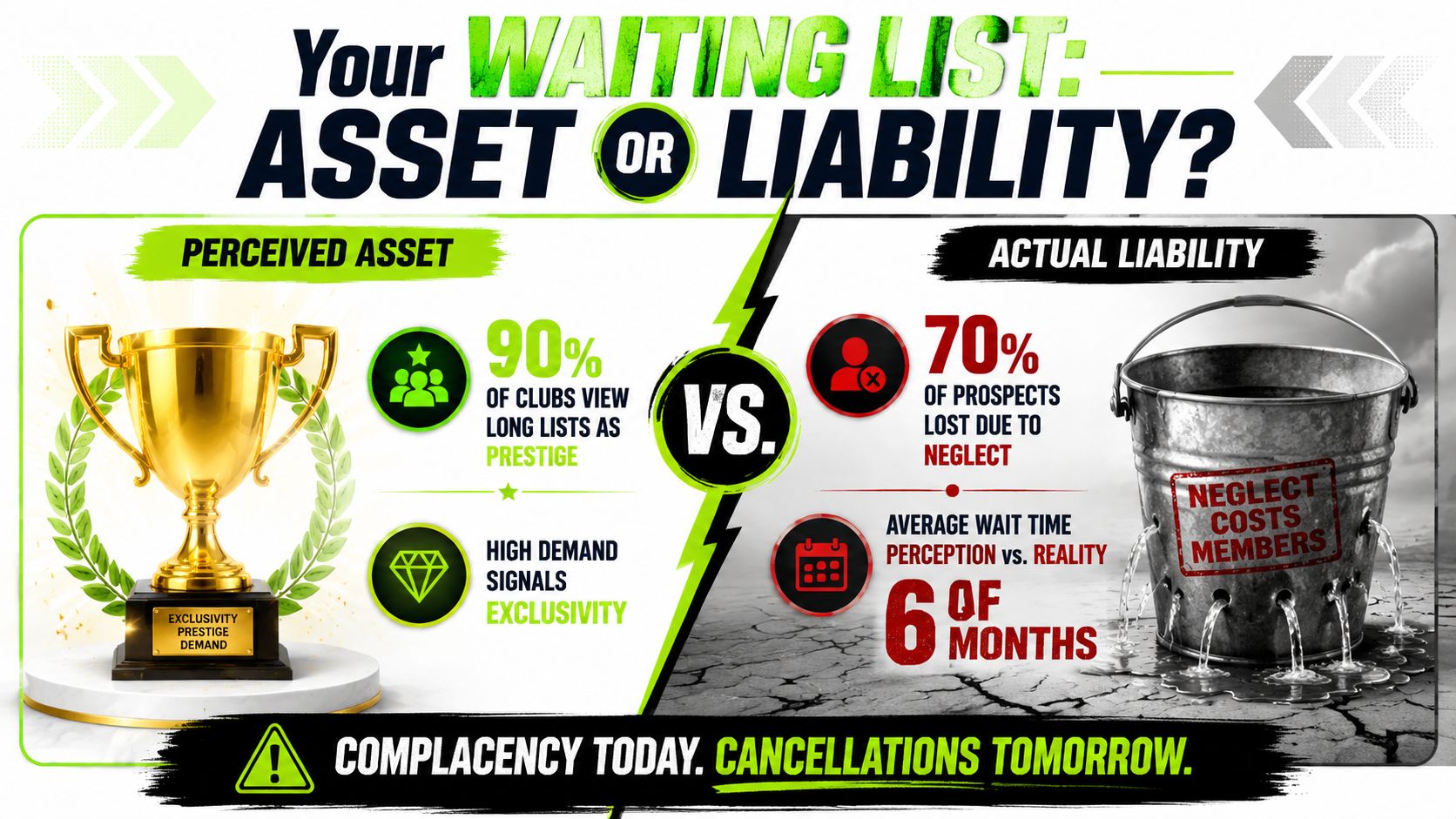
What clubs think they have
On paper, the list looks healthy:
- Strong demand: Plenty of golfers want in.
- Pricing confidence: Scarcity supports premium positioning.
- Future security: There should be a pool of future members ready to convert.
That is the perceived asset. It feels safe because names are sitting there.
What many clubs actually have
In practice, the operational picture is often much messier.
- No lead visibility: Nobody can answer who enquired first, who has paid a deposit, who is still active, or who has gone cold.
- Slow response times: Prospects wait for replies because responsibility sits with one busy secretary or a volunteer committee member.
- No conversion tracking: The club doesn't know how many enquiries become paid members, or how long that path takes.
- Weak expectations management: Prospects hear "we'll be in touch" instead of receiving a clear status, likely timeline, and next step.
Practical rule: If your team can't open one system and instantly see list position, last contact, interest level, and likely conversion timing, you don't have a managed waiting list. You have unmanaged demand.
That matters because the challenge for most clubs isn't generating enquiries. It's handling them properly once they arrive. A golf club waiting list becomes a liability when the club cannot distinguish between genuine buyers and passive names, cannot forecast openings, and cannot maintain trust during the wait.
The shift that matters
The clubs that handle this well stop thinking in terms of a queue and start thinking in terms of a revenue pipeline. That means every prospect has a stage, an owner, a communication history, and a defined next action.
Once you make that shift, the waiting list stops being an admin burden and starts becoming something far more useful: a predictable feeder into future membership.
Designing a Fair and Effective Waiting List Policy
A club can't automate confusion. If the rules are vague, the process will be inconsistent no matter what system sits underneath it.
The strongest golf club waiting list policies are boring in the right way. They are easy to explain, easy to defend, and easy to administer when pressure comes from members, families, referrers, and the committee.
Start with your membership ceiling
Before adding names, define the hard limit for each relevant category of membership. If there is no clear ceiling, the list has no real meaning. It becomes a holding area for hopefuls rather than a structured route to admission.
That ceiling should be practical, not aspirational. It needs to reflect tee sheet pressure, competition access, social use, and the actual member experience you want to preserve.
A simple policy framework usually answers these points:
| Policy area | What the club should define |
|---|---|
| Membership cap | The maximum number of active members in each category |
| Entry criteria | Who can join the list and how |
| Priority rules | Whether some prospects move ahead under defined conditions |
| Deposit terms | Whether a deposit is required and what it secures |
| Review process | Who approves movement and how often it is reviewed |
| Communication standard | What the prospect will be told and when |
Make prioritisation explicit
Many disputes start because clubs internally operate one set of rules and publicly describe another. If referrals, family links, junior transitions, or local residency affect priority, state it clearly.
You don't need an overly legal document. You do need language that a prospect can understand on first reading.
Good policy avoids hidden discretion. That doesn't mean there can be no exceptions. It means exceptions must be governed.
If members think the list is one thing and prospects discover it's another, trust disappears fast.
Decide what the deposit is for
A deposit can help qualify intent. It can also create friction if the terms are unclear.
Some clubs use deposits to confirm a prospect wants active consideration rather than casual interest. Others prefer no deposit and focus on regular qualification through conversations and updates. Either route can work if the club explains the terms in plain English.
Consider the trade-offs:
- Refundable deposit: Lower perceived risk for the prospect, but more administration if the list changes often.
- Non-refundable deposit: Stronger intent filter, but it can create objections if the wait is uncertain or communication is poor.
- No deposit: Easier top-of-funnel capture, but more weak-intent names on the list.
The right answer depends on your club's positioning, demand profile, and admin capacity. What doesn't work is taking money without defining whether it secures list position, confirms seriousness, or grants any interim access.
Write the policy for the person receiving it
Most clubs write policies from the club's point of view. The better approach is to write for the prospect.
That means answering the questions they have:
- Where do I stand?
- How is movement decided?
- What happens if I change my mind?
- Who will update me?
- Can I experience the club while I wait?
A fair policy does more than reduce complaints. It improves conversion because it signals professionalism from the first interaction. Prospects are far more likely to stay engaged when the process feels orderly and credible.
Moving Beyond the Spreadsheet with a CRM
Spreadsheets survive in clubs because they are familiar. They also create most of the problems people later call "conversion issues".
The spreadsheet itself isn't the strategy. It's just a static file. It doesn't tell you who needs a follow-up today, which prospect attended an open event, who has stopped replying, or which category is likely to open next.
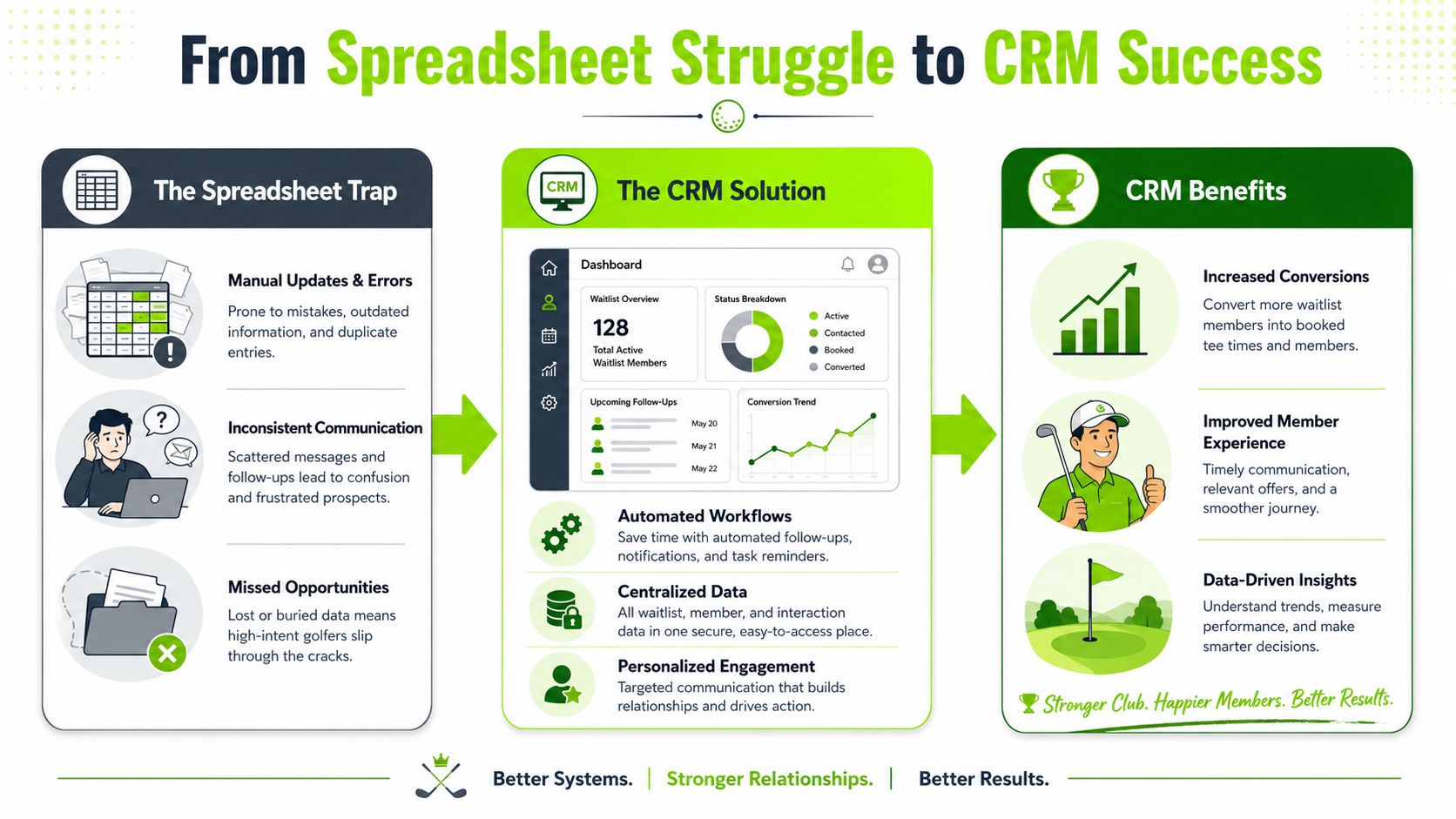
Where spreadsheets break down
A manual list usually fails in predictable ways:
- Version confusion: Different staff members hold different copies.
- Missing context: Notes sit in inboxes, not beside the record.
- No workflow: Nothing prompts the next action.
- No accountability: Nobody owns each prospect from enquiry through conversion.
- Poor reporting: Committee updates depend on someone manually rebuilding the story each month.
These aren't software problems. They are visibility problems.
What a CRM changes
A CRM gives the club one operational view of every prospect. It becomes the place where the enquiry is captured, the waiting-list status is assigned, communications are logged, and follow-up tasks are triggered.
That lets management answer practical questions quickly:
- Which prospects joined the list this month?
- Who hasn't been contacted recently?
- Which prospects are highly engaged?
- Who paid a deposit but hasn't attended a visit?
- Which membership categories are building pressure?
This is why a CRM matters for a golf club waiting list. It doesn't just store contacts. It creates structure around them.
For clubs comparing options, a useful reference point is this guide to golf club CRM software, which outlines what a purpose-built setup should help a membership team do.
The minimum viable CRM setup
Clubs don't need a bloated system. They need a workable one.
A practical setup should include:
| CRM element | Why it matters |
|---|---|
| Lead source tracking | Shows where demand originates |
| Status stages | Separates enquiry, qualified lead, waitlisted prospect, active opportunity, and member |
| Task automation | Stops prospects from being forgotten |
| Contact history | Gives any staff member full context |
| Segmentation | Allows tailored communication by membership type, intent, or timeline |
| Dashboard reporting | Gives the committee a live operational picture |
A waiting list becomes manageable when every prospect has a visible stage and a next step.
One option clubs use in this area is GolfRep, which combines lead capture, CRM-based follow-up, and structured nurture workflows so enquiries don't disappear between first contact and eventual membership. The point is not the brand. The point is that a system must own the process, rather than relying on memory and manual chasing.
How to Nurture and Monetise Your Waitlist
A golf club waiting list only has value if it keeps people warm and moves them toward revenue. Left alone, it turns into stale data, weak forecasts, and missed joining fees.
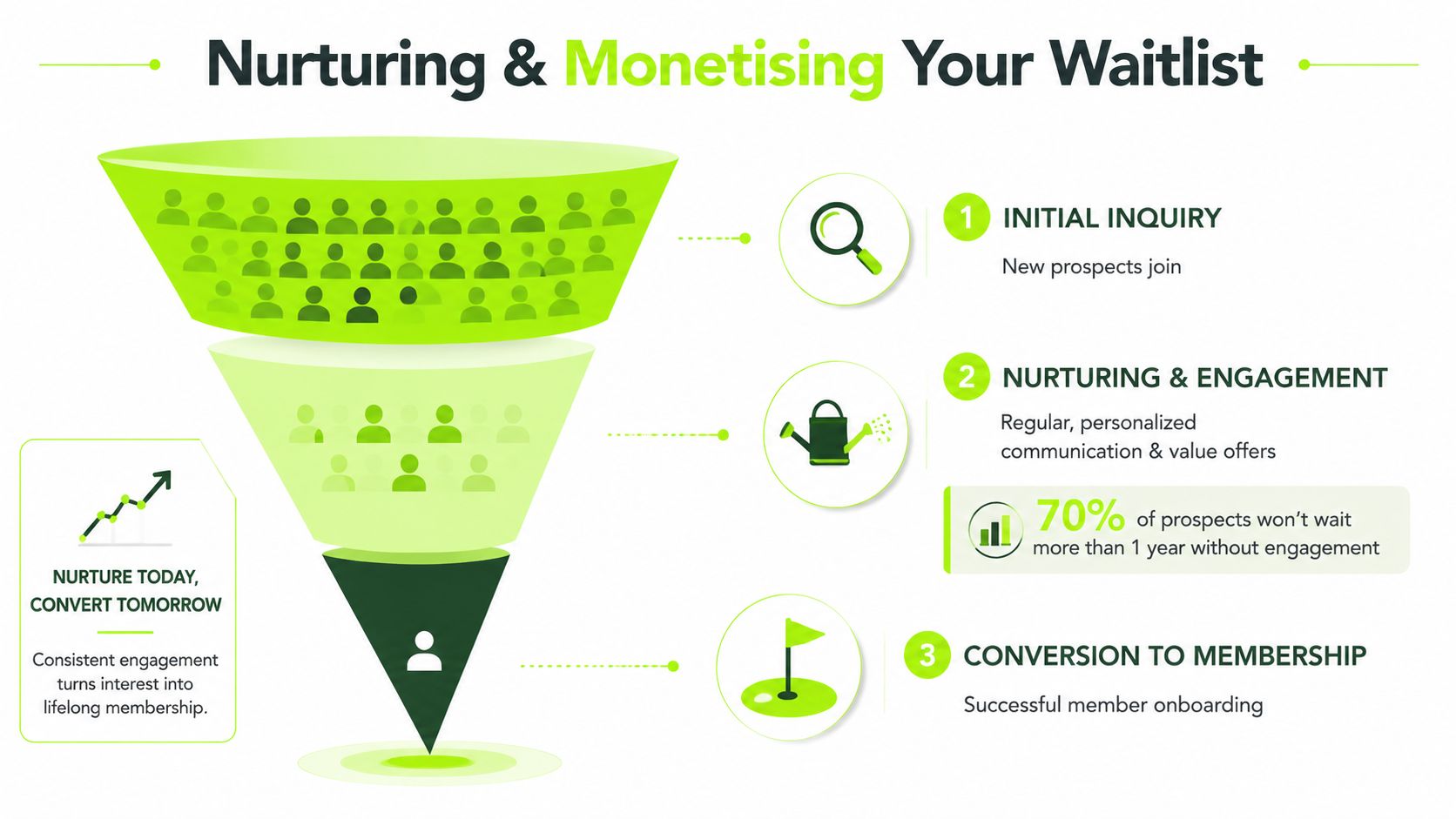
A prospect who has asked to join is not asking for generic newsletters. They want reassurance that the club runs a fair process, remembers their interest, and has a credible path from enquiry to offer. If they hear nothing for months, they do not stay neutral. They drift, buy elsewhere, or mentally downgrade your club from serious option to nice idea.
That is why nurture should be designed as a pipeline, not treated as occasional admin. The job is to maintain intent, qualify demand, and create paid touchpoints that increase the chance of a full conversion later.
Follow one prospect through the system
Take a common scenario. A prospect plays as a guest, enquires the same week, then learns that the membership category they want is currently full.
A weak process puts them on a list, sends a courtesy email, and waits for a vacancy. A working process does more. In the first few days, the club confirms where they sit in the process, explains the rules clearly, and records the factors that matter: target category, likely timing, household details, playing frequency, and level of urgency. Over the next few months, the club keeps contact based on intent, not guesswork.
The difference is commercial. Clubs that do this well know who is still serious, who is cooling off, and who is ready to convert the moment a place opens.
What nurture should actually include
Good nurture has a job to do. Every message should either reduce uncertainty, strengthen commitment, or generate revenue during the wait.
A practical sequence usually includes:
- Process updates: Clear confirmation that the prospect is still active, what stage they are in, and whether expected timing has changed.
- Reason-to-believe content: Course projects, fixture highlights, clubhouse improvements, member stories, or short updates that reinforce the value of joining.
- Participation offers: Open days, beginner clinics, academy sessions, hosted rounds, and social events where policy allows.
- Qualification checks: Simple prompts that confirm interest, budget, preferred category, and whether their circumstances have changed.
- Conversion triggers: Specific follow-up when a prospect attends an event, replies to an email, watches a video, or requests more detail.
This should not rely on staff memory. A CRM should schedule the sequence, trigger follow-up tasks, and change the path based on behaviour. If someone engages twice in 30 days, they need a different next step from a contact who has ignored six messages.
One sentence matters here. Silence is interpreted as indifference.
Monetisation without weakening the main offer
Club managers often worry that selling to waitlisted prospects will dilute full membership. That risk is real if interim products are poorly structured. It is manageable if the offer is designed to support the sale, not replace it.
The test is simple. An interim product should increase familiarity, frequency, and commitment while preserving a clear gap between limited access and full membership.
Options that can work include:
- Restricted interim access: Off-peak or tightly defined playing rights that protect member availability.
- Academy and coaching packages: Especially useful for newer golfers, juniors, and families who want to build a relationship with the club before a place opens.
- Guest access programmes: Easier hosted booking routes that keep prospects using the course within club rules.
- Event access: Selected social or club-introduction events that help prospects build attachment before they join.
There is a real trade-off. Make the interim offer too weak and it does not generate revenue or commitment. Make it too comfortable and you create a substitute for membership. The policy needs pricing, restrictions, expiry rules, and a clear conversion path baked in from the start.
Use better formats, not just more touchpoints
Many clubs still send long blocks of text and call that nurture. Response rates usually tell a different story.
Short video works well for waitlisted prospects because it reduces uncertainty quickly. A 45-second update from the manager about membership timing, course works, or upcoming events often lands better than another formal email. The broader logic is similar to what marketers have seen in examples of how AI videos boost business conversions. Attention improves when the message is easier to absorb.
The point is not to flood prospects with content. The point is to keep the club present and credible without creating more manual work for staff. A structured programme using AI lead nurture for golf clubs helps membership teams send timely follow-up, personalise by intent, and keep serious buyers moving while the waiting period runs its course.
Tracking the Right KPIs for Pipeline Health
Most clubs report the wrong number first. They report how many people are on the list.
That number has some value, but it doesn't tell management whether the pipeline is healthy. A golf club waiting list should be measured by movement, quality, and predictability.
The metrics that matter
With club-market attrition now reported at 3-4% post-pandemic, down from 5-6% pre-pandemic, natural openings are slower, which makes conversion timing far more important for forecasting, as discussed in Golf Life Navigators' analysis of private club waitlists.
That makes these KPIs more useful than raw list size:
| KPI | What it tells you |
|---|---|
| Enquiry-to-waitlist capture | Whether inbound demand is being handled consistently |
| Waitlist-to-member conversion | How effectively the club turns interest into paid membership |
| Average time to conversion | Whether your estimates and process are realistic |
| Churn from the list | How many prospects lose interest before an offer is made |
| Revenue per waitlisted prospect | Whether interim offers and nurturing are commercially useful |
| Response time to new enquiries | Whether demand is being acknowledged quickly enough |
What each KPI reveals
A poor capture rate often means enquiries are slipping through because responses are slow or the next step is unclear.
A weak conversion rate usually points to qualification issues, poor communication, or a waiting experience that feels passive.
A long average time to conversion isn't automatically a problem. It becomes a problem when the club can't explain it, forecast it, or manage expectations around it.
Report pipeline health, not just activity
Committee reporting should move away from "we have a long list" and toward "here is the state of the pipeline". That means showing:
- how many new enquiries came in
- how many were qualified
- how many active waitlisted prospects remain engaged
- how many converted
- how many dropped out and why
golf club pipeline management becomes practical rather than theoretical. If the club can track the movement of each prospect, future capacity planning becomes calmer, pricing decisions become more defensible, and the waiting list stops feeling like a black box.
Track the delay between enquiry and next action closely. In most clubs, that's where preventable conversion loss begins.
Building Your Waiting List Growth System
A well-run waiting list doesn't depend on one organised staff member. It depends on a system that keeps working when inboxes are busy, committees change, and demand rises.
That system has four connected parts.
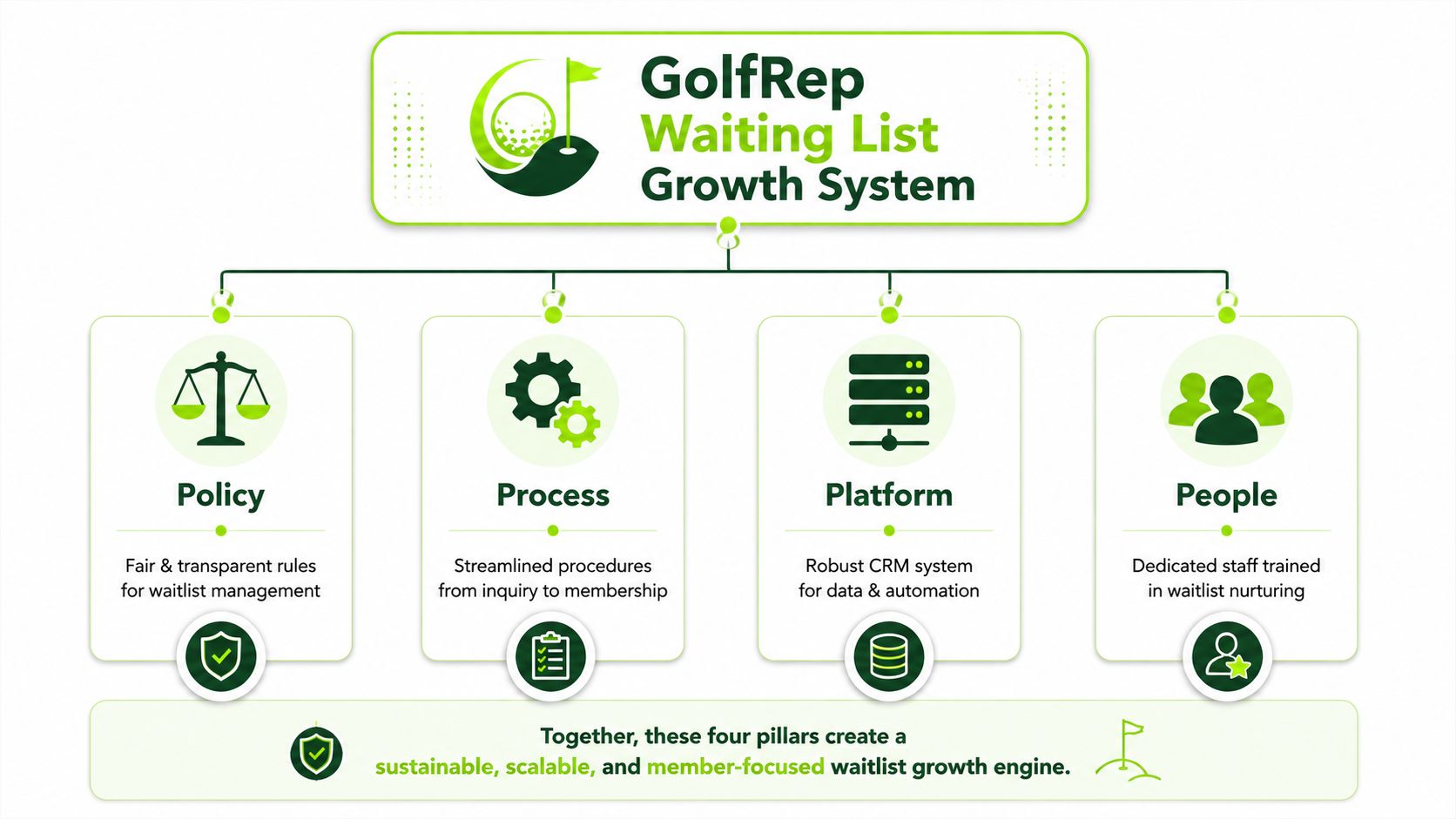
Policy
The rules need to be transparent. Prospects should know how the golf club waiting list works, what priority means, and what they can expect while they wait.
Process
Every stage needs an owner. New enquiry, qualification, waitlist entry, nurture, review, offer, and onboarding all need clear handling. Good clubs don't rely on someone "remembering to follow up".
Platform
The operational backbone should sit in one place. CRM, automation, notes, status, tasks, and reporting all belong in the same system if you want reliable visibility and cleaner decision-making.
People
Staff still matter. Automation doesn't replace judgement. It supports it. The team needs to know when to call, when to qualify harder, when to update expectations, and when to move a prospect forward.
A club that gets these four pillars right stops treating the waiting list as a static queue. It starts using it as part of the wider membership journey. That improves control, reduces admin friction, and gives the committee something every club wants: a more predictable route from enquiry to recurring revenue.
The true shift is simple. Stop asking whether the list is long. Start asking whether it is live.
If your club has demand but still manages its waiting list through spreadsheets, inboxes, and manual chasing, GolfRep can help you build a structured system around it. As a UK growth partner focused on golf clubs, GolfRep helps clubs connect lead generation, CRM follow-up, automation, and conversion tracking so the waiting list becomes a visible, manageable pipeline instead of an admin burden.
Ready to tap into our proven growth system?