Display Campaign Optimization for Golf Clubs

A club manager opens the monthly advertising report and sees a healthy-looking campaign: impressions delivered, clicks recorded, and a reasonable cost per visit. Then the membership team checks the actual pipeline. Few people have asked about joining, even fewer have booked a visit, and nobody can explain which part of the campaign attracted a serious prospect.
That gap is where display campaign optimization either creates commercial value or quietly wastes budget. Golf clubs sell a considered purchase with a local catchment area, a longer decision process and a meaningful difference between a casual golfer and someone who could become a member. The right question isn't how cheaply an advert can generate traffic. It's whether the campaign produces people who are likely to visit, apply and remain valuable to the club.
Why Display Campaigns Often Fail Golf Clubs
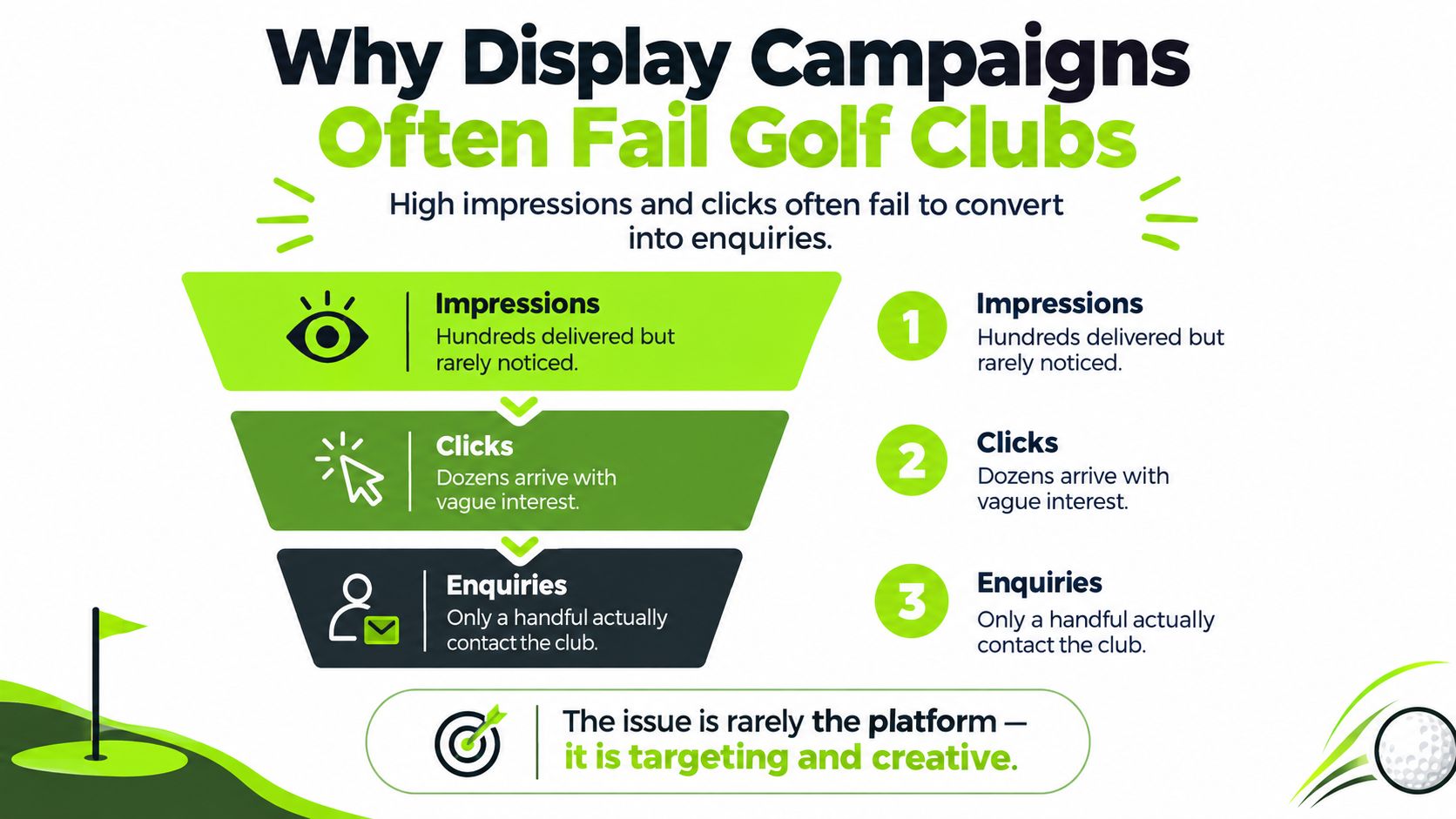
Display campaigns often fail because the reporting looks busy while the membership pipeline stays empty. An impression proves delivery, not attention. A click proves an interaction, not intent. A form completion may still represent someone who isn't suitable for the club, lives too far away or has no realistic intention of joining.
The UK market makes this more important. Online display advertising generated £11.3 billion in 2023, and social video formats on YouTube, TikTok and Instagram accounted for £5.4 billion, up from £4.5 billion in 2022, according to Ofcom's review of IAB UK market data. Display is no longer a single category of static banners. Video, social placements and cross-device delivery now occupy a substantial part of the available inventory.
The reporting problem
A campaign can appear efficient in Google Ads while doing little for membership growth if it rewards the wrong behaviour. Cheap placements may generate clicks from broad audiences, but the resulting traffic can have no connection with the club's genuine catchment area or membership proposition.
A quality-first workflow starts by defining the commercial outcome, then checks whether the advert was seen, delivered in a suitable environment and connected with a relevant person. That means separating:
- Delivery: impressions, measurable impressions and viewable impressions.
- Engagement: clicks, landing-page visits and form starts.
- Commercial action: qualified enquiries, attended tours, applications and joining decisions.
UK evidence shows why this sequence matters. In H1 2020, overall UK ad viewability exceeded 72.5%, while programmatic viewability reached 73.0%. Desktop-display fraud was 0.6%, and desktop-display brand-risk exposure was 3.1%, as reported by MarketingTechNews. Earlier UK evidence found fraud falling from 4.9% without prevention to 0.3% with it when fraud-prevention technology was used, according to the same cited industry report.
Commercial rule: A click is useful evidence only when it leads to a meaningful next step for the club.
GolfRep's perspective is straightforward. Display belongs inside the wider ATTRACT, NURTURE, CONVERT, RETAIN system, but its first job is to attract the right local audience and create measurable commercial opportunities. Clubs that want a broader diagnosis of the underlying issue can also read why golf club marketing often fails, particularly where campaign reporting and commercial outcomes have become disconnected.
Setting Up Conversion Tracking Before You Spend
Don't launch display advertising until the club can record what a valuable response looks like. Google states that advertisers should install conversion tracking before judging performance because campaign optimisation depends on accurately recorded actions, as explained in Google's guidance on optimising Display campaigns.
Start with a written conversion map. Put every action into one of three groups:
- Primary conversions: membership enquiries, booked club tours, trial-round requests, completed applications and attended visits.
- Secondary conversions: enquiry form starts, brochure requests, pricing-page engagement and calls where the caller's intent can be identified.
- Diagnostic events: landing-page views, scroll depth, video engagement and button clicks.
The first group should guide budget decisions. The second helps explain where prospects hesitate. The third can identify technical or creative problems, but it shouldn't be treated as evidence of membership demand.
Build a usable measurement path
Connect the advert to a dedicated landing page or a clearly defined membership journey. Record the campaign, audience, creative, device and placement alongside the enquiry, then pass the lead into the club's CRM or another agreed pipeline. A membership enquiry isn't commercially useful if nobody can later identify whether the person booked a visit, attended, applied or joined.
Use consistent status definitions. “New enquiry”, “qualified”, “visit booked”, “visit attended”, “application submitted” and “joined” should mean the same thing to the marketing platform, sales team and club manager. Consent also matters. Only use customer information for remarketing and measurement where the club has a lawful basis and clear privacy practices.
Google recommends considering engaged-view conversions and view-through conversions alongside click-through conversions. A prospective member may see a club advert, leave without clicking, then return through direct search to enquire or book a visit. That doesn't mean every later action was caused by the advert, but a last-click-only report can undervalue display exposure.
Set an evaluation rule
Don't judge a campaign from a handful of early clicks. Decide in advance how the club will assess assisted activity, direct responses and qualified outcomes. Compare the platform's recorded conversions with CRM records and booking data, then investigate discrepancies rather than quietly accepting the larger number.
A practical setup guide such as conversion tracking setup for marketing campaigns can help a club document the event structure before launch. The important point is operational ownership. Someone must check that forms fire correctly, calls are logged, bookings are attributed sensibly and offline outcomes return to the reporting process.
Choosing Between Broad Awareness and Qualified Audiences
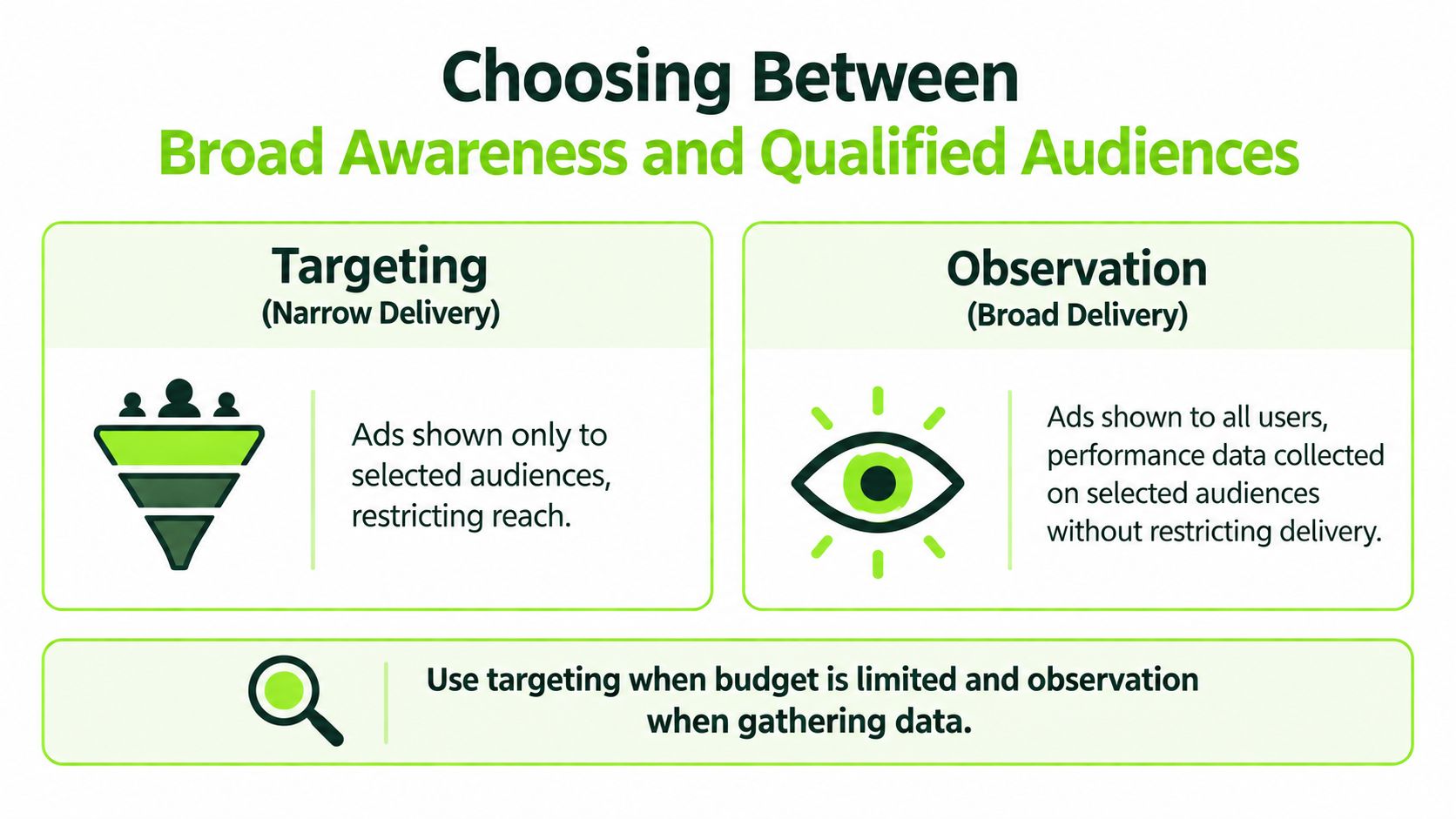
A local radius campaign and a qualified audience campaign solve different problems. Broad delivery helps a club discover demand and build awareness across its catchment. Qualified audiences can concentrate spend around people who have shown relevant interest, but they may restrict reach too early and make a small local audience expensive to reach.
Google distinguishes between Targeting and Observation. Targeting narrows delivery so adverts show only to selected audiences or content categories. Observation doesn't change who can see the adverts. It lets the club compare selected audiences, placements or topics while delivery remains broader, as set out in Google Ads audience targeting and observation guidance.
Use broad delivery deliberately
Broad local awareness makes sense when the club has a strong offer, enough geographic demand and a genuine need to learn which types of golfer respond. It can reveal that a weekday membership message attracts a different audience from a premium full-membership proposition. It can also show whether a facility feature, such as a short course or practice area, draws interest from people the club hadn't considered.
The risk is relevance. A person can live nearby, enjoy golf content and still have no intention of joining. Broad campaigns should therefore use location settings that reflect the club's real catchment, then separate performance by device, placement, audience and creative.
Narrow delivery when the evidence supports it
Targeting is more appropriate when the budget is limited, the club already understands its best prospects or the campaign promotes a clear commercial action. Relevant audience groups might include golf-intenders, previous website visitors or people who started but didn't complete an enquiry.
Don't confuse an audience label with proof of quality. The label is only a hypothesis. The club should promote an audience into active targeting when it produces qualified enquiries or booked visits at an acceptable cost, not just because it generates a higher click-through rate.
A staged process works well:
- Start with observation: Gather comparative data without restricting delivery prematurely.
- Separate the reporting: Review audiences, placements, devices and locations independently.
- Promote proven segments: Apply active targeting where commercial outcomes justify narrower reach.
- Retain a learning group: Keep some broader activity so the campaign can discover new prospects.
This approach avoids the false choice between awareness and performance. Awareness earns its place when it creates useful future demand. Qualified targeting earns its place when it produces commercially valuable actions.
Creative Best Practices for Golf Club Campaigns
A generic course photograph with “Join us today” rarely gives a prospect enough reason to act. The advert needs to connect a specific audience with a specific benefit, then make the next step obvious.
Run at least two message angles while keeping the landing page, geography, offer and conversion definition constant:
- Membership value: Explain what membership enables, such as access, flexibility, playing opportunities or a clear route into club life.
- Club experience: Show a particular reason to visit, such as the course, practice facilities, coaching, social environment or a trial round.
The test isn't which advert receives the most clicks. It's which message produces the strongest rate of qualified enquiries and booked visits.

Design for the placement
Video deserves serious attention. IAB UK reported that UK digital advertising exceeded £35.5 billion in 2024, with video display investment rising 20% to £8.3 billion. Video represented 64% of online display spend, compared with 51% five years earlier, according to IAB UK's 2024 digital adspend report.
That shift changes the creative brief. Test opening frames that communicate without sound, readable text on mobile screens, both orientation formats, and short edits that show the experience quickly. Connected-TV and mobile should be reported separately, since their viewing contexts and response patterns differ.
Static banners still have a role, particularly for retargeting and clear local offers. But resizing the same design across every placement isn't a strategy. Aerial course imagery may suit a destination-led environment, while a mobile news placement may need a closer human image, fewer words and a stronger local cue.
For practical guidance on improving banner click-through rates, focus on hierarchy, contrast, message clarity and the relationship between the visual and the call to action. Keep the test disciplined. Change one meaningful creative variable at a time where possible, then judge the result by qualified conversion rate rather than cheap engagement.
Frequency Capping and Retargeting Strategy
A golf club often serves a geographically limited audience. If the campaign keeps showing the same advert to the same local golfers, frequency can rise while incremental reach falls. The club may appear active in the platform report but spend repeatedly on people who have already ignored the message or aren't suitable prospects.
Frequency management should reflect the buying process. A membership decision may need more than one exposure, particularly when the campaign introduces an unfamiliar club or proposition. Repetition still has a cost, and local audiences can become saturated quickly.
Use a cap as a control, not as a universal rule. Set a lower cap for broad prospecting where the objective is efficient reach. Allow more controlled repetition for people who visited a membership page, started an enquiry or engaged with a relevant video, provided the next advert moves them towards a useful action.
Retarget based on behaviour
A retargeting audience should represent a decision stage:
- Page visitors: Show a clear reason to return, such as a visit booking or membership information.
- Form starters: Remove friction and answer the question that may have stopped completion.
- Video viewers: Introduce the club experience, facilities or a specific invitation.
- Previous interactors: Offer a fresh message rather than repeating the first advert.
Exclude people who have already completed the intended action where appropriate. A member who has joined shouldn't continue receiving a prospecting advert. Likewise, someone who has booked a tour may need a practical confirmation or preparation message, not another generic membership promotion.
Measure exposure without fooling yourself
Keep served impressions, measurable impressions, viewable impressions, clicks and attributed conversions in separate fields. Mixing denominators makes a campaign appear stronger or weaker depending on which stage the dashboard happens to display.
Retargeting should be judged on cost per qualified enquiry, booked visit and attended visit, not only click volume. Google also warns that optimised targeting can expand beyond manually selected audience segments, using the chosen signals as a starting point rather than a permanent boundary. Its guidance recommends waiting until a new campaign has at least 50 conversions or has been active for at least two weeks before evaluating performance, as explained in Google's optimised targeting documentation.
That waiting period doesn't excuse poor tracking or unsuitable placements. It prevents the commercial team from changing direction every day because a small local sample moved around.
Building Your Optimisation Loop
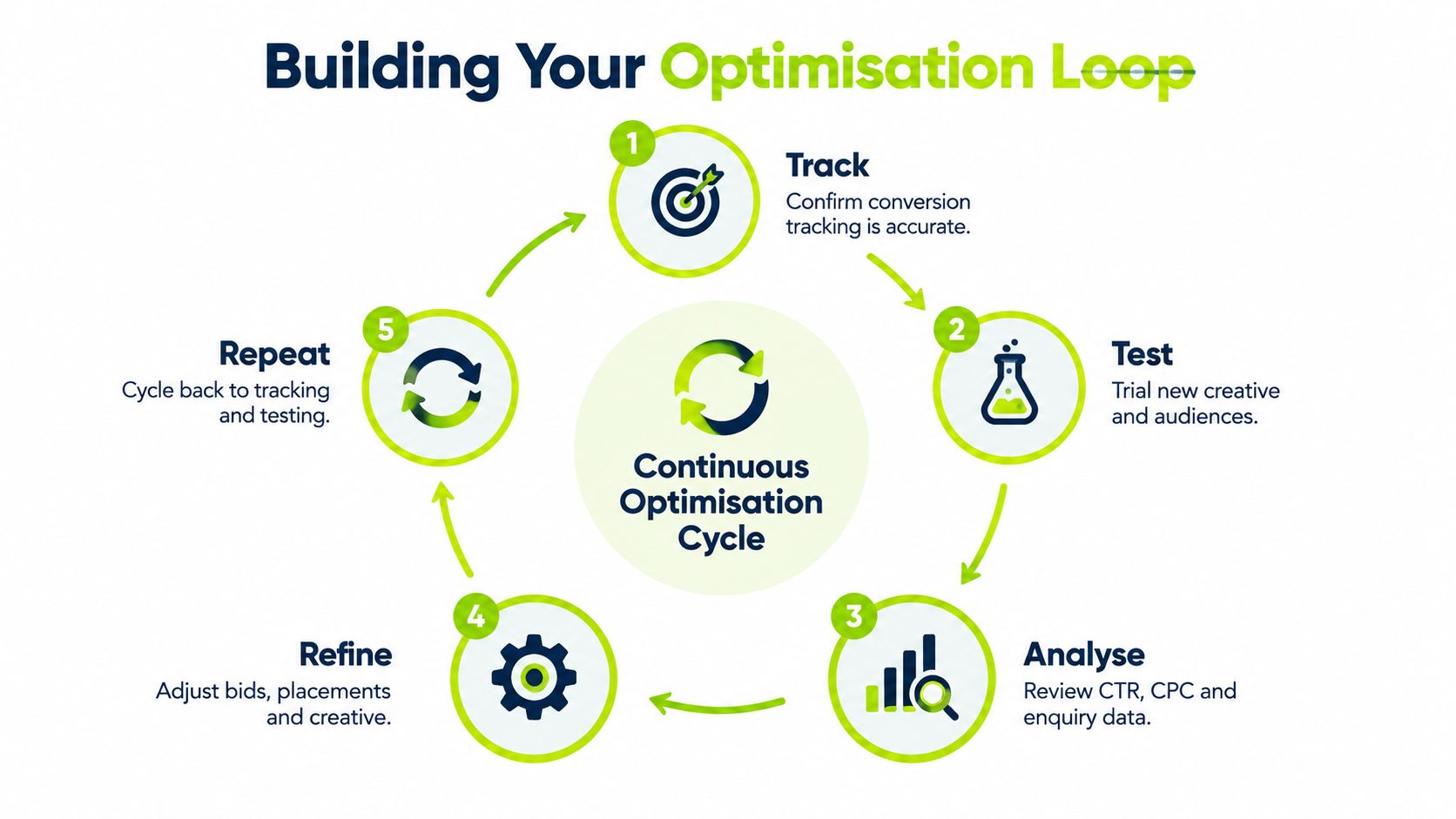
Display campaign optimization works best as a controlled sequence. Change everything at once and the club won't know whether the improvement came from the audience, creative, placement, landing page or reporting correction.
Fix delivery before chasing performance
Start with inventory quality. Apply pre-bid verification and brand-safety filters, review unsuitable placements, and exclude delivery that fails the club's viewability, fraud or suitability requirements. There's little value in rewriting a headline when the advert isn't meaningfully seen.
Then compare creative by qualified conversion rate. Keep the commercial destination stable so the test answers a useful question. Once a message shows stronger downstream performance, adjust audience bids and frequency according to the marginal cost of another qualified lead.
A weekly review should include:
- Tracking: Confirm primary conversion events, CRM statuses and booking records match.
- Quality: Check viewability, fraud indicators, brand safety and placement suitability.
- Audience: Compare local segments, observation groups and expanded delivery.
- Creative: Review message, format, opening frame and landing-page consistency.
- Commercial result: Report qualified enquiries, attended visits, applications and membership outcomes.
Use evidence before making a change
UK benchmark data varies materially by inventory and measurement period. One UK media-quality report found only 57.4% of display campaign impressions in view, while a later benchmark reported nearly three-quarters in view, as described in Integral Ad Science's UK media quality reporting. The lesson isn't to select one universal benchmark. It's to record the denominator, source and date before interpreting a result.
Decision rule: Remove delivery defects first, test creative second, refine audiences third, and change budget only when the commercial evidence supports it.
Wait for a meaningful learning period before drawing conclusions. Google's minimum guidance of 50 conversions or two weeks of activity provides a useful baseline, but a club should still consider sales-cycle length and whether the recorded conversions are genuinely qualified.
Measuring Success Beyond Clicks
A golf club shouldn't celebrate a cheaper click if the membership pipeline becomes weaker. The commercial dashboard needs to show whether advertising is attracting people who take valuable steps and remain worth acquiring.
Track the journey in order:
- Cost per qualified enquiry, not just cost per form fill.
- Cost per attended visit, because a booked tour that doesn't happen has limited value.
- Conversion to membership, once the sales process has enough data.
- Twelve-month member value, including the recurring membership value the club can reasonably associate with the member.
England Golf reported 750,071 club members in 2025, up 2.66% year on year, and more than 24,000 iGolf subscribers had moved into club membership since the programme began, including 9,600 in 2025, according to Northern Golfer's coverage of the England Golf figures. The figures show a sizeable opportunity, but they don't tell a club which audience or advert will produce its next suitable member. That requires CRM and revenue data.
A simple commercial calculation is:
12-month member value = joining revenue + membership revenue + attributable ancillary revenue
Then work backwards. If a member is valuable to the club, the acceptable cost per qualified enquiry can be higher than for a casual visitor. If the enquiry-to-membership rate is weak, lowering the media cost won't solve the economics.
Display also deserves a fair attribution model. A member may view an advert, return through search and then book a tour. Last-click reporting gives the search visit all the credit. Use a documented approach to assisted and view-through activity, and review marketing effectiveness measurement alongside the club's own CRM outcomes. GolfRep's attribution rules for marketing channels can help teams define those decisions before a campaign is under pressure.
The principle is simple: optimise for commercial return, not the lowest media cost. A campaign that reaches fewer people but produces better enquiries, attended visits and lasting members can be the stronger investment.
GolfRep helps UK golf clubs connect display advertising with conversion tracking, qualification, CRM follow-up and revenue reporting, so managers can see which activity produces genuine membership opportunities. Visit GolfRep to discuss where your current campaign is losing value and how to build a clearer path from local reach to booked visits and membership growth.
Ready to tap into our proven growth system?