How to Become a Golf Coach: The UK Pathway
Most advice on how to become a golf coach starts in the wrong place. It starts with ball-striking.
That's outdated.
A low handicap matters, but if you're hiring or developing coaching talent for a golf club, handicap alone is a poor filter. The coach who helps your club grow isn't just the best player in the staff room. It's the person who can teach clearly, build trust quickly, handle new enquiries properly, and turn a lesson booking into a longer relationship with your club.
From GolfRep's perspective, that distinction matters more than most clubs realise. A coach isn't just a service provider renting space on the range. The right coach becomes part teacher, part host, part retention tool, and part conversion asset. If you want stronger membership growth, better member experience, and more consistent use of your practice facilities, you need to understand what the UK coaching pathway produces, and what a modern coach should add beyond it.
Why a Great Coach Is Your Club's Hidden Growth Engine
A lot of clubs still treat coaching as a side business. That's a mistake.
The common assumption is simple. Find a good player, give them some lesson slots, and let them get on with it. But members don't stay because a coach once played well. They stay because someone helps them improve, makes them feel comfortable, and gives them a reason to come back to the club next week.
Coaching drives retention, not just instruction
A strong coach improves more than golf swings. They improve the member experience.
Think about where many new relationships with a club begin. It's often not in the bar, not in the committee room, and not through a membership pack. It's through a beginner lesson, a junior session, a women's group clinic, or a game improvement programme. Coaching is often the softest entry point into club life.
That matters because clubs don't usually suffer from a complete lack of interest. They suffer when interest isn't organised, followed up, or converted. A coach who greets visitors well, captures details, and feeds relevant prospects into a proper follow-up process can influence membership growth far more than clubs expect.
Practical rule: If your coach operates in isolation from your club's enquiry handling, you're leaving revenue on the practice ground.
The modern coach creates club stickiness
A valuable coach gives members reasons to use the club more often. Lessons lead to practice. Practice leads to café spend, range usage, short game area usage, guest visits, and eventually competition confidence.
They also build community. Junior coaching, beginner roll-ups, and structured programmes create regular touchpoints that make members feel part of something. That's especially important for newer golfers who can feel intimidated by traditional club environments.
For managers looking at the wider picture, coaching should sit much closer to member development and acquisition than many clubs currently allow. A coach who can run junior pathways, beginner onboarding, and group coaching well becomes a direct contributor to retention and new member flow. Clubs that want to strengthen that side of the experience should study what makes a strong junior golf coach, because junior delivery often exposes whether a coach can really communicate, organise, and build trust.
What club managers should stop doing
Here's the blunt version. Stop hiring on playing profile first and coaching value second.
Use this lens instead:
- Can they teach beginners without making them feel behind?
- Can they communicate with parents, adult improvers, and existing members equally well?
- Can they support your membership journey, not just fill a diary with lessons?
- Can they operate inside systems, not just through memory and WhatsApp?
That's what a growth-minded club should care about.
The Official UK Pathway to Coaching Excellence
A club that hires coaches on charisma alone usually pays for it later. The UK pathway matters because it gives you a clearer read on discipline, standards, and whether a candidate can operate as a professional inside your club, not just hit positions on a lesson tee.
For UK managers, the starting point is simple. If a candidate wants to build a serious coaching career, the PGA Training Programme is the route that carries weight.
What the PGA route actually requires
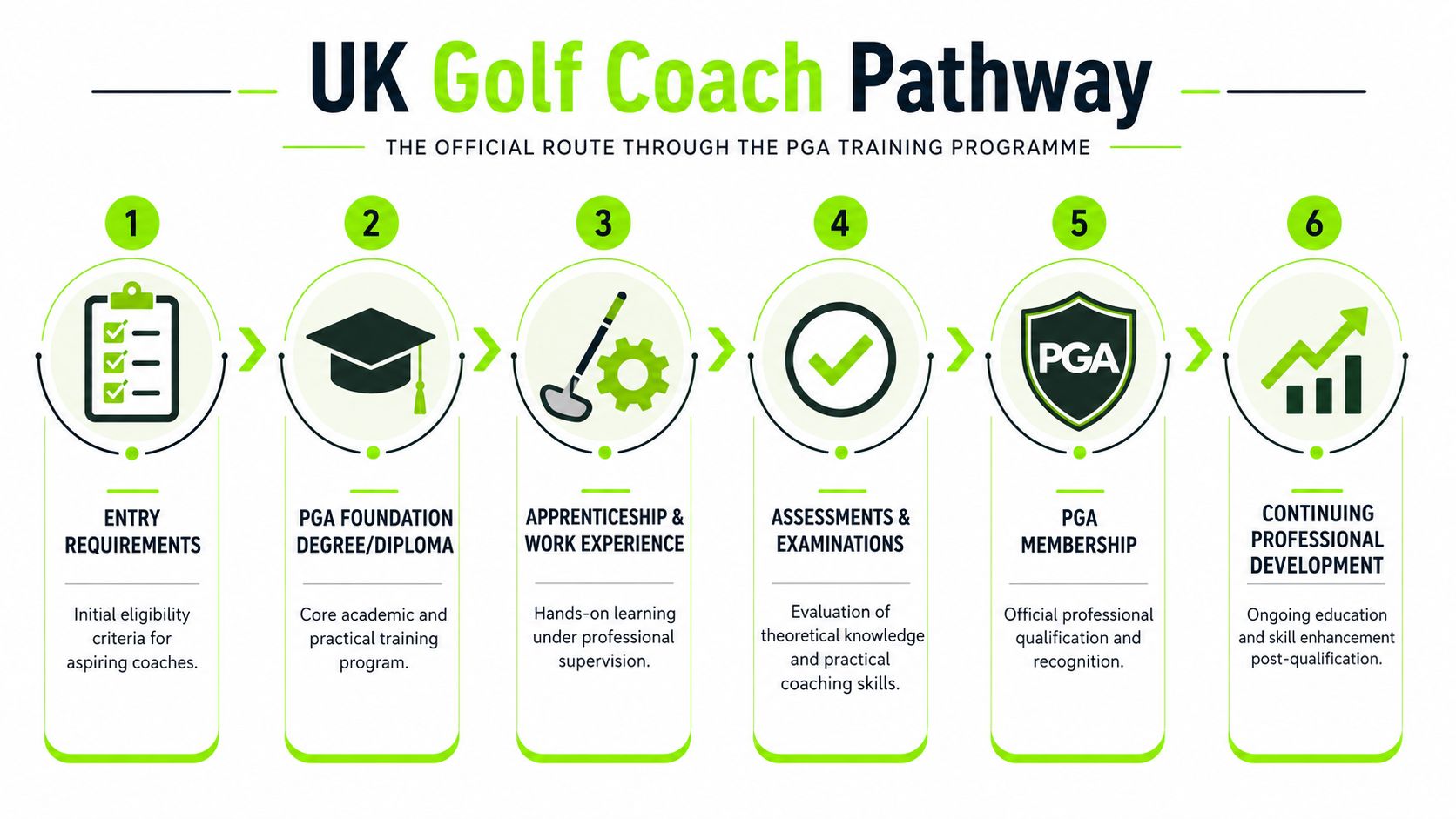
In the UK, becoming a recognised golf coach typically means completing the three-year PGA Training Programme with The PGA. That route includes two separate coaching qualifications, a required Playing Ability Test, and employment at a PGA-recognised golf facility, according to The PGA coaching qualifications pathway.
That matters because the pathway tests more than golf knowledge. It tests whether someone can work inside a structured professional environment over time.
The programme also covers areas such as the PGA Constitution, Rules of Golf, and Career Enhancement. For a manager, that has real hiring value. You are not only assessing whether someone can spot a slice. You are assessing whether they understand standards, conduct, and the day-to-day responsibilities that come with representing a club properly.
Why this matters when you hire
A PGA-trained candidate has usually shown four things that should matter to any club:
| Area | What it tells your club |
|---|---|
| Playing standard | They have met a recognised performance threshold |
| Coaching education | They have studied how to teach and structure learning |
| Workplace exposure | They have worked inside a real golf facility |
| Professional standards | They have been trained in rules, conduct, and safe practice |
That combination is why the PGA route remains the benchmark in UK club hiring.
It is also why managers should stop treating the qualification as a box-tick. A coach who has completed this route has already shown persistence, coachability, and an ability to meet standards over several years. Those traits usually show up later in member experience, programme quality, and reliability.
The qualification is the floor, not the finish line
Do not confuse formal status with coaching value. The certificate gets a candidate through the door. What makes them commercially useful to your club is what they build on top of it.
The strongest candidates keep improving in communication, behaviour change, and session delivery. That is where resources such as Coachful's communication tips for coaches become relevant. They reflect a truth many hiring managers learn too late. Members stay with coaches who explain clearly, listen well, and adapt to the golfer in front of them.
For that reason, use the PGA pathway as your baseline filter, then assess what the coach has done with it. Ask how they teach beginners. Ask how they retain juniors. Ask how they structure programmes, track progress, and represent the club. That is how you separate a qualified coach from a valuable one.
Developing Skills Beyond the Technical Swing
Hiring a coach for swing knowledge alone is a costly mistake.
The coaches who strengthen member retention do far more than spot a fault in takeaway or club path. They turn instruction into progress members can feel, explain changes without jargon, and keep people confident enough to come back. For a club manager, that is the standard that matters. Good coaching quality shows up in repeat bookings, junior retention, referrals, and a stronger overall club experience.

Communication separates useful coaches from impressive golfers
A coach who cannot explain clearly will frustrate beginners, lose juniors, and waste the attention of better players.
The job is translation. One member needs a single cue to stop slicing. Another needs reassurance after a bad run. A third wants evidence, structure, and measurable progress. Coaches who can shift their language and pace for each of those members become commercially valuable. Coaches who teach everyone the same way create avoidable drop-off.
That is why communication should be part of your hiring criteria, not an afterthought. Coachful's communication tips for coaches give a useful benchmark because they reinforce the habits that improve lesson quality: listening, clarity, empathy, and adaptation.
Modern coaching includes people management, not just ball flight
Technical instruction is only one part of the role. The stronger coach can also manage attention, confidence, and decision-making during a lesson.
Watch how a candidate handles a struggling golfer. Do they flood the player with fixes, or reduce the problem to one clear action? Do they notice nerves, impatience, or confusion early enough to adjust? Do they leave the golfer with a plan that feels achievable?
These are coaching skills. They matter because members judge value by whether they improve and whether the session felt productive.
What to assess when you watch a coach teach
Do not get distracted by polished terminology or expensive tech. Focus on whether the lesson works.
Use a practical scorecard:
Clarity
Can the coach explain one change in plain language that the golfer can apply straight away?Adaptability
Can they adjust their delivery for a junior, a nervous beginner, and a competitive adult without sounding scripted?Session control
Can they keep the lesson focused, paced well, and free of unnecessary detail?Emotional awareness
Can they correct mistakes without making the golfer feel judged or defeated?Technology discipline
Can they use video or launch monitor data to support a point, rather than hiding behind numbers?
A strong coach improves confidence and performance at the same time.
Technology should support coaching, not dominate it
TrackMan, video capture, pressure mats, and simulator data can improve lesson quality. They can also turn a simple coaching moment into a confusing lecture.
Your best hire will use technology with restraint. They will pull out one useful insight, connect it to a clear drill, and move the golfer toward action. That is what members remember. They do not pay for a screen full of numbers. They pay for progress they can repeat on the course.
This matters beyond the lesson tee. Coaches often support club open days, beginner funnels, and member activation events, so their ability to communicate clearly in group settings affects the success of your wider golf club event marketing strategy.
The coach's real value is behavioural change
A swing can improve in one session. Habits take longer.
The coaches worth developing inside your club know how to create follow-through. They set simple practice priorities, check understanding before the lesson ends, and give golfers a reason to stay engaged between sessions. That ability turns one lesson into a coaching relationship, and a coaching relationship into longer member lifetime value.
If you are choosing between two qualified candidates, back the one who can teach change, not just describe mechanics. That coach will do more for your members and more for your club.
Gaining Practical Experience and Building a Reputation
Clubs do not get growth from certificates on a wall. They get growth from coaches who can perform in live club environments, earn trust quickly, and turn casual contact into repeat engagement.
That is why practical experience should be treated as a hiring filter, not a nice extra. A coach who has already handled busy group sessions, junior blocks, parent conversations, and post-lesson follow-up will add value faster than someone who only looks polished in an interview.

Where good coaches usually earn trust
Reputation is built in visible, repeatable settings inside the club.
Early-stage coaches usually start by supporting group sessions, helping with admin, setting up practice stations, and observing how different member types respond. Then they move into beginner lessons, short game clinics, and junior activity. That progression matters because it exposes them to the essential demands of the role. Punctuality, organisation, presence, and follow-up all show up long before elite technical coaching does.
For a club manager, those early environments are useful testing grounds. You can see very quickly whether a coach can hold a group, keep energy up, and represent the club well without supervision.
Look for evidence in four areas:
- Group control in mixed-ability sessions
- Operational discipline with timing, setup, and communication
- Commercial awareness when speaking to parents, visitors, and prospects
- Professional presence across the range, short game area, and clubhouse
Junior coaching should be treated as a commercial function
Many clubs still file junior coaching under community goodwill. That is poor management.
According to Golfshake's projections for golf club membership in 2025, junior participation is expected to be one of the strongest areas of growth. A club that ignores that trend leaves future members, family spending, and long-term loyalty to chance.
A capable junior coach does more than run children through drills. They create confidence for parents, establish routine attendance, and make the club feel welcoming to families. That directly affects retention and the wider member experience.
If you want to assess coaching potential properly, put candidates in front of juniors and parents. The good ones bring structure, warmth, and control straight away.
Give developing coaches real ownership
Do not ask a young coach to "build a reputation" and then keep them hidden behind senior staff.
Give them ownership of a clear programme. Holiday camps, beginner pathways, school links, and women's starter groups all work well because they reveal whether the coach can organise, promote, deliver, and follow up. Clubs that connect those programmes to participation activity will get better results, especially when coaching is aligned with a wider golf club event marketing plan.
Visibility matters. So does consistency.
Members trust coaches they keep seeing in well-run sessions, not coaches they hear about second-hand. If you want to help a coach build a reputation faster, give them repeated contact points and track simple outcomes such as rebooking, referrals, attendance, and progression into other club activity. Managers who want coaches to sharpen that client-building side should also discover taap.bio's coaching client system.
A strong reputation is not built on personality alone. It is built on repeated delivery that members talk about for the right reasons.
The Business of Coaching and Client Conversion
A coach isn't just there to teach. In a modern club, they are one of the first people who can convert interest into revenue.
That's why coaching should never sit outside the club's commercial system. If lesson bookings, trial sessions, beginner programmes, and follow-up conversations all live in separate notebooks, inboxes, or memory, the club loses visibility and the coach loses advantage.
The conversion problem is bigger than the lead problem
Clubs often say they need more enquiries. Usually, they need better conversion.
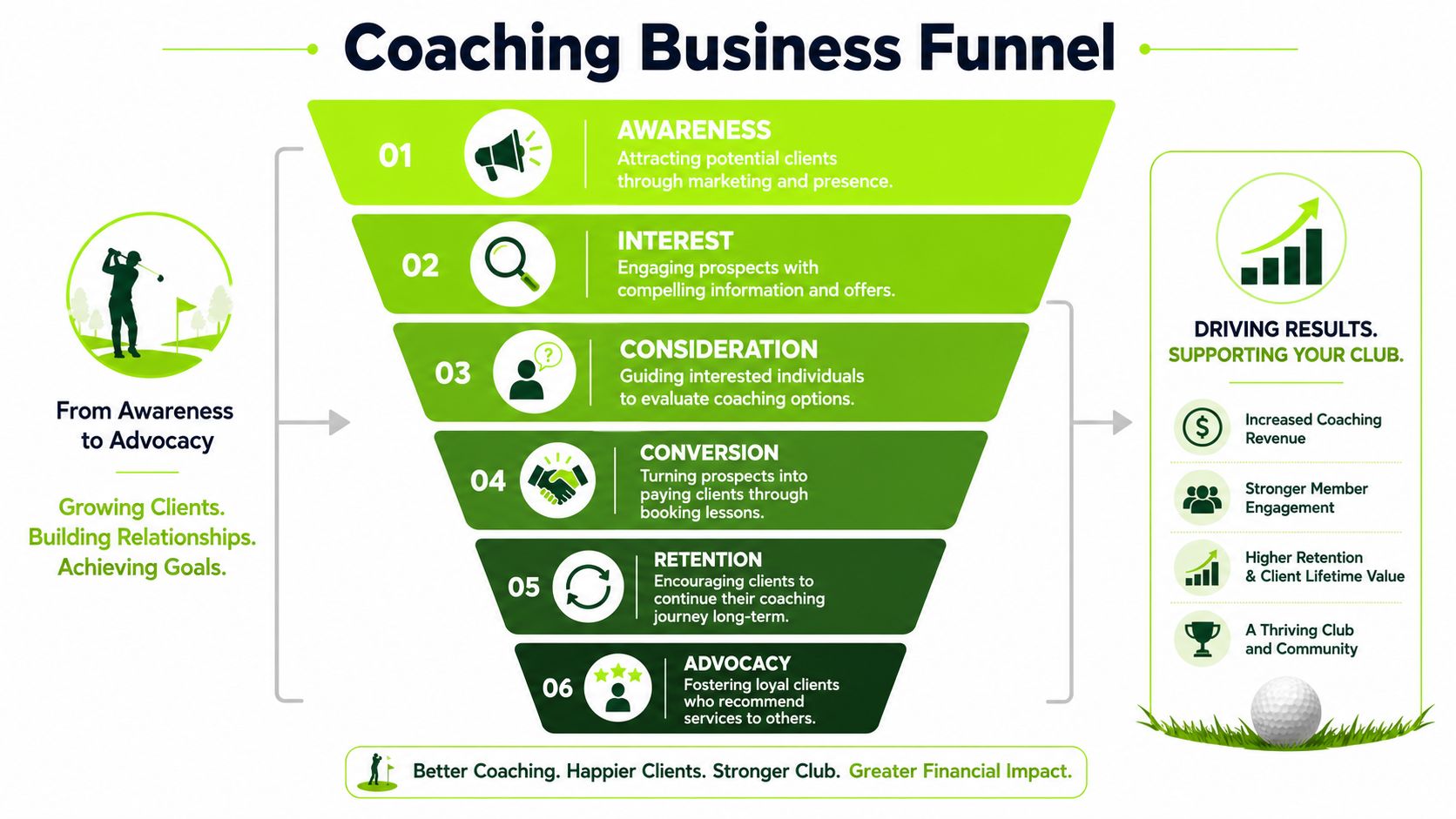
According to The Revenue Club's membership conversion analysis, UK golf clubs convert 9% of membership enquiries into signed members, which means 9 out of every 100 enquiries join. That tells you where the pressure point sits. It isn't only top-of-funnel activity. It's what happens after someone raises a hand.
A coach is often closer to that moment than the membership team. Someone books a lesson. Someone asks about beginner coaching. Someone wants a junior trial. Those are not isolated coaching interactions. They are signals of buying intent.
Coaching bookings should feed the same system
If you want a practical answer to how to become a golf coach who adds commercial value, it starts here. Learn to operate inside a follow-up process.
For clubs, that means the coach's diary shouldn't be disconnected from the club's wider lead handling. The lesson prospect who enjoys their first session should enter a clear nurture path. That might include a second lesson invitation, an academy offer, a beginner package, or a membership conversation. But none of that works if no one can see the lead status.
A sensible operating model includes:
| Stage | What the club needs |
|---|---|
| Initial enquiry | Fast response and clear ownership |
| Lesson booking | Contact details captured properly |
| Post-lesson follow-up | Notes on interest, confidence, and next step |
| Membership readiness | Visibility for the team handling sign-ups |
That's why systems beat manual effort. Manual effort depends on memory. Systems create consistency.
Coaches need business habits, not just lesson plans
The best coaches understand scheduling, safeguarding, payment handling, and client communication. They know that no-show prevention matters. They know that reminder messages matter. They know that a weak booking process creates friction before the lesson even starts.
For coaches building their own client base, there's useful context in discover taap.bio's coaching client system, particularly around creating a clear path from interest to booked session. The principle matters more than the platform. Don't make prospects work hard to buy from you.
Clubs should integrate coaching into the pipeline
If your coaching team sits outside your CRM, your reporting is incomplete.
That's the point many clubs resist because it sounds operational. It is operational. It's also commercial. A shared view of lesson leads, trial users, programme participation, and membership conversations gives managers proper conversion tracking and better lead visibility. It also stops the common problem where a hot coaching lead goes cold because nobody followed up after the first positive interaction.
For clubs reviewing the coaching side of the operation more broadly, golf coaching courses can be a useful lens for understanding what training should connect to in practice. Qualification matters. Process matters just as much.
If a coach generates interest but the club can't track what happens next, the club doesn't have a coaching asset. It has a reporting blind spot.
Identifying and Nurturing Top Coaching Talent
Hiring a coach on playing background and lesson volume is how clubs end up with busy diaries and flat membership growth.
If you want coaching to drive retention, referrals, and a stronger club experience, hire for commercial and interpersonal impact as well as technical ability. The role should cover member engagement, beginner integration, junior pathway support, safeguarding, and active cooperation with your enquiry and follow-up process. If those responsibilities are missing from the brief, the club is recruiting an instructor, not building a growth asset.
How to assess a candidate properly
Interview for behaviour under pressure and value to the club, not just qualifications and career history.
Ask each candidate to explain how they would handle three specific situations: a nervous beginner at their first lesson, a long-standing member who has stopped improving, and a parent deciding whether their child should join the club. Then run a live coaching observation. You will learn more in 20 minutes on the range than from any polished CV or confident interview answer.
Use a scorecard that reflects the job you need done:
Teaching quality
Can they diagnose clearly, explain straightforwardly, and adapt to different players without creating confusion?Member impact
Will members feel supported, motivated, and more connected to the club after working with them?Commercial judgement
Do they understand how coaching feeds trial conversion, retention, referrals, and programme uptake?Professional discipline
Are they organised, reliable, and credible on safeguarding and conduct?Club contribution
Will they strengthen the culture, work well with staff, and improve the member journey beyond the lesson tee?
Development shouldn't stop at qualification
Qualification gets a coach through the door. It does not keep them valuable.
As noted earlier, recognised coaching pathways set a baseline and expect ongoing development. Smart clubs treat that as an operating standard, not a box to tick. Support CPD. Review coaching performance properly. Give coaches feedback on communication, programme design, retention impact, and how well they turn first-time interest into repeat engagement.
The best coaches improve the whole system around them. They spot friction in beginner onboarding. They suggest better programme formats. They help front-of-house staff answer coaching questions with confidence. That is the level worth investing in.
Pay attention to signals that a coach is ready for more responsibility. Members ask for them by name. Juniors stay in programmes longer. Beginners come back for a second step instead of disappearing after one lesson. Staff trust them. Those patterns matter because they point to influence, not just activity.
A strong coach should be treated like a strategic operator inside the club. Hire with that standard. Develop with that standard. Reward with that standard.
If your club wants coaching, membership growth, and enquiry handling to work as one joined-up system, GolfRep helps golf clubs build predictable pipelines with lead generation, structured follow-up, and CRM visibility that turns more interest into booked visits, lessons, and long-term members.
Ready to tap into our proven growth system?