A Modern Guide to Golf Club Event Marketing

If you want to grow your event revenue, the answer is not always to generate more enquiries. The real money is made by systematically converting the leads you already have. It is about optimising how your team handles every single enquiry, from the first click to the final handshake.
As a growth partner for UK golf clubs, we've seen first-hand that the main challenge for most clubs is not generating enquiries, but handling, responding to, and converting them effectively.
Why Most Golf Club Event Marketing Fails

When event bookings are down, the knee-jerk reaction for many clubs is to throw more money at advertising. It seems logical. More ads should mean more enquiries, which ought to lead to more bookings. But this ‘more leads’ mindset often papers over a much deeper, costlier problem with a club's internal sales process.
Having worked with clubs all over the UK, we see the same frustrating pattern time and again. The real bottleneck is not a lack of interest from the market. It is a breakdown in how that interest is managed once it hits your inbox.
High-value enquiries for corporate days, society bookings, and private functions are constantly lost. They are not lost to your competitors, but to internal friction, slow response times, and simple manual errors.
The Hidden Costs of Manual Processes
The problem nearly always boils down to a reliance on outdated, manual systems. An enquiry comes in through a web form and lands in a general inbox. The manager is out on the course, the pro shop staff are tied up with customers, or perhaps the one person who handles it is on a day off.
Hours, or even days, can drift by before anyone sends a reply.
By that point, the prospective client has moved on. Their initial excitement has faded, or worse, they have already put a deposit down with a more responsive venue down the road. This is not just a theory; it is a daily reality that costs clubs tens of thousands of pounds in lost revenue.
These process gaps create some all-too-familiar pain points:
- Slow Response Times: In a competitive market, speed is everything. A delay of just a few hours can be the difference between securing a £5,000 corporate booking and losing it for good.
- Inconsistent Follow-Up: Without a proper system, following up is entirely down to someone's memory or a messy spreadsheet. Leads that need more nurturing just fall through the cracks.
- Poor Team Visibility: When enquiries are stuck in one person's inbox, the sales pipeline grinds to a halt if they are unavailable. No one else has lead visibility.
The fundamental issue is that many clubs run their high-value event sales with the same casual approach they might use for a small retail shop. This often comes from a basic misunderstanding of what modern sales and marketing really involve, a topic we have explored when discussing the outdated state of golf marketing.
This guide is designed to challenge that old way of thinking. We will lay out a practical blueprint for shifting away from sporadic ad campaigns and towards building a predictable revenue machine. It is not about finding more leads; it is about putting the systems in place to make sure you never waste one again.
Designing Event Packages That Actually Sell

Before you spend a single penny on advertising, let's get your product right. Too many clubs fall at this first hurdle, offering a generic 'corporate day' and wondering why they are not attracting high-value clients. It is a missed opportunity.
The secret is to stop selling services and start selling solutions. You need to build distinct, appealing packages that solve a real problem for different types of event organisers. This transforms the conversation from, "How much is it?" to, "Which one of these options is right for my group?".
Every club, including yours, has a unique mix of facilities and character. The key is packaging those assets into compelling offers that are easy for your team to sell and exciting for a client to buy.
Building Your Core Event Products
Your first move is to ditch the one-size-fits-all approach. Different groups have vastly different goals, budgets, and expectations. We typically see clubs succeed when they create specific packages for their three main audiences: golf societies, corporate clients, and charity fundraisers.
A society captain is chasing value for money, a smooth pace of play, and a friendly atmosphere. A corporate planner, however, is probably more focused on impressing their clients, getting great brand exposure, and ensuring a premium feel.
The most profitable clubs we work with do not just sell 18 holes and a bacon roll. They sell branded experiences, meticulously designed to hit a client's specific objectives. Getting this packaging right is the bedrock of any successful event marketing campaign.
A brilliant way to do this is by creating tiered packages within each category. This gives prospects a clear 'good-better-best' pathway, letting you capture business at various price points. It also makes your sales team's job infinitely easier, giving them concrete products to discuss.
Example Tiered Packages for Corporate Clients
Here is how you could structure three distinct tiers for the corporate market, each solving a different problem for a different type of business.
The 'Business Networker' Package
This is your entry-level, high-volume offer. It is perfect for local businesses wanting an informal networking event without the commitment of a full day.
- Who it is for: Small to medium-sized businesses looking to connect with peers and prospects.
- What is included: An afternoon 9-hole round followed by drinks and a premium barbecue on the terrace.
- The sell: It is a cost-effective, low-time-commitment option that builds professional relationships in a relaxed, memorable setting.
The 'Client Showcase' Package
This is the classic corporate golf day, refined. It is aimed at companies who want to spend quality time with and impress their most important clients.
- Who it is for: Firms focused on high-touch client entertainment and relationship building.
- What is included: A full 18-hole competition, pre-round breakfast rolls, on-course contests (like 'Nearest the Pin'), and a two-course meal in a private dining room.
- The sell: A sophisticated, full-day experience that delivers quality time and leaves a lasting positive impression on key guests.
The 'Premium Tournament' Package
This is your flagship product. It is for larger organisations seeking a major annual event that makes a huge statement about their brand.
- Who it is for: Large firms or industry leaders wanting a high-impact, fully managed brand event.
- What is included: Everything in the 'Client Showcase' plus exclusive course access for the day, bespoke on-course branding (flags, tee markers), a PGA professional clinic, and a three-course awards dinner with a generous drinks package.
- The sell: This is the ultimate, all-inclusive tournament. It positions the client as a market leader and provides an unparalleled VIP experience that will be talked about for months.
By defining your packages with this level of clarity, you create tangible products. Suddenly, your marketing has a purpose. You can run a LinkedIn ad promoting the "Business Networker" directly to local business owners or showcase the "Premium Tournament" in your outreach to major corporations. This focused strategy is the first major step toward building a predictable and profitable event business.
Building Your Digital Marketing Engine
You have got your event packages sorted and they are looking sharp. The next job is to build the digital marketing engine that gets them in front of the right people. This is exactly where so many clubs fall down.
They will often just ‘boost’ a generic post on Facebook or fire off an email to their member database and hope for the best. That is not a strategy. It is not targeted, it is not scalable, and it is certainly not a reliable way to build a pipeline of high-value corporate and society bookings.
To do this properly, you need a far more disciplined approach. It is about using the raw power of digital advertising to pinpoint the exact decision-makers in your area. You then drive them, not to your homepage, but to a dedicated webpage built for one thing only: getting that enquiry. This is how you stop hoping for bookings and start building a predictable system.
Precision Targeting on Facebook and LinkedIn
Your ideal event clients are not just out there waiting to be found; you can actively go and get them. Platforms like Facebook and LinkedIn are incredibly powerful for this, but only if you know how to use them properly. The secret is to forget broad, general targeting and get laser-focused on the specific traits of your ideal event organiser.
For instance, when we build campaigns for our partner clubs, we never just target "people interested in golf." That is a waste of money. Instead, we build highly specific audiences to reach the people holding the purse strings:
- Local Business Owners: Using job title targeting on both platforms, you can serve ads directly to people listed as ‘Owner’, ‘Director’, or ‘CEO’ within, say, a 20-mile radius of your club.
- Executive and Personal Assistants: These people are the gatekeepers and often the real decision-makers for corporate events. Targeting job titles like ‘Personal Assistant’, ‘Executive Assistant’, or ‘Office Manager’ is a goldmine.
- Known Society Organisers: Got a list of past society organisers? As long as you have their consent, you can upload that list to create a ‘Custom Audience’ on Facebook. This lets you show them your latest packages directly.
This level of precision means every penny of your marketing budget is spent talking to people who actually have the authority and intent to book. If you want more detail on this, our guide on social media for golf clubs breaks it down even further.
Crafting Ads That Actually Convert
Once you know who you are talking to, you have to cut through the noise with compelling copy and eye-catching visuals. Your ads need to sell the experience and the outcome, not just the list of features.
Instead of a slightly blurry photo of your 18th green captioned "Book your corporate day here," think about visuals that tell a story. A quick video testimonial from a beaming corporate client or a slick photo album showing a packed awards dinner from a recent event will do the selling for you.
Then, your ad copy needs to speak their language.
Ad Copy Example (Targeting Local Business Owners):
"Host a client event that actually closes deals. Our 'Business Networker' 9-hole package is the perfect way to build relationships outside the boardroom. Impress your clients this summer. Enquire today for availability."
This copy hits on a business benefit (closing deals, impressing clients) rather than just the golf itself.
The Make-or-Break Role of the Landing Page
This is, without a doubt, the most important part of the entire process and the one most clubs get wrong. Whatever you do, never send paid ad traffic to your club’s homepage. A homepage is a jack of all trades, designed for a general audience with dozens of buttons and distractions. It pulls the user in a hundred different directions, and getting an event enquiry is just one of many competing goals.
Instead, every single ad campaign must point to a dedicated landing page, built for the sole purpose of promoting your event packages. This page has one job: to persuade the visitor to fill out that enquiry form.
A great landing page is your club's 24/7 digital salesperson. It strips away all the distractions and guides a potential client smoothly from interest to action. Sending paid traffic anywhere else is like paying for a billboard that points to the wrong building.
A high-converting event landing page absolutely must include these key elements:
- A Compelling Headline: It should instantly connect with your ad. Something like, "The Perfect Venue for Your 2024 Corporate Golf Day."
- Clear Package Details: Lay out your tiered packages (like the 'Business Networker' or 'Client Showcase') in a simple, easy-to-compare format. Use bullet points to highlight exactly what's included.
- Powerful Social Proof: This is non-negotiable. You need testimonials, logos of past corporate clients you have hosted, and brilliant photos or videos of successful events in full swing. This builds immediate trust.
- A Simple Enquiry Form: Keep it brief. Ask only for the essentials: name, company, email, phone number, and maybe a preferred date. A long, complex form is the fastest way to kill your conversion rate.
When you combine precision-targeted ads with a conversion-focused landing page, you create a powerful and efficient digital marketing engine. It is a system that consistently captures the attention of your ideal clients and walks them right to your door.
The System for Converting Enquiries into Bookings
You have done the hard work. Your ads are running, the landing page is live, and enquiries for your club’s events are starting to roll in. This is where most clubs breathe a sigh of relief, but it is where the real work and the biggest risk of fumbling the ball begins.
An enquiry left to languish in an inbox is not just a missed opportunity; it is a lead that is getting colder by the minute. The speed and quality of your response, your enquiry response time, will make or break your entire event marketing effort.
Relying on a busy staff member to manually monitor emails and find time to reply is a strategy destined to leak revenue. You need a system. A bulletproof process that kicks into gear the second an organiser expresses interest, ensuring no enquiry ever falls through the cracks. This is the difference between hoping for bookings and building a predictable revenue engine.
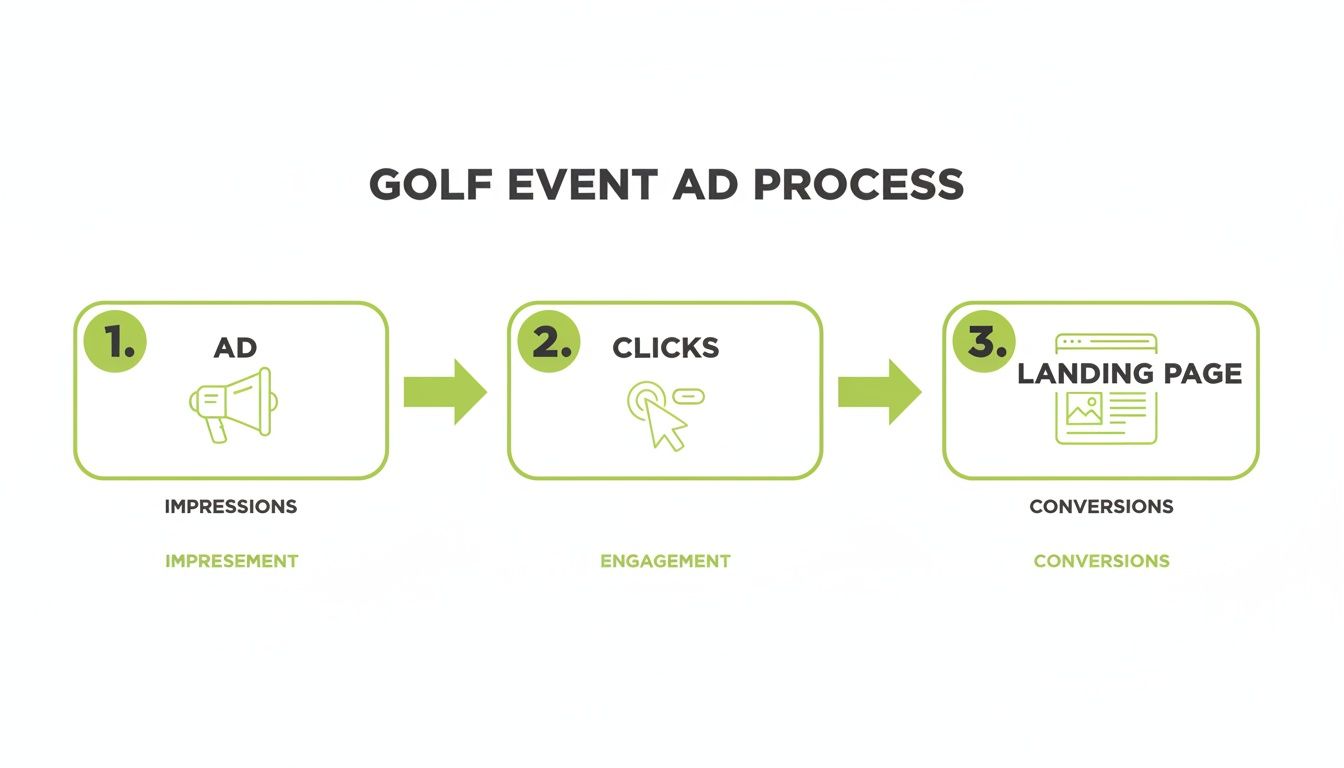
This simple diagram shows the journey from a prospect seeing your ad to landing on your page. The next part is all about what happens after they click "submit".
Capitalising on Peak Interest with an Instant Response
From the event organiser's perspective, they have just filled out your form, and their interest in your club is at its absolute peak. Your mission is to meet that enthusiasm immediately with a professional, organised response. This is practically impossible to do consistently by hand, but it is the bread and butter of a good automated system.
The moment a form is submitted, a well-set-up Customer Relationship Management (CRM) system should do two things at once:
- Alert your team instantly. Your events coordinator or manager gets a notification with all the lead's details. This creates immediate lead visibility and accountability. No more "I did not see the email."
- Acknowledge the prospect immediately. The organiser receives an automated email and even an SMS. This is not just a bland "Thanks, we will be in touch." It is a strategic touchpoint that reassures them they made a great choice.
Contrast this with what usually happens. An enquiry comes in at 6 PM on a Friday. It sits there, unread, until Monday morning. By then, the organiser has already spoken to two other venues, and your chances have plummeted.
A strong automated reply can even deliver instant value. Imagine the organiser immediately receiving a beautifully designed, downloadable event brochure. It gives them something tangible to look over and immediately positions your club as professional and on the ball.
From Manual Chaos to Automated Revenue
The difference between a manual and an automated approach to handling enquiries is not just about saving time; it is about plugging significant revenue leaks. A manual process is riddled with delays and inconsistencies, whereas an automated system provides a predictable and professional experience that directly translates to more bookings and better conversion tracking.
This table breaks down the real-world financial impact.
Manual vs Automated Enquiry Handling: A Revenue Impact Comparison
| Process Step | Typical Manual Approach (High Revenue Leakage) | Automated System Approach (Predictable Revenue) |
|---|---|---|
| Initial Enquiry | Sits in a shared inbox for hours or days. | Instant SMS/email notification to staff. |
| First Response | Generic email sent when staff have time. Slow response kills momentum. | Prospect gets instant, personalised email & SMS with brochure. |
| Follow-Up | Relies on memory. Maybe one chase-up email is sent before the lead is forgotten. | Automated 3-5 step email & SMS nurture sequence runs for 14+ days. |
| Lead Status | No tracking. Leads are "hot" or "cold" in someone's head. | Leads are automatically tagged and segmented in a CRM for full visibility. |
| Staff Focus | Wasted on admin, chasing cold leads, and data entry. | Focused on calls with warm, qualified leads who have been nurtured. |
| Revenue Outcome | Unpredictable bookings, high lead wastage. Revenue leakage is common. | Consistent tour bookings and a predictable sales pipeline. |
Ultimately, automation frees up your team to do what they do best: building relationships and closing deals, rather than getting bogged down in low-value administrative tasks.
Keep the Conversation Going with an Automated Nurture Sequence
Very few leads are ready to book a tour the moment they enquire. Most are in the early stages, gathering information and comparing their options. This is precisely where a manual follow-up process falls apart. A staff member might send a follow-up email or two, but then the lead goes cold and gets lost in the shuffle.
An automated system, however, never forgets.
Using a CRM, you can build a multi-step nurture sequence. This is a series of pre-written emails and texts sent automatically over several days or weeks. This keeps your club top-of-mind and builds a relationship without your team lifting a finger. It is a core component of a modern golf club follow-up system.
A simple yet highly effective sequence might look like this:
- Day 1 (Instant): The initial welcome email with your event brochure.
- Day 3: A follow-up email sharing a powerful video testimonial from a happy corporate client.
- Day 7: An email that shines a spotlight on a unique feature of your venue, like your stunning terrace for post-golf drinks or your state-of-the-art indoor swing studio.
- Day 14: A final, friendly check-in, asking if they have questions or would like to schedule a quick chat.
Each message provides a little more value and gently nudges the prospect towards taking the next step. This system does the tedious, persistent work, so your team can focus their energy on talking to genuinely warm, qualified leads. This is how you stop leaving money on the table and start building a reliable revenue stream for your club’s events.
Maximising Value After the Booking
You have secured the booking. It is a great feeling, but your work as a marketer is far from over. Getting that event in the diary is just the first win; the real, long-term value comes from what you do next.
Too many clubs treat the event day as a purely operational handover. The marketing team breathes a sigh of relief and moves on to the next lead. This is a huge missed opportunity. The day itself and the crucial follow-up period are where you turn a one-off sale into a loyal client and a source of incredible word-of-mouth referrals.
Let's walk through how to squeeze every drop of value out of that booking.
The Pre-Event Briefing: Your Golden Upsell Window
That final planning call or meeting with the event organiser is more than just a logistical check-in. It is your prime sales opportunity. This is not about a hard sell; it is about being a genuinely helpful expert, guiding them to create a better, more memorable day for their guests.
Most corporate organisers, especially if it is their first golf day, have no idea what is possible. They are thinking about the basic package they booked. It is your job to open their eyes to the enhancements that will make their event stand out.
During this briefing, your team should be ready to talk through ideas like:
- Food & Beverage Upgrades: Can we elevate that post-round sandwich platter to a two-course meal in a private dining room? What about a drinks reception on arrival or a branded snack and drink waiting at the halfway house?
- On-Course Competitions: Offer to run and manage a 'Nearest the Pin' or 'Longest Drive'. This adds a fantastic competitive buzz and gives you a chance to sell prizes, from sleeves of balls to a top from the pro shop.
- Branded Merchandise: Suggest creating welcome bags with branded balls, pitch mark repairers, or towels. It is a brilliant touch for their guests and doubles as lasting advertising for both your club and their company.
By proactively suggesting these extras, you are not just padding the bill. You are showing a level of care that sets your club apart. The organiser feels supported, their guests have a better time, and the event becomes one they will be praised for.
On the Day, Everyone is in Marketing
When the event day arrives, your operational team, from the bag drop staff to the bar manager, becomes your most important marketing asset. Every single interaction shapes the client's perception of your club.
A smooth, welcoming, and professional experience is what gets people talking for all the right reasons. It is far more powerful than any ad you could ever run. When an organiser's boss pulls them aside and says, “That was the best corporate day we have ever had. Book it again for next year,” you have just secured guaranteed future revenue.
Make sure your team understands this. They are not just serving drinks or parking cars; they are crafting the very experience that dictates whether that client ever comes back.
Your Post-Event Playbook for Repeat Business
The few days immediately following the event are a golden window. This is your chance to lock in a rebooking and gather powerful testimonials while the positive feelings are still fresh. A structured follow-up process, managed in your CRM, is non-negotiable.
Your post-event sequence should be just as planned and automated as your initial lead nurturing.
- The Immediate 'Thank You': Within 24 hours, the organiser should receive a personal thank-you email. Mention something specific you enjoyed about their day. It shows you were paying attention and genuinely cared.
- The Feedback & Testimonial Grab: In that same email, pop in a link to a short feedback survey. You will get fantastic insights to improve your service and, with permission, glowing testimonials for your website and future ads.
- The Rebooking Nudge: About a week later, follow up with an exclusive offer to rebook for the same time next year. This could be a modest discount, a complimentary upgrade (like a free 'Nearest the Pin' setup), or simply first refusal on their preferred date. The key is creating a little urgency and making them feel valued.
This simple system capitalises on goodwill and makes it incredibly easy for a happy client to say “yes” again.
Do not forget the attendees. Using your CRM, tag every guest whose details you captured. These people are not cold leads anymore; they have walked your fairways and enjoyed your hospitality. This is a perfect audience segment for future campaigns, whether it is a special green fee offer, an invitation to an open competition, or even a targeted membership drive. This is how one single event becomes a powerful engine for growing your entire club.
How to Measure Your Event Marketing Success
You have run a campaign and the enquiries are rolling in. It is a great feeling, but a full inbox does not automatically equal a full year-end report. To build a genuinely predictable revenue stream from your events, you need to look past the surface noise and understand precisely what your marketing efforts are actually delivering.
This is not about dull bookkeeping. It is about strategy. Setting a realistic budget and measuring its return is how you get the clarity to double down on what is working and confidently cut what is not. This is the shift that turns event marketing from a cost centre into a proven profit driver for your club.
Moving Beyond Simple Enquiry Volume
One of the most common traps we see clubs fall into is judging a campaign’s success purely by the number of leads it generates. A flood of enquiries might feel like a victory, but it is a vanity metric if those leads are low-quality or never convert into paid-up bookings.
To get a real picture of your performance, you have to connect the dots between your marketing spend and the revenue it creates through effective conversion tracking.
The goal is not just to be busy with enquiries; it is to be profitable with bookings. Tracking the right data empowers your club to make informed decisions, justify marketing spend, and prove the tangible financial contribution of your event systems.
So, what should you be tracking? There are three metrics that tell the real story:
- Cost Per Lead (CPL): This is your total campaign cost divided by the number of enquiries. Spend £500 on a Facebook ad campaign that brings in 20 enquiries? Your CPL is £25. Simple.
- Lead-to-Booking Conversion Rate: This tells you the quality of your leads. Of those 20 enquiries, how many turned into a confirmed event? If 4 booked, your conversion rate is a solid 20%.
- Cost Per Acquisition (CPA): This is the big one, the true cost of a sale. It is your total campaign spend divided by the number of actual bookings. In our example, £500 spent to get 4 bookings gives you a CPA of £125.
Understanding the Nuance in Your Numbers
Once you have these figures, you can start making much smarter decisions. For instance, a high Cost Per Lead is not always a red flag.
Let’s say you run a LinkedIn campaign targeting company directors for corporate golf days. Your CPL might be £75. At the same time, a broader Facebook campaign for society golf might only have a CPL of £15.
On the surface, the Facebook campaign looks five times more efficient.
But what if those expensive LinkedIn leads are for high-value corporate tournaments worth £8,000 a pop, while the Facebook leads are for society bookings averaging £1,500? Suddenly, that higher initial cost is more than justified. This is exactly why you must look at the full journey, from CPL right through to the final booking value.
Proving the Financial Impact of Your System
When you pair a structured sales process with this kind of clear reporting, demonstrating the value of your marketing becomes effortless. You are no longer just talking about one-off events; you are showing how you drive substantial, year-round revenue that supports the entire club.
The impact of this approach is becoming more obvious across the UK golf industry. For example, recent data showed that in 2023, clubs working with The Revenue Club saw their average visitor income surge to £315,000. This represents a £41,000 increase from the previous year, alongside a 13% growth in total rounds played. That is a clear testament to how strategic marketing can boost financial performance well beyond core membership fees.
By tracking your CPA and the average value of each booking, the ROI calculation becomes crystal clear. If your average event booking is worth £3,000 and it costs you £125 to acquire it, you have an incredibly powerful business case for continuing and even scaling your investment in golf club event marketing. This data-driven approach removes guesswork and builds a predictable path to growth.
At GolfRep, we do not just generate leads; we build the complete system that turns them into predictable revenue. We partner with UK golf clubs to implement the strategies, automation, and CRM frameworks needed to grow membership and event bookings sustainably. If you are ready to move beyond manual processes and build a true growth engine for your club, let's talk.
Find out how we can help at https://www.golfrep.co.
Ready to tap into our proven growth system?