10 Golf Club Revenue Ideas for Sustainable Growth

Revenue growth starts after the enquiry. Golf clubs are often told to solve revenue pressure by generating more leads, adding new products or discounting membership. That advice misses the operational problem. Many clubs already have overlooked opportunities across memberships, visitor play, events, coaching, hospitality and clubhouse services, but lose value when enquiries are answered slowly, recorded inconsistently or left without structured follow-up.
The UK market gives clubs room to grow. Golf clubs, including food and beverage operations, contributed £796 million to the UK golf industry's £2.666 billion GVA in 2019, while consumer spending by UK golfers reached £5.1 billion, according to the UK golf satellite account. The opportunity is to convert more of the interest clubs already receive into booked visits, memberships, repeat play and profitable clubhouse spend.
At GolfRep, we see predictable growth as the combination of a credible offer and a visible conversion process. Every prospect should be trackable from first enquiry to visit, sign-up or repeat purchase.
Revenue comes from both the offer and the process that turns interest into action.
The ten golf club revenue ideas below are assessed through implementation steps, operational effort, return considerations, KPIs, pitfalls and practical club scenarios.
1. Membership Tier Optimisation and Premium Upgrade Programmes
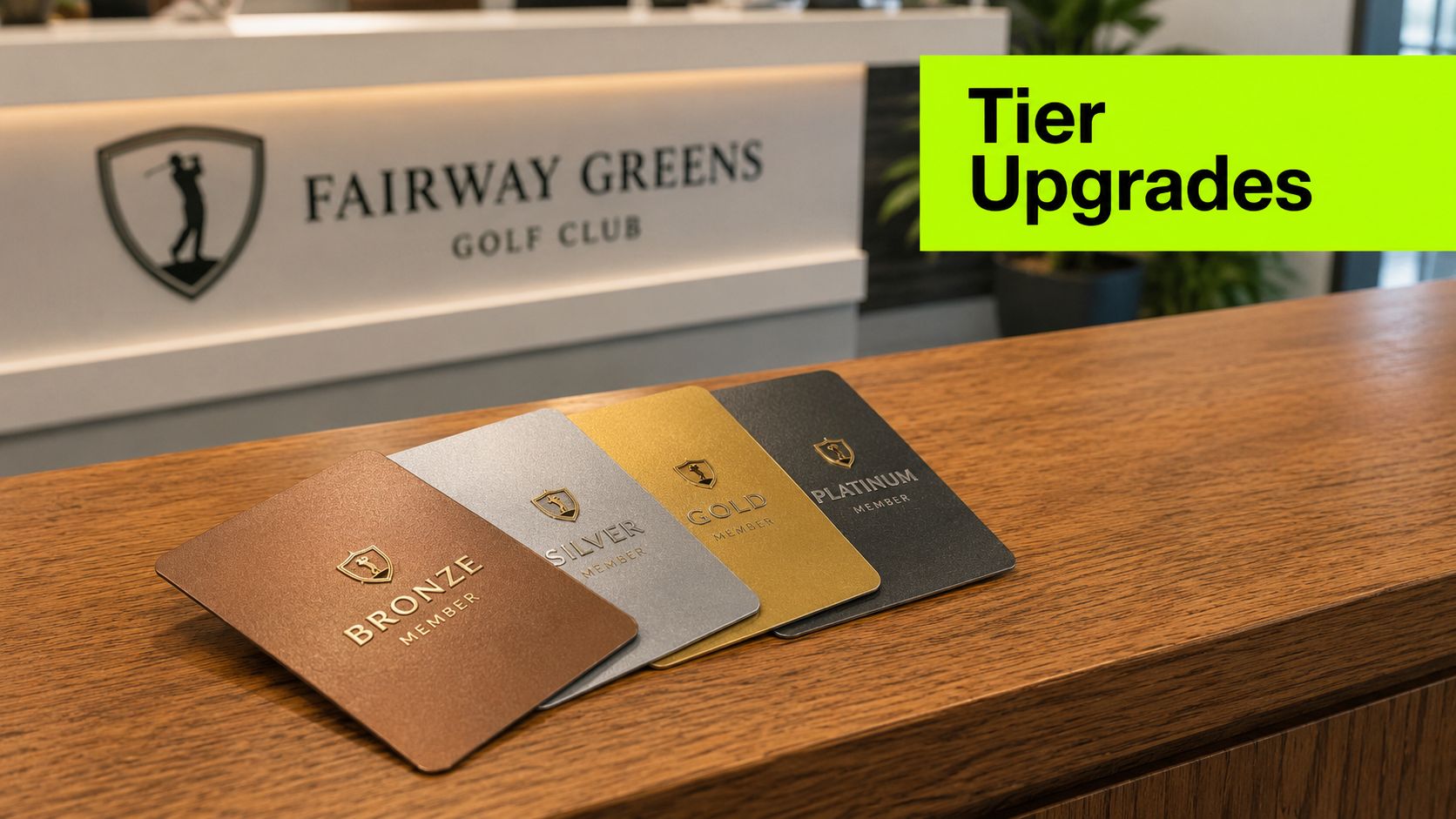
A single full-fee membership rarely fits every golfer. Some prospects need a lower-friction entry point, while established members may value more access, convenience or recognition and will pay for it when the difference is clear.
Tiered memberships can capture that range without turning every conversation into a discount negotiation. A club might separate access, booking priority, guest privileges, practice facilities, coaching credits or clubhouse benefits into distinct packages. The important point is differentiation. If the only visible difference is price, members will compare cost rather than value.
Clubs should audit how members currently use the course and facilities before introducing new tiers. Frequent visitors, members who bring guests and those who regularly attend competitions may be natural upgrade candidates. That information belongs in a CRM, not in a spreadsheet held by one membership secretary.
Make progression feel earned
Existing members need reassurance that the club isn't only raising prices. Explain what remains stable, then show the additional value available through each tier. Upgrade messages work best around relevant triggers, such as membership anniversaries, tournament participation, or increased guest activity.
Bidston Golf Club is a useful example of how restructuring can support recovery. Its membership tiers were redesigned with clearer value differences, contributing to more than double membership and six-figure recurring revenue, as described by GolfRep's golf club growth case studies.
Track upgrade enquiries, upgrade rate by member segment, average revenue per member and cancellation rates after the change. Test new pricing with a contained group first. A complicated tier structure won't work if staff can't explain it in a short conversation.
2. Guest Fees and Visitor Revenue Maximisation
Visitor revenue should be managed as more than a green-fee transaction. A guest may buy food, hire a buggy, book a lesson, return with friends or become a member. If the club records only the tee time and payment, it can't understand the full value of that relationship.
England's casual golf market is moving through digital channels. Recent UK market coverage reported average green-fee income of £189,240 per club in 2025, up 17% year on year, with online sales representing 67% of casual sales and online revenue rising 25%. Those figures are reported by Golf Business News. The commercial question is what happens after the booking.
Create visitor packages that protect the member experience while giving guests a clear reason to spend more. A course knowledge tour, coaching add-on, buggy option, post-round meal or return-visit invitation can increase value without blanket discounting.
Track the visitor journey
Every guest should have a record showing source, date played, package purchased, satisfaction and follow-up outcome. Member referrals deserve particular attention because the sponsoring member can provide context and credibility.
- Use time-based pricing carefully: Encourage off-peak play while protecting the value of sought-after tee times.
- Build natural add-ons: Present coaching, dining and equipment options during booking, not only at reception.
- Measure conversion: Record which visitors book again, enquire about membership or stop responding.
- Separate feedback: Review guest satisfaction independently from member feedback so service problems don't remain hidden.
GolfRep's guide to generating more revenue from visitors addresses the commercial journey beyond the initial green fee. The trade-off is operational discipline. More packages create more fulfilment work, so start with offers the clubhouse and golf operations teams can deliver consistently.
3. Food and Beverage Revenue Enhancement
Food and drink should be managed as a commercial part of the member journey, not just a clubhouse service. Hillier Hopkins reported that 81% of members' clubs generated annual bar revenue above £150,000, the highest level since its survey began, in its 2024/25 UK golf clubs report. The bar and clubhouse therefore deserve the same attention as other revenue lines.
The strongest opportunities follow visits already in the diary. A member finishing a round, a competition participant planning a meal and a family attending an event all present natural prompts for evening dining, weekend menus, private dining or event catering.

Replace reactive service with planned demand
A CRM can group members by visit frequency, event attendance and previous purchases. Staff can then send a relevant post-round message about an evening menu or invite regular competition participants to a themed dining event. The system should also record enquiry source, response time, booking outcome and follow-up, so the club can see which offers create revenue rather than just more activity.
At the point of sale, staff can suggest complementary products when the recommendation is useful and properly briefed, rather than scripted.
GolfRep's food and beverage management guide examines ways to connect hospitality with member engagement.
Use clear packages for private functions, such as entry-level, standard and premium catering. Track revenue per service period, average transaction value, event enquiries, booking conversion and waste. The trade-off is kitchen capacity. Promoting an offer that the team cannot deliver consistently will damage trust faster than a quiet service period.
4. Corporate and Group Event Hosting
A golf club can sell a managed business occasion, not only access to its course. Client entertainment, team days, charity events, group tournaments and networking functions can combine tee-time revenue, catering, room hire, coaching and equipment. The commercial return depends on what happens after the enquiry, as well as the appeal of the venue.
Clubs near commuter routes or business communities may find a local audience for clearly defined packages. Downes Crediton illustrates the value of reaching local business networks with a specific offer and prompt follow-up. The practical lesson is to make the proposition easy to understand, then give organisers a clear response route.
Prepare packages that staff can quote without rebuilding a proposal for every enquiry. Set out course access, catering choices, event coordination, branding options and optional coaching. Standard packages reduce administrative time, while a controlled set of upgrades preserves flexibility for higher-value bookings.

Turn event enquiries into future revenue
Record the organiser, enquiry source, response time, quote, booking outcome and agreed follow-up in the CRM. Capture attendee details only with consent and a clear purpose. After the event, send something useful, such as photographs or feedback questions, before offering a visitor booking or relevant membership conversation.
For practical guidance on how to impress with corporate events, align the event experience with the organiser's objectives, rather than adding unnecessary extras.
Track enquiry response time, quote-to-booking conversion, net contribution, catering spend and guest-to-member enquiries. Review results by package and source. A low-margin event that restricts member access, overloads staff or demands extensive custom work may reduce total club value, even when the booking fills the diary.
5. Professional Services and PGA Lesson Packages
Coaching is one of the clearest ways to monetise interest before asking someone to commit to membership. A beginner may not be ready to buy an annual plan, but may be willing to book an introductory lesson or attend a group clinic. That first service gives the club a practical opportunity to demonstrate the course, the professional team and the wider member experience.
PGA lesson revenue can include private instruction, group clinics, junior development, women's programmes, beginner pathways, launch monitor sessions and video analysis. The commercial strength comes from progression. A person shouldn't finish one lesson without knowing what the next appropriate step is.
Build a pathway, not a menu
A clear route might move from a beginner clinic to individual lessons, then to an intermediate group and finally to regular play or membership. The PGA professional should own the coaching experience, while the membership team records consented prospect information and handles the next conversation.
Useful CRM segments include members who haven't booked a lesson, lesson-takers who haven't played a round and prospects who attended a clinic but didn't join. Automated reminders can promote relevant coaching without sending every member the same message.
Measure lesson utilisation, revenue by service, repeat booking rate, clinic attendance and lesson-taker-to-member conversion. Bundle lesson credits into selected membership tiers only if the professional can fulfil them. Unused credits create an apparent benefit that may become a cost and a source of dissatisfaction.
A junior programme also creates a long-term family relationship. England Golf-linked reporting recorded junior membership rising from 46,028 to 61,483, an increase of more than 34%, between 2024 and 2025, according to Northern Golfer's coverage. Clubs should connect junior coaching with parent communication, family clubhouse spend and future membership pathways.
6. Membership Retention Optimisation and Churn Reduction
Acquiring a replacement member is not the only response to churn. A club should first understand why an existing member's engagement is falling. Fewer rounds, declining event attendance, unused facilities or repeated service complaints can indicate risk before a resignation arrives.
Retention work is less visible than a membership campaign, which is why committees often underfund it. Yet an engaged member can contribute through subscriptions, visitor introductions, coaching, food and beverage, events and shop purchases. A lapsed member contributes none of those streams.
Give staff an early-warning view
Define the signals that matter for the club. A CRM dashboard might show members with a declining usage trend, members who haven't attended a competition or members whose payment history requires attention. The system should prompt a relevant human action, not just produce a report.
Start with a friendly check-in. If the member responds, route the issue to the person who can solve it. That might be the general manager, membership director, PGA professional or clubhouse manager. A win-back offer can help, but it shouldn't hide a course-access, service or culture problem.
- Record the reason for risk: Separate low usage from dissatisfaction, financial pressure or relocation.
- Use personal follow-up: A phone call often carries more weight than another automated email.
- Review departing members: Exit conversations can identify recurring issues before they become structural.
- Compare segments: Look at tenure, membership type, age profile and engagement patterns without assuming one solution fits all.
England Golf-linked reporting puts the average member age in England at 54.99 years, which supports a balanced strategy that retains established members while making the club more accessible to younger adults. The figure appears in Golfshake's membership reporting. Track retention, reactivation, reasons for resignation and revenue retained, not just the number of emails sent.
7. Handicap Services and Affiliated Club Networks
Affiliation and reciprocal access can strengthen a membership offer without requiring the club to build another physical product. Members may value the chance to play elsewhere, maintain recognised handicaps and enter competitions or networks beyond their home course.
The commercial value depends on how clearly the benefit is presented and what happens after an enquiry. A reciprocal arrangement described only in a joining pack will rarely influence a prospect comparing clubs. Sales and retention messages should show how access works, who can use it and whether availability differs by membership tier. Record each enquiry in the CRM, assign ownership and track whether the prospect joins after receiving the information.
England has 1,735 affiliated golf clubs and approximately 730,000 club members, according to Golfshake's account of England Golf-linked reporting. That national network creates scope for partnerships, although its commercial value depends on member usage, reliable access and the administration required.
Make the network measurable
Track reciprocal bookings, handicap-service enquiries, qualifying-event attendance and member satisfaction. If usage remains low, check availability, communication, booking friction and whether the offer suits the member base.
Higher membership tiers might receive broader access, while entry-level members retain a useful core benefit. Reciprocal play can also sit alongside guest days, coaching or corporate entertainment. Publish clear rules, restrictions and booking procedures. Ambiguity creates work for the secretary and weakens perceived value.
The trade-off is administration. External arrangements need coordination, response discipline and regular review. A network that looks strong on paper but delivers unreliable access can damage retention. Start with dependable relationships, measure enquiries through to usage, and communicate the terms accurately.
8. Membership Payment Plans and Financing Options
A large annual payment can delay a decision even when the prospect likes the club and can afford the membership over time. Payment plans address that friction by spreading the cost through monthly direct debit, quarterly payments or seasonal structures.
The plan should be presented as a payment choice, not as a cheaper membership. If the annual total changes between options, explain why. Clear terms around payment dates, failed payments, grace periods and escalation protect both the club and the member.
Connect payment preference to the sales process
Ask about preferred payment timing during the enquiry stage and record it in the CRM. A prospect considering a monthly plan needs a different conversation from one who is ready to pay annually. Automated reminders can reduce missed payments, but staff still need a defined process for handling failed collections.
Clubs should model the effect on cash flow, administration and arrears before launch. Payment plans may improve accessibility, but they can create collection work if the club lacks ownership and visibility. Use an established provider and make the terms easy to find.
For a plain-language comparison of BNPL and instalments, clubs can review the different structures before deciding what suits their membership model.
The practical KPIs are enquiry-to-join conversion by payment preference, payment failure rate, arrears recovery, cancellation rate and cash collected. Avoid presenting a monthly amount without showing the full commitment. Trust matters more than a superficially attractive figure.
9. Seasonal and Campaign-Based Membership Drives
Demand doesn't arrive evenly throughout the year. Prospects may act around New Year routines, the approach of summer, a return to regular activity in autumn or a change in work and family circumstances. A campaign calendar helps the club match its message to the reason someone is considering membership now.
England Golf reported English club membership rising from 730,602 in 2024 to 750,071 in 2025, an increase of 2.66%, while iGolf membership also grew by more than 34%, according to Golf Business News. The market is expanding, but growth still depends on whether each enquiry receives timely, relevant handling.
Build separate CRM campaigns for each seasonal window. Record the source, message, offer, response time, booked visit, outcome and later retention. A campaign that produces many enquiries but few visits may have a response or qualification problem rather than a traffic problem.
Protect momentum after launch
Set a clear service standard for campaign enquiries. Automated acknowledgement should confirm receipt and provide a next step, while a member of staff should take ownership of high-intent prospects. Email nurture can answer common questions about playing rights, fees, joining process and the first month as a member.
Review each campaign by conversion rate, cost per acquired member, member quality, payment preference and early engagement. Don't carry an offer forward just because it performed well on lead volume. If it attracts poor-fit prospects or overwhelms the club, adjust the message, audience or capacity.
Downes Crediton's rapid membership campaign shows the value of combining a clear seasonal push with operational execution. The example is relevant because campaign intensity creates a workload that manual processes often can't absorb.
10. Enquiry Response Systems and Conversion Process Optimisation
The strongest golf club revenue ideas can fail after launch. A membership tier, visitor package or event offer creates commercial value only when the club captures each enquiry, responds promptly and follows it through to a measurable outcome.
UK businesses average 47-hour response times to new enquiries, and only 7% respond within five minutes. The UK lead-response research also reports that 78% of customers buy from the first company to respond. Property-sector findings do not transfer perfectly to golf, but the operational lesson is clear: response time affects revenue.
A separate UK survey found that nearly 10% of firms responded within five minutes and more than 46% within an hour, according to Survey Booker's lead-response study. A defined process therefore gives clubs a practical advantage, particularly outside office hours.
Build a process staff can follow
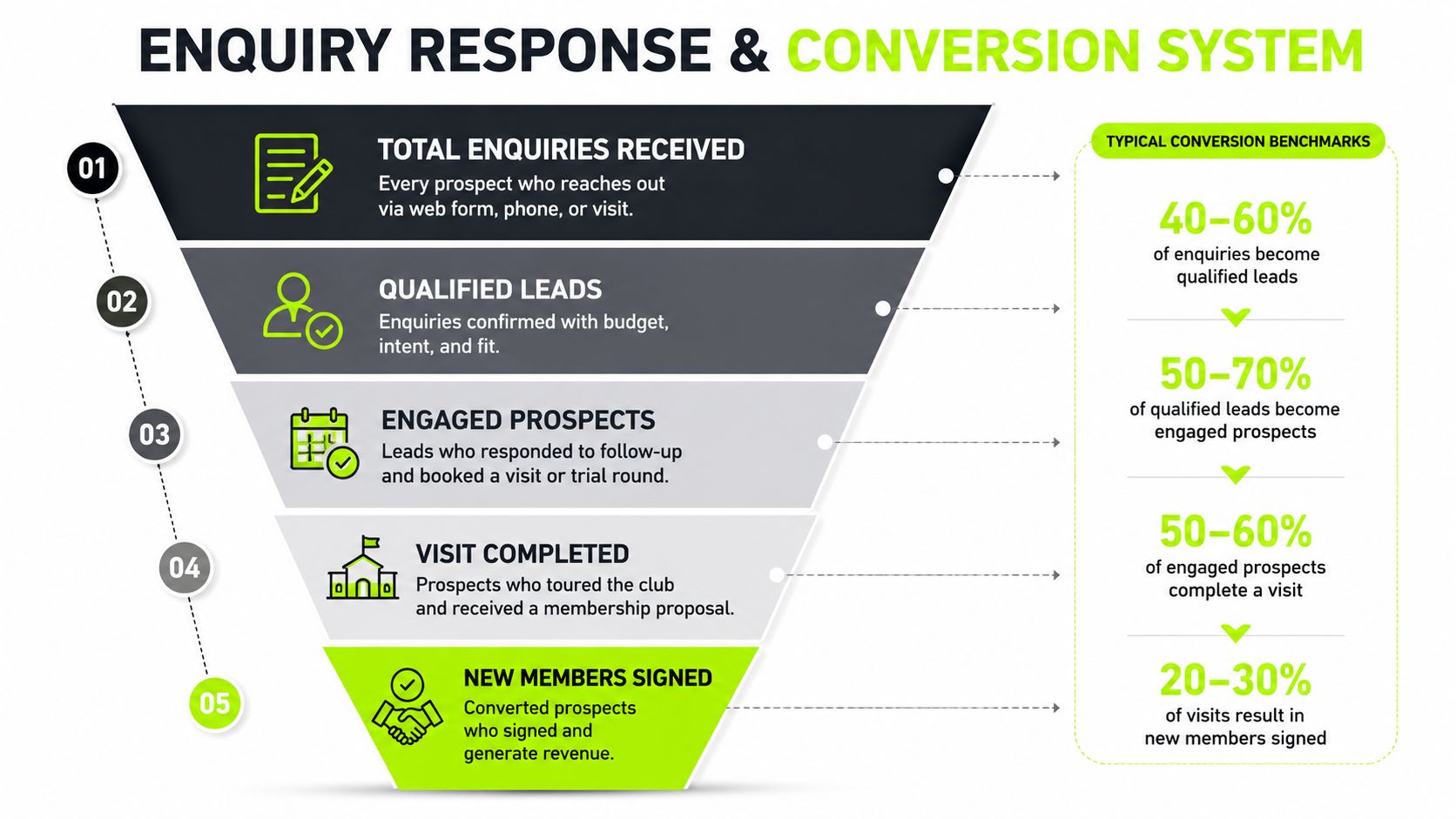
Start with a baseline. Record enquiry-to-contact time, source, assigned staff member, booked visit, conversion rate and the reason a prospect stalled. This shows whether a campaign generated revenue or merely added workload. GolfRep's enquiry conversion guide sets out the process in more detail.
A workable system includes:
- Instant acknowledgement: Confirm receipt, answer the immediate question and offer a clear next step.
- Visible ownership: Assign the enquiry to a named person in the CRM, rather than leaving it in a shared inbox.
- Structured nurture: Follow up when a prospect has not replied, with human contact when engagement signals stronger intent.
- Weekly review: Revisit stalled enquiries and resolve unanswered questions.
- Monthly analysis: Compare conversion by source, enquiry quality, month and staff member.
Store response time as a CRM field and measure the period from receipt to first contact, including out-of-hours enquiries. Sift Software's lead-management guidance provides this operating model.
Benchmarking links a response within five minutes with stronger lead qualification than a response after thirty minutes, while longer delays can reduce qualification rates sharply, according to Anthill's enquiry-response analysis. GolfRep combines lead generation with 24/7 qualification, structured nurture and CRM visibility. Clubs can also review qualifying leads with fonea when staffing makes continuous first response difficult.
Automation does not replace a welcoming club team. It gives that team the right prospect, context and next action, while conversion tracking shows which revenue ideas deserve more attention.
Top 10 Golf Club Revenue Ideas Comparison
| Strategy | Implementation complexity | Resource requirements | Expected outcomes | Ideal use cases | Key advantages |
|---|---|---|---|---|---|
| Membership Tier Optimization and Premium Upgrade Programs | High, pricing design, segmentation, comms | CRM analytics, pricing expertise, marketing, ongoing data review | Increased ARPM, higher upgrade rates, improved LTV | Clubs with diverse member needs or stagnant revenue | Captures more revenue per member; structured progression and loyalty |
| Guest Fees and Visitor Revenue Maximization | Medium, dynamic pricing and capacity planning | Digital booking, guest tracking CRM, operational capacity | Immediate non-member revenue, better off-peak utilization | Urban/resort clubs or those with spare tee times | Quick revenue uplift; pipeline for future members |
| Food and Beverage Revenue Enhancement | Medium, operational focus and promotions | Skilled F&B staff, kitchen, POS, inventory management | High-margin ancillary revenue, stronger member engagement | Clubs with clubhouse traffic and event demand | Profitable recurring revenue; strengthens community space |
| Corporate and Group Event Hosting | High, event coordination and cross-team logistics | Dedicated event coordinator, catering capacity, flexible scheduling | Large one-off revenues, corporate lead generation | Clubs near business hubs or with weekday capacity | High-value bookings; exposure to decision-makers |
| Professional Services and PGA Lesson Packages | Medium, staffing and program development | PGA professionals, coaching tech (launch monitors), practice space | Reliable lesson income, high conversion to membership | Clubs with coaching demand or junior programmes | Builds engagement and a strong membership pipeline |
| Membership Retention Optimization and Churn Reduction | Medium, process and automation setup | CRM with engagement scoring, staff for outreach, analytics | Lower churn, higher member LTV, more predictable revenue | Clubs experiencing attrition or wanting stable base | Cost-effective revenue preservation; improved satisfaction |
| Handicap Services and Affiliated Club Networks | Low–Medium, admin and partnership management | Admin staff, affiliation fees, reciprocal agreements | Recurring affiliation fees, tournament revenue, added member value | County clubs or clubs seeking reciprocal play benefits | Recurring income, prestige, access to other courses |
| Membership Payment Plans and Financing Options | Medium, payment integration and compliance | Payment processor, legal/compliance, billing administration | Higher conversion, predictable MRR, lower upfront barrier | Clubs with large joining fees or price-sensitive prospects | Increases sign-ups; smooths cash flow and affordability |
| Seasonal and Campaign-Based Membership Drives | Medium, concentrated planning and execution | Marketing budget, campaign assets, CRM campaign tracking | Concentrated acquisition spikes, improved ROI per campaign | Clubs that benefit from seasonal demand peaks | Efficient spend allocation; higher conversion in windows |
| Enquiry Response Systems and Conversion Process Optimization | Medium–High, CRM, automation, cultural change | CRM/automation tools, trained staff, dashboards and discipline | Significant conversion lift from existing enquiries; better forecasting | Clubs losing prospects due to slow or inconsistent follow-up | Maximizes value of existing leads; scalable acquisition system |
Turn the Strongest Ideas Into a Measurable Pipeline
Ten ideas don't make a revenue strategy. A club that launches new membership tiers, visitor packages, coaching campaigns and events at the same time may create activity without learning which changes revenue. Staff become stretched, members receive mixed messages and the committee can't separate a successful offer from a process failure.
Rank opportunities against three practical tests: revenue potential, operational readiness and effect on member experience. A visitor package may be commercially attractive but unsuitable if the tee sheet is already constrained. A food and beverage promotion may work well if the kitchen has capacity, but fail if it creates service delays. A payment plan may improve access while adding collection work. Every idea has a trade-off.
Start with a baseline. Record current enquiries, response time, booked visits, conversion rate, average member value, retention and revenue by stream. Include visitor spend, coaching, hospitality and events where the data exists. Clubs should also record source and staff ownership, because a headline conversion figure can hide major differences between referral, website, paid advertising and walk-in enquiries.
The first change should usually pair one commercial initiative with one process improvement. For example, launch a structured visitor package while introducing CRM tracking for every visitor enquiry. Or promote a beginner coaching pathway while setting an agreed response standard and follow-up sequence. This approach gives the team a manageable test and shows whether the offer and the conversion process are working together.
Set an owner for each activity. The membership manager may own joining enquiries, the PGA professional may own coaching follow-up, the clubhouse manager may own hospitality bookings and the general manager may review the commercial picture. Review active KPIs weekly, then refine the system monthly. Useful measures include response time, booked-visit rate, conversion by source, average revenue per customer, repeat purchase, member engagement and retention.
Bidston Golf Club, Addington Palace and Downes Crediton illustrate different growth situations, from recovery and membership development to campaign execution. Macdonald Hotels and Resorts demonstrates why multi-site operators need centralised CRM visibility and follow-up processes across properties. These examples don't remove the need for local judgement. A club still has to match its offer to its brand, capacity, pricing and member expectations.
GolfRep works with clubs as a specialist growth partner rather than a conventional marketing agency. Its approach combines lead generation, 24/7 qualification, structured nurture and CRM tracking so managers can see what happens after an enquiry arrives. That visibility helps clubs identify whether the constraint is demand, response discipline, sales handling, service delivery or retention.
Sustainable growth shouldn't depend on indiscriminate discounting. It comes from making better use of the demand already available, improving the value of each visit and giving staff a repeatable process for turning interest into action. The right next step is practical: choose one revenue initiative, choose one process improvement, assign owners, define the KPIs and review the evidence before expanding.
GolfRep helps UK golf clubs turn enquiries into booked visits, memberships and repeat revenue through lead generation, 24/7 qualification, structured follow-up and CRM visibility. Visit GolfRep to discuss a measurable growth system suited to your club's brand, capacity and commercial priorities.
Ready to tap into our proven growth system?