How Do Golf Clubs Make Money: Revenue Streams Explained

A general manager starts the week with the same argument waiting in the inbox. Should the club raise membership fees, open more visitor tee times, promote society days, or push the clubhouse harder? Each option can produce income, but none answers the more important question: which revenue lines are reliable, which depend on weather, and which are being lost after an enquiry arrives?
So, how do golf clubs make money in practice? The answer starts with subscriptions and green fees, then extends into catering, events, coaching, retail, venue hire, and underused assets. The commercial difference between a stable club and a frustrated one is often not demand. It's whether the club can respond quickly, keep every enquiry visible, and move prospects from first contact to booked visit or payment.
Why Understanding Your Club's Revenue Mix Matters
A club manager can spend weeks debating whether the annual subscription is too high or whether visitor pricing is too low. That debate is premature if nobody has mapped the money already coming in. Before changing prices, identify every income line, the member or visitor category attached to it, the timing of receipts, and the person responsible for converting the opportunity.
Start with a simple revenue map:
- Recurring income: subscriptions, joining fees, locker charges, and other payments that can be forecast.
- Usage-based income: visitor rounds, society bookings, buggy hire, trolley storage, coaching, and competition entries.
- Hospitality income: food, drink, functions, weddings, and corporate use.
- Asset income: venue hire, land arrangements, filming, and other uses of club property.
This classification matters because two pounds of turnover can carry very different risks. A subscription provides a recurring base, while a visitor round depends on weather, tee-time availability, course condition, and the effectiveness of the booking process. A wedding or corporate event may bring useful margin, but it relies on a different sales cycle and operational capability.
Map before changing prices
A proper revenue review should show:
- What arrives every month or year.
- What changes with weather and seasonality.
- Which categories depend on a small group of members.
- Which income lines have unused capacity.
- Where enquiries stop before payment or booking.
The 2022 to 2024 period exposed the danger of relying on assumptions. Weather disrupted play, household budgets came under pressure, and clubs faced rising operating costs. A club that understood its mix could see which lines were absorbing the shock and which were failing first.
Practical rule: Don't approve a new price list until the club can explain where its current turnover comes from and how each line is converted.
The rest of this guide treats revenue as an operating system rather than a list of products. The core streams come first, followed by ancillary income, examples from different UK club models, revenue leakage, performance measures, and a practical implementation plan. The working thesis is straightforward: revenue growth at many UK clubs is a follow-up problem dressed up as a marketing problem.
The Two Income Streams That Drive Every UK Club
Membership subscriptions usually provide the foundation. The GCMA's insight on member subscriptions says member fees contribute between 50% and 60% of a club's budget. Hillier Hopkins' 2020/21 survey also reported that 80% of clubs planned to increase membership fees in 2022, while 77% kept them below £1,612. That combination explains the commercial balancing act. Clubs need recurring cashflow, but they also need to remain competitive for local golfers.
The second major stream is course access beyond annual subscriptions. Visitor rounds, societies, corporate days, competition entries, buggy hire, trolley storage, and lockers all sit around the course and clubhouse. The GCMA's cash-flow insight reports that between 95% and 98% of gross profit comes from member subscriptions and visitor green fees, showing how concentrated the commercial model remains. The GCMA analysis of club cash flow and expenditure makes the implication clear: catering, retail, and other extras matter, but they don't replace the two primary engines.
What sits inside the core lines
A manager should separate the core lines instead of reporting them as one broad “golf income” figure:
- Subscriptions: full seven-day, five-day, intermediate, junior, flexible, county, academy, and social categories.
- Member-related receipts: joining fees, competition entries, arrears recovery, locker charges, and member guest payments.
- Visitor play: direct visitor bookings, society rounds, corporate days, opens, and packages.
- Course extras: buggy hire, trolley storage, club hire, practice facilities, and other access-related charges.
The pricing architecture can vary sharply by club. Hillier Hopkins reported average member green fees of £31 and non-member green fees of £58 in the survey cited by the GCMA, illustrating the difference between member access and visitor yield. The same source notes that subscriptions often remain below £1,612, while clubs use visitor pricing to monetise spare capacity at a higher rate.
| Revenue line | Budget club % | Mid-range club % | Premium club % |
|---|---|---|---|
| Membership subscriptions | Core base | Core base | Core base |
| Visitor and society green fees | Supporting line | Major supporting line | Major supporting line |
| Ancillary golf income | Smaller contribution | Moderate contribution | Moderate contribution |
| Hospitality and other income | Supplementary | Supplementary | Supplementary |
These categories aren't forecasts. They're a management view of concentration. A club with a full membership book may have limited subscription upside but unused weekday capacity. Another may have strong visitor demand yet weak conversion into societies or repeat bookings. Weather and demographic changes can affect both, which is why lead visibility and category-level reporting matter as much as headline turnover.
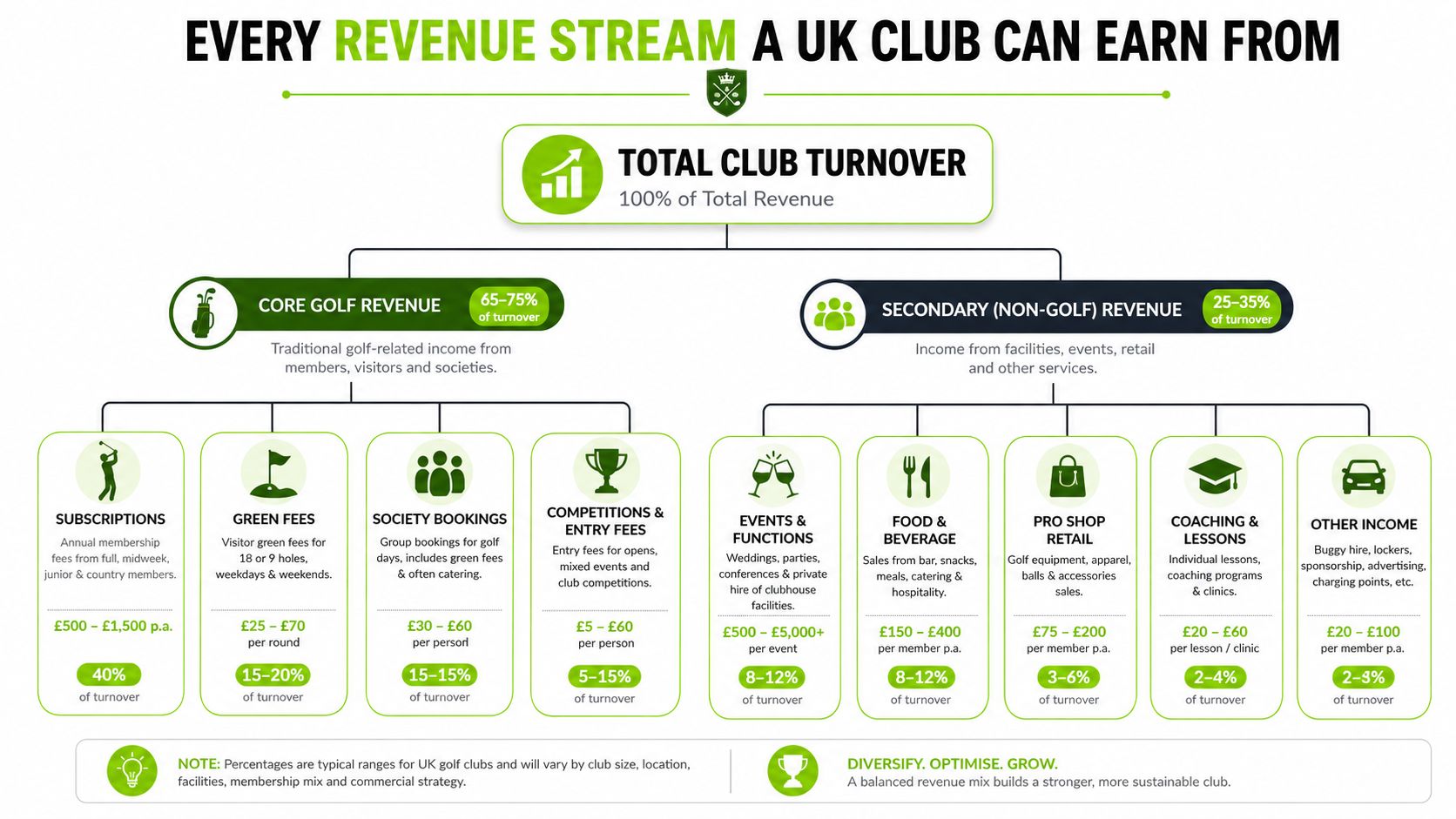
Every Revenue Stream a UK Club Can Earn From
A club's income inventory should begin with the lines it can sell repeatedly, then move towards opportunities that depend on staffing, premises, or planning permission. The point isn't to launch everything. It's to identify what the club already has the capacity to sell and what an enquiry process can convert without damaging member value.
Start with access and participation
Subscriptions should be structured around different needs rather than one blunt membership product. Full seven-day access, five-day access, intermediate categories, junior and academy options, flexible play, county access, and social membership can widen the addressable market. Use a clear progression between categories, and review whether a low-commitment member has an obvious route into a fuller package.
Visitor green fees should vary by day, season, member accompaniment, and tee-time demand. Hillier Hopkins' 2023/24 report recorded members' club average charges ranging from £28.81 for a weekday round with a member to £108.25 for all-day play without a member, while 80% of members' clubs generated more than £60,000 in annual green-fee income. The Hillier Hopkins golf clubs report provides a useful comparison point for reviewing your own visitor yield.
Society and corporate packages can combine green fees with breakfast, halfway catering, room hire, prizes, and buggy access. Competition entry fees, buggy hire, locker rental, trolley storage, club hire, and practice-range or simulator sessions add smaller transactions that can still improve the value of each visit.
Build non-golf income around existing assets
Food and beverage income can include daily catering, bar sales, functions, weddings, meetings, and corporate hospitality. The commercial question isn't whether the club has a bar. It's whether the team has a defined offer, a visible booking route, and a follow-up process for every function enquiry.
Coaching can include individual lessons, group programmes, junior academies, beginner courses, and seasonal packages delivered through the attached PGA professional. The pro shop can earn from equipment, apparel, club fitting, repairs, and accessories. Custom fitting deserves separate attention because it can combine professional expertise with equipment sales rather than competing purely on product price.
Ancillary partnerships can include physiotherapy, fitness studio memberships, wellness services, holiday scratchcard partnerships, and other carefully selected offers. GDPR applies whenever the club captures and follows up personal data, while alcohol, food, premises, and event activity can create licensing and compliance obligations. Record consent, ownership, and next action instead of leaving these details in personal inboxes.
Finally, review the property itself. Corporate venue hire, filming and location fees, solar arrangements, ground rent, and development potential on underused land can create income outside normal golf operations. These options require proper legal, planning, and member consultation processes, so they shouldn't be treated as quick fixes.
For clubs reviewing their structure, guidance on membership levels that drive growth can help frame tiers around customer needs. For the visitor side, audit the booking journey and increase golf club green-fee revenue by improving how spare capacity is presented and followed up. Every line remains only as strong as the enquiry-to-booking process behind it.
What Diversification Looks Like in Real Clubs
Diversification doesn't mean every club should become a wedding venue, a resort, or a leisure complex. The right mix depends on location, member expectations, available buildings, staffing, and the type of demand the club can reach without disrupting play.
Bidston Golf Club illustrates a members' club model that layers society days, pay-and-play bays, and a growing coaching programme onto one 18-hole site. The result is a broader commercial base, with non-member income reported at roughly 35% of turnover in the example provided. The lesson isn't to copy every product. It's to use existing access, practice space, and professional expertise when those assets can serve non-members at suitable times.
Addington Palace Golf Club represents a different model. An urban, multi-site operator can use food and beverage, weddings, and corporate hospitality to counter fluctuations in green-fee revenue. Food and drink contributes around 22% of group income in the supplied example, showing how a clubhouse can operate as more than a post-round facility.
Downes Crediton demonstrates a venue-hire approach where course access is only part of the commercial proposition. Meetings, stay-and-play packages, and simulator income give the business more reasons to be contacted and more ways to monetise the property.
| Revenue stream | Bidston, members' club | Addington Palace, urban multi-site | Downes Crediton, venue-hire model |
|---|---|---|---|
| Membership | Primary foundation | Important across sites | One part of the mix |
| Visitor and society play | Strong supporting line | Significant but variable | Supporting offer |
| Food and beverage | Clubhouse support | Major group contributor | Linked to functions and stays |
| Coaching and practice | Growing opportunity | Site-dependent | Simulator and coaching potential |
| Events and venue hire | Selective | Weddings and corporate hospitality | Central commercial proposition |
These examples point to a practical decision rule. Diversify where the club already has an asset, a reachable audience, and someone accountable for selling it. Adding a service without ownership creates another unmonitored inbox, not a new revenue stream.
Where Most UK Clubs Lose Revenue
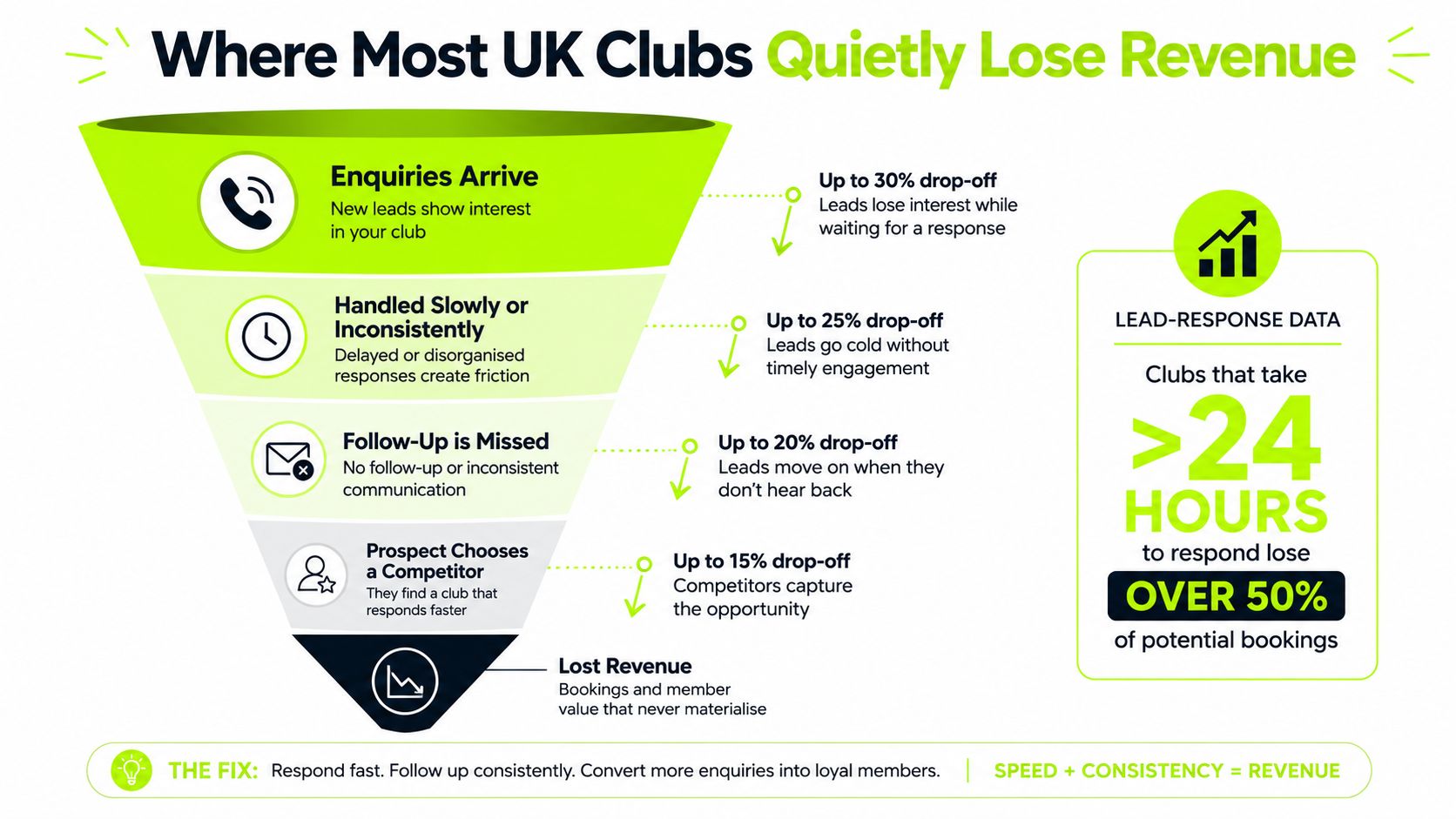
A membership form arrives on Friday afternoon. A society organiser asks for a date, or a visitor wants a tee time. The enquiry then waits in a shared inbox while staff handle the day's operational work. By the time someone replies, another venue may already have secured the conversation.
The bottleneck for many UK clubs sits in the follow-up system. A UK lead-response study from SurveyBooker found that nearly 10% of firms replied within five minutes and more than 46% replied within an hour. The same reference reports that conversion potential falls from 70% to 85% when contact happens within five minutes to 50% to 60% when prospects wait 30 minutes.
Those figures are not a club forecast. They show why response time belongs in the revenue process, alongside tours, deposits, subscriptions, and bookings. Set a response target, assign ownership by enquiry type, and review the outcome after the first reply.
Four points where revenue leaks
The first response is too slow. Prospective members and society organisers often contact several venues. A next-day reply gives competitors time to arrange the visit, confirm the date, or answer the commercial question first.
The lead has no visible owner. Shared inboxes and spreadsheets obscure responsibility. The secretary, professional, events manager, or general manager may assume somebody else is handling it.
Follow-up depends on memory. One reply rarely completes a membership or event sale. Scheduled reminders should prompt relevant next steps, such as a tour, package detail, availability check, or deposit request.
Marketing and sales are disconnected. Without recording the source and outcome, the club cannot see whether activity produced visits, subscriptions, society deposits, or only clicks.
The club needs a process that works when staff are busy.
A CRM can hold contact details, source, status, next action, and outcome in one place. Automation can acknowledge an enquiry immediately, route it to the right person, and prompt human follow-up. It should support a conversation, not replace one. GolfRep is one sector-focused option that combines CRM tracking, automated follow-up, and reporting for club enquiries. Test any system by asking whether the team can see every open opportunity, its owner, and its next action.
For a fuller examination, read how most golf clubs lose 30% of enquiries without realising. Treat the percentage in that title as the article's framing, not a universal benchmark for every club.
The KPIs That Tell You If Revenue Is Actually Growing
A revenue dashboard should fit on one screen and connect activity to cash. Enquiry volume alone is a weak measure. A club can generate more enquiries while producing fewer visits, fewer subscriptions, and less profitable society work.
Track these measures monthly:
| KPI | What it measures | 2026 benchmark |
|---|---|---|
| Enquiries by source | Which channels create demand | Establish a club baseline |
| Speed to lead | Time from enquiry to first contact | 85% contacted within 10 minutes |
| Enquiry to visit | Ability to secure a tour or playing visit | 35% to 45% |
| Visit to membership | Effectiveness of the sales conversation | Establish a club baseline |
| Member lifetime value | Revenue retained across the relationship | Track by category |
| Member churn rate | Retention performance | Below 8% annually |
| Average society booking value | Revenue per society guest | £55 to £75 per head including food |
| Food and beverage spend per head | Hospitality yield | Track by booking type |
| Pro shop attach rate | Retail or fitting revenue linked to play | Track by product and visit |
These are management benchmarks supplied for 2026 planning, not universal industry results. Use them to expose weak points, then compare performance by membership category, source, day, and staff owner.
A faster response should improve the chance of arranging a visit. A better visit process should improve membership conversion. Stronger retention then increases lifetime value without requiring the club to buy another enquiry. The dashboard should therefore show the chain, not isolated figures.
Read the practical framework for golf club revenue systems when deciding how to connect enquiry capture, ownership, follow-up, and reporting. If a KPI doesn't lead to a decision, remove it from the dashboard.
A Practical 90-Day Plan to Grow and Diversify Income
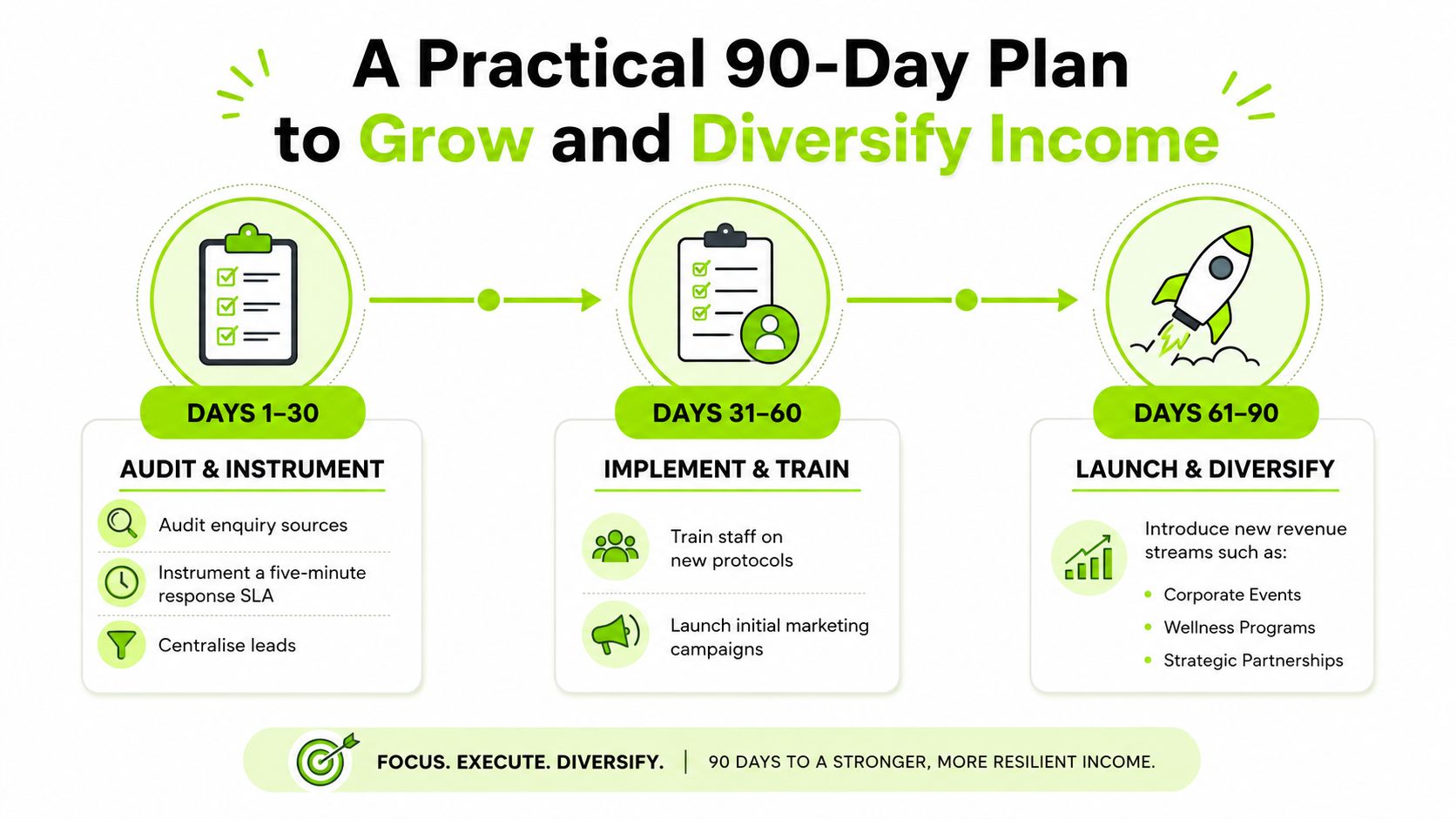
A UK club can improve income within one quarter by tightening enquiry handling before changing prices or adding products. The order matters: make demand visible, standardise follow-up, then test diversification where capacity already exists.
Days 1 to 30
Audit every enquiry source, including website forms, email, phone calls, social messages, visitor platforms, and referrals. Set a five-minute response SLA for priority membership, visitor, society, and event enquiries. Centralise those leads in one CRM view, with a named owner and next action for each prospect. Compare the revenue mix with the GCMA ranges already discussed. Mark each line as recurring, weather-sensitive, or under capacity.
Days 31 to 60
Build follow-up sequences for membership visits, society proposals, event enquiries, and abandoned bookings. Train staff to own leads, meet response standards, record outcomes, and escalate stalled opportunities. Repackage society and corporate offers around clear inclusions. Test one secondary income line, such as coaching, buggy hire, venue hire, or simulator access, only where existing demand and operational capacity support it.
Days 61 to 90
Review the dashboard by source, response time, visit conversion, revenue per booking, and retention. Commit resources to the two opportunities generating the strongest enquiry-to-revenue results. Avoid spreading staff across every possible idea. Present a rolling quarterly revenue review to the committee, with owners, actions, and next-month targets.
Predictable pipelines beat occasional demand spikes because the club can see what is coming, who owns it, and where prospects are being lost. Pricing still matters. Systems determine whether the club captures the value its existing demand can produce.
GolfRep helps UK golf clubs connect lead generation with structured follow-up, CRM visibility, and conversion reporting across membership, visitor, society, and event enquiries. Visit GolfRep to review a practical growth system for turning more club enquiries into booked visits, confirmed bookings, and recurring revenue.
Ready to tap into our proven growth system?