Junior Golf Coach: Your Club's Growth Playbook for 2026
Most advice on a junior golf coach starts in the wrong place. It starts with the person.
Clubs say they need a great junior coach, then write a vague advert, book a few weekly sessions, post a few photos on Facebook, and hope a junior section appears around it. That approach rarely produces a dependable pipeline of future members because the hire sits in isolation from the club's commercial systems.
The bigger issue has been visible for years. A 2014 England Golf survey found UK golf clubs had, on average, only 5 girl junior members each, and many clubs had fewer than 10 junior members in total according to the Golf Science Journal review of junior participation evidence. That isn't a coaching tweak problem. It's a club design problem.
A junior golf coach can become one of the most valuable growth hires a club makes. But only when the role is built into a proper system. That means clear accountability, strong safeguarding, structured delivery, fast enquiry handling, parent communication, progression pathways, and visible reporting to the manager and committee.
A coach without that system is an expense. A coach operating inside it is an investment.
Beyond the Hire Thinking Systemically About Junior Golf
The wrong question is, "Who can coach the juniors on Saturday mornings?" The right question is, "What programme can this club build that turns interest into participation, participation into membership, and membership into long-term family retention?"
That shift matters because junior golf doesn't grow from lessons alone. It grows when the club removes friction for parents, gives children a reason to come back, and makes the next step obvious. A strong junior golf coach helps with all three, but can't carry the burden alone.
Why clubs get this wrong
Most clubs still frame the role around delivery hours.
They ask for someone to run sessions, maybe organise holiday camps, and perhaps support a few competitions. They don't define enquiry ownership, parent follow-up, progression tracking, or conversion into junior membership. So the club ends up measuring activity rather than outcomes.
A busy coach isn't the same thing as a productive junior programme.
That trade-off shows up quickly. Sessions can be full enough to look healthy while the club still struggles to convert triallists, retain beginners, or move families into regular club use. If the receptionist writes names on paper, the pro keeps parent contacts in a phone, and no one tracks who attended a taster session three weeks ago, the programme leaks value at every stage.
What a system-led junior programme includes
A commercially useful junior setup usually has six moving parts:
- Role clarity: The coach owns delivery, parent communication, and reporting within defined boundaries.
- Lead handling: Every parent enquiry gets logged, acknowledged, and followed up.
- Programme structure: Children can see where they start and what comes next.
- Membership pathway: Families understand when coaching-only status should become club membership.
- Safeguarding and standards: The club reduces risk and builds trust.
- Measurement: Managers can see attendance, retention, and conversion.
Here's the practical test. If your current junior coach left tomorrow, could the club continue the programme with the same visibility, same parent communication, and same conversion process? If the answer is no, the club doesn't have a junior programme. It has one person holding things together.
Defining the Role and Commercial Model
A junior golf coach shouldn't be hired as a casual instructor if the club expects strategic value. The role needs to be written as a programme-building position with coaching at its centre, not as the only duty.
That starts with the brief. If the advert only talks about passion, enthusiasm, and a love of working with children, you'll attract people who can run a session. If it spells out retention, parent communication, pathway design, and membership conversion, you'll attract people who understand the club side of the job as well.
Write for outcomes, not hours
The risk in a narrow coaching brief is that it overweights technique and underweights experience. That's dangerous in junior sport. The International Golf Coaching Framework material highlights that common pitfalls in junior coaching, such as overemphasising technical skills, lead to burnout in 41% of participants by age 14 in the evidence cited within the IGCF framework document.
A better role description asks for evidence in areas such as:
- Programme planning: Can the candidate design age-appropriate pathways rather than isolated lessons?
- Human skills: Can they teach confidence, focus, resilience, and behaviour on the course?
- Parent management: Can they communicate progress clearly and professionally?
- Club integration: Will they work with membership, operations, and the professional shop?
- Reporting discipline: Can they maintain records, attendance logs, and progression notes?
What the role should include
A practical job description usually covers four buckets.
| Focus area | What good looks like |
|---|---|
| Coaching delivery | Group sessions, beginner pathways, on-course coaching, holiday activity |
| Programme management | Session plans, assessment notes, term schedules, event coordination |
| Parent and player communication | Progress updates, behaviour standards, next-step recommendations |
| Commercial contribution | Taster day support, trial-to-programme follow-up, membership handover |
That last line matters. The coach doesn't need to become a salesperson. But they do need to support conversion by making progress visible and by signalling when a child is ready for more formal club engagement.
Choosing the right commercial model
There isn't one perfect pay structure. The right choice depends on your club's risk tolerance, facility use, and operational control.
Flat salary suits clubs that want tight integration and consistent availability. It gives control, but you need enough programme volume to justify it.
Retainer plus performance element can align the coach with retention and programme growth. It only works if the club has clean tracking. Without that, it creates arguments over credit.
Self-employed partnership can work where the coach already has demand and entrepreneurial drive. The trade-off is less control over standards, admin, and parent experience unless the agreement is detailed.
Commercial rule: Pay models don't fix poor systems. They only amplify them.
A useful job advert reads more like this than the standard version:
- Purpose of role: Build and run a structured junior golf programme that feeds long-term club membership.
- Core responsibilities: Deliver coaching, assess players, maintain records, communicate with parents, support club junior events.
- Success measures: Retention, pathway progression, programme utilisation, and membership handover quality.
- Essential background: Junior coaching experience, safeguarding competence, and familiarity with structured development frameworks.
That attracts a different calibre of candidate. And it changes how the club manages the role after appointment.
Recruitment Safeguarding and Onboarding
Recruitment is where many clubs either protect the programme or weaken it before it starts. Hiring on likeability alone is risky. Junior coaching requires trust, consistency, and strong standards around children, parents, and club culture.
The search should be deliberate. Use specialist routes first, then widen only if needed. PGA networks, local academy relationships, county golf contacts, and club referral networks tend to produce stronger candidates than generic job boards because they surface people already familiar with the environment.
How to assess properly
A CV won't tell you whether someone can hold a group of mixed-ability children, calm an anxious parent, or manage a waiting list. Interviews need structure.
Use a blend of conversation and demonstration:
- Scenario questions: Ask how they'd handle a child losing confidence on the course, a parent pushing too hard, or a mixed group with wide ability gaps.
- Practical assessment: Put them in front of juniors if possible, or ask them to run a short mock session.
- Planning review: Request a sample six-week outline for beginners and a progression route beyond it.
- Communication test: Have them draft a parent update after a first assessment block.
This reveals whether the candidate can operate as a programme lead rather than just a ball-striking coach.
Safeguarding isn't an admin footnote
For a club manager, safeguarding needs to sit above convenience. Checks and policies can't be treated as paperwork to tidy up after the appointment.
Your process should include:
- DBS and background checks: Completed and verified before delivery begins.
- References: Properly taken, not only requested.
- Policy alignment: The coach understands the club's current safeguarding procedures and escalation routes.
- Conduct expectations: Clear rules on photography, communication with juniors, collection procedures, and supervision.
- Record keeping: Session registers, incident notes, and emergency information handled consistently.
A technically strong coach who is weak on these basics isn't a good hire.
Parents rarely inspect your internal systems, but they notice instantly when a club looks organised and safe.
Onboarding that shortens the ramp-up
A rushed onboarding usually leads to three avoidable problems. Parents get inconsistent communication. Staff don't know who owns enquiries. The coach builds their own process outside the club's systems.
A stronger onboarding plan includes the club's operational side from day one:
- Commercial briefing so the coach understands junior membership targets, pricing logic, and facility priorities.
- System access including CRM, enquiry forms, attendance tools, and reporting templates.
- Internal handoffs between reception, membership, the professional shop, and the coach.
- Parent journey mapping from first enquiry to taster session to programme booking and membership conversation.
- Early review dates at short intervals so problems are fixed before habits set.
Good onboarding should answer one simple question. If a parent enquires on Tuesday evening, who responds, what happens next, and where is that interaction recorded? If nobody can answer that cleanly, the club hasn't onboarded the coach. It has only introduced them.
Building a Scalable and Engaging Curriculum
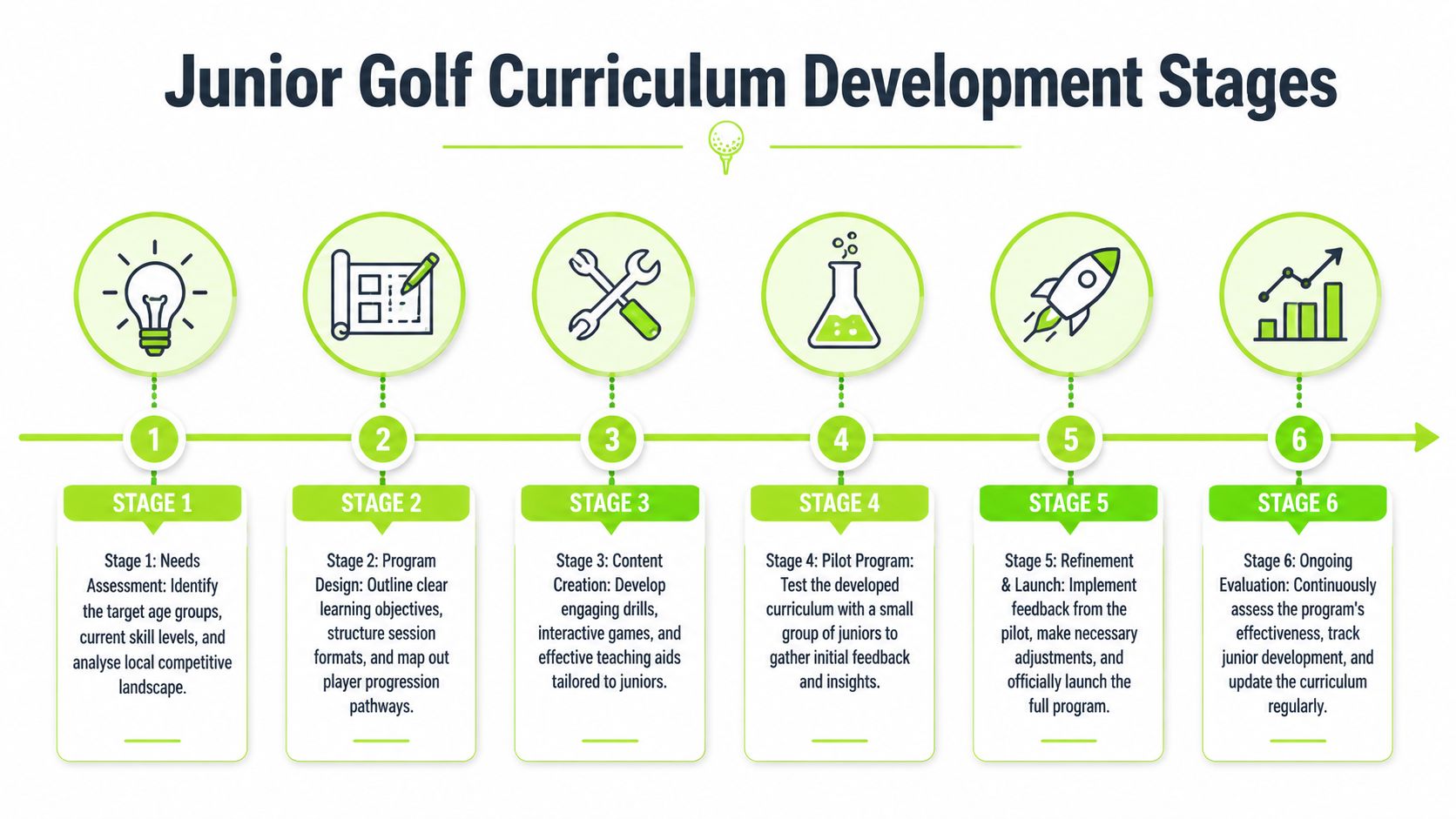
The programme itself is the product. If it's improvised week to week, the club can't scale it, parents can't understand it, and children can't see progress. A junior golf coach needs a curriculum that is structured enough to produce consistency and flexible enough to suit different ages and motivations.
Many clubs drift into the familiar trap of teaching swings instead of building golfers. Children don't stay because the technical advice is complex. They stay because sessions feel achievable, social, purposeful, and fun.
Start with assessment and pathways
The strongest junior programmes begin with an initial assessment, not with a generic group allocation. That gives the coach a baseline on skill, confidence, physical capability, and attitude. It also gives parents a clear signal that the club is organised.
That structured model is now common for a reason. A structured approach to junior coaching, including initial assessments and personalised plans, is adopted by 78% of UK junior clinics, and this model has produced a 32% increase in sustained membership retention among juniors aged 8 to 16 compared with unstructured programmes according to Golf Done Right's report on innovative junior clinic methods.
What the curriculum should contain
A useful curriculum doesn't need to be complicated, but it does need shape. For most clubs, that means separating delivery into stages rather than ages alone.
For example:
- Starter stage: Basic movement, safety, simple games, very low pressure.
- Learner stage: Contact, target awareness, simple scoring formats, etiquette.
- Player stage: Course strategy, emotional control, practice habits, club competition readiness.
- Performance support stage: More individual planning for the juniors who want it.
Notice that swing mechanics are only one part of the picture.
The programme should also include elements that most public junior coaching advice still underplays. Mental toughness, handling setbacks, and learning how to take practice skills onto the course matter more than many clubs realise. Parents often see this before coaches formalise it. A child can look talented on the range and still struggle badly when score, nerves, and decision-making come into play.
Build transfer, not just technique
A lot of junior coaching fails at the handover from practice ground to course. The child hits decent shots in drills, then tightens up during play. If the curriculum doesn't train that transfer, the club creates frustration rather than confidence.
That usually means adding:
- Game-like tasks instead of static repetition every week
- Short on-course formats that lower pressure while teaching decision-making
- Reflection moments where juniors talk through choices and emotions
- Visible progression markers so parents and players can see development beyond handicap alone
A useful reference point for coaches reviewing their own structure is this guide to golf coaching courses, especially when considering how session design and development pathways fit together.
The best junior curriculum doesn't ask, "What will we teach this Saturday?" It asks, "What experience are we building over the next twelve months?"
Make it scalable for the club, not just enjoyable for the coach
Scalability means another coach could step in and deliver the same stage with broadly the same standards. It means holiday camps, beginner groups, and progression squads all connect. It means reports can be produced without chasing scattered notes.
That requires three operating habits:
- Standard session templates: So quality doesn't depend on memory.
- Progression criteria: So movement between groups is consistent.
- Parent communication rhythms: So families know what's happening and what's next.
When those pieces are in place, the club stops selling random lessons and starts running a proper junior product.
Pricing Strategies and Membership Conversion
A junior programme can be popular and still be commercially weak. That usually happens when clubs price for convenience rather than for progression.
Pay-as-you-go sessions are easy to launch, but they create uneven attendance, weak commitment, and poor forecasting. They also make it harder for the coach to plan groups and harder for the club to move families towards membership because the relationship stays transactional.
Price around commitment
Most clubs are better served by packaging junior activity in blocks.
Termly programmes tend to work best for beginners and developing players because they create routine. Parents know the dates, the coach can plan outcomes, and the club can manage capacity more confidently.
Monthly memberships can work for clubs with year-round junior activity, especially where practice access, coaching touchpoints, and social events are bundled together.
Private coaching add-ons should remain available, but they shouldn't become the default model for the whole junior section. Too much dependence on one-to-one revenue can pull the coach away from building the wider programme.
A practical pricing structure often includes:
- Entry route: Low-friction taster or starter block
- Core route: Termly group programme
- Enhanced route: Programme plus selected individual support
- Club route: Junior membership with integrated coaching and competition access
Don't separate coaching from membership for too long
A common mistake is leaving children in coaching-only status indefinitely. The family enjoys sessions, but the child never becomes part of the club. They don't develop habits around practice, informal play, club events, or belonging.
That weakens retention because coaching remains something bought in blocks, not a pathway into the life of the club.
A better model creates a deliberate handover point. After a child reaches a certain level of attendance, confidence, or course readiness, the club starts the junior membership conversation with a clear rationale:
- More access to practice and play
- A clearer development route
- Inclusion in junior competitions and events
- Better value over time for committed families
Treat conversion as a process
Membership conversion shouldn't rely on one annual email inviting families to join.
Use a repeatable pathway instead:
| Stage | Club action |
|---|---|
| Trial or taster | Capture full parent details and reason for enquiry |
| First programme block | Set expectations and explain the next milestone |
| Mid-block review | Share progress and identify likely next-step families |
| End-of-block conversation | Present the relevant membership route |
| Post-conversation follow-up | Confirm options, answer questions, and set decision timing |
Often, clubs lose momentum in such situations. The coach assumes the office will follow up. The office assumes the coach has covered it. The family hears nothing specific, so they drift.
If membership is the logical next step, the club should present it that way. Not as a favour. Not as an afterthought.
Good pricing supports that journey. It shouldn't trap families in casual lesson buying when what the club really wants is long-term participation and membership income.
Marketing the Programme and Nurturing Enquiries
Most clubs don't have a junior demand problem. They have a handling problem.
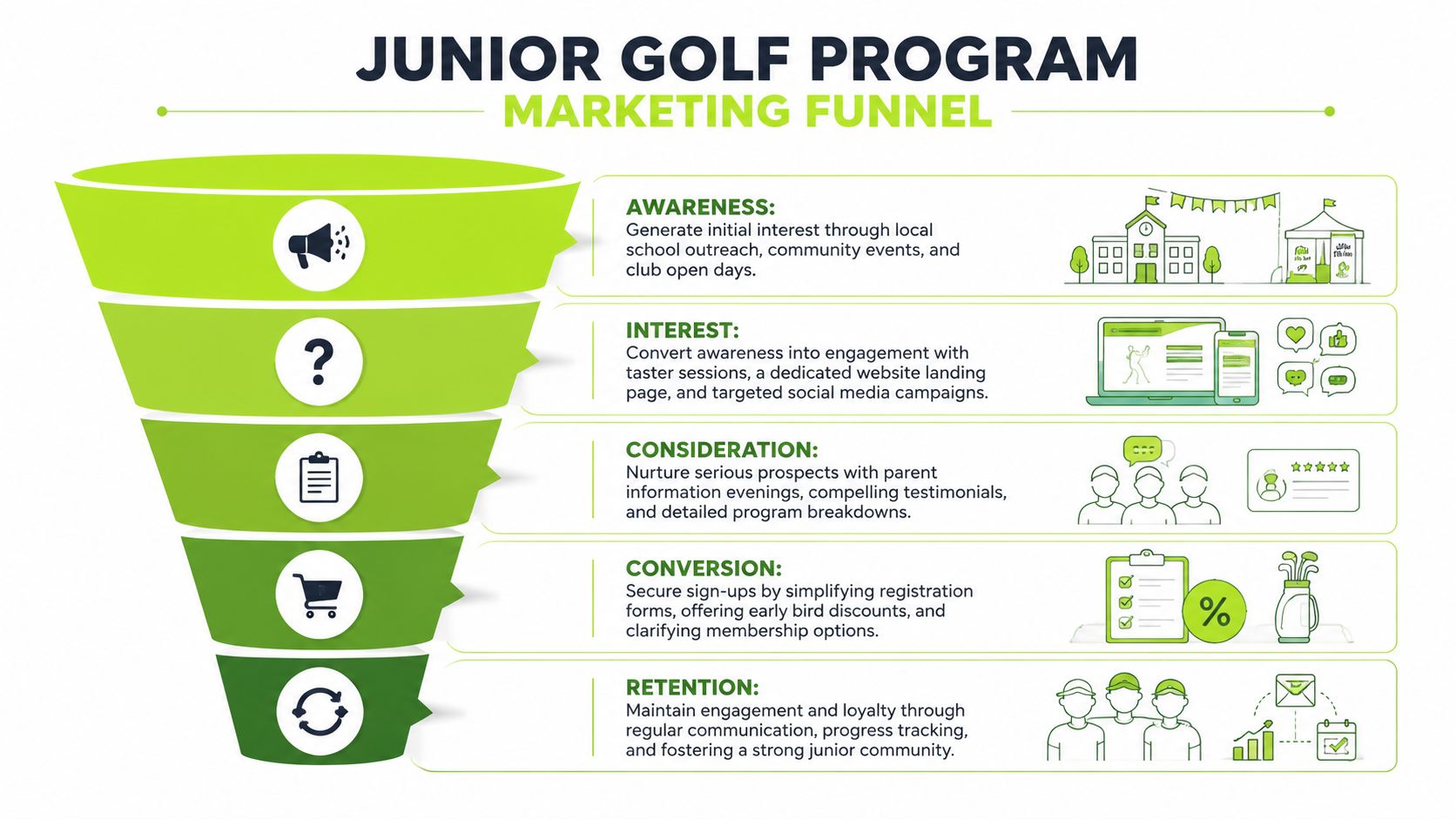
They generate attention through school outreach, community partnerships, open days, posters in the clubhouse, Facebook posts, and recommendations from existing members. Then the parent enquiry arrives and sits in an inbox, gets answered late, or receives a thin reply with no clear next step.
That's where promising junior programmes stall.
Speed changes the economics
In the UK golf market, a lead that receives a response within one hour is five times more likely to convert into a paying member than a lead that waits 24 hours, and the average club response time remains 30 hours according to CRM Golf's analysis of golf club response speed and conversions.
That single operational fact should change how managers think about junior marketing. More reach won't fix slow handling. Better creative won't fix poor follow-up. If a parent enquires while comparing several local activities for their child, the club that replies first and clearly usually earns the next conversation.
What the nurture system needs to do
The marketing job isn't finished when the form is submitted. The process after the enquiry matters just as much.
A workable nurture setup includes:
- Immediate acknowledgement: The parent knows the enquiry has been received.
- Fast human follow-up: Someone answers the actual question and suggests the next step.
- Clear booking route: Taster session, assessment, or phone call.
- Reminder flow: So interested families don't disappear because life gets busy.
- Visibility for staff: Everyone can see status, notes, and ownership.
For clubs reviewing this side of the journey, this article on AI lead nurture for golf clubs is a useful reference on how faster, more consistent follow-up can support conversion without adding manual chaos.
Manual handling breaks under volume
A few junior enquiries can be managed with goodwill. A proper campaign can't.
Once schools, social media, and referral activity start working, manual methods break. Reception misses a voicemail. The coach is on the range. A parent fills in a form on Sunday evening. Nobody logs it properly. By Tuesday, the family has booked elsewhere.
The clubs that convert well build simple systems:
- One enquiry capture point rather than messages spread across email, phone, and social inboxes
- Shared visibility so the office and coach aren't working from separate lists
- Defined response ownership so nobody assumes someone else has done it
- Follow-up templates that save time but still sound human
Marketing creates opportunity. Systems decide whether the club keeps it.
If your junior programme already gets interest, the highest-return improvement may have nothing to do with advertising budget. It may be a faster and more organised way to respond.
Measuring Success and Proving Club ROI
Junior programmes become vulnerable when managers report them as activity rather than performance. Full sessions sound good in a committee meeting, but they don't tell the club whether the programme is retaining families, creating members, or just staying busy.
The reporting needs to connect delivery to commercial value.
Use a dashboard the committee can understand
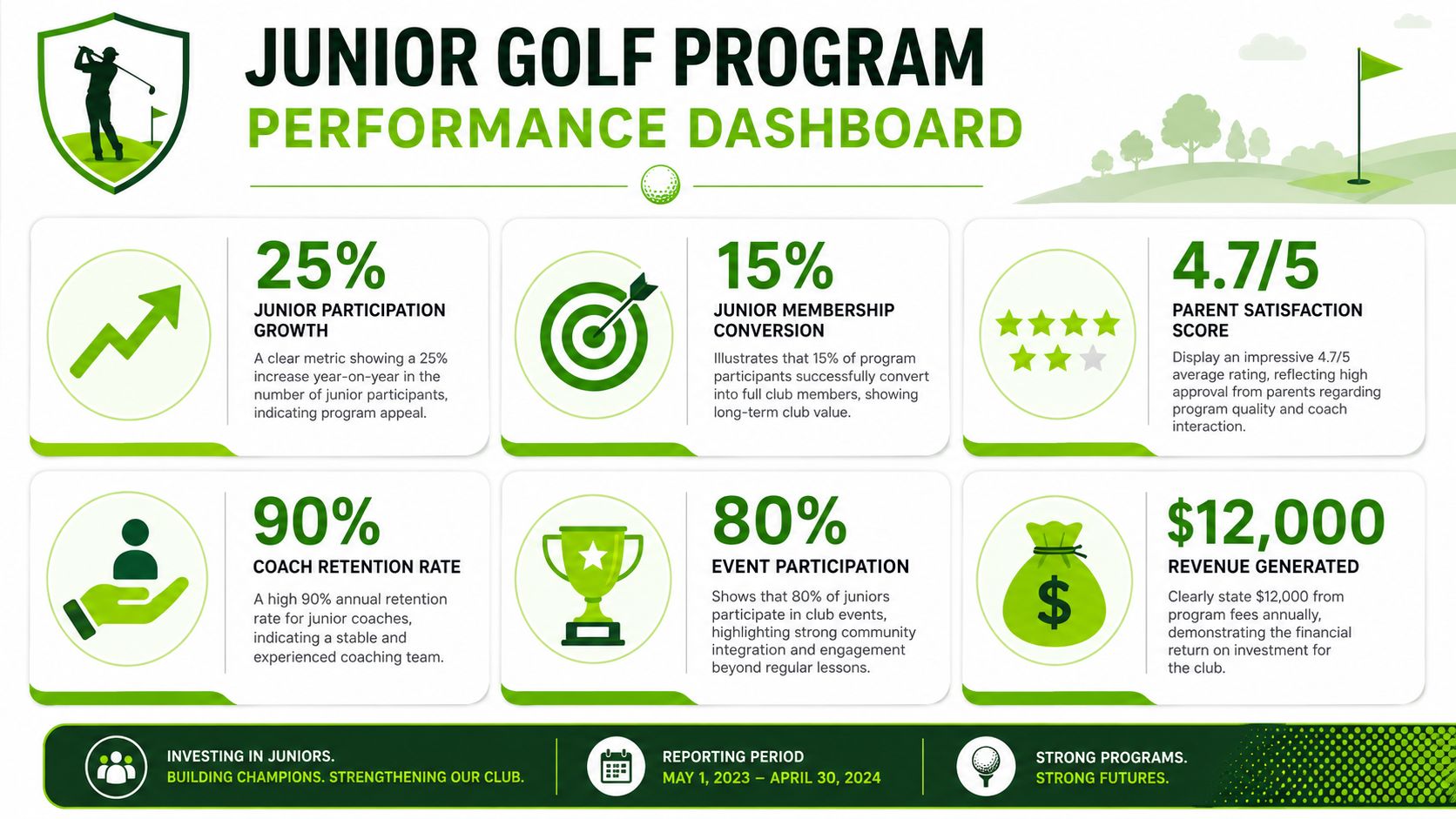
Track a small set of measures consistently:
- Enquiry to booking rate: Are parents moving from interest to first action?
- Programme attendance and completion: Are children staying through the block?
- Retention into the next stage: Are beginners progressing or disappearing?
- Junior membership conversion: Are coaching participants becoming club members?
- Secondary family value: Are parents or siblings engaging with the club too?
A dashboard only works if the underlying data is captured cleanly. If enquiry notes sit in inboxes and attendance sits on paper, reporting becomes guesswork. Clubs that want better visibility often benefit from studying the wider principles behind the real ROI of golf club marketing, because the same discipline applies here. Track the journey, not just the first touch.
Report trends, not just anecdotes
One glowing parent comment is nice. One quiet term isn't a disaster. The club needs pattern recognition.
Show what happened by cohort. Which intake channels brought the best-fit families. Which programme stages retained well. Where the drop-offs appeared. That gives the manager something useful to improve, and it gives the committee a defensible reason to keep backing the programme.
A junior golf coach becomes far easier to justify when the club can show a clear line from enquiry to participation to membership.
GolfRep helps golf clubs build that line with proper systems, not just promotion. If your club wants a junior programme that supports predictable membership growth through better lead handling, follow-up, and conversion visibility, see how GolfRep approaches golf club growth.
Ready to tap into our proven growth system?