Boost Membership: How to Attract Younger Golf Club Members

Most advice on how to attract younger golf club members starts in the wrong place. It starts with awareness, branding, or the assumption that younger people aren't interested in club golf.
That isn't the primary issue.
For most UK clubs, the bigger problem is that younger golfers do enquire, browse, visit, and test the water, but the club has no reliable system for turning that interest into membership. Enquiries sit in inboxes. Follow-up depends on who is on shift. Trial offers exist, but nobody measures what happens next. Clubs end up blaming demand when conversion is the weakness.
From GolfRep's perspective, that distinction matters. If you think the market has disappeared, you'll keep throwing out generic offers and hoping for a result. If you recognise that demand already exists, you start looking at the club's front-end offer, digital journey, response process, and onboarding with much more discipline.
The Real Challenge Isn't Finding Younger Golfers
The idea that golf is only attracting older players is out of date. In Great Britain and Ireland, the R&A reported 3.3 million golfers in 2023, with 26% aged 18–34 and 38% aged 18–44. The same research found 1.85 million people playing at least once a month, which is exactly the type of repeat behaviour clubs should care about for membership growth, not just casual green fee income (R&A participation figures referenced here).
That should change the conversation inside the committee room.
You don't need to create younger golfers from scratch. A substantial group already plays. A meaningful share already plays regularly. The commercial question is whether your club gives them a reason to join, and whether your process makes joining easy.
What clubs often get wrong
A lot of clubs still diagnose the problem as visibility alone. They assume that if they post more on social media, run the odd promotion, or lower the joining cost for under-35s, the issue solves itself.
It rarely does.
The weak points are usually more basic:
- No clear value proposition: Prospects can't quickly see why your club fits their life better than staying casual.
- No consistent enquiry handling: One person replies promptly, another replies three days later, another forgets altogether.
- No tracked pipeline: The club doesn't know how many enquiries came in, which offer produced them, or what percentage converted.
- No progression path: Interested golfers face a jump from curiosity straight to full membership.
Younger golfers don't disappear. They drift when the club makes the next step unclear.
The operational reality
Managers often tell themselves they need more leads. Sometimes that's true. But many clubs already have enough interest leaking through the gaps.
A younger golfer might click through from Instagram, look at the membership page, hesitate because pricing is vague, send a question, then wait too long for a useful reply. By the time someone answers, the moment has gone. That isn't a marketing failure. It's a process failure.
If you want to know how to attract younger golf club members, start with a simpler question. When a younger golfer shows intent, can your club capture that intent, respond properly, and move them towards a low-risk next step?
If the answer is no, more promotion won't fix the underlying problem.
Crafting Membership Offers Younger Golfers Actually Want
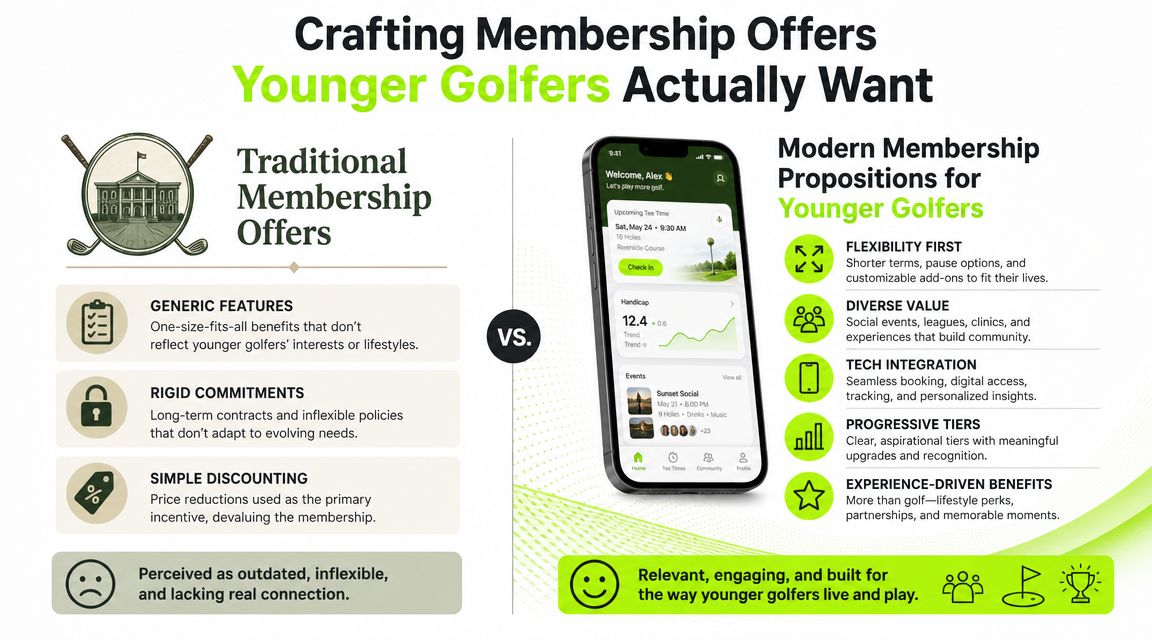
The default answer for younger prospects is often a discount. That's understandable, but it's usually lazy product design.
The stronger approach is to build offers around how younger adults organise sport in real life. UK golf coverage has consistently pointed to the importance of flexible formats, shorter play, and social golf for newer and younger participants. The more useful question isn't how much to cut the price. It's how to package access, coaching, and belonging in a way that feels low-risk and high-value to people balancing work, study, and family commitments (UK industry perspective on flexible offers).
Stop leading with price cuts
A pure discount does three unhelpful things.
First, it trains prospects to compare your offer on price alone. Second, it often attracts people who were never a good long-term fit. Third, it can annoy full members if the value gap isn't explained properly.
A better offer reduces friction without devaluing the club.
Consider the difference:
| Approach | What it signals | Likely outcome |
|---|---|---|
| Simple age-based discount | "We're cheaper" | Short-term attention, weaker commitment |
| Flexible access plus defined benefits | "This fits your lifestyle" | Better qualification and clearer expectations |
| Trial with guided progression | "You can test this safely" | Stronger transition into full membership |
Design around life stage, not just age
A 25-year-old city professional, a 32-year-old parent, and a 39-year-old returning golfer may all sit inside a "young member" category, but they don't buy for the same reasons.
Clubs usually get better results when they segment by situation:
- Early-career golfers: They often need flexibility, simple payment structures, and social ways to meet people.
- Busy professionals: They value speed, booking ease, shorter formats, and access that doesn't feel wasted if their schedule changes.
- Young families: They respond to family-friendly events, coaching pathways, and a club environment that feels welcoming rather than formal.
- Returning golfers: They need confidence, not pressure. Coaching bundles and friendly roll-ups matter more than status.
Practical rule: Don't ask, "What can we discount for younger adults?" Ask, "What membership model removes the most risk for this type of golfer?"
Build value into the offer itself
The strongest membership propositions usually combine golf access with a reason to stay engaged. That can include coaching, beginner-friendly competitions, range use, social events, or a staged route into fuller membership.
If your club runs family open days or beginner events, tie them back to a defined next step instead of treating them as isolated activity. That's where structured event planning helps. A club reviewing its event strategy may find useful ideas in these golf club open day marketing ideas, particularly when the event is meant to feed a membership pipeline rather than just create footfall.
There is also a practical point around new players in the household. If a younger prospect is trying to bring children into the game as well, access to suitable youth golf equipment can make family participation easier. That doesn't replace a membership offer, but it supports a wider proposition built around convenience and inclusion.
Building a Digital Front Door That Never Closes
Most clubs don't have a marketing problem online. They have a capture problem.
A younger prospect can tolerate a modest clubhouse website. They won't tolerate confusion. If your membership page hides key information, lacks a clear next step, or sends people into a generic contact form with no context, you're wasting intent.
That matters because the audience is there. Sport England's Active Lives data showed around 1.1 million adults in England played golf in the year to November 2023, and participation among 18–24-year-olds was higher than before the pandemic. England Golf's figures also showed 742,000 affiliated members in 2024 across 1,800+ clubs, which confirms there is a large membership market and a live pipeline of prospects to compete for (participation and membership context).
What a useful digital front door looks like
The website should work like a membership reception desk. It should answer basic questions quickly and guide the prospect to an action.
That means a younger membership journey usually needs:
- A dedicated membership page: Not a PDF hidden three clicks deep.
- Clear package descriptions: Enough detail to help someone self-qualify.
- Simple enquiry routes: A short form linked to the specific offer they viewed.
- Visible next steps: Visit, call, trial, or request details.
- Mobile-first usability: Because a large share of interest starts on a phone.
Social content should point somewhere
Clubs often treat Instagram, Facebook, and TikTok as separate efforts. They aren't. They should all direct attention to one measurable destination.
If you post a reel about twilight golf, the caption should point to the relevant landing page. If you showcase coaching, there should be an offer behind it. If members post from an event, the club should already know what page new visitors are supposed to reach next.
For clubs experimenting with short-form video, it helps to think in repeatable content themes rather than random posting. Something as simple as behind-the-scenes clips, beginner tips, course condition updates, or member stories can work if each post connects to a capture point. A planning resource like these TikTok content ideas for 2026 is useful for format inspiration, even if your club adapts the ideas for golf-specific content.
A social post without a clear destination is publicity. A social post tied to a landing page is pipeline building.
Track the path, not just the traffic
Many clubs can tell you how many people viewed a page. Far fewer can tell you which channel produced an enquiry, which offer generated the best-fit prospects, and where leads stalled.
That gap matters.
If you're running paid social or promoting offers organically, the club needs one place where every lead lands and every source is recorded. That is the only way to know whether low younger-member uptake comes from weak traffic, poor messaging, or poor follow-up.
For clubs considering paid acquisition, these golf club Instagram ads are worth looking at through that lens. The advert itself isn't the system. It's only the entry point into one.
The System for Turning Enquiries into Members
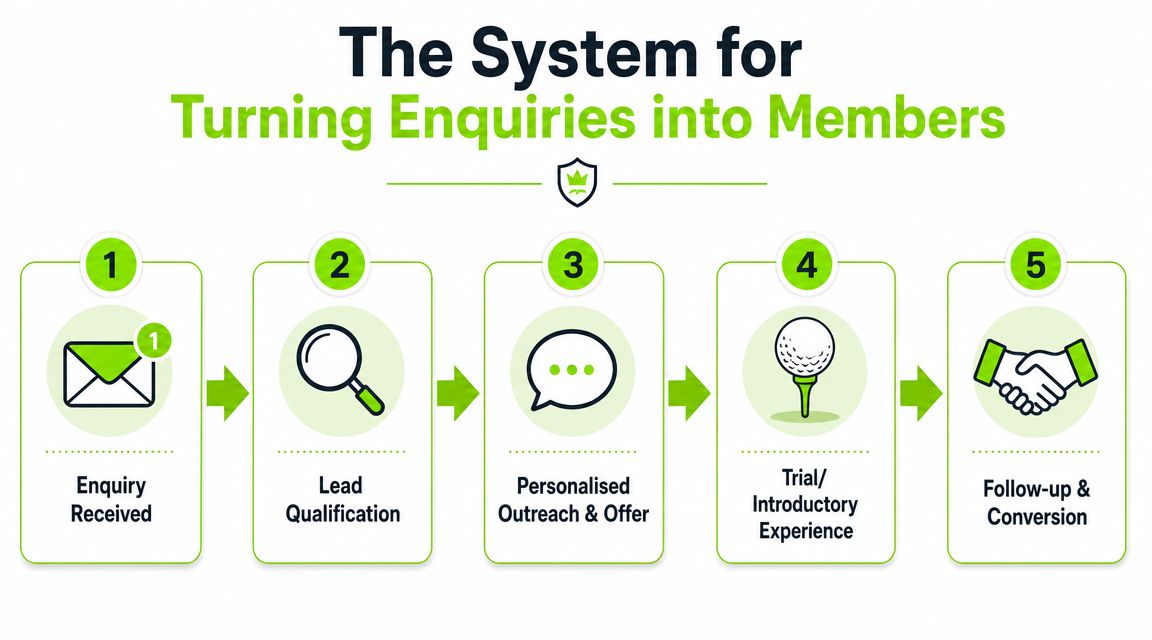
Most clubs handle membership enquiries as admin. They should handle them as sales operations.
That doesn't mean hard selling. It means building a process that gives every prospect a clear path from first enquiry to decision. GGA Partners' practical framework is useful here. Segment the audience, publish the offer, capture the lead, and monitor conversion rates. The critical warning is just as important. If you don't instrument the funnel, you can't tell whether weak results come from a traffic issue or a conversion issue (membership funnel guidance).
What the funnel looks like in practice
A functioning conversion system is not complicated, but it does need discipline.
Enquiry arrives
The source should be visible immediately. Was it Instagram, Google, a referral, an open day, or a direct website visit? If staff can't see origin, they can't judge intent or refine the campaign later.
Lead is categorised
Not every younger golfer wants the same thing. Some are ready to visit. Some want pricing. Some want a trial. Some are comparing clubs. Tagging this properly matters.
Response is sent quickly
A useful reply answers the likely question and gives a next step. "Thanks, we'll be in touch" is not a membership process. It's a holding message.
Follow-up is scheduled
Many clubs rely on memory at this point. That's where leads disappear. If nobody owns the next action, nobody does it.
Outcome is recorded
Joined, trialled, no reply, delayed, wrong fit, revisit later. If you don't track outcomes, you can't improve the funnel.
Manual handling breaks under pressure
Many clubs lose younger prospects when the process lives across a shared inbox, a spreadsheet, someone's notebook, and the professional's memory.
That setup creates predictable issues:
Lead visibility disappears
Managers can't see what happened without chasing staff.
Response quality varies
One prospect gets a clear invitation to visit. Another gets a forwarded attachment.
Follow-up becomes optional
Busy periods push membership leads behind daily operations.
No one knows the conversion rate
The club can feel busy while underperforming.
The fastest way to lose a warm membership enquiry is to let it become "someone will deal with it later".
Use systems that reduce staff dependency
A central CRM solves more than storage. It creates accountability.
Every lead should sit in one pipeline with status, notes, source, tasks, and follow-up history visible. Automated acknowledgements can confirm receipt immediately. Staff reminders can assign ownership. Nurture messages can keep the conversation moving when a prospect isn't ready to join on day one.
That doesn't replace human contact. It supports it.
A structured setup matters more than another campaign. Tools can range from a simple CRM with task automation through to a golf-specific nurture workflow. One example is GolfRep's AI lead nurture approach, which focuses on handling enquiries consistently and tracking movement from first contact to membership outcome.
Measure what actually matters
A healthy younger-member pipeline should answer basic management questions without guesswork:
| Question | Why it matters |
|---|---|
| Where did this lead come from? | Shows which channels produce intent |
| Which offer did they enquire about? | Reveals what message is resonating |
| How long did the first response take? | Highlights avoidable delay |
| What happened next? | Exposes drop-off points |
| Did they join, trial, or go quiet? | Improves future follow-up |
If your club can't answer those questions quickly, the bottleneck isn't demand. It's process control.
Creating Low-Friction Pathways to Full Membership
The jump from interest to full membership is where many clubs ask too much, too soon.
A younger golfer might like the course, like the people, and still hesitate. That isn't resistance. It's sensible buying behaviour. They want to know whether the club fits their routine before taking on a full commitment.
That's why structured trials matter. Guidance from club operators points to low-friction trial pathways and referral loops as a strong acquisition route, and one club report described a youth-style programme with an over 80% conversion rate from trial to full membership with roughly 45-50 participants. The important lesson wasn't the discount. It was that the offer, onboarding, and follow-up were tightly managed (trial conversion example).

A good trial removes uncertainty
The best trial offers don't feel vague or open-ended. They feel designed.
That usually means:
- A defined timeframe: Enough time to experience the club, not enough time to drift.
- A clear usage scope: Access, booking rights, coaching inclusion, and event access should be obvious.
- Named contact points: The prospect should know who to speak to.
- Pre-planned review points: The club should know when to check in and when to discuss the next step.
A weak trial is just discounted access. A strong trial is a guided route into membership.
Referral works best when the club does the heavy lifting
Committees love the idea of referrals. Members will bring friends, in theory.
In practice, referrals only work when the club makes them easy to act on. Give members a clear invitation process, a simple booking route for guests or tasters, and a defined follow-up once the referred golfer attends. If the member has to explain every detail themselves, most won't bother.
A referral is not a strategy if the club treats it as a favour. It becomes a channel when the process is simple, visible, and followed up properly.
Open days should convert, not just entertain
Many clubs run welcome events that create activity but not movement. The event looks good. The diary feels full. Then nothing happens.
Every taster event should have one conversion outcome in mind. That might be a trial sign-up, a hosted visit, or a membership conversation within days of attendance. Staff should know who attended, who asked questions, and who needs a follow-up call.
If there isn't a post-event process, the event was branding. Not acquisition.
Onboarding New Members to Maximise Retention
Signing the form isn't the finish line. It's the point where the club proves the decision was right.
This is especially important with younger members because many are still testing fit. They haven't joined out of habit. They've joined because the offer looked workable. If the early experience feels unclear, slow, or socially cold, retention risk starts immediately.
The first ninety days need structure
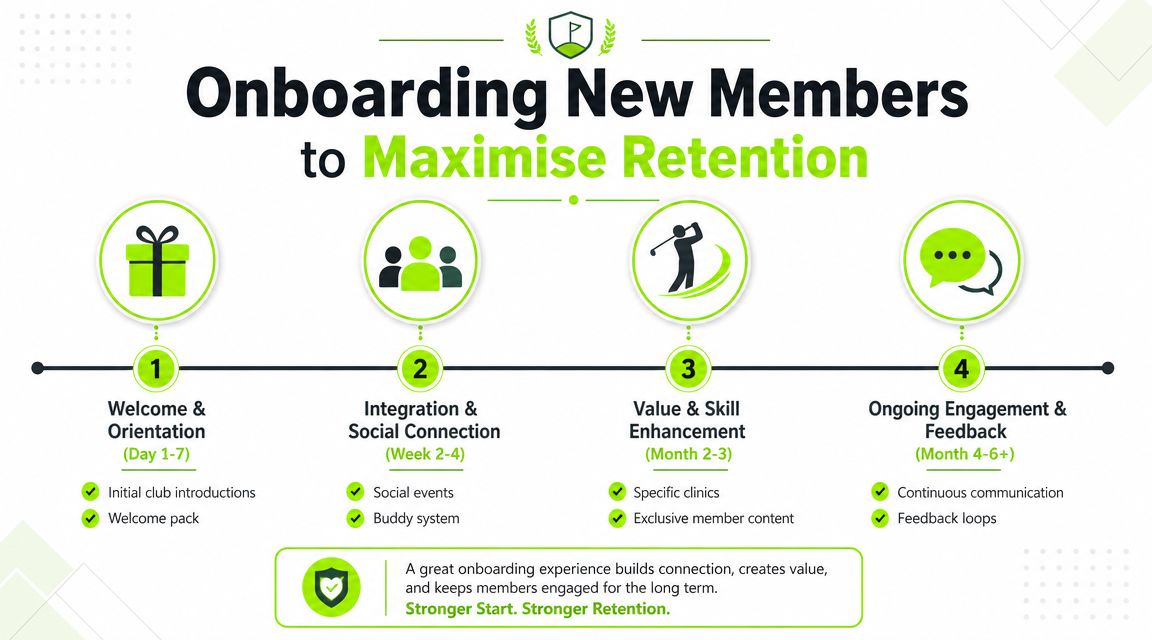
Most clubs say they welcome new members. Fewer have a repeatable onboarding sequence.
A practical early-stage process usually includes:
- Immediate welcome: A prompt, personal message with booking guidance, key contacts, and what to do first.
- Early orientation: A short introduction to competitions, tee booking, clubhouse norms, and coaching options.
- Social connection: An invitation to a roll-up, a group session, or a member host who can make introductions.
- Progress check: A follow-up to ask whether they've used the club and whether anything is getting in the way.
Don't leave integration to chance
Newer and younger members often struggle less with golf than with belonging. They don't always know where to start, who to play with, or whether they fit the culture.
Clubs can reduce that friction by assigning responsibility. Someone should own the first call, someone should invite them into a suitable activity, and someone should review engagement if the member goes quiet.
This doesn't need to be elaborate. It does need to be intentional.
Use feedback before renewal season
Brief surveys and simple confidence questions can be useful leading indicators when used consistently. You don't need pages of feedback. A short check-in can tell you whether the member feels welcomed, understands the offer, and expects to stay engaged.
If you wait until renewal to discover they never settled in, you've already left it too late.
Your Blueprint for Predictable Membership Growth
Clubs that succeed with younger members rarely rely on one clever campaign. They build a system that makes joining easier, follow-up faster, and retention more deliberate.
That system starts with the offer. If the membership product doesn't fit real life, promotion won't rescue it. It continues with the digital journey. If the website and social activity don't capture intent cleanly, interest leaks away. It depends even more on enquiry handling. If nobody can see, track, and progress leads properly, the club will keep confusing activity with growth.
Low-friction trials then bridge the gap between curiosity and commitment. Structured onboarding turns a signed-up member into an active one. That's where predictable growth comes from. Not from shouting louder, but from removing friction at each step.
For clubs thinking beyond referrals and informal word of mouth, there is also value in building member advocacy more deliberately. A broader framework such as Sup's complete brand ambassador guide can help clubs think about how enthusiastic members represent the club, introduce peers, and support credibility in a more organised way.
If you want to know how to attract younger golf club members, 'market more' isn't the whole answer. It's this. Build a membership proposition that fits younger lives, capture every enquiry properly, follow up with discipline, and onboard with intent.
That is manageable. It is measurable. And for most clubs, it is far more effective than another generic discount.
If your club wants a clearer membership pipeline, GolfRep helps golf clubs put structure around enquiry capture, follow-up, and conversion so promising interest doesn't get lost between inboxes, spreadsheets, and busy operational days.
Ready to tap into our proven growth system?