Golf Club Instagram Ads: The Complete Playbook for 2026
Most advice on golf club Instagram ads points clubs in the wrong direction. It tells you to chase more reach, more clicks, more leads, and more followers, as if volume alone solves the problem.
It doesn’t.
For most UK clubs, the primary issue isn’t whether Instagram can generate interest. It can. The issue is what happens after someone taps an ad, fills in a form, and becomes an enquiry. If that handoff is slow, manual, or poorly tracked, paid social turns into an expensive list-building exercise rather than a reliable membership channel.
That’s why good golf club Instagram ads aren’t really about ads alone. They’re about building a complete acquisition system that attracts the right people, qualifies them quickly, follows up properly, and shows you which campaigns produce actual revenue.
The Real Problem with Instagram Ads for Golf Clubs
The most common goal clubs set is “we need more enquiries”.
That sounds sensible, but it usually hides a more expensive problem. Most golf club Instagram ad guides rarely address the conversion gap, even though 73% of golf enquiries from social ads go unqualified, and UK golf clubs typically see 40-60% of Instagram lead enquiries drop off within 24 hours because of manual response delays and weak qualification workflows. That’s the primary bottleneck.
If your team is relying on a membership inbox, a spreadsheet, and someone remembering to call people back between operational tasks, the issue isn’t demand. The issue is process.
Why more leads can make things worse
A club can run decent creative, generate steady interest, and still feel that “Instagram doesn’t work”. In practice, what often fails is the handover after the lead arrives.
Three things usually happen:
- Slow response times: A prospect enquires in the evening, on a Sunday, or during a busy club period. Nobody replies quickly.
- No filtering: Serious buyers and casual browsers get treated the same way.
- Poor visibility: Management can’t see where each enquiry sits, who followed up, or whether a sale came from the campaign.
The result is familiar. Staff feel busy, reports show leads, and membership numbers barely move.
Practical rule: If a club can’t identify which enquiries are qualified within minutes, ad spend starts leaking before the sales conversation has even begun.
That’s why the conversation around golf club Instagram ads has to move beyond top-of-funnel metrics. Reach matters. Click-through matters. But neither tells you whether the person is suitable for membership, available for a visit, or able to move forward.
The gap between enquiry and revenue
Instagram is strong at creating initial interest because it suits golf as a visual product. Course views, clubhouse atmosphere, social events, coaching, and member lifestyle all translate well on-platform.
But interest alone isn’t commercial value.
A useful enquiry is one that enters a structured journey. It should be acknowledged immediately, qualified consistently, assigned properly, and tracked all the way to visit, proposal, and sign-up. Without that, clubs pay to generate demand they can’t convert.
A lot of what holds clubs back is discussed in why most golf club marketing fails. The pattern is the same. Marketing gets judged on lead count, while the actual damage happens in follow-up.
The clubs that make Instagram profitable don’t just run ads. They build a pipeline.
Setting Foundations for a Profitable Campaign
Before you open Meta Ads Manager, decide what commercial outcome the campaign must produce.
A profitable campaign starts with a business target, not a platform metric. “More visibility” is too vague to guide budget, creative, or follow-up. A better objective is tied to a membership outcome, such as filling a specific category, promoting a trial pathway, or driving booked club visits from a defined audience.

Start with the offer, not the advert
Many clubs try to advertise the club in general terms. That usually leads to weak response because the prospect isn’t given a clear next step.
The strongest campaigns tend to centre on a concrete offer that fits the club’s positioning. That doesn’t have to mean discounting. In fact, discount-led ads often attract the wrong type of enquiry.
Better options include:
- A guided membership visit: Give prospects a reason to book time with the club, not just request generic information.
- A structured trial route: Useful for golfers who are interested but not ready to commit on the first interaction.
- A category-specific invitation: For example, an ad designed for weekday flexibility, beginner pathways, or social golf interest.
A good offer does two jobs at once. It attracts attention and automatically pre-qualifies the prospect.
Decide what success actually means
Once the offer is clear, choose the metrics that matter commercially. For golf club Instagram ads, the important numbers are rarely likes, comments, or impressions on their own.
Focus on measures such as:
| Metric | Why it matters |
|---|---|
| Qualified lead volume | Shows whether the campaign is attracting genuine prospects, not just curiosity |
| Booked visit rate | Tells you whether follow-up is turning interest into sales conversations |
| Membership conversion | The actual test of campaign value |
| Cost per qualified lead | Helps you compare audience and creative quality |
| Cost per acquired member | The clearest commercial benchmark |
If a club can’t track those numbers, it can’t judge whether a campaign is working.
Clubs often think they need better ads when they actually need better measurement.
Build the campaign around your sales process
Planning should also account for who receives the lead, how they respond, and how the next step gets booked. That’s where a proper golf club CRM system matters. Not because software is fashionable, but because Instagram campaigns fail when nobody can see lead status, contact history, or sales outcome in one place.
At this stage, a simple checklist is enough:
- Define the membership objective
- Choose the offer
- Map the enquiry journey
- Decide who owns follow-up
- Set reporting around qualified leads and sales
If those foundations are weak, the ad account won’t fix it.
Targeting Local Golfers Who Are Ready to Join
Most clubs still target Instagram the same way. They drop a pin on the clubhouse, pick a radius, and hope local golfers convert.
That approach is tidy, but it’s often too blunt for membership growth. Real demand isn’t distributed neatly inside a circle, and serious prospects don’t always live where clubs assume they do.
Why postcode radius alone falls short
In the UK, golf clubs see 34% higher enquiry intent during March-April and September-October, yet many still run flat budgets all year. Also, 28% of membership enquiries at UK private clubs come from 8-15km beyond the club’s primary postcode radius. That means timing and geography both need more nuance than the standard local-only setup.
A rigid radius can cut out motivated buyers who will travel for the right course, membership category, social fit, or handicap access.
It can also over-serve nearby people who like golf casually but have little intention of joining any club.
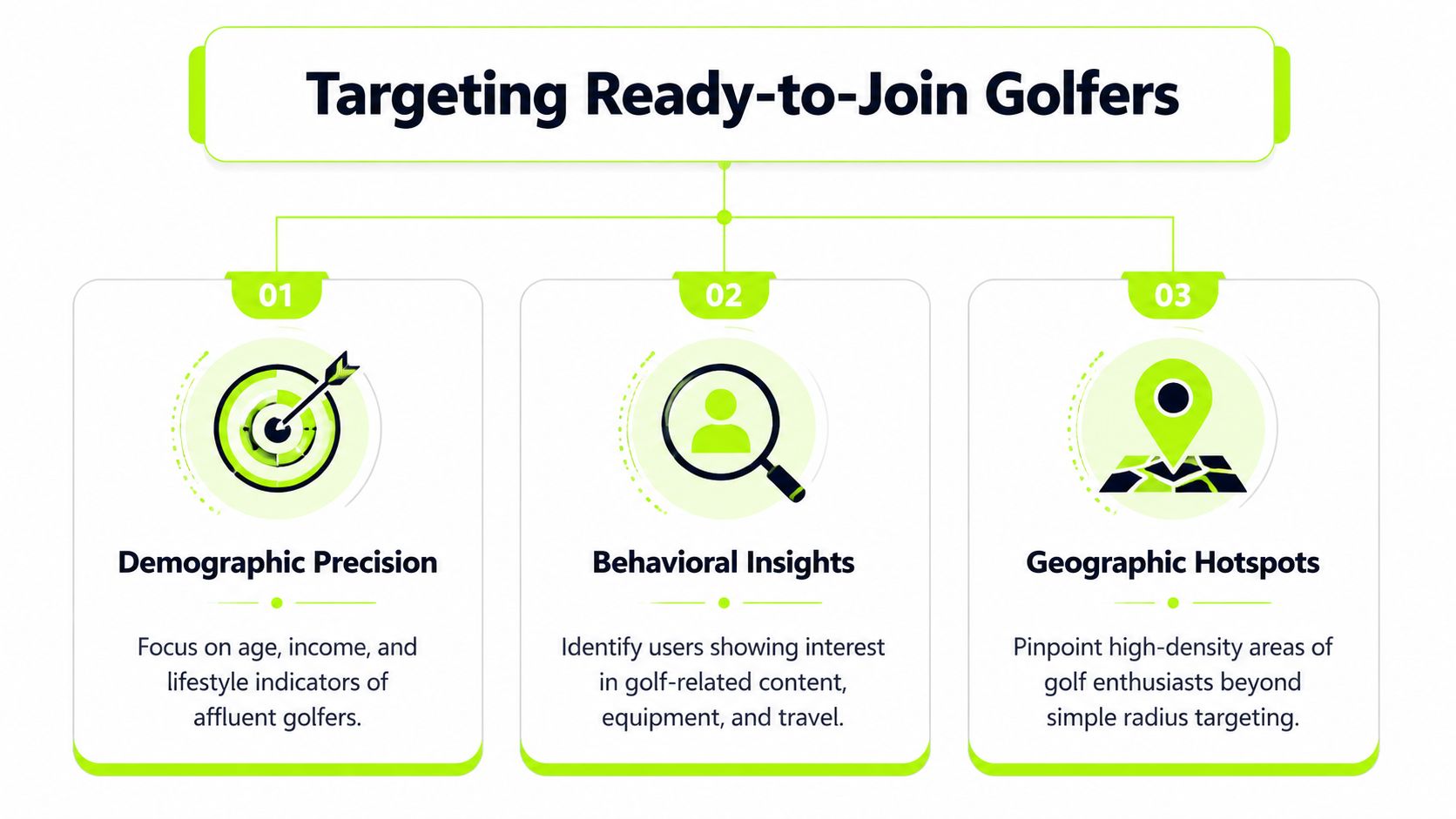
The three audiences worth building
The most effective golf club Instagram ads usually combine several audience types rather than relying on one.
Core local audiences
This is still the starting point. Geography matters, especially for regular play. But the local audience should be layered, not left broad.
Useful filters often include age band, household profile, and signs of golfing interest. The point isn’t to overcomplicate things. It’s to avoid paying for attention from people who are close to the club but unlikely to convert.
Interest-based audiences
Instagram has enough behavioural data to help clubs move past pure location targeting. Interest-led audiences can include people engaging with golf media, equipment, coaching, destination golf, and related golf content.
Golfing behaviour often signals intent earlier than a lead form does. A consistent consumer of golf content presents a stronger prospect than someone who lives nearby.
First-party and lookalike audiences
Many clubs frequently miss out on potential value. If you have existing member lists, past enquiry data, website traffic, or event leads, those audiences can help shape better prospecting.
You’re no longer guessing who might be interested. You’re using your own historical data to guide targeting.
The best-performing audience is often built from people the club already knows something about.
Adjust targeting to the season, not the calendar year
Budgeting should follow buying intent. If enquiry intent rises in the spring and early autumn, clubs shouldn’t treat August, March, and October as identical buying environments.
That doesn’t mean turning campaigns on and off constantly. It means adjusting spend, creative emphasis, and audience testing around real periods of demand.
A practical approach looks like this:
- Spring push: Membership ambition is high, weather improves, and golfers reassess where they play.
- Mid-summer caution: Interest may still exist, but attention can shift toward playing rather than joining.
- Autumn opportunity: Golfers start thinking about next season, fixture access, and joining before winter offers close.
For clubs trying to grow membership with paid social, how golf clubs can add 50-100 members using paid advertising is useful because it frames paid media as a system of targeting and conversion, not just local promotion.
What to test first
Instead of launching one broad audience, test a small set with different intent signals.
| Audience type | What it helps answer |
|---|---|
| Tight local radius | Are nearby golfers responding well enough to justify concentrated spend? |
| Expanded catchment | Is the club attractive beyond its assumed core area? |
| Golf interest stack | Are content consumers turning into quality enquiries? |
| Website or enquiry-based audience | Does first-party data improve lead quality? |
The goal isn’t to win the lowest cost lead. It’s to find the audience that produces the most sales-ready conversations.
Designing Ad Creative and Copy That Converts
A lot of golf club Instagram ads fail before the audience even has a chance to respond. The targeting may be sound, but the ad looks like a committee noticeboard. Stiff photography, vague copy, no clear next step.
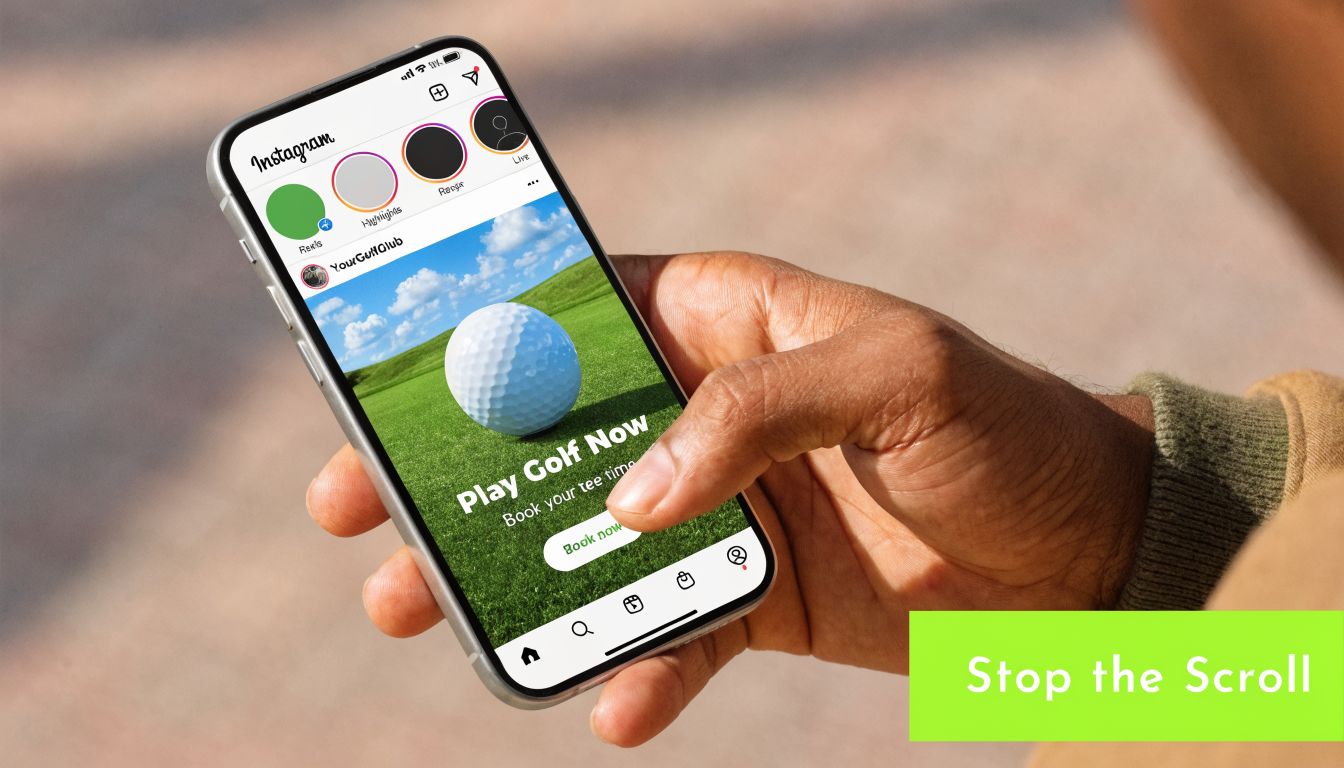
Instagram is a visual platform. Golf has an advantage here, but only if the creative feels real.
What strong golf creative actually looks like
The shift toward creator-style content matters. According to Digiday’s reporting on golf creator growth, YouTube golf uploads grew from 427,000 in 2023 to 454,000 in 2024, and by mid-2025 creators had already uploaded 242,000 golf videos, putting the platform on track to exceed 500,000 new golf videos annually. That points to a simple truth. Golf audiences are consuming huge amounts of visual, personality-led content, and that carries over into what works on Instagram.
The ads that tend to perform best don’t feel over-produced. They feel credible.
A few examples:
- Member testimonial video: A current member talking plainly about why they joined, what they enjoy, and who the club suits.
- Short course walk-through: Not just drone footage. Include the arrival, practice areas, clubhouse, and moments that help someone picture belonging there.
- Day-in-the-life content: A Saturday morning roll-up, mixed competition, coaching session, or social evening often sells the club better than a polished slogan.
Copy should qualify, not just attract
The biggest copy mistake is trying to appeal to everyone. Broad copy may create clicks, but it often lowers lead quality.
Good copy does three things:
- Names the type of golfer the offer suits
- Makes the next step obvious
- Reflects the club’s actual positioning
If your club is premium, the ad should feel premium. If your club is friendly and accessible, the wording should sound human and straightforward. Either way, don’t hide behind generic phrases like “join our thriving community” unless the rest of the ad proves what that means.
“The best ad copy doesn’t chase attention from everyone. It helps the right golfer recognise themselves.”
Formats worth using
Different creative formats solve different problems.
| Format | Best use |
|---|---|
| Reels or short-form video | Stopping the scroll and showing atmosphere |
| Carousel ads | Explaining the full membership story across course, clubhouse, and social proof |
| Lead form ads | Reducing friction for prospects ready to enquire |
| Story placements | Timely offers, events, and direct-response campaigns |
Clubs often ask whether professional media is necessary. It helps, but relevance matters more than polish. A genuine member clip filmed well on a phone can outperform a glossy brand film if it answers the prospect’s real question: “Would I want to join this place?”
Connecting Ads to Your CRM for Instant Follow-Up
At this stage, most campaigns falter.
A prospect taps an Instagram ad, completes a lead form, and then waits. Maybe someone sees the enquiry later that day. Maybe the next morning. Maybe after the weekend. By then, interest has cooled and another club has already responded.
That’s why backend systems matter more than most clubs realise. Golf club Instagram ads only become reliable when the handoff from ad to follow-up is immediate and visible.
Manual follow-up loses momentum
Manual lead handling sounds manageable when enquiry volume is low. It rarely stays manageable for long.
The problems are practical:
- No one owns the first response every hour of the day
- Important questions get missed
- Staff quality varies
- Leads disappear into inboxes and paper notes
- Managers can’t see pipeline stage clearly
Even good teams struggle when follow-up relies on memory and spare time.
What the system should do instead
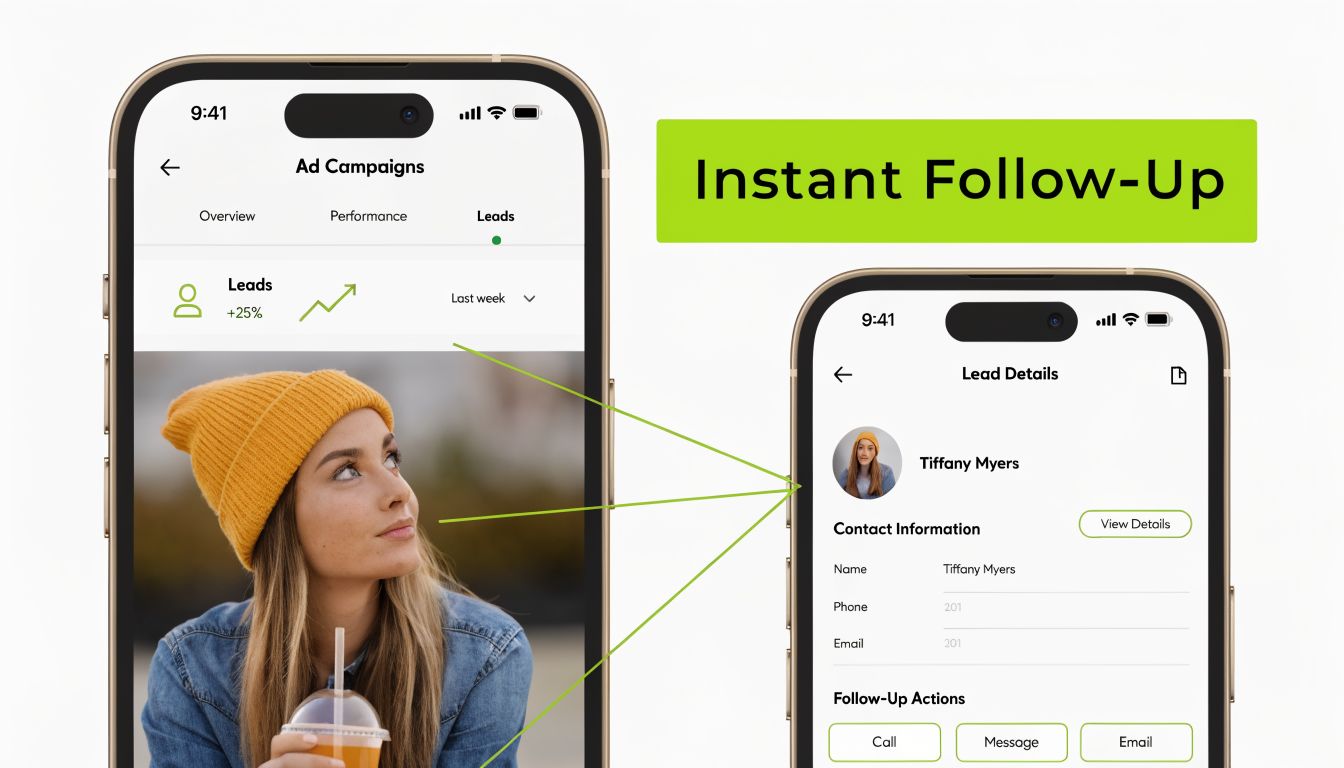
A proper setup connects Instagram Lead Forms, landing pages, or enquiry forms directly into a CRM. The moment a lead is created, the system should trigger the next action automatically.
That usually means:
- Creating a contact record instantly
- Sending an immediate acknowledgement
- Asking qualification questions
- Assigning the lead to the right person
- Prompting or booking the next sales step
This isn’t about replacing staff. It’s about making sure no enquiry arrives in a vacuum.
The broader marketing trend supports this direction. Hampton Golf’s overview of 2025 marketing trends notes that AI and data analytics now support precision targeting and follow-up, including personalised invitations and offers based on behaviour and engagement patterns. For clubs, that means the sales process can adapt to the lead rather than forcing every enquiry into the same generic reply.
Qualification should happen early
Not every Instagram lead deserves the same amount of staff time. Some people are ready for a club visit. Others are comparing categories. Some are only browsing.
The follow-up flow should sort that quickly.
A practical qualification sequence might identify:
- Membership intent: Are they exploring now or later?
- Category fit: Full, weekday, flexible, beginner, family, or social route
- Readiness for a visit: Can they attend in the near term?
- Decision factors: Playing access, community, coaching, value, location
That gives the club usable context before the first personal contact.
Operational insight: Fast follow-up matters, but relevant follow-up matters more. A quick generic email is better than silence, but a quick personalised response is what moves people forward.
For clubs evaluating systems, there are several CRM and automation routes available, including custom workflows, membership platforms with integrations, and specialist setups such as GolfRep, which combines Meta lead generation with CRM-based follow-up and nurture for golf clubs. The right choice depends on whether the club needs simple lead capture or a full membership pipeline with visibility from enquiry to sign-up.
Visibility changes decision-making
When leads flow into a structured CRM, managers can finally answer the questions that matter.
Which campaigns produce booked visits? Which staff convert best? Which audience sends poor-fit enquiries? How long does each lead sit untouched? Which membership categories close fastest?
Without that visibility, clubs end up debating creative preferences while the main issue sits in follow-up.
Tracking, Optimising, and Proving ROI
If you only measure what Meta shows you, you’ll only understand part of the journey.
Instagram can tell you about clicks, leads, reach, and on-platform conversions. That’s useful, but it doesn’t tell a committee whether ad spend produced recurring membership revenue. For that, you need attribution that continues after the form fill.
Platform metrics are only the starting point
A campaign can look healthy inside Ads Manager and still fail commercially. The opposite can also happen. An ad might produce fewer leads, but those leads convert better once they enter a proper sales process.
That’s why reporting needs to connect:
- Ad data
- Website behaviour
- CRM pipeline stages
- Membership sales outcomes
North American data reported by Lightspeed’s golf marketing guide shows that longer-running managed campaigns can increase website sessions by 142%, but it also highlights the limitation most clubs face in practice. It doesn’t provide UK-specific membership CPA benchmarks or a clear attribution method for recurring membership revenue. So clubs need their own closed-loop reporting rather than relying on generic industry comparisons.
What to track each week
Weekly optimisation should stay practical. Don’t drown the team in data they can’t act on.
A sensible weekly review includes:
- Lead quality by audience: Which audience is producing serious conversations?
- Creative fatigue: Are response rates slipping because the same ad has run too long?
- Form completion quality: Are enquiries coming through with enough information to qualify properly?
- Follow-up speed: Is every new lead entering the workflow immediately?
- Booked visit rate: Are leads progressing or stalling?
Clubs often discover the truth: The ad wasn’t the issue. The issue was weak qualification, poor routing, or missing sales tracking.
What to review each month
Monthly analysis should be tied to business performance, not just campaign activity.
| Review area | Key question |
|---|---|
| Audience performance | Which segments generate members, not just leads? |
| Offer strength | Is the campaign invitation strong enough to move prospects to a visit? |
| Sales conversion | What proportion of qualified enquiries become members? |
| Channel contribution | Is Instagram assisting other channels even when it isn’t the final click? |
| Budget allocation | Should spend shift toward better-performing campaigns or seasons? |
UK Golf Club Instagram Ad KPI Benchmarks 2026
Because public UK membership attribution data is limited, clubs should be careful with generic benchmark claims. The safest approach is to build internal benchmarks from your own pipeline and tighten them over time.
| Metric | Target Benchmark | Notes |
|---|---|---|
| Lead volume | Club-specific | Useful only when reviewed alongside qualification quality |
| Qualified lead rate | Improve month by month | More meaningful than raw enquiry count |
| Booked visit rate | Track consistently | A strong indicator that follow-up is working |
| Membership conversion rate | Track by category and campaign | Different membership products convert differently |
| Cost per qualified lead | Reduce through better targeting and qualification | More useful than cost per lead alone |
| Cost per acquired member | Primary commercial benchmark | Best measure of sustainable paid social performance |
| Response time to enquiry | As fast as operationally possible, ideally automated | Slow response weakens every other metric |
| Pipeline visibility | Full visibility required | If lead stage can’t be seen, optimisation becomes guesswork |
A golf club doesn’t need perfect attribution on day one. It does need a reporting model that links ad spend to pipeline movement and signed members.
When clubs get this right, the conversation changes. Instagram stops being “something marketing is trying” and becomes a measurable acquisition channel with clear commercial accountability.
If your club wants to turn golf club Instagram ads into a predictable membership pipeline, GolfRep helps UK clubs connect paid social, lead qualification, CRM follow-up, and revenue tracking into one system. The key isn’t generating more names. It’s building a process that shows which enquiries are worth pursuing and converts them consistently.
Ready to tap into our proven growth system?