Golf Club Open Day Marketing: The Complete 2026 Playbook
Most advice on golf club open day marketing is still too shallow. It tells clubs to post on Facebook, print a flyer, run an offer, and hope enough people turn up.
That isn't the hard part.
The hard part is what happens when interest arrives. If a prospective member clicks an ad and lands on a generic homepage, if their enquiry sits in an inbox for two days, or if nobody knows whether they were a beginner, a returning golfer, or a serious membership prospect, the club hasn't got a marketing problem. It has a conversion system problem.
That distinction matters more now because the audience is there. England Golf reported 472,000 adult club members in Great Britain in 2024, and England Golf survey data cited by Lightspeed showed 62% of golfers used the internet to search for golf before choosing where to play, rising to 72% among 18 to 34 year olds, while 52% booked tee times online (England Golf digital behaviour data via Lightspeed). Interest exists. Digital discovery is normal. Clubs don't need more random awareness nearly as much as they need a cleaner path from enquiry to visit to membership conversation.
From GolfRep's perspective, an open day should sit inside a measurable acquisition pipeline. The event is only the visible part. Underneath it, you need targeting, a proper landing page, clear lead capture, fast follow-up, and conversion tracking that shows whether the day produced real revenue or just footfall.
Beyond the Brochure Rethinking Your Open Day's Purpose
Most clubs still frame an open day as a promotional exercise. They focus on attendance. They talk about posters, local press, a few social posts, and maybe a discounted joining incentive if registrations feel slow.
That approach misses the point.
An open day isn't valuable because people walk through the door. It's valuable if the club can identify who came, why they came, what membership route suits them, and how the team will move them towards a joining decision. If that system isn't in place, more promotion just creates more unmanaged enquiries.
Promotion is the visible part, not the important part
A lot of committees judge an open day by what they can see. Full car park. Busy putting green. Decent atmosphere in the clubhouse. Those are useful signals, but they don't tell you whether the day worked commercially.
The more useful questions are simpler:
- Did every prospect register properly
- Did staff know which visitors were beginners, lapsed golfers, families, or ready-to-join members
- Did someone own the follow-up process
- Can the club trace eventual memberships back to the open day
If the answer to any of those is no, the event was underbuilt.
Clubs rarely lose open day revenue because nobody heard about the event. They lose it because interest wasn't handled consistently.
The open day should feed a membership pipeline
A better model is to treat the open day as the peak moment in a broader process. The campaign attracts the right traffic. The registration journey captures intent. The event gives prospects a reason to visit. The follow-up turns attention into decisions.
That changes the way you market it.
Instead of asking, "How do we get as many people there as possible?", ask, "How do we get the right people into a system we can track and convert?" That shift usually improves quality as much as quantity.
For private clubs especially, this matters. Discount-led attendance often fills the day with people who like the offer but don't fit the club. A structured pipeline lets you position the event around belonging, progression, and confidence rather than short-term price tactics.
Defining Success Before You Start
If the objective is only "get more members", the campaign will drift. The manager will want quality. The committee will want visibility. The pro might want a busy range. The office will end up handling registrations manually, and nobody will agree afterwards on whether the day was successful.
Success needs a business definition before spend starts.
Start with outcomes, not activity
Sport England's Active Lives data showed 1.04 million adults in England played golf in the 12 months to November 2024, and England Golf's Go Golf initiative aims to reach 1 million adults and 100,000 juniors by 2026 (UK golf participation and growth initiative). That means the market is broad enough to support a properly planned acquisition event. It doesn't mean every open day will work by default.
A sensible objective usually has four layers:
| Focus area | What to define |
|---|---|
| Audience | Which people you want most. Beginners, women, families, lapsed golfers, younger working-age joiners, or experienced players comparing clubs |
| Event result | Registrations, attended visits, booked tours, membership meetings |
| Commercial result | New members, trial conversions, future coaching uptake, junior pathway enquiries |
| Operational result | Response speed, lead visibility, staff ownership, follow-up completion |
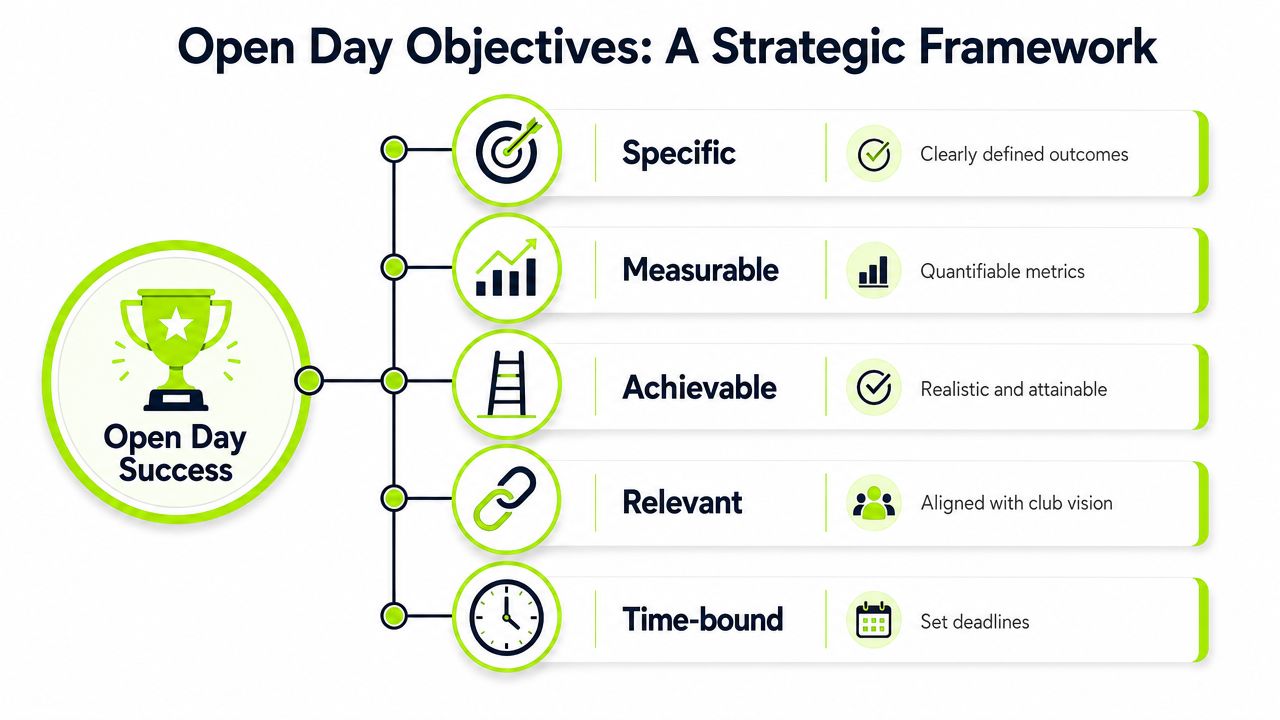
Use a practical SMART standard
SMART planning sounds basic, but most clubs skip it. For an open day, it stops the event becoming a vague brand exercise.
A strong target is specific enough that any committee member can understand it and any staff member can execute against it. The best way to do that is to separate top-line ambition from operational control.
For example:
- Specific means naming the audience and offer format
- Measurable means tracking registrations, attendance, tours, meetings, and joined members
- Achievable means matching the event format to staff capacity
- Relevant means aligning the day to the club's real growth priority
- Time-bound means locking campaign dates, follow-up deadlines, and review points
Practical rule: if the office team can't tell you who owns each stage from registration to follow-up, the objective isn't defined well enough.
Build the budget backwards
Most clubs budget the wrong way round. They decide what they can spare, then try to force a campaign into that number. A better method is to budget backwards from the value of a joined member and the number of serious membership conversations you need.
That doesn't require invented benchmarks. It requires internal clarity.
Map the budget across three areas:
Traffic generation
Paid social, search activity, email sends, and local promotion.Conversion infrastructure
Landing page, form setup, automations, confirmation messages, CRM tagging.On-day delivery
Signage, staff time, refreshments, printed material, and a clean joining process.
Clubs that treat the second category as optional usually struggle most. Promotion gets people interested. Infrastructure decides whether that interest becomes revenue.
Attracting Your Ideal Future Members
Open day promotion usually fails before the first ad spend is wasted. The problem is not reach. It is relevance.
If the wrong people register, the club still gets a busy day and a weak sales pipeline. That creates extra follow-up work for the office team and very few serious membership conversations. A better approach is to attract the people your club can convert, then label that interest clearly enough for staff to handle it properly.

Segment first, write second
Clubs get better results when they build the campaign around a small number of audience types instead of one generic invitation.
A useful segmentation model looks like this:
Beginners and returners
They need reassurance. Lead with a friendly first visit, coaching support, and a format that does not assume confidence or prior knowledge.Established golfers comparing clubs
They want evidence. Show course access, competition structure, pace of play, member culture, and whether the membership options fit how they play.Women and family audiences
They tend to respond to social fit, pathways into the club, and whether the environment feels comfortable rather than intimidating.Junior-focused households
The parent usually makes the decision. Show coaching structure, supervision, progression, and what the family experience looks like beyond the first session.
That segmentation also improves what happens after registration. If the form, CRM tag, or booking source shows whether someone is a beginner, a parent, or an active club golfer, your team can prepare the right conversation before they arrive.
What stronger ad copy looks like
Weak ad copy describes the club. Strong ad copy addresses the reason someone would bother visiting.
Compare these approaches:
| Weak version | Better version |
|---|---|
| Join us for our annual open day | Curious about joining a golf club but not sure where to start? Visit our beginner-friendly open day and meet the team |
| Discover our fantastic facilities | See the course, ask questions, and find the right membership route for your golf and your schedule |
| Limited-time membership offer | Explore membership, coaching, and playing options in a relaxed visit designed for local golfers |
The difference is practical. Better copy reduces uncertainty, sets the tone, and helps self-selection. That means fewer casual sign-ups from people who were never a fit, and more registrations from prospects the club can convert.
Use your owned audience properly
Many clubs already have the right people sitting in their database. Past enquiries, coaching contacts, event attendees, trial players, newsletter subscribers, and lapsed members often produce better registrations than cold targeting because some trust already exists.
Those groups should not receive the same invite.
A lapsed member may care about what has changed since they left. A beginner wants to know whether they will feel out of place. A parent wants to know who their child will meet, what the coaching standard is, and how the pathway works after the open day. If every audience gets the same message, the club creates avoidable friction before the first conversation.
For clubs reviewing their wider acquisition mix, this guide on how to attract new golf club members is a useful companion to open day planning because it starts from the same discipline. Define who the club wants more of, then build the message and process around that audience.
Creative should pre-qualify, not just attract clicks
A lot of open day marketing underperforms because clubs ask one advert to do too much. One image, one headline, one boosted post, one catch-all promise to everyone within ten miles. That usually produces interest without intent.
Use separate creative for separate audiences. Show coaching and friendly faces for beginners. Show course condition, playing opportunities, and member experience for established golfers. If you use video, keep it short and audience-specific. This video marketing guide for 2026 gives a useful overview of how clubs and local businesses can structure that kind of content without overcomplicating production.
The trade-off is simple. More audience variants take more planning and a bit more admin. They also give the team better leads, cleaner follow-up, and a much clearer view of which membership segments the campaign is attracting.
That is the point. An open day campaign should not just fill the tee sheet or the clubhouse. It should create identifiable, well-matched prospects that the club can move into tours, meetings, and joined memberships.
Building Your Digital Welcome Mat
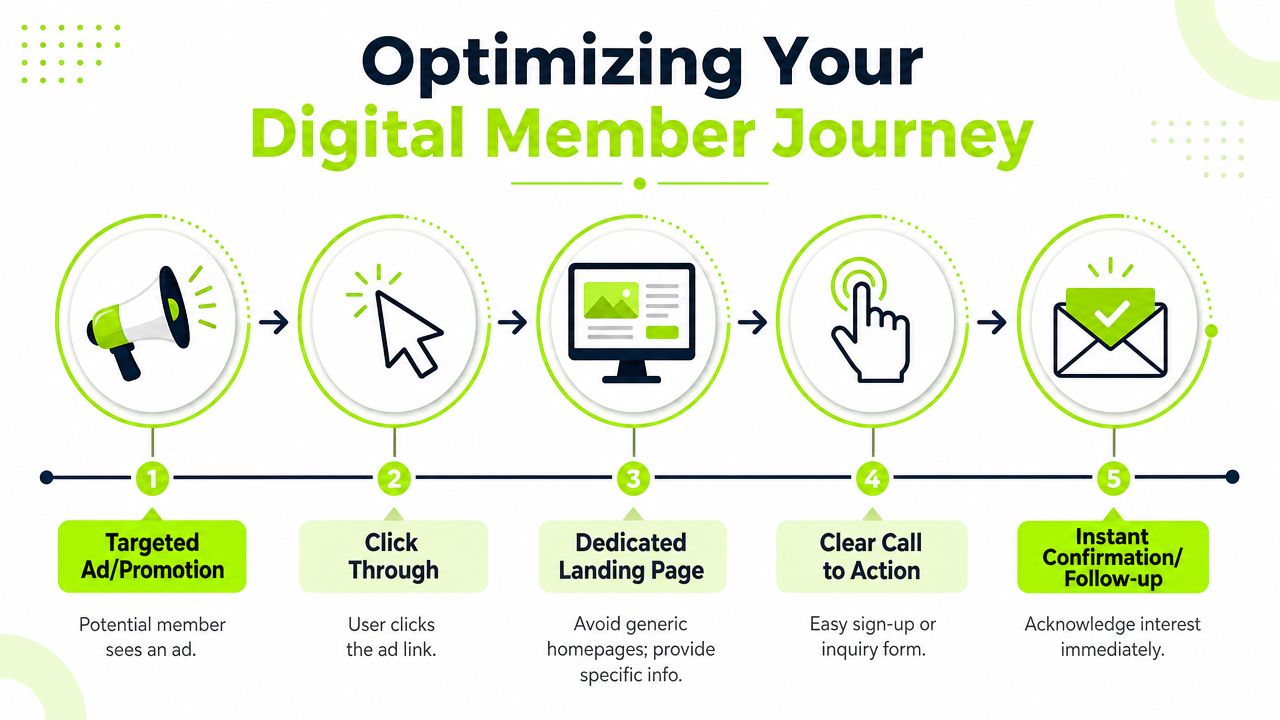
The biggest leak in golf club open day marketing usually sits between the click and the registration.
A prospect sees a strong ad, clicks with intent, and lands on the club homepage. They have to hunt for details, find a PDF, or send a generic enquiry. By that stage, the club has already made the process harder than it needs to be.
That's why a dedicated funnel matters more than a nice-looking page.
A landing page should do one job
Independent golf marketing guidance for clubs recommends launching campaigns several weeks before the event, using a dedicated landing page, keeping the form short enough to reduce drop-off while still capturing enough information to route the lead properly, and retargeting visitors who don't register before the day itself (open day campaign timing and landing page guidance).
That advice is sound because a landing page isn't there to explain everything about the club. It's there to move one action forward.
A good open day landing page should include:
A clear event promise
What the visitor will experience and who it suits.Simple reassurance
Beginner-friendly, family-friendly, or suitable for experienced golfers, whichever is relevant.Essential event details
Date, time, location, what to bring, and what happens on arrival.One clear call to action
Register, book a place, or request a visit. Not three different choices.
Short forms convert better than clever forms
Many clubs ask for too much too early. Full postal address. Handicap history. Budget. Preferred membership type. A message box that nobody completes properly.
That creates friction before trust exists.
You need enough information to route the lead, not enough to satisfy every possible admin question. Name, email, mobile, and one or two qualifying fields are usually far more useful than a long form that people abandon. Better qualifying fields might include current golf status, interest area, or whether they'd like a guided tour.
Every extra field should earn its place. If the team won't use the answer during follow-up, don't ask for it on the first form.
Automation sets the tone immediately
Once someone registers, silence is a mistake. They should receive confirmation straight away, a reminder before the event, and a clear message about what to expect. That doesn't need to feel robotic. It needs to feel organised.
A simple automation sequence can handle:
- Instant confirmation with date, time, directions, and a named contact
- Reminder messaging closer to the event
- Pre-qualification prompts where relevant
- Internal notifications so staff can see new leads quickly
If you're using video in those confirmations or on the landing page, concise walkthrough clips often work better than polished brand films. This video marketing guide for 2026 is useful for thinking about how short-form video supports response, clarity, and action rather than just awareness.
Retargeting isn't optional
Some visitors won't register on the first visit. That doesn't mean they weren't interested. It usually means they were interrupted, unconvinced, or not ready yet.
Retargeting gives you a second chance to bring back people who already showed intent. In practical terms, that audience is often warmer than the people seeing the club for the first time. If a club wants tighter control of this process, tools such as a CRM-linked enquiry workflow or GolfRep's structured capture and follow-up system can make those leads visible instead of leaving them in disconnected inboxes and ad platforms.
Converting Visitors into Members On The Day
When the day arrives, most clubs focus heavily on atmosphere. That's sensible, but atmosphere alone doesn't convert. People join when the visit helps them picture themselves belonging.
The best open days feel organised from the car park onward. Guests aren't left wondering where to go, who to speak to, or whether they fit in. Staff don't hover awkwardly, and they don't disappear either. The whole visit should reduce uncertainty.
The first 15 minutes shape the rest
A useful on-day flow is simple. Welcome at arrival. Quick sign-in. A visible host. Then move people into the right experience rather than pushing everyone through the same route.
That might mean:
- Beginners go first to a coach-led introduction
- Experienced golfers head toward course view, playing access, and competition information
- Families speak early with the person who can explain junior or social pathways
- Serious joiners know where the membership conversation will happen before they leave
A club that tries to show everything to everyone often overwhelms people and misses what they care about.
Build value through the visit
Private clubs in particular need to resist the reflex to make the day all about price. Guidance for golf facilities increasingly points towards community, belonging, and specific pathways for women, juniors, or beginners rather than broad discounting (club positioning and audience pathway guidance).
That plays out practically on the day in a few ways:
| Touchpoint | What it should communicate |
|---|---|
| Welcome desk | This club is organised and expecting you |
| Tour route | The club has a lifestyle and rhythm, not just facilities |
| Coaching or activity area | Newer golfers will be supported, not judged |
| Membership conversation | There is a clear route in, with options explained confidently |
For clubs running wider clubhouse recruitment events alongside membership activity, this guide to clubhouse event marketing strategy can help align the member journey with the social side of the venue.
Don't apologise for your fees if the club delivers value. Explain who the membership is for, how people settle in, and what support exists in the early months.
Close with clarity, not pressure
You don't need a hard sell. You do need a next step.
That next step might be an application discussion, a follow-up tour, a beginner package conversation, or a call with the membership lead. What matters is that nobody leaves interested but directionless. The staff member finishing the conversation should know what happens next, who owns it, and when the prospect will hear from the club.
The Follow-Up System That Drives ROI
Most open days don't fail on the day. They fail in the days after it.
A prospect attends, likes the club, means to think about it, and goes back to normal life. If the club follows up quickly and relevantly, that interest stays live. If the club sends one generic email or does nothing at all, momentum fades and the event's value leaks away.
Speed matters because intent cools quickly
UK golf marketing guidance increasingly points to online booking, clear event visibility, and CRM-linked enquiry handling because the conversion risk isn't just awareness. It's what happens in the 24 to 72 hours after the event, when convenience and responsiveness influence whether interest becomes a visit or a membership conversation (follow-up speed and data capture in golf marketing).
That should reshape how clubs think about ROI. The event itself creates intent. The follow-up system captures the value.
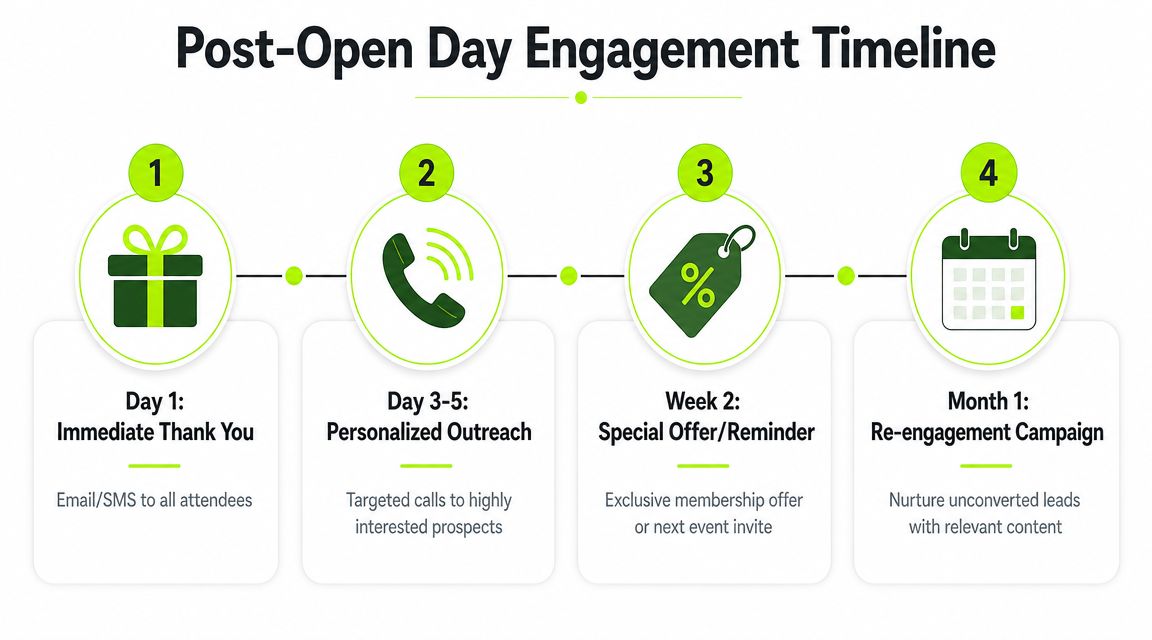
A basic post-open day sequence might include:
Same day or next morning
Thank you message, practical recap, and the clearest next step.Early personal outreach
Calls or personalized emails to the strongest-fit prospects based on what they asked about.Ongoing nurture
Useful information for people who liked the club but weren't ready to decide immediately.
Treat attendees and non-attendees differently
One of the easiest wins is separating your follow-up by behaviour. Someone who registered but didn't attend needs a different message from someone who spent an hour at the club and asked about joining.
A workable structure looks like this:
| Prospect type | Better follow-up angle |
|---|---|
| Attended and engaged | Personal call, membership route, invite back for a focused visit |
| Attended but undecided | Address objections, send relevant pathway details, keep the tone helpful |
| Registered but absent | Offer another visit option or a simple rebook path |
| Low-intent lead | Light nurture rather than repeated sales messages |
For message timing and format, ideas from outside golf can still help. These Shopify SMS marketing strategies are useful for thinking about cadence, clarity, and when a text message works better than another email.
Visibility beats memory
Clubs often run follow-up from memory, inbox searches, and spreadsheets. That works until staff are busy, someone is off, or nobody can remember whether a prospect already got a call.
CRM discipline becomes commercial discipline. Each lead should have a source, a status, an owner, and a next action. If that sounds basic, good. Basic systems usually outperform heroic improvisation.
For clubs refining this area, GolfRep's guide to a golf club follow-up system is useful because it focuses on process ownership rather than just sending more messages.
The club shouldn't have to ask, "Did anyone call that open day lead?" The system should already show it.
Measure the event against revenue, not noise
The review meeting after an open day often centres on soft observations. Good turnout. Nice feedback. Busy bar. Helpful volunteers.
Those things are positive, but they don't tell you whether the campaign paid back.
A stronger review asks:
- Which channels produced registrations
- Which registrations attended
- Which attendees moved into real membership discussions
- Which prospects joined later
- What handling gaps appeared in the process
When you can connect source, attendance, follow-up, and eventual joining, the open day stops being a hopeful annual tradition. It becomes a repeatable acquisition channel.
Your Open Day Is a Process Not an Event
The clubs that get the best results from golf club open day marketing don't only promote harder. They build a cleaner system.
They define success before they spend. They target people who fit the club. They send traffic to a proper landing page instead of a generic homepage. They capture useful information without creating friction. They run the day in a way that builds confidence and belonging. Then they follow up fast, track every lead, and measure outcomes against membership revenue.
That's what creates predictability.
An open day should never stand alone as a one-day burst of effort surrounded by admin guesswork. It should sit inside a repeatable process that the manager can review, the office can operate, and the committee can understand. Once that process is in place, promotion becomes easier because the club knows that interest won't be wasted.
The usual assumption is that clubs need more enquiries. In practice, many clubs need better control of the enquiries they already generate. That's the difference between a busy event and a reliable pipeline.
If your club wants to turn open days into a structured membership pipeline rather than a one-off promotion, GolfRep helps build the systems behind the campaign, from lead capture and follow-up to CRM visibility and conversion tracking.
Ready to tap into our proven growth system?