Golf Club Google Reviews: A Growth Strategy for 2026

A new Google review lands on your club profile and the reaction is usually the same. You want it to be glowing, you worry it won't be, and you know other golfers will read it before your team gets a chance to explain anything.
That moment matters more than most clubs think.
For many managers, reviews sit in a separate mental box from membership sales, visitor bookings, and enquiry handling. They get treated as a reputation issue, not a pipeline issue. That's a mistake. A prospective member who has already visited your website, looked at your joining options, and then checks your reviews is not browsing casually. They're validating whether your club feels worth a call, a visit, or a trial round.
Good clubs lose business here every week, not because the course is poor, but because the public evidence around the club feels patchy, outdated, unanswered, or inconsistent.
Why Google Reviews Are More Than Just a Star Rating
Golf club Google reviews are often discussed as if the job is simple. Get more 5-star ratings, keep the average high, and you'll be fine.
That view is too narrow.
In practice, reviews sit right in the middle of the conversion journey. A golfer sees your club, clicks through, compares you against nearby alternatives, and then uses your Google profile to answer practical questions. Is the course well kept? Are staff welcoming? Is the clubhouse worth spending time in? Does the experience feel aligned with the price?
The booking impact is already clear. In the UK golf market, online reviews materially affect booking behaviour. GolfNow's Consumer Insights Study found that 52% of all golfers consult online ratings and reviews before booking a tee time, rising to 74% of GolfNow users, according to GolfNow's consumer insights for facility owners.
That means reviews don't sit at the edge of demand. They influence whether demand converts.
Reviews shape confidence before your team speaks to the lead
Most clubs focus heavily on generating attention. Paid campaigns, social posts, website tweaks, referral pushes. Those things matter, but they only create the opportunity.
Conversion happens when a prospective member decides your club feels credible enough to contact, visit, or join. Google reviews are one of the last checks before that step. If they see stale responses, recurring complaints, or no sign that the club listens, confidence drops fast.
Practical rule: Treat your review profile like part of your sales process, not a noticeboard you glance at once a week.
This is why reputation management isn't a side task for the office team. It belongs alongside enquiry handling, follow-up, and sales visibility. If your profile helps a golfer move from curiosity to action, it is performing a commercial role.
Clubs that understand this usually make better decisions. They don't chase empty praise. They build a review system that supports trust, reflects the experience, and gives prospects fewer reasons to hesitate.
The wrong metric is the average score on its own
A star rating matters, but it rarely tells the full story. A club can hold a decent average and still lose conversion because recent reviews mention slow service, poor communication, or tired presentation. Another club may carry an imperfect score but win trust because management replies quickly, explains issues properly, and shows that standards are being addressed.
If your club is serious about attracting and converting the right enquiries, reviews need to be managed with the same discipline as any other front-end touchpoint.
For a broader look at that discipline, this guide to golf club reputation management is worth reading alongside your review process.
Building Your Foundation on Google Business Profile
Before you ask anyone for a review, your Google Business Profile needs to be worth landing on. Too many clubs start with review generation when the profile itself is incomplete, inconsistent, or neglected.
That wastes the traffic reviews create.
A golfer who clicks through from search is making a quick judgement. If your opening hours look uncertain, the phone number is wrong, the latest photos are old, or key services aren't listed clearly, confidence drops. People don't separate those details from the wider club experience. They assume the profile reflects how the club is run.
The core audit every club should run
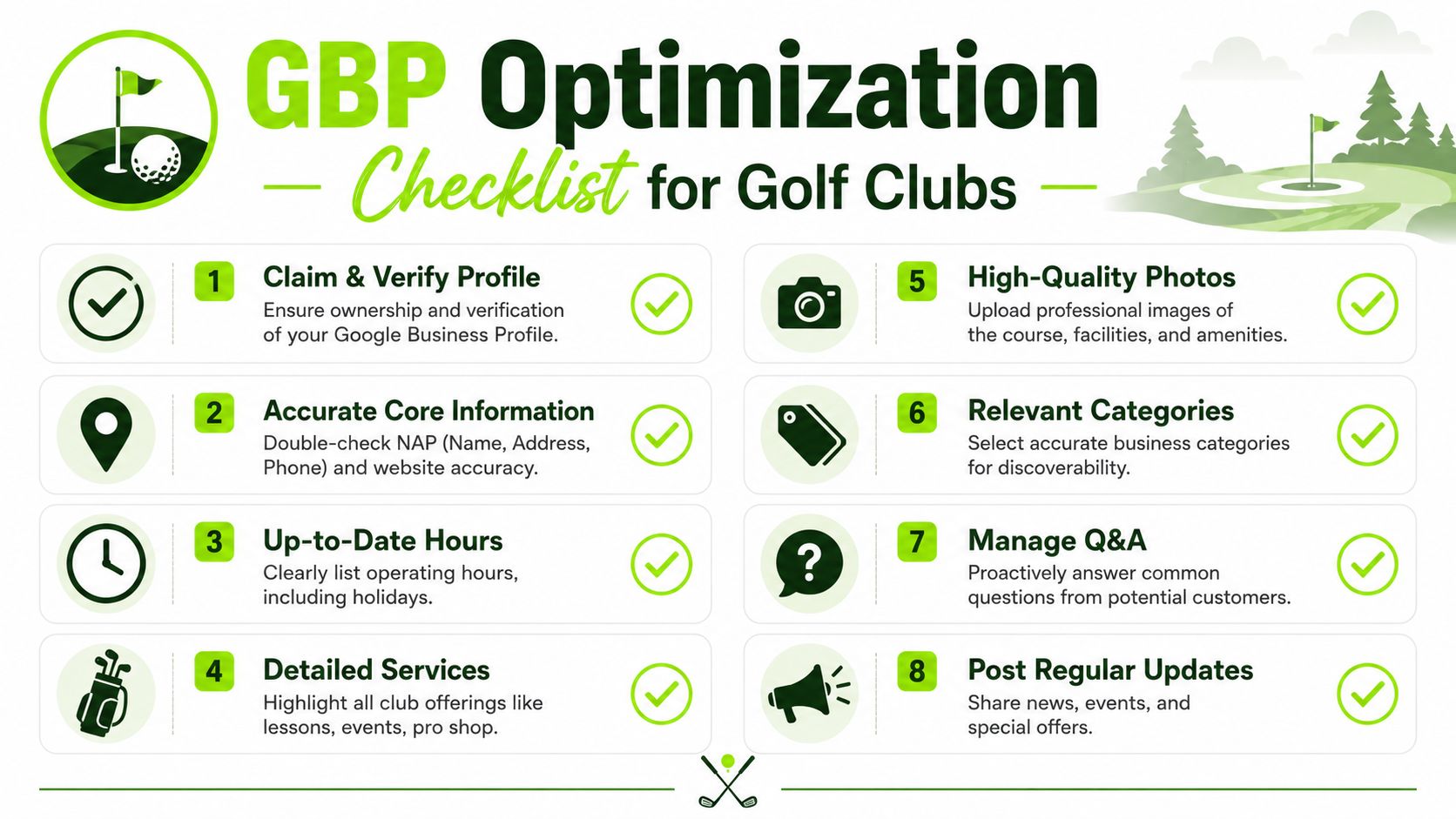
Use a simple checklist and fix the basics first.
- Claim and verify the profile: Make sure the club controls the listing directly. If access sits with a former staff member or supplier, sort that before doing anything else.
- Check your core details: Name, address, phone number, website link, and map pin all need to be accurate.
- Update opening hours: Include seasonal changes, bank holidays, and any separate timings that affect the visitor experience.
- List real services: Membership enquiries, visitor golf, coaching, custom fitting, society days, clubhouse dining, events, and the pro shop should be represented clearly where relevant.
- Review your images: Replace weak or dated photos with current images of the course, practice areas, clubhouse, terrace, food offering, and team.
- Choose the right categories: Categories help Google understand what the club offers and help golfers understand what to expect.
- Manage Q&A properly: Unanswered public questions create friction. If golfers are asking about dress code, green fees, buggies, or trial rounds, answer them.
- Post updates: Course conditions, events, open days, membership evenings, and seasonal offers help keep the profile active and useful.
A practical external guide on how to boost local business presence can help if you want a non-technical reference point for the setup itself.
What strong profiles actually do
A good Google Business Profile doesn't just look tidier. It reduces the gap between interest and action.
If a golfer can see accurate details, strong visuals, current updates, and a clear path to contact the club, you're making the next step easier. That's the point. Every unnecessary question or mismatch creates delay, and delay hurts conversion.
An incomplete profile doesn't just look untidy. It makes the club feel harder to trust.
Keep the profile connected to your website journey
Your profile and website need to support the same message. If Google presents one picture of the club and your site presents another, prospects hesitate.
Make sure the website page linked from the profile matches the intent of the visitor. If someone is looking at membership, don't send them to a generic homepage and hope they find the right page themselves. This is one reason clubs benefit from reviewing their wider golf course online presence as one connected system rather than a set of separate tasks.
Systematically Generating a Stream of Positive Reviews
The phrase "just ask for reviews" sounds sensible until you watch how clubs do it.
Usually, it means a staff member remembers occasionally. A pro mentions it after a lesson. Someone in the bar points at a QR code. A committee member says more reviews would be nice. Nothing is timed, nothing is tracked, and nobody really knows which touchpoints are producing feedback.
That approach won't give you consistency.
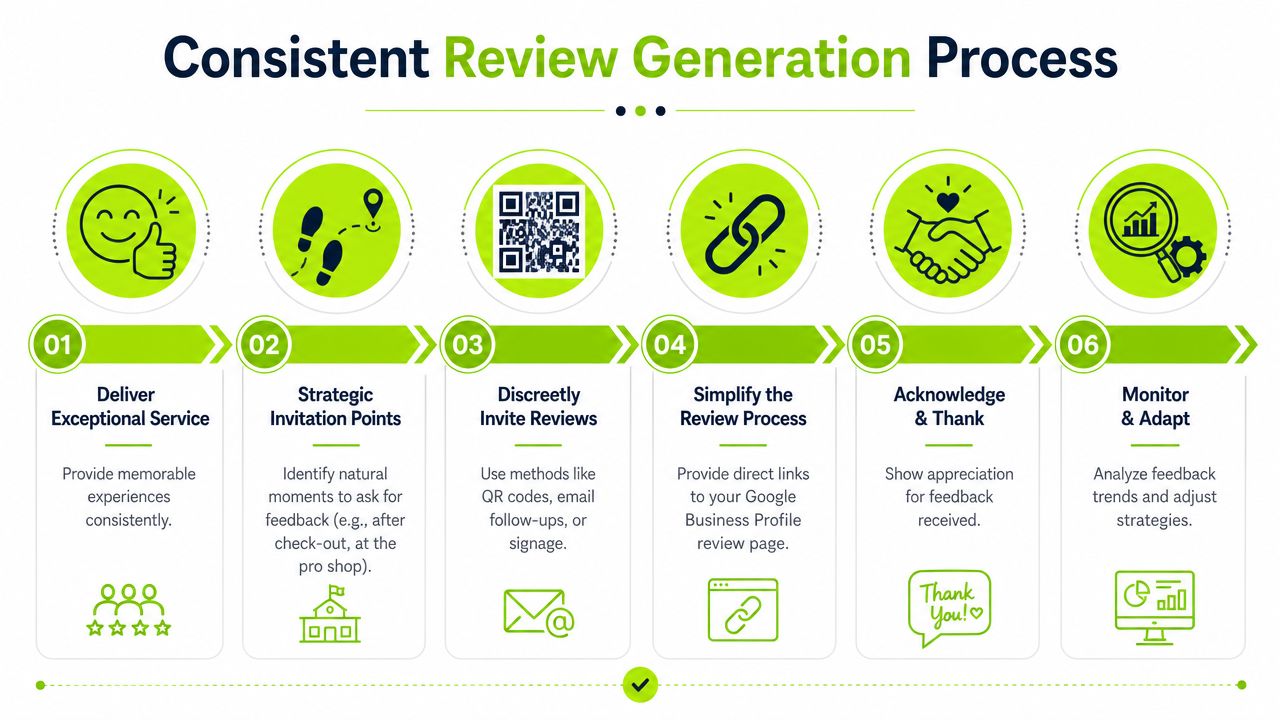
A better model is simple. Build a repeatable request flow around real customer moments, then let the system do most of the work.
A golf-specific feedback platform reported that clubs can increase Google reviews by up to 68%, moving one example venue's Google rating from 4.0 to 4.4 while accumulating 446 total reviews, with 91% of them at 5 stars, based on Realtime Feedback's golf review management example. The useful lesson isn't the tool itself. It's the process behind the result: structured post-round collection works better than hoping staff remember to ask.
Pick the moments that feel natural
Not every interaction deserves a review request. The best moments are those where the golfer has experienced the club and still remembers the details.
Good trigger points often include:
- After a visitor tee time is completed and the player has left the course.
- After a society or corporate day once the organiser has had time to reflect.
- A short time after a new member joins and has used the facilities.
- After a coaching block or fitting session when the service outcome is clear.
The timing matters. Ask too early and the experience isn't complete. Ask too late and the memory has cooled.
Build the workflow inside your CRM or follow-up system
This doesn't need to be complicated, but it does need to be reliable. A basic review workflow should include:
- A trigger: Completed round, event, lesson, or joining date.
- A delay: Enough time for the golfer to finish the visit and reflect.
- A personalised message: Use their name and reference the visit.
- A direct review link: Remove the need to search for your club.
- A light follow-up: One reminder is usually enough if there's no response.
If your club still relies on manual lists and ad hoc reminders, review generation will stay inconsistent. The same issue shows up elsewhere in club growth. Manual processes create gaps, and gaps cost conversion.
If asking for reviews depends on memory, your volume will always be uneven.
Keep the message simple
Most clubs overcomplicate the request. You don't need a long explanation.
Try wording like this:
Hi [First Name], thanks for visiting [Club Name] today. We hope you enjoyed your round. If you have a moment, we'd really appreciate your feedback on Google. Your comments help other golfers decide whether we're the right fit. [Direct review link]
For new members, a version like this works well:
Hi [First Name], thanks again for joining [Club Name]. We hope your first few visits have been positive. If you'd be happy to share your experience so far on Google, we'd appreciate it. [Direct review link]
What works and what doesn't
A short comparison helps here.
| Approach | What happens |
|---|---|
| Staff occasionally asking in person | Inconsistent volume, dependent on confidence and memory |
| Generic signs with no follow-up | Low action because the golfer has to do the work later |
| Timed message after a completed experience | Higher intent because the request matches the moment |
| CRM-linked requests with direct links | Repeatable, trackable, and easier to manage |
The key point is this. Positive reviews shouldn't arrive by luck. They should come from a system built around service delivery and structured follow-up.
Responding to All Reviews The Right Way
Most clubs reply to reviews in one of two bad ways. They either write something so generic it adds nothing, or they become defensive the moment criticism appears.
Both approaches miss the opportunity.
A review response isn't just for the person who wrote it. It's for every prospective golfer or member who reads it afterwards. They are judging how the club behaves under praise and under pressure.

Positive reviews deserve specific replies
A weak response to a strong review looks like this:
Thanks for your review. We hope to see you again soon.
It isn't rude, but it wastes the detail the reviewer gave you.
A better version sounds like this:
Thanks for visiting and for taking the time to mention the greens and the welcome from the bar team. We're pleased you enjoyed both the course and the clubhouse, and we hope to see you back again soon.
That reply does two jobs. It thanks the reviewer, and it reinforces the exact selling points that matter to future readers.
Negative reviews need control, not emotion
Now consider the wrong way to answer criticism:
We completely disagree. The course was in good condition and our team did everything possible. You should have raised this on the day.
That response may feel satisfying internally, but it damages trust publicly.
A stronger response follows a simple sequence:
- Acknowledge the issue
- Show empathy
- Move the detail offline
- State what will be reviewed or addressed
For example:
Thank you for the feedback. We're sorry to hear that the pace of play and condition of the tee boxes affected your visit. That's not the standard we want to deliver. Please contact the club office so we can look into the day in more detail, and we've also raised your comments with the operations team for review.
That answer doesn't admit fault blindly, and it doesn't argue. It shows professionalism.
Respond to the issues golfers actually care about
Vague review management produces vague learning. An independent USGA course-satisfaction study implies that review prompts should ask about high-signal dimensions like pace of play, conditioning, and staff response, and that vague praise creates less useful management insight than structured feedback, as outlined in the USGA course satisfaction classification report.
If your club gets comments about slow rounds, poor bunkers, weak hospitality, or indifferent service, your response should address those operational themes directly. A flat "sorry you feel that way" tells prospects very little.
For teams that want a broader framework for effectively managing customer feedback, that resource is a helpful companion to a review response policy.
Good response handling can soften a bad review. Poor response handling can make a manageable issue look systemic.
Set a response standard internally
Many clubs typically fall short. Nobody owns the process, so responses drift.
Create internal rules such as:
- Assign ownership: One person should be responsible for checking and drafting responses.
- Use approval only when needed: Don't send every review through a slow committee chain.
- Keep a tone guide: Friendly, calm, and specific beats corporate wording.
- Escalate operational complaints: If reviews mention recurring issues, send them to the relevant manager, not just the inbox archive.
Review responses are customer-facing service. Treat them with the same urgency as a membership enquiry.
Turning Reviews into Marketing Assets and Operational Insight
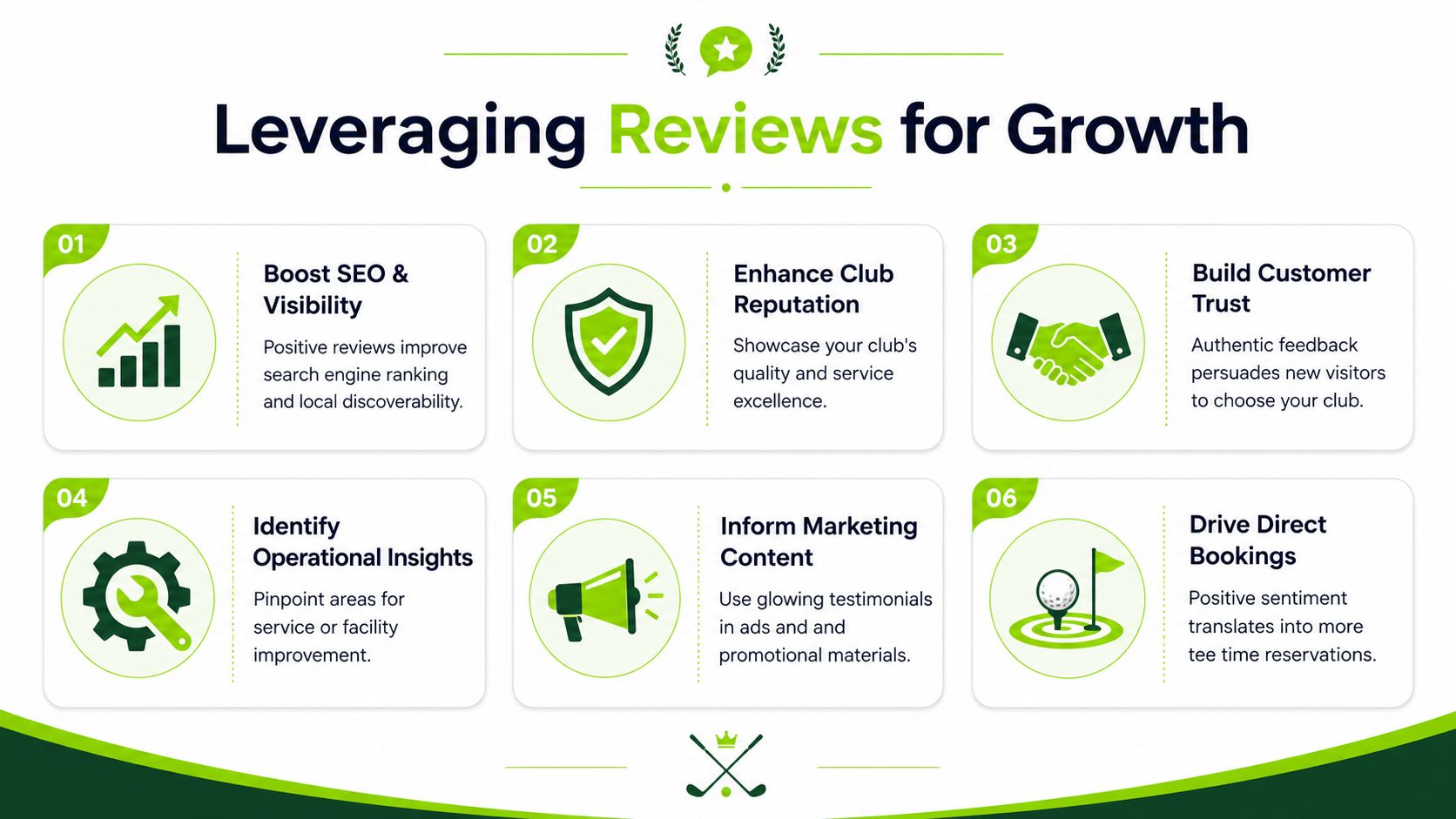
Once your club is collecting and managing reviews properly, the value goes beyond public perception. Reviews can support growth on two fronts at the same time. They help you persuade new prospects, and they help you spot internal issues earlier.
Most clubs only use one side of that equation.
Use your best reviews where buying decisions happen
If someone is considering membership or a visitor round, don't make them leave your site and search Google to find reassurance. Put selected review proof closer to the decision point.
That can include:
- Membership pages: Add recent review snippets that mention atmosphere, welcome, course condition, or value.
- Visitor pages: Use reviews that reference the full day experience, not just the course.
- Email follow-up: Include a short review quote in post-enquiry nurture messages.
- Sales packs and PDFs: Let the membership team use authentic customer language, not just club-written claims.
- Social content: Turn standout comments into simple graphics or posts, with permission where needed.
The point isn't decoration. It's reducing doubt at the moment someone is deciding whether to enquire, visit, or commit.
Review text tells you more than the average score
A significant opportunity is often missed by clubs. Review text can be more diagnostic than the average rating because complaints tend to cluster around repeat themes such as course presentation and hospitality, and a low score isn't always the underlying problem if maintenance messaging and response handling are poor, as discussed in this example of review pattern analysis around golf venue feedback.
That matches what many managers already suspect. Prospects don't read reviews like statisticians. They read for patterns.
If several people mention muddy tee boxes, tired bunkers, slow service in the bar, or a frosty welcome in the shop, that becomes the story. Even if the overall score looks acceptable, the text can still suppress conversion.
A club rarely loses trust because of one awkward comment. It loses trust when several reviews point in the same direction and nobody addresses the pattern.
Turn themes into management data
You don't need advanced software to start. A simple monthly review log can help if it's used consistently.
Track comments under headings such as:
| Theme | What to look for |
|---|---|
| Course condition | Greens, fairways, bunkers, drainage, tee boxes |
| Pace of play | Delays, spacing, marshalling, booking flow |
| Hospitality | Food, bar service, atmosphere, waiting times |
| Staff interaction | Welcome, helpfulness, professionalism |
| Value perception | Whether golfers feel the experience matched the price |
Once you can see recurring themes, you can act faster. That may mean fixing a service issue, tightening messaging around temporary maintenance, or giving the membership team better talking points during follow-up calls.
If your club wants to go further in interpreting feedback at scale, this overview of an AI strategy for SMB customer insights offers a useful lens for categorising sentiment and spotting repeated themes faster.
There is also a wider lesson here for clubs that want cleaner decision-making. Review analysis works best when it sits inside a broader data-driven golf marketing approach, where demand, feedback, and conversion are measured together rather than in separate silos.
Measuring What Matters and The Path Forward
A lot of clubs still measure review performance in a shallow way. They look at the star average, feel pleased or worried, and stop there.
That isn't enough if your goal is predictable growth.
England Golf reported that club membership in England reached a record 790,000 in 2024, which means more golfers are comparing clubs publicly and deciding whether the experience feels worth the price, as noted in England Golf's membership update on Instagram. In that environment, the useful question isn't just "What is our rating?" It's "Which review themes affect enquiry conversion and trial-round bookings?"
The KPIs that actually help
Track metrics that tell you whether your review system is helping commercial performance:
- Review volume trend: Are new reviews arriving consistently or in bursts?
- Response rate: Are you replying to the majority of reviews?
- Response speed: How quickly does the club acknowledge public feedback?
- Theme tracking: What are people repeatedly praising or criticising?
- Conversion correlation: Do stronger review periods align with more booked visits, better tour attendance, or cleaner enquiry-to-join movement?
That last point matters most. Reviews should not be managed in isolation. If the club gets more enquiries but the same old follow-up gaps remain, the result won't improve enough. Reviews support conversion, but they don't replace disciplined handling.
What mature clubs do differently
The strongest operators build one connected process.
They generate reviews from real customer moments, respond quickly, learn from recurring themes, and make sure the membership or visitor enquiry team can see the full picture. They don't leave feedback sitting in Google while the sales conversation happens elsewhere.
A useful internal check is to ask:
- Can we see review trends alongside enquiry quality?
- Do recurring complaints match what prospects ask on calls or visits?
- Are we using positive review language in our sales follow-up?
- Does someone own this process every week, not just when a bad review appears?
Golf club Google reviews become valuable when they're treated as an operating system, not a vanity metric. They help attract attention, shape trust, inform service decisions, and support the final step from interest to membership.
That is the path forward. Fewer manual gaps. More visibility. Better follow-up. Better conversion.
If your club wants a clearer system for turning reviews, enquiries, and follow-up into a more predictable membership pipeline, GolfRep helps golf clubs build the structure behind growth. That includes lead visibility, CRM-enabled follow-up, and conversion tracking so opportunities don't go missing after the first click.
Ready to tap into our proven growth system?