Golf Simulator Lead Generation: A Measurable Playbook

82% of traditional golfers in Britain and Ireland have already tried an alternative format, including simulators, pitch-and-putt and adventure golf, and 36% of people in England played one of those formats before they ever stood on a full course, according to BBC Sport. That split changes how a club should read a simulator enquiry. Plenty of the people booking a bay aren't members waiting for winter, and they aren't all ready for an annual subscription either.
Golf simulator lead generation works when every booking is treated as an intent-classified lead, then judged on cost per qualified opportunity and revenue per lead, not on how cheap the first contact looked. A busy Saturday bay can still be a weak commercial result if the people in it never come back, never take a lesson, and never visit the course. The job is to tag what each person wants, route them to the right next step, and only then decide whether more advertising spend is justified.
Map the Funnel From First Click to Recurring Revenue
England Golf reported 1,815 affiliated clubs and approximately 722,000 members in 2024, with more than 10.2 million scores submitted, the highest annual total recorded at that point, as covered by National Club Golfer. 43% of those scores came from social golf and nine-hole scores rose 17.89% year on year. The audience is large, and a lot of it isn't playing a conventional competition round. Size alone doesn't tell you who will buy a lesson, a league place or a membership.
Treat the funnel as a chain of stages you can count each week. The table below is the one I'd put in front of a committee before anyone argues about ad spend.
| Stage | Metric | How to Calculate | Common Distortion |
|---|---|---|---|
| Enquiry or booking | Leads captured by source | Count of unique contacts per source each week | Duplicate contacts across campaigns |
| Qualified lead | Leads with intent fields complete | Qualified leads divided by total leads | Forms that ask too many questions |
| Booked visit | Visits booked within 14 days | Booked visits divided by qualified leads | Slow first response lowering bookings |
| Second session | Second-session rate | Repeat customers divided by first-time customers | Single-use peak bookings masking weak off-peak demand |
| Membership or lesson sale | Conversions by source | Sales divided by booked visits | Long gaps between visit and offer |
| Cost per qualified opportunity | Spend per qualified lead | Total spend divided by qualified leads | Cheap leads that never qualify |
Why a cheap lead can still lose money
Say a campaign spends an illustrative £2,000 and returns 400 leads. Cost per lead is £5. If only 80 of those leads complete the intent fields you need, cost per qualified opportunity is £25. Those figures are illustrative, not a benchmark. A lead who never books is a cost, not a pipeline. A booked visit changes the picture only if you value it. Before you judge a campaign, price a booked visit at its average spend, for example an illustrative £40 of bay, food and lesson income. A qualified opportunity that costs more than that visit is worth has to earn its keep on a second session or a later sale.
Practical rule: Every lead needs a source, a venue and a session type tagged at the moment of capture, so each row in the table can be split by campaign.
The same discipline shows up outside golf. AdCrunch's SaaS advertising playbook is useful reading on why paid campaigns should be scored on qualified pipeline, not on the cheapest click. In a simulator business that means revenue per lead, split by the campaign that created the booking.
Match Each Segment to Its Offer and Budget
A simulator enquiry is not one membership lead wearing six different jumpers. England recorded 750,071 club members in 2025, up 2.66% year on year, while 72,921 people used the independent-golfer iGolf scheme, and World Handicap System scores reached 11.83 million, with nine-hole scores up 28% and general-play scores up 26%, as reported by Glenmuir. Nine-hole players, independents and social groups won't all respond to an annual-membership pitch.
Opinium research found that 35% of UK non-golfers would be more likely to try golf through a simulator first, and 67% of 18 to 34-year-olds see simulator use as a good social activity, against 55% of UK adults. Build the offer around that, not around a handicap conversation they haven't asked for.
| Segment | Typical Need | Entry Offer | Next Step |
|---|---|---|---|
| Non-golfers curious about golf | Low-commitment first experience | Beginner team session | Introductory coaching or club visit |
| Social groups and corporate teams | Evening entertainment and group pricing | Team challenge session | Repeat group booking or club event |
| Existing handicap golfers | Practice and course preparation | Performance session or league | Lesson or membership conversation |
| Nine-hole and flexible players | Short formats and low commitment | Nine-hole trial or flexible pass | Flexible membership option |
| Juniors and families | Youth and family coaching | Junior taster session | Junior or family membership |
| Independent golfers | Playing without a club membership | Pay-and-play booking | Visit or membership offer where relevant |
For a 12-bay venue, an illustrative week of 120 bookings might split as 30 non-golfers, 25 social groups, 20 handicap golfers, 20 nine-hole and flexible players, 15 juniors and families, and 10 independent golfers. Use your own diary, not this mix, when you set the budget.
Build one path per segment
- Create one campaign per segment. Give each its own landing page and booking link, so a beginner team session never shares a form with a performance league.
- Match the offer to a price you already charge. A team challenge at your evening rate beats a discount as the hook. Discounting trains the next booking to wait for a deal.
- Ask only what the next step needs. Golfer status, group size, preferred time, and interest in lessons versus social play are enough to route the lead. Coaching offers belong on the lesson path, which is why how clubs market simulator lessons is a separate job from filling social bays.
- Split the budget and wait four weeks. Review cost per qualified opportunity by segment. Scale a campaign only when that cost sits below the value of a booked visit. If the beginner campaign qualifies cheaply but never books a second session, fix the follow-up before you buy more of those clicks.
Capture Intent and Qualify Leads at Booking
The form decides what the club knows later. A booking that only holds a name and a time slot can't be routed. A booking that holds intent can.
Keep it to six questions before the slot is confirmed. Extra fields cut completion, and you can collect the rest after the first session.
- Golfer status: Non-golfer, beginner, social, handicap golfer, independent, or junior or parent. This chooses the journey.
- Group size: One person and a party of eight need different staffing, pricing and follow-up.
- Preferred day and time: Evening and weekend demand is where bays fill, so this protects the diary.
- Lessons or social play: The answer decides whether the next conversation is coaching or another group booking.
- Played a full course before: Beginners go toward an introduction. Course golfers can go toward practice, a league or a visit.
- Source tag: Campaign, referral or walk-in, stored automatically so you aren't asking the guest to remember an advert.
Two bookings for the same Saturday 7pm bay can be completely different leads. One is a beginner in a group of four who ticked lessons. They should hear from the professional, with a short intro package and a suggested lesson time, not a membership brochure. The other is a handicap golfer who wants a league. They should get the next league date, the weekly slot, and a note on how scoring works. Same bay, same hour, two owners, two offers.
Name one person for every new lead, and make sure that person sees any lead flagged for coaching or membership interest on the same day.
Add a separate marketing consent tick box, distinct from the booking terms. The later nurture sequence only runs where that consent is recorded under UK GDPR and PECR. If your club hosts overseas visitors or a sister site abroad, multilingual forms for global audiences are worth a look so the same six questions stay clear in more than one language. A form people abandon teaches you nothing.
Automate First Response Without Losing the Personal Touch
A simulator enquiry that arrives during a busy evening can sit unanswered while the team is helping guests. Speed matters, but a fast reply should also give the golfer a useful next step. GolfRep uses AI-powered automations to follow up, qualify and engage leads 24/7.
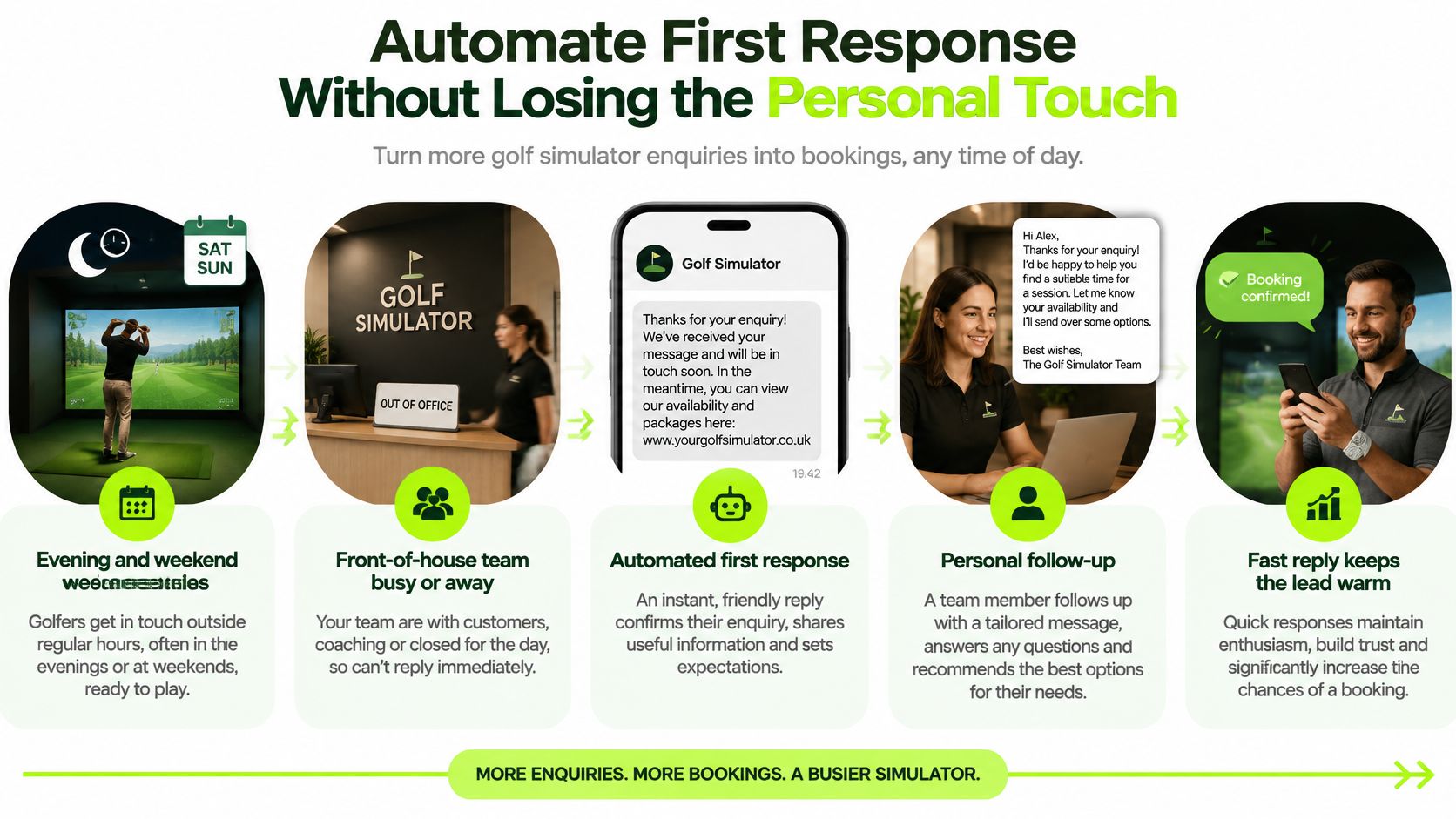
| Stage | Timing | Message | Purpose |
|---|---|---|---|
| First touch | Within minutes of enquiry | Acknowledge the enquiry and name the next step | Confirms receipt and shows the club responds |
| Same-day follow-up | Same day, during opening hours | Offer two specific times to book | Moves the lead from interest to a booked session |
| Final nudge | Two to three days after enquiry if not booked | Invite a visit, tour or call | Gives a clear, low-pressure last step |
Where the machine stops
Automation can confirm a slot, send a reminder and route a lead based on form answers. A person should handle questions that need judgement, such as lesson options, league rules or a membership visit. Route any reply that mentions these interests to a named team member for same-day follow-up.
GolfRep's internal data shows that AI-driven follow-ups are associated with a shorter conversion lag and a higher membership sign-up rate. Set a target for your own enquiry-to-booking lag, then report time from enquiry to first touch each week.
Phone enquiries need the same discipline. If the desk misses a call during a busy session, manage unanswered business calls with SnapDial so the caller receives a text rather than waiting for a voicemail to be checked. Staff can then make the personal follow-up, with a clear record of who needs to respond.
Nurture Toward Repeat Sessions, Leagues and Membership
The second session is where a simulator lead becomes recurring revenue. A Golf Genius study reported by The Herald mapped 2,683 venues and 9,580 bays across 12 countries, including the UK and Ireland. Within those venues, 58% offered memberships and 32% ran leagues, with demand concentrated in evenings and weekends. Recurring products are already normal in mature venues. A one-off bay hire doesn't have to be the end of the relationship.
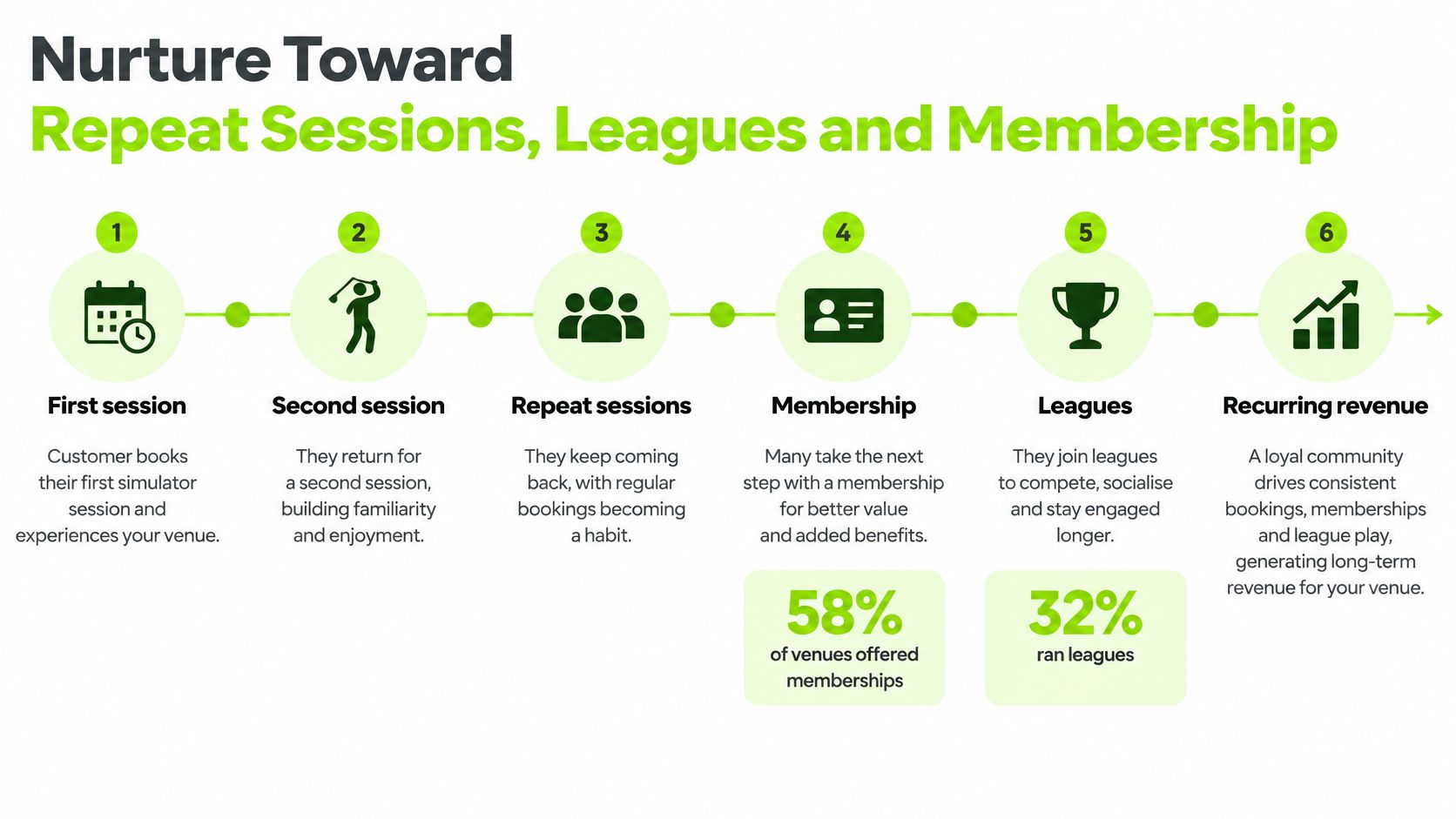
Our nurture system builds trust, sends the reminders, and keeps the club in mind so the team only speaks to people who are warm. Run it for about 60 days from the first session, and only for people who opted in. Don't repeat the pre-booking messages. Those already sit in the first-response rhythm.
A timeline that starts after they play
- Within 24 hours of the first session: A short note with one coaching or practice recommendation tied to what they booked. Metric: reply rate and lesson enquiries, not opens.
- About a week later: A league or group invitation with the next dated event. Metric: league sign-ups from that cohort.
- Off-peak offer: A weekday slot matched to the day they already preferred. Metric: off-peak occupancy from nurtured leads.
- After two completed sessions: An invitation to look at a membership or a flexible pass, with a visit if the course is part of the offer. Metric: second-session rate, then conversion from that second session.
Say a group of four books one Friday challenge. One player replies to the next-day note, joins a midweek league a fortnight later, and after two league nights takes a flexible pass because the annual category felt too heavy. That path is worth more than four cheap first bookings that never return. Watch second-session rate and off-peak occupancy. Open rates won't tell you if the bay is earning.
Stop the sequence the moment someone books the next step, asks for a person, or unsubscribes. For the longer job of keeping those players, indoor golf customer retention is the operational piece that sits behind this timeline.
Confirm the Bottleneck Before Adding Budget
A venue can be excellent at taking bookings and still weak at bringing people back. A 2026 analysis of UK and international simulator venues, set out in our indoor golf facility business plan, found that 73% had booking infrastructure, only 11% had a recorded competition or league platform, and just 0.5% had a CRM or app. Average off-peak utilisation was approximately 20%. More ads on top of that pattern fill Friday night and leave Tuesday empty.
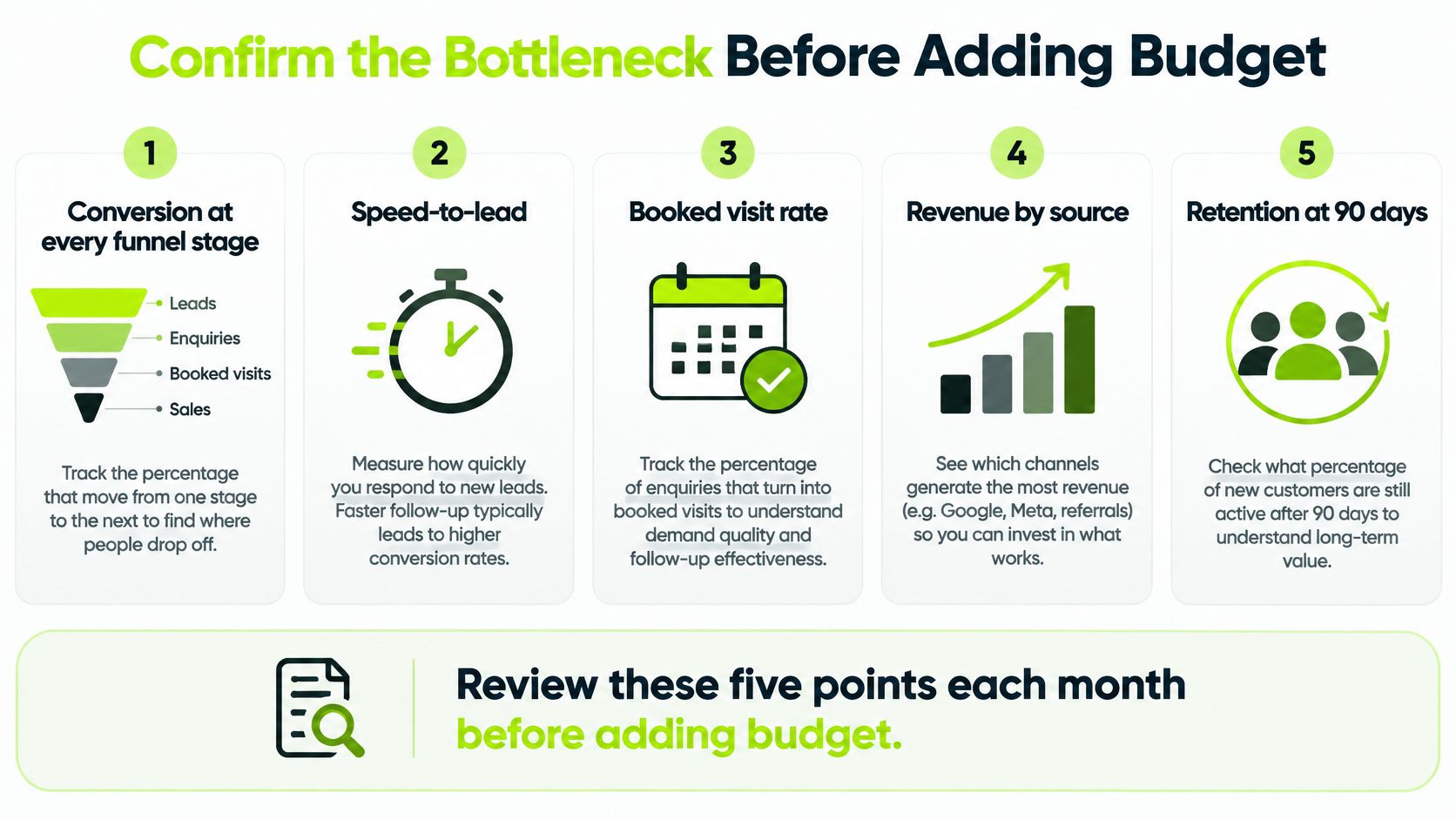
We ask clubs to review five points every month before anyone adds budget: conversion at every funnel stage, speed-to-lead, booked visit rate, revenue by source, and retention at 90 days. Lead generation tracking is how you keep those five honest, rather than arguing from a single cost-per-lead screenshot.
An illustrative quarter
Take an illustrative quarter of 300 enquiries, 90 qualified, 54 booked visits, 20 second sessions and 4 flexible memberships. Stage rates are 30%, 60%, 37% and 20%. The lowest rate sits at the membership step, not at the top of the funnel. The first fix is the timing and the terms of the flexible offer, not another £2,000 of ads. Change that step, then measure the next quarter before you touch anything else.
Fix the lowest stage first, measure the impact, then move to the next constraint.
List last quarter's funnel numbers, mark the weakest stage, and set it against the venue's own targets. If a second view on that constraint would help, we can review the pipeline with you.
GolfRep works with golf clubs and indoor venues on acquisition, follow-up, conversion and recurring revenue, so simulator demand is classified by intent and judged on qualified opportunity rather than cheap leads. If you want that pipeline mapped against your own bays, talk to GolfRep.
Ready to tap into our proven growth system?