Golf Club Lapsed Member Win Back: A Step-by-Step Guide

In the 2022 Hillier Hopkins Members' and Proprietary Golf Clubs Survey, members' clubs reported an average of 48 leavers per club, up from 35 in 2021, a 37% rise. Average new-member acquisition fell to 70 in 2022, from more than 90 in both 2020 and 2021. 23% of members' clubs recorded more leavers than joiners that year. No clubs had reported that imbalance in 2021.
The same survey found that 52% of clubs still had waiting lists, with an average of 61 people waiting. Demand had not vanished. Individual members had. A golf club lapsed member win back only works when the recorded reason for leaving decides who is called, what is said, and whether any offer is made at all.
Why Lapsed Members Deserve a Proper Plan
The Hillier Hopkins 2024/25 survey recorded an average of 63 leavers per members' club in 2024, up from 56 in 2023. 22% of members' clubs had more leavers than joiners. An average of 21 members per club moved from the waiting list into membership at the last renewal. These are industry figures for the market as a whole. They are not a target win-back rate for your club.
For this process, a lapsed member is someone who resigned or stopped renewing within the last 12 to 24 months. They already know the course, the members and the fee. Many left for a reason the club can still address: time, health, family, a winter they couldn't play, or a subscription they never saw explained.
A former member with a reversible reason is usually easier and cheaper to reach than a cold prospect, provided the contact is personal and prompt. Calling every name on an old export burns the same secretary hours and annoys people who moved away.
If you track lifecycle KPIs that matter, leavers, reactivations and play after return sit beside joiners instead of in a side spreadsheet. You should leave this with four working pieces: a list sorted by exit reason, a contact sequence, rules for offers, and a monthly read of results.
Sort Lapsed Members by Why They Left
| Exit reason | Signal in the records | Response route | First contact |
|---|---|---|---|
| Lack of time | Weekly play drops to monthly, then stops | Structured playing plan with weekday or twilight access | Personal call within 30 days |
| Injury, illness or family commitments | Sudden stop, often mid-season | Temporary pause or flexible return route | Short personal note, check-in at 90 days |
| Cost or value for money | Downgrade in category before lapse, low rounds | Playing-value conversation and fee explanation | Call from the manager or secretary |
| Course or tee-time access | Booking complaints or competition frustration logged | Service-recovery conversation and visible access changes | Manager-led call |
| Relocation or unresolved complaint | Address change, or open complaint on file | Suppress from win-back until any complaint is resolved | None unless the complaint is closed |
| Reason unknown | No exit reason recorded | One diagnostic question, then route to a segment above | Call with one question |

Read each row as a filter, not a personality type. A drop from weekly medals to one round a month points to time. A clean stop in April, with no complaint on file, points to health or family. A category downgrade plus thin rounds points to value. Logged booking rows point to access. An address outside your catchment, or an open complaint, means you do not sell. You either stay quiet or you close the complaint first.
In Golfshake's 2023 membership survey of 4,000 golfers, 10% said they had stopped their golf-club membership in 2023. The most common reasons included lack of time, membership cost, perceived value for money and injury. 50% of non-club golfers had previously been members, yet only 23% of former members said they had been asked why they left. Without that answer, the later message is generic.
We recommend logging lost reasons so the club can see whether price is a messaging problem, a weak tour or member experience is an operational problem, and inconsistent follow-up is a process problem. The same discipline helps with people who have not left yet. In the 2025 Golfshake survey of more than 2,500 golfers, 77% planned to renew, 4% said they would not, and 19% were undecided. That undecided group is where a renewal conversation beats a win-back months later. How golf club churn builds is a separate question from who you call this month.
What to capture before anyone dials
Rank the file before the first call. Put high historic usage, strong social ties and a clear reversible reason at the top. Push relocation and open complaints to the bottom.
- Date and tenure: When they resigned, and how many seasons they held.
- Category and rounds: Last category, and rounds in the final year.
- Stated reason: Their words, not a staff guess.
- Open complaint: Yes or no, and whether it is closed.
When staff time is short, work down that ranked list. Do not start with the easiest phone numbers.
Return Offers That Fit Each Lapse Reason
The offer has to remove the reason they left. Use the response route for that row, and do not invent a second incentive because the call feels awkward.
Say a 62-year-old played weekly until March, then stopped after a knee operation. She needs a temporary pause that keeps her place and handicap history, plus a date to review. A discount does not put her back on the tee. A member who left after repeated booking complaints needs a service-recovery meeting that shows what changed in tee-time access. Make that change visible before you mention money.
Time-short members need a structured playing plan built on the weekday or twilight slots they can use. Name the competitions, roll-ups or nine-hole options that fit that pattern. A full-seven-day sales pitch repeats the problem.
For cost or value, explain what the fee covers and what their own pattern of play cost them per round. Then stop and listen. Only offer a price concession when the records and the conversation both show affordability is the constraint. National Club Golfer's look at membership decisions found course quality selected by 55%, value for money and tee-time availability by 39% each, and price by 22%. Price is in the mix. It is not the first lever.
Practical rule: A blanket discount trains former members to wait for a concession, feels unfair to people who stayed, and hides the service failure that caused the lapse.
Record every offer against its exit reason. Later checkpoints only mean something if you can see which remedy belonged to which segment. Wider membership offer design still matters for people who have never joined. It should not override the exit reason on a win-back call.
How to Run the Win-Back Contact Sequence
England Golf notes that converting a new member into a retained member is, on average, a three-year process. Win-back copy should reconnect someone with that club journey. It should not open with a price.
The six steps
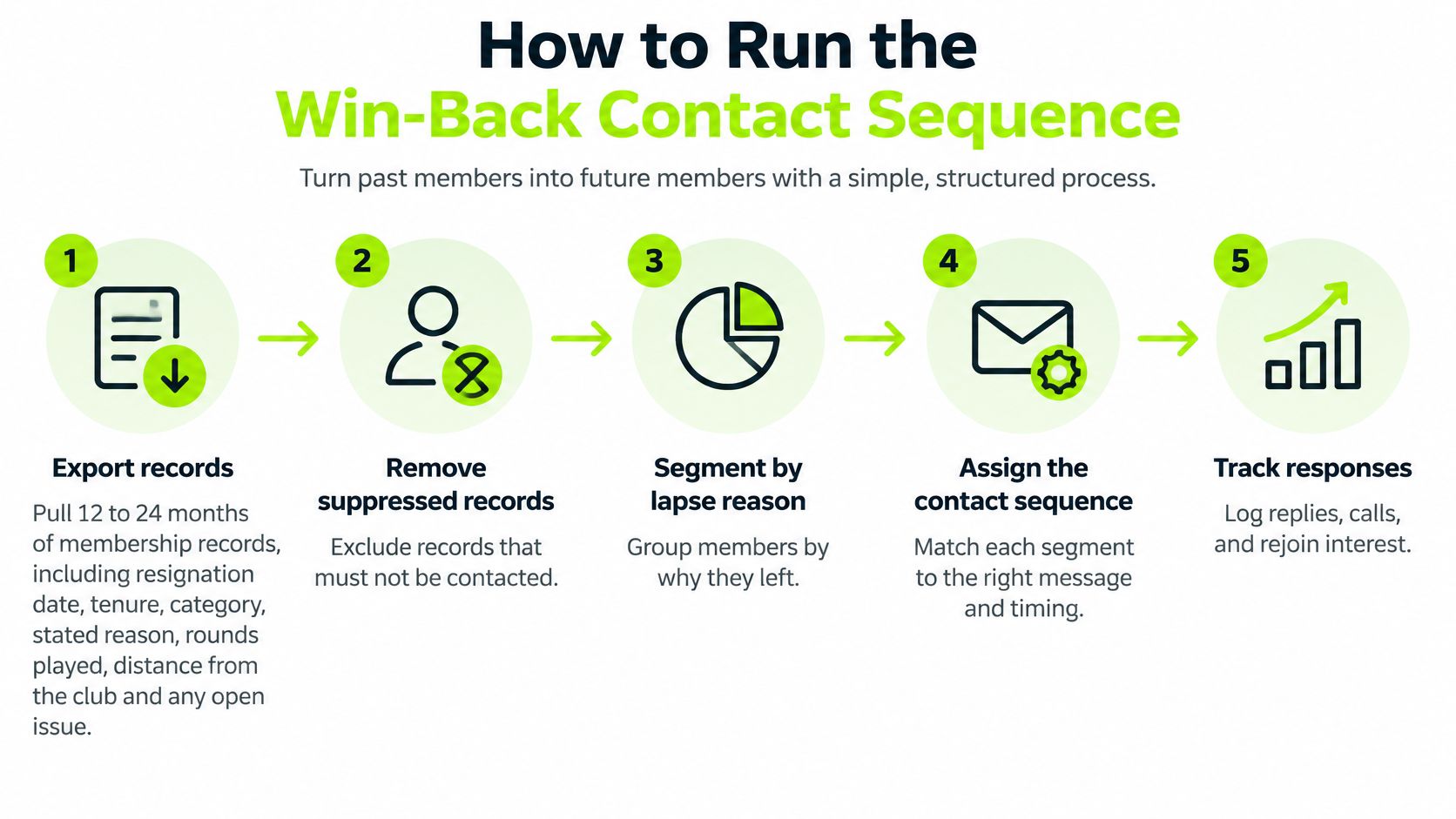
- Export the previous 12 to 24 months of membership records. Include resignation date, tenure, category, stated reason, rounds played, distance from the club and any open issue.
- Remove suppressed records: relocation, unresolved complaints, and anyone who has asked not to be contacted. Confirm the lawful basis for each contact with the club's data protection adviser before any bulk email. Validate emails before reactivating users so bounced addresses do not sit in the send.
- Phone first. The manager, secretary or PGA professional asks one diagnostic question: “What made you stop playing here?” If they give no reason, follow with: “Would a different arrangement have kept you?”
- Within two working days, send one personal email that refers to the call and offers one remedy. A usable opening is: “Thank you for talking to me about your winter schedule. Here is the flexible return option we discussed.”
- Invite a low-friction visit: a hosted round, a social afternoon or a short course walk. Do not book a sales meeting as the first step back.
- If there is no reply, move to the checkpoint timing below. Stop the sequence the moment someone asks you to.
Slips that waste the list
Emailing before the call, a generic “we miss you”, and a fourth nudge all train people to ignore the club. Contacting someone who opted out is not a commercial shortcut.
Keep the sequence owned by a named person, and let automated follow-up handle only the dated reminders after a human has spoken. Automation does not choose the remedy. The exit reason does.
Checkpoints and Measures That Show Results
| Checkpoint | Action | Measure to record |
|---|---|---|
| 30 days after lapse | Personal call and tailored email | Contacted-to-conversation rate by segment |
| 90 days after lapse | Visit, hosted round or short course walk invitation | Conversation-to-visit rate and visit uptake |
| 180 days after lapse | Rejoin offer review and reason re-check for non-responders | Visit-to-rejoin rate and reacquisition cost |
| 90 days after rejoining | Retention and activity check | 90-day post-rejoin retention, rounds played and competition entries |
Read the rates in order. A weak contacted-to-conversation rate means the call list or the opener is wrong. A decent conversation rate with a poor visit rate means the invitation is too heavy. A visit that does not rejoin means the remedy did not match the reason.
Reacquisition cost is total win-back spend divided by members who rejoin. Include staff time at an agreed hourly rate and any offer cost. If two people spend 20 hours a month on calls, that time belongs in the cost of every rejoin that month, not in “free” secretary work.
Hold back a random sample who receive only the normal renewal note. Compare their rejoin rate with the sequenced group before you tell the committee the programme worked. Small counts mislead. Wait for a full pass of the checkpoints before you change the offer.
After someone rejoins, the join itself is not the result. Log rounds, competition entries, guest bookings and referrals. We recommend clubs review stage-by-stage conversion, speed-to-lead, visit-to-join performance, source-level revenue, and retention at the 90-day mark. On a win-back file, that means one change at a time: the script, the visit, or the offer, never all three.
Report monthly to the committee or management team: leavers, joiners, reactivated members, and the stated reason for departure by category. That is the view that shows whether reactivation is shrinking the net loss.
Start Building Your Lapsed Member List
In the first month, do four things and stop there.
Run the export and count how many records carry a usable exit reason. If most are blank, add a required reason on the cancellation form and use the one-question call before you scale anything. Choose two segments to test, usually time-short members and the injury or family group, because a playing plan and a pause are the simplest remedies to deliver. Name one owner per contact: the manager for service recovery, the secretary or PGA professional for playing plans. Fix a single 90-day review date and agree the three measures that will decide whether you continue: conversation rate, visit rate, and 90-day retention after rejoin.
Only contact people who pass the suppression check. Protect sender reputation with permission before any wider email, or the club's ordinary renewal notes start landing in junk.
We provide a system, strategy and partnership for clubs that want to grow membership, increase enquiries or stabilise retention, including the path from first lapse through rejoin. The commercial test is simple.
The reason for leaving decides the message, and the message decides the offer.
GolfRep works with UK clubs on acquisition, CRM, conversion and retention, including a lapsed-member process built from the exit reason rather than a blanket discount. If you want a clear view of where membership leakage sits in your own numbers, start with GolfRep.
Ready to tap into our proven growth system?