Golf Simulator Lessons Marketing: How to Fill Quiet Bays
Average off-peak simulator utilisation was only about 20% in the multi-country industry report covered by The Golf Business, which mapped 2,683 venues and 9,580 bays across 12 countries, including the UK and Ireland. For a commercial manager, that makes the question less about installing impressive technology and more about giving golfers a reason to return to it.
At GolfRep, our approach to golf simulator lessons marketing is to treat the first lesson as the start of a commercially worthwhile routine. Judge the offer by attended lessons, repeat participation and revenue per bay-hour, not by how many enquiries an advert generates alone.
Why Simulator Lessons Need Their Own Marketing Plan
The same industry report put average simulator-bay pricing at approximately £21 per hour, with demand concentrated in evenings and weekends. It also found that 58% of venues offered memberships, but only 32% operated a league. Those are cross-market figures rather than UK-only benchmarks, but they make a useful distinction between selling access and organising repeat participation.
Bay hire is a single ticket. A coaching programme is closer to a season ticket. The first sells time in front of a screen; the second sells a reason to return, a progression plan and an ongoing relationship with a professional.
That changes the marketing job. An empty-bay photograph and a booking button can explain availability. They don't explain why a returning golfer should work on their strike, what a beginner will learn or how an assessment leads to better practice.
Sell an outcome, not equipment access
Build each campaign around a problem the coach can address. That might be inconsistent iron distances, uncertainty about getting back onto a course or not knowing how to start.
- Show the experience: Film the professional explaining a result in everyday language, with the golfer's permission.
- Explain the first visit: State what to bring, whether clubs are available and what happens during the session.
- Make progression visible: Show the relationship between the assessment, practice and the next coached session.
For practical production ideas, revid.ai's guide to boost sales with video content is useful background. Apply it to showing instruction and reassurance, rather than producing another simulator equipment showcase.
Commercial rule: Don't replace profitable peak-time hire with coaching merely because the lesson has a higher headline price. Compare what the facility retains after the professional's payment and delivery costs.
A separate lesson plan should therefore identify the audience, the outcome, the available teaching capacity and the next bookable product. Lessons booked, lessons attended and repeat sessions belong alongside bay bookings in the commercial report.
Mapping Golfer Groups to the Right Lesson Format
Golfer groups, lesson formats and next steps
| Golfer group | Main goal | Lesson format | Core message | Next step |
|---|---|---|---|---|
| Beginners new to golf | Build confidence and basic technique | Suggested pathway: 20-minute warm-up, then a one-hour one-to-one lesson | No handicap needed and no pressure | Book a second lesson or small group session |
| Lapsed or returning golfers | Rebuild swing and course confidence | Suggested pathway: one-hour coaching, then a two-hour on-course playing lesson | Get back on the course with a plan | Book a nine-hole preparation session or club trial |
| Performance-minded golfers | Improve distance and consistency | Sixty-minute launch monitor lesson or gap test | Measured data on every shot | Suggested coaching block of three to four sessions |
| Independent golfers who play off-course | Practise accessibly and prepare for play | Flexible evening session or structured practice slot | Fits around work and family life | Repeat session or membership enquiry |
| Social groups, friends and societies | Shared practice and fun | Group bay with optional coaching for one player | Good value per person for a group | Repeat group session or coached follow-up |
These are suggested customer pathways, not promises that every facility should deliver identical packages. Before advertising them, confirm instructor availability, equipment provision and what each session includes.
BBC Sport reported that 82% of traditional golfers in Britain and Ireland had tried an alternative format, while England data indicated that 36% of people trying those formats did so before experiencing a golf course. A beginner and an established golfer can therefore arrive through the same simulator door with very different expectations.
Separate intent before choosing the message
England Golf figures reported by National Club Golfer showed 5.3 million adults in England playing an off-course format during the previous 12 months, alongside 7.3 million playing on a nine- or eighteen-hole course. Don't add those audiences together or assume they're separate groups.
The practical opportunity is to offer a bridge between formats. An independent golfer might welcome course preparation without wanting a membership conversation immediately.
Record the reason for booking as lesson, practice, social use, junior coaching or club fitting. Keep that separate from skill level: a capable player booking a social visit isn't necessarily shopping for technical instruction.
Our guidance on golf coaching courses provides a useful companion when shaping the coached pathway. Start with two target groups, selected against the gaps in your bay calendar, rather than launching every offer together.
A weekday daytime gap requires an audience that can attend then. A compelling campaign aimed at golfers who are working during that window won't solve the capacity problem.
Pricing a Lesson Ladder Customers Can Climb
Published UK simulator lesson and hire examples
| Offer | Format | Published UK example | Best for |
|---|---|---|---|
| Warm-up taster | 20 minutes per person | £6 per person, Bulbury Woods | Beginners and first-time visitors |
| Standard coaching | One hour one-to-one | £60, North West Indoor Golf | Improvers wanting a clear plan |
| Extended coaching | Two hours one-to-one | £110, North West Indoor Golf | Players working on technique |
| Performance lesson | 60 minutes on a launch monitor | £60 TrackMan lesson, Cotswolds Club | Performance golfers wanting data |
| Gap test | 60 minutes | £40, Cotswolds Club | Golfers checking clubs or yardages |
| Long-drive lesson | 90 minutes | £100, North West Indoor Golf | Distance-focused golfers |
| On-course playing lesson | Two hours | £90, North West Indoor Golf | Returning golfers preparing for the course |
| Simulator hire, peak | Per hour | £35 during its stated peak period, Cotswolds Club | Practice sessions |
| Simulator hire, after 2pm | Per hour | £40, Cotswolds Club | Practice and social sessions |
| Group hire, up to three players | Per hour | £15 for one, £10 each for two, £7.50 each for three, Bulbury Woods | Friends and social groups |
| Group hire, up to four players | Per hour | £20 for one, £15 each for two, £12 each for three, £10 each for four, Hurtmore Golf | Friends, families and societies |
These are advertised examples, not recommended prices. North West Indoor Golf publishes the standard, extended, long-drive and on-course coaching prices shown above; the other facility examples distinguish coaching from self-directed hire.
Calculate the bay yield before setting the offer
Using the published group rates in the table, Hurtmore's hourly booking totals are £20, £30, £36 and £40 as the group grows from one player to four. A full group therefore produces twice the gross bay revenue of a solo booking, despite the lower individual price.
Bulbury's equivalent totals are £15, £20 and £22.50. Those calculations illustrate why the booking page must distinguish per-person price from total booking value.
A cheaper price per player doesn't necessarily mean a lower-yielding bay. Equally, a higher lesson price doesn't necessarily mean more retained income.
Calculate revenue per bay-hour as session revenue divided by occupied bay hours. Then compare contribution after coaching payments, payment charges and other variable delivery costs. Our guide to golf simulator bay pricing develops that pricing decision.
Reduce commitment without discounting the full lesson
England's 2025 score figures, reported by Glenmuir, showed nine-hole submissions rising 28%, compared with 14% for eighteen-hole scores. That isn't proof of demand for short simulator lessons, but it gives a sensible reason to test a lower-commitment entry product.
Consider a 30-minute assessment or course-preparation session as a test offer. Sell a narrower outcome, not the full lesson at a reduced price.
Give each rung its own booking option, qualification question and defined next step. Bragly's guidance on reducing hesitation on ecommerce product pages offers relevant principles: explain inclusions, answer practical objections and use genuine customer feedback rather than unsupported improvement promises.
Tracking Each Stage From Advert to Membership Enquiry
Track the journey as advert response → assessment booking → attended lesson → repeat lesson or package → membership or course enquiry. Keep separate records for booking and attendance, because paying for a session and turning up aren't the same commercial event.
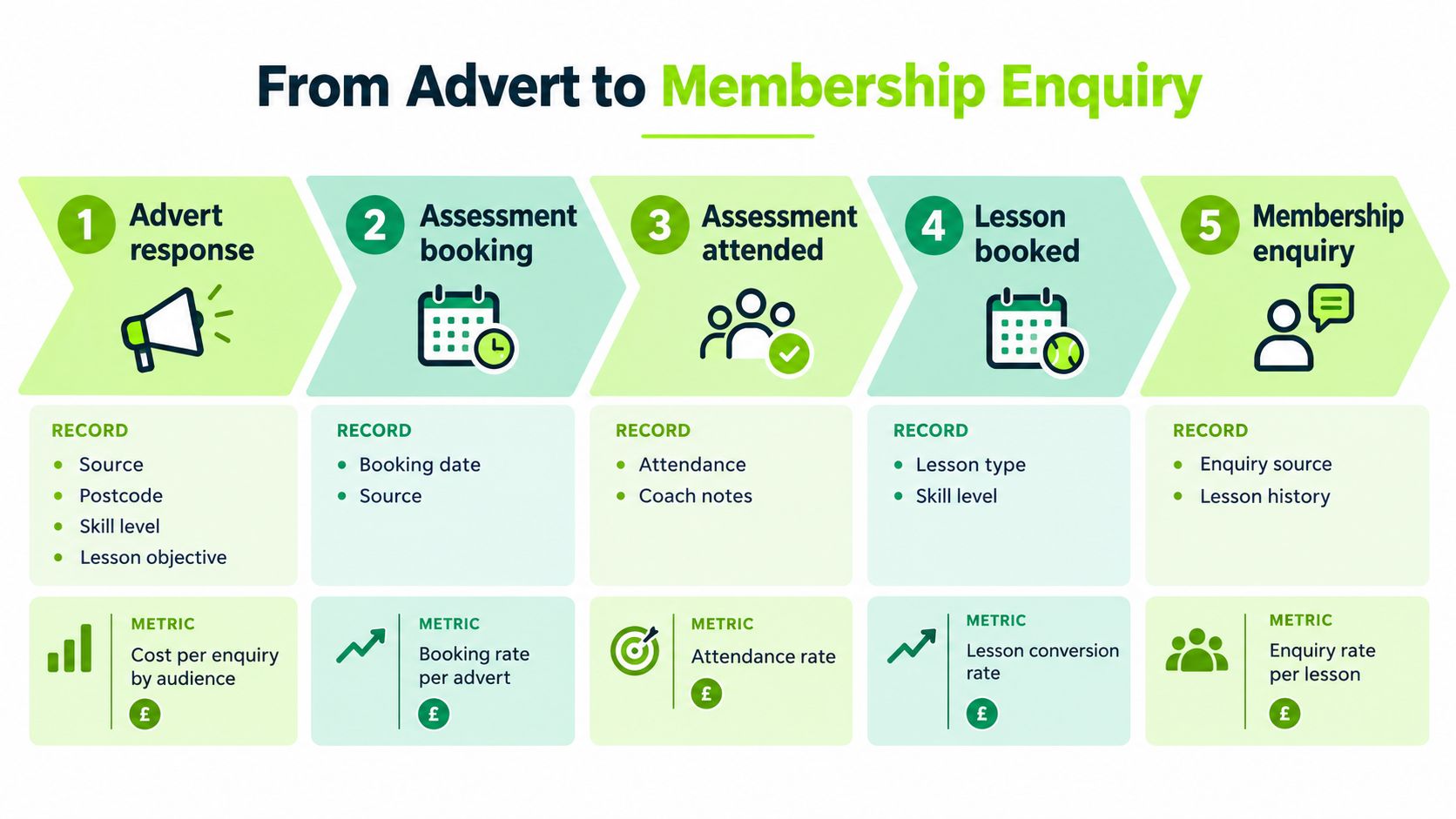
Lesson funnel stages, records and metrics
| Stage | Record at this stage | Metric |
|---|---|---|
| Advert response | Source, postcode, skill level, lesson objective | Cost per enquiry by audience |
| Assessment booking | Booking route and offer chosen | Booking rate from enquiry |
| Attended lesson | Attendance and no-shows | Attendance rate |
| Repeat lesson or package | Session count and days to next booking | Repeat rate within a chosen 90-day reporting window |
| Membership or course enquiry | Enquiry source and stated intent | Enquiry rate among repeat customers |
PGA Play figures reported by Golf Business News identified more than 1.5 million annual UK searches for terms such as golf lessons near me and golf coach; 74% of respondents booked a lesson after using the platform, 70% chose one-to-one lessons, 25% booked a series, and 73% were beginners, defined as having no handicap or a handicap of twenty or above.
Those figures establish context, not targets for your advertising account. Platform users and respondents aren't interchangeable with everyone who clicks a local advert.
Make the records commercially useful
At advert response, retain the campaign source against the individual customer. A postcode helps assess whether you're attracting golfers within a realistic travelling distance; the lesson objective tells the coach what the person expects.
At booking, record which offer they selected and whether they booked directly or needed staff assistance. At attendance, mark cancellations and no-shows separately so you don't mistake a scheduling problem for poor demand.
For repeat business, record both the purchase and the delivered session. A prepaid package creates a commitment, but it doesn't prove that the golfer has established a practice routine.
Use separate conversion events in your booking system and CRM. Keywordme's guide to track conversions to optimize ad campaigns explains the advertising mechanics, while our guide to measuring marketing effectiveness supports the wider commercial assessment.
Read the constraint, not just the cheapest lead
Use your first sixty days as a proposed baseline-building period, rather than copying external conversion targets. Compare like-for-like audiences and allow each customer cohort enough time to return.
- Insufficient responses: Check local reach, channel choice and whether the outcome is compelling.
- Weak booking progression: Investigate price clarity, availability and the booking journey.
- Poor attendance: Examine reminders, directions and cancellation reasons.
- Few repeat sessions: Review the coaching experience and whether the next lesson has a clear purpose.
The largest meaningful drop between stages tells you where to investigate first. A low cost per enquiry is useful only when those enquiries become commercially worthwhile customers.
How to Build a Repeat Lesson Routine for Quiet Periods
Build the programme around a recurring space in the diary, not whichever bay happens to be free. Protect enough instructor time to deliver the session and record the outcome properly.
The warm-up and group-hire formats advertised by Bulbury Woods illustrate distinct entry routes: a visitor can arrive for brief preparation or shared practice without initially buying coaching. Keep those purposes visible in the customer record rather than treating every booking as a lesson prospect.
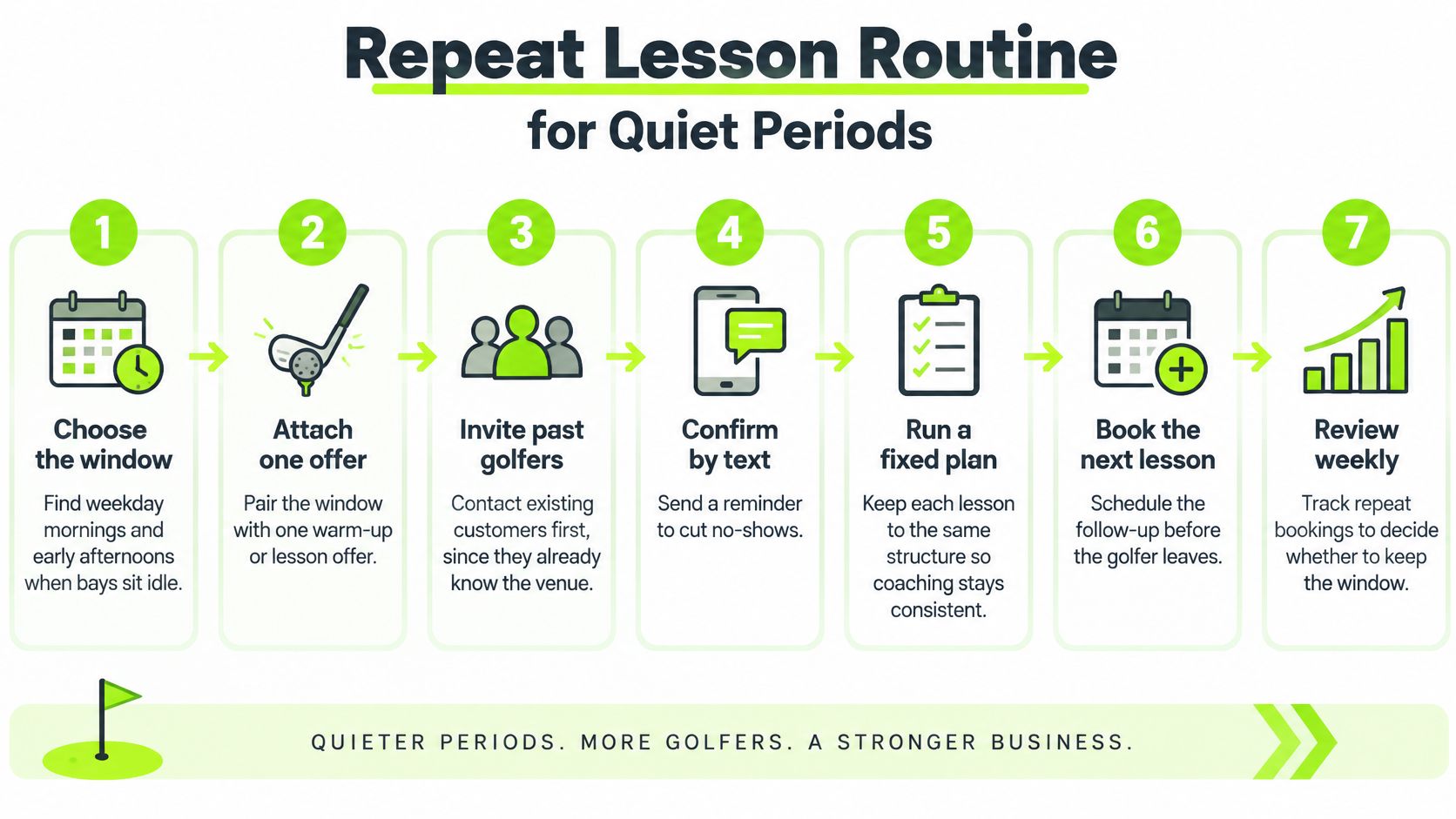
A seven-step operating routine
Choose the window. Find weekday mornings or early afternoons where your own booking history shows spare capacity. Attach a warm-up or lesson offer only where both the bay and the professional are available.
Message a single segment. Use the relevant part of your existing database and suitable local channels. Keeping the audience narrow makes it easier to understand whether the message suits that group.
Capture details per player. Record player numbers, objective, skill level and preferred time. For groups, don't leave every participant hidden behind the organiser's record; invite individual contact details and respect each person's marketing preferences.
Automate administration, not judgement. Send a same-day acknowledgement, a pre-session reminder and a next-booking prompt. GolfRep advises keeping membership fit, course discussions and specific concerns with a person; instructor suitability and coaching anxieties deserve the same treatment.
Send a useful results summary. Include a measurable target, such as carry distance or a yardage gap, plus a practice task. For a beginner, the target should suit their stage rather than overwhelm them with launch-monitor measurements.
Make a timely next-step invitation. As a working routine, offer the follow-on within a week. That could be a proposed three-lesson block or shared practice session, with a direct booking option rather than an instruction to telephone reception again.
Review a mature cohort. At your proposed ninety-day review, compare repeat participation by segment and offer. Keep weekly operational checks, but don't judge a recently acquired golfer against someone who's had a full reporting window to return.
Put ownership into the weekly calendar
Use a shared calendar with fields for quiet slot, bay, instructor, offer, audience and named follow-up owner. Add a delivery note showing whether the results summary and next-step invitation were completed.
Management check: If nobody owns the next action, the programme depends on whoever remembers it between lessons.
The professional should own coaching advice. Reception or the commercial team can own booking administration, with a clear handover when the golfer asks something they can't answer.
Run a Thirty-Day Pilot Before Scaling Your Spend
Use a thirty-day pilot as a proposed test period, not as a promise that repeat revenue will be proven within a month. Choose a golfer group, lesson offer, channel and quiet window, then agree a fixed spending limit and weekly review.
The existing database or a Google Business Profile listing can provide a manageable starting channel. If you use paid advertising instead, keep the offer and audience sufficiently focused that you can explain what the campaign is testing.
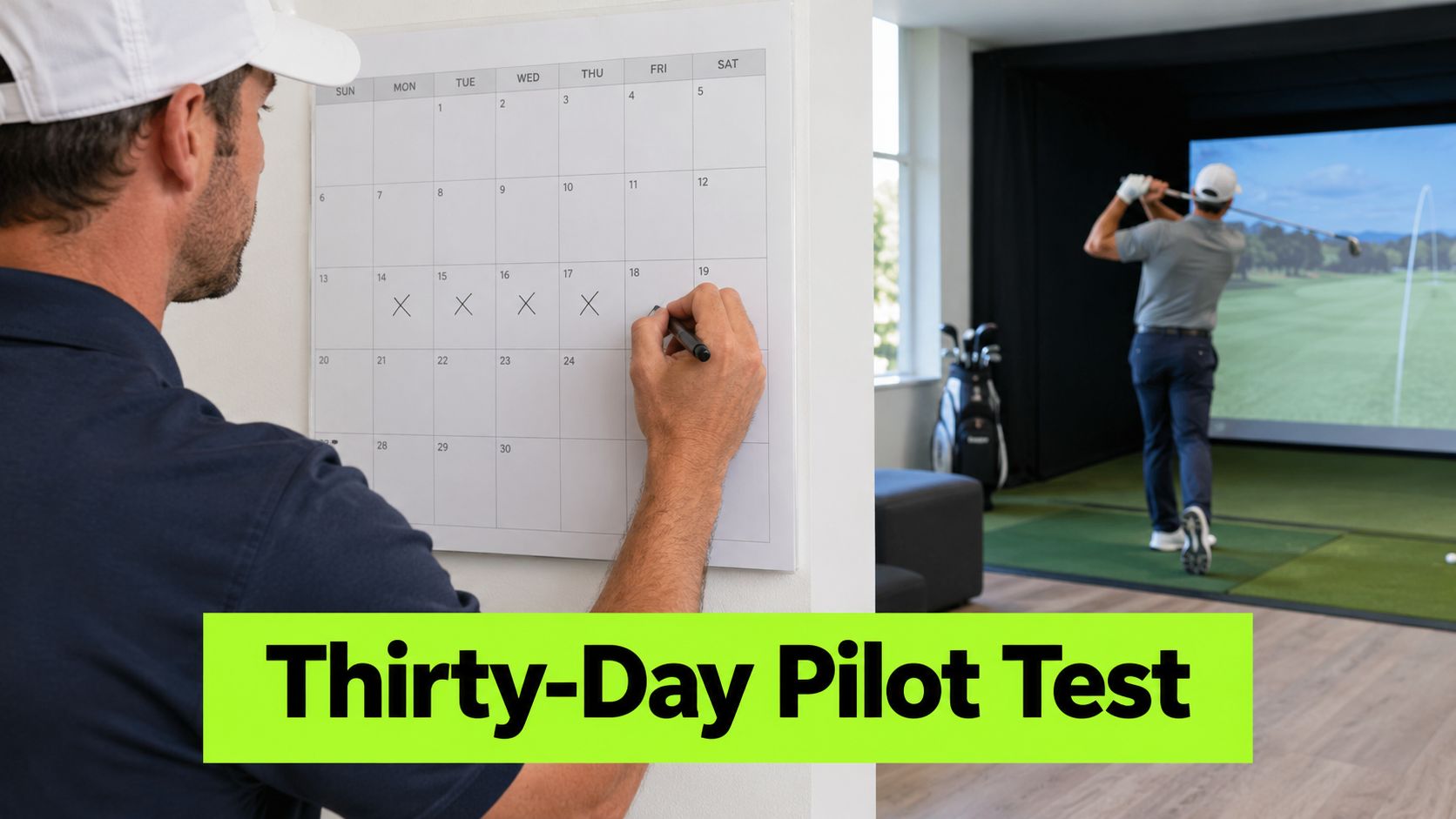
Use decision rules in sequence
| What the pilot shows | What to investigate | Practical change to test |
|---|---|---|
| Enquiries arrive, but few people book | Offer clarity or booking friction | Simplify the product description and shorten the form |
| Golfers book, but miss sessions | Confirmation and reminder arrangements | Test same-day confirmation and a reminder twenty-four hours beforehand |
| Customers attend, but don't repeat | Relevance of the follow-on offer | Add a proposed three-lesson block or suitable group session to the results summary |
| Customers repeat, but don't ask about course play or membership | Visibility and suitability of the course pathway | Offer a nine-hole preparation session or clearly explained club trial |
These are diagnostic starting points, not automatic verdicts. Ask non-bookers and non-returners a brief, neutral question before changing the offer; unsuitable times, injury or travel can explain behaviour that looks like a marketing failure.
Don't change every variable together. If you alter the audience, price, landing page and teaching window simultaneously, you won't know which change affected the result.
Keep the scorecard honest
Record pilot start date, segment, offer, spend, enquiries, bookings, attended sessions, repeat bookings within the chosen ninety-day window and revenue per bay-hour. Add coaching delivery costs so a rise in gross takings doesn't conceal a weaker contribution.
Keep later repeat outcomes attached to the original pilot cohort. The initial month can establish demand and delivery practicality; the longer follow-through tests whether the lesson ladder creates an enduring routine.
Scale when the segment's attended-to-repeat performance and retained contribution justify additional acquisition spend. More enquiries alone aren't a reason to buy more traffic, and a busy professional isn't necessarily evidence of a profitable facility programme.
Decide who can run the pilot reliably before commissioning additional support. An in-house test with clear ownership is more useful than an elaborate campaign that the team can't consistently deliver.
GolfRep helps UK golf facilities connect customer acquisition, booking processes and retention to measurable revenue, including repeat simulator lessons. Visit GolfRep to schedule an open, no-obligation conversation with our founder about your setup, goals and challenges, and whether this pilot is best run in-house or with outside support.
Ready to tap into our proven growth system?