The Modern Club Guide to a Digital Driving Range
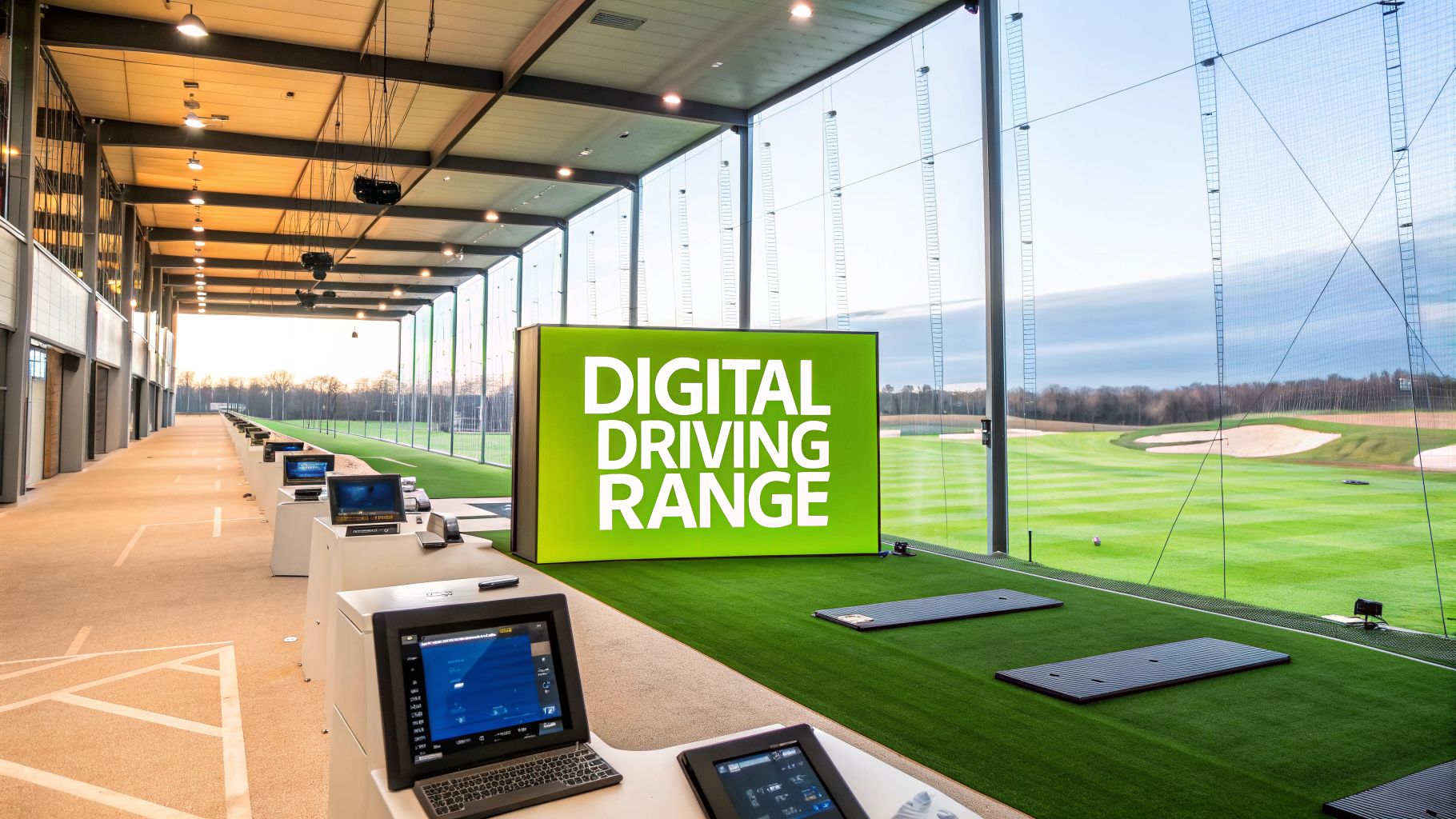
Gone are the days when a driving range was just a field for solitary practice. Today, a digital driving range is fast becoming the new benchmark for modern golf clubs, turning simple practice bays into lively, data-driven entertainment venues. By integrating ball-tracking technology, these facilities offer an experience that pulls in a much broader crowd and opens up major revenue streams well beyond traditional green fees.
Why a Digital Range Is the New Standard
The old-school driving range, often a quiet spot for dedicated golfers to work on their swing, is being completely reimagined. For any forward-thinking club manager or committee, installing a digital range is not just an upgrade, it is the creation of an entirely new, reliable business asset. It fundamentally changes what the range means to your club and your local community.
This technology creates a vibrant, all-weather social destination that operates year-round. It transforms a routine practice session into a genuinely compelling social outing, attracting people who might have found the traditional game of golf a bit intimidating or out of reach.
More Than Just a Game
While the fun and games are what initially grab people's attention, the real win for club management is the business opportunity. The message here is simple: this is about building a powerful new profit centre.
By turning the range into a go-to destination, clubs can see a huge uplift in secondary spend. People who come for a high-tech range experience are far more likely to stay for food and drinks, turning a quick one-hour visit into a full evening out with friends or family.
This new model challenges the long-held belief that a club's income has to revolve almost entirely around the course. A digital range builds a highly profitable, community-focused business that perfectly complements your core golf offering.
A Tool for Dependable Growth
Ultimately, a digital driving range is a strategic investment. It guarantees a steady flow of visitors and income, even during off-peak hours or on rainy days when the course is empty. For any club trying to build a more resilient business, that kind of predictability is invaluable.
The benefits go much further than just the immediate takings:
- Brings in New Faces: The gamified, relaxed environment is a magnet for young professionals, families, and social groups who would not typically consider a round of golf.
- Builds a Sales Pipeline: Every person who visits your digital range is a potential new member. If you have the right systems in place to capture their details, you create a direct funnel of warm leads for memberships, lessons, and corporate events.
- Gathers Crucial Data: These systems provide fantastic insights into how people are using your facility, from shot performance data to peak visiting times. This allows you to make smart, data-backed decisions on everything from marketing to staffing.
This is about more than just installing some new screens and sensors. It is about building a structured, predictable engine for growth that will secure your club’s financial health for years to come.
Understanding the Technology Powering Your Range
When you start looking into a range upgrade, you'll quickly find that 'digital driving range' is not a one-size-fits-all term. The technology behind it varies quite a bit, and each system serves a different purpose. Getting this choice right from the start is absolutely crucial.
Are you trying to give your serious golfers tour-level data? Or are you aiming to attract families and corporate events for a fun night out? Your answer will point you towards the right technology.
Let’s break down the three main options. Each comes with its own level of investment, data depth, and customer experience, so understanding the differences is the first step toward building a new, profitable part of your business.
1. Bay-Based Ball-Tracking Systems
This is the technology most people imagine when they hear 'digital range'. Think of industry leaders like Toptracer or TrackMan Range. These systems use a network of advanced cameras or powerful radar units positioned around the facility to track every single ball, from every single bay.
This data is then beamed to an in-bay screen, giving players instant feedback on their shot. They see the ball's flight path, carry distance, speed, and other key metrics in real-time. It’s a game-changer for serious practice.
But the real magic is in its versatility. The same system that provides granular data for your club champion also includes a full suite of games, virtual courses, and point-scoring challenges. This turns the range into a social entertainment destination, perfect for groups who might never have picked up a club before. It allows you to cater to your core members and attract a completely new crowd, all from the same installation.
2. Full-Swing Golf Simulators
While ball-tracking enhances an outdoor range, full-swing simulators create a completely self-contained, virtual golf experience. These are typically indoor bays where a player hits a real ball into a high-impact projection screen. Using a combination of launch monitors, cameras, and sensors, the system simulates the ball's flight with incredible accuracy on world-famous courses.
Simulators are ideal for creating a dedicated indoor golf centre. They are a fantastic asset for all-weather coaching, professional club fittings, and year-round play when the course is closed. The experience is not about watching your ball soar down a physical range; it is about total immersion in a virtual game.
From a business perspective, simulators create a premium, year-round revenue stream. You can book them by the hour at a higher rate, creating a boutique 'swing studio' or a social hub with its own bar that operates independently from the course.
For clubs with underused indoor space, simulators can become a high-margin attraction. They're especially brilliant for pulling in corporate events and keeping dedicated golfers engaged during the off-season. The only thing to remember is that they typically accommodate a smaller group (one to four players) per bay, so the throughput is different from a bustling outdoor range.
3. In-Bay Camera & Sensor Systems
A third option sits neatly between the other two. These systems place high-speed cameras or other sensors directly within each bay to capture the ball at impact and measure its initial launch characteristics. Instead of tracking the ball over its entire flight down the range, they calculate the full trajectory based on that initial data.
These systems offer a great middle ground. They provide accurate enough data for productive practice sessions while still powering the fun and games needed for social entertainment. The main advantage is that the cost and complexity of installation can be lower than a facility-wide radar system, making it an accessible entry point into the digital range market for many clubs.
To help you weigh the options, here’s a quick comparison of how the three main technology types stack up against each other.
Comparison of Digital Driving Range Technologies
Ultimately, choosing the right system is about matching the technology to your club's ambition, budget, and physical space.
This diagram perfectly illustrates how a digital range, regardless of the technology, becomes a new profit engine. It pulls in new audiences, encourages them to spend more per visit, and gives you invaluable data to keep them coming back.
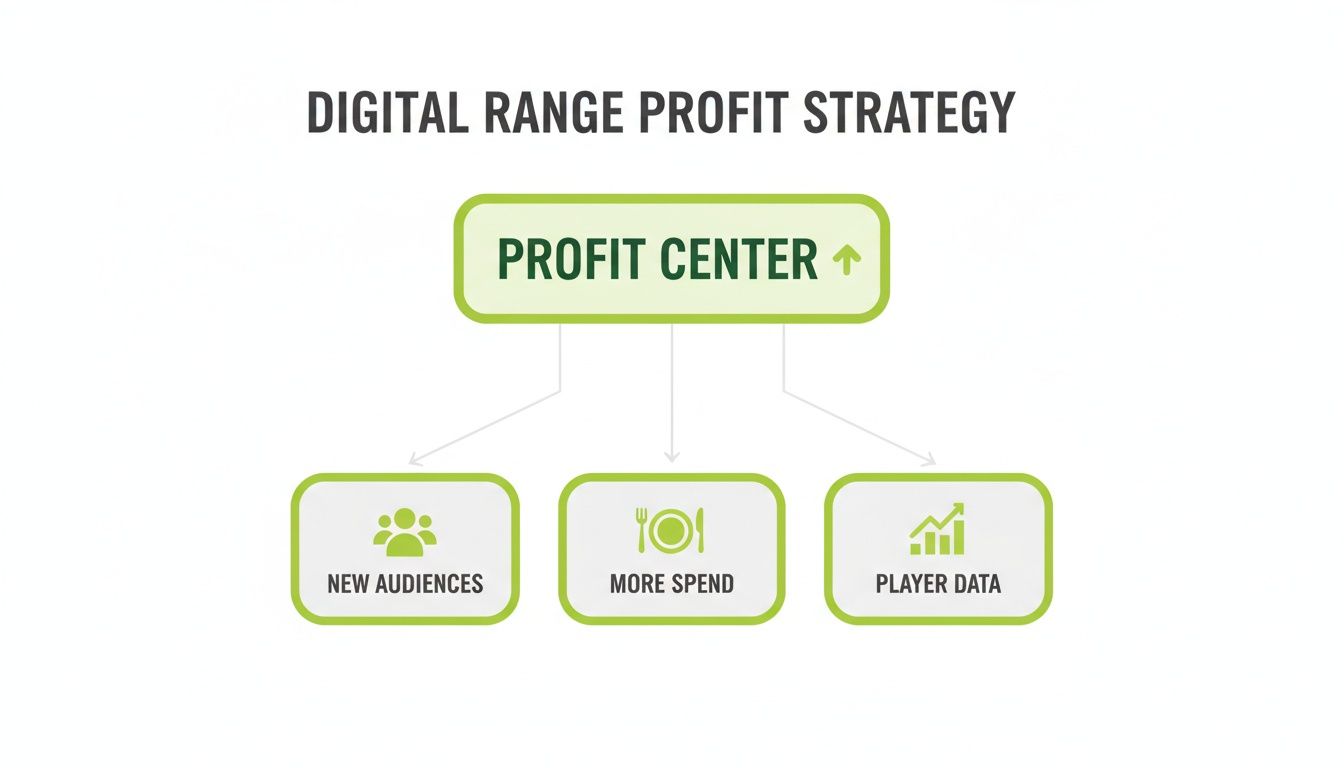
Each of these paths transforms your range from a simple practice facility into a strategic asset that can drive real, measurable growth for your club.
Building the Business Case for Investment
Let’s move from the tech to the numbers. Any conversation about installing a digital driving range inevitably lands on the initial investment, which can look daunting to any club manager or committee. But if you only focus on the upfront cost, you are missing the bigger picture entirely. The return on investment (ROI) goes far beyond simply selling more baskets of balls.
Think of it this way: a modern digital range is not just an upgrade to an existing facility. It is the launch of an entirely new, standalone profit centre for your club, complete with multiple, predictable revenue streams. You’re turning what is often an underused asset into a primary driver of footfall and income, especially during those quiet off-peak hours or when the course itself is closed. It’s about building genuine financial resilience for your whole operation.
The core argument is this: a digital driving range creates a destination. It gives people a compelling reason to visit your club, spend money, and stay for longer, completely independent of the weather or the time of day.
This fundamental shift in purpose is what unlocks its true financial power. It elevates your range from a simple cost centre or a low-margin amenity to a thriving, high-margin business in its own right.
Diversifying Your Revenue Streams
The financial model for a digital range is far more creative and profitable than a traditional setup. Instead of relying solely on the keen golfer paying for a bucket of balls, you can build a layered and much more lucrative offering. The technology’s ability to appeal to everyone, from serious players to complete beginners, lets you create new income pipelines that simply did not exist before.
This diversification is your key to predictable growth. With multiple income sources, the club is no longer quite so dependent on seasonal green fees and memberships. A digital range delivers a steady, year-round flow of cash.
Here are a few of the most effective revenue models we see clubs implementing:
- Tiered Bay Pricing: It is simple but effective. Charge a premium for high-demand slots like evenings and weekends, while offering standard rates for quieter, off-peak practice times.
- Corporate Event Packages: The fun, social nature of digital range games is perfect for corporate clients. Think team-building days, client entertainment, and even Christmas parties. These packages bundle bay hire with food and drinks, generating significant revenue from a single booking.
- Leagues and Competitions: Organise weekly leagues for members and visitors. This creates fantastic recurring revenue and, just as importantly, builds a real community around your range.
- Data-Driven Coaching: For the serious golfer, the shot data is gold. Your PGA professionals can design premium lesson packages that use the technology to track real progress and prove player improvement, justifying a higher price point.
Quantifying the Financial Impact
The business case really clicks into place when you look at the hard numbers. We have seen clubs across the UK that have made the investment report dramatic boosts in both range usage and overall club revenue.
Take Playsport Golf Range in Glasgow. In its first year after installing ball-tracking technology, it recorded a 52% increase in balls hit and a staggering 90% jump in revenue. An even more striking example is Gloucester's driving range, which saw its ball volume explode by 350% from 400,000 to 1.8 million balls hit annually after adopting the technology. These are not outliers; they show how a digital range acts as a powerful catalyst for financial growth.
This success is not just about selling more golf balls. It is a direct consequence of increased footfall, which drives much higher secondary spending. As the range becomes a social hub, it is often the food and beverage sales that see the biggest lift. A group of four playing a virtual round for a couple of hours will almost certainly buy several rounds of drinks and food. Their total spend will dwarf that of a lone golfer hitting a single bucket of balls.
The financial justification is clear. By turning your range into a modern entertainment venue, you are not just improving a facility. You are building a powerful commercial engine that drives predictable, year-round profit for the entire club. For a deeper analysis of financial returns, you might be interested in our guide on the real ROI of golf club marketing.
How to Attract New Audiences and Boost Participation
Think of your digital driving range as much more than a facility upgrade; it is your club’s single most powerful welcome mat. Its true power is in dismantling the very barriers that have historically made golf feel inaccessible to so many. The formal, time-consuming nature of an 18-hole round can be daunting for a newcomer, but the lively, game-focused atmosphere of a digital range is instantly inviting.
This is your club’s direct line to the people who have often been hardest to reach: young professionals looking for a new social spot after work, families searching for weekend fun, and groups of friends wanting a bit of competition without the pressure of a full-on game.

Making Golf More Approachable
What really makes a digital range so good at drawing in new players are the social and interactive touches. Suddenly, a solo practice session is transformed into a shared event, thanks to leaderboards, points-based challenges, and stunning virtual courses. It lowers the stakes and turns up the fun, the perfect recipe for getting newcomers hooked.
This is not just a passing fad. Making golf more accessible is now a cornerstone of the sport's growth strategy. The R&A's research confirms this, showing that 80 per cent of young people in the UK first engage with golf through formats other than the traditional 9 or 18 holes. Digital ranges and simulators are a huge part of this success story, as you can read more about in this analysis of golf participation figures.
From Visitor to Member: A Strategic Pipeline
Every single person who books a bay at your digital range is an excellent prospect. They are local, they have already shown an interest in golf, and they have spent money at your club. This is a ready-made audience that most clubs could only dream of capturing through their usual marketing.
But getting them through the door is just the beginning. The real challenge, and something we see clubs struggle with time and again at GolfRep, is not just generating these enquiries; it is handling, responding to, and converting them effectively. Without the right systems in place, this stream of potential members can dry up as quickly as it appeared.
Here lies the biggest missed opportunity for many clubs. A bustling digital range looks great, but if you have no idea who those visitors are or how to follow up with them, you are leaving an enormous amount of predictable revenue on the table.
This is exactly why having a clear view of your leads and a process for converting them is so crucial. When a visitor books a bay, you have just gained a new lead. A smart, structured system can then begin nurturing that relationship automatically, sending them helpful information on:
- Beginner coaching clinics: A gentle introduction to your PGA professionals, offering a clear next step for anyone wanting to improve.
- Introductory membership offers: A low-commitment taster of club life, giving them a reason to experience the full benefits.
- Social events and leagues: An invitation to come back and become a real part of the community you’re building.
By linking your digital range to a solid CRM and an automated follow-up process, you create a predictable pipeline for growth. You can track how many range visitors take a lesson, and how many of those eventually convert to a full membership. It turns your range from a simple attraction into a measurable and incredibly effective engine for the club's future. For more on this, see how the same principles apply in our guide on using digital marketing to fill your tee times in our guide.
Integrating Your Range with Club Management Systems
A digital driving range is a fantastic asset, but its real power is only realised when it’s connected to the rest of your club's operations. So many clubs make the costly mistake of treating their new range as a standalone attraction, a separate island from their core business. To turn this facility into a genuine growth engine, it has to be deeply woven into your main management systems.

This is the point where the technology goes beyond simple entertainment and becomes a strategic commercial tool. It is all about linking every visitor's time on the range back to a structured system for follow-up and, ultimately, conversion. This principle is central to our approach at GolfRep: sustainable growth is built on smart systems, not just manual effort and hoping for the best.
Creating a Complete Customer View
The goal here is straightforward: connect your range's booking software directly to your central membership database or Customer Relationship Management (CRM) system. When that link is in place, every piece of data starts working together. You get a complete, 360-degree picture of every single person who interacts with your club, from long-standing members to first-time visitors.
This simple connection has a massive impact on your business. Suddenly, you can track customer behaviour across every touchpoint, from the first tee to the final bay on the range.
Think of it this way: a non-member books a bay for an hour. Without integration, their contact details just sit there, isolated in the booking platform. With integration, their information automatically flows into your main CRM, instantly creating a new lead profile.
This is where things get interesting. Your system now knows who this person is, that they are local, enjoy golf, and have already spent money with you. This is not just a bit of data; it is a clear signal of their potential.
Automating the Path to Membership
Once that lead is in your system, automation can take over. This is how you replace inconsistent, manual follow-ups with a structured and predictable sales pipeline. The new lead can be automatically entered into a pre-built communication sequence, carefully designed to guide them towards membership.
This automated process might look something like this:
- A Welcome Email: Sent right after their visit, thanking them for coming and maybe including a simple link to book their next session.
- An Information Pack: A few days later, an email could go out showcasing your coaching academy or beginner lesson packages.
- An Exclusive Offer: A week on, you could send a special invitation for a taster membership or a social event, giving them a compelling reason to come back.
This kind of automated flow ensures no lead ever falls through the cracks. It guarantees every single range visitor gets a consistent, professional follow-up that nurtures their interest over time. This is exactly what we mean by lead visibility and conversion tracking. You can see precisely how many range users become members and fine-tune your process to get even better results.
By connecting your digital driving range to a robust management system, you are doing more than just offering a fun hour of golf. You are building a measurable, automated pathway from casual visitor to committed member. If you are interested in this approach, you can learn more about how a dedicated golf CRM system can transform your club's growth.
Planning Your Digital Range Project
Putting a digital range project together is a big move, but with some smart planning, the whole process can be surprisingly smooth. The trick is to see it for what it is: a construction project, not just a tech purchase. Let us be clear, you are not just buying screens; you are managing a complex installation.
By breaking the project down into clear, manageable stages, you can avoid the common traps, keep your budget in check, and deliver a fantastic new asset for your club. Thinking about the entire journey, from the first survey to the grand opening, is the key to getting it right.
Assessing Your Site and Infrastructure
Before you pick up the phone to a single supplier, your first job is to take a long, hard look at your existing range. Every piece of technology has its own demands for power, light, and data, and it is rare that an older range will meet these specifications out of the box. A proper site survey is not just recommended; it is essential.
Have a good look at your bay dividers and the roof structure. Can they physically support the weight of new screens and tracking units? Then there are the electrics. Each bay needs its own reliable power for the screen, any heaters, and lighting. Getting this wrong at the start often leads to expensive and disruptive groundwork later on.
We have seen it time and again: clubs underestimate the groundwork. Getting your power, structured data cabling, and lighting sorted from day one is the single best way to prevent huge delays and budget blowouts further down the line.
Choosing the Right Technology Partner
When you are selecting a supplier, you are not just comparing quotes. You are choosing a partner for the long haul, someone whose technology and support will be central to your new venture's success. Your best bet is to find a company that has a solid history of successful projects in clubs similar to your own.
When you sit down with potential partners, be prepared to ask probing questions that go well beyond the glossy sales brochure. This is about understanding the total cost of ownership and what it will actually be like to run this system every day.
A simple checklist is the best way to compare them side-by-side:
- Total Project Cost: What exactly is included in the price? Does it cover absolutely everything, including installation, shipping, and all the brackets and fixings?
- Ongoing Fees: What are the recurring costs? Get clarity on annual software licences, maintenance contracts, or any revenue-share agreements they might have.
- Installation and Training: Who is physically doing the installation? Crucially, what level of staff training do you get at the start, and what is available later on?
- Support and Maintenance: If something goes wrong, what is the deal? Ask for their service level agreement (SLA). Is their support team based here in the UK?
- System Integration: Can their booking platform talk to your existing club management system, CRM, or tee sheet? This is a big one for operational efficiency.
Creating a Phased Rollout Strategy
Let us face it, a full, range-wide refit is not always the right move from the get-go. If you are working with limited capital or just want to dip your toe in the water first, a phased rollout is a very shrewd approach. You could begin by upgrading just a handful of bays, positioning them as a premium offering to test the waters and build demand.
This method lets you prove the concept on a smaller scale, get invaluable feedback from your members, and start creating a real buzz. The revenue you generate from this first phase can then be funnelled directly into funding the next stage of the rollout across the rest of the range. It is a fantastic way to minimise your upfront risk while still getting your digital journey underway.
Common Questions About Digital Driving Ranges
It is only natural for club managers, owners, and committee members to have questions before committing to a major project like this. Any significant investment brings up practical and financial considerations that need a thorough review.
We hear the same handful of questions time and again from clubs exploring this technology. Let's tackle them head-on and give you the straightforward answers you need to make a confident decision.
How Much Revenue Can We Realistically Expect?
This is always the first, and most important, question. The honest answer is: it depends. Your club’s location, your pricing model, and how effectively you market the new facility will all play a huge part.
That said, we regularly see clubs transform their range from a little-used amenity into a primary profit centre for the entire business.
The revenue does not just come from one place. It is a combination of:
- Higher bay fees, especially for those prime evening and weekend slots.
- Longer opening hours, allowing you to generate income well after the sun has set on the course.
- A major uplift in food and beverage sales, as groups linger longer. In many cases, F&B spend can actually eclipse the bay hire revenue.
For many clubs, the digital range quickly becomes one of the most profitable arms of the entire operation.
What's the Typical Upfront Investment?
The initial cost is, of course, a major factor. This varies widely depending on the technology provider you choose and how many bays you’re looking to upgrade. A full, professional installation can range from several thousand to tens of thousands of pounds per bay.
It is crucial to get a detailed proposal that breaks down the total project cost. Look beyond the hardware and make sure you account for any necessary groundworks, electrical upgrades, structural changes, and installation fees.
Do not forget the ongoing costs, either. These usually include annual software licences, hardware maintenance contracts, and sometimes a revenue-sharing agreement with your technology partner.
How Will a Digital Range Affect Our Existing Members?
This is a very common concern, but our experience shows the impact on members is almost always overwhelmingly positive. You are not taking something away; you are giving them a world-class practice facility.
Suddenly, they have access to the kind of performance data and immediate feedback that was once reserved for touring pros. It also breathes new life into the club, creating a more vibrant, social hub where members can gather.
Ultimately, a thriving digital range strengthens the club's financial future by attracting new visitors and potential members. That security benefits everyone in the long run.
A digital driving range is a fantastic tool for getting visitors through the door, but turning that footfall into new members requires a proper system. GolfRep helps clubs build that predictable pipeline. We combine targeted lead generation with the automated follow-up and CRM systems you need to convert enquiries into sign-ups.
Ready to tap into our proven growth system?