Golf Course Repositioning Strategy for UK Clubs

England's club membership reached 750,071 in 2025, up 2.66% year on year, according to England's 2025 membership data. That's good news, and it's also the wrong place to stop. A growing national total doesn't tell you whether your tee sheet, your member mix or your wage bill is in shape. A golf course repositioning strategy answers that local question. It decides who the course is for, what access each group can buy, which hours carry the margin, and how a first-time golfer progresses towards a membership they'll renew.
When a Full Diary Still Leaves the Club Exposed
A summer medal sheet can look healthy while the surplus barely moves. The diary is full, the car park is busy, and yet the club is relying on the same golfers, playing at the same peak times, to fund rising costs. Busy isn't the same as well positioned.
Participation and subscription aren't the same product
England Golf's 2018 survey of 426 clubs, reported by Glenmuir's summary of England Golf's 2018 survey, found average membership of 484 players, up from 460 in 2016, while more than 3.7 million people in England had played on a full-length course during the preceding year and over 2 million played at least twice a month. In the same survey, membership aged 65 and over had increased by 13%.
Read those figures together. Plenty of people play golf. Far fewer buy a traditional annual subscription, and the base that does is getting older. Your problem usually isn't a shortage of golfers in the catchment. It's that you've packaged one product, built for one type of player, and asked everyone else to fit around it.
What repositioning means in practice
Repositioning is a deliberate reset of four things.
- Audience: Which groups you serve first, and which you serve only when capacity allows
- Access: The specific categories, formats and booking rights each group can buy
- Time: Which dayparts are protected for full members and which ones must earn their keep
- Progression: How a beginner, visitor or nine-hole player moves to a higher-value category
A new logo doesn't do that. A fee cut doesn't do it either, and a single open day certainly doesn't. Those are communications or short-term tactics. They can support a reset, but they can't substitute for one.
By the end of this guide, you'll have a way to read your current position, a ladder of offers that protects full membership, tee-time rules tied to price, a test for course spending, and a twelve-month set of measures a committee can govern.
One caution before you copy a neighbour. A member-owned club and a proprietary club don't have the same freedom to change categories, voting rights or joining structures. The same local demand doesn't imply the same offer, the same pace, or the same approval process.
How to Read Your Market Position
Don't rewrite a single offer until you've pulled five internal figures. Get them from your own booking system and accounts, not from memory in a meeting.
- Playing members: The actual total by category, not the mailing list
- Joiners: New members in the last twelve months, split by category and source
- Leavers: Non-renewals and mid-year exits, with the reason recorded where you have it
- Member rounds by day and time: Occupancy and no-shows by daypart, not just a monthly total
- Revenue split: Membership, visitors, societies and clubhouse shown separately
Set those beside the national picture. National Club Golfer's report on Hillier Hopkins' 2024/25 survey found 59% of members' clubs had more than 600 playing members, compared with 56% in 2023, while the average club recorded 105 joiners and 82 leavers during the year. Member rounds ranged from 400 to 210,000 annually. In 2023, women represented 18% of membership, juniors 9%, and 64% of members were aged 51 or over, while 46% of clubs had waiting lists, down from 52% in 2022.
| Signal | UK benchmark | What it suggests | First move |
|---|---|---|---|
| Clubs with more than 600 playing members | 59% of members' clubs in 2024/25, up from 56% in 2023 | A larger headcount is common and doesn't prove the offer fits | Check who plays, when, and what they pay before chasing more joiners |
| Joiners and leavers | Average club recorded 105 joiners and 82 leavers | Net growth can hide a leak in recurring revenue | Pair any new offer with a retention look at who leaves and why |
| Intensity of use | Member rounds ranged from 400 to 210,000 a year | Similar membership totals can hide very different utilisation | Map occupancy by day and time before adding products |
| Member mix in 2023 | Women 18%, juniors 9%, 64% aged 51 or over | The paying base can be older and still narrow | Build distinct pathways rather than assuming the next member matches the last |
| Waiting lists | 46% of clubs in 2023, down from 52% in 2022 | A queue is a less reliable strategy than it was | Plan for variable demand and yield, not permanent scarcity |
Read each row as a decision
If you're above 600 playing members, you're in the majority. That tells you nothing about whether Tuesday morning earns money or whether your weekend sheet is turning away the members who pay the most.
If you gained members net, look at the leavers anyway. Replacing a long-standing full member with a discounted joiner who leaves in year two is churn dressed up as growth.
The rounds range is the warning against league tables. Two clubs with identical membership totals can place completely different pressure on the course, the greenkeeping team and the clubhouse tills.
The member mix is a resilience question. A base that's older and narrow can fund this year comfortably and still leave you exposed in five years if nobody younger is coming through a pathway you've built on purpose.
If your thinking needs external structure before it reaches committee, 3228 Digital UK's strategy consulting guide is a useful reminder that strategy work starts with diagnosis, not delivery. For the golf-specific version of that spadework, work through how to identify the market opportunities in your own catchment using your postcodes and competitor set.
Price a tee time before you redesign around it
Say a Tuesday 9am tee time earns a £30 green fee and £8 of food and beverage. That's £38 per occupied tee time before labour and course costs. Those are hypothetical figures, so replace them with your own till data. Now compare that slot sold as a discounted off-peak right. If the new product returns less and fills the same slot, you've moved revenue, not added it.
Practical rule: Name one constraint, whether it's mix, churn, quiet-time yield or an offer that only suits the existing member. Don't launch a second change until that constraint has a measure.
Build the Access Ladder and Its Tee-Time Rules
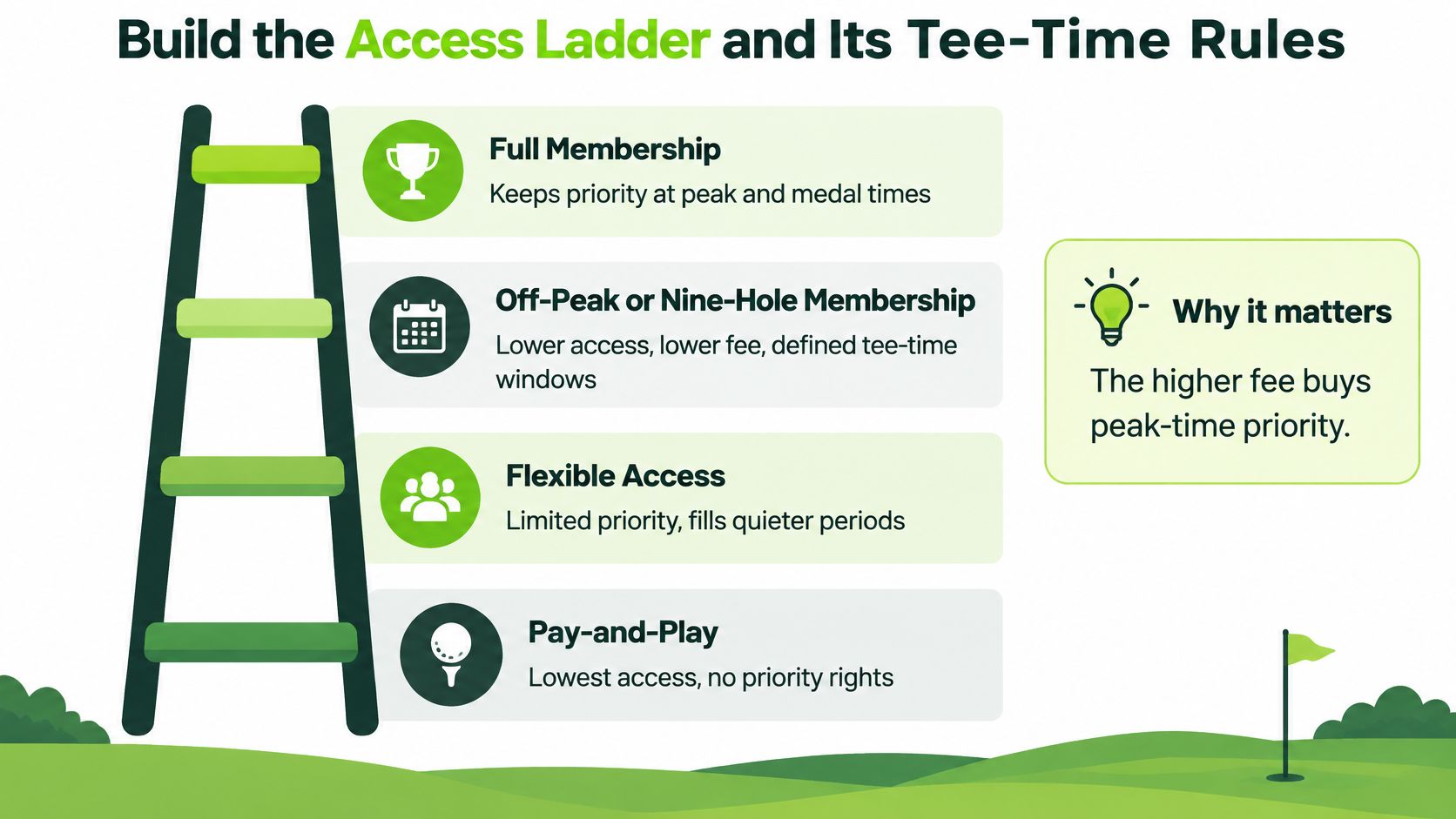
Build the ladder from full membership downwards, and give every rung a job. If you start at the bottom with a cheap entry offer, you'll spend the next two years explaining to full members why they pay more for less certainty.
Start with what the highest fee protects
Full 18-hole membership keeps priority at peak and medal times. That's what the higher fee buys, and you should say so plainly in the category description, the booking rules and the renewal letter. If full members can't get a Saturday morning game because flexible players booked earlier, your ladder is upside down.
The commercial anchor matters here. Savills' Aspects of Leisure golf briefing cites an average UK membership fee of £1,181.46, and reports that England recorded more than 10.2 million submitted scores in 2024, while nine-hole scores increased by 17.89% year on year. The aim of every lower rung is a credible route towards that kind of recurring fee, not volume at any price. Shorter formats aren't a dilution of the product. They're how a growing share of golfers already play.
Add the middle rungs with named windows
Next comes off-peak, weekday or nine-hole access for time-poor adults and golfers who want a shorter session. Limit it to named windows, bar it from weekend mornings, or publish a peak supplement. Don't write "some restrictions apply" and leave the pro shop to negotiate at the counter.
A points or flexible package sits alongside this for mixed-use golfers. Weight it properly. A Saturday morning round must cost more points than a Tuesday afternoon round, or you'll train your most price-sensitive players to occupy your scarcest inventory.
Below that, an introductory pathway serves newcomers, returning adults and families. Make it coached or supervised, give it an end date, and remove automatic renewal. The end date is the feature, not a flaw. It forces a conversation about the next category while enthusiasm is still there.
Designing those categories properly, including joining fees and upgrade credit, is covered in our guide to golf club membership tiers.
Visitor and society golf is ancillary revenue. Price it well, host it properly, but don't let it set the terms for members.
Decide who gets a pathway and who stays ancillary
This is the sorting rule most clubs skip, and skipping it is why databases fill up with people nobody follows up sensibly.
Give a named route towards a membership category to juniors, coached beginners and regular nine-hole players. These golfers have shown intent and a pattern you can build on. Record their first visit, their second, their first lesson and their first event, then make the next step a specific offer with a date on it.
Keep a one-off society golfer, a hotel guest or a casual travelling visitor as ancillary revenue until something changes. A second visit, a lesson booking or an event enquiry is that signal. Until then, they're welcome, they're profitable if you've priced the daypart correctly, and they shouldn't consume your membership team's week.
Write the rules before you sell the product
Each rung needs four things on one page before launch. A booking rule stating when the category can book and how far ahead. A handicap or eligibility test so pace of play and etiquette are protected. A peak restriction that's visible in the booking system, not just in a PDF. And a conversion record showing who moved up, who stayed and who left.
Then price the difference in rights, not the golfer's willingness to haggle. When one category is quiet, the answer isn't a discount across everything. It's a check on whether that category's windows, price gap and progression route are set correctly.
| Product | Who it is for | Tee-time rule | 90-day measure |
|---|---|---|---|
| Full 18-hole membership | Competition and regular players | Priority at peak and medal times | Renewal rate and rounds per member |
| Off-peak or weekday membership | Time-poor adults | Limited or barred at weekend mornings, or a published peak supplement | Midweek occupancy and upgrades to full membership |
| Nine-hole access | Golfers wanting a shorter session | Named windows only, removed when the member standard is already met | Slots filled and rate of move to a longer category |
| Pay-and-play or visitor | Occasional and travelling golfers | Inventory the membership ladder is not using, priced by daypart | Repeat visit rate |
| Introductory pathway | New, returning and family golfers | Coached or supervised slots with an end date and no automatic renewal | Share who buy a paid category |
| Points or flexible package | Mixed-use golfers | More points required at peak than off-peak | Share of points used in peak times |
Measure three things per rung. Conversion into the next category tells you whether the ladder works as a ladder. Contribution per occupied tee time tells you whether it's worth the wear on the course. Retention at 90 and 365 days tells you whether you've sold a product or a one-season bargain.
Review one full season of real bookings before widening any right. Widening access takes five minutes in a meeting and two years to reverse without upsetting the people you granted it to.
Link Course Investment to Member Value
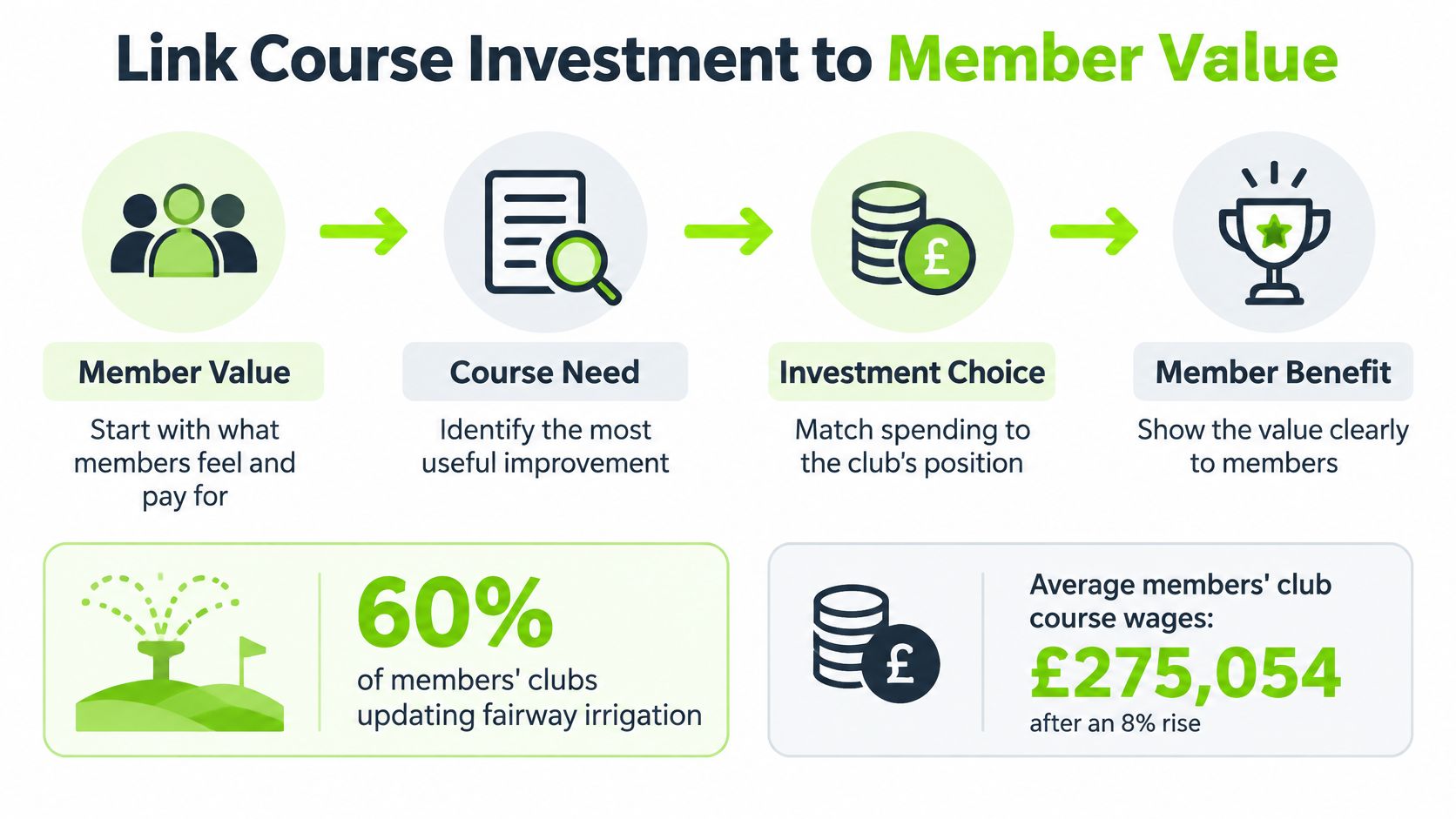
Stop treating a renovation as proof of ambition. A capital project is a bet that members will notice, value and pay for the result. If you can't describe that chain, you're buying machinery and hoping.
The 2024/25 Hillier Hopkins UK golf-club survey reports that 60% of members' clubs were updating fairway irrigation systems, while average members' club course wage costs reached £275,054, an 8% increase from the prior year. Reported gross-profit margins ranged from 40% to 78%, with a 59% average.
That spread is the point. A better-presented course can support fees and renewals. It can also absorb your entire surplus if labour and water costs rise without extra revenue attached.
Rank every project against four tests
- Member impact: Does the target member feel this in the golf they play, or only in a photograph?
- Operating cost: What does it add or save annually in wages, water, energy and materials?
- Playable days: Does it hold surfaces through dry spells and wet winters, or shorten the season?
- Incremental revenue: Which retention, visitor or previously unplayable periods pay for it?
Set a payback threshold in seasons before approval. "It'll pay for itself over time" isn't a threshold. Three seasons, five seasons, write it down and give someone ownership of the number.
For irrigation specifically, judge water use, extra playable days, maintenance hours saved and movement in the renewal rate. A system that cuts hand-watering hours and holds fairways through August is a commercial asset. One that only makes the course greener in a wet May is a cost.
The agronomy behind that judgement, including what routine work protects playing quality, is explained in our guide to the maintenance of golf courses.
Sequence the work with the offer
Have the fee architecture and the member explanation ready when conditions change. Tell members what's being protected, such as reliable greens and playable fairways in dry spells. Don't promise carpet conditions that your wage bill can't hold through a drought.
If a project fails the revenue or playable-day test, defer it and spend the year on the access ladder instead.
That discipline keeps a golf course repositioning strategy accountable to both the golf and the accounts, which is where committees get nervous and where vague projects usually slip through.
Three Club Situations and the Move That Fits
The same move doesn't fit three different constraints. Work through these in the same order each time. Constraint, single move, number that would prove it.

Similar headcount, different club
Say a proprietary club and a members' club in the same town both sit above 600 playing members and both want younger joiners. Copying each other's brochure would be a mistake.
Hillier Hopkins' 2024/25 golf clubs report found 59% of members' clubs and 55% of proprietary clubs had more than 600 playing members, compared with 56% and 55% respectively in 2023. Members' clubs averaged 75 joiners in 2024, broadly unchanged from 73 in 2023, and flexible membership packages were offered by 40% of members' clubs and 64% of proprietary clubs.
For the members' club, the constraint is usually governance and trust. The move is a tightly governed weekday or points category the committee can explain as protecting Saturday rights. The number is upgrades into full membership against complaints about peak access.
For the proprietary club, the constraint is rarely a shortage of flexible labels. It already has them. The move is to stop adding another one and audit which existing package converts and stays. The number is retention at 365 days by package, with the weakest withdrawn.
Rebuilding a weak local reputation
Say a club has drifted. Local golfers have a dated view of it, reviews are thin, and the membership has thinned with them. The instinct is to advertise a discount and hope volume fixes the story.
Do it in the other order. Clarify who the club is for, rebuild the local and online standing, then generate demand into an offer worth joining. At Bidston Golf Club, GolfRep helped the club more than double its membership base and add over £230,000 in recurring revenue within two years, while rebuilding its reputation locally and online. The lesson is sequence. Offer and reputation first, then demand, never a fee cut asked to carry a damaged story.
Already near capacity
Say a club sits at its target of 600 playing members and the weekend sheet is full. Repositioning here isn't a volume question at all. It's a mix and peak-rights question.
Cap weekend morning rights for any new category. Grow weekday or points access instead. Track weekday occupancy and the share of peak rounds taken by full members, rather than adding volume the tee sheet can't absorb.
Write down the one constraint, the one product change and the 90-day number before the season starts. Three lines on one page will do more for you than a forty-slide deck nobody reopens in June.
Build the Twelve Month Repositioning Plan
Take this sequence to committee as four numbered beats. Each one has an owner, a date and a stop rule.
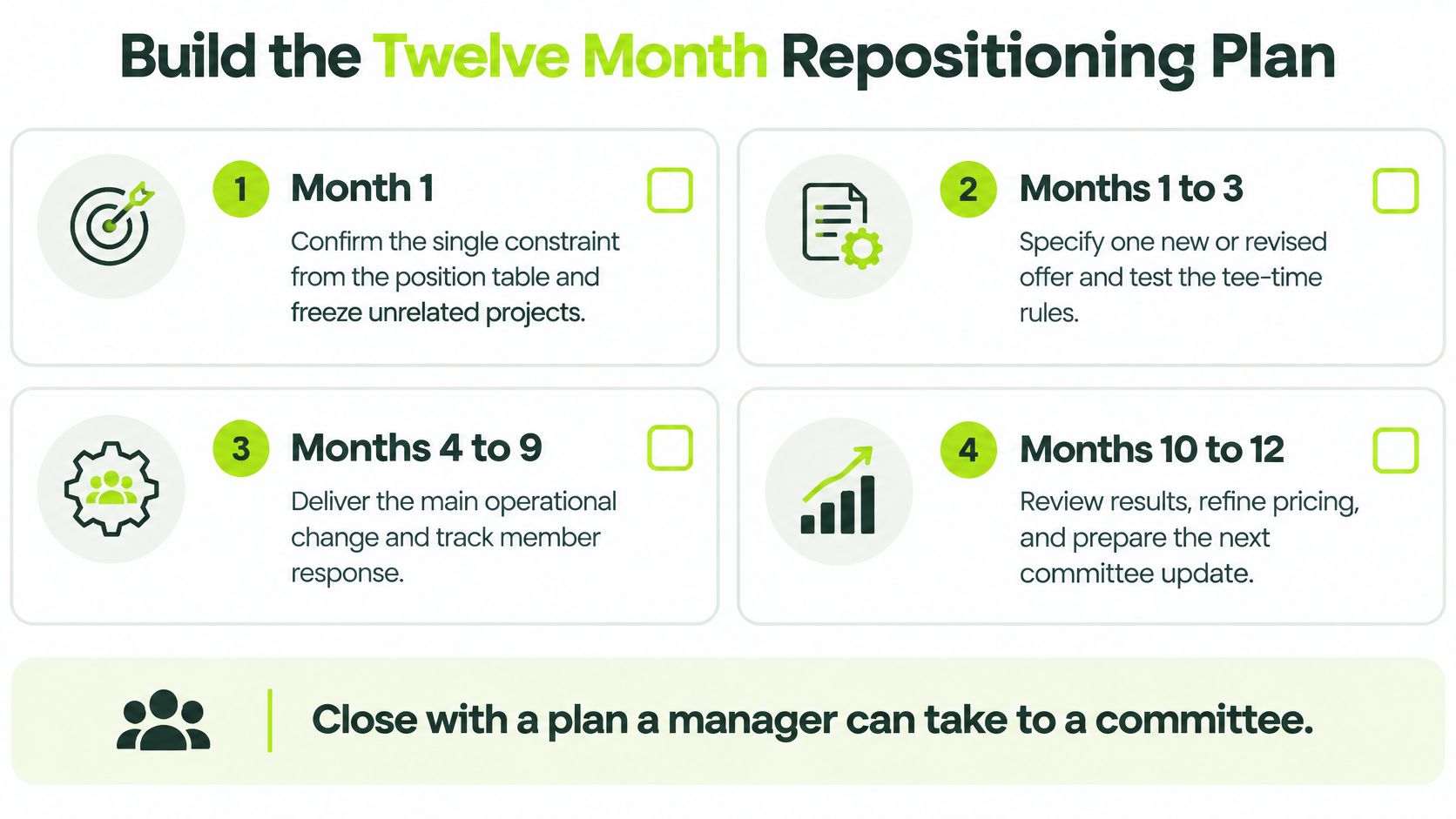
- Month one: Confirm the single constraint from your position figures and freeze unrelated projects. If everything's a priority, nothing gets measured properly.
- Months one to three: Specify one new or revised access product, its tee-time rule, its fee relative to full membership, and the member note stating which peak rights are unchanged. Attach any approved course project to the value it protects, or defer it.
- Through the season: Record enquiries, visits, joins and category moves by source. Check new joiners at 90 days rather than waiting for an annual renewal shock to tell you onboarding failed.
- Month twelve: Judge source quality, whether conversion held steady, and whether the new category still respects peak times. If the constraint has moved, pick the next one.
Resist the obvious temptation at that review. Don't add a second flexible product because the first produced a few joins. A handful of joins is a signal to check retention and contribution per tee time, not a reason to widen the catalogue.
The lesson running through every decision here is simple. A golf course repositioning strategy works when participation is packaged into distinct routes, priced by the rights it includes, and checked against use of the course and the wage bill it has to support. It fails when it's a rebrand, a discount, or a capital project with no revenue attached.
If you'd like that map drawn against your own diary, our first conversation is an open look at your current setup, goals and constraints, not a scripted pitch. It's there for clubs that have at least named the constraint and want a structured growth system built around it.
If you're ready to package your participation into access routes that feed full membership instead of discounting against it, GolfRep can help you identify the constraint, design the ladder and measure what converts. Visit GolfRep to book an open, strategic call and see whether our proven growth system is a good fit for your club.
Ready to tap into our proven growth system?