A Guide to the Maintenance of Golf Courses for UK Clubs

Most club managers are living the same tension. Members want fast greens, tidy presentation, reliable drainage, and a course that looks strong in every season. The committee wants tighter control of spend. The course team wants enough labour, working machinery, and the space to do the job properly.
That tension is why the maintenance of golf courses can't be treated as a back-of-house function. For most UK clubs, the course is the product. It shapes member satisfaction, visitor perception, and the credibility of every membership conversation your club has.
At GolfRep, we see the commercial consequence of that every week. Strong course conditions create interest. Poor follow-up wastes it. Clubs often assume growth starts with more enquiries, when the bigger issue is usually what happens after the enquiry arrives. If the course team has done the hard work and the club still responds slowly, tracks leads poorly, or relies on inboxes and spreadsheets, a major investment in course quality gets diluted before it ever turns into revenue.
Why Course Maintenance Is Your Biggest Asset and Risk

A golf course isn't just a playing surface. It's your club's most persuasive proof of value. Prospective members don't experience your budget. They experience greens that putt true, fairways that recover well after bad weather, and a site that feels cared for.
That makes maintenance both an asset and a risk. Done well, it builds reputation and supports pricing. Done poorly, it pushes existing members into complaint mode and leaves sales staff trying to overcome objections that shouldn't exist in the first place.
A busy UK golf course typically handles between 35,000 and 40,000 rounds per year, and maintenance expenses increased by 6.7 percent between 2010 and 2017 according to USGA maintenance cost research. That means clubs are managing heavier wear and higher cost pressure at the same time.
The course is your strongest marketing asset
Most clubs still separate operations from growth. The course team maintains standards. The office handles membership. Marketing sits somewhere else again. In practice, those functions are linked.
When the course improves, demand usually improves with it. Better presentation strengthens word of mouth, gives sales staff a better story to tell, and increases the chance that a visiting golfer asks about joining. That's why managers should read beyond golf-specific channels and look at broader actionable landscaping insights that sharpen thinking around presentation, asset care, and grounds standards.
Practical rule: If your course quality rises and your conversion process doesn't, you haven't finished the job. You've only funded the first half of growth.
Where clubs lose the return
The mistake isn't spending on greenkeeping. The mistake is spending on greenkeeping without protecting the commercial return on that spend.
A club can invest heavily in drainage, mowing quality, bunker consistency, and presentation, then still let new enquiries sit in a shared inbox. It can generate interest through visible course quality, then fail to log the enquiry source, fail to book a visit quickly, and fail to follow up when the prospect goes quiet.
That's where risk enters. Maintenance creates demand, but demand without systems is fragile. The clubs that perform best usually don't have perfect conditions every day of the year. They have clear standards on the course and clear systems in the office.
The Foundations of Modern Golf Course Agronomy
Good greenkeeping starts with a simple principle. Turf quality isn't created by mowing alone. It comes from the interaction between drainage, grass plant health, and how much stress the playing surfaces are asked to absorb.
Managers and committee members don't need to become agronomists, but they do need enough understanding to judge whether a maintenance plan is coherent. If you can't separate essential work from cosmetic work, every budget meeting becomes harder than it needs to be.
Drainage sets the baseline
In UK conditions, drainage is rarely a side issue. If water sits on tees or fairways, turf weakens, wear becomes visible faster, and recovery takes longer. Surface shape matters as much as subsurface infrastructure.
For optimal drainage, UK fairways and tees should have a surface gradient of 1 to 2%, and for playability, greens are typically trimmed to 0.140 inches in spring and autumn, dropping to 0.100 inches in summer, while fairways sit between 0.38 and 0.5 inches according to golf course maintenance guidance from Limble.
A useful way to think about it is this:
| Area | What matters most | What poor practice causes |
|---|---|---|
| Tees | Surface fall and firmness | Standing water, divot damage, weak recovery |
| Greens | Tight height control and consistency | Inconsistent ball roll, stress, thinning turf |
| Fairways | Balanced cut height and density | Scalping, patchiness, poor lies |
Mowing height is a business decision as well as an agronomic one
Every manager has heard some version of the same request. Make the greens faster. Make the fairways tighter. Improve presentation before an event. Sometimes that request is sensible. Sometimes it pushes the plant too hard for the conditions.
Shorter isn't always better. If the course team cuts aggressively to satisfy a short-term perception goal, the club can end up paying for it in weaker turf, slower recovery, and more disruption later.
A surface that looks sharp for one weekend but struggles for the next month isn't efficient maintenance. It's deferred trouble.
Species, stress, and realistic standards
The strongest maintenance programmes match standards to site reality. Soil profile, shade, airflow, rainfall, traffic, and available labour all shape what the course can sustain.
That means constructive conversations with the course manager should focus on questions like these:
- What is the limiting factor: Is the actual issue drainage, compaction, shade, traffic, or staffing?
- Where does quality matter most: Greens, approaches, tees, entrances, and visible first impressions usually drive perception fastest.
- What standard is sustainable: A target that can be held consistently is more valuable than a higher standard that collapses under pressure.
Committees often get into trouble when they judge agronomy by occasional appearance alone. Sound maintenance of golf courses is about repeatable standards, not short bursts of polish.
Structuring Your Annual Maintenance Calendar
A strong course rarely feels improvised. The best operations run to a calendar that balances agronomy, labour availability, machinery capacity, competition dates, and member tolerance for disruption.
That calendar also helps the office team communicate properly. Members don't object to necessary work as much as they object to surprise, confusion, and silence.
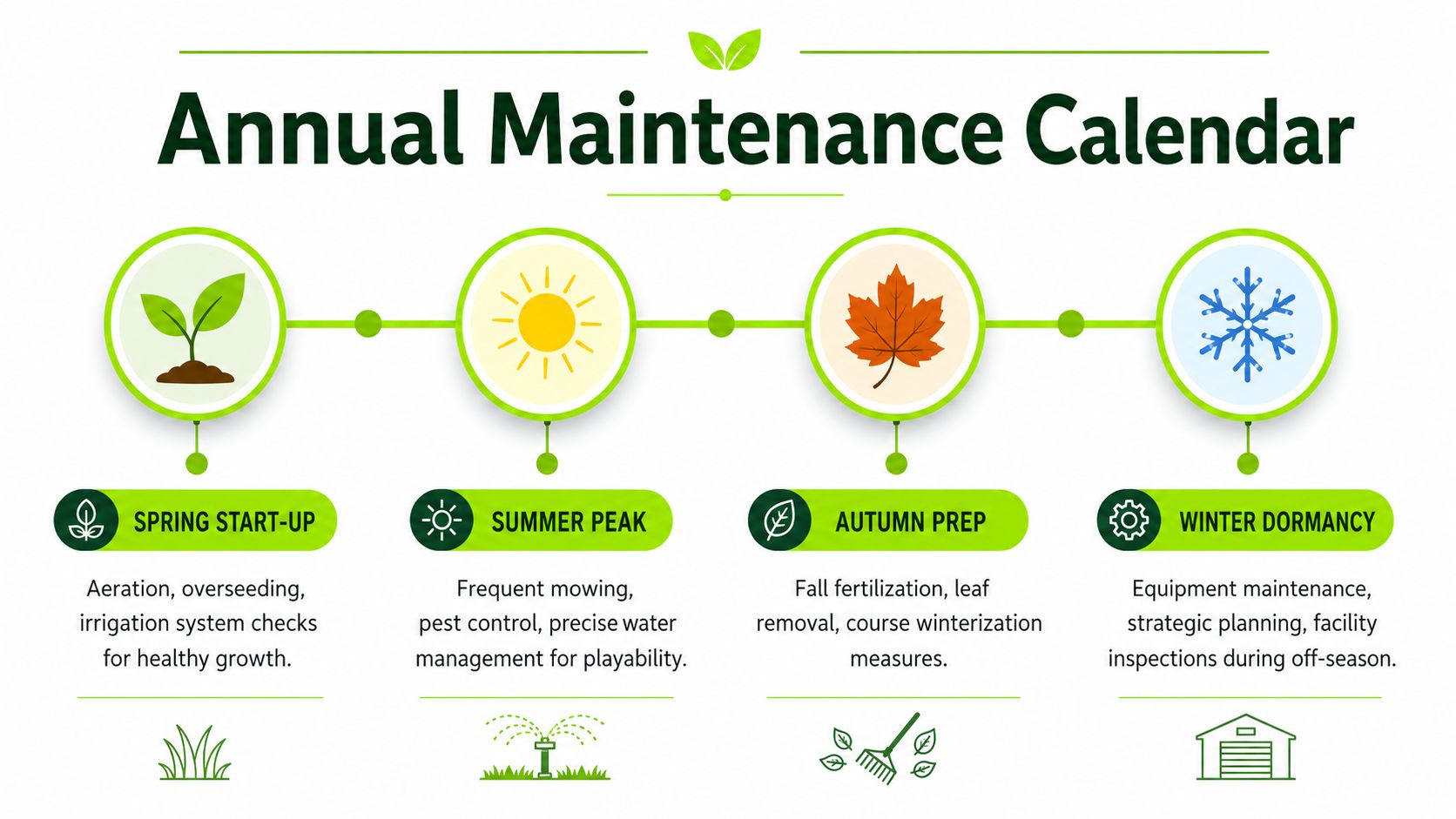
Spring start-up
Spring is about recovery and preparation. Surfaces are coming out of winter stress, growth is returning, and the club wants presentation to improve quickly.
Typical priorities include:
- Aeration and overseeding: These support root health and help repair worn areas before peak play.
- Irrigation checks: Faults that go unnoticed in spring usually become expensive in summer.
- Presentation reset: Tees, walk-ons, bunker edges, and surrounds need to catch up together. If only greens improve, the course still feels behind.
Spring is also when communication matters most. If members understand why certain areas are being nursed rather than chased visually, complaints usually drop.
Summer demands precision
Summer creates the highest expectations and the narrowest margin for error. Mowing frequency rises, moisture management becomes more exact, and any lapse in equipment readiness shows up quickly.
Clubs benefit from proper asset records, especially for irrigation and hydraulic equipment. A clear hydraulic system asset inventory mindset helps managers think in terms of critical components, service history, and failure risk rather than waiting for a breakdown in peak season.
A summer plan usually lives or dies on discipline:
- Protect the priority surfaces first. Greens and approaches drive perception fastest.
- Avoid reactive watering. Watering by panic creates inconsistency.
- Keep machines available. Lost cutting time in summer is hard to recover.
Autumn is the repair window
Autumn gives clubs one of the best opportunities to do work that restores long-term quality. Conditions are often suited to renovation, and recovery can still happen before winter shuts growth down.
This is the time for more invasive work, but clubs often underuse it because they worry about temporary disruption. That's short-sighted. If you don't take the repair window, you'll carry preventable weakness into the next season.
Tell members what work is happening, why it matters, and what improvement they should expect. Most frustration comes from poor explanation, not from the work itself.
Winter is not downtime
Winter changes the type of work, not the importance of it. Turf growth slows, but planning should intensify.
Winter jobs often include:
- Machinery servicing: Mowers and utility vehicles need to be ready before spring pressure returns.
- Tree and drainage review: Visibility improves when leaf cover drops and wet areas declare themselves.
- Operational planning: Event dates, staffing, purchase decisions, and maintenance sequencing should be agreed before the year starts racing.
The annual calendar works best when course operations and front-of-house planning sit together. If the office doesn't know when disruption is coming, it can't manage golfer expectations well.
Planning Your Equipment and Labour Resources
Most committees spend too much time debating machinery purchases in isolation and not enough time looking at the broader operating model. Equipment matters, but people determine whether the maintenance plan is executed.
In UK golf course maintenance, labour takes over 50 percent of the maintenance budget, while materials account for around 10 percent. Golf-only clubs typically allocate 45% of fixed operating expenses to the course, compared with 30% at full-service clubs, based on industry data from Reesink Turfcare.
That tells you where the core management challenge sits. Labour isn't a support line in the budget. It's the engine.
Labour first, machinery second
A new mower can improve cut quality. It can't replace judgement, consistency, or local site knowledge. Skilled greenkeepers decide where time goes, when conditions allow work, and how to protect surfaces when the plan collides with weather or traffic.
The strongest clubs usually focus on three labour questions:
| Decision area | Weak approach | Strong approach |
|---|---|---|
| Staffing | Fill shifts and hope | Build a team with clear standards and role ownership |
| Training | Only train when problems appear | Train continuously on turf, machinery, and task quality |
| Retention | Treat turnover as normal | Protect knowledge and create a stable working culture |
This is one reason broader operations thinking can help. Tools and workflow ideas from sectors facing similar field-team pressures can be useful. Even a software-focused resource like Pebb's guide for landscapers is relevant because it highlights how scheduling, communication, and task visibility affect labour efficiency.
What equipment planning really means
Equipment planning isn't just a buying list. It's a serviceability plan. Clubs should know which machines are mission-critical, how often they fail, what backup exists, and whether the fleet fits the actual maintenance standard being promised.
Useful management questions include:
- Which machine failures stop work immediately
- Where are we relying on one ageing asset
- Do we have a replacement plan or only a repair habit
- Can our current fleet support the playing standards we market
Managers looking to sharpen the commercial side of operations often find that the same thinking applies beyond turf. Better visibility, cleaner workflows, and clearer ownership help across the club, which is why many leaders also follow practical ideas for golf course managers dealing with growth and operational alignment.
The cheapest staffing model on paper often becomes the most expensive one on the course.
Budgeting for Excellence and Measuring Course KPIs
A maintenance budget shouldn't be built as a defensive document. It should be built as a decision tool. The question isn't only what the course costs. Rather, it concerns what standard the club wants, what inputs that standard requires, and how the club will know whether the spend is working.
Too many committees reduce the discussion to line-item pressure. Cut this. Delay that. Stretch machinery one more year. That approach can balance a meeting. It rarely strengthens the course.
Build the budget in layers
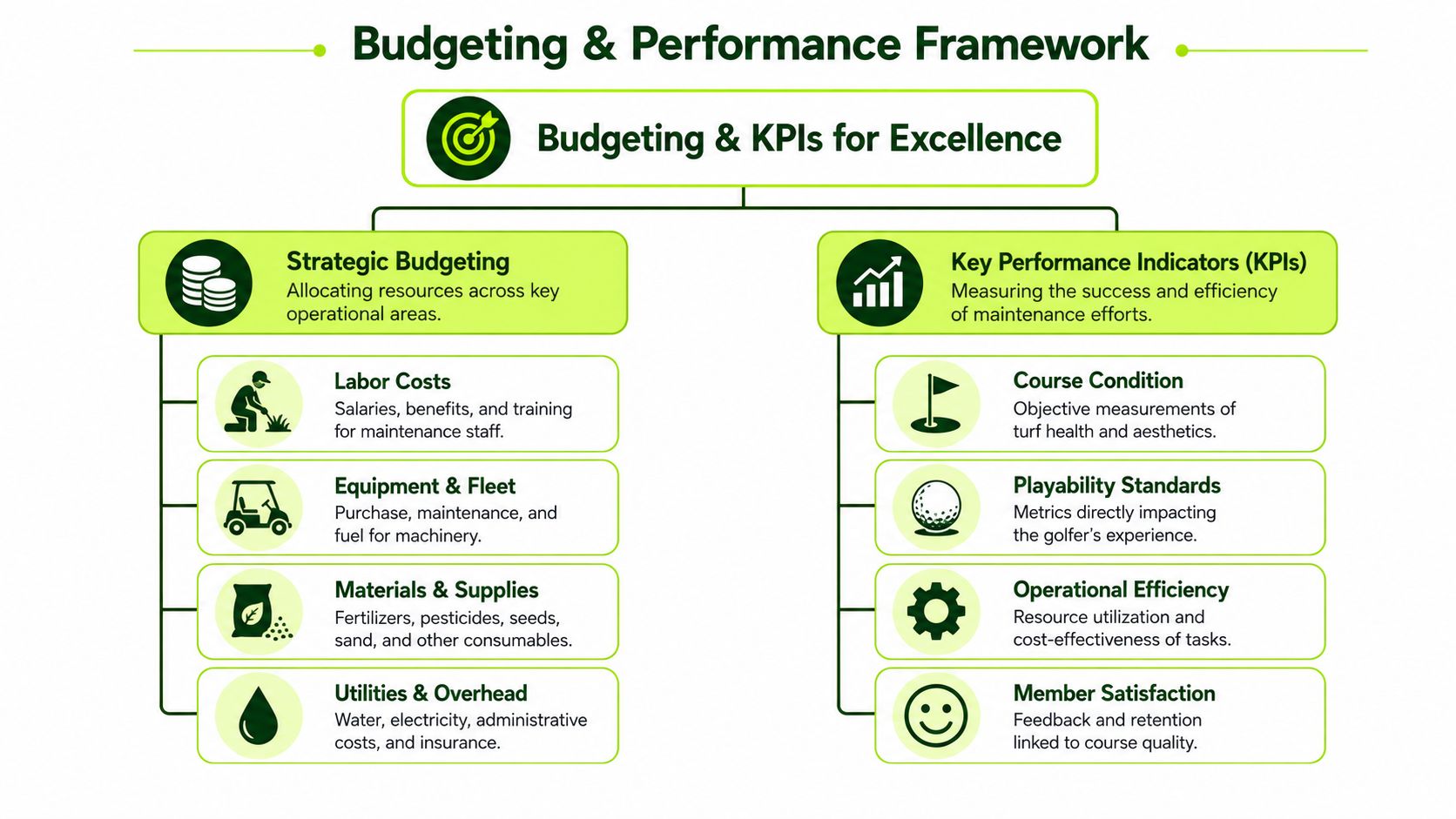
A practical maintenance budget usually needs four separate views, not one blended total.
- Operating labour: Salaries, seasonal support, training, and cover for essential tasks.
- Fleet and equipment: Purchase, lease, service, repair, and replacement planning.
- Materials and inputs: Fertiliser, seed, sand, fuel, oils, and everyday consumables.
- Utilities and overhead: Irrigation-related costs, workshop overhead, and broader support costs.
That structure gives committee members a better view of what can flex and what can't. It also prevents the common mistake of treating one-off machinery needs as if they were routine monthly costs.
Track the right KPIs
Course KPIs need to be useful to both the course manager and the board. If a measure can't inform a decision, it isn't helping.
The most useful indicators are often operational and member-facing at the same time:
| KPI area | What to watch | Why it matters |
|---|---|---|
| Course condition | Consistency of key surfaces | Reflects the product members actually buy |
| Playability | Availability, disruption levels, recoverability after work | Shows whether standards are sustainable |
| Efficiency | Task completion, machinery uptime, labour deployment | Reveals where budget is being absorbed |
| Member response | Complaint themes, praise patterns, repeat issues | Connects course spend to member sentiment |
A good KPI set also helps clubs avoid a false economy. If spend is cut but availability falls, disruption rises, and member complaints increase, the club hasn't saved money in any meaningful sense.
Link maintenance to commercial performance
Course budgeting becomes more persuasive when managers connect it to member retention, pricing confidence, and conversion quality. That's the broader lesson behind understanding the real ROI of golf club marketing. Marketing works better when the product supports the promise, and the course is the core product.
The strongest budget conversations usually sound less like procurement debates and more like strategy discussions. What are we trying to protect. Where does quality matter most. Which spend supports long-term reputation rather than short-term appearance.
Sustainability and Modern Maintenance Techniques
Some clubs still hear the word sustainability and assume compromise. In practice, the best modern maintenance programmes use sustainability to improve resilience, reduce avoidable labour pressure, and make standards easier to hold.
That matters because maintenance teams are already stretched. Any technique that cuts non-essential workload without damaging playability deserves serious attention.
Naturalised rough is a commercial decision
One of the clearest examples is rough management. Many clubs still mow rough on a broad, routine basis because that's how it's always been done, not because every hectare needs the same treatment.
UK clubs can spend 5+ full working days per week on rough mowing on an 18-hole course, and a naturalised rough strategy can reduce mowing time by 30 to 40% according to the naturalised rough discussion referenced here. In a market where lack of skilled labour is the industry's top challenge, that's not a niche agronomy tweak. It's an operating model decision.
The benefit isn't only lower mowing demand. Naturalised areas can also sharpen visual contrast, frame holes more effectively, and direct maintenance attention back to the surfaces golfers judge most closely.
What sustainable maintenance actually looks like
A sensible sustainability plan usually includes a mix of practical choices rather than one big programme.
- Integrated pest thinking: Treat the root cause where possible instead of reaching first for repeat applications.
- Water discipline: Match irrigation to need, not habit.
- Selective intensity: Keep elite standards where golfers experience them directly and lower intensity where they don't.
- Habitat value: Use out-of-play areas more intelligently instead of maintaining every zone to the same visual standard.
Sustainable maintenance works best when it removes work that adds little golfer value and protects work that affects perception immediately.
What doesn't work
Clubs get this wrong in two common ways. The first is announcing an environmental initiative that members interpret as neglect because the visual presentation changes without explanation. The second is trying to maintain every part of the site at the same intensity while also claiming to be sustainable.
Neither approach lasts. Members accept change when the logic is clear and the playing surfaces improve. They don't accept untidy edges, inconsistent messaging, or a drop in standards on the parts of the course they use most.
The best sustainable maintenance of golf courses is selective, deliberate, and communicated early.
Connecting Course Quality to Membership Revenue
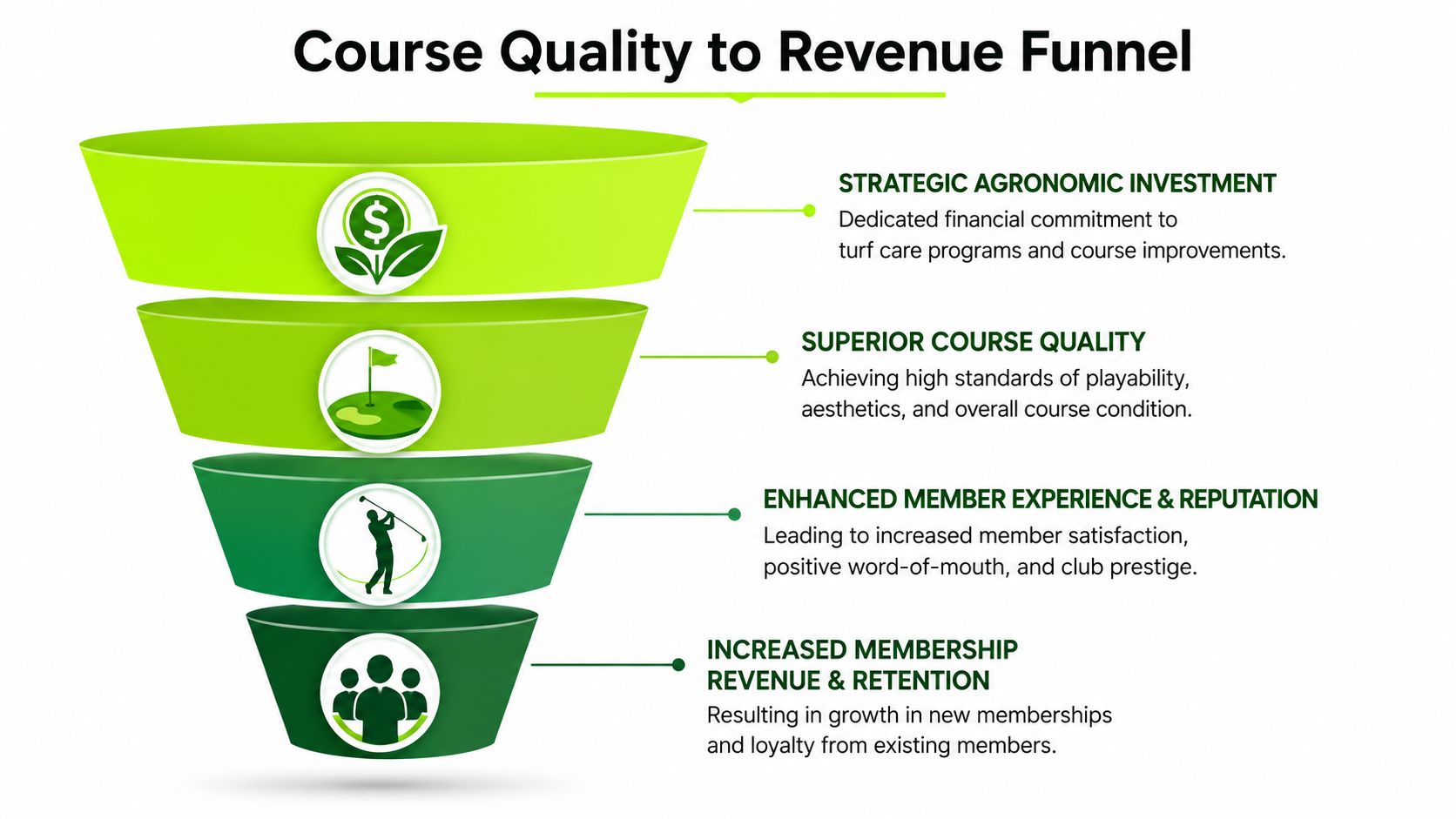
Course quality creates demand. That's the commercial truth many clubs already sense but don't fully operationalise. If the greens are healthy, the site presents well, and members speak positively about the course, enquiries usually follow.
But demand on its own doesn't create revenue. A club still needs a process that captures the enquiry, responds quickly, tracks the lead, and moves that person towards a visit, a conversation, and a decision.
The hidden leak after the enquiry arrives
In the UK, 30% of golfers report their club has a waiting list, yet the average response time to new enquiries is still 30 hours, and faster response times are linked to higher conversion rates according to UK golf membership and enquiry response reporting.
That gap matters. Clubs spend heavily to maintain the product, then lose momentum at the exact moment a prospect raises their hand. The issue isn't always lack of interest. It's often lack of process.
Typical breakdowns look familiar:
- No lead visibility: Enquiries land in personal inboxes and disappear.
- Slow first contact: The prospect cools off before anyone responds properly.
- No conversion tracking: The club can't see which sources produce members.
- Manual follow-up: Staff intend to chase, then the week gets away from them.
Systems beat effort
Committee-led clubs and busy managers often get caught out. They rely on conscientious people rather than a reliable system. That works until annual leave starts, inboxes get busy, or one key person leaves.
A stronger setup usually includes:
- Immediate acknowledgement so the prospect knows the enquiry was received.
- Clear ownership so one person is responsible for the next step.
- CRM visibility so every enquiry, note, and follow-up sits in one place.
- Nurture sequences so interested prospects don't vanish after one missed call.
Clubs trying to improve visitor and membership income often discover the same weakness across different revenue lines, which is why this broader view of boosting golf club green fee revenue is useful. Revenue doesn't usually stall because clubs have no demand. It stalls because demand isn't handled consistently.
The full return on maintenance
A well-maintained course should make sales easier. It should reduce objections, increase pride among existing members, and improve the quality of every viewing. But that return only becomes predictable when the commercial side is organised enough to capture it.
If your course is good enough to create demand, your systems need to be good enough to convert it.
The clubs that grow most steadily usually understand both sides of the equation. They invest in agronomy to protect the product. They invest in response speed, lead tracking, and structured follow-up to protect the outcome.
If your club is generating interest but still losing enquiries through slow follow-up, poor visibility, or manual admin, GolfRep helps build a more predictable pipeline. We work exclusively with golf clubs in the UK, combining lead generation with CRM structure, automated follow-up, and conversion tracking so the demand your course creates has a better chance of turning into revenue.
Ready to tap into our proven growth system?