Choosing Golf Course Management Companies: A 2026 Guide

Most advice about golf course management companies starts in the wrong place. It assumes the club's problem is general management, so the answer must be a management company.
That's lazy thinking.
For many UK clubs, the primary failure sits much closer to the front door. Enquiries come in and no one owns them. Response times drift. Prospects disappear into inboxes. Committee members ask how marketing is performing, but no one can track an enquiry from first contact to paid membership. If that system is broken, hiring a management company won't fix the underlying issue unless that partner also fixes lead visibility, follow-up and conversion.
Golf clubs don't usually suffer from a total absence of interest. They suffer from poor handling of interest. That distinction matters because it changes what you should buy, who you should trust and what success should look like.
Rethinking the Need for a Management Company
When a club's numbers soften, committees often jump straight to the biggest intervention available. Bring in outside management. Hand over operations. Hope expertise solves everything.
Sometimes that's justified. Often it isn't.
A club can have an excellent course, a decent local reputation and healthy demand in its catchment, yet still underperform because enquiries aren't treated like a pipeline. They're treated like admin. That means no agreed response standard, no central record of conversations, no proper follow-up and no reliable way to see where prospects stall.
Fix the diagnosis before you change the operator
Before you shortlist golf course management companies, ask harder questions internally:
- Who owns incoming enquiries: Is it the secretary, the pro, the office team, or nobody in particular?
- How quickly do prospects hear back: Not what you hope happens. What takes place.
- Can you see the pipeline: Can the committee review open enquiries, booked visits, pending decisions and signed members in one place?
- Do you track conversion: Can you tell which lead sources produce tours, applications and revenue?
- Is follow-up systemised: Or does it depend on who happens to be on shift?
If your answers are vague, your problem isn't “we need management”. Your problem is “we don't have a growth engine”.
Practical rule: Don't outsource confusion. Fix the process or insist your partner can.
That's why governance-minded clubs should spend time on operational resilience before they sign anything. If you want a sensible framework for that broader thinking, GolfRep's view on future-proofing golf clubs is a useful place to start.
The popular advice is too broad
A management company can improve staffing, standards and reporting. But if membership growth is one of your goals, broad competence isn't enough. You need a repeatable system that handles demand properly.
That means the decision isn't just “Should we hire a management company?” The better question is, “What exactly is broken, and can this partner fix that specific system?”
What Golf Course Management Companies Actually Do
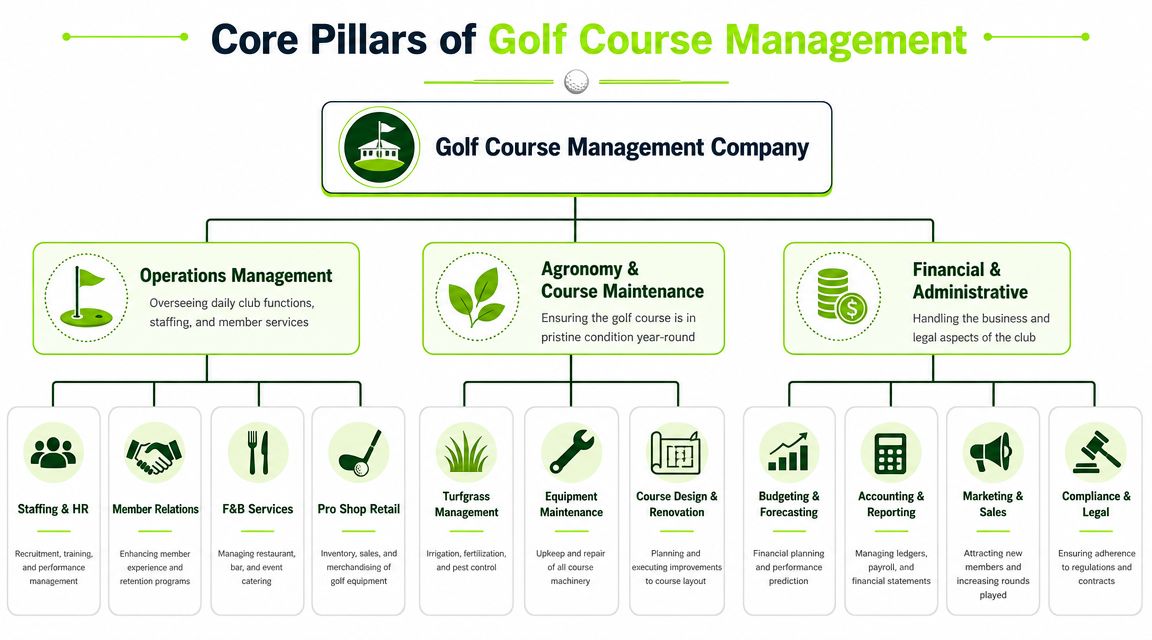
Golf course management companies do far more than cover staffing gaps or tidy up operations. The better ones install control. They set standards, assign ownership, build reporting rhythms and remove the committee from daily firefighting.
Operations sits at the centre
Most providers start with day-to-day operations. That usually means staffing, rotas, training, service standards, member communications and oversight of clubhouse activity. At stronger clubs, these tasks already exist. The difference is whether they run through a documented operating system or live in someone's head.
Good operators also bring discipline to front-of-house consistency, complaint handling, event delivery and staff accountability. At a resort or multi-amenity site, they often coordinate golf with hospitality systems. At a member-led club, they become the layer that stops committee decisions from disrupting the staff team every week.
Relief comes fast when this is done properly. Reporting lines become clear. Service issues get handled earlier. Fewer decisions drift.
The course, the clubhouse and the numbers
Most providers group their offer into three working areas.
| Area | What it usually covers | What to watch |
|---|---|---|
| Agronomy and maintenance | Course conditioning, machinery oversight, seasonal planning, renovation coordination | Whether standards are written down, inspected and tied to budget reality |
| Food, beverage and retail | Bar, catering, events, stock, margins, pro shop processes | Whether golf, hospitality and stock data sit in one reporting view |
| Finance and admin | Budgeting, payroll, management accounts, purchasing, compliance support | Whether reports arrive on time and make sense to the committee |
On paper, every management company can describe these functions. The gap appears in execution. Strong firms use documented workflows, named owners, service levels and weekly reporting. Weak firms depend on a capable general manager and hope standards hold.
If you want an outside benchmark for that kind of process discipline, this practical agency workflow framework is worth reading. It is not golf-specific, but the operating principle carries across. Repeatable workflows beat heroic effort.
Marketing and sales expose the biggest gap
Committees need to stop accepting vague promises.
Many golf course management companies say they handle marketing and sales. In practice, that can mean social posts, a few email campaigns, basic brochure updates and someone answering the phone. None of that guarantees membership growth. It only proves activity took place.
Your concern is the enquiry-to-member system. Who captures leads. How quickly prospects hear back. Whether visits are booked consistently. How follow-up is tracked. Which campaigns produce applications. What happens to a prospect who goes quiet for 30 days.
Ask for the workflow, not the service list.
A capable partner should be able to map the full journey from first enquiry to signed member, show who owns each stage, and report conversion by source, offer and staff member. If they cannot do that, they are managing tasks, not building revenue.
That is also why clubs should examine the commercial mechanics behind the marketing promise. A provider can spend money and still produce weak results if there is no pipeline discipline underneath it. If you need a clearer view of what those activities should cost and how to judge them, review this breakdown of golf club marketing costs and budget expectations.
The strongest management companies connect operations and sales instead of treating them as separate departments. Membership enquiries feed into a tracked pipeline. Tours are scheduled against staff availability. Follow-up sits inside a clear process. Management reports show movement, bottlenecks and conversion rates. That is the standard to look for.
A management company that cannot explain its systems will struggle to improve your results.
Understanding Service and Pricing Models
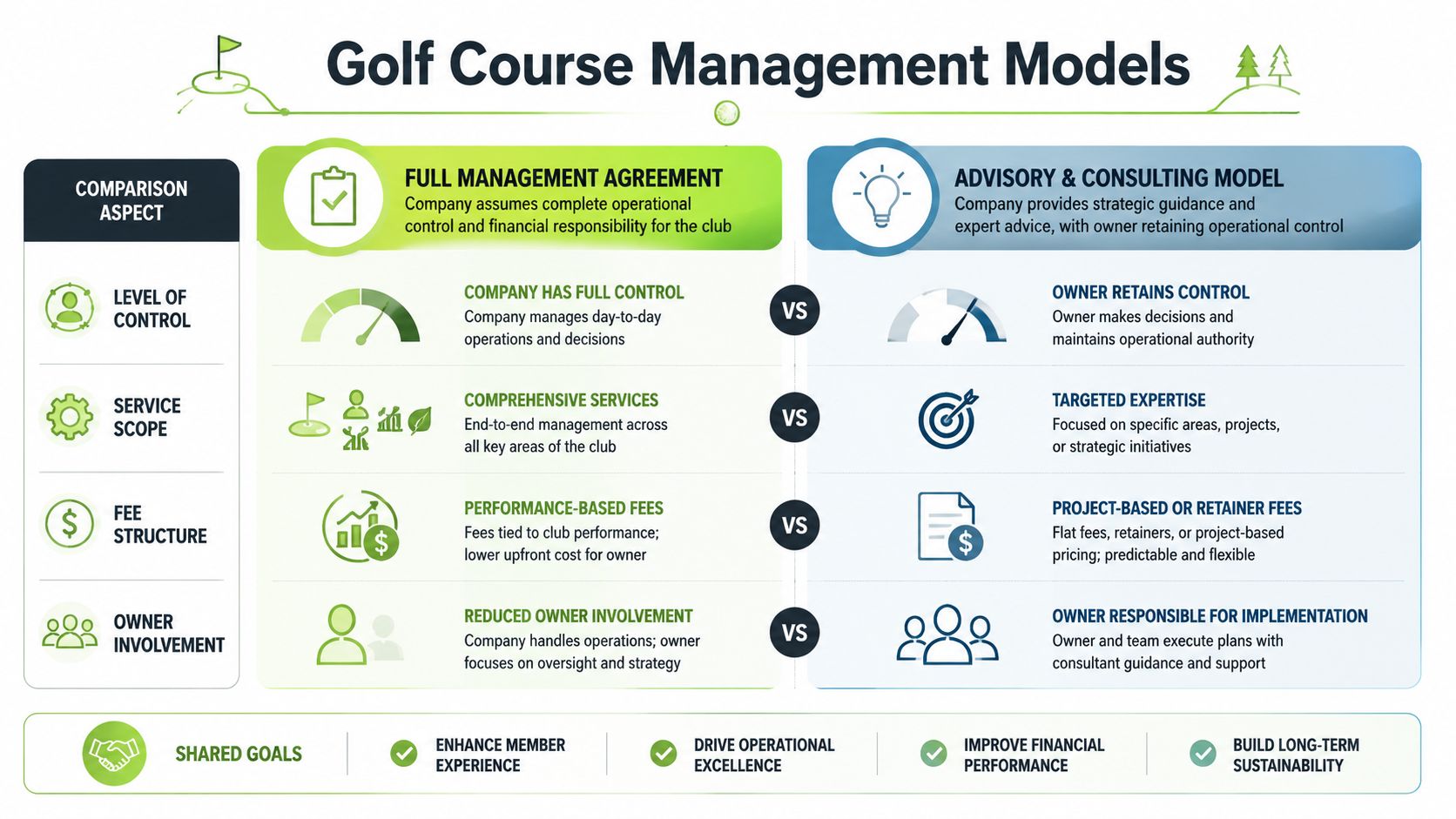
The commercial model matters as much as the service list. Clubs often focus on the monthly fee and miss the bigger issue, which is control. If you don't understand who makes decisions, who carries risk and what sits outside scope, you'll sign the wrong deal even if the headline price looks sensible.
Full management agreements
Under a full management agreement, the external company takes broad operational control. The club or owner still holds the asset, but the operator handles staffing, standards, budgeting, purchasing and much of the day-to-day decision-making.
This model suits clubs that need decisive change, lack internal leadership capacity or want to professionalise quickly. It can also suit owners who care more about outcomes than direct operational control.
The trade-off is obvious. You gain management depth but lose direct grip on the daily running of the club.
Revenue share and incentive-led structures
Some providers align their fees to revenue, performance or a blend of base fee plus incentives. That can sound attractive because it suggests shared interest.
Sometimes it is. Sometimes it just shifts complexity into the small print.
If a partner earns more when topline revenue rises, ask how they'll protect margin, member experience and pricing discipline. A club can increase short-term sales and still weaken its long-term position if the operator chases volume without proper retention.
Advisory and a la carte support
The lightest model is advisory, consulting or a la carte support. The club keeps control and buys specialist help for defined problems such as agronomy planning, commercial strategy, membership growth or systems setup.
This model works well when the club already has capable people but lacks process, structure or outside perspective. It also suits committee-led clubs that want accountability without handing over the whole operation.
If your core issue is inconsistent enquiry handling, a full management contract may be excessive. A tighter commercial and CRM fix may solve more than a broad outsourcing deal.
Compare the real implications
A simple comparison helps committees cut through sales language.
| Model | Club control | Scope | Best fit |
|---|---|---|---|
| Full management | Lower | Broad operational delivery | Clubs needing strong external control |
| Revenue or incentive-led | Medium to lower | Broad, with performance elements | Clubs comfortable with variable fees |
| Advisory or a la carte | Higher | Targeted support | Clubs with team capacity but weak systems |
Don't let a provider define the frame. Define it yourself first. Are you buying leadership, execution, reporting, growth systems, or all four?
Committees also need to model the practical burden on the club side. A cheaper advisory retainer can become expensive if your internal team still has to implement everything. A broader contract can become poor value if it includes services you won't use.
If you're weighing what should be outsourced versus what should be built internally, GolfRep's piece on how much golf club marketing costs is a useful companion because it forces the right commercial question. Not “What's the fee?” but “What system are we paying for?”
Outsourcing vs Building In-House Systems
This is the decision most clubs frame badly. They act as if the choice is binary. Outsource growth or build it in-house.
That's the wrong argument.
The fundamental choice is whether your club will run on systems or on goodwill. You can outsource. You can build internally. Either can work. But if enquiries still sit in shared inboxes, follow-up still depends on memory and nobody can see pipeline movement, both models fail.
The commercial opportunity is there. The UK golf club market is projected to reach USD 280.7 million by 2027, with a CAGR of 2.5% from 2020 to 2027. Demand isn't the only question. Operational readiness is.
What outsourcing gets right
A good external partner can bring:
- Decision speed: Fewer committee bottlenecks and clearer responsibility.
- Specialist knowledge: Better commercial, operational and service discipline.
- Process consistency: Tasks get documented and repeated properly.
- Leadership cover: Useful when the club lacks management depth.
That can be enough if the current operation is fragmented. Some clubs need a significant reset.
But outsourcing is not a substitute for visibility. If the partner can't show enquiry response standards, lead ownership and conversion reporting, you've merely moved the blind spot outside the building.
What in-house often gets wrong
Clubs love the idea of keeping control. Fair enough. But “in-house” too often means one capable person holding too much together manually.
That person answers the phone, replies to email enquiries, books taster rounds, sends membership information and chases decisions when they remember. It works until they're off, busy or gone.
Then the pipeline disappears.
Build the engine, then decide who drives it
The practical answer for many clubs is hybrid. Keep strategic ownership and club identity internal. Build a proper operating system around enquiries, follow-up and reporting. Then decide which parts need outside help.
At minimum, every club should have:
- A single enquiry capture point: No scattered forms, inboxes and handwritten notes.
- Response standards: Who replies, how fast and with what next step.
- CRM visibility: Every live prospect in one place.
- Stage tracking: Enquiry, contact made, visit booked, visit attended, application pending, member joined.
- Follow-up automation: So prospects don't vanish because the office got busy.
Clubs don't lose members only because competitors market better. They lose members because they fail to respond, fail to follow up and fail to measure.
If an external management company can implement that properly, good. If your internal team can own it with the right support, that can be even better. The key is to stop treating growth as a series of isolated tasks. It's a managed pipeline.
A simple decision test
Ask your committee these four questions:
- Do we lack leadership capacity or just system capacity?
- Can our current team improve if given the right tools and process?
- Will an outside partner provide transparent pipeline reporting?
- If memberships rise, will we know why?
If the answer to the last question is no, you're not ready to scale. You're ready to get organised.
A Practical Checklist for Evaluating Partners
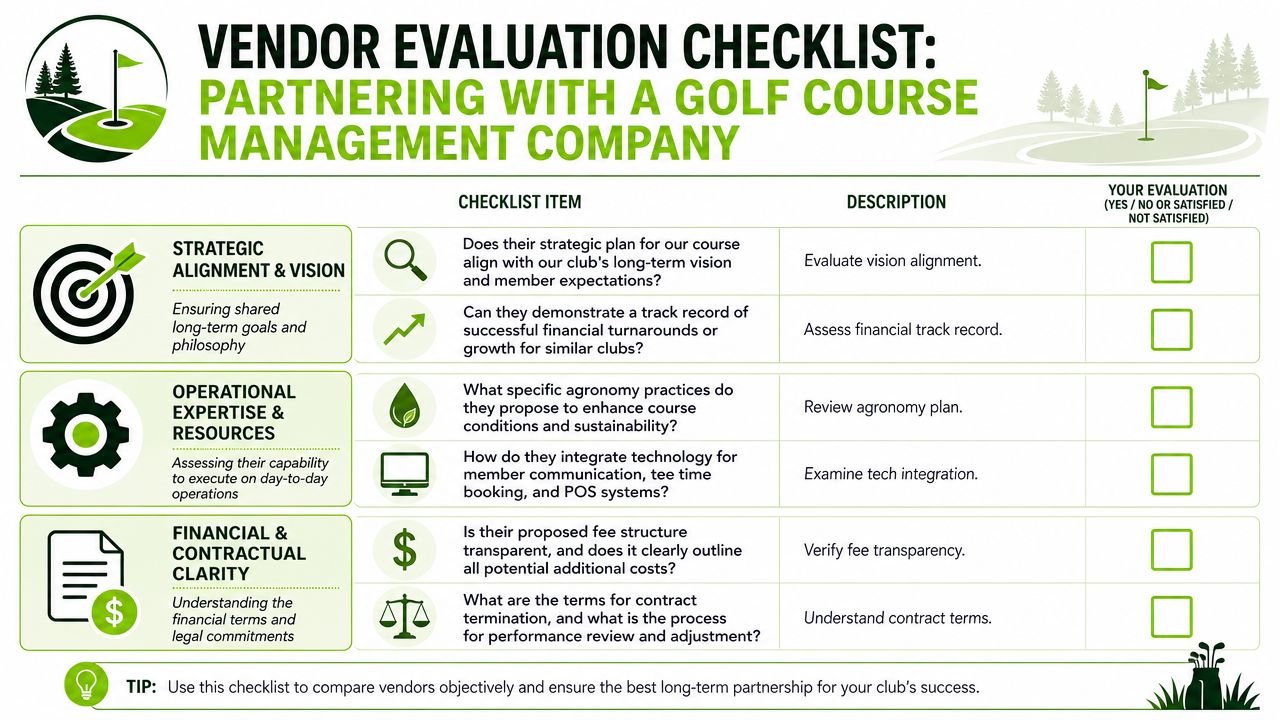
The wrong partner will give you more activity, more meetings and more reports, then leave the core problem untouched. Your club does not need another polished presentation about operations. It needs a partner that can build a repeatable system for turning enquiries into members and show the committee exactly how that system performs.
Start by forcing specificity.
Any firm can say it supports growth. Ask them to map your membership pipeline from first enquiry to signed application, with names, systems, service levels and reporting points. If they stay high-level, they do not have a working model. They have sales language.
Use these questions first:
- Where does every enquiry enter the system? Website forms, calls, walk-ins, visitor activity, referrals and event leads should feed one process.
- Who owns first response? Ask for the role and the expected response time.
- What happens after first contact? You want scheduled follow-up, not a vague promise to “keep in touch.”
- What can the committee see each week? Dashboard access, stage-by-stage reporting and lead source performance should be standard.
A serious operator should answer those quickly and without jargon.
Check whether they can manage a pipeline, not just a property
A lot of golf course management companies are strong on maintenance, staffing and day-to-day administration. That may help the club run better. It does not automatically help the club grow.
Your evaluation should focus on whether they can identify demand, capture it, follow it up and convert it. If your committee is also weighing alternative growth structures, this guide to golf club franchise models and operating control is a useful comparison point.
Ask for evidence of process maturity:
| Question | Why it matters |
|---|---|
| Can you track an enquiry from first contact to joined member? | Shows whether they understand progression and accountability |
| Can you show a live pipeline by stage? | Gives the committee visibility into current opportunities |
| How do you identify stalled prospects? | Reveals whether follow-up is managed or left to chance |
| Can you connect visitor behaviour to membership outreach? | Shows whether guest activity is used as a conversion signal |
| What report would we review at board or committee level each month? | Tests whether reporting is built for governance, not just managers |
Put their operating discipline under pressure
Do not ask whether they care about communication or member experience. Those answers are worthless. Ask what happens in real situations.
Use scenarios like these:
- A prospect submits an enquiry after office hours. What happens before the next business day starts?
- A visitor plays twice in six weeks and spends in food and beverage. How is that flagged for membership follow-up?
- A club tour is completed, then the prospect goes quiet for ten days. What task, reminder or escalation is triggered?
- The committee wants to know which lead sources produce actual members, not just enquiries. What report do you provide?
Strong partners answer with process, ownership and timing. Weak partners answer with intentions.
Test fit with your governance model
Clubs often overvalue technical capability and underweight governance fit. That is a mistake. A partner can have good systems and still fail because they cannot work inside a committee-led environment, respect approval cycles or train front-of-house staff to follow one standard every time.
Ask direct questions:
- How do you report to committees and subcommittees?
- How do you handle delayed approvals without letting leads go cold?
- How do you train reception, bar and golf operations staff to spot and record membership opportunities?
- How do you protect club identity while enforcing one sales process?
- What happens when existing staff ignore the new system?
Choose the partner that gives clear process answers, accepts scrutiny and is willing to be measured. Avoid the one that charms the room and leaves the hard parts vague.
Decoding the Contract and Avoiding Hidden Costs
Clubs get caught not at the pitch stage, but at the contract stage.
The headline fee looks reasonable. The scope appears broad. Everyone feels relieved that a solution is finally on the table. Then the extras appear. Central charges. Admin allocations. support costs. marketing levies. travel. project work that somehow wasn't included after all.
That isn't a small issue. A 2025 Golf UK report found that 68% of private clubs in England and Scotland overpaid by £12,000 to £45,000 annually due to undisclosed service charges in management contracts. If you're not reading the agreement line by line, you're not being prudent. You're being optimistic.
What to look for in the small print
Start with a blunt review of anything that sounds centralised, variable or non-specific.
Focus on these areas:
- Management fee definition: What exactly is included in the base fee?
- Central overhead allocations: Are you paying for head office functions without clear line-item detail?
- Marketing charges: Is “marketing support” included, or billed separately through another budget line?
- Technology fees: CRM, booking, reporting or support software can sit outside the core agreement.
- Travel and expenses: Are site visits included or rechargeable?
- Project work: Renovations, recruitment, training or system implementation often create extra invoices.
The contract questions that matter
Use a direct question set. Don't soften it.
| Ask this | Why it matters |
|---|---|
| Please list every service included in the management fee | Forces scope clarity |
| Please list every item that may be billed separately | Exposes hidden cost categories |
| How are central services allocated to our club | Prevents vague overhead charging |
| Who approves additional spend and at what threshold | Protects governance control |
| What reporting will support each invoice line | Stops unexplained pass-through costs |
Watch for vague language
The most dangerous wording is usually the most harmless-sounding. Terms like “administrative support”, “group services”, “commercial oversight” or “marketing contribution” can hide broad charging rights if they aren't defined.
If a provider says “that's standard”, don't let that end the conversation. Standard for them may still be poor value for you.
A clean contract doesn't just protect cost. It protects trust.
Termination terms also deserve attention. You need to know what happens to staff, systems, data access, member records and supplier relationships if the agreement ends. A club that can't regain operational control cleanly is taking on more dependency than it realises.
Golf clubs should also think about structure. Some arrangements start to resemble franchise logic without offering franchise clarity. If you want a useful lens on that difference, GolfRep's article on the golf club franchise model helps sharpen the distinction between operational support and commercial lock-in.
Insist on invoice-level transparency
A good partner shouldn't resent transparency. They should welcome it.
Ask for sample invoices before signing. Ask how costs are coded. Ask what the board will receive each month. If the answer is a summary sheet with broad categories, that's not enough.
You're not being awkward. You're governing properly.
Measuring Success with the Right KPIs
If success is defined as “things feel better”, the committee will never know whether the partnership is working. You need measurable outcomes. Not vanity metrics. Not vague satisfaction. Real operating numbers tied to growth, service and financial performance.
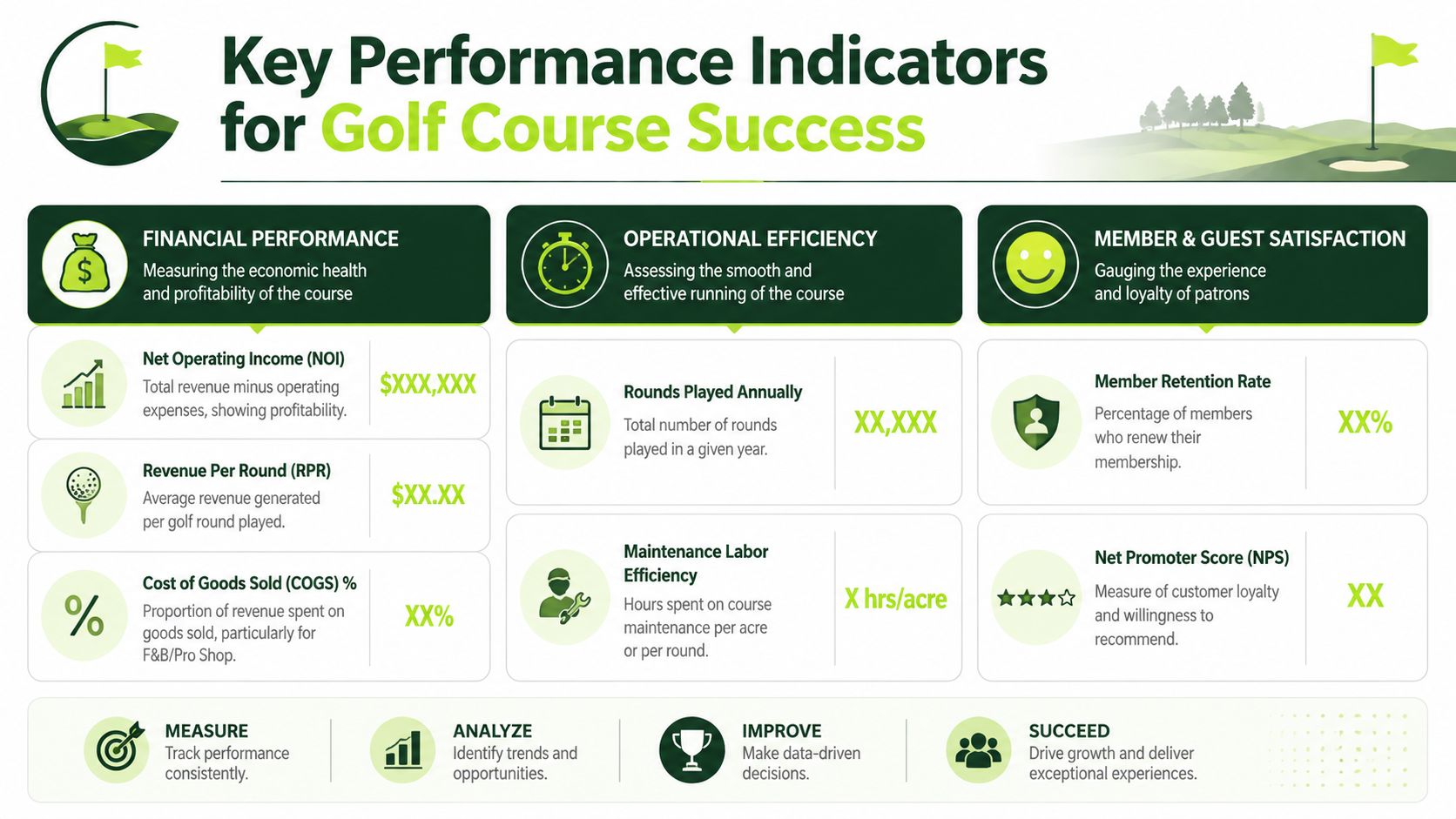
Start with the commercial pipeline
For clubs focused on membership and visitor revenue, the first KPI set should sit around the enquiry journey.
Track:
- Enquiry response time
- Lead-to-tour conversion rate
- Tour-to-application conversion rate
- Application-to-member conversion rate
- Lead source quality
- Ageing open enquiries
These numbers tell you whether the club is handling demand properly. They also show where the process breaks. If response time is strong but tours are weak, the issue may be messaging or offer fit. If tours are strong but joins are weak, the sales conversation or follow-up may be poor.
Add operational KPIs that link to revenue
A management company also needs to prove it can run the club efficiently. In this context, many committees separate operations and growth when they should connect them.
For example, pace of play is not just a course experience issue. It affects capacity and revenue. Tagmarshal reports that AI-driven pace-of-play optimisation can reduce on-course congestion by 20–30% and increase revenue per round by enabling 15–20% more daily tee-time slots, based on analysis of more than 95 million rounds.
That matters because it shows what proper KPI thinking looks like. Better operations should lead to measurable commercial gain.
Build a board-level scorecard
Your committee or ownership group shouldn't need to read through operational noise to understand performance. A concise monthly scorecard is enough if it includes the right measures.
Use a board pack built around three groups:
| KPI group | What to include | Why it matters |
|---|---|---|
| Growth | Enquiries, response time, stage conversion, joiners | Shows pipeline health |
| Operations | Capacity use, tee-time flow, service bottlenecks, issue resolution | Shows delivery quality |
| Economics | Revenue per round, spend per guest, acquisition efficiency, retained value | Shows whether growth is profitable |
Don't let reporting stop at output
The weakest operators report activity. The better ones report outcomes.
Activity is “we ran campaigns”, “we posted content”, “we attended events”. Outcome is “we generated qualified enquiries, converted visits and retained members”. Committees should insist on the second category.
If a partner can't tie work to pipeline movement, they're asking you to fund effort rather than results.
The same principle applies whether the club outsources broadly or keeps most functions in-house. The scoreboard doesn't change. Only the delivery model changes.
A good KPI framework also protects relationships. It lowers emotion in review meetings. Instead of arguing over impressions, personalities or isolated anecdotes, the conversation moves to evidence. Are leads being answered? Are visits converting? Are members staying? Is operational performance supporting spend and retention?
That's the standard clubs should hold. Not “Are we busy?” but “Can we see what drives growth, where it stalls and what needs fixing next?”
If your club wants predictable membership growth, clearer enquiry handling and proper pipeline visibility, GolfRep helps golf clubs build the systems behind the result. That means lead generation paired with structured follow-up, CRM tracking and reporting that shows exactly what's converting.
Ready to tap into our proven growth system?