Future Proofing Golf Clubs: A Guide to Predictable Revenue & Membership Growth
The real challenge facing UK golf clubs today is not a lack of interest in the sport. The problem I see time and again is operational. Many clubs are simply not set up to convert the enquiries they already receive into tangible, predictable revenue.
This is not a lead generation problem; it is a lead conversion problem. The solution lies in building structured systems that turn interest into income.
The Reality on the Ground for UK Golf
Too often, discussions about the health of UK golf miss the point. The narrative suggests a dying sport, but that is far from the truth. The problem lies within our own clubhouses and offices, where potential revenue slips through our fingers because of outdated, manual processes.
Think about it. Many clubs still rely on a paper diary behind the bar, a single shared email account for all enquiries, and one overburdened staff member trying to juggle everything. That model is no longer fit for purpose.
Why Old Ways Are Costing You Dearly
Today's customer, whether a potential new member or a visiting society, expects a fast, simple, digital experience. They book flights, reserve restaurant tables, and order shopping online in minutes. When they enquire about membership and have to wait days for a reply or can only call during limited office hours, you create a barrier.
That friction is a deal-breaker. They will simply move on to a club that makes it easy for them.
The biggest leak in most golf clubs is not a lack of people knocking on the door. It is the inability to effectively track, manage, and convert the enquiries that are already coming in. Without a proper system, opportunities are lost every single day.
The numbers back this up. Between 2018 and 2023, traditional golf club membership in the UK fell by around 15%, dropping from 681,000 to about 580,000. Rigid annual subscriptions, often costing upwards of £1,000, are a tough sell for younger players who prioritise flexibility. This trend will only continue unless clubs adapt. If you want to dig deeper, you can explore more on these golfing trends and their implications for the future.
What a 'Future-Proofed' Club Actually Looks Like
So, what does it mean to be 'future-proofed'? It is about building a resilient and predictable business. It is about moving away from the rollercoaster of seasonal income and creating a reliable pipeline for growth, month after month.
This is achieved by putting structured systems in place that give you a clear view of every single enquiry, from the first click on your website to a handshake on the first tee.
To get there, you will need to:
- Embrace modern tools: A central Customer Relationship Management (CRM) system is non-negotiable. It is your single source of truth for every lead and interaction.
- Automate simple tasks: Set up automated follow-ups to ensure every enquiry gets a prompt, professional response, day or night.
- Diversify your income: Look beyond the traditional membership model. Think corporate packages, a modernised food and beverage operation, and flexible 'pay-and-play' options that attract a wider audience.
The operational differences between a club clinging to the past and one prepared for the future are stark.
Traditional vs Future-Proofed Club Operations
| Area of Operation | Traditional Approach (At Risk) | Future-Proofed Approach (Resilient) |
|---|---|---|
| Enquiry Management | Manual tracking (spreadsheet, email inbox, paper notes). Slow, inconsistent responses. | Centralised CRM. Automated follow-ups. Instant, professional communication. |
| Decision Making | Based on gut feeling, anecdotes, and historical habits. | Data-driven insights from CRM and financial reports. |
| Revenue Streams | Heavily reliant on annual membership fees. Some green fee income. | Diversified income from memberships, visitor golf, corporate events, F&B, retail, and academy. |
| Marketing | Sporadic local ads. Word-of-mouth. Limited digital presence. | Targeted digital marketing. Active social media engagement. Data-driven campaigns. |
| Member/Visitor Experience | Inconsistent service dependent on which staff member is on duty. | Standardised, high-quality experience enabled by technology and empowered staff. |
| Staff Focus | Bogged down in repetitive administrative tasks. Reactive. | Focused on high-value activities: building relationships and delivering exceptional service. |
Ultimately, a future-proofed club is simply a more efficient, intelligent, and resilient business. It is one where your team is not drowning in admin but is free to focus on what they do best: creating an incredible experience that keeps people coming back.
Building a Predictable Revenue and Membership Pipeline
To truly future-proof our clubs, we must stop relying on seasonal spikes and good fortune to hit membership targets. The aim should be to build a consistent, year-round engine for growth, but for most clubs, there is a major roadblock.
The truth is, the problem is not usually a lack of interest from potential members. The real issue is a fundamental breakdown in how new enquiries are handled. Club managers often think they need more leads, when in reality, the goldmine is in properly managing the ones they already have. It is a process problem, not a promotion problem.
The Anatomy of a Modern Growth System
A reliable growth system is not complicated, but it does require a few key pieces working in harmony. It typically starts with smart, targeted local advertising to get your club in front of people who are genuinely searching for a new club. That is the easy part.
The make-or-break moment is what happens next. When someone reaches out, speed is everything. A delay of just a few hours can mean the difference between signing up a new family of members and losing them to the club down the road that replied instantly.
The core principle here is simple: every single enquiry must be captured, responded to immediately, and followed up with a clear, consistent process. This is something that is frankly impossible to do well using spreadsheets and a shared inbox.
A systematic approach does more than just plug the leaks in your pipeline. It immediately tells a prospective member that your club is professional, organised, and values their interest.
The flowchart below shows a story I have seen play out at countless clubs. It is a direct line from manual, disorganised enquiry handling to lost leads and, ultimately, a significant drain on revenue.
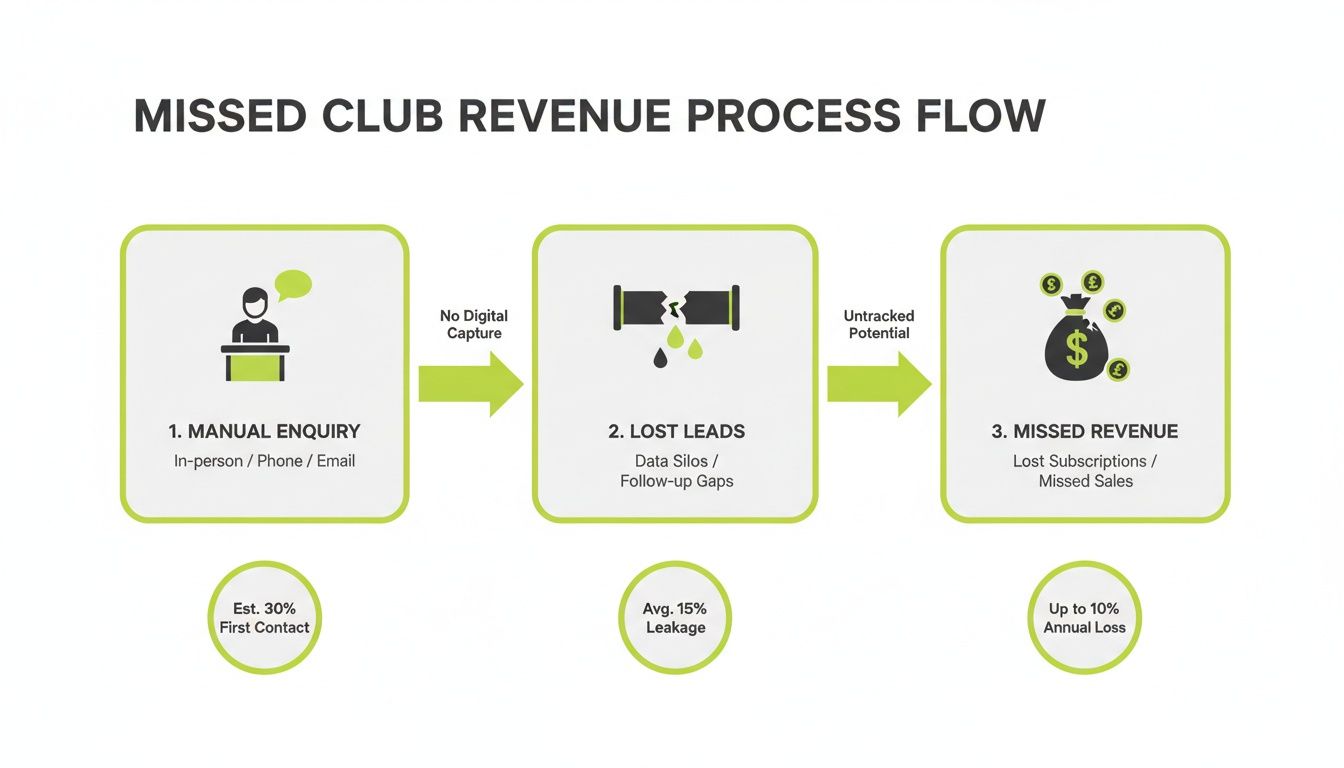
This is the classic "leaky bucket" syndrome. It is a costly, yet entirely preventable, flaw in club operations where a lack of structure leads directly to lost income.
Manual vs. Automated Lead Management: A Scenario
Let's make this real. Imagine a successful marketing campaign brings in 100 new membership enquiries this month. How would your club handle that?
Approach 1: The Manual Method (Spreadsheet & Email)
Your club secretary gets flooded with 100 emails. They spend the next few hours painstakingly copying and pasting names, emails, and phone numbers into a spreadsheet. Only then do they start the slow process of replying, often a day or two after the person first showed interest.
What about follow-ups? They are sporadic at best. The spreadsheet becomes a confusing maze of colour-coded cells and half-remembered notes. Who has been called? Did they reply? After a week, maybe 50% of the leads have had some contact, but consistent follow-up is almost non-existent. The result is a dismal conversion rate and a huge amount of time and money down the drain.
Approach 2: The Automated System (CRM & Automation)
Now, let's contrast that with a modern approach. The same 100 enquiries flow directly into a central Customer Relationship Management (CRM) system. Here is what happens automatically:
- Instant Acknowledgement: Every single person receives an immediate, personalised text or email. It confirms you have received their enquiry and gives them some helpful next steps.
- Systematic Follow-Up: A smart sequence of automated messages kicks in over the next few days, gently reminding them to book a tour or schedule a quick call.
- Complete Visibility: The club manager has one simple dashboard showing exactly where every lead is in the process. You can see who is engaged and who needs a personal phone call at a glance.
- Focused Effort: Your team is no longer bogged down in admin. Their time is spent having quality conversations with warm, interested people who are ready to talk, not chasing cold leads from a messy spreadsheet.
This system ensures all 100 leads are nurtured professionally, dramatically increasing your chances of conversion. By putting a robust process in place, you get predictable results and a far better return on your marketing spend. To dive deeper into these mechanics, you can learn more about effective golf club lead management in our dedicated guide. This is the bedrock of a future-proof revenue strategy for any golf club.
Diversifying Your Revenue Beyond Green Fees
Relying solely on membership dues and green fees is a house of cards. A wet spring, a heatwave in July, or a dip in the economy, and your entire business model is under threat. A truly resilient club thinks beyond the 18th green and builds a business that thrives all year round, transforming itself from just a golf course into a vibrant community hub.
The real goal here is to insulate your club from the whims of weather and golf-specific trends. It is about looking at every asset you have, from the clubhouse kitchen to that function room gathering dust, and asking a simple question: "How can this make money for us, even if nobody is playing golf today?"
Transforming Your Food and Beverage Offering
For too many clubs, the food and beverage (F&B) operation is a functional afterthought for a quick pint and a sandwich after a round. This is a massive missed opportunity. By modernising your F&B, you can pull in a completely new crowd from the local area, people who might not know a birdie from a bogey.
Think about repositioning your restaurant or bar as a destination in its own right. What does that look like in practice?
- Create a separate brand: Give your restaurant a name and identity that stands apart from the golf club.
- Build a menu with appeal: Ditch the tired clubhouse fare. Could you become known for the best Sunday carvery in town? What about themed food nights or a top-notch café that pulls in the morning coffee crowd?
- Open the doors: Actively market your F&B to non-members and make it incredibly easy for them to book a table online.
You need to shift the perception that your clubhouse is an exclusive, members-only fortress. It should feel like a welcoming spot for families, local businesses, and community groups.
Leveraging Your Facilities for New Audiences
Your club’s assets do not stop at the first tee. Most clubs have function rooms, meeting spaces, and car parks that sit empty for huge chunks of the week. These are revenue-generating resources just waiting to be tapped.
Start by thinking about who could use these spaces and package them into compelling offers for both corporate and private customers.
- Corporate Hospitality: Put together packages for local businesses. Think meetings, team-building days (a bit of golf followed by lunch), and full-blown corporate events. A well-run corporate golf day can be incredibly profitable.
- Private Functions: Get the word out that you are the perfect venue for weddings, birthday parties, anniversaries, and other celebrations.
- Community Events: Why not host a summer fete, a Christmas market, or a family fun day? Draw the local community onto your grounds.
Every one of these activities brings in direct revenue. But just as importantly, it introduces new people to your club. They have a great experience, and suddenly you are on their radar for a future membership, a round of golf, or another event. The more positive interactions people have with your facility, the stronger your reputation in the community becomes.
The most resilient clubs we work with are those that have successfully made their clubhouse the centre of local life. They are no longer just a golf club; they are a community asset that operates seven days a week, generating income from a dozen different sources.
Embracing Technology for Year-Round Engagement
Technology also presents some powerful new ways to make money, especially in the off-season or on those rain-soaked days when the course is unplayable. Modern golf simulators are a perfect example, turning an underused indoor space into a year-round attraction.
Simulators appeal to everyone: the serious golfer honing their swing, the beginner who finds the course intimidating, and social groups just looking for a fun evening out. You can build entirely new revenue streams around them:
- Pay-per-hour bookings
- Indoor golf leagues through the winter months
- Coaching and custom fitting sessions
- Corporate and private party packages
This is not just about golf; it is about creating a social, entertaining experience that keeps your clubhouse buzzing and the tills ringing, whatever the weather is doing outside. As clubs explore new ways to bring people in, they should not forget their practice facilities. For more on this, take a look at our guide on the potential of a digital driving range and how it can capture the interest of a new generation.
By weaving together a brilliant F&B offering, versatile event spaces, and modern entertainment tech, you start to build a much stronger foundation for your club. You move away from having all your eggs in one basket and create a diversified, robust business that is ready for whatever the future holds.
Using Digital Systems for Operational Excellence
Any solid plan to future-proof a golf club needs the right tools to turn strategy into results. For many club managers and committees I speak with, the phrase ‘digital transformation’ sounds daunting and expensive. But it is not about the technology itself; it is about what it actually does for you: creates efficiency, gives you clear oversight, and delivers a much better experience for members and visitors.
Let us be blunt. Clubs still clinging to spreadsheets, chaotic shared inboxes, and paper diaries are playing with a serious handicap. These outdated methods are not just inefficient; they are actively costing you money. They create friction for potential members and bury your team in administrative tasks that add zero value. Real operational excellence in 2026 means investing in modern systems that eliminate these bottlenecks for good.

Moving From Spreadsheets to a Centralised CRM
At the core of any modern club operation should be a Customer Relationship Management (CRM) system. Do not think of it as just another piece of software. It is your club’s central nervous system, the single hub for every single interaction you have with a prospect, a member, or a visitor. It is what finally replaces those fragmented spreadsheets and siloed email accounts with one clear source of truth.
Instead of a new membership enquiry getting lost in the secretary’s inbox, a CRM logs it automatically. Every phone call, every email, every form filled out on your website is captured against that person's record.
A good CRM gives you complete visibility. You can see the entire story of an enquiry, from the very first marketing email they opened to the day they sign their membership papers. Without it, you are simply flying blind.
This is the kind of insight that changes everything. You can finally get concrete answers to fundamental business questions: How many new membership enquiries did we get last month? Which marketing channels are actually bringing us the best leads? And, crucially, where in our follow-up process are people losing interest?
The Power of Automated Follow-Up
The single biggest challenge for most clubs is not getting enquiries, it is handling them effectively. A prospective member who enquires on a Saturday afternoon cannot be left waiting until Monday morning for a reply. In that window, they have probably already reached out to, and heard back from, two or three of your local competitors.
This is where automation becomes your most valuable asset. It is not about replacing the personal touch; it is about making sure it happens at the right time. By automating the first few steps, you can:
- Respond Instantly: Every new enquiry gets an immediate, personalised text message or email. This simple acknowledgement confirms you have received their request and tells them what to expect next. It is a small detail that makes a massive first impression.
- Guarantee Consistent Nurturing: A pre-planned sequence of follow-up messages can be sent automatically over the next few days. This keeps your club top-of-mind without anyone on your team having to lift a finger.
- Free Up Your Staff: With automation handling the repetitive, initial follow-ups, your team can pour their energy into what they do best: having meaningful conversations with warm, engaged prospects who are genuinely ready to talk.
This structured approach means no lead ever falls through the cracks because the front desk got busy or someone forgot to follow up. If you want to dig deeper into this, our guide on golf club automation breaks down the practical steps in more detail.
Choosing the Right Technology Partner
When you start looking at technology, it is easy to get lost in a long list of features. The most important things to look for are genuine ease of use and a smooth integration into how you already work. After all, the best system is the one your team will actually use every day.
Look for a partner who truly understands the golf industry, not just a software vendor. A real growth partner, like GolfRep, does not just hand you a login; we help you implement the system and build the strategy to make it successful. The goal is to create a predictable pipeline that combines smart lead generation with a structured follow-up process, all powered by a robust CRM.
Ultimately, this kind of technology is not an expense; it is an investment in efficiency. It gives your team the tools they need to deliver the exceptional service that defines a great club, which in turn drives both member satisfaction and financial stability. This is a cornerstone for any club serious about its long-term success.
The Green and The Group: Your Two Most Valuable Assets
Future-proofing your club goes much deeper than just tweaking membership fees or diversifying your revenue. It comes down to the two things that form the very soul of your club: the quality of the turf under your members’ feet and the strength of the community you build.
An immaculately kept course and a vibrant, welcoming atmosphere are not just perks. They are your most powerful retention tools and the bedrock of your club's legacy. A club’s health is reflected on its tee sheet just as much as its balance sheet. When members are proud of their course and feel a genuine sense of belonging, they do not just stay, they become your most passionate ambassadors.
Getting Course Management Right: The Foundation of Member Satisfaction
In an era of soaring costs and heightened environmental awareness, modern agronomy is no longer a conversation confined to the greenkeeping shed. It is a board-level business strategy. Clubs that get smart about sustainable course management are not just ticking a green box; they are unlocking serious long-term financial efficiencies.
The focus has to shift to proactive, data-driven methods that give you better results with fewer resources. The key areas I always advise clubs to tackle are:
- Smarter Water Use: Forget watering on a fixed schedule. Modern smart irrigation systems, which use live weather data and soil moisture sensors, can slash your water consumption and the hefty bills that come with it.
- Integrated Pest & Disease Management: Blanket-spraying your course is an outdated and expensive habit. A data-led approach, predicting and targeting specific threats, prevents turf disease far more effectively and dramatically reduces your chemical spend and environmental footprint.
- Modern Agronomy Techniques: Simple but effective practices like hollow coring and using advanced, slow-release fertilisers are game-changers. They build healthier, more resilient turf that provides better playing surfaces all year round.
Investing in sustainable course management is not just an expense line. It is a strategic investment in the quality of your core product. A healthier course needs fewer costly emergency fixes and consistently delivers the premium experience that members expect for their money.
These practices do not just prepare your course for future climate challenges. They also turn it into a major selling point for the growing number of golfers who care about sustainability.
It's Not Just a Course, It's a Community
While a great course gets people through the door, a strong community is what makes them stay. A club with a stuffy, exclusive, or unwelcoming culture is living on borrowed time. The clubs that are truly thriving are those that have consciously worked to build an inclusive, friendly environment where everyone feels they belong.
This does not happen by accident. It requires deliberate, consistent effort. It means putting yourself in the shoes of a brand-new member, a junior, or a female golfer and honestly assessing what barriers might make them feel like an outsider.
Here are a few practical steps that make a real difference:
- Onboard New Members Properly: Do not just hand someone a welcome pack and a rulebook. Create a structured induction programme. Personally introduce them to other members. Run a few relaxed, social roll-ups to help them find their footing and make friends.
- Build Engaging Programmes for Everyone: Be proactive in developing specific programmes for women and juniors. This could mean women-only coaching clinics with a glass of prosecco afterwards, family-friendly tee times on a Sunday afternoon, or junior camps that make the club a hub for the entire family.
- Check Your "Shop Window": How does your club present itself to the world? Make sure your website, social media channels, and even the signage in the car park project a modern, open, and welcoming image.
A club that gets this right stops bleeding members and starts building a loyal community that spans generations. It transforms the club from just a place to play golf into a cherished local asset, securing its relevance for decades to come. By focusing on both the green and the group, you build a truly resilient foundation for the future.
Your Questions Answered on Future-Proofing Golf Clubs
Making a big strategic shift is bound to raise some questions. It is completely normal for club managers, owners, and committee members to wonder about the practical side of future-proofing their club. Here, we tackle the most common queries we hear, with straight, practical answers to help you move forward with confidence.
Our Club Is Run by Volunteers. Is This Still Feasible?
We hear this all the time from clubs run by passionate, dedicated volunteers. The short answer is a resounding yes. In fact, these are often the clubs that benefit the most.
Volunteer-run clubs are almost always stretched for time. The whole point of putting a proper growth system in place is to lighten that administrative load, not add to it. A system that automates enquiry responses and follow-ups immediately unchains your volunteers from the email inbox or the phone. It guarantees that even when no one is in the office, every potential member gets a prompt, professional welcome.
Think of it this way: instead of someone spending hours manually typing up spreadsheets and chasing old enquiries, the system does that heavy lifting. Your volunteers can then put their valuable time into the things that really matter, giving personal tours, welcoming new members, and strengthening the club community. It provides the structure they need to be effective, without them needing to be tech experts.
We Already Have a Marketing Manager. Why Do We Need This?
That is a fantastic starting point, but it also highlights a common blind spot for many clubs. A good marketing manager is brilliant at what we call 'top of the funnel' activity, running campaigns, generating interest, and getting the phone to ring.
But what happens after that initial enquiry? The real bottleneck for most clubs is not a lack of interest, but the absence of a solid process to handle, nurture, and convert that interest into a paying member. This is precisely where a systemised approach complements your marketing manager's work.
Our focus is on building the engine that runs after someone shows interest. We help implement the CRM and automation that ensures every single lead your manager works so hard to generate is captured and systematically moved towards joining. This gives your marketing manager two incredibly powerful assets:
- A way to prove their value: They can finally show clear data on how many enquiries from their campaigns actually converted into members.
- More time to do what they do best: They are freed from the admin swamp of lead management and can focus entirely on creating the next successful marketing campaign.
We work with marketing managers, giving them the tools and the data they need to be even more successful.
The goal is not to replace your marketing efforts. It is to build the operational engine that guarantees the investment you are already making in marketing delivers a predictable return. It is the missing link between marketing activity and club revenue.
What Is the Typical ROI for Implementing These Systems?
Return on investment is, quite rightly, at the top of everyone's mind. While the exact figure will naturally vary based on your membership fees and starting point, the results are always direct and measurable. The ROI really comes from two places: more revenue and better efficiency.
Based on what we have seen with clubs time and again, even a tiny improvement in converting enquiries into members has a huge financial impact. If a full membership at your club is worth £1,200 a year, converting just one extra member a month adds £14,400 to your annual recurring revenue. Most clubs we work with achieve far more than that.
The other half of the ROI is the time you get back. Think of all the hours your team currently spends on manual tasks each week. By automating those jobs, you free them up to focus on what really drives loyalty: the member experience. This "soft" return is harder to put a number on, but it is just as crucial for the club's long-term health. The system pays for itself very quickly, simply by plugging the leaks in your revenue pipeline.
How Can We Get Members on Board with Significant Changes?
This is a critical step, and success hinges on communication. The only way to bring your existing members along on the journey is to frame the changes around the benefits they will feel. If changes are seen as purely commercial, you are bound to meet resistance.
You have to communicate the ‘why’ behind the ‘what’. Explain that a financially secure club is one that can afford to invest in the things they care about most, a perfectly conditioned course, better clubhouse facilities, and a buzzing social calendar. Future-proofing is not about chasing profit; it is about securing the club’s legacy for generations to come.
Be transparent. Share the vision. Explain that by creating new income streams or using better systems, you are ensuring the club can keep membership fees reasonable while continuing to improve the experience for everyone. When members understand that these changes are designed to protect and enhance the club they love, they quickly turn from sceptics into your biggest supporters.
Ready to stop guessing and start building a predictable future for your club? GolfRep provides the systems and strategies to turn interest into income. Let's have a conversation about how we can help you achieve sustainable growth. Find out more at GolfRep.
Ready to tap into our proven growth system?