How Much Does Golf Club Marketing Cost? Your 2026 Guide

For a UK golf club, marketing can cost anywhere from under £10,000 a year to more than £100,000, depending on revenue, ambition, and whether the club is trying to maintain visibility or actively grow. In practice, the better way to set the budget is as a share of revenue, usually around 5% to 7% for sustained growth and 10% or more for aggressive expansion, rather than picking a random monthly retainer.
That simple shift changes the whole conversation.
Most clubs ask, “How much does golf club marketing cost?” as if they're pricing fertiliser, insurance, or clubhouse utilities. A fixed line item. Something to keep as lean as possible. But marketing doesn't behave like a maintenance expense if your goal is more members, more visitor revenue, more societies, or stronger event sales.
The expensive version of marketing isn't always the one with the biggest invoice. Often, it's the cheaper setup that generates a handful of enquiries, leaves them sitting in a shared inbox, replies three days later, and then concludes that “marketing didn't work”. In golf, poor follow-up wastes good demand. It also creates a false impression that the club needs more advertising, when the underlying issue is usually lead handling.
A club would never judge the performance of the pro shop on stock purchased alone. It would ask what sold, what margin it made, what sat on the shelf, and what should be reordered. Marketing needs the same discipline. Cost matters, but only in relation to pipeline, conversion, and revenue.
Thinking Beyond Cost Per Month
The usual advice on golf club marketing is too narrow. It treats the answer like a menu of monthly services. One fee for social media, another for email, another for paid ads. That can be useful, but it misses the key decision.
The decision is how much investment your club needs to hit a specific growth target.
Private club guidance often recommends 5% to 15% of projected gross revenue for marketing and communications, yet many golf clubs still operate at around 1% of revenue according to private club marketing budget guidance. That gap explains why many clubs want growth while funding only maintenance.
Why the cheapest option often costs more
If your club spends very little, the problem usually isn't just low visibility. It's that every part of the pipeline stays manual.
A typical pattern looks like this:
- Enquiries arrive in different places. Website forms, Facebook messages, email replies, phone calls, and walk-ins all sit separately.
- Nobody has full visibility. The manager thinks the office handled it. The office thinks the membership contact replied. The committee assumes there weren't many leads.
- Follow-up becomes inconsistent. One prospect gets a warm tour and timely call. Another hears nothing until the following week.
- Reporting becomes guesswork. At month end, the club knows what it spent, but not which campaign produced visits or sign-ups.
That's why “cost per month” is a poor starting point. A lower spend with weak systems can produce less revenue than a larger budget that is properly tracked and followed through.
Practical rule: Don't ask what marketing costs in isolation. Ask what it costs to create and convert enough qualified enquiries to meet your membership target.
A monthly retainer tells you almost nothing on its own. It doesn't tell you whether the club has lead routing, response standards, tour booking, CRM stages, or a clear view from first enquiry to joined member.
That's also why the return from golf marketing often comes from fixing process, not just adding promotion. The clubs that improve fastest usually don't need magic creative. They need a dependable pipeline and a better way to manage it. We explored that in more detail in our piece on the real ROI of golf club marketing.
The right framing for a club manager
A committee will often ask for a cheaper quote. A better question is this:
What level of investment gives the club a realistic chance of hitting its growth goal without creating operational waste?
That's a management question, not a marketing one. It belongs in the same category as staffing the bar for a busy function or planning tee sheet utilisation for a peak weekend. Under-resource it, and the opportunity is lost before it reaches the till.
Three Models for Your Marketing Investment
Clubs usually choose one of three operating models. None is automatically right. The best fit depends on your internal capability, your appetite for management, and whether you need marketing activity or measurable acquisition.

In-house team
An internal team gives the club control. Brand tone, offers, photography, member communications, and local knowledge all stay close to the operation. That can work well when the club already has capable staff and enough time to manage campaigns properly.
The downside is management load. Somebody still has to write campaigns, update landing pages, monitor ads, chase enquiries, maintain the CRM, report results, and keep things moving when golf operations get busy. In many clubs, marketing becomes the task that gets pushed behind fixtures, staffing issues, and member complaints.
Traditional agency
A traditional agency gives you external capacity. Design, paid advertising, social media, and email can all be outsourced without hiring internally. For clubs that need execution support, that can be useful.
The risk is fragmentation. An agency may generate clicks and leads, but the club still owns response time, lead qualification, tours, follow-up, and conversion. If those pieces are weak, the agency can appear to be underperforming when the handover is the actual problem.
Good promotion with poor follow-up is like filling the tee sheet with no one in the pro shop to check golfers in.
Growth partner
A growth partner sits closer to commercial operations than a standard agency. The focus isn't just campaigns. It's pipeline design, lead handling, CRM structure, automation, attribution, and conversion visibility.
That model suits clubs that want predictable demand and clearer accountability. It also reduces the strain on managers who don't want to chase suppliers for reports while also running the club.
One example is GolfRep's comparison of agency support versus doing it yourself, which looks at where outsourced execution helps and where internal process still matters.
Marketing model comparison
| Factor | In-House Team | Traditional Agency | Growth Partner |
|---|---|---|---|
| Control | Highest internal control | Moderate | Shared, with commercial focus |
| Management time required | High | Medium | Lower day-to-day burden |
| Access to specialist skills | Depends on staff | Usually broad | Usually focused on acquisition and systems |
| Accountability for outcomes | Internal | Often channel-specific | Usually tied to pipeline and conversion |
| Best fit | Clubs with strong internal capability | Clubs needing external execution | Clubs seeking structured growth |
A lot of clubs start with a channel supplier because it feels safer. Someone runs social media. Someone else manages ads. Someone in the office sends emails. That can function for a while, but it rarely gives the manager a clean commercial view.
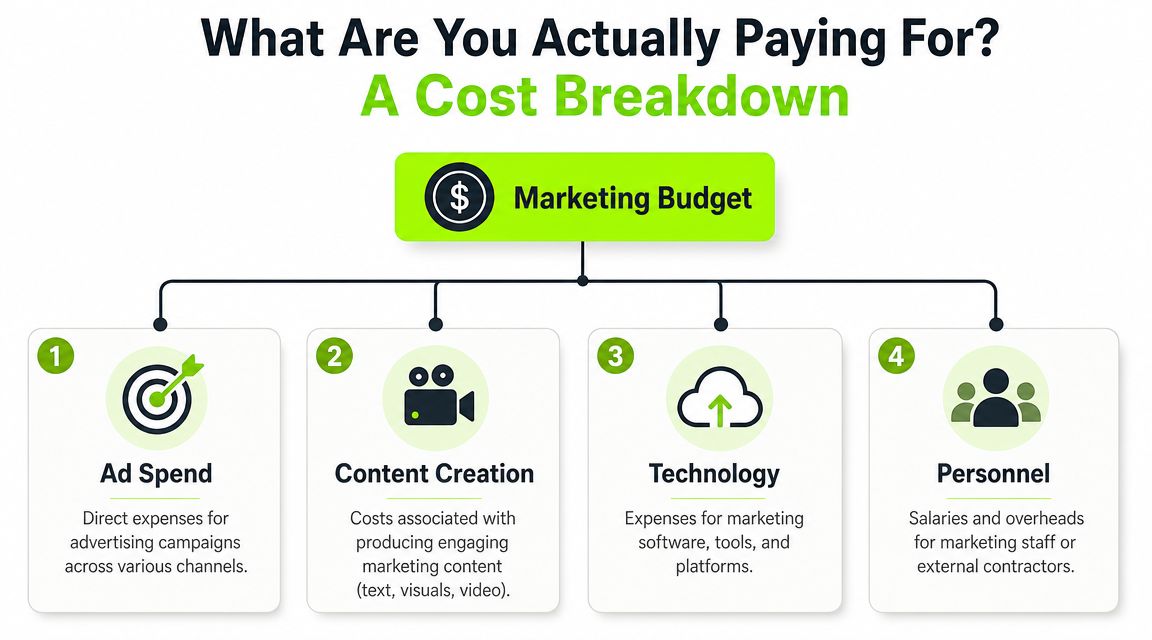
What Are You Actually Paying For? A Cost Breakdown
A marketing quote only looks simple on paper. In practice, you are funding a chain of work that starts with attention and ends with a booked tour, a visitor round, or a new member joining. If one link in that chain is weak, the whole investment underperforms.
Many public golf courses spend less on marketing than other hospitality and leisure businesses, as noted by Teesnap's comparison of marketing spend by sector. That does not mean a club should copy hotels or gyms. It does explain why many clubs struggle to grow while working with a budget that covers promotion but not conversion.
That distinction matters.
A club does not need more Facebook posts for the sake of it. It needs enough investment to hit a target. If the goal is 20 extra membership sales, the budget has to cover both lead generation and the systems that stop those leads from going cold in someone's inbox.
The four cost areas that matter
Marketing works like running a busy visitor diary. Green fees only flow if the tee sheet, the booking process, the staff response, and the follow-up all do their job.
Ad spend
This pays for reach. If you want to get in front of local joiners, society organisers, event buyers, or lapsed members who are not already in your database, paid distribution is usually part of the plan.Creative and content
This covers the offer and how it is presented. Copy, photography, video, landing pages, and campaign assets all sit here. Weak creative usually brings in weaker enquiries, which wastes staff time as well as budget.Technology and systems
This includes CRM, forms, automation, tracking, call handling, booking workflows, and reporting. It is often the line item clubs try to trim first. It is also the part that prevents missed follow-up, duplicate admin, and poor visibility on what produces revenue.Management and staff time
Someone still has to respond quickly, qualify enquiries, book visits, update records, and review performance. If nobody owns that process, paid campaigns can create more admin without producing more sales.
What low retainers usually leave out
A low monthly fee can cover activity without covering the operating system behind it. That is the trap.
Clubs often buy ads, email sends, or social posting as separate services. Those can all have value. But if the quote excludes lead tracking, CRM setup, automated follow-up, landing page updates, or conversion reporting, the club is paying to create opportunities it may not convert.
The most significant cost is often not the invoice. It is the missed membership revenue from enquiries that were never chased properly, never tracked, or never handed to the right person.
That is why managers should read quotes like they read a set of clubhouse accounts. Ask what is included, what is excluded, who owns each step, and where leads go after the first click. For clubs reviewing suppliers, our golf club marketing resource guide gives a practical checklist for those conversations.
The same discipline applies to budgeting. Clubs that treat marketing as a growth investment, not a monthly overhead, usually make better decisions about staffing, systems, and spend allocation. The principles are similar to budgeting for growing SMEs, where cash has to be tied to outcomes rather than spread thinly across disconnected activities.
A sound budget funds demand generation and demand handling. If one side is underfunded, the other side loses value.
Sample UK Golf Club Marketing Budgets for 2026
A budget only becomes useful when it's tied to a club's revenue base and growth plan. That's why broad averages can mislead. The same monthly fee might be too much for one club and nowhere near enough for another.

A useful UK benchmark is 5% to 7% of gross revenue for sustained growth, and for a club with £1 million in annual revenue, that equals £50,000 to £70,000 per year, based on UK golf club marketing budget guidance.
Scenario one, steady growth club
Take a club with stable operations, decent retention, and a clear need for more consistent membership enquiries. It isn't trying to reinvent itself. It wants a reliable pipeline and better visibility over what works.
In that case, a budget built around the lower end of the growth range can make sense. The priority wouldn't be flashy volume. It would be disciplined execution:
- Paid campaigns to reach nearby prospects with clear membership and visitor propositions
- Landing pages and enquiry capture that route leads properly
- CRM setup and pipeline stages so every enquiry has an owner
- Follow-up sequences for people who enquire but don't book a visit straight away
- Reporting that shows which campaigns produce visits, conversations, and joins
Good budgeting matters. Clubs often know what they can spend, but not what they need to fund. A practical framework from outside the golf sector, such as this guide to budgeting for growing SMEs, can help managers structure marketing spend within wider business planning.
Scenario two, expansion-focused club
Now take a club that wants faster acquisition. Perhaps it has capacity to fill, a facility launch to support, or a strategic push into membership, events, and off-peak utilisation.
That club needs a more assertive investment model. The budget has to support not just promotion, but faster testing, stronger follow-up, and tighter reporting. More campaigns mean more operational pressure, so the systems matter even more.
When a club moves into growth mode, the budget shouldn't just buy more enquiries. It should buy more control over what happens after the enquiry arrives.
A club in this position may need a budget at the upper growth range or beyond it, provided the commercial model supports it. The wrong move is trying to run an expansion plan on a maintenance budget. That's like expecting a small winter drainage fix to solve a full course infrastructure problem.
From Investment to Payback Calculating Your ROI
Monthly marketing fees are the wrong place to start. A club can spend modestly and still waste money if enquiries go cold, or spend more and produce strong payback if the process turns interest into visits and joins.

The better question is simple. What investment is required to hit the club's growth target profitably?
A £500 campaign that produces five serious membership conversations and two joins can outperform a cheaper package that fills the inbox with weak enquiries nobody follows up. Club managers see this in operations all the time. A full tee sheet means little if half the fourballs cancel or never buy anything in the bar. Marketing works the same way. Payback comes from conversion, not activity.
Start with member value
Before approving any budget, calculate what a new member is worth over time. That number gives the committee a commercial reference point instead of a debate about whether a supplier sounds expensive.
Use your own figures for:
- Annual subscription income
- Secondary spend, such as bar, food, competitions, lessons, buggy hire, and guest rounds
- Average retention period based on how long members typically stay
A club that knows its member value can judge acquisition spend with far more confidence. A club that does not know it usually treats every invoice as a cost centre, even when the return is there.
Work back from the result you need
Set the target first. If the club needs 20 new members, the maths should flow backwards from that number.
Track the stages that matter:
- New members required
- Visits or tours needed to produce those joins
- Qualified enquiries needed to generate those visits
- Marketing spend needed to create those enquiries
- Follow-up capacity needed so leads do not stall after the first contact
That last point gets missed. Many clubs assume poor ROI means they need better adverts. In practice, the leak is often after the lead arrives. Slow replies, no tour booking process, weak follow-up, and scattered records can turn paid demand into missed revenue.
For a clear explanation of the maths behind acquisition cost, these expert tips on calculating CPA are useful for managers and committees who want to sanity-check the numbers.
Where clubs really lose return
Poor ROI rarely comes from one dramatic mistake. It usually comes from small operational failures repeated every week.
An enquiry lands on Friday afternoon. Nobody replies until Monday. A prospect asks about membership options and gets a generic email. A tour is suggested, but never booked. The lead sits in an inbox, then disappears from view. The ad spend is blamed, even though the true cost came from a broken conversion process.
That is the shift clubs need to make. Stop asking only what marketing costs per month. Ask what missed opportunities are costing in lost memberships, visitor revenue, and downstream spend.
Systems fix that problem better than extra ad spend alone. A setup that connects lead generation, follow-up, CRM stages, and revenue tracking gives the manager a usable view of payback. GolfRep is one example of that type of system, combining advertising, automated follow-up, and tracked conversion for golf clubs.
If campaign spend cannot be tied to booked visits, sales conversations, and signed memberships, ROI is still being guessed.
Your Next Step A Growth Planning Session
If you're asking how much golf club marketing costs, the honest answer is that the right figure depends on what the club is trying to achieve and how well it can handle the demand created.
That's why budget planning should start with business questions. How many new members do you need. Which revenue lines matter most. Where does the club currently lose enquiries. Who owns follow-up. What can be tracked from first touch to signed form.
A sensible plan doesn't begin with “How cheap can we do this?” It begins with “What would a predictable pipeline require?”
For many clubs, the next useful step isn't shopping for another supplier. It's sitting down and mapping the numbers properly. Revenue target, lead target, response process, CRM stages, reporting, and staff ownership. Once those are clear, the budget becomes easier to defend because it's tied to an operational plan rather than a vague hope that more exposure will somehow fix growth.
That's the right point to have a growth planning session. Not a sales pitch. A working session focused on targets, capacity, conversion process, and what investment level is realistic for your club.
Frequently Asked Questions
How much does golf club marketing cost per month in the UK
It varies too much for a single monthly figure to be useful. Some clubs piece together low monthly service fees, while others build a proper annual budget linked to revenue and growth ambition. The more useful approach is to set the budget as a share of revenue and then decide how that investment should be allocated across promotion, systems, content, and follow-up.
Is cheaper outsourced marketing a false economy
Often, yes. A low monthly fee can look attractive if you only compare supplier invoices. But if that service doesn't include enquiry tracking, CRM structure, follow-up process, or reporting, the club may save money on paper while losing revenue in practice.
The hidden cost in golf marketing is usually not the campaign. It's the enquiry that nobody followed up properly.
Do volunteer-run or committee-led clubs need a different approach
They usually need a simpler one, not a weaker one. Committee-led clubs benefit from clear ownership, clean reporting, and systems that reduce reliance on memory and manual chasing. If several people are involved in membership enquiries, structure matters even more.
How quickly should a club expect results
That depends on the offer, local demand, seasonality, pricing, response speed, and internal conversion process. Some parts of marketing can generate enquiries quickly. Turning those enquiries into paid memberships takes longer if the club's follow-up is inconsistent or if decision-making sits with multiple stakeholders.
What usually goes wrong first
In most clubs, it's one of these:
- Slow response time to new enquiries
- Poor lead visibility across the team
- No consistent nurture process for people who aren't ready immediately
- Weak attribution so nobody knows what generated the best prospects
Those are operating issues as much as marketing issues.
What should a manager ask before approving a budget
Keep it practical:
- What growth target is this budget built around
- How will enquiries be captured and assigned
- Who follows up, and how quickly
- How will tours, calls, and joins be tracked
- What will the committee be able to see each month
If those questions aren't answered, the club doesn't yet have a marketing plan. It has spend.
If your club wants a clearer answer than “it depends”, GolfRep can help you map the numbers properly. A growth planning conversation should show what level of investment fits your revenue target, where enquiries are being lost today, and what systems need to be in place so marketing spend turns into booked visits and signed members.
Ready to tap into our proven growth system?