Golf Club Lead Generation: A Practical Playbook

The most popular golf club lead-generation advice starts in the wrong place. It tells clubs to publish more content, increase advertising spend, or chase wider reach. That can create activity, but activity isn't the same as membership growth.
The commercial problem usually appears after the enquiry arrives. A prospect fills in a form, sends a message, or asks for a membership pack, then waits while the enquiry sits in an inbox. By the time someone replies, the prospect may have contacted another club, lost momentum, or decided that joining will be difficult.
GolfRep works from a different premise. A predictable membership pipeline needs demand, fast handling, clear qualification, organised follow-up, and reliable conversion tracking. Traffic matters, but the system behind it decides whether traffic becomes a visit and whether a visit becomes a signed membership.
Where Most Clubs Lose Membership Enquiries
More enquiries are not automatically the answer for UK golf clubs. England Golf's satellite-account data estimates that 1,919,316 adults in England played golf regularly, representing a 4.2% participation rate, compared with 1,099,000 golfers and a 2.5% participation rate in the earlier 2016 report (England Golf's satellite account for golf in the UK). The market contains interested golfers. Clubs lose them through slow, inconsistent handling after the first enquiry.
A UK club analysis reported an average membership-enquiry response time of 47 hours and 32 minutes. Leads answered within 1 hour were five times more likely to convert than leads answered after 24 hours (GolfRep analysis of golf club database marketing). The priority is therefore operational: give each enquiry an owner, a fast first reply, and a defined route to a visit.
| Response time | Relative conversion likelihood | Operational impact |
|---|---|---|
| Within 1 hour | Five times more likely than a lead answered after 24 hours | Keeps interest active and creates a clear next step |
| After 24 hours | Lower likelihood than a lead answered within 1 hour | The prospect has time to compare alternatives or disengage |
| Around 47 hours and 32 minutes, the reported average | Substantial leakage risk | Enquiries remain unassigned, delayed, or forgotten |
GolfRep's analysis describes five stages: enquiry, qualification, engagement, visit, and follow-up. Clubs usually measure only the first. They count forms, calls, and messages, then lose sight of how quickly staff responded, who booked a visit, and which visits became memberships.
Use this rule:
Practical rule: Don't increase lead volume until every new enquiry has an owner, a response path, and a recorded next action.
The wider UK response-time picture supports the same operating choice. Made Smarter reported that 78% of customers buy from the first company to respond, while UK businesses averaged 47-hour response times and only 7% achieved sub-5-minute responses (Made Smarter's lead response research). A club does not need a large sales department. It needs an immediate acknowledgement, sensible qualification, and a clear reason for a staff member to make the call.
That process turns the first click into a managed path toward a signed membership.
Mapping Your Real Membership Audiences
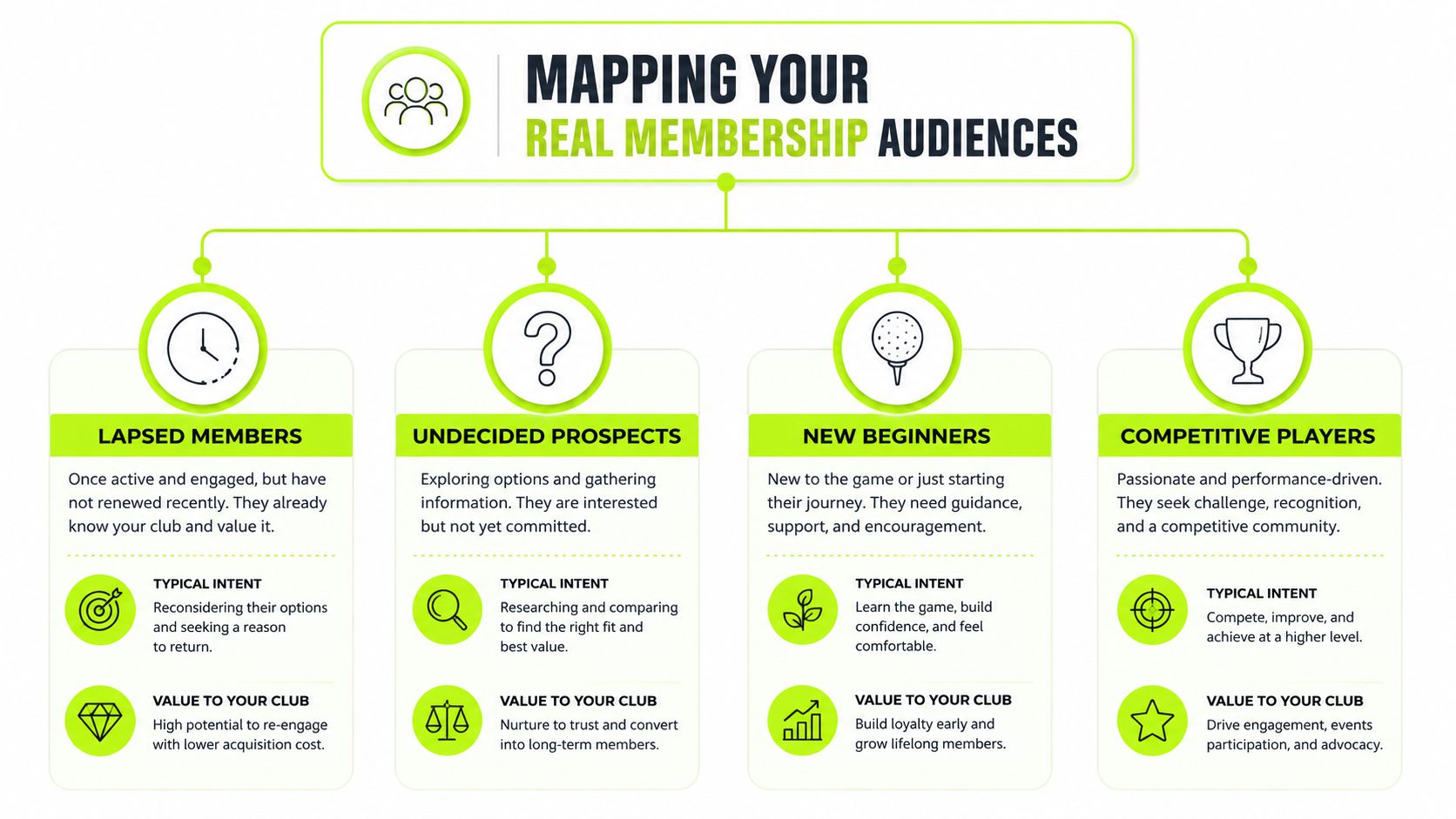
A single “Join our club” page asks too much from too many people. A lapsed member, a beginner who has only used a range, a low-handicap golfer comparing private clubs, and an office manager planning a society day have different concerns and different decision patterns.
Start by separating audiences according to relationship, intent, and likely next action. The useful question isn't just “Who might join?” It's “What does this person need to believe before they'll book a conversation or visit?”
Lapsed and undecided members
These prospects already understand club golf. A lapsed member may have left because of cost, relocation, changing work patterns, or dissatisfaction with the playing experience. An undecided member might be approaching renewal while weighing whether the club still fits their life.
Use a direct, respectful message. Lead with flexibility, playing access, social value, or a conversation about current needs. Don't treat these people like cold prospects, and don't force them through a beginner-focused campaign. Their next action could be a renewal call, a membership review, or a low-pressure visit.
Retention deserves equal attention to acquisition. A 2025 UK survey of more than 2,500 golfers found that 77.9% planned to renew, while 18.3% were undecided (Golfshake's 2026 renewal survey coverage). That undecided group should sit visibly in the CRM rather than disappearing into a general member list.
Active non-members
This is the largest and most neglected opportunity. England Golf-related reporting cited about 750,071 club members in England in 2025, while a sector article reported that roughly 12.6 million adults played some form of golf in England in the last year and 5.3 million played off-course formats, including ranges, simulators, or Topgolf (The Golf Business report on English golf membership).
These golfers need a bridge into club membership. Build separate messages for the range regular who wants course confidence, the occasional golfer who wants a flexible route in, and the active player who wants regular tee times. The offer might be a taster round, an introductory package, a lesson-led pathway, or a visit with the membership team.
Corporate and society enquiries
A corporate organiser isn't buying an individual membership. They're assessing ease, hospitality, availability, catering, parking, communication, and whether the event will reflect well on them.
Give this audience its own form and routing rule. Ask for preferred date, group size, event purpose, and contact details. A society lead should reach someone who understands event delivery, not enter the same queue as a junior membership enquiry.
Junior, family, and competitive prospects
Families care about welcome, coaching, safety, scheduling, and whether a child will make friends. Competitive players care about competitions, practice facilities, course quality, handicap support, and the standard of the playing calendar.
The average member age in England has fallen from 56.18 to 54.99 overall, with female average age at 62.98 and male average age at 53.78, according to the Golfshake coverage cited above. That shift makes life-stage-specific communication more useful than one broad membership proposition. Segment before you advertise, not after the lead has gone cold.
Choosing the Right Traffic Channels
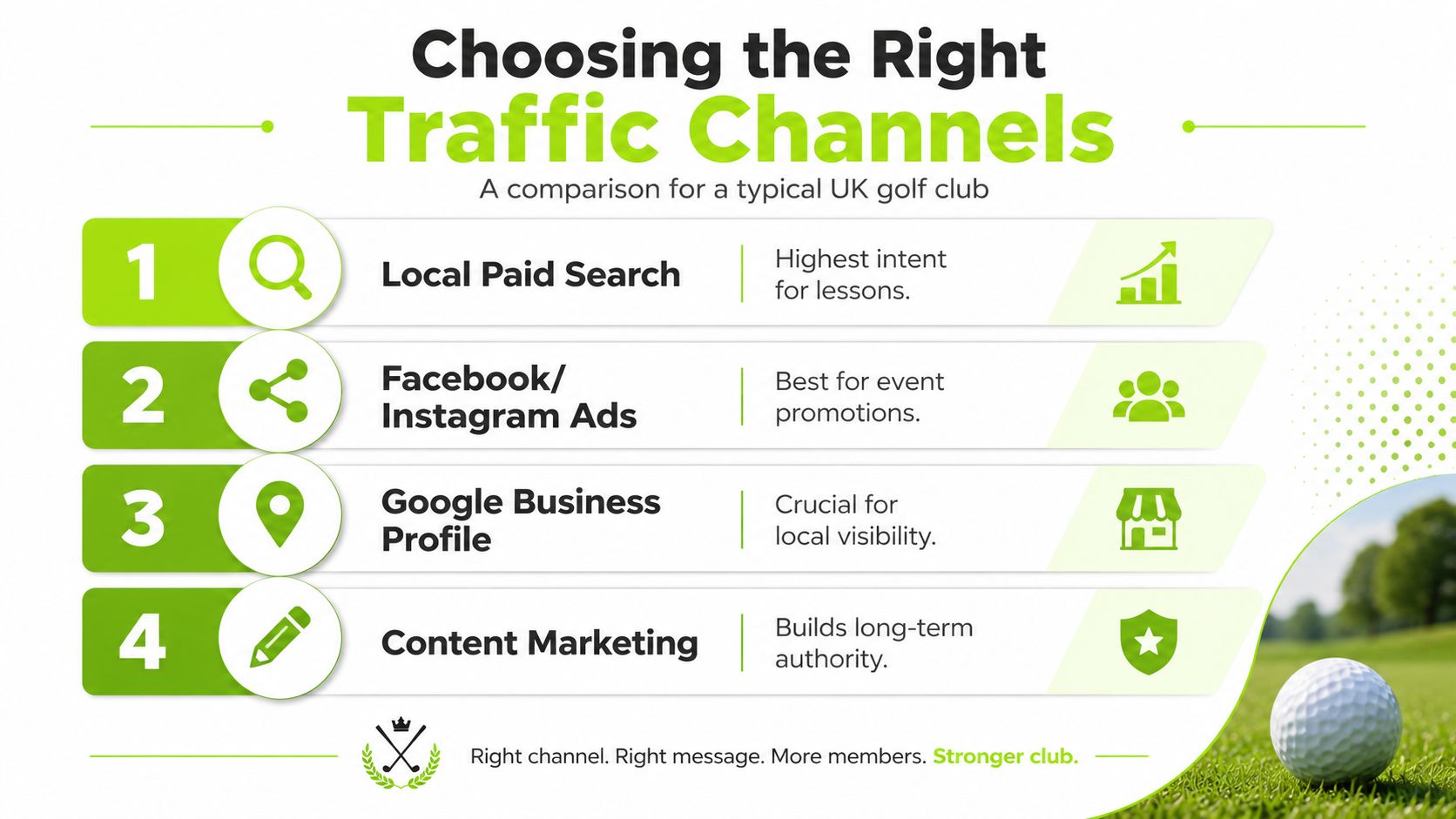
Channel choice should follow audience intent. A club that spends equally across every platform usually creates plenty of reporting noise and too little qualified demand. Rank channels by the quality of enquiries they can feed into the five-stage pipeline, not by impressions or clicks.
First, capture existing intent
Local paid search should usually be the first paid test. Someone searching for golf membership, beginner golf lessons, a golf club near them, or a society venue has already expressed a need. Send each search theme to a relevant page, not to a generic homepage.
Google Business Profile is equally important for local discovery. Keep the profile accurate, add current photographs, explain the route to membership, answer questions, and make contact details easy to use. Clubs that want a structured local-search checklist can use VisiLocali's prioritised GBP framework as a practical reference.
Use social channels to create context
Facebook and Instagram work well when the club has something visual and specific to show. Use them for open days, beginner sessions, family events, course improvements, member stories, and society packages. Social advertising can introduce the club to people who aren't searching yet, but the landing page must make the next step obvious.
GolfRep's guidance on Facebook ads for golf clubs is useful when building campaigns around a defined offer rather than boosting general awareness. The trade-off is clear. Social can reach a broader local audience, but search usually supplies stronger immediate intent.
Treat organic search as an asset
Organic search takes longer to build, but a well-written membership page can keep working after a campaign ends. Create pages for the audiences you serve, such as beginner membership, junior golf, flexible membership, society golf, and returning members.
Don't publish generic articles to fill a blog. Answer the questions prospects ask before visiting: What does membership include? Who is the club suitable for? How does the joining process work? Can a beginner get support? What happens after submitting an enquiry?
Reactivate warm audiences before buying cold traffic
Email is often the most economical route to lapsed members and inactive prospects because the club already has a relationship or permission to communicate. Use a separate message for each reason someone might return. A returning member needs reassurance and conversation, while a dormant enquiry needs a clear invitation to re-open the discussion.
Partnerships also deserve a place in the pilot. County golf bodies, PGA professionals, local employers, schools, leisure businesses, and nearby accommodation providers can create relevant introductions. These leads may arrive in lower volume, but personal context can make qualification easier.
For a 90-day pilot, start with local paid search, a properly maintained Google Business Profile, one social offer, and an email reactivation campaign. Add content and partnerships once the club can track where enquiries go after arrival.
Building Conversion Assets That Actually Convert
A good advert can't rescue a weak landing page. The page must answer three questions quickly: Is this club relevant to me? What can I do next? Why should I trust the club?
Build the page around one audience and one action. A beginner page might offer a taster session or lesson-led introduction. A returning-member page might offer a membership conversation. A society page should move towards an event enquiry, not an individual membership form.

Use a clear page structure
Your headline should name the audience and outcome. “A welcoming route into club golf for local beginners” is more useful than “Membership available now.” Follow it with a short explanation of what happens next, a relevant image, and one prominent button.
Then show the offer. It might be an introductory membership, taster day, society package, or lesson bundle. Keep the promise concrete. Avoid vague language about “achieving your potential” unless the page explains exactly what the prospect receives.
Use proof that reflects the decision being made. A member quote about making friends helps a family prospect. A visitor comment about the course and hospitality helps a society organiser. Keep quotes accurate and obtain permission before publishing them.
Ask only what the team will use
A short form normally performs better than an interrogation. Capture name, email, telephone number, audience type, preferred contact method, and the reason for enquiry. Add one useful qualifier, such as playing experience, desired membership type, or event timing.
The form should create an immediate confirmation page. Tell the prospect what will happen, when someone will contact them, and how they can book a visit directly if that option is available.
Remove friction from visits
A calendar embed can let a prospect choose a membership conversation or course visit without waiting for a reply. Decide whether a deposit makes sense for the type of booking. A no-deposit flow may reduce friction, while a deposit can protect scarce appointment capacity. The choice should reflect the club's operational reality, not a generic conversion rule.
Confirmation messaging matters. Send the appointment details, location, contact name, parking information, and a simple route for changing the booking. The landing page should make the club feel organised before the prospect ever arrives.
Instant Qualification Through Automation
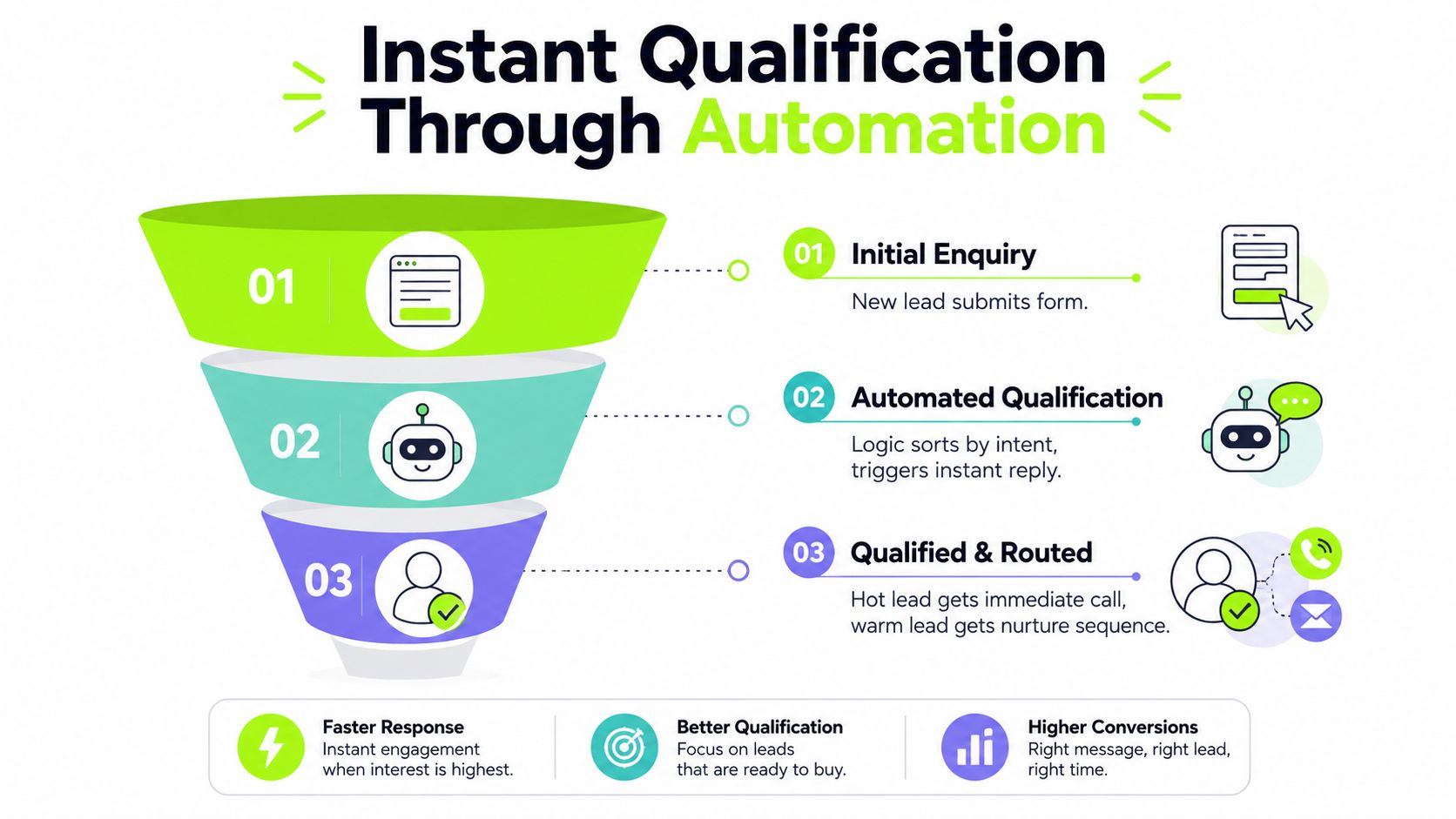
Automation shouldn't replace the membership team. It should remove the delay between an enquiry and a useful human conversation.
The first response needs to do more than say, “Thanks, we'll be in touch.” It should confirm receipt, reflect the prospect's stated interest, answer the immediate question where possible, and offer a clear next step. Form logic can then sort the enquiry by membership type, playing experience, family interest, corporate purpose, or visit preference.
Build the five stages into the workflow
Enquiry starts when the prospect submits a form, calls, sends an email, or starts a conversation. The system should create a contact record regardless of the channel.
Qualification identifies what the person wants and how ready they are. Ask practical questions, not a long sales script. “Are you looking to join for regular play, social golf, junior development, or another reason?” gives the team useful direction.
Engagement provides the right information. A beginner may receive details about lessons and confidence-building. A competitive player may receive the competition calendar and playing options. A society organiser needs event information and a prompt route to the events team.
Visit is the operational hand-off. Hot leads should be routed to a named person for a call or appointment. Warm leads can receive a booking link and a short nurture sequence.
Follow-up keeps the conversation alive after the visit. Record the outcome, the objection, and the agreed next action. A CRM should make that visible to anyone who needs to continue the conversation.
A basic autoresponder acknowledges the form. A qualification sequence asks the next question, routes the answer, updates the CRM, and triggers the correct follow-up. That distinction matters.
PostSyncer's 2025 review of social media automation tools offers useful context on automation selection, but clubs should judge any tool against their actual hand-offs, records, permissions, and response process. The technology is secondary to ownership.
For a practical example of how qualification can work in a golf setting, see GolfRep's guide to AI lead qualification for golf clubs. A typical flow is straightforward: a prospect submits an enquiry, receives an immediate acknowledgement, answers a small number of qualifying questions, receives a booking option, and is routed to a staff member when the enquiry shows strong intent.
CRM, Tagging, and Follow-Up That Closes the Gap
The first reply protects the opportunity. The follow-up closes the gap.
A CRM should show every open enquiry, who owns it, what the prospect wants, what has happened, and what must happen next. If staff have to search through email threads or personal notes, the club has no dependable pipeline.
Tag the decision, not just the contact
Use tags that help staff choose the next action:
- Membership type: Full, flexible, junior, family, introductory, or another club-defined category.
- Visit status: Not booked, booked, attended, cancelled, or no-show.
- Playing profile: Beginner, occasional golfer, regular golfer, competitive player, or returning member.
- Lead purpose: Individual membership, society, corporate event, lesson, or partnership.
- Household context: Parent, junior golfer, couple, family, or individual.
- Temperature: Ready to speak, considering options, needs information, or inactive.
Keep the list short enough for the team to use consistently. A tag that nobody applies has no value. Every tag should change a message, route a task, or affect a report.
GolfRep's golf club CRM software guide covers the role of a centralised record in this process. The important principle is simple: the club needs one visible source of truth, not separate versions held by the secretary, professional, manager, and committee.
Give each segment a follow-up rhythm
The first day should confirm the enquiry and provide the agreed next step. If the prospect hasn't booked, send a useful answer to the question they're most likely to have. Don't send a brochure with no context and expect it to do the selling.
By day three, send value that matches the tag. A beginner might receive a short explanation of how new golfers are supported. A returning member might receive the current route back into the club. A society organiser might receive event options, catering information, and a direct contact.
By day seven, ask for the booking. Use a clear invitation such as, “Would you like to visit on one of these available dates?” If the prospect isn't ready, offer an alternative action, such as a call, a course tour, or an update when the next open day is scheduled.
Cold leads shouldn't remain in an endless active queue. Move them into a re-engagement sequence with a reason to reply, then mark the outcome. A lead can be inactive without being deleted, but an unclassified lead makes reporting unreliable.
Measure movement through the pipeline
A committee or general manager should review a compact scorecard monthly:
- Enquiry volume by channel: Shows where demand originates.
- Average response time: Shows whether the team acts quickly enough.
- Enquiry-to-visit conversion: Shows whether qualification and booking work.
- Visit show-up rate: Shows whether confirmations and reminders are effective.
- Visit-to-membership conversion: Shows whether the proposition and sales conversation are strong.
- Open leads by owner: Shows whether enquiries are unassigned or stuck.
- Membership value at 12 months: Shows whether acquisition is producing durable revenue, not just sign-ups.
The exact thresholds should come from the club's own baseline. Don't import a target from another club without understanding differences in pricing, access, course capacity, geography, and membership structure.
Hillier Hopkins reported an average of 73 joiners for members' clubs in 2023, up slightly from 70 in 2022, demonstrating why annual joiner volume is a useful operating measure rather than relying only on headline membership totals (Hillier Hopkins' 2023/24 golf clubs report). The same survey found that 23% of UK golf clubs reported more members leaving than joining (Golf Business News coverage of the Hillier Hopkins survey). That makes the dashboard a management tool, not a marketing accessory.
Run a quarterly decision meeting
Bring the channel report, pipeline report, and retention view into one meeting. Ask which source produces qualified visits, where leads stall, which objections recur, and which audience has the strongest long-term value.
Then make one of three decisions. Increase investment in a channel that produces quality and is handled well. Change the page or offer when traffic arrives but doesn't convert. Repair ownership and follow-up when enquiries accumulate without a next step.
The club doesn't need a dashboard full of decorative charts. It needs a one-page view that tells the team what happened, where the pipeline is leaking, and what someone will change next quarter.
Your 90-Day Rollout and Practical Next Steps
A club can build a dependable lead process without waiting for a perfect website, a large advertising budget, or a complete digital transformation. Start with the operational basics, then add reach once the hand-off works.
Days one to thirty
Choose the audiences that matter most and create one offer for each priority group. Audit every enquiry route, including the website, phone, email, social messages, and reception desk. Decide who owns each route and write the first-response message.
Create a simple CRM pipeline with the five stages: enquiry, qualification, engagement, visit, and follow-up. Add the essential tags, remove duplicate records, and make sure staff know where to record calls and outcomes.
Days thirty-one to sixty
Build or improve the landing page for the first offer. Set up the form, confirmation message, booking route, and automated acknowledgement. Launch a focused channel pilot using local paid search, the club's Google Business Profile, one social campaign, and a reactivation message to a relevant existing audience.
Don't launch every possible campaign at once. A narrow pilot makes it easier to see whether a problem comes from the channel, the page, the offer, or the follow-up.
Days sixty-one to ninety
Review enquiry sources, response times, ownership, booked visits, attendance, membership decisions, and open opportunities. Speak to the staff handling enquiries. Their observations often reveal objections that the dashboard can't explain.
Use the review to change one thing at a time. Rewrite the page if the right audience is arriving but not booking. Change the offer if people engage but don't visit. Repair routing if response time is poor. Reallocate budget only after the club understands conversion quality.
Avoid four common mistakes:
- Relying on one channel: Channel concentration makes the pipeline fragile.
- Leaving leads unassigned: An enquiry without an owner has no dependable next step.
- Ignoring renewal risk: Undecided members can be commercially valuable before they become lapsed members.
- Stopping measurement after launch: A campaign isn't finished when it goes live. It's finished when the club knows what it produces.
GolfRep helps clubs connect advertising, immediate qualification, CRM records, structured nurture, and revenue tracking into one membership pipeline. Visit GolfRep to see how the system can be adapted to your club's audiences, offers, and existing team.
Ready to tap into our proven growth system?