Golf Course Cash Flow Management for UK Clubs

A club can report a better surplus than it managed a decade ago and still have an uncomfortable Friday when payroll leaves before the next society balance lands. That's not poor trading. It's timing. Golf course cash flow management is the discipline of putting every receipt and every bill on the week it moves, then making spending decisions from the lowest week, not from the annual result.
Subscriptions provide the base load. Visitor and hospitality takings move with weather and the diary. Course costs barely flex at all. Put those three facts on one rolling sheet and you'll see liquidity problems weeks before they become a committee emergency.
Why a Healthy Surplus Can Still Run Short
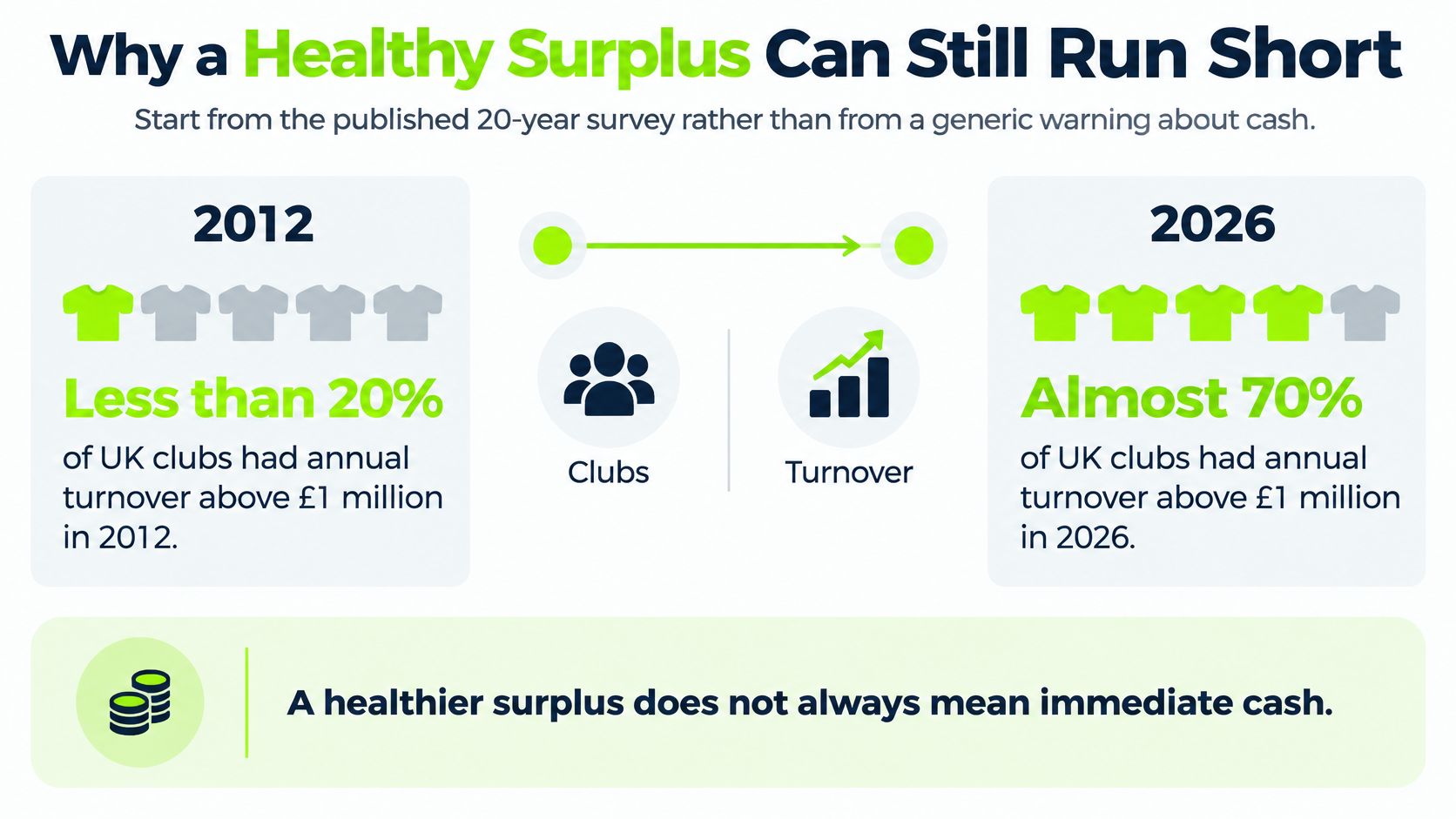
The Hillier Hopkins 20-year survey of UK golf clubs reports that the proportion of clubs with annual turnover above £1 million rose from less than 20% in 2012 to almost 70% in 2023, while average annual surplus increased from £31,000 to £80,000 over the same period. Read that on its own and you'd assume cash pressure has eased. It hasn't, because the commitments grew alongside the income.
Average course maintenance costs increased from £97,000 in 2012 to £138,000 in 2023, course wages rose from £155,000 to £256,000, and the share of clubs paying more than £15,000 annually for insurance increased from 5% to 64%. Those aren't discretionary lines you can pause for a quiet month. They're wages, materials and cover that fall due whether the tee sheet is full or empty.
Surplus Is an Accounting Result, Cash Is a Date
A surplus tells a committee that income exceeded costs across a year. It doesn't tell the manager whether money is in the bank on the 14th, when wages, a fertiliser invoice and an insurance instalment all land. Subscriptions may be billed in one lump in January, or collected by monthly direct debit, while payroll repeats every week or month without regard to either pattern.
That mismatch is where clubs get caught. The annual figure looks comfortable, so a project gets approved, a machine gets ordered or an extra pair of hands gets recruited. The cash to pay for it was spoken for months earlier, when subscription money arrived and was absorbed by running costs.
Practical rule: Never approve a discretionary spend from the surplus. Approve it from the lowest forecast cash week after that spend is included.
Visitor Income Helps, but Only When It Is Played
Visitor money has become a more important buffer. Average green fee ranges increased from £20 to £54 in 2012 to £26 to £86 in 2023, and the proportion of clubs generating more than £60,000 in green fee income rose from 45% to 80%. That's real cash, but it's cash tied to a tee time on a specific day. It can't be pulled forward to cover a bill due three weeks earlier.
Treat each stream separately. Forecast membership receipts, green fees, payroll, maintenance, insurance and capital expenditure as distinct lines with distinct dates. The question your forecast has to answer is simple. Can the club pay payroll and course bills in a quiet fortnight without discounting the diary in a panic or spending reserves that were set aside for the course?
If you can't answer that from your current reporting, you don't have a cash problem yet. You have a visibility problem, and that's fixable.
How to Build a 13-Week Club Cash Forecast
Build a 13-week rolling forecast and refresh it every Monday. Thirteen weeks is long enough to see a payroll clash, a VAT payment or a contractor invoice coming, and short enough that the diary assumptions stay honest. Record cash on the date it clears, not the date an invoice is raised. A subscription invoiced on the 1st that clears on the 15th belongs in the week of the 15th.
Start by treating subscriptions as base load rather than the whole plan. The Hillier Hopkins Golf Clubs Survey Report 2025-26 records Golf Club Managers' Association evidence that subscriptions typically provide only 50 to 60% of annual club income, with one cited club budgeting £2.3 million of revenue of which £1.3 million comes from subscriptions. The rest has to come from visitors, societies, food and beverage, functions and other trading, on the weeks that money arrives.
The Six Steps
- Enter subscriptions by clearance date: Put renewals, instalments and new direct debits in the week the money lands, and knock off expected failures before you rely on the total.
- Enter visitor fees from rounds, not hope: Multiply expected rounds by the fee you're achieving after twilight rates and county cards, not the rack rate on the website.
- Split society money in two: Show deposits already banked separately from balances contracted but not yet paid. Only the first category is certain.
- Keep hospitality cautious: Enter function deposits and known covers at full value, then add a deliberately modest figure for casual bar and catering trade.
- Load every committed outflow: Payroll, materials, utilities, insurance, VAT, loan payments and capital spend already approved. Nothing speculative, nothing omitted because it's inconvenient.
- Mark the lowest week: Compare it against a reserve the committee has agreed in advance. That lowest point, not the average, is your liquidity position.
If you're setting this up in a spreadsheet or accounting package, it helps to follow the standard approach to organizing cash flows by activity from Matil, so operating receipts, capital spend and financing don't blur into one undifferentiated pot.
The Control Figure That Matters Most
Each week, calculate minimum non-subscription cash: forecast operating outflows minus subscription receipts for that week. That number tells you exactly what visitors, societies and the clubhouse have to produce before the club stands still. Some weeks it's small. In a month with an insurance payment or a VAT quarter, it's the whole ballgame.
Judge acquisition spending against that figure too. A campaign earns its place when it adds recurring cash after joining incentives, card fees and expected churn, not when it produces a pleasing enquiry count. Enquiries don't pay greenkeepers.
Lines for a 13-week golf club cash forecast
| Line | What to enter | When cash moves | Weather sensitive |
|---|---|---|---|
| Subscriptions | Renewals, instalments and new direct debits | Date the money clears, not the invoice date | No |
| Visitor green fees | Expected rounds times the achieved fee | Daily takings | Yes |
| Societies and groups | Deposits banked and balances contracted | Deposit on booking; balance before play | Partly if the day is lost |
| Food, beverage and functions | Known covers, deposits and a cautious casual bar | Event date and weekly takings | Casual trade yes; booked functions partly |
| Payroll | Greenkeeping, clubhouse and professional staff | Weekly or monthly pay date | No |
| Course materials and contractors | Fertiliser, aeration, drainage and repairs | Seasonal window and invoice terms | Weather can pull spend forward |
| Utilities, insurance and finance | Energy, insurance, VAT and loan payments | Monthly or annual due dates | Energy partly |
| Capital spend | Only projects already approved and committed | Supplier due dates | No |
An annual budget hides the week where wages leave on Friday and a society balance arrives the following Tuesday. This sheet doesn't. That is the entire point of it.
Planning Cash Around Weather and the Diary
Rain can cut visitor and hospitality takings within days, while subscriptions provide a steadier base. The greenkeeping team still needs paying, and other course costs may be due regardless of how many rounds are played. Cash is a 13-week timing problem: a healthy annual budget or strong membership does not guarantee enough money in the bank for a difficult fortnight.
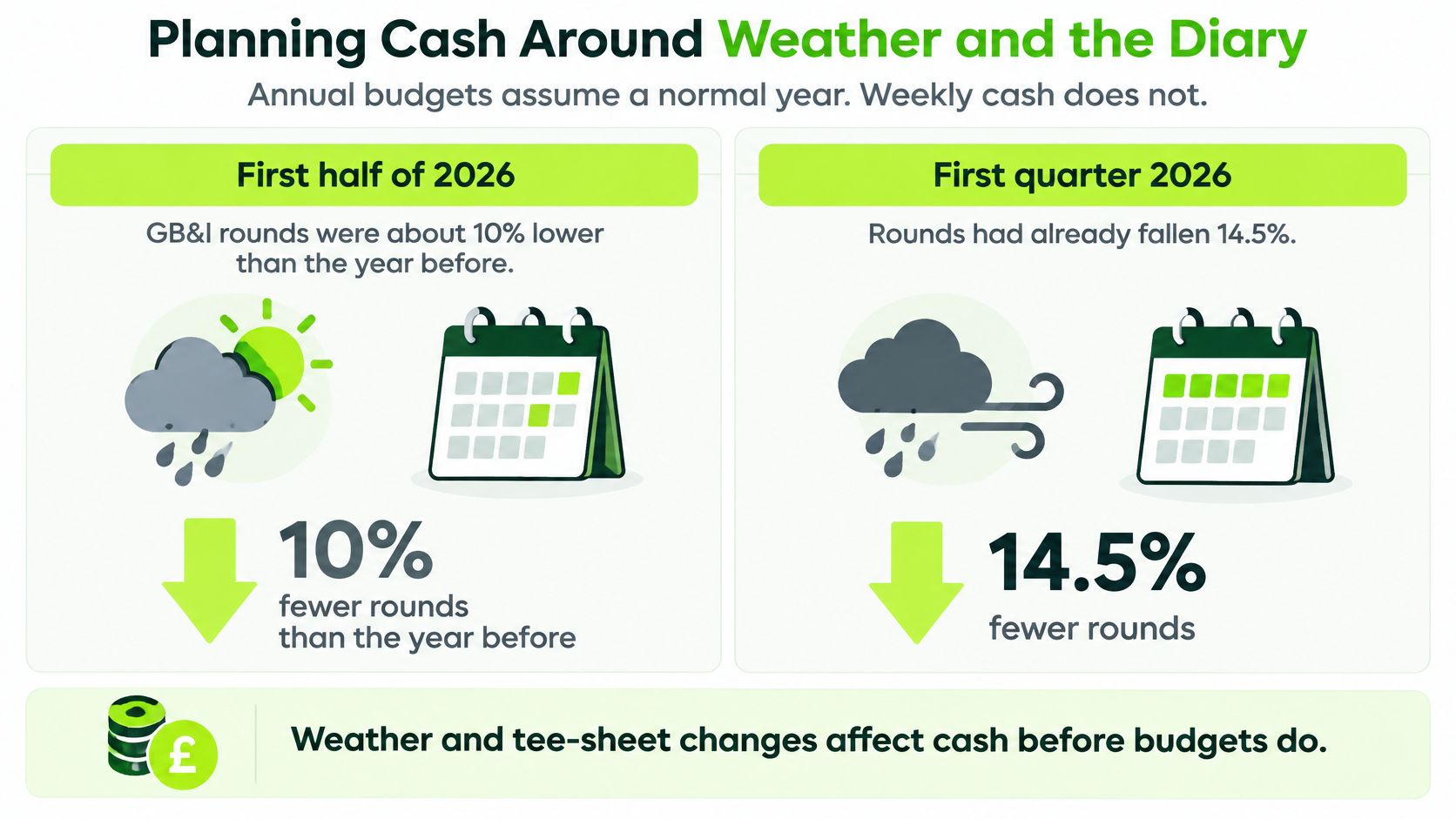
Golf Business News reporting on GB&I rounds states that rounds were about 10% lower in the first half of 2026 than the previous year, after Q1 rounds had fallen 14.5% year on year. Use weather scenarios to test the timing and size of likely receipts, rather than assuming a normal year.
Run Three Versions of the Same 13 Weeks
Keep one forecast and run three cases through it. Base uses the diary as booked. Soft reduces casual rounds by about 10%, in line with the reported first-half pattern. Poor uses the 14.5% Q1 pattern and removes society days at risk, while retaining deposits already received.
Reduce only the income weather can affect: green fees, buggy hire, casual catering and society balances not yet paid. Keep payroll, contracted maintenance and insurance at their full amounts in every case. Those bills do not shrink when the course is quiet.
Weather cases for the same 13 weeks
| Scenario | Rounds assumption | Income to reduce | Costs that stay | If cash is under the reserve |
|---|---|---|---|---|
| Base | Diary as booked | None | All committed costs | Proceed with planned work |
| Soft weather | About 10% fewer rounds, in line with the first half of 2026 | Green fees, buggies and casual catering | Payroll, contracts and insurance | Delay discretionary projects |
| Poor weather | About 14.5% fewer rounds, first-quarter pattern, plus washed-out societies | Those lines plus society balances not yet paid | Payroll and contracted maintenance | Freeze recruitment, chase deposits and defer capital |
What to Do When the Poor Case Bites
If the poor case takes cash below the agreed reserve, act on timing first. Defer non-critical capital work, move a contractor to a stronger week and collect money already contracted but not yet received. Deposited functions can provide a firmer receipt than casual trade in poor weather. Include planned golf club events that generate revenue in the forecast, with deposits and balances entered on their expected payment dates.
Avoid cutting visitor rates across the diary to fill a temporary gap. A discount on a wet Tuesday may not bring in extra rounds, and it reduces the cash from golfers who would have paid the usual rate on a playable day.
A rate cut is a lasting response to a temporary problem. The rain stops; the lower price can remain.
Each Monday, record which case the club is tracking and the action it triggers. This keeps decisions tied to the forecast, rather than reopening the same debate after every spell of rain.
Controlling Course Costs That Do Not Flex
The course is where the money goes, so it's where cash control has to be sharpest. The Hillier Hopkins 2024-25 golf clubs report reports that average course wage costs increased 9% and course maintenance costs increased 26% in 2025, with members' clubs expecting energy costs to rise by an average of 7% over the following year. Industry finance guidance cited there puts almost 50% of each revenue pound into the golf course, with course salaries the largest component.
A single inflation percentage applied to a course budget hides all of that. A 9% wage rise and a 26% maintenance rise are different problems arriving on different dates, and lumping them together guarantees you'll be surprised by one of them.
Split the Drivers, Then Stress Test Them
Run four separate monthly drivers: greenkeeping payroll, materials, utilities and planned maintenance. Each gets its own assumption, its own timing and its own owner who can explain a variance. Sensible planning for the maintenance of golf courses already separates routine work from project work, so the cash forecast should follow the same split rather than merging everything into one course line.
Before a committee approves recruitment or a discretionary project, run a 26% maintenance shock through the 13-week sheet. Test it against subscription clearance dates and the soft weather visitor case at the same time, because cost shocks and weak trading have an unfortunate habit of arriving together. If the sheet survives that combination, the decision is sound. If it only survives the base case, it isn't a decision yet. It's a hope.
Set a Reserve and a Deferral Rule
- Agree a minimum cash reserve: Set the figure with the committee in a calm month, based on the poor weather low point, and write it down.
- Attach an automatic action: If the forecast low point falls under the reserve, non-critical capital expenditure defers without a fresh vote.
- Name the cause weekly: Every variance gets labelled as extra labour hours, weather repairs, materials or energy. Unlabelled overspend repeats itself.
Timing matters as much as totals. Aeration, fertiliser applications and contractor days should be scheduled into weeks when cash is already in, not into the month where the annual surplus looks comfortable on paper. A contractor who can work in week nine instead of week six may cost exactly the same and cause none of the stress.
A cost that can't be switched off in a wet fortnight is a liquidity decision, even when the full-year budget still balances. Committees find that framing uncomfortable, but it's the honest one. The course doesn't stop needing work because the diary went quiet, and pretending otherwise just moves the bill into a worse month.
Turning Membership Into Collectible Recurring Cash
The cash value of a member depends on what they pay, when the money clears and how long they stay. National Club Golfer's report on England Golf participation and club membership states that 12.6 million adults in England played some form of golf in the latest reported period, including 7.3 million who played a nine- or 18-hole course. England had 750,071 club members in 2025.
That gap offers scope to grow, but more members do not automatically mean more cash available. Discounted introductions can lift headline numbers while adding little contribution towards the staffing and course work those golfers require. The Hillier Hopkins 2024-25 report recorded a 26% increase in course maintenance costs. Read the report's findings on golf club finances and maintenance costs.

Build a Cash Waterfall for Every Product
For full, flexible and trial memberships, as well as regular visitors, map the same steps: lead source and acquisition cost, conversion, and the date the first payment clears. Deduct incentives, processing fees, expected bad debt and onboarding time. Then account for course usage, servicing costs and likely length of stay.
The result is each product's contribution. Use it to set acquisition budgets and compare offers. A flexible membership with a lower monthly fee can work well when payments clear reliably and members stay. If servicing costs outweigh the income, it is a subsidised green fee under another name.
Set prices with contribution in view. Compare golf club membership fees with the cost of serving each member, rather than copying a nearby club's price without knowing its cost base.
Segment Before You Spend
Separate leisure golfers, occasional on-course players and regular golfers before committing acquisition spend. They differ in conversion, course use and reasons for leaving. One campaign and one product for all three groups can spend heavily on golfers who are unlikely to join or stay.
Track results by source, not just by enquiry volume. Check what came in, what happened next, and whether each source led to a single booking or continuing revenue. A source that produces fewer joins can be more valuable if those members pay on time and renew, while discounted trials that lapse by autumn may add little.
Committee test: Report cleared recurring cash added, and the month it started clearing, instead of using gross joins as the headline.
Membership growth supports liquidity when payments are collectible, dated and retained. The number of golfers is a starting point; the cash waterfall shows what the club can count on.
A March Fortnight When the Diary Goes Quiet
Take an illustrative March fortnight at a members' club. This is a worked example of the arithmetic, not a case study. January collected most annual subscriptions, so member cash this fortnight is monthly instalments plus a handful of new direct debits from golfers who joined over winter. It's steady money, and it isn't large.
Against it, greenkeeping and clubhouse payroll falls on Friday. An aeration contractor is booked for the second Tuesday, arranged months ago because that's the right agronomic window. A Saturday society has its deposit already in the bank, with the balance due seven days before play. Three visitor four-balls sit on the sheet across the fortnight, all of them weather dependent.

Work the Fortnight in Order
First, do the control sum. Outflows minus subscription instalments equals the non-subscription cash this fortnight still needs to find. Write that figure at the top of the sheet, because everything else is commentary on it.
Second, count the society balance only because it's contracted, and chase it now, before you roster extra staff for the day. If the organiser pays late, you want to know while you can still adjust the rota and the food order, not after both are committed. The deposit is already banked, so the day probably happens. Probably isn't a payment date.
Third, rerun the weather lines twice. Cut visitor fees, buggy hire and casual bar takings by about a tenth, then run the poorer quarter-style reduction. The wages don't shrink in either version. Neither does the contractor, unless you move him.
The Decision the Sheet Forces
Say the poor version drops the closing week below the reserve. The correct move is to move the contractor into a fortnight where a society balance and stronger visitor income have already landed. The agronomy can usually flex by a fortnight. Payroll cannot flex at all.
What you don't do is cut the green fee to buy rounds. If the course is wet and the forecast is worse, cheaper golf doesn't produce golfers. It produces the same empty tee sheet and a lower fee banked from the hardy few who would have played anyway.
Write the variance note while it's fresh. State the cause, in this case lost visitor rounds and a pulled-forward contractor, the week cash is expected back above the reserve, and the action taken. That single paragraph is what the committee should see at the next meeting. It tells them more about the club's financial health than a full-year surplus line ever will, because it shows a manager who saw the problem early and moved a bill instead of missing one.
Agree the Reserve and Review It Weekly
Liquidity at a golf club is the match between subscription clearance dates, weather-sensitive trading and course bills that don't flex. A larger membership helps only when payments clear on known dates and the visitor gap has been stress tested. Everything else is arithmetic and habit.
Do three things this month. Agree a minimum cash reserve with the committee, sized from the poor weather week rather than the annual surplus. Put the eight forecast lines onto a 13-week sheet and update it every Monday, before payroll and known invoices go out. Record a dated action for any week that falls under the reserve, whether that's deferring capital, moving a contractor or chasing a balance already owed.
If the sheet is sound but recurring cash stays thin because new members don't stick or visitor income arrives as one-off rounds rather than repeat bookings, you've found a different constraint from forecasting itself. That one sits in the commercial system behind the numbers. The first call with GolfRep is an open, strategic conversation, not a sales pitch, where we look at a club's current setup, goals and challenges and map out what a growth system could look like. It helps. It isn't a substitute for knowing which week you can pay for the course.
If your 13-week sheet shows recurring cash is the constraint, we can help you build a more predictable flow of members, repeat visitors and society income to sit behind it, tracked from first enquiry to cleared payment. Visit GolfRep to start an open conversation about your club's current setup, goals and the commercial bottleneck worth fixing first.
Ready to tap into our proven growth system?