Is a Golf Membership Worth It? a Practical UK Cost Guide

71% of UK golfers surveyed in 2025 said membership offers good value for money, and the average annual fee in England was £901. So yes, a golf membership can be worth it, but only when you play enough, use the access properly, and avoid letting extras turn a decent deal into an expensive habit.
The mistake most golfers make is judging membership on the subscription alone. The full decision depends on the total annual cost, what you receive for it, and how often you'll use the club without feeling boxed in by tee-time rules, travel, or fees you didn't think about on day one.
What's the Real Value of a Golf Membership?
A golf membership is worth it when it gives you more than discounted rounds. It buys certainty, access, social structure, competition entry, and a base you can return to without starting from scratch each time. That is why regular players usually get more from it than occasional golfers, even before you look at the numbers.
The UK evidence points in the same direction. In Golfshake's 2025 membership survey, 71% of respondents said membership offers good value for money, 15% said it does not, and 30% reported a waiting list at their club. The same survey found that 77% planned to renew, while only 4% said they would not. For many golfers, membership still feels worthwhile because it secures access and consistency, not just a tee time.
Practical rule: if you want golf to be part of your routine, membership can justify a higher headline price. If you only play now and then, pay-and-play usually makes more sense.
The England benchmark makes the economics clearer. At an average annual fee of £901, the right question is not whether membership looks cheap on paper. The right question is how many rounds, how much convenience, and how much club use you need before the cost starts to make sense.
A club can look expensive and still be the right call. A player who wants weekly golf, familiar conditions, and reliable access will usually find the subscription easier to justify than someone who only plays when the weather and diary both line up. That is the dividing line.
Breaking Down the Full Cost of UK Golf Membership
The headline subscription is only the start. A proper cost check needs every compulsory charge and the likely extras, because the first-year bill can be well above the number on the brochure.
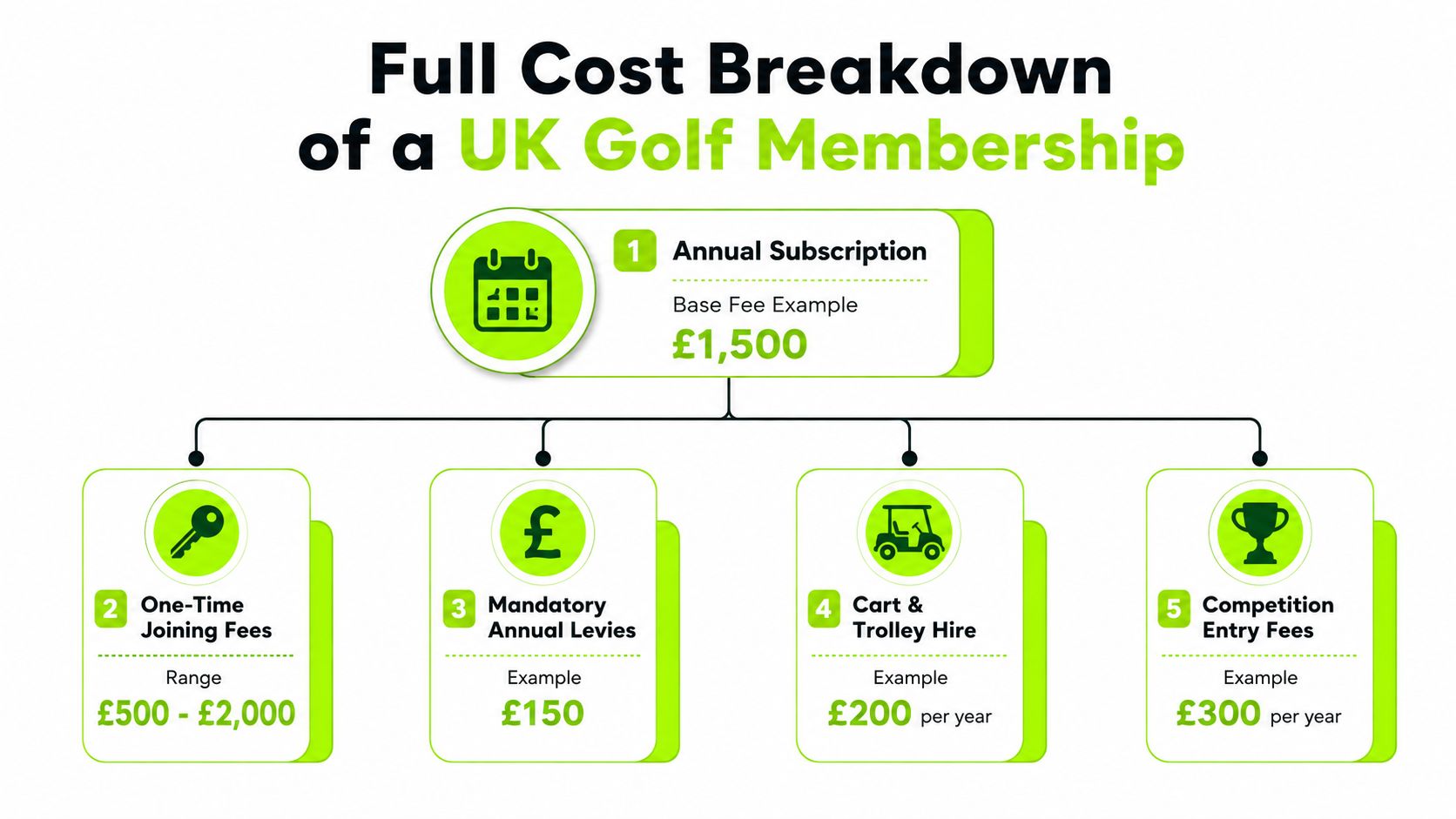
A club can sell you on the annual fee and still leave out the charges that matter most to your wallet. The key comparison is total annual cost, not the sticker price.
What to include before you sign
Start with the annual subscription, then ask about joining fees, because those can change the first-year maths quickly. Clubs are increasingly using them to protect demand and strengthen their pricing position, which is why you should treat the opening bill as a package, not a single line item.
Then check the smaller but still important items. These are the ones golfers forget most often:
- County and national affiliation fees, because they are often treated as standard rather than optional.
- Locker, trolley, and buggy storage, which matter if you want convenience, not just access.
- Bar or clubhouse minimum spend, which can be a quiet drain if you do not use the venue socially.
- Competition entry fees, especially if you want medal golf or board events.
- Guest fees and reciprocity charges, if you plan to bring friends or play away.
Some clubs package perks and benefits generously, others strip them back and charge separately. For a useful comparison point on how membership extras are presented, the overview from Dartee Golf shows how clubs can frame value beyond the annual sub.
A club that prices transparently usually handles members better too. If the fee structure is vague, the admin often is as well.
The pricing question matters for clubs as much as it does for golfers. A membership line that looks tidy on a spreadsheet can hide weak value if the extras pile up, which is why a clear membership pricing strategy matters. The right structure is the one a golfer can read quickly and understand without chasing the pro shop for explanations.
The conclusion is blunt. If a club charges extras heavily and explains them badly, the true cost rises fast. If the extras are modest, visible, and useful, the subscription can still represent strong value.
Calculating Your Personal Break-Even Point
The cleanest way to answer this question is to work backwards from your playing habits. Use the £901 England average as your benchmark, then compare it with what you'd spend pay-and-play at your target courses.
The maths that actually matters
If membership saves you £25 to £40 per round, then the break-even point lands at roughly 23 to 36 rounds a year before you even think about joining fees or other extras. That's the useful threshold, because it tells you when the membership stops being a nice idea and starts becoming the cheaper route.
| Membership Break-Even by Annual Rounds | |||
|---|---|---|---|
| Saving Per Round | Rounds to Break Even | Effective Cost Per Round at 40 Rounds | Verdict |
| £25 | 36 | Lower than pay-and-play once usage rises | Better for frequent players |
| £30 | 30 | Lower than pay-and-play once usage rises | Strong value for regular golfers |
| £40 | 23 | Lower than pay-and-play once usage rises | Excellent for high-frequency play |
The point of the table is not to pretend every club charges the same. It's to show the logic. If your target club gives you a decent saving every time you play, membership gets better as your round count climbs. If you're not going to reach that range, you're subsidising access you don't use.
Adjust for your own habits
Twilight rates, winter offers, and multi-course access can change the picture, but only for golfers who use them. If you mostly play one Saturday a month, don't build a fantasy model around cheap midweek tee times you'll never take. If you practice, compete, and play socially at the same club, the value case is much stronger.
The right calculation is brutally personal. Take your likely round count, subtract what you'd pay casually, then add the extras you'd use. If membership still wins, sign. If it only wins on paper, keep your money in your pocket.
Who Benefits Most from Club Membership
Membership is not a universal product. It fits some golfers brilliantly and others badly, and the difference comes down to usage, routine, and how much they value certainty over flexibility.

The weekly player
If you're out most weeks, membership usually makes sense. You're using the course enough that the annual fee starts to feel like a routine expense rather than a big decision, and the social side, competition access, and familiar playing environment all start to matter.
That golfer tends to value the club as a base, not a venue. They know the greens, they know the members, and they'll usually get more out of the year because they're on site often enough to use practice areas, competitions, and casual roll-ups.
The time-poor weekend golfer
This is the tricky middle ground. If you only play 15 to 25 rounds a year but care about guaranteed weekend access, reliable tee times, and competition entry, membership can still work. The financial case may be tighter, but the practical value can be real if your free time is limited.
The golf market has more players than ever chasing convenient tee times, which makes dependable access a genuine benefit. For this group, the club isn't just saving money, it's removing friction.
The occasional player
If you play fewer than 15 rounds a year, membership is usually weak value unless you've got a very specific reason to join. Pay-and-play, flexible points-based access, or a lighter social option will often suit you better.
Simple test: if you're constantly checking whether you'll “get your money's worth”, you probably won't.
Hybrid participation also matters now. Some golfers want lessons, range use, short-form play, and only selective full membership benefits. That can be a smart middle path if your schedule is irregular and your golf is split between practice and the odd round. The point is to buy the access you'll use, not the version that sounds most committed.
Common Pitfalls That Undermine Membership Value
A club can be perfectly decent and still be poor value if the structure is messy. The biggest trap is signing because the course looks attractive, then realising the fee stack is heavier than expected or the club isn't flexible when life gets in the way.
The contract and fee traps
The first red flag is a joining fee that isn't justified by anything tangible. If the club can't explain what you're paying for, treat that as a warning. The second is inflexibility. A contract that offers no sensible route out during injury, relocation, or a prolonged spell away from golf can turn a good deal into a nuisance.
You also need to watch for cost creep in the clubhouse. If the bar, catering, storage, and competition charges are all written vaguely, the membership can drift beyond what you budgeted.
Poor enquiry handling tells you plenty
A club's response to a new enquiry tells you how it operates. If it takes days to reply, sends half the information, or never follows up properly, assume the same weakness exists in other parts of the operation. That usually means problems in member communication, event organisation, and admin discipline too.
Golf clubs that want to run cleanly need the same mindset as any well-managed hospitality business. A club that can't handle membership questions properly will rarely make the joining experience feel easy.
For a useful comparison point on venue staffing and overhead discipline, Relief Chefs UK's guide to private chef staffing costs for venues shows how hidden operational costs shape the customer experience behind the scenes. Golf clubs are no different. Badly understood costs usually show up somewhere else.
The lesson is straightforward. Don't just inspect the course. Inspect the club's behaviour. If communication is slow and the fee structure is opaque, the membership will probably frustrate you later.
Negotiation Tactics and Trial Strategies Before You Commit
You don't need to accept the first offer. Clubs often have more flexibility than they admit, especially when they want to convert an enquiry into a member and keep the pathway simple.
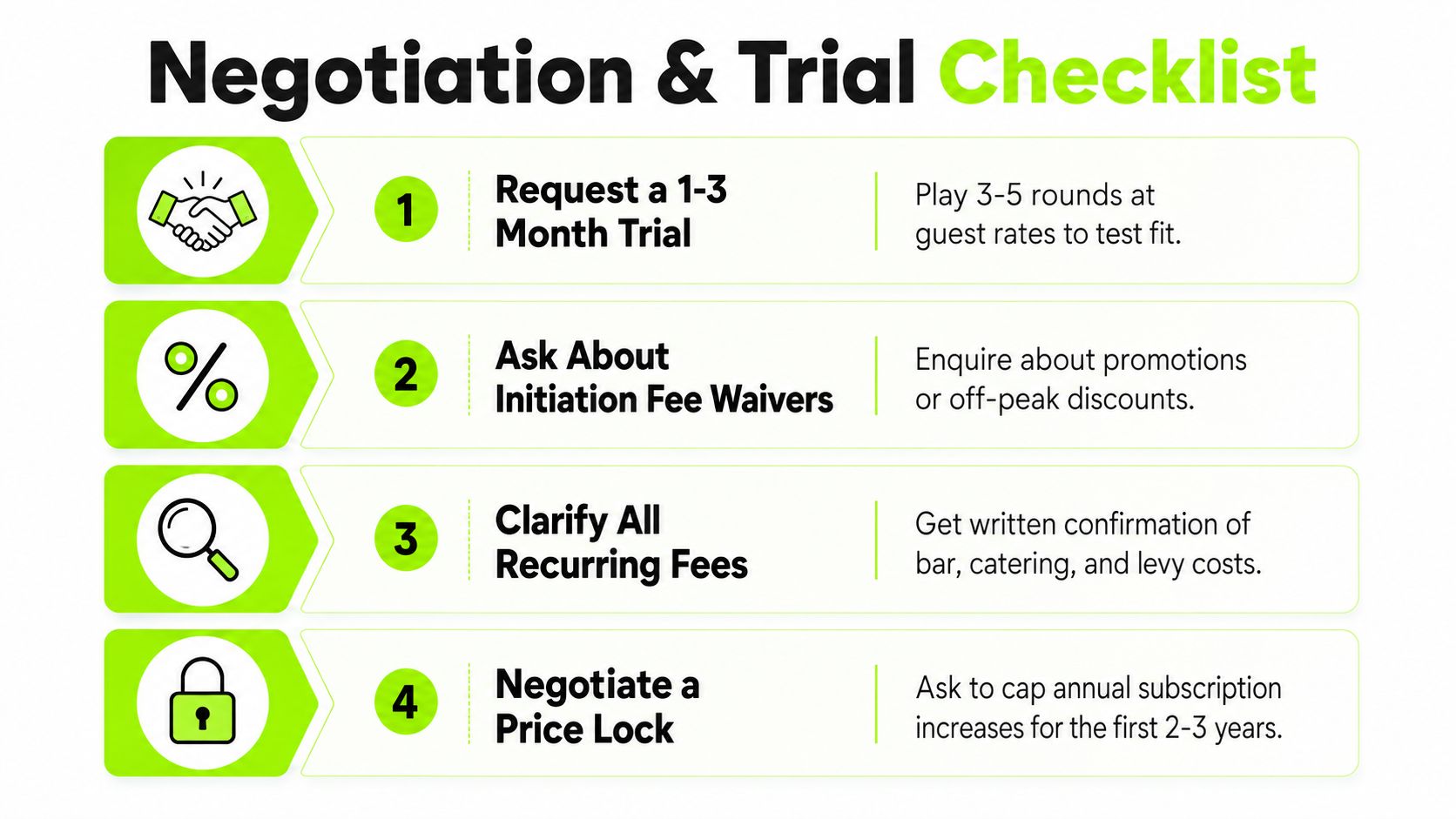
What to ask before you sign
Request a short trial if the club offers one, then use it properly. Don't just play once in perfect conditions. Play enough rounds to test weekend access, tee-time availability, pace of play, and how the staff handle visitors. If the club won't offer a trial, ask for a guest-rate visit or a structured taster period.
Next, ask directly about fee waivers or promotions on joining fees. Clubs don't always volunteer discounts, but they may be open to them, especially if you're a strong fit. Also ask for written confirmation of recurring charges so nobody can later “clarify” the bill after you've signed.
How to compare clubs properly
Use the same method for every club. Compare total annual cost, the flexibility of the contract, and the quality of response you got during the enquiry stage. A slow or muddled reply is not a small issue. It's part of the buying experience.
If you're considering a club's membership promotion, GolfRep's guidance on membership promotion is a practical reference for how clubs should present offers clearly rather than leaving prospects to decode the small print.
If the club makes you chase for answers before you've joined, don't expect the admin to become slicker after you pay.
One final point. Speak to current members if you can. Ask how easy it is to book, how the club handles communication, and whether the fee structure felt fair after the first year. That's the part brochures never show you.
How Clubs Can Convert Golfers Researching This Question
Clubs reading this should take the hint. Golfers asking whether membership is worth it are not casual browsers. They're high-intent prospects, and the club that answers them clearly usually wins the enquiry.
The problem is rarely enquiry volume. It's handling the enquiry properly. Clubs lose sign-ups when nobody owns the response, when pricing is buried, or when the follow-up is left to memory instead of a system. A fast reply matters because it keeps the prospect engaged while the question is still fresh.
That's why lead visibility matters across the whole team. If the office, pro shop, and membership lead can all see who enquired, what they asked, and where they are in the process, you stop losing people in the gaps. Structured CRM follow-up also gives clubs a proper view of conversion, instead of guessing which campaigns are producing members.
GolfRep's approach to membership conversion reflects that reality. Transparent pricing gets attention, but structured follow-up turns interest into visits, and visits into sign-ups. Clubs that rely on manual chasing usually miss prospects who were ready to buy.
The club that responds first, answers cleanly, and follows up with discipline usually wins the member.
That's the operational truth behind the question. If a club wants more members, it needs systems that keep every enquiry visible and every follow-up accountable. Marketing can create demand, but conversion happens in the handoff.
Your Membership Decision Checklist
Use this before you commit. If you fail more than two points, walk away or keep looking.
- Total cost: Have you added the subscription, joining fee, and recurring extras into one annual figure?
- Usage: Are you likely to play enough rounds to justify the cost on your own habits, not your best-case fantasy?
- Break-even: Does the per-round saving make sense against your likely round count?
- Flexibility: Can you deal with the contract if you get injured, travel, or relocate?
- Access: Do you value guaranteed tee times, competitions, and social access enough to pay for them?
- Responsiveness: Did the club reply quickly and clearly during the enquiry stage?
If you can tick those off, the membership probably fits. If not, you're better off with pay-and-play or a lighter model that suits a less regular schedule.
Corporate membership can be useful if the club needs access for staff or guests, but it only works when usage is predictable. During long travel or injury, ask whether the club offers any pause or deferral option before you sign.
Golf clubs that want more of the right members need a clear pricing story, fast enquiry handling, and follow-up that doesn't depend on memory. If you want help building a membership pipeline that tracks leads properly and converts interest into signed members, visit GolfRep and see how we help clubs turn enquiry traffic into predictable growth.
Ready to tap into our proven growth system?