Golf Club Video Marketing That Grows Membership in 2026

91% of UK adult internet users watched videos or clips online through a video-sharing platform in 2024, according to Ofcom's Adults' Media Use and Attitudes report. Your prospective members are already watching video. The commercial question is which membership decision your club can help them make.
At GolfRep, our approach to golf club video marketing starts with a buyer's question, not a filming brief. A sweeping aerial shot might introduce the course, but it won't explain whether a working parent can get suitable tee times or whether a beginner will feel comfortable joining. Give each film a specific job, then judge it by the next step a suitable golfer takes.
Matching Video Formats to Each Stage of Membership Research
Video formats by business intent
| Business intent | Video format | Best platform | Measure of success |
|---|---|---|---|
| Local discovery | 30 to 60 second vertical clips of the first tee and course highlights | Instagram, Facebook, YouTube Shorts | Qualified sessions from the target postcode radius |
| Proof of club culture | 2 to 3 minute member stories and social event films | YouTube, club website | Enquiries that mention a specific video |
| Objection handling | Explainers on fees, playing rights, visitor access and joining steps | YouTube, linked landing pages | Membership pack requests from the page |
| Conversion | Course tour or trial round walkthrough with a booking link | Retargeting audiences, email | Booked tours and trial rounds |
Treat these durations as production starting points, not performance guarantees. Read the table from the question the golfer is asking: where could I play, would I fit in, does membership suit me, and how do I experience it?
Start where prospects have the least useful information. If local golfers already know the course but misunderstand the joining process, another highlights reel won't address the uncertainty.
Move from curiosity to confidence
For local discovery, show the first tee, clubhouse terrace and an ordinary playing day. Share the clip within a realistic postcode catchment rather than chasing national attention. The question is whether the club looks worth investigating, so send viewers to a concise membership introduction.
For proof of culture, ask members to explain how they found playing partners or settled into club life. Social evenings and junior squad days offer useful supporting footage. Avoid turning every interview into praise for course condition, because the prospect needs to understand the people as well as the property.
Our guide to golf club social media content ideas can help turn those everyday activities into practical filming subjects.
Answer the question before asking for a visit
An objection-handling film should explain the joining fee, subscription, playing rights, guest arrangements or joining steps in plain English. Show the relevant booking screen or membership category where that makes the answer clearer. Have the manager approve the details before publication.
For conversion, film the experience of arriving for a course tour or trial round. Show where to park, who welcomes the prospect and what happens next. Use one primary call to action and one tracked destination, not competing requests to subscribe, follow, enquire and book.
Practical rule: Make two useful formats for the next 90 days before commissioning a complete video library.
That's a manageable production plan, not a promise of results. One generic club film rarely answers a single objection well because scenery, testimonials, coaching and pricing compete for attention. A focused film gives the golfer a clearer reason to act.
Choosing Platforms by Reach and Audience Age
Platform reach and best club use
| Platform | UK online adult reach (May 2025) | Best club use | Limit to plan around |
|---|---|---|---|
| YouTube | 94% (46.3 million) | Course tours, coaching clips and membership explainers | Titles and descriptions need searchable location terms |
| Facebook/Messenger | 93% | Open-day invitations and event footage | Audience spans all ages, so segment by age group |
| 90% | Sharing clips with existing members and their friends | Private sharing, so don't treat it as a discovery channel |
The reach figures come from Ofcom's Online Nation 2025 report, which also records average YouTube usage of 51 minutes a day in May 2025. These are national audience measures, not estimates of how many suitable golfers your club can reach.
A platform's scale doesn't settle the distribution decision. A searchable explanation of membership categories needs a different home from an invitation to a local open day.
YouTube isn't just for younger golfers
In a 2024 survey of more than 1,200 predominantly UK golfers, Golfshake found that 71% of golfers over 45 and 88% of golfers under 45 watched golf content on YouTube, while four in five respondents researched a new course before playing.
That supports keeping useful course tours and explainers on YouTube rather than treating it solely as an entertainment channel. Include the club name, location and actual question in the title. A prospect searching for membership information shouldn't have to guess what a film called “Experience Something Special” contains.
Facebook is a sensible secondary choice for event footage, open-day invitations and local distribution, including campaigns aimed at older prospects. Don't assume every Facebook viewer belongs to the same age group or wants the same membership category. Our guide to Facebook ads for golf clubs explains how to approach local campaign targeting.
Give each platform a distinct role
WhatsApp is useful when members want to pass a short invitation to friends. It's not a substitute for building a discoverable public video presence, and private sharing makes attribution less straightforward.
A course explainer can therefore have different uses without becoming different productions: searchable on YouTube, introduced with a locally relevant Facebook post, and shared privately by members.
Choose one primary platform and one secondary platform for local reach. Judge their contribution through tracked enquiries, not their national audience totals.
Segmenting Video for Independent Golfers and Visitors
England Golf figures reported by the Golf Club Managers Association show more than 10.2 million scores submitted in England in 2024, with general play increasing from 3.9 million to 4.4 million rounds. The same report identifies more than 55,000 iGolfers, about 7% of golfers with a handicap, submitting nearly half a million scores annually without club membership.
That audience isn't a single pool of membership prospects. Some golfers value independence, others haven't found a suitable club, and some want an occasional visitor round.

Match the message to the golfer
- Nearby visitors: Use a trial-round walkthrough showing the booking route and applicable green fee. Don't hide practical information behind a general membership pitch.
- Independent golfers with a handicap: Use an explainer about what membership adds, such as regular access, playing rights and opportunities to find playing partners. Only describe benefits your club provides.
- People new to golf: Use a member story or welcome film showing beginner coaching, the arrival experience and who helps them get started.
- Families and juniors: Show a junior squad day, supported by a clear explanation of the junior pathway, parental involvement and subscription structure.
These messages need different evidence. An established golfer may want to see the booking arrangements; a beginner may need to see someone like them enjoying a lesson.
A practical two-film example
Say a club produces two 90-second clips as a small campaign test. One explains playing rights for independent golfers and leads to a membership comparison page.
The other follows a visitor through a trial round and leads to an eligible booking page. Both can use footage from the same shoot, but their opening questions, explanations and destinations differ.
A casual golfer who books another visitor round hasn't necessarily failed to convert. They may have taken the right next step for their current needs.
Keep visitor bookings and membership interest distinct in reporting. A large casual audience isn't automatically ready to join, so assess each message against the stage it's intended to move.
Setting Up Tracking and Testing Creative Variants
Build the measurement before publishing. Otherwise, the committee may see a convincing engagement report without being able to identify which film prompted a membership conversation.
- Set one goal per video. Choose a trial-round booking, membership pack request or another clearly defined action.
- Give it a matched destination. Use a dedicated landing page or unique URL parameters that identify the campaign and creative.
- Carry the source into the enquiry. Include a required source field, populated automatically where possible, and store the video identifier alongside the prospect's CRM stage.
- Count offline responses. Give reception and the professional shop a booking code to record against telephone and in-person bookings.
- Launch controlled variants. Change one feature, such as the first three seconds, while holding the offer and call to action constant.
- Set a review window. As a practical starting point, allow four to six weeks, then extend the comparison if enquiries remain too sparse to support a decision.
Our conversion tracking setup guide provides a useful basis for checking that campaign details survive the journey from landing page to enquiry.
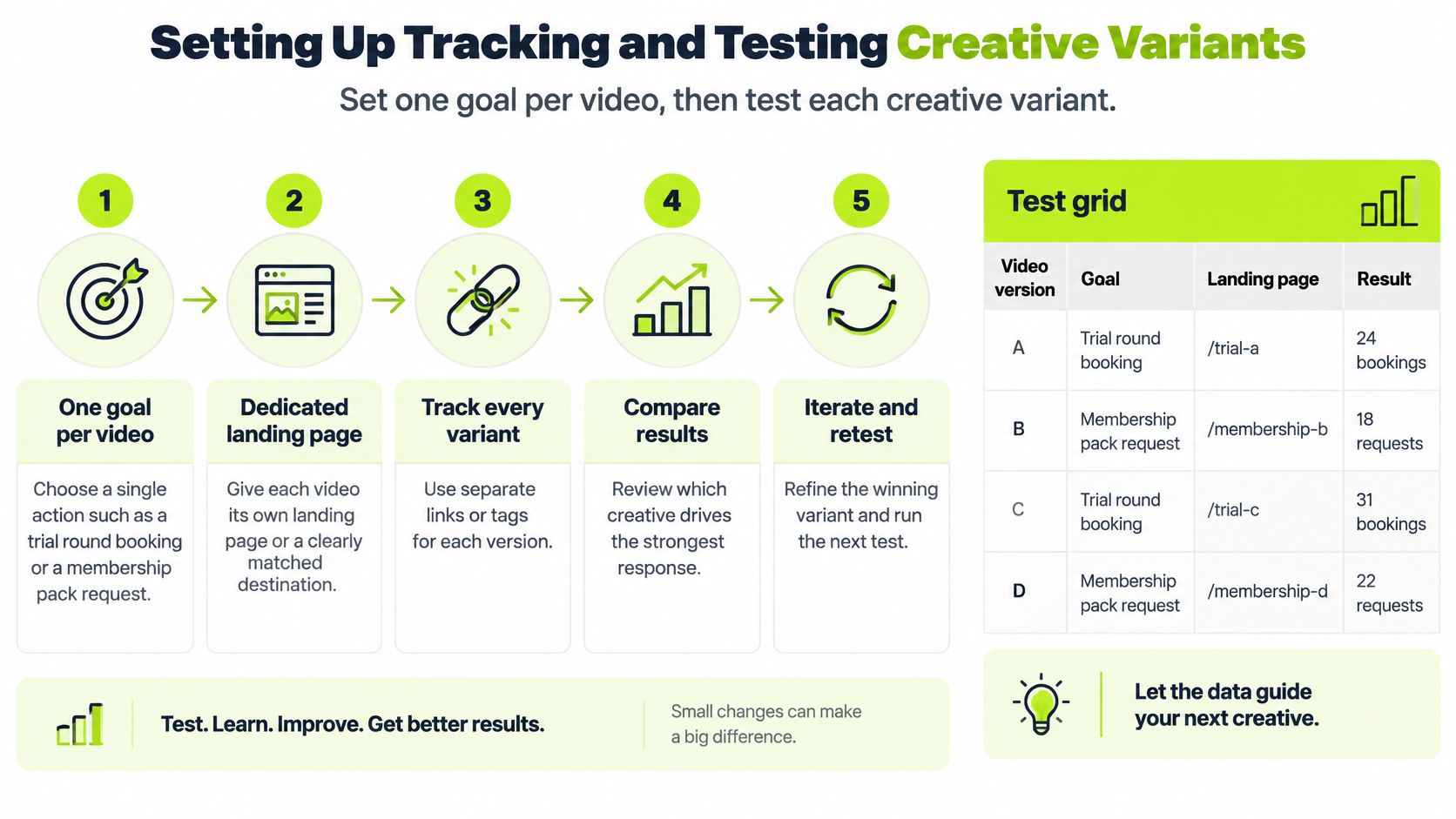
Change one creative variable at a time
Video variables to test one at a time
| Variable | What to change | What to keep constant |
|---|---|---|
| First three seconds | Opening shot or on-screen question | Offer, landing page and call to action |
| Presenter | PGA professional, member or manager | Script length and offer |
| Offer framing | Joining fee, trial round or course tour as the lead message | Video length and visuals |
| Captions | Burned-in captions or none | Edit, offer and landing page |
| Aspect ratio | 9:16 vertical or 16:9 landscape | Message and call to action |
| Call to action | Book a tour or request the membership pack | Video and offer |
Use 9:16 vertical edits for mobile placements, with captions that preserve the meaning when sound is muted. Keep important text away from interface buttons and check the preview on a phone.
The caption comparison is a diagnostic test, not a reason to make information inaccessible. Retain an accessible version on the website and make sure essential offer details remain available in text.
For production support, the ShortGenius AI ad creative tool is an option to assess when preparing variants. Keep actual course footage and approved membership information under club control; don't use generated scenes as evidence of facilities or member experiences.
Record permission and responsibility
Before testing, record filming permissions, footage ownership, music rights and any restrictions on reuse. Take particular care with junior footage and obtain appropriate permissions.
Have the club's privacy lead check remarketing against PECR and UK GDPR requirements. Obtain consent before activating non-essential advertising cookies or pixels, and capture marketing permission separately from the enquiry itself rather than making it a condition of requesting information.
Assign a named owner to each enquiry source and agree a response standard. After the test, record the winning variant, cost per qualified enquiry and the single change to test next.
Measuring Video by Membership Outcomes, Not Views
Read the funnel in order: views → viewing thresholds → qualified landing-page sessions → completed enquiries → booked visits → new members.
Before interpreting it, check that destinations identify the creative and that reception records offline booking codes. Missing attribution can make a useful film look ineffective or give another channel credit for its work.
Video KPIs and the decision each one drives
| Metric | What it tells you | Decision it drives |
|---|---|---|
| Video views | Exposure only | Whether to inspect opening-second retention |
| 50% completion or set watch time | Genuine interest in the film | Who to add to remarketing audiences, where consent allows |
| Qualified landing-page sessions | Visitors from the video who reached the offer page | Whether the video attracts the right people |
| Completed membership enquiries | Prospects who submitted a request or form | Whether the offer and call to action convert |
| Booked visits or trial rounds | Prospects who committed to a visit | Whether the next step works in practice |
| New members from video-tracked enquiries | Revenue outcome | Whether the video justifies its production cost |
A 50% completion threshold is a suggested campaign setting, not proof of membership intent. Someone can enjoy a course film without having the location, budget or playing requirements to join.

Diagnose the first weak transition
Use this decision sequence rather than changing the entire campaign:
- Strong views, weak landing sessions: Inspect the offer and call to action first. Check that the destination works and that viewers have a clear reason to leave the platform.
- Strong sessions, few enquiries: Review the landing page, membership information and form. A prospect shouldn't need to submit personal details just to discover basic eligibility.
- Enquiries, few visits: Examine follow-up, appointment availability and prospect fit. Listen for unresolved questions about price or playing access before blaming the film.
These are diagnostic starting points, not automatic verdicts. A local targeting error can affect every subsequent stage.
Keep the commercial report short
Define a qualified enquiry before calculating costs. For example, require a genuine contact, a suitable membership category and a realistic travel area, rather than counting spam and unrelated requests.
Calculate campaign cost per qualified enquiry and per booked visit, and review them weekly. Keep definitions consistent across the season, separating media spend from total campaign cost if production is included.
A video-tracked sign-up shows a recorded route to membership. It doesn't prove that video alone caused the decision.
Members may also have encountered referrals, search results or previous visits. Keep the report to one page: the funnel metrics, week-on-week changes, cost measures and one decision about the current constraint.
Planning a Video Calendar Around the Membership Year
Consider a club planning its filming around the questions prospects ask throughout its own membership year. The commercial manager starts with recruitment dates, available capacity and course presentation, then chooses the footage needed.
In winter, that might mean indoor coaching clips and new-season joining explanations. In spring, the emphasis could shift to open days, trial rounds and the first-tee experience, provided course condition and availability support the message.
Follow the club's actual trading pattern
Summer gives the club opportunities to capture visitor rounds, society hospitality and social events. Film early or late where the light suits the location, but agree access with the professional and greenkeeping teams rather than interrupting play.
Autumn can support member stories, referral invitations and renewal information. A club with a different subscription anniversary should move those messages accordingly; the calendar isn't a fixed industry timetable.
- Before filming: Check maintenance work, tee-sheet pressure, staff availability and permissions.
- Before publishing: Confirm that prices, joining availability and booking links are still accurate.
- At review: Compare themes by tracked responses, not by which course shot attracted the most compliments.
Make a filming day work harder
As a practical production example, plan one filming day for six to eight cuts: a 60-second master, vertical extracts, member answers and a focused explainer. Capture clean sound and additional arrival, practice-ground and clubhouse footage so edits don't rely on repeated drone shots.
A volunteer-run club could start with one published video a fortnight, supported by a monthly commercial review. Those are workload choices, not a minimum required to succeed.
Once the assets and approval dates are agreed, a calendar tool such as FoPost can help build a cross-platform publishing schedule. Keep a named approver and the intended audience beside every scheduled post.
The calendar should follow the commercial priority of the season, not the most attractive footage available on the day. There's little value promoting unrestricted access when the relevant membership category is full.
Start With One Measured Video Campaign
Choose a narrow test rather than authorising a general video programme. Select one business intent, one primary platform, one audience group and a six-week window as a practical pilot.
For example, a club seeking independent golfers could film a playing-rights explainer for YouTube and direct viewers to a membership comparison page. The question is specific: does the club's access proposition justify moving from casual play to membership consideration?
Write the baseline before publishing
Record current monthly membership enquiries, cost per enquiry and booked visits. Note how those figures were calculated, including whether costs contain advertising only or staff and production expenditure as well.
If historical attribution is unreliable, say so. An honest starting point is more useful than a precise-looking comparison built from incompatible figures.
For local search presentation, Taja AI's guide to optimize business videos for local SEO offers a supporting resource. Apply the basics carefully: identify the club location clearly, answer a recognisable question, and match the description to what the video explains.
Publish the film with its matched landing page and tracked form. Check the entire journey yourself on a phone, including confirmation messages and the booking process.
Make a decision rather than collecting another report
Review the pilot in week three and week six as a suggested management schedule. Separate early technical checks from commercial judgement, especially where membership decisions take longer than the test.
At each review, choose among these actions:
- Keep running: Suitable prospects are taking the intended next step at a cost the club can justify.
- Change one variable: There's a clear weakness to test, such as an unclear opening or an unsuitable destination.
- Retire the format: The question, audience or proposition doesn't merit further investment under the club's current priorities.
Don't call a low-volume test a failure because it hasn't produced enough evidence. Equally, don't extend an attractive film indefinitely when the audience is wrong or the membership offer cannot meet the promise.
GolfRep creates campaigns around a club's brand, pricing and goals, using data-led targeting to reach prospects who match its ideal member profile. That makes creative selection a commercial decision rather than a preference for a particular filming style.
Keep the next step small: one video, one landing page and one measured pilot. Video earns its place when it helps a specific golfer make a decision the club can track.
GolfRep helps golf clubs connect targeted video campaigns with membership enquiries, booked visits and measurable commercial outcomes. Visit GolfRep if you'd like help choosing a focused campaign and identifying where prospects need better information or support before joining.
Ready to tap into our proven growth system?