Golf Club Trial Membership Offer That Converts

A cheap, open-ended trial is not a growth tactic. It is a yield leak. The strongest golf club trial membership offer is a timed proof of fit, with published access rules, a pre-agreed upgrade and a date the office can report on. General managers, secretaries, owners, commercial managers, PGA professionals and committee members should treat that offer as its own acquisition stage, with a cost, a utilisation rate and a conversion rate. Demand still matters. The trial only pays when enough of the right local golfers are invited in, then asked to decide.
The Golfer Pool a Trial Can Reach
England's golf-club membership base is only part of the audience a club can target. In 2024, National Club Golfer reported that England Golf counted approximately 730,000 members across 1,735 affiliated clubs. That gives clubs a reason to look beyond current members when building a trial offer.
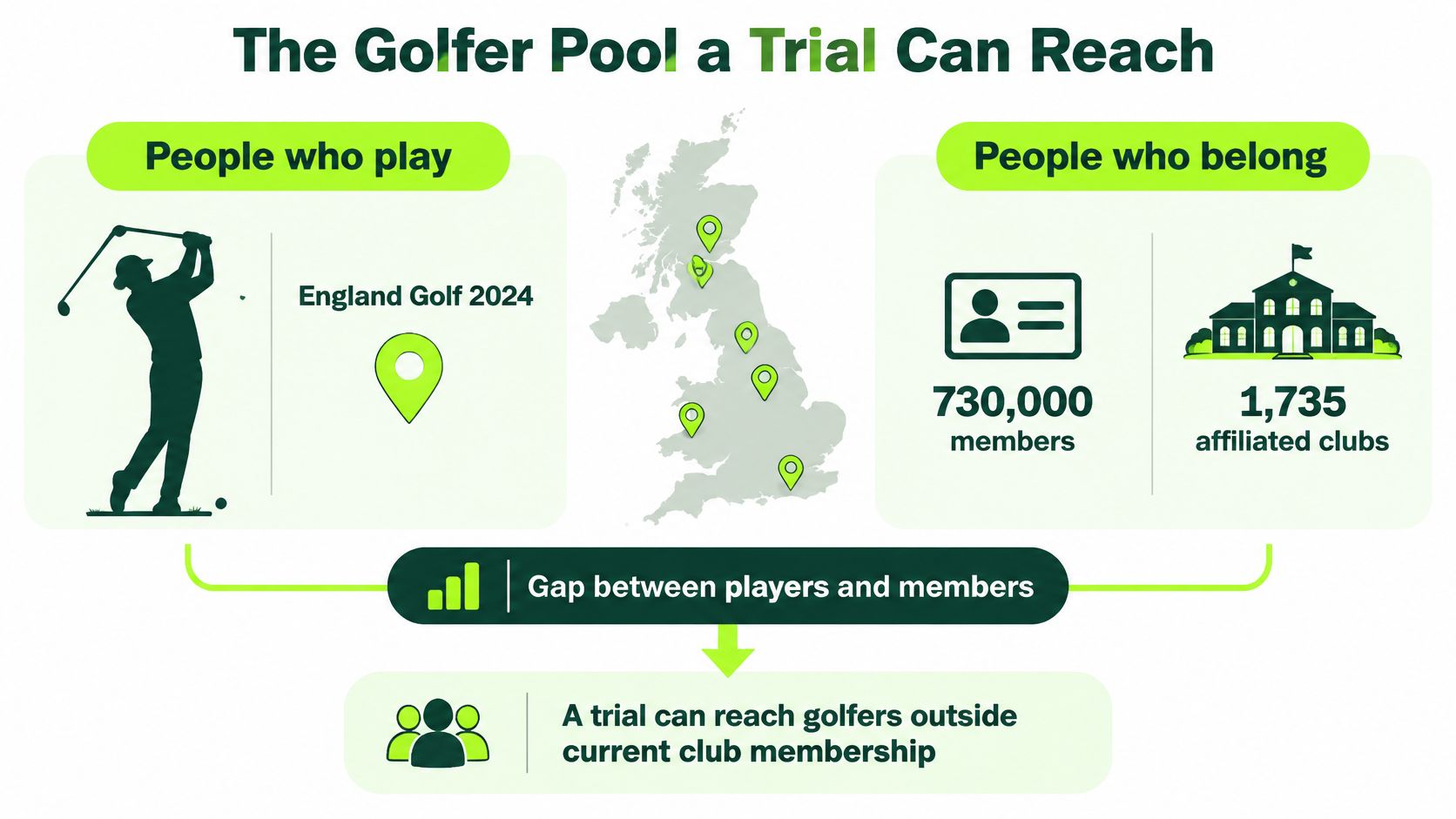
A low-commitment route can introduce golfers to club membership, but a national participation scheme is not a template for your club's pricing. Set the trial around your course's capacity, the golfer you want to attract and a clear next step.
What the trial has to be
Treat each trial as a measurable acquisition stage. Record enquiries, trial participation and full memberships separately so you can see where prospects drop out and which sources produce members.
Practical rule: Track the cost of each trial, how much access is used and how many trialists join. Without those figures, you cannot tell whether the offer is bringing in members or simply selling discounted golf.
A trial needs an audience as well as an offer. Target local golfers who fit your intended member profile, give them clear terms and set a decision date. Open-ended access makes it harder to manage tee-time demand and gives prospects little reason to choose full membership.
Trial Structures UK Clubs Already Sell
A trial's price is only one part of its value. Set a defined term, publish what access includes, and agree the upgrade before the golfer pays. That makes the trial a timed proof-of-fit, rather than a cheap membership with no clear end.
| Structure | Offer shape | Typical terms | Conversion mechanic |
|---|---|---|---|
| Round allocation | A set number of rounds | Use within a defined window; specify whether peak times and competitions are included | Unused rounds expire at the end of the window, prompting a decision |
| Refundable taster | Pay upfront, with the fee refunded on joining | State the taster period and refund conditions | Define what counts as joining, the deadline and how the refund is claimed |
| Restricted member access | Temporary access to selected facilities and benefits | Publish booking notice, peak-time limits and any exclusions | Set a joining credit or other upgrade terms before payment |
| Targeted introductory fee | A short-term offer for a defined group | State who qualifies, what access includes and when the offer ends | Publish the full-category price and upgrade deadline |
When each shape fits
Round allocation suits a club that needs to manage capacity. Set the number of rounds and the expiry date, then state whether weekend times and competitions are included. A clear limit lets prospects try the course while protecting the tee sheet from open-ended use.
A refundable taster tests whether a golfer will pay for access. State the full fee, taster period, refund deadline and joining conditions together. If the golfer must request the refund, say so plainly.
Restricted member access gives a prospect a realistic experience while reserving selected times or activities for full members. Publish the booking window, excluded sessions, visitor rules and included benefits. Put any joining credit and its expiry in the same offer.
A targeted introductory fee can address a group the club wants to attract. Define eligibility, access and the offer's end date, then show the full membership price. A low fee without a clear upgrade can attract bargain-seekers rather than likely members.
Do not run overlapping trials. Choose one structure for one cohort, then measure paid take-up, use and upgrades. Trial fees also arrive on a different schedule from annual subscriptions, while access uses course capacity. Clubs that spot cash shortfalls before payroll should include both timing and tee-sheet use in the decision.
Access Rules That Belong in the Offer
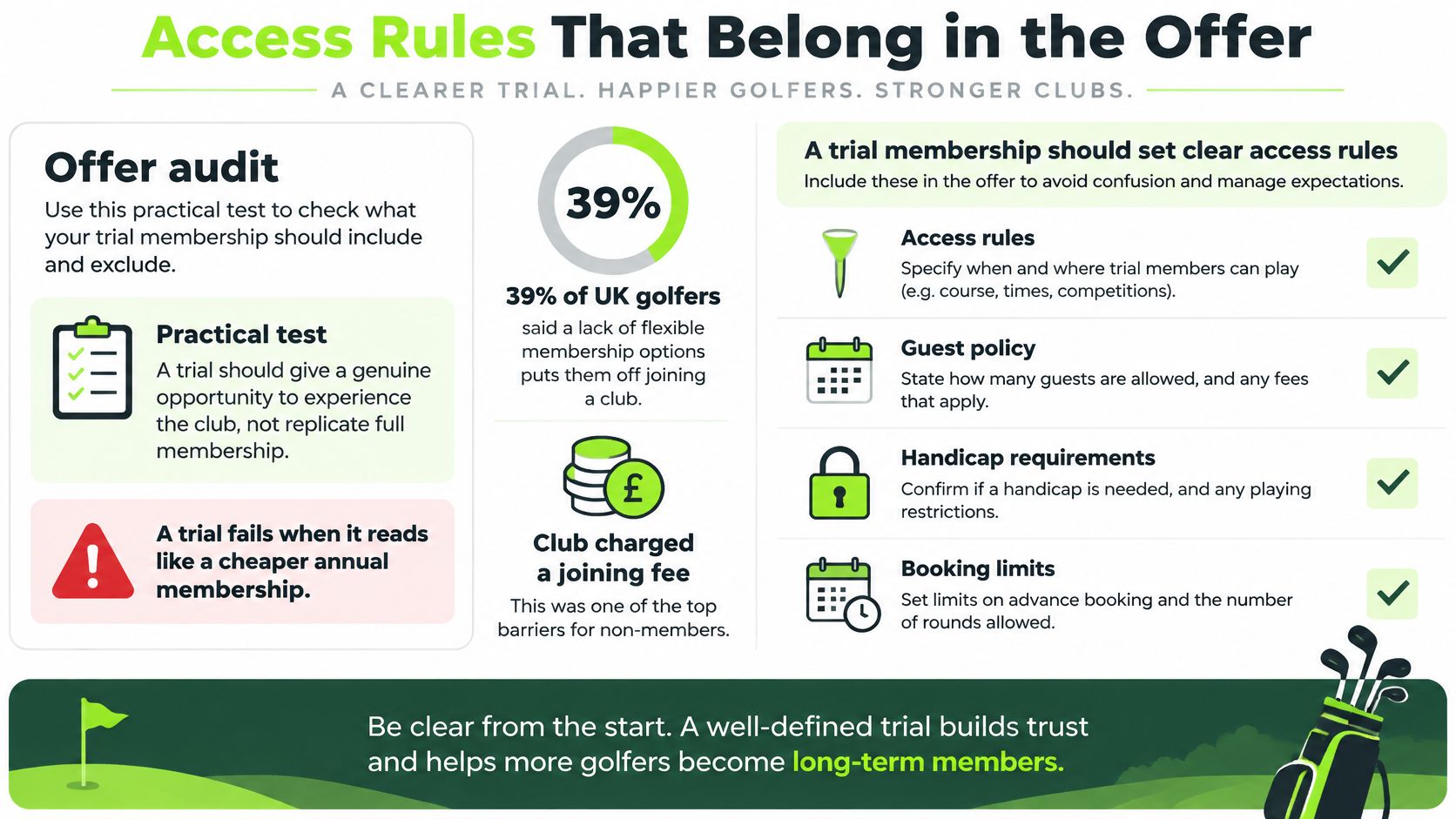
A trial's access rules determine what the golfer is buying. Publish them beside the price, so nobody has to call to find out whether Saturday morning is included.
In a 2025 survey, 39% of UK golfers said their club charged a joining fee, and 30% said their club had a waiting list, up from 27% in 2024, according to Golfshake's membership survey. State whether the full category they can upgrade to has a joining fee or waiting list. The trial should lead to a defined membership, not an unclear promise of access.
Before you join
Publish these details before the advert goes live. Use rules the club can apply consistently.
| Checklist item | What to publish | Example from a UK club |
|---|---|---|
| Tee-time rights | Weekend and medal-morning access | Beeston: no play before 1pm on Saturday |
| Competitions and matches | What is included or excluded | Grimsby: no club competitions |
| Visitors | Whether trialists can introduce guests | Beeston excludes visitor bookings; state clearly whether guests are allowed |
| Handicap | Whether one is issued, held or unused during the trial | State whether a handicap is issued, held or left unused |
| Booking window | How many days ahead trialists can book | Beeston: up to 10 days |
| Member benefits | Which lessons, practice facilities and discounts are included | Beeston: one PGA lesson, 15% off drinks, 7% off food |
| Joining fee and credit | Whether the trial payment is refunded or credited on joining | Beeston: £100 off subscription; Ramsey: full refund |
| End date | The exact expiry date and what happens to unused rounds | Grimsby: 60 days |
| Destination category | The full category name and current annual subscription | Show the category and its current annual subscription beside the trial price |
The strongest trial is a timed proof-of-fit, not the cheapest one. Spell out whether peak tee times, medals and social events are included. If the trial excludes competition access or handicap administration, say so plainly. Then state the full category and the pre-agreed upgrade terms. For a clear guide to golf club membership tiers, see how category names and access differ.
A prospect should be able to tell from the offer what they can book this Saturday and what they will pay if they upgrade.
If they cannot, the offer is not ready.
How to Qualify a Trialist Before They Pay
A trial is a product match, not an open gate. Selling it to anyone with a card invites the golfer your rules cannot satisfy, then blames marketing when they walk.
The Golf Business reports more than 730,000 members across 1,735 English clubs, with an average handicap of 18.62 and an average age of 54.99. Those averages are prompts to segment. They are not a profile to copy onto every applicant.
Four questions before payment
Ask these before you take the money.
- Playing frequency: How many rounds do they expect in the trial window?
- Competitions: Do medals matter inside the first 60 days?
- Handicap: Do they need one issued, or are they testing the course first?
- Destination: Is weekday, family or full membership the honest next category?
Route the answers. Do not let the cheapest button on the website do the routing.
| Golfer profile | Trial type | Full category to aim at |
|---|---|---|
| Plays most weeks and wants medals | Unrestricted or credit-based trial | Full or competition category |
| Occasional or returning golfer | Capped-round trial | Flexible or points category |
| Confidence is the barrier | Hosted or coached trial | Category that matches their weekly play |
| Wants weekday golf only | Restricted member access trial | Weekday membership |
| Under-served segment such as women or families | Targeted introductory fee | Family or social category, price stated in advance |
A high-frequency golfer needs access that matches how they already play. An occasional or returning golfer usually fits a capped allocation better than an unlimited pass. Someone whose barrier is confidence needs a hosted round or the included lesson, not a competition diary. A weekday-only golfer should not be sold a story about Saturday medals. A segment you under-serve, such as women or families, can take a targeted fee, but only with the full-category price stated before they pay.
Refuse or redirect anyone the offer cannot satisfy. A golfer who needs medal golf during an exclusion period will leave disappointed, and they will tell other local players.
Record lead source, start date, rounds played, coaching or social attendance, and trial-to-member outcome as separate fields. The same discipline sits behind a proper lead qualification process. Weak conversion then points at demand, category mismatch, limited course access or the price step-up. It stops being a vague marketing failure.
A Sixty Day Path from Trial to Full Member
Proof of fit needs a clock. One UK industry report, covered by National Club Golfer, cites 12.6 million adults playing some form of golf in the previous year, against 750,071 club members in England in 2025, roughly 6% of that reported player population. The gap supports a short, dated experience of course, clubhouse and members, with the upgrade agreed before the first tee time.
Our UK analysis puts the average time from first enquiry to signed membership at 47 days. A 60-day window that starts after that enquiry often lands the decision inside the period clubs already take to close. Do not stretch access because the diary looks quiet.
The operating timetable
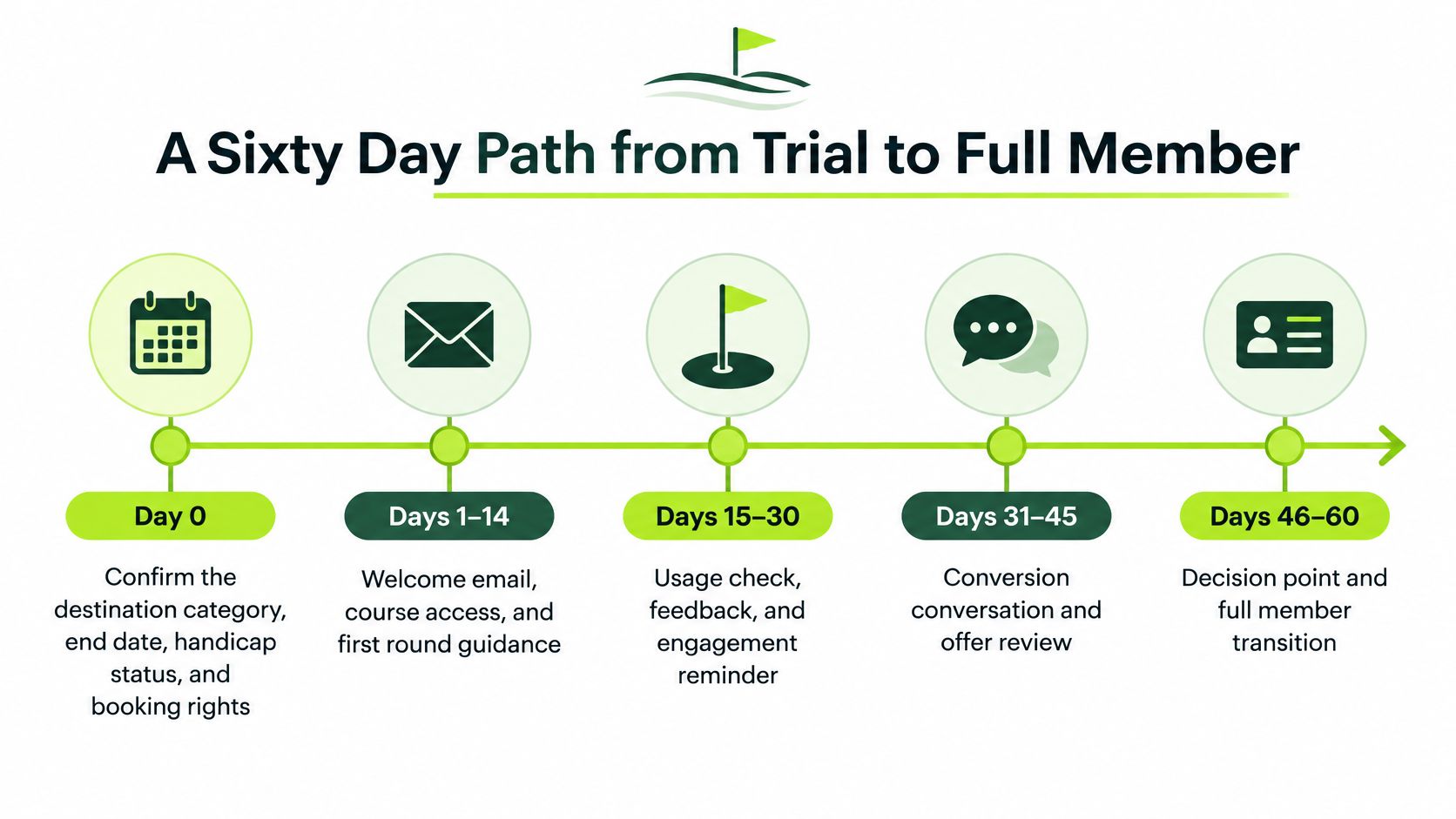
Use this for a 60-day round allocation, or for a three-month product with the same early checkpoints.
| Checkpoint | When | Action | Record |
|---|---|---|---|
| Enrolment | Day 0 | Confirm destination category, end date, handicap need and upgrade price or credit | Offer type, source, start and end date |
| First use | Within 7 days | Book a round or the included PGA lesson | First-use date |
| Club experience | During the trial | Invite them to one social event or an eligible roll-up | Event attended |
| Welcome review | Day 30 | Review rounds played, booking friction and category fit | Rounds used, open issues |
| Conversion meeting | Day 45 | Present the full fee and apply the published credit or refund rule | Decision and objection |
| Expiry | Day 60 or published end | Close, or grant one recorded extension | Outcome and revenue |
Day 0 is paperwork, not a welcome drink. The destination category, the end date, the handicap need and the upgrade price or credit go in writing. Inside the first week, book a round or the included lesson so the trial is used, not parked. During the window, one social invitation, or a roll-up where the rules allow, puts them with members rather than only the starter.
The day-30 call covers rounds played, booking friction and whether the category still fits. Day 45 is the conversion conversation. Apply the refund or the subscription credit exactly as published. At day 60, or the published end, close the access. One short extension is allowed only with a recorded reason. Do not leave the rate running because nobody pressed stop.
Outside golf, teams evaluate trial account fit before they extend access. A club should do the same with a tee sheet. A prospect who has not played by day 30 is an onboarding problem. One who has played and declines is a category or price problem. Those need different fixes.
Report each cohort and source on cost per trial, share playing in week one, rounds used, conversion rate, first-year revenue and months to pay back any credit. That is what makes the offer financially testable, instead of a blanket reduction that pulls in low-intent golf and weakens yield.
What Regional Value Means for Trial Pricing
Price is local. A national “three months for £100” poster ignores how clubs charge to join.
A 2024 Golfshake survey of 3,000 golfers found that 46% had belonged to a club for more than 10 years, while 16% had been members for fewer than two years. The trial has to make sense to long-standing members, who will notice a giveaway, and to recent joiners and switchers, who are comparing clubs.
Joining fees are not uniform. 46% of southern respondents said their club charged one, against 36% in the Midlands and 31% in the North. Conversely, 51% in the South, 62% in the Midlands and 67% in the North said their club did not. A £100 three-month offer and a £415 one can both be rational. Each has to sit beside that club's own annual fee and joining fee. How those full fees should be framed is set out in our note on golf club membership fees.
Outside the South and Midlands, 70% of respondents said membership represented good value, while 17% disagreed and 13% were unsure. Lead with what the month includes, then the upgrade number. Do not lead with a slash through the annual fee.
A worked cohort
Say a club's annual fee is £1,200 and it sells 20 three-month trials at £100. That is £2,000 of trial income. Ten join and pay £1,100 after a £100 credit, which is £11,000 of first-year fees. The other ten still paid £1,000 for the golf they used. Before you scale, compare the cost of each trial, including staff time and course use, with the first-year fee per converted member.
Software products sometimes stretch a trial for months, as in WebinOne's six-month trial site update. A golf club cannot. Open-ended cheap golf teaches people to wait for the next reduction, and it annoys the member who paid the full rate in January.
We put a growth system across five Macdonald golf sites, with CRM, AI-driven follow-ups and automated nurture. Within eight weeks, 118 new trial members joined and the group gained £23,500 in winter revenue. The useful lesson is the cohort, not the headline. Three numbers belong in the committee pack: trials sold, the percentage playing in week one, and the percentage taking a full category before expiry, split by the category you qualified them for.
Choose One Structure and Measure It
Set the rules before the first golfer pays. Record the offer structure, access limits, upgrade terms, eligibility and expiry date.
- Structure: Choose one, such as a round cap, refund, restricted access or targeted fee.
- Exclusions: State the rules for Saturdays, medals, guests and booking windows.
- Upgrade: Publish the full-category price and any credit or refund in pounds.
- Eligibility: Define who the offer suits and who should be directed to another option.
- End date: Specify when access expires and allow no more than one recorded extension.
Match the offer to the club's actual capacity. If weekend medals are full, do not imply that trialists can play Saturday competition golf. If the aim is to introduce golfers to the course, use a capped-round offer or refundable taster. If the club wants to attract women, families or younger adults, tailor the fee and welcome, then make the upgrade price clear.
Run one cohort and track utilisation and conversion. Change one condition at a time, whether that is the included rounds, the credit or the time allowed to book a first tee time. Otherwise, you will not know which change affected the result.
A trial should be a timed proof of fit, not cheap, open-ended golf. Promote it only when a non-member can see what they can book, what is excluded, when access ends and what full membership will cost at the decision point.
GolfRep helps UK golf clubs grow membership, enquiries and retention through campaigns and a proven growth system. Book a call to see whether GolfRep is a good fit for your club: GolfRep.
Ready to tap into our proven growth system?