Golf Club Lead Nurturing: A Practical Playbook for UK Clubs
How many membership enquiries does your club receive, and how many become signed members? The gap between those two figures is where commercial discipline matters most. A prospect may be interested, but interest alone doesn't create a visit, an application or a joining fee.
For UK golf clubs, lead nurturing has to account for more than email frequency. Waiting lists, committee approvals, different membership categories, limited weekend tee-time capacity and flexible golfers all change what a prospect should receive next. This playbook treats nurturing as a capacity-aware revenue system, not a generic email sequence.
What Lead Nurturing Actually Means for a Golf Club
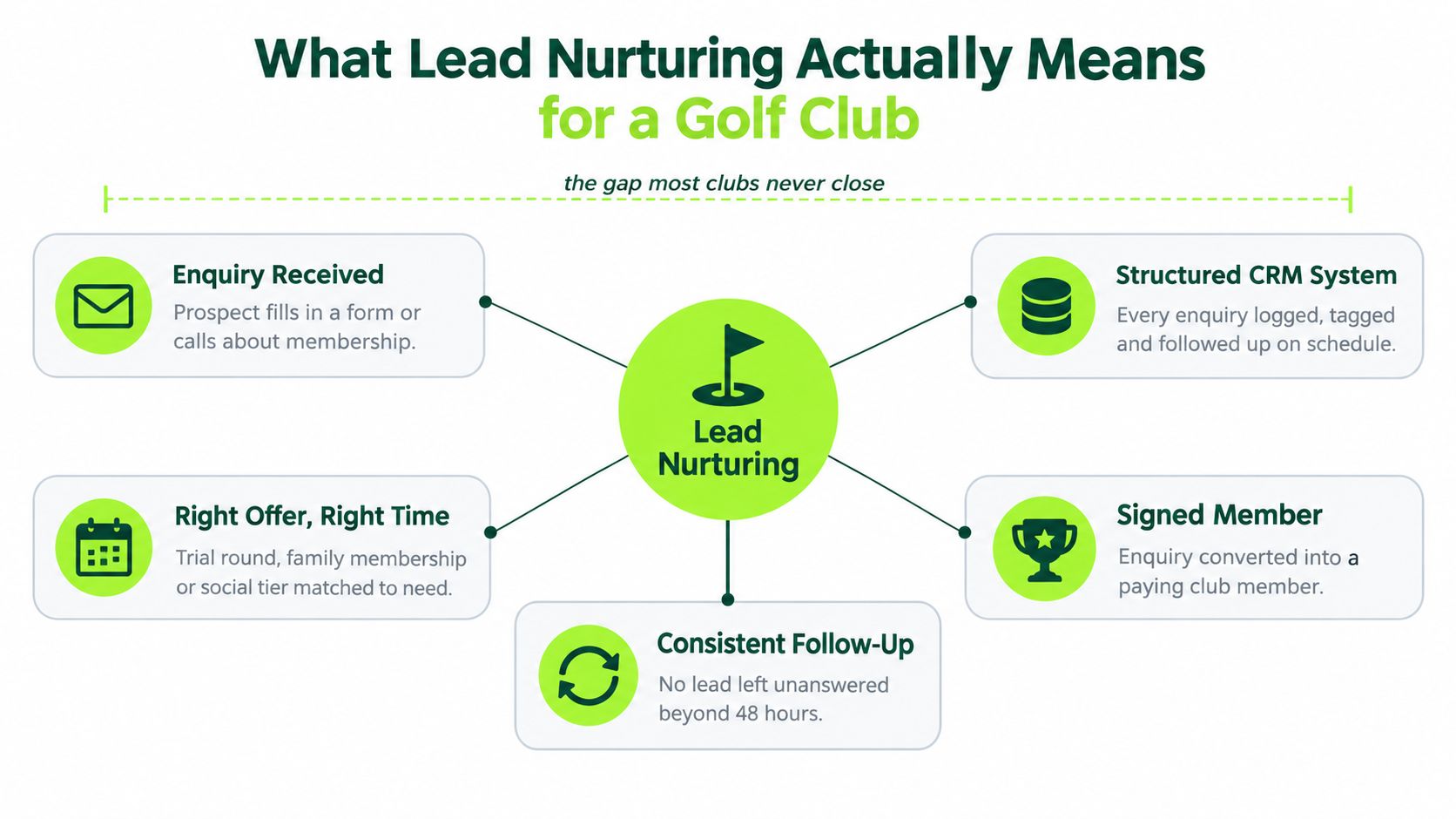
Golf club lead nurturing is the organised process of matching the right prospect with the right conversation, offer and next step at the right time. It starts with a consented enquiry, continues through qualification and a visit or playing experience, and ends with a joining decision or a clearly recorded reason for loss.
That definition matters because a club can't use the same follow-up for every golfer. A prospect seeking a 7-day membership needs different information from someone considering a 5-day category. A family may need junior coaching and practical weekend details, while an iGolf-style flexible golfer may want access without the commitment of traditional membership.
The UK market also includes clubs with restricted categories and waiting lists. England had more than 730,000 golf-club members and 1,735 golf clubs, while golfers submitted more than 10.2 million World Handicap System scores during 2024, according to GolfRep's analysis of UK golf club membership growth. There's a substantial audience, but demand won't convert automatically when availability, approval processes or playing preferences vary.
Nurture around capacity
A capacity-aware system does three jobs:
- Protects the relationship: If a category is full, the club explains the position, records the golfer's preferences and keeps the prospect informed.
- Improves tee-time yield: A weekday golfer can be offered a relevant category or playing experience rather than pushed towards unavailable weekend access.
- Creates commercial visibility: Managers can see how many prospects are waiting, what they want and when demand is likely to convert.
This is also why mapping the customer journey is useful. It forces the club to document the experience from first contact through to membership, including points where staff, systems or unclear information create friction.
Start with a central CRM, clear ownership and agreed stages. A useful lead nurturing framework for golf clubs should make every enquiry visible, assign the next action and prevent joined, lost or unsubscribed contacts from receiving the wrong message.
Building the CRM Pipeline That Powers Nurturing
A CRM pipeline should mirror the actual decision journey, not the internal structure of the club. HubSpot, ClubSystems or GolfManager can all support the process if staff use the same definitions and record the same fields.
Use these stages:
- New Enquiry: The club has captured contact details, consent, source and initial interest.
- Engaged: A reply, call or meaningful interaction has been recorded.
- Qualified: Staff understand the golfer's playing needs, category fit, location, budget and timeframe.
- Visit Booked: A tour, taster round, open day appointment or membership meeting is confirmed.
- Taster Played: The prospect has experienced the course, facilities or relevant programme.
- Offer Sent: The club has issued suitable joining information and a clear next step.
- Join Pending: The prospect has indicated intent but still needs approval, paperwork, payment or a decision.
- Member: The joining process is complete and the CRM hands the contact into onboarding.
- Lost: The club has recorded a reason, such as price, location, capacity, timing or no response.
Each stage needs an exit criterion. “Spoke to them” isn't enough for qualification. The record should show what was discussed and what action follows.
Recommended pipeline structure
| Stage | Data Captured | Owner | Automation Triggered | Exit Criteria |
|---|---|---|---|---|
| New Enquiry | Name, contact details, source, consent, category interest | Membership lead | Immediate acknowledgement and response task | Contact attempt recorded |
| Engaged | Contact outcome, preferred channel, questions | Assigned staff member | Follow-up task if no reply | Two-way conversation established |
| Qualified | Frequency, location, tee-time need, budget, handicap, timeframe | Membership lead | Segment tag and tailored sequence | Fit and next step agreed |
| Visit Booked | Date, appointment type, host, access needs | Host or membership lead | Confirmation and reminder SMS | Appointment confirmed |
| Taster Played | Attendance, feedback, playing fit, objections | PGA professional or host | Follow-up task and feedback form | Recommendation recorded |
| Offer Sent | Category, fees, availability, joining terms | Membership lead | Decision reminder | Prospect accepts, declines or pauses |
| Join Pending | Application, approval, deposit, missing documents | Club administrator | Escalation task for incomplete items | Application complete or declined |
| Member | Joining date, category, source, agreed onboarding actions | Member services owner | Onboarding workflow | Handover complete |
| Lost | Reason, competitor or alternative, recontact permission | Membership lead | Suppression or future reactivation tag | Closed with reason |
Operating rule: No stage, no nurture. If the club can't identify where a prospect sits, it can't know what to send or who should act.
A pipeline view should show owner, age, last contact, next task, category and capacity status. That gives the manager a practical answer to questions such as which qualified golfers haven't booked, which visits produced no follow-up and which applications are waiting for committee action.
Use the same principles found in lead nurturing automation for B2B, but adapt the triggers to golf. A booked visit should create an appointment reminder, while an incomplete application should create a staff task, not another promotional email.
For a golf-specific CRM structure, see CRM for golf clubs. The technology is secondary. Consistent stage definitions and staff accountability are what make the system useful.
Segmenting Prospects by Intent, Not Just Source
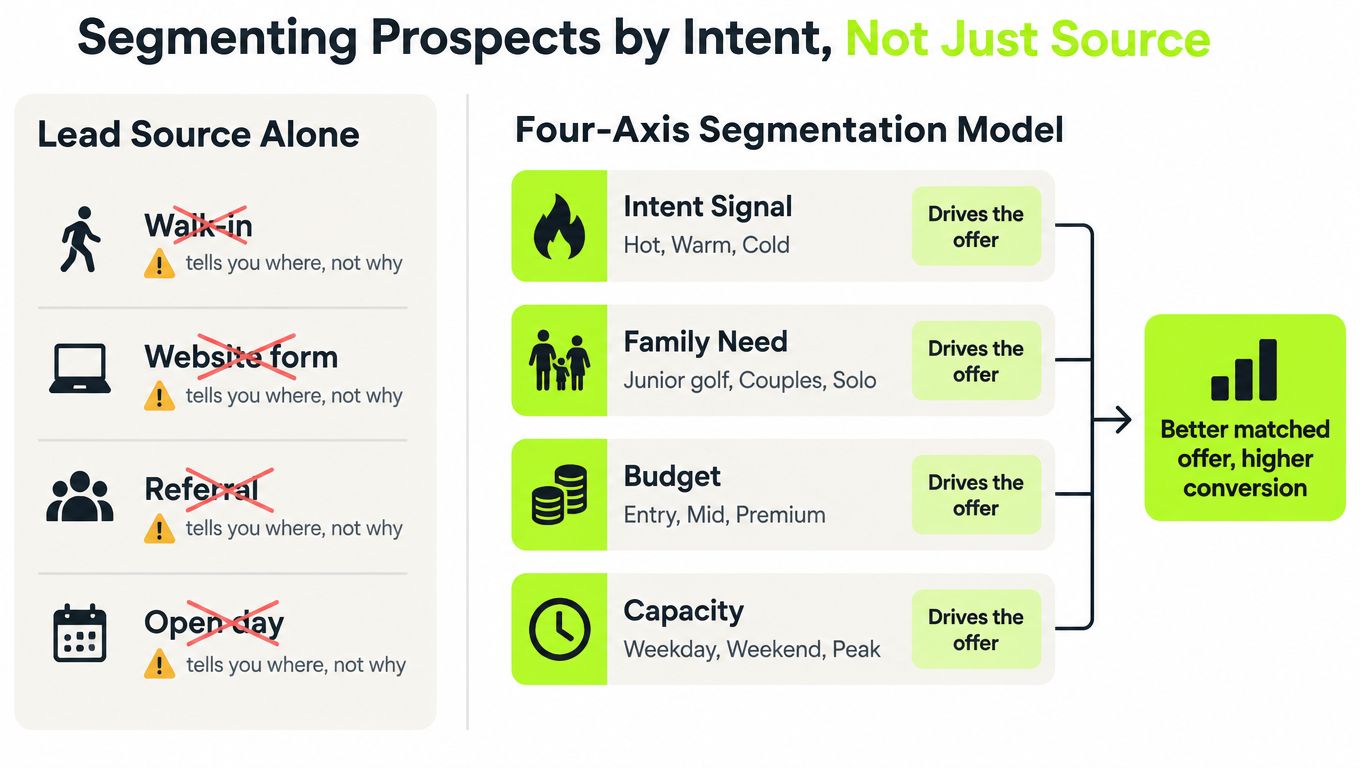
“Website enquiry” tells you where a prospect came from. It doesn't tell you what they want, how soon they may join or whether the category they're asking about is available.
A club should segment every qualified prospect across four axes before writing a message.
The four axes
Intent signal shows urgency. Hot prospects have asked about joining, availability or a visit. Warm prospects have engaged but still need confidence. Cold prospects may have downloaded information or made an early enquiry without a defined timeframe.
Membership type identifies the commercial proposition. Tags might include full, 5-day, intermediate, corporate, junior, family, flexible or social membership.
Capacity reality prevents the system from promising what the club can't deliver. Record whether the relevant category is open, restricted or waiting list only, and whether the golfer wants weekday or weekend access.
Life context changes the message. A new golfer needs reassurance and a welcoming first experience. Someone relocating needs location and timetable information. A parent wants clarity on junior coaching, supervision and family logistics. A corporate buyer wants a straightforward explanation of access, billing and the experience for employees or clients.
A practical comparison
Take two enquiries.
A parent asking about junior membership may need a call from the junior organiser, coaching dates, a clear explanation of supervision and an invitation to a family-friendly visit. The CRM should tag the household, the child's playing stage and the parent's preferred contact channel.
A corporate buyer asking about four 5-day memberships needs a commercial conversation. The club should establish whether the access is for employees, clients or a mixture, explain weekday restrictions and identify the decision-maker. The right next step may be a meeting and proposal, not a standard membership brochure.
The source could be identical. The nurture path shouldn't be.
Practical rule: Segment before you write a single email. Source is a useful reporting field, but intent and capacity determine the offer.
Budget should also be handled carefully. Don't send a premium proposition to a price-sensitive prospect, and don't lead with a discount when the primary objection is access, approval or uncertainty about the member experience. For broader list hygiene and targeting ideas, these 2026 email segmentation tips provide useful context, although a golf club must apply them to its own categories and capacity.
Email, SMS and Ad Templates That Match the Journey
A nurture message should respond to a trigger, not arrive because the calendar says it's the first Monday of the month. The templates below give a marketing assistant enough detail to build a usable system.
Template map
| Lifecycle Stage | Trigger | Channel | Send Window | Primary CTA |
|---|---|---|---|---|
| New Enquiry | Form submission or recorded call | Immediately, then follow-up within the sequence | Book a visit | |
| New Enquiry | Prospect has engaged with course information | Within the first follow-up window | Explore the club | |
| New Enquiry | Prospect has opened community information | Later in the welcome sequence | Meet the membership | |
| Waitlist | Qualified prospect is waiting for availability | Monthly, only while relevant | Confirm preferences | |
| Stalled | No recorded activity | After 45, 75 and 110 days | Restart the conversation | |
| Visit Booked | Appointment confirmed | SMS | 24 hours before visit | Confirm attendance |
| High-intent enquiry | No booking after contact | SMS | Same day, during staffed hours | Choose an appointment |
| Flexible golfer | Interest in flexible access | Paid ad | Always-on testing by audience | View flexible options |
| Family joiner | Junior or family interest | Paid ad | Audience and capacity dependent | Visit the family programme |
Welcome sequence for a new enquiry
Email one, subject: “Your next step at [Club Name]”. Send immediately. Thank the prospect, confirm the category they asked about and offer two specific visit options. Required CRM fields are category interest, preferred contact channel and visit status.
Email two, subject: “How members use [Club Name]”. Send after the prospect has engaged with the first message. Focus on course access, playing opportunities and the practical rhythm of membership. The CTA is “Ask a question or book a visit”.
Email three, subject: “Meet the community before you decide”. Send later in the welcome sequence. Explain social golf, events, coaching or family activity that matches the segment. The CTA is “Arrange a visit”.
Waitlist nurture for committee-led clubs
Send a monthly update only when the prospect has opted into continued contact. Confirm the current position or status where the club can do so, explain any change in availability and share relevant member-only events or visitor opportunities. Don't imply that a place is imminent if the club can't support that expectation.
Store the preferred category, playing days, original enquiry date, committee status and next review date. When capacity changes, create a personal contact task before sending a general update.
Re-engagement for stalled prospects
Use three messages after 45, 75 and 110 days of silence. The first asks whether the requirement has changed. The second answers common objections around access, category and joining process. The third gives the prospect a clear choice to book, pause or opt out.
The CTA should change from “Book a visit” to “Tell us what you need now” when the contact has gone cold. That protects the relationship and keeps the database accurate. Build the wider message system around golf club email marketing, with joined and unsubscribed contacts automatically suppressed.
SMS and paid creative
SMS reminder: “Hi [Name], we're looking forward to seeing you at [Club] tomorrow at [Time]. Parking is available [location]. The dress guidance is [guidance]. Reply YES to confirm or call [number] if you need to change the appointment.”
Same-day booking nudge: “Hi [Name], we have [option one] and [option two] available for a visit at [Club]. Would you like us to reserve one for you?”
For flexible golfers, use a headline such as “Golf access that fits your week”, a flexible-membership offer and a landing page focused on playing patterns and category rules. For family joiners, use “A welcoming route into golf for the whole family”, a family or junior proposition and a landing page showing coaching, facilities and the visit experience. Keep each audience on its own CRM path.
Converting Interest into Booked Visits and Joins
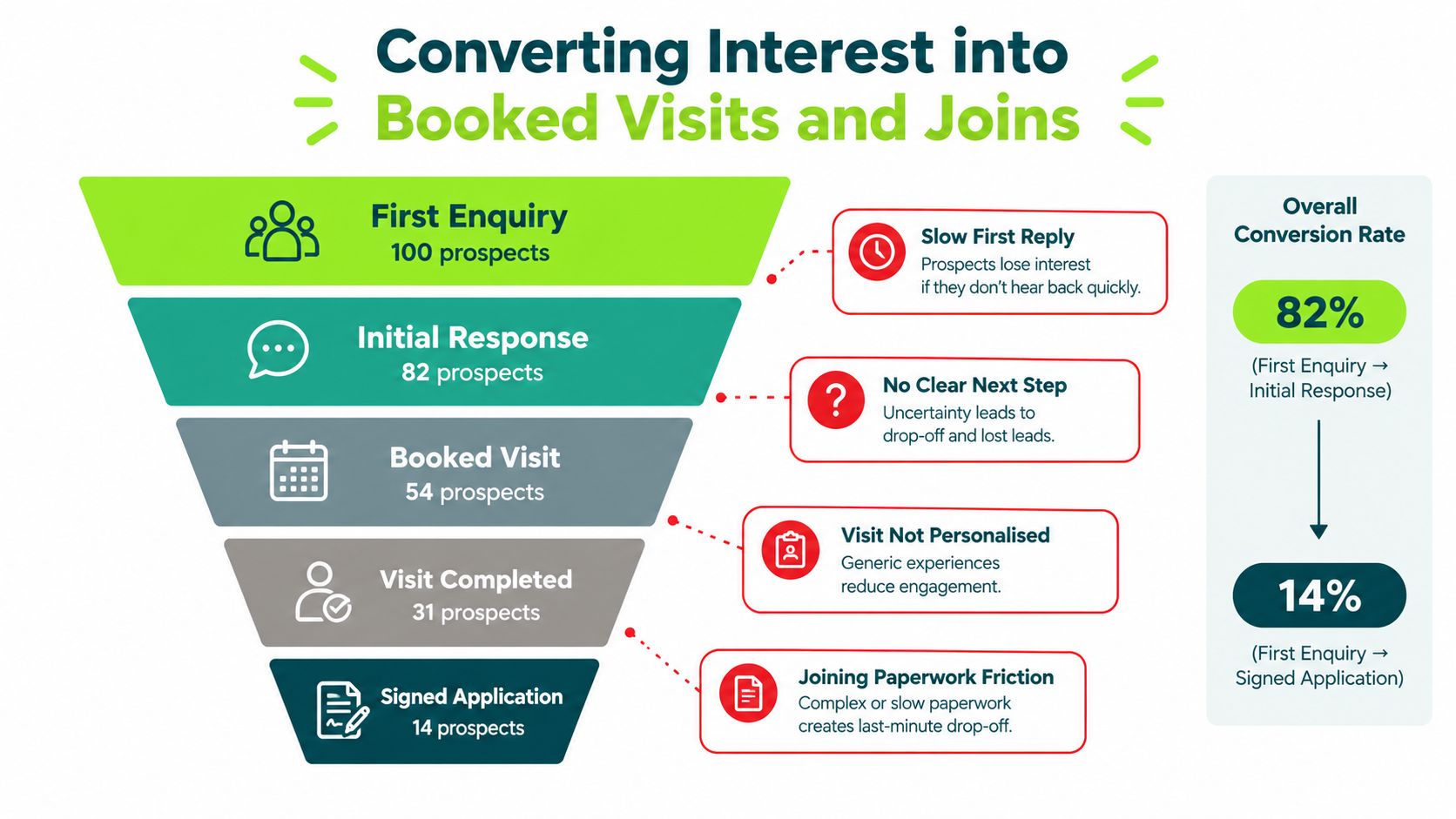
The booking and joining flow is one conversion system. A club should map every movement from enquiry to signed application and identify the exact point where the prospect stops progressing.
The common leaks are operational:
- After the automated reply: The prospect receives information but no named person or specific next action.
- Between enquiry and taster booking: Staff ask the golfer to “let us know” instead of offering appointment choices.
- Between taster and member-guest round: The visit ends without a host explaining what happens next.
- Between offer and deposit: Pricing, paperwork or committee approval creates uncertainty.
Fix the handovers
Set an internal response standard of under 30 minutes during staffed hours. This is a club operating target, not a universal industry benchmark. The first response should acknowledge the enquiry, name the owner and offer a concrete next step.
The taster needs structure. Assign a named host, confirm what the prospect will experience and record attendance, questions and objections afterwards. A PGA professional, membership director or trained club representative should know whether the prospect is assessing the course, the people, the access or the value.
Contact the prospect within 24 hours of any visit. Ask what they thought, answer the unanswered question and recommend the correct membership category. If an offer is appropriate, set a joining offer validity of 14 days and record the date in the CRM. Don't use a deadline to manufacture pressure. Use it to create a clear decision point.
Make accountability visible
The manager's pipeline report should show:
- enquiry to first contact
- first contact to qualified
- qualified to booked visit
- booked visit to attended visit
- attended visit to offer
- offer to application
- application to member
- loss reason at every closed stage
A stalled record needs an owner and a next task. If the same stage produces repeated losses, inspect the process before increasing advertising. The problem may be unclear category rules, poor hosting, slow administration or a proposition that doesn't fit the golfer's actual need.
Measuring the Nurture System With the Right KPIs
A committee doesn't need a dashboard full of vanity metrics. It needs a small set of measures that show whether the club is responding, progressing suitable prospects and converting visits into members.
Treat the following as proposed operating targets for the club, not national benchmarks.
| KPI | Target | Reporting Owner | Action Threshold |
|---|---|---|---|
| Enquiry response time | Under 30 minutes during staffed hours | Membership lead | Median response exceeds target |
| Taster-to-visit conversion | Above 60% | Membership lead | Rate falls below target for a segment |
| Visit-to-join conversion | Above 35% | General manager | Rate falls below target across a review period |
| Cost per acquired member | Within approved marketing budget | Commercial manager | Cost rises beyond budget or source quality declines |
| Source attribution | Every enquiry has a recorded source | Marketing or admin owner | Unattributed records appear |
| Segment conversion | Reported by category and capacity status | Membership lead | One segment materially underperforms its own baseline |
| Email open and click rate | Trended by sequence, not judged in isolation | Marketing assistant | Engagement declines across consecutive sends |
| SMS reply rate | Trended by appointment and segment | Membership lead | Replies fall while booking demand remains |
| Lapsed-lead reactivation | Reported by reactivation sequence | CRM owner | No movement after the final message |
The most important report is the stage movement report. It should show the number of records entering each stage, the time spent there, the owner and the exit outcome. Add a source and segment filter so the club can separate a strong family campaign from a weak general enquiry stream.
Weekly control rhythm
On Monday, hold a 15-minute pipeline review with the head of membership or nominated owner. Discuss new qualified prospects, visits due, overdue tasks and applications awaiting action.
Mid-week, review stalled leads. Look specifically for records with no next action, missed appointments, unanswered questions or a capacity issue that needs a personal explanation.
At month end, give the board or committee a concise summary covering trend, spend, forecast, capacity constraints, joiners, leavers and loss reasons. England Golf reported 750,071 affiliated club members in 2025, compared with 730,602 in 2024, an increase of 19,469 members, or 2.66%, as reported by Golf Business News. Use that as market context, not as a substitute for measuring your own funnel.
Don't use open or click rates to declare success. A message that gets attention but produces no visit has done little commercially.
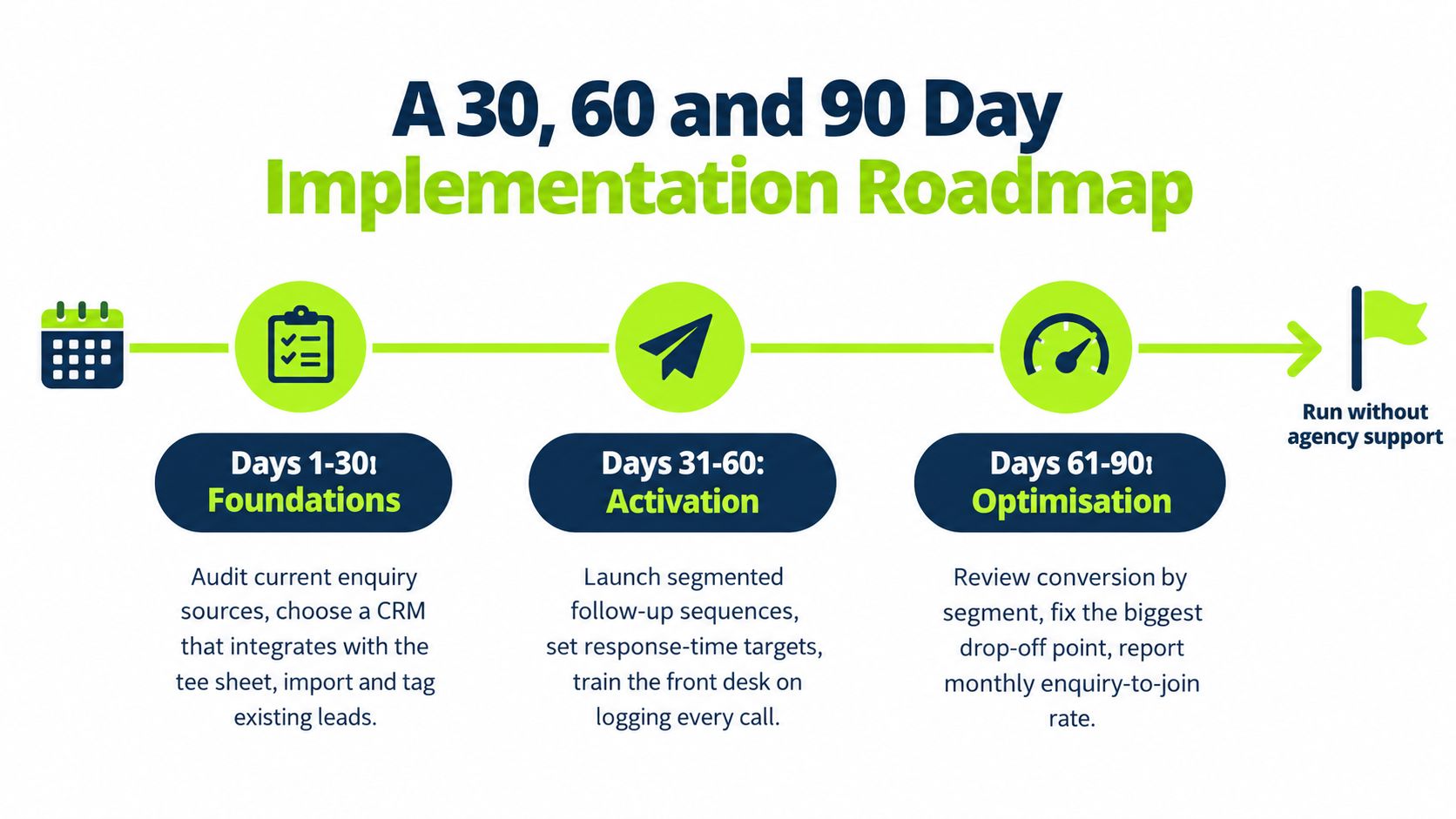
A 30, 60 and 90 Day Implementation Roadmap
A club doesn't need a large transformation programme to start. It needs a defined owner, a clean pipeline and a sequence of improvements that staff can maintain.
Days 1 to 30, foundations
General manager: Audit every enquiry source, including forms, phone calls, social messages, open days, referrals and walk-ins. Choose a CRM that can connect with the tee sheet or at least share appointment and availability data.
Membership lead: Define the pipeline stages, exit criteria, owners and required fields. Import existing prospects, remove duplicates, record consent and tag category, source, capacity status and last contact.
Club administrator: Create the acknowledgement email, response task and appointment fields. Deliverable: one visible pipeline containing every active prospect.
Days 31 to 60, activation
Marketing lead: Build three or four core segments around intent, membership fit, life context and capacity. Write the welcome, waitlist and stalled-lead sequences.
CRM owner: Configure lead scoring or practical tags. A hot prospect might have requested a visit, while a warm prospect has engaged but not booked. Switch on the first two automations and test every branch.
Front-of-house manager: Train reception, the pro shop and the membership team to log every call and social conversation. Deliverable: a working nurture engine with named ownership.
Days 61 to 90, optimisation
Commercial manager: Connect booking, trial-round and joining data to the pipeline. Run paid retargeting for appropriate audiences, with separate landing pages for flexible golfers and family joiners.
General manager: Review conversion by segment and fix the largest drop-off point. Don't change every part of the system at once. Improve the constraint that currently limits joins.
Committee or board sponsor: Receive a monthly enquiry-to-join report and agree the next commercial priority. Deliverable: a repeatable operating rhythm that the club can run without agency support.
Stop these habits now
- Stop sending generic monthly newsletters to prospects with different categories, intent and availability.
- Stop accepting untracked Facebook enquiries that never reach the CRM.
- Stop leaving ownership vague between the office, PGA team and committee.
- Stop treating a waiting-list prospect as lost when the club could maintain a useful, honest relationship.
- Stop reporting clicks without pipeline movement.
The commercial principle is simple. Attract the right golfers, nurture according to their needs and the club's capacity, convert the next step, then retain the member through a proper handover. GolfRep helps UK golf businesses build that connected system across acquisition, CRM, follow-up and revenue growth. Visit GolfRep to map your current enquiry pipeline, identify the biggest constraint and decide what should be fixed first.
Ready to tap into our proven growth system?