How to Grow Golf Club Tee Time Revenue

Most clubs are told to fix tee time revenue by pushing prices up or spending more on ads. That misses the leak. In a fixed tee-sheet business, the bigger problem is often what happens after someone shows interest, because a slow reply, a weak follow-up, or a clumsy booking process can lose demand long before a green fee is ever tested. UK golf operators are dealing with a finite inventory, and the revenue risk sits in every unused slot, every abandoned enquiry, and every unstructured handoff between marketing and the diary. The clubs that treat this as a conversion problem usually make better decisions than the clubs that reach for blanket discounts first.
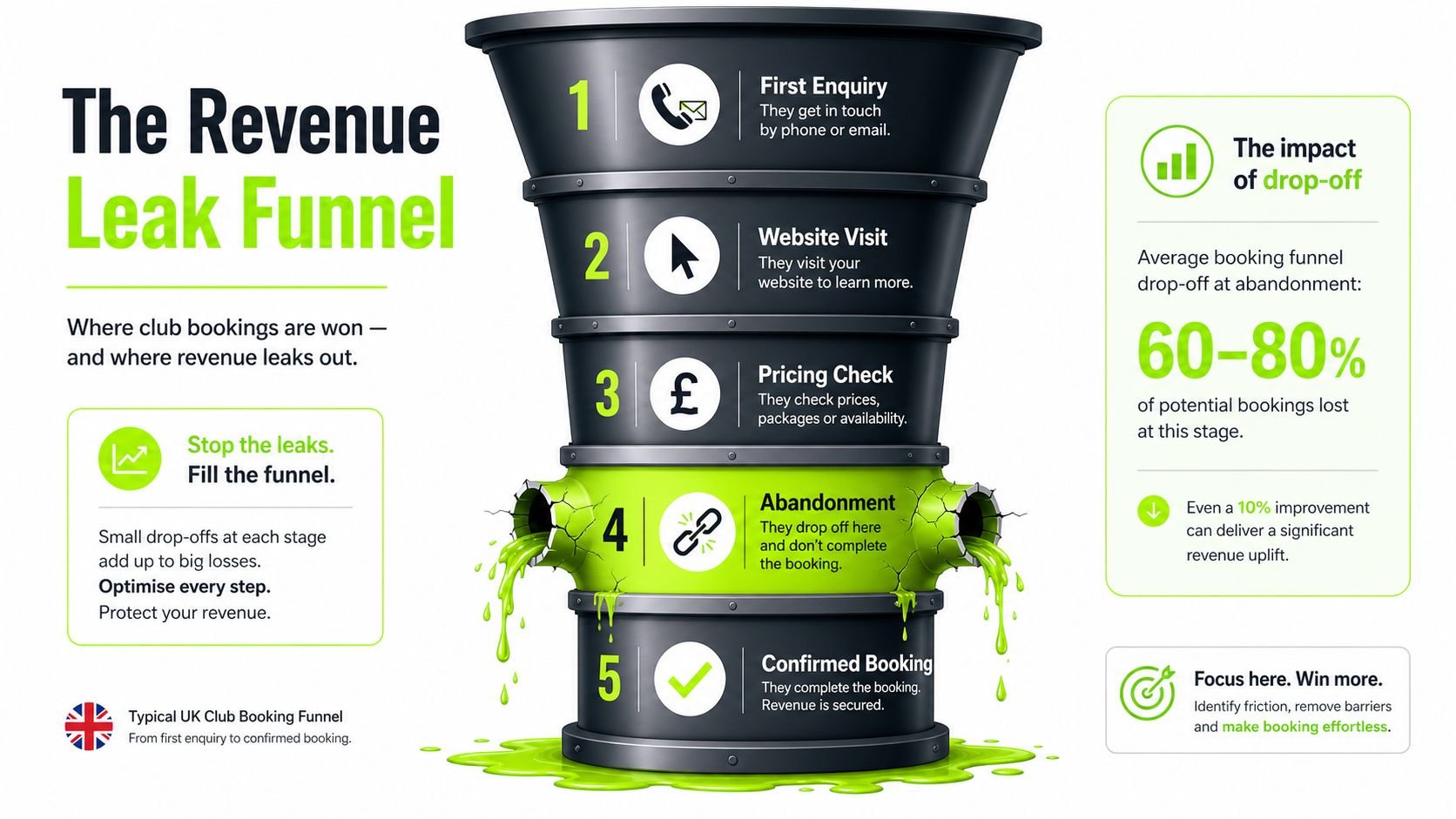
The real question is not whether demand exists. It's how much of that demand survives contact with the booking process.
Why Most Clubs Leak Tee Time Revenue Before Pricing Even Matters
A lot of tee time pricing debates start in the wrong place. Clubs look at the green fee and assume the answer is to charge more or discount harder, but the first loss often happens before anyone sees the final price. The booking funnel is where revenue slips away, because enquiries sit unanswered, websites do not make the next step obvious, and staff rely on memory instead of a tracked process. GolfRep's analysis of why tee sheets stay empty explains this leak in detail, and it is usually more useful than another round of price tinkering.
That matters because tee time inventory is fixed. The 2025 whitepaper on UK golf no-shows found that 9% of all tee times go unused due to no-shows and estimated that this translates into more than $1.2 billion in lost green fees annually whitepaper on UK no-show losses. That is not a marketing footnote, it is a reminder that every empty slot is revenue that never comes back. If a club is already leaking at the back end through no-shows, it makes little sense to ignore the front end where abandoned leads and delayed replies are happening as well.
What to check before touching green fees
Start with the basics. How fast does an enquiry get answered, who owns the follow-up, and what happens when the first attempt fails? If the answer is “it depends who's in the office” or “we usually get back to them later”, the problem is process, not pricing.
The more useful lens is conversion visibility. Clubs need to know which enquiries became booked visits, which stalled, and which were never qualified properly in the first place. That is why structured follow-up matters more than another round of manual discounting, and why GolfRep often treats enquiry handling as the first revenue system, not the last admin task. A club can protect its tee sheet without racing to the bottom on price, but only if the funnel is being managed with the same care as the diary.
The same logic applies to every step after the first click. If the booking path is clumsy, if the call back is slow, or if a member of staff has to remember who wanted what, demand leaks before it reaches the tee sheet. That is where margin disappears, and it happens long before anyone argues about whether Saturday morning should cost more.
Yield Management Rules That Protect Revenue on a Fixed Tee Sheet
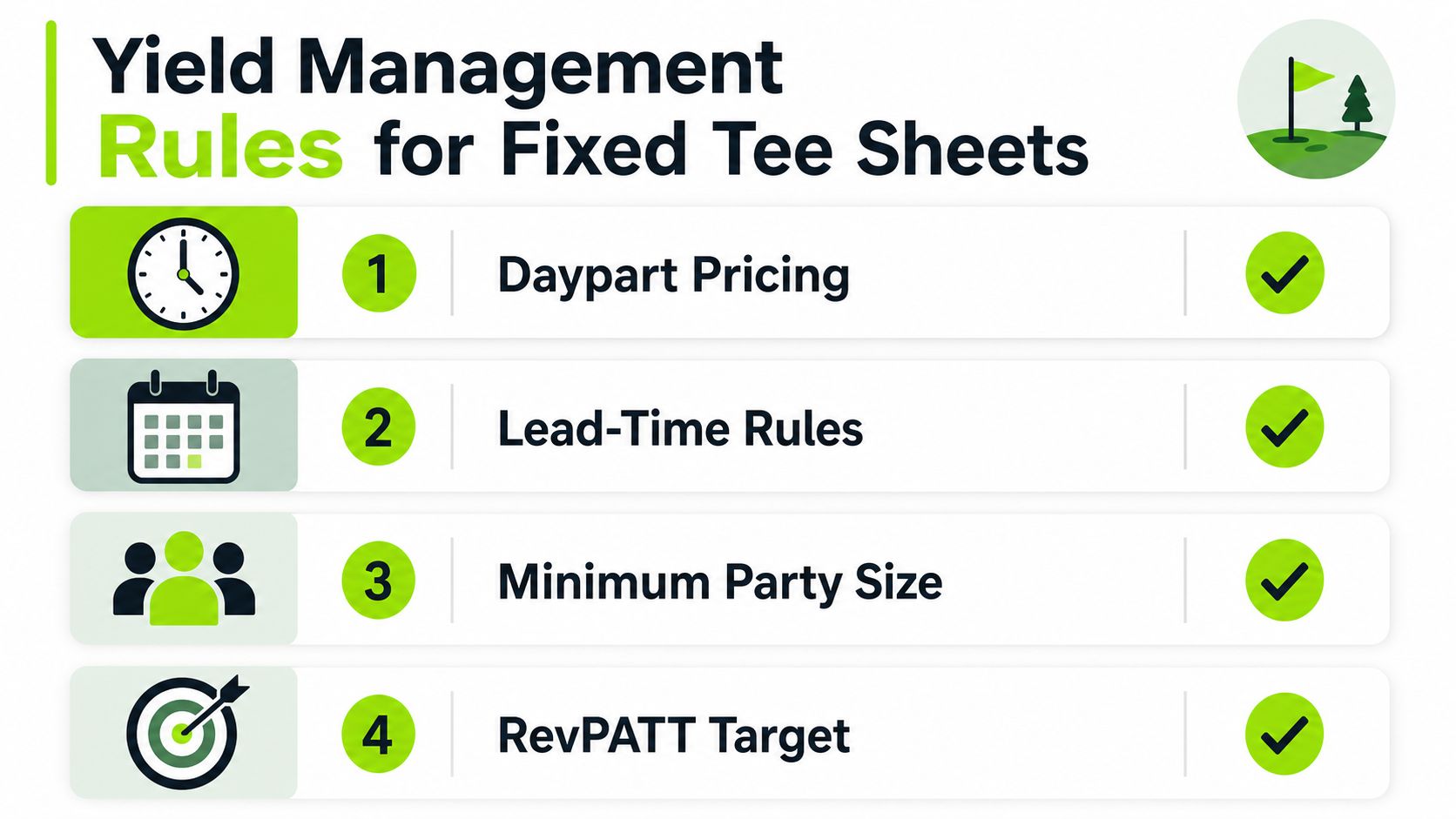
Yield management only works if it protects the inventory you can't recreate. A golf club doesn't have unlimited morning tee times, and it can't manufacture a busy Saturday after the fact. That's why Revenue Per Available Tee Time, or RevPATT, is such a useful operating metric, because it measures revenue divided by the number of tee times available and gives you a clean view of how well the tee sheet is being monetised RevPATT definition. It's also why round counts on their own can mislead, since a full diary at the wrong price can still underperform.
Set rules around time, not instinct
The best clubs use rules, not guesswork. Weekend mornings usually deserve a different price and booking stance from twilight midweek slots, because they're not the same product. Lead-time rules matter too, especially for higher-value windows where you want commitment earlier rather than later, and minimum party size can protect against low-value bookings fragmenting valuable blocks.
The operating loop is simple. Review underfilled dayparts, adjust the rules, watch the demand response, then check the channel mix again the following week. That loop mirrors practical UK guidance that says the KPI to watch is not rounds sold in isolation, but revenue against fixed tee-sheet inventory operating guidance on golf revenue management.
Practical rule: don't ask whether a tee time is sold, ask whether it was sold in the right way, at the right price, through the right channel.
Use cancellation and no-show rules to recover value
A cancellation policy is not just admin. It protects inventory from being blocked up by casual intent, and reminder systems help reduce the number of slots that disappear without warning. The technical research on tee-time assignment also points in the same direction, reservations should be sorted by arrival time and party size, then assigned through a feasible maximum-revenue process before optimisation is applied golf revenue-management methodology. The pitfall is obvious, if you optimise only for occupancy, you can end up blocking premium slots with lower-value bookings.
The practical takeaway for a committee is simple. Write rules that protect the best inventory, then measure whether those rules improve RevPATT rather than just tee-sheet fill.
Choosing Booking Channels Without Giving Away Margin
Not every booking channel does the same job, and not every channel deserves the same commercial treatment. A direct website booking should behave differently from a hotel partnership, a phone booking, or a third-party aggregator. The key question is not whether the tee sheet looks busy, it's whether the club still owns the relationship, the data, and enough margin to make the booking worthwhile. That's where channel mix starts to matter more than volume.
A healthy mix often leans heavily to direct sales, because direct traffic gives the club better visibility and less leakage. Over-reliance on intermediaries can fill gaps, but it can also obscure the underlying economics if the club only looks at occupancy. GolfRep's booking-system guidance is useful here, because it treats booking flow, ownership, and reporting as one operational system rather than separate problems booking system guidance.
| Booking channel comparison for tee time revenue | Typical commission or cost | Customer data ownership | Impact on tee time revenue |
|---|---|---|---|
| Direct website | Usually lowest external cost | Club owns the relationship | Strongest control over margin and repeat bookings |
| Club management software | Internal system cost, sometimes transaction fees | Club usually owns the record | Good for visibility if setup is clean |
| Third-party aggregator | Commission or listing cost | Often shared or limited | Can increase reach, but margin and data are weaker |
| Hotel or resort partner | Commercial agreement dependent | Shared or split | Useful for packaged demand, but needs rules |
| Phone booking | Staff time cost | Club owns unless data is not recorded | Good for conversion, weak if not logged properly |
Test every channel before it goes live
Before approving a new channel, ask three questions. What will it cost in real terms, who owns the customer record, and how easy is it to trace the booking back to a source? If the answers are vague, the club is likely buying convenience at the expense of long-term yield.
A channel should earn its place by adding profitable demand, not by making the tee sheet look active.
The other question is whether the channel helps the club learn. If a booking source can't show the committee where demand is coming from, it's hard to improve pricing, promotions, or follow-up. Clubs that track source quality usually make cleaner decisions than clubs that only count occupancy.
Dynamic Availability and Upsells That Lift Average Order Value
A lot of clubs still leave money on the table because the booking screen is treated like a form, not a sales moment. Once a golfer has decided to book, the club has a narrow window to increase value without feeling pushy. That's where smart availability rules and sensible add-ons work better than headline price changes, because they lift the value of the round instead of bluntly increasing the entry fee. If you want a useful primer on the logic behind basket value, what is average order value in e-commerce is a sensible outside reference, even though golf has its own operational rhythm.
The practical upside is easy to see. Offer buggies at the point of booking, suggest them for groups of three or more, and bundle a coffee or post-round drink where it fits the venue. Premium or restricted slots can also be shown first to higher-value customers or booked through the club's direct path, which keeps better inventory away from bargain-hunting behaviour.
GolfRep's upsell guidance takes the same view, upsell is merchandising, not pressure upsell strategy guidance. The booking screen should be designed to guide the golfer towards useful extras, not force them through clutter.
Make the upsell feel like part of the round
The mistake many clubs make is leaving these offers to the pro shop counter. By then, the booking is already done and the chance to shape the basket has passed. Good clubs build the logic into the booking journey itself, where a golfer can add what they need while the intent is still high.
A useful way to think about it is this. Every extra item attached to a booking should either improve convenience, improve the experience, or help protect the diary. If it does none of those things, it's clutter.
Practical rule: upsell only where it genuinely fits the booking, otherwise it feels like friction and kills conversion.
The point isn't to make every round more expensive. It's to make each booking more complete, more useful, and more aligned with the club's actual capacity.
CRM, Automation, and Nurture Flows That Convert Enquiries Into Tee Times
The biggest difference between clubs that guess and clubs that grow is usually the system behind the enquiry. Marketing can bring traffic in, but operations decides whether that interest becomes a booking. That's why a CRM is not just a database, it's the operating layer that keeps enquiries visible, followed up, and assigned to the right outcome. GolfRep works in this space by combining lead handling with structured follow-up, and the principle applies whether a club uses its own team or another platform.
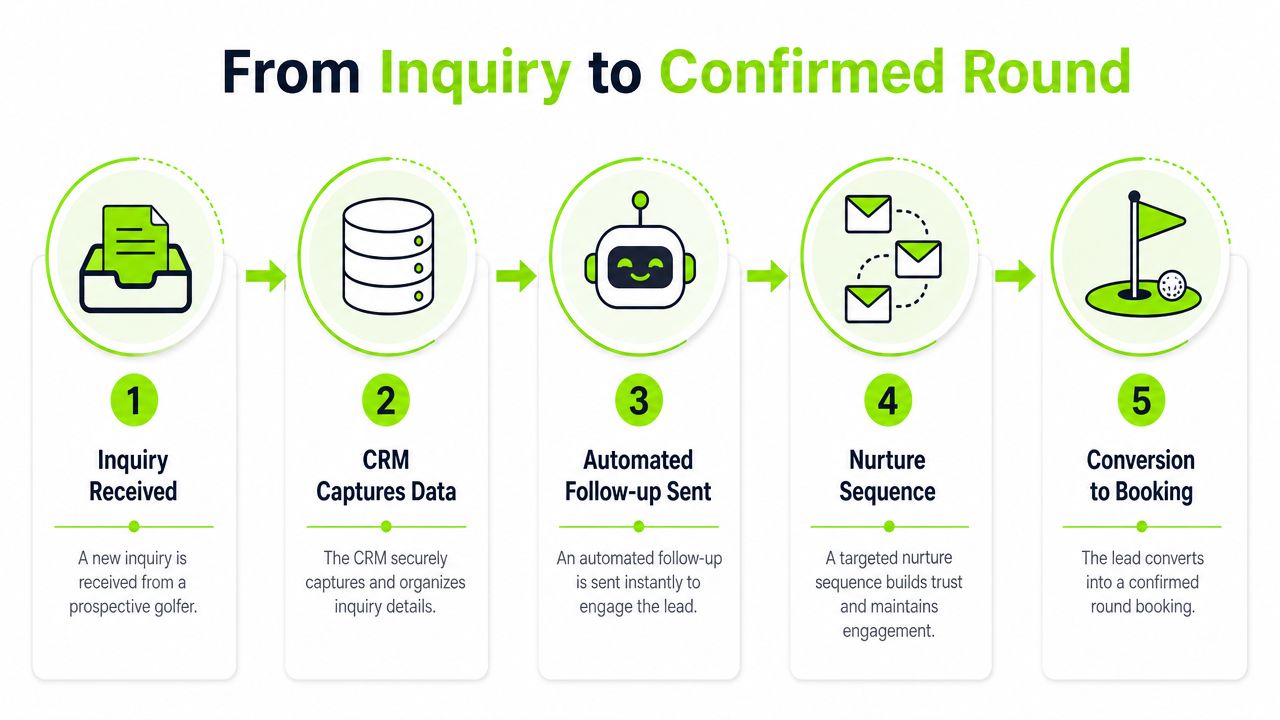
A basic enquiry flow should be boring in the best possible way. The golfer sends an enquiry, the CRM captures it immediately, the club sends an acknowledgement without waiting for office hours, and the booking link or next-step message goes out automatically. If the lead does not book straight away, a reminder sequence follows, then a lighter nurture message keeps the club present for future rounds or repeat visits.
That process matters because a voicemail is not a follow-up system. Neither is a shared inbox full of unread web forms or a committee member trying to remember who asked for a fourball on Tuesday. Clubs lose revenue in those gaps because good intent decays quickly once the enquiry goes cold.
What a good flow looks like
A practical flow is simple enough to run without drama:
- Inquiry received and stored in one place.
- Details captured so the club can see source, date, and intent.
- Immediate acknowledgement confirms the enquiry wasn't lost.
- Qualification sorts serious demand from casual browsing.
- Booking link or call-back moves the prospect towards a confirmed round.
The exact tools matter less than the discipline. A strong CRM can handle this cleanly, and the point is to remove manual memory from the process. If you want a wider comparison of platforms, choose gym CRM software is a useful analogue because it shows how different sectors think about structured follow-up and data ownership.
The post-round stage matters too. If the visit is logged properly, the club can invite the golfer back with context rather than a generic promotion. That's how enquiry handling turns into repeat tee-sheet value, instead of disappearing into admin.
Promotions and Member Priority Access Without Trashing Yield
Promotions are where many committees get themselves into trouble. A blanket discount feels decisive, but it often trains people to wait for a cheaper price and weakens the club's ability to protect premium demand. The better approach is narrower and more deliberate, with offers tied to specific dayparts, specific audiences, or specific recovery goals. A promotion should solve a revenue problem, not create a habit of discounting the strongest inventory.
Take a typical club scenario. The secretary sees poor midweek afternoon fill and suggests a broad rate cut across the entire diary. A better move is to target only the underperforming window, keep the stronger sessions intact, and use the offer for new visitors or lapsed golfers rather than those who would have booked anyway. That protects the value of the tee sheet and keeps the club from handing away margin where demand is already healthy.
Give members value without blocking visitor revenue
Member priority access is politically sensitive, but it doesn't have to be destructive. Earlier booking windows, reserved access to selected slots, or priority on specific days can give members genuine value while leaving the club enough inventory for visitors. The mistake is locking so much of the diary that the club starves its own visitor revenue.
The useful test is balance. If members get meaningful priority, the visitor side still needs enough flexibility to support commercial demand. Clubs that get this right treat priority as a scheduling rule, not a blanket closure.
Do: use member access to reward loyalty.
Don't: let priority access remove the very tee times that keep the business healthy.
Keep offers narrow and measurable
Promotions should also be time-limited and easy to measure. If a committee can't tell which daypart or audience the offer was meant to improve, the offer is probably too broad. That's how clubs end up chasing volume with no clear return, while the best tee times stay underpriced.
The useful habit is to ask whether the promotion lifts a weak segment without harming stronger ones. If the answer is no, it's not a revenue tool, it's a discount.
A 30-Day Operating Plan and the KPIs a Secretary Should Actually Track
The easiest way to improve tee time revenue is to stop trying to fix everything at once. A 30-day plan forces the club to focus on the actions that move booking quality, not just booking volume. Week one should clean up the enquiry process, week two should tighten tee-sheet rules, week three should review channel mix, and week four should check which offers drove profitable bookings.
A practical dashboard doesn't need to be complicated. The secretary or GM should track RevPATT, direct versus aggregator split, enquiry response time, show-round conversion, and repeat-visitor rate. Each one points to a different decision, pricing, channel management, follow-up speed, front-of-house handling, and retention.
| KPI | What it tells the club | Decision it supports |
|---|---|---|
| RevPATT | How well tee-sheet inventory is monetised | Pricing and inventory rules |
| Direct vs aggregator split | Where margin and data are being lost | Channel mix decisions |
| Enquiry response time | How quickly prospects are handled | Staffing and automation changes |
| Show-round conversion | Whether interest becomes visits | Follow-up and qualification quality |
| Repeat-visitor rate | Whether bookings are turning into habit | Nurture and retention actions |
A representative mid-sized club does not need a dramatic rebrand to improve this. It usually needs clearer ownership, better follow-up, and fewer blanket discounts. That combination tends to produce steadier tee time revenue because the club is finally managing the booking funnel as a system, not a series of disconnected tasks.
If your club wants a more predictable way to fill the tee sheet, start with the funnel, the rules, and the follow-up, not with a rushed price cut. A short conversation with GolfRep can help you map where bookings are leaking and what a cleaner, trackable process would look like for your club.
Ready to tap into our proven growth system?