Golf Club Reputation Management: A Practical UK Playbook
A high Google rating won't rescue a club that takes two days to answer a membership enquiry, ignores a complaint about course condition, or lets a promising visitor disappear into someone's inbox. Golf club reputation management isn't primarily a star-rating exercise. It's a pipeline discipline.
From GolfRep's experience working with UK golf clubs, reputation becomes commercially useful when it helps a club turn trust into a booked visit, a sign-up, a repeat round or a renewal. Reviews matter, but so do response speed, lead visibility, service recovery and the evidence members give you through booking behaviour and feedback.
That distinction matters in a crowded market. England Golf records 1,735 affiliated golf clubs and roughly 730,000 club members across England, while the average member age has fallen from 56.18 to 54.99. The female average age has also dropped from 64.65 to 62.98. England averages about 50 clubs per county, creating dense local catchments where reputation travels quickly through conversations, community groups and search results. (England Golf data reported by The Golf Business)
The practical question isn't, “How do we get another half-star?” It's, “Which reputation signals are affecting enquiries, visits and renewals, and what system turns those signals into action?”
Why Most UK Clubs Get Reputation Management Wrong
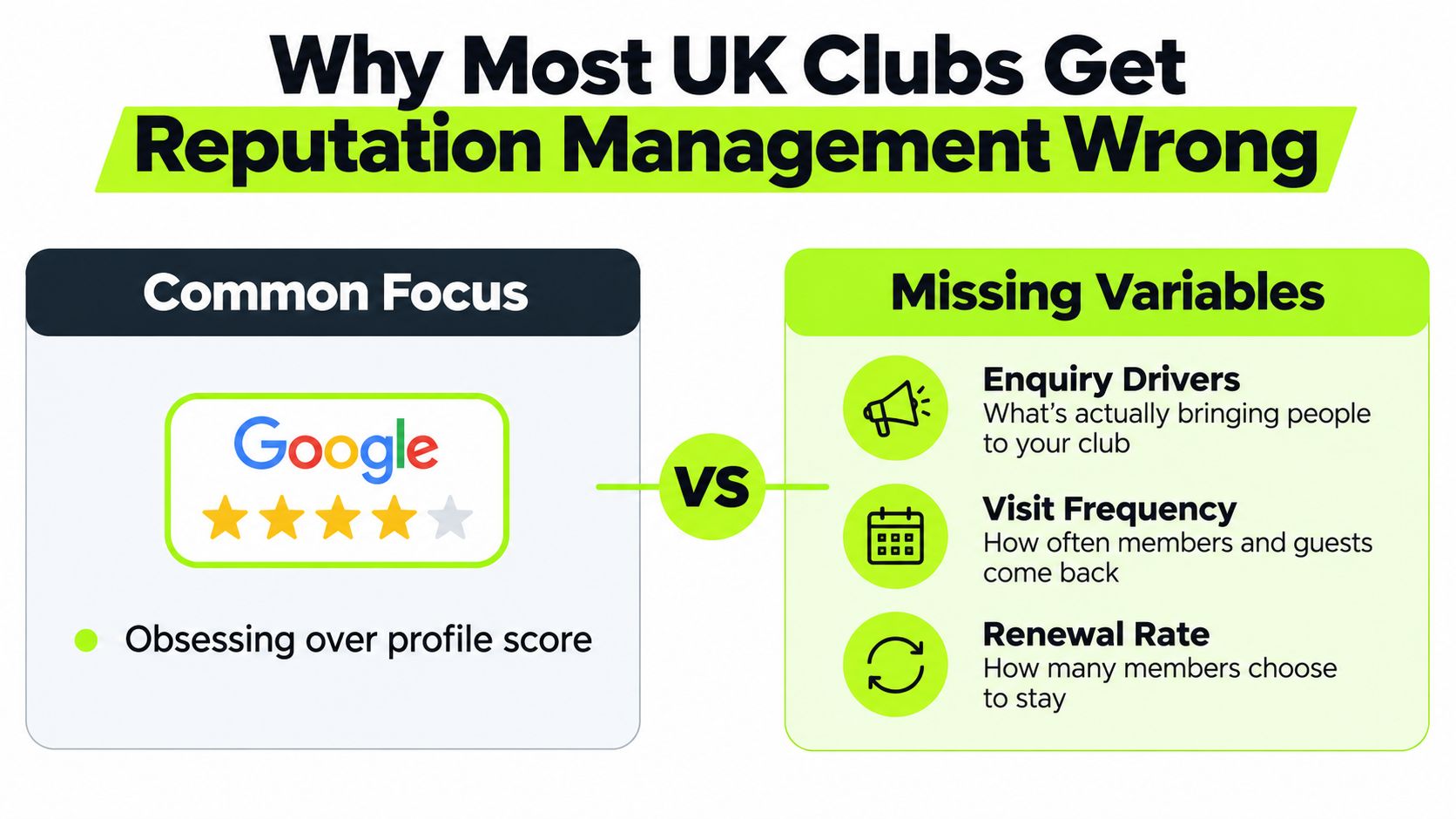
Most clubs start with the wrong dashboard. They open Google Business Profile, check the average rating and ask whether a recent review has moved the score. That's understandable, but it's a narrow view of a much wider commercial problem.
A golfer may discover a club through a non-branded search, read a comment about slow service, submit a membership form and then receive no reply until the following afternoon. Another member may complain about winter greens in a Facebook group, while the office only sees a positive review from a visitor. The club's star rating looks healthy, but the experience driving decisions is deteriorating in places no one owns.
Reputation is built in the operating detail
Hillier Hopkins' 2024/25 survey found that 59% of members' clubs and 55% of proprietary clubs surveyed had more than 600 playing members. The survey also recorded waiting lists at 46% of clubs, down from 52%, with the average waiting list falling from 61 people to 51. (Hillier Hopkins Golf Clubs Report 2024/25)
Those figures point to a more competitive environment. A club can't assume that demand will cover weak communication or inconsistent service. If waiting-list pressure eases, the clubs that convert interest efficiently and retain confidence will have an advantage.
Course condition remains a particularly visible part of that confidence. A 2026 UK golfer survey reported that 90% of members considered year-round course quality relevant to their membership decision, with course conditioning ranked as the deciding factor by 55% of respondents. (Carr Golf Maintenance UK golfer survey)
The useful shift
Treat the public review as one input into a commercial system. Track whether sentiment affects:
- Enquiry drivers, including the pages, searches and messages that lead to contact.
- Visit frequency, especially after a complaint or poor service interaction.
- Renewal rate, with attention to members showing early signs of disengagement.
This is why clubs should move beyond review cleanup and connect reputation work to response and retention processes. Deleting a difficult review, where removal is even possible, doesn't repair the bar service, answer the next enquiry or reassure an undecided member.
Setting Up Reputation Monitoring That Actually Works
Monitoring doesn't need a costly listening platform or a daily meeting. A busy club office needs a repeatable sweep that identifies issues early, gives each signal an owner and records what happened next.
Start with four input layers. The first is Google Business Profile, where the club should review new feedback, response status and recurring themes. The second is wider golf and consumer review activity, including Trustpilot and Golfshake where relevant to the club's audience. The third is social conversation across Facebook, Instagram and local golf forums. The fourth is local search visibility, separating branded searches for the club from non-branded searches such as local membership, society days or pay-and-play terms.
Member-side information completes the picture. Add HowDidiDo scores, member app feedback and front-desk enquiry notes. A receptionist's note that several visitors struggled to understand joining options can be more valuable than another generic five-star comment.
A weekly rhythm with named owners
Use a simple shared spreadsheet if the club doesn't have a suitable dashboard. Record the date, channel, issue category, sentiment, named owner, response deadline and resolution. Google Business Profile is free, and social inboxes often provide enough visibility for a small office when someone checks them consistently.
A practical rhythm looks like this:
- Monday, membership secretary: Sweep Google reviews, Trustpilot and Golfshake. Assign every unanswered review and flag anything involving safety, discrimination, staff conduct or repeated service failure.
- Wednesday, marketing or membership lead: Check Facebook, Instagram, local forums and map-pack visibility. Compare branded and non-branded searches, then record changes in a shared log.
- Friday, general manager: Review member app comments, HowDidiDo feedback and front-desk notes. Group complaints into course condition, access, hospitality, value and communication.
Don't spend time chasing every passing comment or trying to monitor the entire internet. Focus on channels where members, visitors and local prospects make decisions. The GolfRep guide to Google reviews for golf clubs is useful for setting up a disciplined review process without turning the office into a full-time moderation team.
A service recovery example
Suppose a visitor posts that bar service was slow after a Saturday round. The duty manager sees the review during Monday's sweep, checks the booking and till notes, and identifies the likely shift. The response acknowledges the experience without arguing, invites the visitor to speak privately and records the issue under hospitality.
The club then changes the queue process for busy periods and follows up with the visitor. The objective isn't to request deletion. It's to demonstrate that the club heard the complaint, corrected the underlying issue and created a better chance of a future visit.
Response Workflows That Turn Feedback Into Members
A review reply, social message and membership enquiry may arrive through different channels, but they still represent one relationship. Clubs lose opportunities when each channel sits with a different person and nobody can see the complete history.
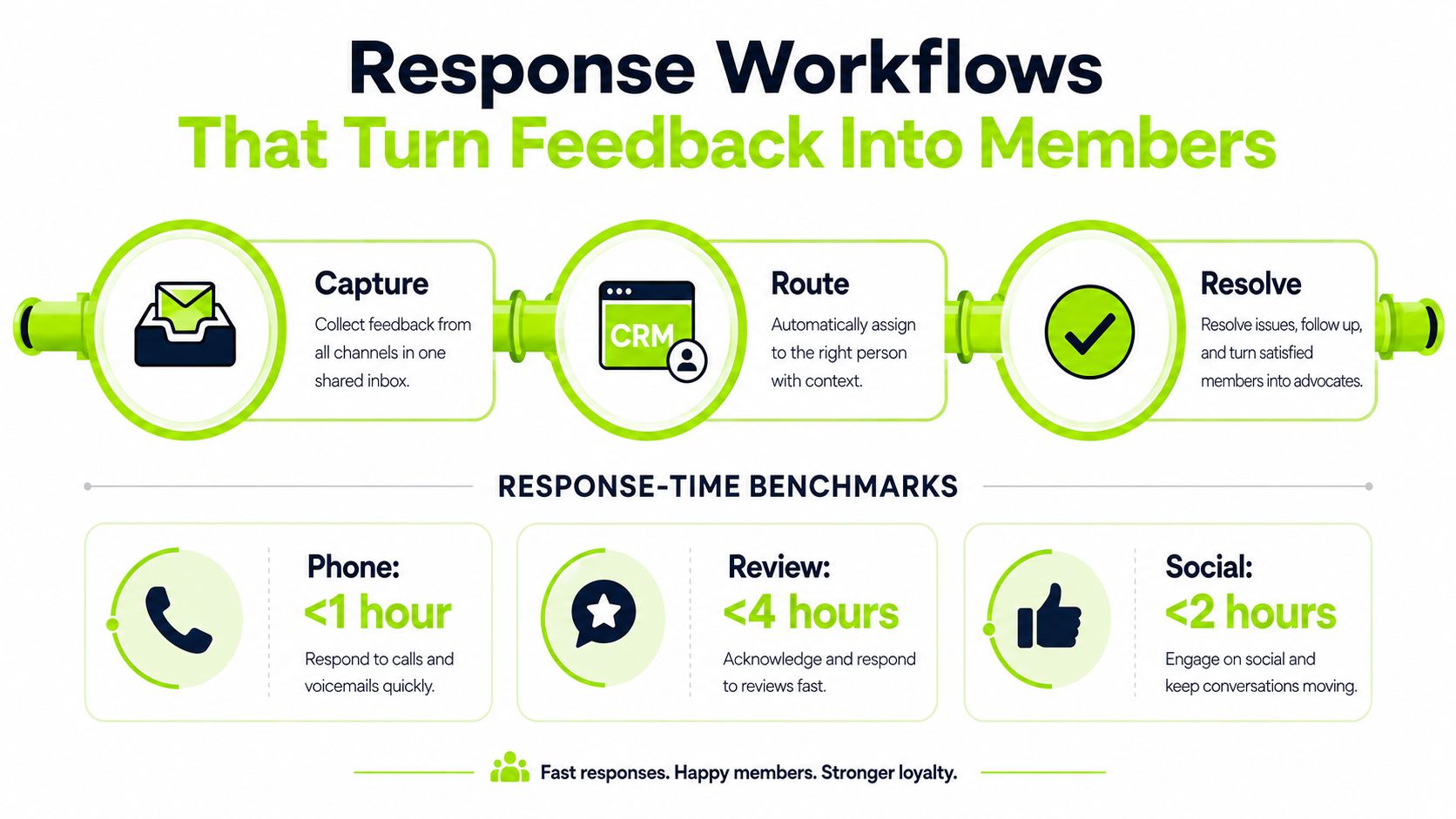
Set service standards before writing templates. GolfRep recommends an operational target of under one hour for phone enquiries, under two hours for email and web forms, under 24 hours for Google reviews, and under four hours for social direct messages during operating hours. These are working benchmarks, not promises that every issue can be resolved immediately. The first response should confirm ownership and provide a credible next step.
Capture, route and resolve
Every contact should enter a visible record with the channel, contact details, topic, urgency and next action. Triage then determines who owns it:
- Front of house: Speed, booking questions, hospitality and straightforward service issues.
- General manager or marketing lead: Public complaints, repeated failures, sensitive wording and anything likely to attract wider attention.
- Club secretary: Member complaints, formal escalation, committee matters and renewal risk.
A complaint involving safety, safeguarding, discrimination, staff conduct or legal threats should bypass normal queues and reach the general manager and secretary immediately. A routine question about visitor green fees can stay with the membership team, provided the contact receives a prompt answer and a recorded follow-up.
Templates that sound human
Positive review reply
Thank you for taking the time to share this. We're pleased you enjoyed the course and the welcome from the team. We hope to see you back at [club name] soon.
One-star course-condition complaint
We're sorry the course condition didn't meet expectations during your visit. Our team is reviewing the areas you mentioned, and we'd welcome the chance to understand the date and specific holes involved. Please contact [named person] at [contact detail] so we can follow this up properly.
Slow-service complaint
Thank you for raising this. Slow service after a round isn't the experience we want visitors to have. We've passed your comments to the duty manager and would appreciate the opportunity to discuss what happened privately.
Private follow-up
I've seen your comment and would like to speak with you directly rather than debate the details online. I'm available at [time] or [time], or you can reply with a convenient number and I'll call you.
Turning a complaint into a joiner enquiry
A visitor complains that green fees feel expensive compared with nearby options. The reply shouldn't defend the price immediately. It should acknowledge the concern, explain what the fee includes in plain language and ask whether the visitor has considered membership for regular play.
The CRM then records the contact as a warm prospect. A follow-up sequence can send joining information, invite the golfer to a suitable visit and create a task for the membership team. A complaint hasn't magically become a sale, but structured handling has preserved trust and created a relevant next conversation. For clubs building this process, the GolfRep follow-up system guide covers the practical mechanics of keeping enquiries visible.
Member Feedback and NPS Loops for Early Risk Detection
A satisfaction survey is only useful if someone acts on the answer. Asking members whether they're happy, then leaving the response in a survey platform, creates theatre rather than retention intelligence.
Use two feedback moments. Send a transactional survey 48 hours after a round, event or food and beverage visit, then run a quarterly relationship survey for members. Score both on a 0 to 10 scale. Bucket 0 to 6 as detractors, 7 to 8 as passives, and 9 to 10 as promoters.
The score needs context. A year-one member whose bookings are falling and whose feedback is in the detractor range presents a more immediate renewal risk than a long-standing member who gives a passive score but continues to play regularly. Connect survey results to tenure, booking frequency, complaint history and previous service recovery.
Route risk to a person
A detractor response should reach the general manager or membership secretary within four working hours. The first action should normally be a call, not another automated email.
Use a simple script:
- Thank the member for being direct.
- Ask what changed and what outcome they expected.
- Confirm the specific action the club will take.
- Set a date for the follow-up.
- Record the result against the member record.
Practical rule: A score is a warning signal, not a diagnosis. The comment, booking pattern and conversation explain the risk.
A family membership example
A family member in their second year gives a detractor score after slow Sunday service. Their recent booking frequency has also declined. The membership secretary calls, apologises for the specific failure, asks how the family uses the club and confirms a service recovery with the hospitality manager.
The CRM creates a follow-up task after the next family visit and another check before renewal communication begins. If the member returns and gives positive feedback, the club records the recovery rather than treating the original score as permanent. That record also helps the manager identify whether the problem was one shift or a recurring Sunday capacity issue.
Crisis Management Plan for the Three Scenarios That Hit Clubs
Clubs rarely need a 40-page crisis manual. They need a short, rehearsed protocol for the incidents that can damage confidence quickly: a serious safety or safeguarding event, a public complaint that spreads on social media, and a financial or governance story picked up locally.
The first 24 hours should have one decision-maker, one holding statement and one approved place for updates. Draft statements should sit in a shared folder with a member email template, social response framework, contact list and escalation route. They shouldn't depend on one person finding an old document in an inbox.
| Scenario | Decision-owner | First public response |
|---|---|---|
| Serious safety or safeguarding event | General manager with secretary and appropriate authorities | Confirm awareness, prioritise people's welfare and state that further information will follow when verified |
| Public complaint spreading on social media | General manager or named communications lead | Acknowledge the concern, avoid argument and move personal details into a private channel |
| Financial or governance story in local media | Chair with secretary and legal adviser where required | Confirm the club is reviewing the matter and provide a clear route for accurate updates |
The secretary manages member communication. The general manager manages press and public replies. The chair manages the board and governance decisions. Staff should know who is on duty and who can approve a statement outside office hours.
Before publishing, ask whether the message includes personal data, an allegation, an admission of liability or information that could prejudice an investigation. If it does, obtain legal sign-off. If it doesn't, a factual holding statement can usually go out through the named decision-maker. A practical external reference is TheBestReputation crisis playbook, but clubs still need their own contacts, wording and authority lines.
Run a quarterly desktop rehearsal. Give the duty manager a scenario, set a short response window and test whether they can find the documents, contact the decision-owner and issue the approved first message. Silence also communicates something, usually that nobody is in control.
Using CRM and Automation to Scale Reputation Work
Reputation work fails when it lives in email threads, private notes and the memory of one experienced manager. The club may already pay for a CRM, review platform, survey tool and social inbox, but those systems only help when contacts and actions connect.
Start with the data model. Every enquiry, review, survey response and complaint should attach to the relevant contact or member record where identity is known. Add fields for source, topic, sentiment, urgency, owner, next action and resolution. Keep categories practical, such as course condition, hospitality, access, value, communication and governance.
Automate the repeatable actions
A new Google review can create a thank-you task or a triage task based on its rating and content. A detractor NPS response can open a call-back sequence for the membership secretary. An unanswered enquiry after two hours can alert the membership team and the general manager.
Automation should support judgement, not replace it. Anything tagged sensitive, member-facing, legally risky or above the club's complaint threshold should require human review before a response is sent. The system should also stop follow-up when a staff member records a completed conversation, otherwise the member receives contradictory messages.

Make the dashboard useful to committees
A single member dashboard should show trends by category and connect them to commercial outcomes. The general manager can then see whether complaints about golf, hospitality or course condition are linked to fewer bookings, lost enquiries or renewal risk.
GolfRep is one option for clubs that want to combine lead generation, CRM-enabled nurture, AI-driven automation and reputation inputs in one growth system. The GolfRep CRM guide provides a practical starting point for deciding which records, stages and follow-up tasks need to be visible.
The test is resilience. If the membership manager leaves, another person should be able to open the dashboard, see unresolved issues and continue the right follow-up without reconstructing months of history.
KPIs, Reporting and a 90-Day Reputation Plan
Boards don't need a longer report. They need a short view of whether trust is becoming commercial activity. A one-page weekly dashboard should show review velocity, response time, enquiry-to-visit rate, member churn risk score and conversion value.
Star rating belongs on the page, but it shouldn't dominate it. A club can have a strong average rating and still miss enquiries, lose first-year members or fail to act on recurring service complaints. Report the owner, trend, action and outcome for each important measure.
A UK golf-club survey from Hillier Hopkins found that only 24% of clubs had more leavers than joiners, while average joiners rose from 70 in 2022 to 73 in 2023 and average leavers rose from 48 to 56. (Hillier Hopkins Golf Clubs Report 2023/24) Those figures reinforce why headline membership totals can hide replacement demand and underlying churn.
Avoid unsupported claims about performance lifts. A club may improve response speed and generate more growth, but the dashboard should prove that relationship from its own records rather than relying on a promised percentage.
A practical 90-day sequence
- Days 1 to 15: Audit current sentiment, review platforms, response ownership and enquiry tracking. Establish the baseline.
- Days 16 to 45: Implement the response workflow, templates and transactional and quarterly feedback loops.
- Days 46 to 75: Connect CRM automations and publish the crisis communication tree in the shared folder.
- Days 76 to 90: Review the data, inspect unresolved risks and agree the next quarter's priorities with named owners.
The mindset shift is operational. Reputation belongs in documented systems, with clear roles and follow-up, not in occasional review requests or whichever manager happens to notice a complaint first.
GolfRep helps UK golf clubs connect reputation signals with lead response, CRM follow-up, booked visits and membership nurture, rather than treating reviews as a standalone marketing task. Visit GolfRep to discuss a practical growth system built around your club's enquiries, member experience and renewal priorities.
Ready to tap into our proven growth system?