Creating Golf Club Package Deals That Convert

A lot of clubs are sitting on the same problem right now. They have a few package ideas, a few seasonal offers, maybe a society day flyer from last year, and a handful of staff handling enquiries between everything else on the desk.
That rarely fails because the idea was poor. It fails because the process around it is loose.
A package goes live. Enquiries come in by email, phone, Facebook, the website, and word of mouth. One gets answered quickly, another waits until tomorrow, a third is passed to someone else, and a fourth disappears into an inbox no one owns. The club then concludes that package deals are inconsistent, price-sensitive, or too much effort.
From our side at GolfRep, the pattern is familiar. The issue usually isn't demand generation alone. It's the lack of a reliable system for pricing, presenting, tracking, and converting interest into booked revenue.
Beyond Ad-Hoc Discounts
Most clubs don't suffer from a shortage of package ideas. They suffer from ad-hoc execution.
A manager wants to fill a quiet week. Someone suggests a reduced green fee with coffee. A committee member asks for a “special offer” to attract societies. The pro shop adds a last-minute incentive. None of it is joined up, and none of it gives the club a repeatable commercial model.
That approach also trains buyers to wait for the next discount.
Bundling already works in golf
Bundling is not a new experiment. In UK golf, stay-and-play packages have been a mature product for decades, combining accommodation and tee times to increase per-customer spend and capture demand for short golf breaks, as noted in this UK golf travel analysis. The principle is established. Buyers understand bundled value when the offer is clear.
The mistake is assuming that because bundling works in theory, any bundle will work in practice.
A package only performs when the club can explain it quickly, price it clearly, and convert the enquiry without delay.
Why more enquiries don't solve the problem
A common assumption is that the answer is just more leads. More Facebook spend. More posts. More email sends. More “awareness”.
That's often the wrong diagnosis.
If a club can't see where enquiries sit, who owns the follow-up, how quickly responses go out, or which package converts, adding volume just creates more unmanaged demand. Revenue stays uneven because the sales process is uneven.
The clubs that get consistent results from golf club package deals usually have a few basics locked down:
- Clear offer structure so staff can explain inclusions without hesitation
- Fast response handling so interested buyers don't cool off
- Lead visibility so management can see what is pending, quoted, booked, or lost
- Conversion tracking so future pricing and promotion decisions rely on evidence, not memory
Packages should increase value, not create operational noise. If the club treats every offer as a one-off promotion, that noise keeps growing.
The Blueprint Strategy Before Structure
Before a club bundles anything, it needs a commercial blueprint. That means deciding who the package is for, what business problem it solves, and what success looks like internally.
Clubs usually go wrong when they start with components. Golf, bacon roll, buggy, maybe a drink. That's backwards. Start with the buyer and the revenue objective.
Segment the audience properly
Not all package buyers want the same thing, and not all of them create value in the same way.
A visiting society organiser wants simplicity. They need confidence that the day will run smoothly, the pricing will hold, and the group won't be left chasing details. A prospective member wants a low-friction trial of the club experience. A corporate host cares about hospitality, presentation, and reliability. A tourist or short-break visitor values convenience above almost everything else.
Treating those groups as one audience leads to muddled offers.
A practical segmentation model looks like this:
| Audience Segment | Main Buying Trigger | Main Risk if Mishandled |
|---|---|---|
| Society organisers | Easy planning and clear inclusions | Too many back-and-forth emails |
| Prospective members | Low-risk first experience of the club | Offer feels like a cheap green fee, not a pathway |
| Corporate bookers | Professional hosting and smooth delivery | Weak communication damages trust |
| Golf break visitors | One coordinated booking | Friction between golf, food, and accommodation |
Set the objective before the package
Each package should have one primary job.
Sometimes the job is filling quieter tee sheet periods without undermining headline pricing. Sometimes it's generating strong membership conversations. Sometimes it's lifting food and beverage spend from visiting play. Sometimes it's making dormant midweek inventory saleable.
If the objective is vague, the package becomes vague too.
Practical rule: one package, one lead audience, one primary commercial outcome.
Build around operational reality
Managers also need to test the offer against the club's delivery capacity. There's no point launching an attractive package if staff can't quote it consistently, reserve the right times, or follow up enquiries in a structured way.
That's why the blueprint stage should answer these questions before launch:
- Who owns the enquiry from first contact to booking confirmation?
- Which channel carries the offer most clearly, website, email, direct outreach, or partner referrals?
- What gets tracked so you can judge if the package worked?
- What must be standardised so buyers receive the same answer from every staff member?
For clubs promoting group golf specifically, the structure used in a society day marketing approach is a useful reference point because it forces the offer, audience, and follow-up process to line up before launch.
Designing High-Value Package Components
A package starts to fail at the point a buyer has to ask too many clarifying questions.
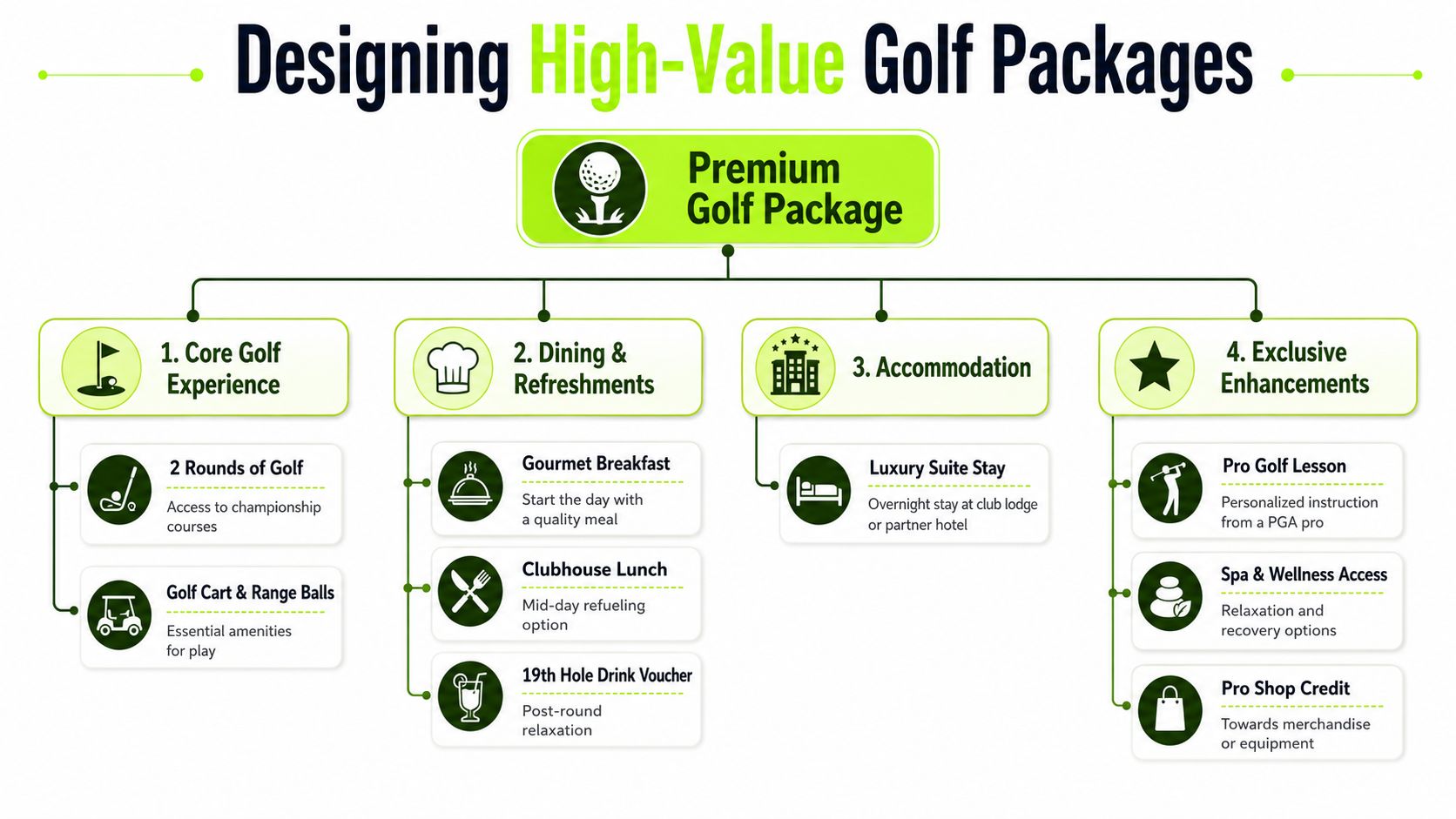
That usually happens when clubs bundle items because they are available, not because they solve a defined booking problem. A strong package reduces decision friction. The buyer can see what is included, who it is for, and why the offer is easier to book than building the day piece by piece.
Build around the buying job
Different buyers hire the same club for very different reasons.
A society organiser wants fewer moving parts. They need tee times, catering, prize support, and clear timings so the day runs without constant chasing. A corporate host needs confidence. They care about guest handling, presentation, and whether the club can deliver a polished day without last-minute issues. A prospective member wants a low-risk way to experience the club properly, with enough access to judge fit but without the pressure of a full annual commitment.
That distinction matters because package components should remove the buyer's main source of effort or doubt. If the package does not solve that problem, it becomes a discounted list of extras.
Sample package structures
| Package Type | Core Components | Value-Add Options | Target Audience |
|---|---|---|---|
| Stay and Play | Golf, accommodation, breakfast or dinner allocation | Range access, buggy option, welcome gift | Short-break visitors |
| Corporate Day | Tee times, food, reserved area, scoring support | Branded materials, prize handling, host support | Businesses and client entertainment |
| Taster Membership | Introductory golf access, clubhouse credit or social access, member touchpoint | Hosted induction, lesson add-on, follow-up membership meeting | Prospective members |
| Society Day | Golf, catering, organiser support, prize table option | Arrival gifts, nearest pin setup, reserved dining | Group organisers |
Choose components staff can quote and deliver consistently
High perceived value often comes from simple components that are easy to explain in one sentence.
Reserved dining space is a good example. For many groups, that has more practical value than vague references to hospitality. A clearly defined food allocation also works well because it sets expectations early and gives the organiser a cleaner budget picture. Arrival coffee, range tokens, or buggy upgrades can strengthen the experience if they are presented as standard inclusions rather than loosely added perks.
Welcome packs can also work, especially for corporate days or premium group bookings. The test is whether they feel considered and relevant to the guest. Clubs looking for unique golf gift ideas for golfers can use that as inspiration, then adapt the concept to suit their own audience and margin.
Tier packages by outcome, not by minor extras
Three tiers only work when each one helps a buyer make a clear decision.
An entry package should cover the core job at a sensible price point. The middle package should fit the most common booking scenario and remove the add-ons buyers usually request anyway. The premium package should save the organiser time, improve hosting quality, or add convenience that matters enough to justify the price.
What slows conversion is false choice. If Bronze, Silver, and Gold differ by a bacon roll here and a sleeve of balls there, buyers compare small details instead of picking the package that matches their needs. Clear jumps in usefulness produce better buying behaviour and make quoting easier for the team.
For society and group offers, this is usually where clubs need more discipline. Components should be organised around organiser priorities, not internal habit. A structured golf club society day marketing model is a useful reference because it forces the offer to reflect what group buyers need to book.
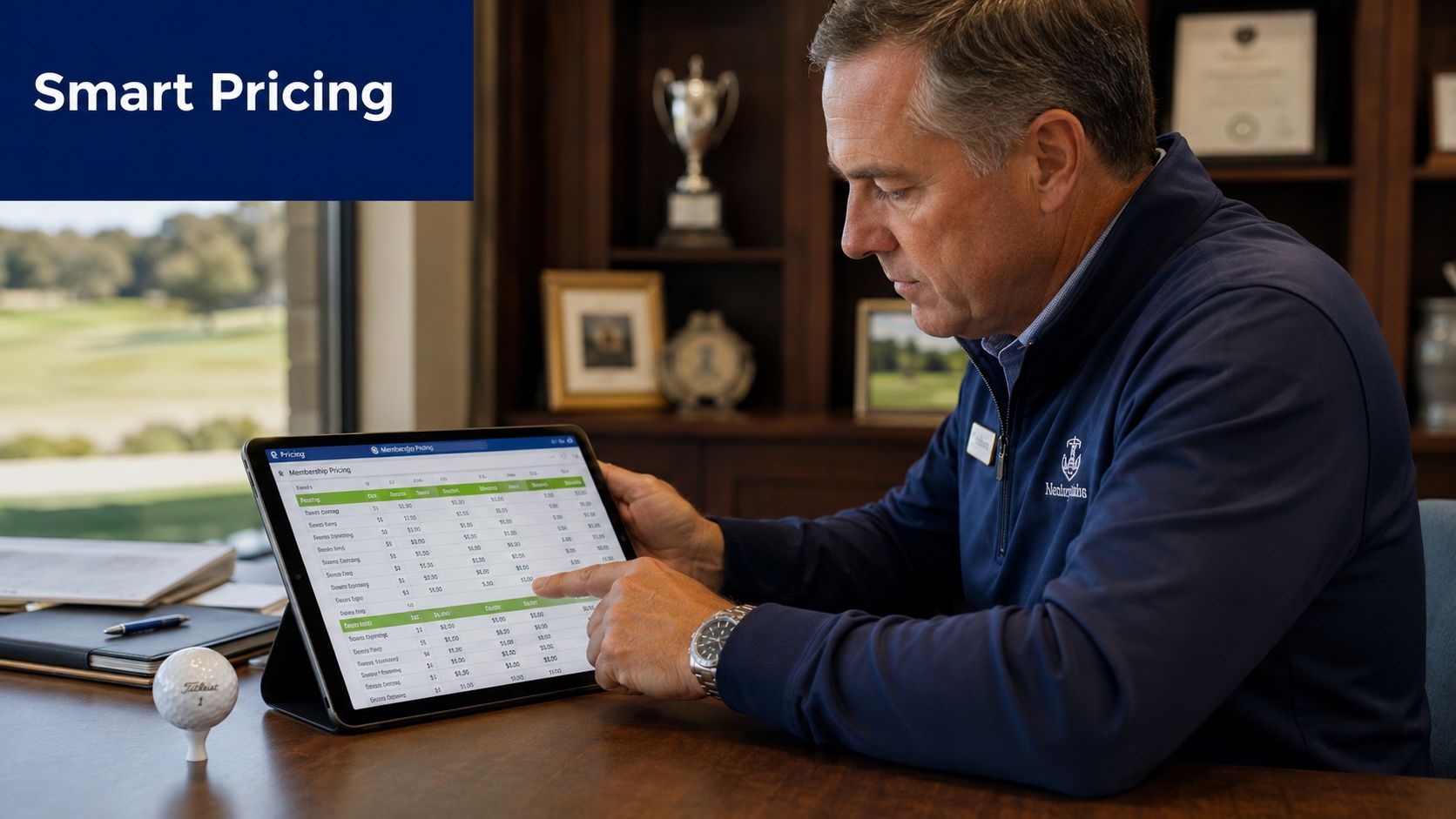
Smart Pricing Models for Predictable Revenue
Pricing is where many golf club package deals become either timid or careless.
Timid pricing happens when a club adds up direct costs, adds a little margin, and hopes the package looks competitive. Careless pricing happens when the club discounts too heavily just to make the offer feel marketable. Both approaches leave money on the table or weaken the club's positioning.
Why value beats simple cost-plus
Household budgets in the UK remain under pressure, and buyers are value-sensitive. That doesn't mean they only want the cheapest option. It means they need a package to show clear, justifiable value, and a poor-fit package can become a false economy, as discussed in this review of current value sensitivity in golf buying.
That should change how clubs think about price.
The question isn't only, “What does this cost us to deliver?” It's also, “What problem does this save the customer from having to solve?” Convenience, coordination, host confidence, and reduced booking friction all have value.
A practical pricing comparison
| Pricing Model | Where It Helps | Where It Breaks |
|---|---|---|
| Cost-plus | Useful as a minimum floor | Ignores perceived value and demand |
| Match-the-market | Helps avoid obvious overpricing | Pushes clubs into commodity thinking |
| Value-based | Protects margin when convenience and experience matter | Requires clear messaging and strong delivery |
| Quiet-period packaging | Helps monetise softer inventory | Can damage positioning if overused |
A package shouldn't exist just because the club has spare space. It should exist because the package format lets you sell that space more intelligently.
Protect the headline product
Managers often worry that visitor packages or trial offers will cheapen membership or standard green fee pricing. That only happens when the package is framed as a discounted substitute rather than a distinct buying route.
For example:
- Membership taster packages should lead naturally into a membership conversation.
- Visitor bundles should package convenience, timing, and add-ons rather than slash the green fee itself.
- Corporate packages should be sold on delivery quality and hosting ease, not on “cheap golf”.
If a club wants to strengthen revenue from visitor play without relying on blanket reductions, this guide to golf club green fee revenue is a useful companion.
If price is the only reason to buy, the offer is probably too weak. If the package removes friction and improves the experience, price becomes easier to defend.
The Launch Plan From Enquiry to Conversion
A package launch is not the day the graphic goes on Facebook. It starts there, perhaps, but commercial performance depends on what happens after the first expression of interest.
That's where many clubs leak revenue. The marketing works well enough to generate enquiries, but the response process is inconsistent. One person replies with detail. Another sends a short note and waits. A third forgets to chase. Interest fades, and the club assumes the market wasn't serious.

Launch through more than one route
A sensible launch plan usually combines owned channels with selective outbound effort.
- Email to existing contacts works well when the audience is segmented properly rather than blasted with a generic offer.
- Website landing pages give staff a single reference point for inclusions, terms, and next steps.
- Social promotion can widen reach, but only if the enquiry path is simple.
- Local partnerships with hotels or nearby businesses can improve package relevance for visiting golfers.
- Direct outreach remains effective for societies and corporate buyers when the message is specific.
Clubs that want to boost your conversion rates from digital traffic often find that the biggest gains come from reducing friction after the click, not from changing creative alone.
The response system matters more than the announcement
A package enquiry should trigger a defined process, not an improvised reply.
That process usually needs:
- Immediate acknowledgement so the buyer knows the enquiry was received
- Fast human follow-up with the right package detail, not a generic response
- Visible ownership so one staff member is responsible for progression
- Structured chasing when the buyer doesn't commit straight away
- Clear booking path from quote to deposit or confirmation
Systems outperform memory, with a CRM providing the club lead visibility, next-action discipline, and a record of what was discussed. GolfRep is one option clubs use for this kind of structured enquiry handling because it combines lead capture, follow-up automation, and CRM visibility around golf-specific sales processes.
Don't let marketing and operations work separately
The launch fails when the advert promises one thing and the booking process delivers another.
Fast response is not a customer service extra. It is part of conversion.
Staff need one version of the offer, one quoting method, and one follow-up standard. If enquiries come from multiple sources, they should still flow into the same pipeline. That's the only way to stop package demand from becoming scattered admin.
A club looking to improve the handoff from enquiry to sale should pay attention to golf club enquiry conversion, because the conversion path is usually where packaged revenue becomes predictable or unreliable.
Measuring and Optimising Your Package Funnel
Most clubs review package performance too loosely. They remember which offer “felt busy” and which one created a few complaints. That isn't enough.
If golf club package deals are going to become a dependable revenue line, they need to be measured as a sales funnel, not remembered as a promotion.
What to track
Not every metric matters equally. Start with the figures that expose bottlenecks in handling and conversion.
- Qualified enquiries tell you whether the offer is attracting the right buyer, not just traffic.
- Lead-to-booking conversion shows whether the package and sales process work together.
- Response time exposes whether delays are hurting otherwise viable deals.
- Booked value by package type reveals which formats deserve more focus.
- Lost reasons help separate pricing objections from operational friction or poor-fit audiences.
A centralised pipeline matters here because managers need lead visibility across every stage. If a package gets plenty of interest but poor booking numbers, the answer could be weak pricing, slow follow-up, poor positioning, or confusion in the offer. Without visibility, every explanation becomes a guess.
Review patterns, not isolated wins
A single booked corporate day doesn't prove the package works. A single quiet month doesn't prove it doesn't.
Look for patterns:
| Funnel Question | What It Usually Reveals |
|---|---|
| Are enquiries strong but bookings weak? | Offer or follow-up problem |
| Are bookings strong in one segment only? | Segmentation is clearer there |
| Do some staff convert better than others? | Process is not standardised |
| Are objections repeating? | Messaging or package design needs tightening |
Optimisation should be disciplined
Don't rebuild the entire package every time results dip. Change one variable at a time and watch what happens.
You might refine the package naming, clarify inclusions, simplify the enquiry form, tighten the quote template, or shorten the response window. Small operational improvements often outperform dramatic promotional changes.
The clubs that improve fastest are usually the ones that can see every enquiry, every follow-up action, and every reason a deal was won or lost.
That is what turns package selling from reactive admin into managed commercial performance.
From Ad-Hoc Deals to a Growth Engine
The clubs that get the most from golf club package deals usually aren't the clubs with the most creative offers. They're the clubs with the most reliable system around those offers.
They know who each package is for. They structure it around a clear commercial objective. They price it on value, not panic. They launch it through channels that suit the audience. Then they handle every enquiry with speed, visibility, and follow-up discipline.
That's the shift that matters.
An ad-hoc discount asks, “What can we sell this month?” A growth engine asks, “How do we build a repeatable process that keeps converting the right demand?”
For club managers, secretaries, owners, and committees, that distinction is practical. It affects revenue consistency, staff workload, and how often good enquiries go missing. It also protects the club from the cycle of last-minute offers that create activity without building a pipeline.
The strongest package strategy is usually less about invention and more about control. Clear packaging. Clear pricing. Clear ownership. Clear measurement.
When those parts are in place, package deals stop being a scramble for short-term bookings. They become a structured route to visitor revenue, society business, and membership opportunity.
If your club wants to build a more dependable package pipeline, GolfRep helps golf businesses put the full system in place, from offer structure and lead handling to CRM visibility and conversion tracking, so enquiries don't just arrive, they get converted.
Ready to tap into our proven growth system?