How to Choose a Golf Marketing Agency for Your Club

Most advice about choosing a golf marketing agency starts in the wrong place. It tells you to compare creative portfolios, audience sizes, or monthly media budgets. Those things matter, but they won't rescue a club that takes two days to answer an enquiry, loses track of missed calls, or leaves every follow-up to a busy secretary.
The UK golf market already contains substantial demand. England Golf reported 750,071 club members in 2025, up from 730,602 in 2024, while junior membership rose from 46,028 to 61,483 and the iGolf independent golfer programme reached 72,921 users. England Golf membership reporting shows why clubs shouldn't treat every marketing problem as an awareness problem.
From GolfRep's perspective, the right partner is the one that can turn interest into a booked visit, a trial round, a membership conversation, and eventually a renewal. The agency's design work and advertising skills should support that system, not distract from it.
Why Finding More Golfers Is the Wrong Starting Question
More leads will not repair a club's membership pipeline if enquiries sit unanswered, arrive without an owner, or receive one vague follow-up. The committee should examine what happens after interest appears before approving another campaign or comparing agency portfolios.
The wider participation funnel makes that problem clear. The R&A's UK satellite account estimated that 5.356 million adults play golf at least once a year, while 2.357 million play at least once every four weeks and 889,000 are club members. The Golfshake summary of the UK golf membership account points to a broad audience with different needs, not one pool that will respond to a generic membership advert.
An occasional golfer may need an introduction to the club and reassurance about the first visit. A regular independent golfer may be ready for a trial round. A lapsed member may respond to a renewal conversation. Each route needs its own qualification, message, next step, and follow-up owner.
Where the leakage happens
The committee's first practical question should be, “What happens to every enquiry after it arrives?” Ask how quickly someone responds, where the enquiry is recorded, who owns it, what qualifies a prospect, and how staff know whether the person eventually joined.
| Funnel Stage | Typical Conversion Rate | Where Clubs Focus Spend | Where Clubs Bleed Enquiries |
|---|---|---|---|
| Awareness to enquiry | Varies by channel and offer | Ad creative, reach, targeting | Weak landing pages and unclear calls to action |
| Enquiry to first response | Varies by club process | Lead volume | Slow replies, missed calls, unassigned inboxes |
| First response to booked visit | Varies by qualification | Promotional offers | No ownership, no reminders, poor scheduling |
| Visit to membership conversation | Varies by sales process | Website traffic | Staff lack context about the prospect |
| Membership conversation to join | Varies by follow-up | Brand presentation | No structured nurture or clear next step |
| Join to renewal | Varies by member experience | Acquisition campaigns | No lifecycle communication or retention visibility |
The table avoids invented benchmark rates. Clubs should calculate their own figures from actual records. A platform-reported lead is only a possibility until a person responds, qualifies the enquiry, and creates a clear next action.
A UK lead-response analysis found that businesses took an average of 47 hours to respond to an online enquiry, while only 7% achieved a response within five minutes. The same analysis reported that 78% of customers buy from the first company to respond. The lead response crisis report is not golf-specific, but its operational lesson applies directly to clubs competing for a prospect's attention.
The selection test: choose the agency that can explain what happens between form submission and membership decision.
Judge a golf marketing agency on enquiry response time, lead visibility, qualification, conversion tracking, and follow-up discipline before assessing creative style. Media buying creates opportunities. A defined response system determines whether those opportunities become visits, membership conversations, and members.
Auditing Your Club Before You Brief Any Agency
Don't brief an agency with opinions such as “Facebook isn't working” or “we need more younger members”. Give it evidence. A short internal audit will expose whether the constraint sits in demand generation, enquiry handling, sales capacity, or retention.
England has 1,735 affiliated golf clubs and more than 730,000 club members, according to England golf club and participation reporting. A market of that size needs repeatable processes. Manual knowledge held in one person's inbox isn't a reliable pipeline.
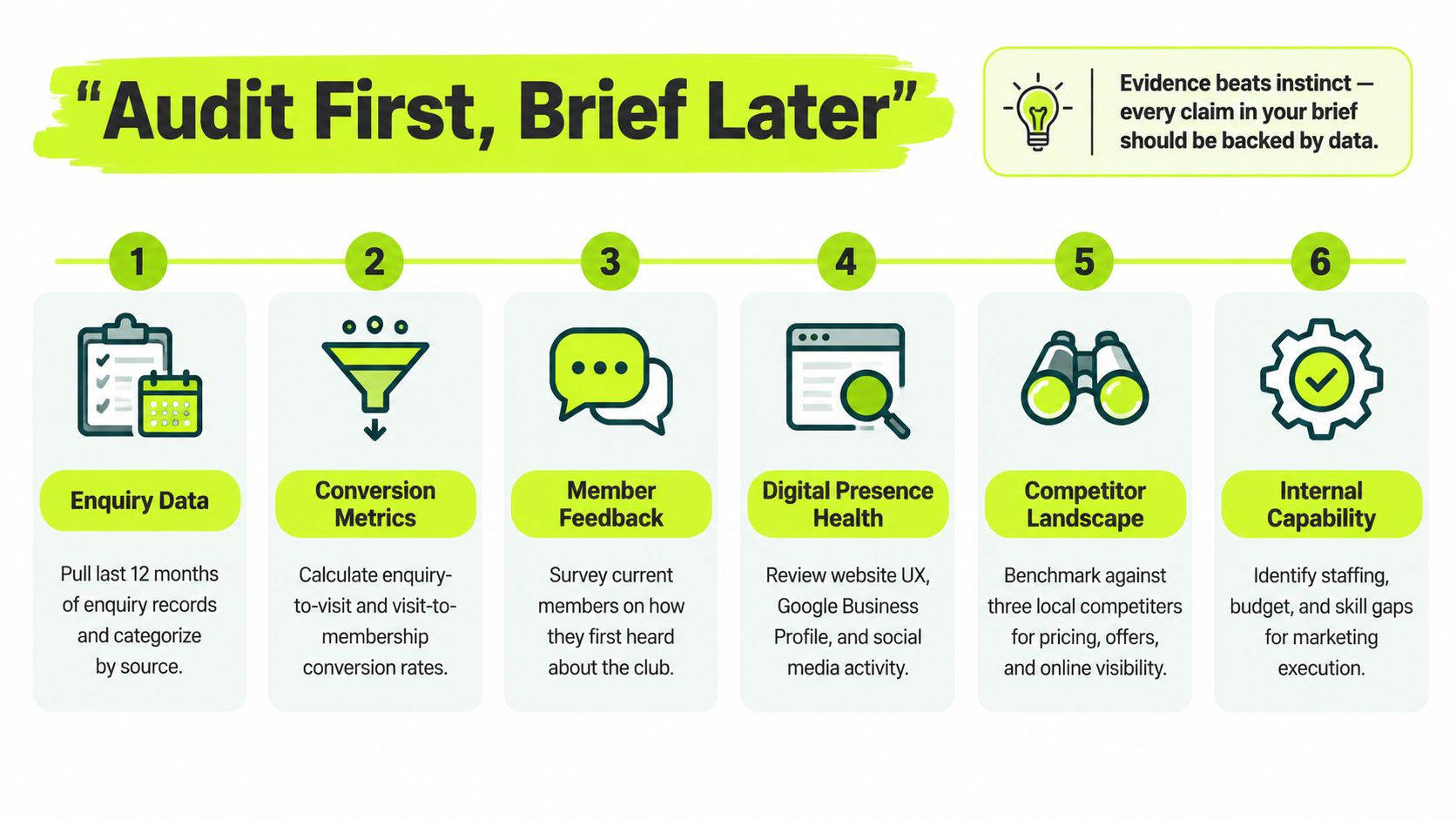
Start with the records you already own
Pull the last 12 months of enquiries from your website forms, general email inbox, membership inbox, phone logs, social messages, and booking tools. Create one record per person, then add:
- Source: Website, Google Business Profile, paid social, referral, phone, or another identifiable channel.
- Date and time: First enquiry, first human response, booked visit, follow-up, and final outcome.
- Status: New, contacted, qualified, visit booked, joined, deferred, lost, or uncontactable.
- Value: Membership type considered, joining route, and any relevant commercial context.
- Reason lost: Price, timing, distance, course fit, no response, or unknown.
Don't confuse an empty CRM field with a lost lead. “Unknown” is a finding. It tells you the club can't yet explain where its pipeline disappears.
Next, test the response process yourself. Submit a website enquiry, call outside peak hours, send a social message, and ask a current member how the club first contacted them. Record the exact time until a human reply, whether the reply answers the question, and whether someone owns the next action.
Turn the audit into a useful brief
A good brief doesn't need elaborate language. It needs a factual snapshot that every agency receives in the same format.
Include:
- Current enquiry volume by source, with gaps clearly labelled.
- Median and slowest response times, separated by channel.
- Enquiry-to-visit and visit-to-join figures, calculated from known outcomes.
- Unassigned or incomplete records, including missed calls and social enquiries.
- Target segments, such as full members, flexible golfers, juniors, societies, or independent players.
- Internal capacity, including who responds, who conducts visits, and who updates records.
- Commercial priorities, such as filling quieter tee times, managing a waiting list, or improving renewals.
Hillier Hopkins' reporting found that 64% of members were aged 51 and over, while female membership represented 18% and junior membership 9% in the survey data cited by the R&A's UK account. The UK satellite account for golf reinforces the need to brief agencies around specific segments rather than broad demographic assumptions.
End the audit with one sentence that states the constraint: “We need more qualified enquiries”, “We need faster first responses”, or “We need a clearer path from visit to membership.” That sentence will make weak agency pitches much easier to spot.
What a Specialist Golf Marketing Agency Actually Does
A genuine specialist doesn't stop at the advert click. It understands the membership decision, the booking path, the internal handover, and the follow-up required when someone isn't ready to join immediately.
That doesn't mean every specialist uses the same software. It means the agency can connect marketing activity to a club's operating reality. It should understand how a taster round differs from a society enquiry, why a flexible member needs different messaging from a full member, and how a waiting list changes the call to action.
A generalist agency may produce attractive golf creative and manage paid media competently. The dividing line appears after the form is completed. Does the agency own the handoff? Can it connect the lead to a CRM? Will it build reminders, qualification questions, booking options, and reporting that reaches verified membership outcomes?
GolfRep's approach sits in that operational gap, combining lead generation with CRM capture and structured follow-up rather than treating advertising as the complete service. Clubs comparing providers can also review GolfRep's golf marketing agency approach to see how a growth system connects acquisition with nurture and pipeline visibility.
| Capability | Golf-Specialist Agency | Generalist Marketing Agency |
|---|---|---|
| Funnel design | Maps golfers from first enquiry to visit, membership, and renewal | Often focuses on campaign landing and lead volume |
| Booking process | Connects taster rounds, visits, and callback requests to available club processes | May send leads to a generic form or inbox |
| CRM setup | Defines stages, ownership, source, outcome, and follow-up actions | May treat the CRM as a reporting destination |
| Nurture | Builds journeys for undecided, deferred, lapsed, and waiting-list prospects | Often limits follow-up to a campaign email |
| Paid media | Calibrates campaigns to member value and club capacity | Optimises towards platform metrics |
| Content | Uses golfer intent, club fit, local access, and membership questions | May produce polished but interchangeable content |
| Reporting | Shows enquiry source, response, visits, joins, and pipeline value | Leads with reach, clicks, and impressions |
The questions that expose the difference
Ask the agency to draw your enquiry journey on one page. It should show the form, notification, ownership, first response, qualification, booking, reminder, follow-up, and outcome update.
Then ask what it will do when the club is at capacity. A specialist should discuss waitlist management, trial experiences, flexible membership, and future nurture. A generalist will often return to increasing reach.
Look for a partner that can explain how it will work with your existing tee sheet, membership software, email platform, and staff routines. You don't need a fashionable stack. You need clear ownership and reliable data movement.
Evaluating, Shortlisting, and Pitching Agencies the Right Way
Don't let the first meeting become a theatre production. A polished deck can hide weak enquiry handling, unclear responsibilities, and reporting that never reaches the membership register.
Use a four-stage evaluation process. It keeps every contender on the same evidence base and gives committee members a defensible reason for the final decision.
Build a disciplined shortlist
Start with six to eight agencies, then reduce the field using practical criteria:
- Golf relevance: Can the agency discuss clubs, member categories, tee-time capacity, trials, and renewals in operational terms?
- Enquiry workflow: Does it document response, qualification, assignment, reminders, and escalation?
- CRM experience: Can it integrate with your current system or explain a sensible replacement path?
- Lifecycle campaigns: Can it support prospects who aren't ready to join today?
- Measurement: Can it distinguish a platform lead from a verified visit or member?
Send each contender the same audit and ask for a written response methodology. The exercise matters because a serious agency will ask for missing information rather than pretending that a media plan can solve every problem.
If your team is issuing a formal request for proposal, a resource such as BoloSign streamlines RFP replies can help organise responses and keep the process consistent.
Use discovery meetings to test their thinking
Don't spend the hour reviewing portfolio screenshots. Ask:
- How will you respond when a prospect submits an enquiry outside office hours?
- Who owns the lead before a club employee speaks to it?
- What counts as a qualified enquiry for our club?
- How will you track a member who first arrives through a social advert but joins after a phone conversation?
- What happens when a prospect postpones a decision?
- Which dashboard will our committee see?
- What information do you need from our staff each week?
- What would make you reduce or pause spend?
Score the answers, not the confidence of the presenter. The strongest agencies will challenge your assumptions, ask about staffing, and identify risks in your current process.
Score the proposal before discussing price
| Criterion | Weight | What to Score | Agency A | Agency B | Agency C |
|---|---|---|---|---|---|
| Golf and membership experience | High | Relevant operating understanding and references | |||
| CRM and automation capability | High | Integration, ownership, follow-up, data access | |||
| Reporting depth | High | Pipeline and verified outcomes, not vanity metrics | |||
| Response methodology | High | Clear SLA, qualification, and escalation | |||
| Contract flexibility | Medium | Notice, exit, assets, and data portability | |||
| Strategic fit | Medium | Alignment with capacity, segments, and club priorities | |||
| Price | Medium | Total cost against scope and accountability |
Red flags include vague performance promises, reluctance to share a sample dashboard, no named account lead, and a pitch dominated by creative awards. Another warning sign is an agency that can't explain what the club must do after a lead arrives.
Pricing Models, Contracts, and How to Align Incentives
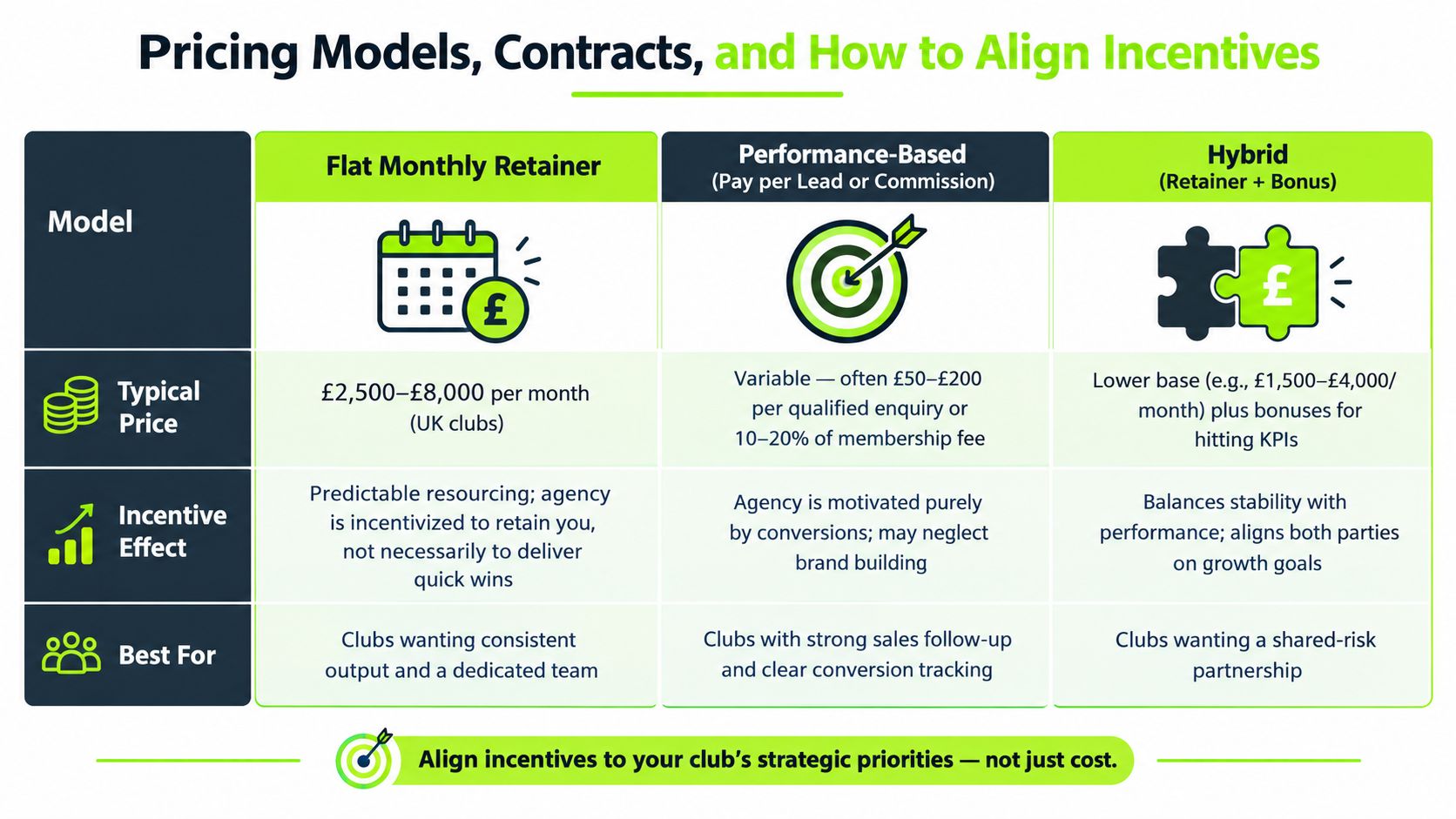
Price discussions become difficult when clubs compare unlike services. One agency may charge for media management and creative production. Another may include CRM work, automation, reporting, and sales support. Compare the scope and incentive structure, not just the monthly figure.
A flat retainer offers predictable resourcing. It can work well when the club wants a dedicated team, but it may reward activity rather than outcomes if the agreement contains no response, reporting, or delivery standards.
Performance pricing links payment to an agreed outcome. That can sharpen accountability, but it creates attribution disputes unless the contract defines a qualified enquiry, a booked visit, a converted member, and the period in which the agency receives credit.
A hybrid arrangement combines a smaller base with performance bonuses. It often gives both sides enough stability to do proper setup while keeping attention on commercial progress.
Read the contract beyond the fee
The contract should settle practical questions before launch:
- Notice period: How quickly can either party end the relationship?
- Data portability: Will the club receive CRM records, audiences, tracking history, and reporting data?
- Asset ownership: Who owns landing pages, creative files, copy, and automation sequences?
- Attribution rules: How are referrals, returning prospects, and multiple touchpoints handled?
- Exclusivity: Can the agency work with nearby clubs or competing sites?
- Continuity: What happens if the agency changes ownership or the account team leaves?
- Exit process: Does access transfer on the first day of termination, or only after a dispute?
Don't accept a dashboard that reports only platform figures. A campaign can produce leads in Meta or Google while the club's own records show no completed conversations or visits. Require a distinction between reported activity and verified commercial outcomes.
Clubs should also compare pricing options carefully when building an internal procurement view, but a software or service price page can't replace a scope comparison. The cheapest proposal can become the most expensive if it leaves staff with manual follow-up and no usable records.
For further context on the wider cost discussion, review how much golf club marketing costs. Negotiate around the pipeline the club needs, not impressions the platform displays.
Onboarding, KPIs, and Reporting That Build a Real Pipeline
Signing the contract is not the result. It's the point at which both sides need to make the commercial system observable.
The first 30 days should establish the foundations. Give the agency access to relevant enquiry and membership data, confirm user permissions, install tracking, and write a shared definitions document. If “qualified enquiry”, “booked visit”, and “member” mean different things to the agency and the club, every later report will create arguments.
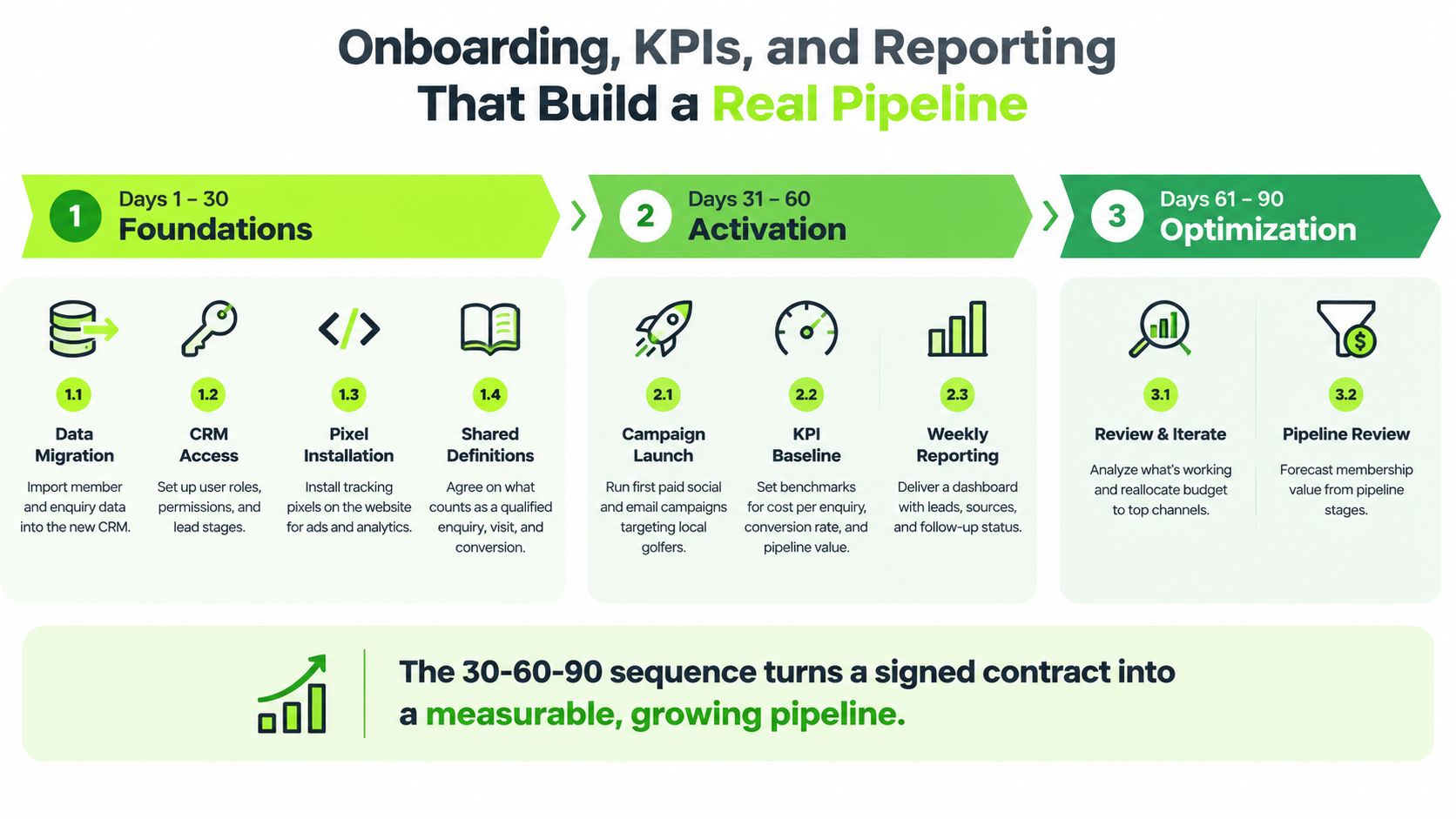
Set expectations for the first 90 days
Days 1 to 30, foundations: Migrate usable records, connect CRM access, install tracking, map forms and phone routes, and agree ownership. Establish the baseline for response time and conversion before changing the campaign.
Days 31 to 60, activation: Launch the first campaigns, test the booking path, and produce the initial pipeline dashboard. The team should see lead source, current stage, follow-up status, and known outcome in one place.
Days 61 to 90, optimisation: Review channel quality, adjust audiences and offers, and forecast membership value from the active pipeline. Fix the handoff before increasing spend.
A sensible handoff standard is a five-minute acknowledgement and a 24-hour follow-up, provided the club has the staffing to honour it. Those are operating targets to agree in writing, not universal performance claims.
Use three KPI levels
- Volume: Enquiries, calls, taster bookings, and visit requests.
- Conversion: Enquiry to booked visit, visit to membership conversation, and conversation to join.
- Commercial: Cost per acquired member, membership value, and renewal or retention indicators.
Keep the reporting cadence simple. Use a weekly pipeline snapshot for open actions, a monthly strategic review for channel and segment decisions, and a quarterly planning session for offers, capacity, and member lifecycle priorities.
Reporting standard: one live dashboard should answer who enquired, where they came from, who owns the next action, and what happened.
A slide deck can summarise the month, but it shouldn't be the only place the information exists. Your committee should be able to see whether the club is accumulating unanswered enquiries before the next meeting. The agency should flag pipeline risks early, not explain them after a disappointing quarter.
The broader discipline is covered in how to measure marketing effectiveness, particularly the need to connect activity with outcomes the club can verify.
Checklist and Case Study Takeaways for Your Next Decision
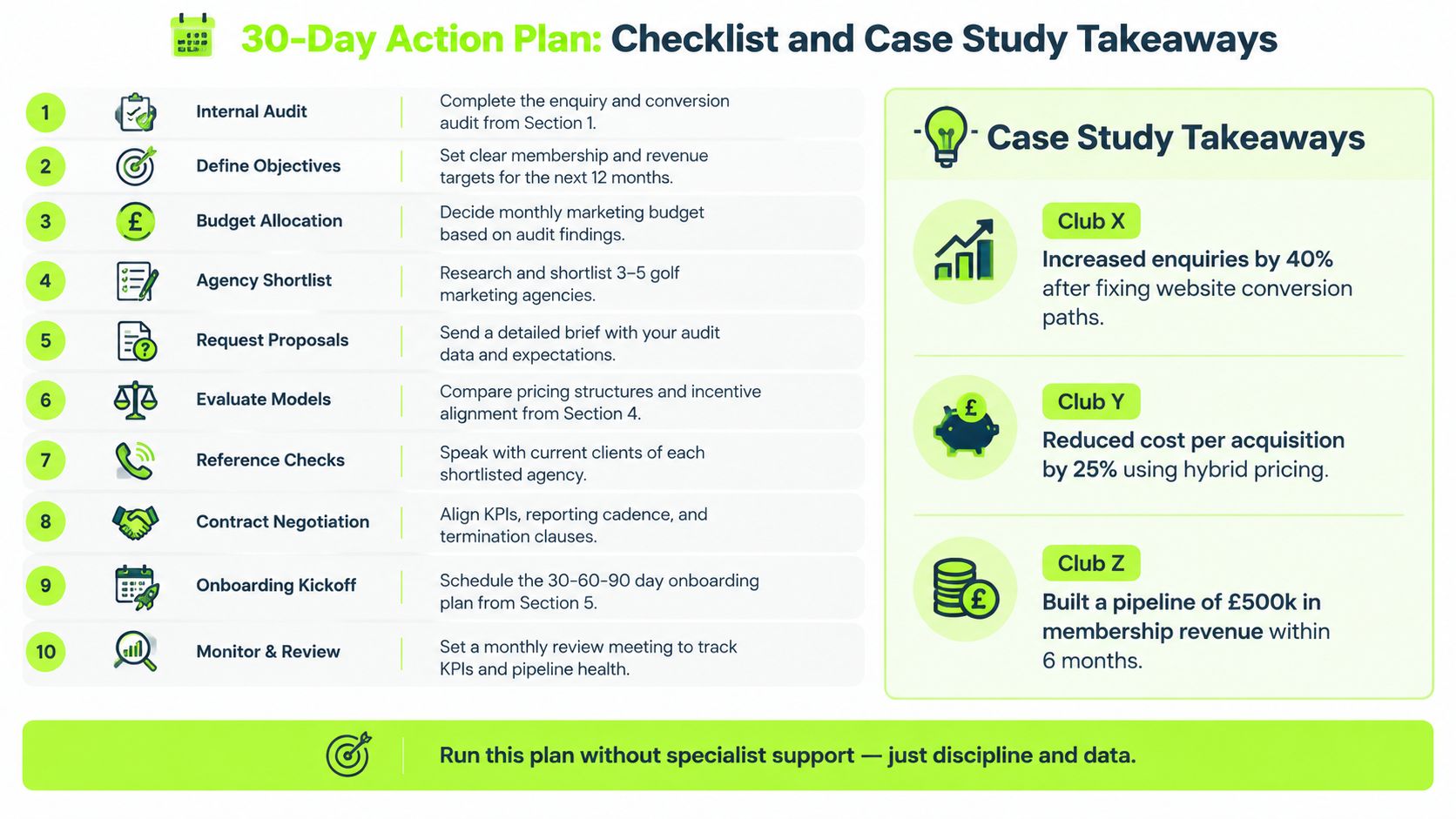
A committee can make meaningful progress within 30 days without becoming a marketing department. It needs one owner, one dataset, and an agreed definition of success.
- Audit enquiries: Review website, phone, email, and social records.
- Set the baseline: Calculate known response, visit, and membership conversion figures.
- Shortlist agencies: Choose three finalists using CRM, follow-up, and golf capability criteria.
- Ask identical questions: Test response ownership, qualification, reporting, and attribution.
- Review the contract independently: Ask someone outside marketing to inspect data, assets, notice, and exit terms.
- Set the onboarding milestone: Agree the first 90-day deliverables before signing.
- Fix the reporting rhythm: Book weekly pipeline checks and monthly strategic reviews.
Use scenarios carefully
The private-club scenario often presented in agency pitches is revealing: a team tracks the gap between a paid social form and the first human reply, then improves the handoff and follow-up. The useful lesson isn't a promised conversion lift. It's that the club can identify where prospects wait, who owns them, and which action changes the result.
A multi-course operator may instead test a performance-priced agreement where payment depends on a clearly defined converted membership. That approach can reveal whether the existing CRM and sales process are reliable enough to support attribution. It can also give the operator evidence for renegotiating terms, but only if “converted” is defined before the campaign starts.
Neither scenario excuses weak records. A guarantee won't fix an unassigned lead, and a performance fee won't resolve disagreement about whether a returning prospect came from the agency or a member referral.
Take three decisions to your next committee meeting:
- Choose the constraint: More qualified demand, faster response, better visit conversion, or stronger renewal.
- Choose the evidence: Agree which records and outcomes the agency must report.
- Choose the accountability: Name the internal owner and the external responsibility for every stage.
A golf marketing agency should make those decisions easier, not bury them beneath creative language. If a proposal can't show how it will protect and progress every enquiry, it isn't ready for approval.
GolfRep helps UK golf clubs combine targeted lead generation with CRM capture, automated follow-up, and reporting from first enquiry to membership outcome. Review your current enquiry journey, identify where prospects are being lost, and visit GolfRep to discuss a more predictable growth system for your club.
Ready to tap into our proven growth system?