GolfRepOS Golf Club CRM: A Practical Guide for Clubs

Most golf clubs don't have an enquiry problem. They have a response and conversion problem.
The instinct is understandable. If membership numbers look flat, the club asks for more Facebook activity, more Google Ads, another printed leaflet, or a new joining offer. But additional enquiries won't fix an inbox that isn't monitored, a spreadsheet nobody owns, or a pricing structure that changes depending on who answers the phone.
The evidence points to a market where demand and operational pressure exist at the same time. England Golf recorded 750,071 members in 2025, the highest level in at least 13 years, while independent UK club research found that 30% of golfers reported a waiting list at their club, up from 27%, and 39% said their club charged a joining fee, up from 37% (Golf Business, Golfshake). The commercial question is no longer how to create interest. It's how to prioritise, respond to, nurture, and convert that interest without losing control of the member experience.
GolfRepOS is designed around that operating reality. It connects acquisition, enquiry handling, pricing logic, follow-up, and reporting so clubs can see what happens after someone fills in a form or calls the office.
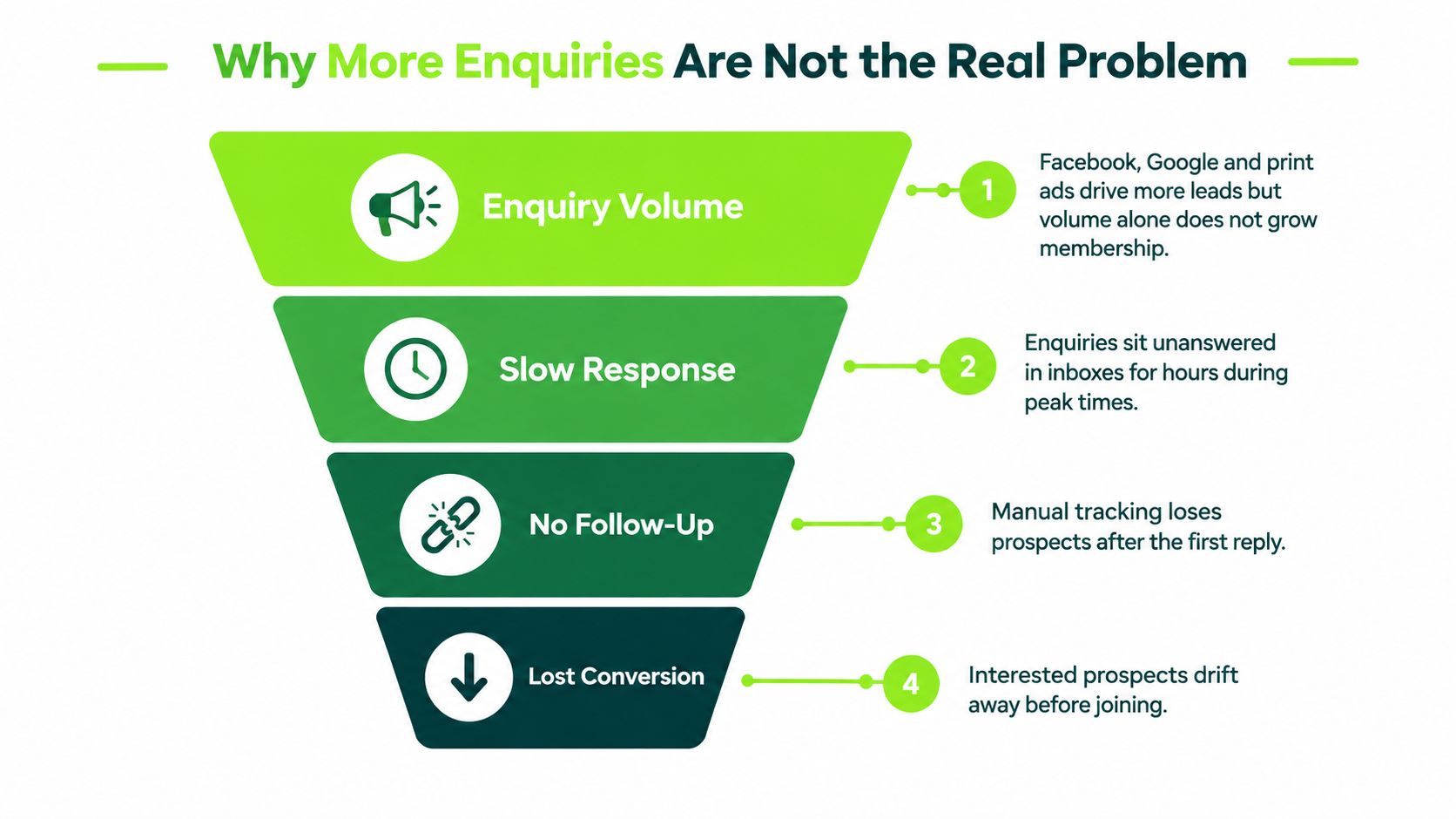
Why More Enquiries Are Not the Real Problem
The popular advice says that clubs need more leads. Spend more on Facebook, improve the website, run a Google campaign, and membership growth will follow.
That advice skips the part where a real person has to answer the enquiry, understand the prospect's situation, explain the right membership category, book a visit, and follow up when the prospect doesn't respond immediately. A club can generate healthy interest and still lose potential members because nobody can see which enquiries are new, which are urgent, and which have already gone cold.
England Golf's 2016 questionnaire showed that 89% of surveyed English clubs used a club website regularly for marketing, while 75% used social media such as Facebook, Twitter, and Instagram (England Golf membership questionnaire coverage). Digital visibility was already widespread, but the average club had 460 members, compared with 466 in 2014, and the average number of clubs with members aged 65 or over rose from 148 to 171. That combination describes a digitally active, retention-sensitive market. Being visible online wasn't the same as converting and retaining the right people.
Speed is only useful when the process is organised
Response time matters because prospects rarely submit one enquiry and patiently wait for a committee meeting. A UK lead-response study found that nearly 10% of 132 surveying firms replied within 5 minutes, while more than 46% replied within an hour. The study recommends responding within the first hour, ideally within the first five minutes, to remain in a strong position to convert leads (UK lead-response study).
Other UK research found that the average business takes 42 hours to respond to an online enquiry, while a separate SME analysis reported an average of 47 hours and only 7% achieving a response within five minutes (First Knock research). A separate crisis report says 78% of customers purchase from the first company to respond (lead-response crisis report).
Practical rule: A fast reply without ownership, qualification, and a next action is only a faster way to create an untidy pipeline.
The right question for a club is not, “How do we buy more enquiries?” It's, “Can we respond to every worthwhile enquiry, know its source, and move it towards a visit or joining decision?” Clubs exploring the creative side of acquisition may also find the ShortGenius AI ad generator useful for producing campaign assets, but the advert is only the beginning. The conversion system behind it determines whether that spend becomes a booked tour.
For a closer look at the operational leakage that often sits behind headline enquiry figures, see how most golf clubs lose 30% of enquiries without realising.
What the GolfRepOS Golf Club CRM Actually Is
A conventional CRM stores names, emails, and notes. A GolfRepOS golf club CRM should do more. It should give the club a connected operating layer that captures demand, decides what happens next, records the outcome, and feeds the learning back into advertising and pricing decisions.
That means four connected components.
CRM core: Member, prospect, visitor, referral, and enquiry records sit in one structured profile rather than across inboxes and disconnected spreadsheets.
Enquiry handling: Website forms, paid social leads, phone enquiries, and referrals enter a defined pipeline. The system can assign ownership, apply a category, and create a task for the person responsible.
Communications: Automated emails and messages acknowledge interest, answer common questions, and keep prospects engaged while the secretary, membership manager, or PGA professional handles the human conversation.
Reporting: The club can see the condition of its pipeline, including source, stage, membership type, booked visit, and eventual outcome.

The operating layer connects decisions
The value isn't in having four features listed on a supplier's website. The value comes from the connection between them. If a prospect submits a form for flexible membership, the record should carry that category into the response, follow-up, visit booking, pricing conversation, and reporting view.
That structure is particularly important as membership products become more varied. Flexible options grew from 34% to 40% at members' clubs and were used by 64% of proprietary clubs, according to the UK golf club survey (Hillier Hopkins Golf Clubs Report 2024/25). A single generic nurture sequence won't reflect the difference between a full member, a flexible player, a junior prospect, and someone waiting for a place.
Golf clubs assessing CRM design can also review these marketplace CRM insights from TrainingBooker for a broader view of how marketplace and customer records can be organised. For the golf-specific operating model, GolfRepOS as the operating system for modern golf clubs sets out how the CRM sits inside a wider growth system rather than functioning as an isolated database.
Core Pillars of the Growth System
A club CRM earns its place when it improves a real operating decision. The four pillars below work together, but each solves a different failure point.
| Pillar | Primary Function | Club Problem It Solves |
|---|---|---|
| Data-led advertising | Connect campaign and enquiry data to member categories | Spending without knowing which sources produce suitable prospects |
| AI automation | Route, acknowledge, score, and prompt follow-up | Delayed responses and inconsistent manual handling |
| Structured workflows | Move prospects through visits, waitlists, trials, and renewals | Lost handoffs between the office, professionals, and committees |
| Reporting | Link activity and spend to membership outcomes | Reporting clicks and enquiries without showing commercial results |
Advertising should produce usable context
A paid campaign becomes more valuable when the CRM knows what it promoted, which landing page generated the enquiry, and which membership category the prospect selected. UK golf-club guidance recommends tracking conversions with Google Ads and Meta pixels, alongside call-tracking software, so phone enquiries can be associated with the campaign that generated them. It also recommends negative keywords such as cheap, jobs, and free to filter out low-quality traffic (UK golf club membership growth guidance).
That information helps a committee judge quality, not just volume. A campaign that produces fewer enquiries but more suitable visits may deserve more budget than one producing a crowded inbox of poor-fit prospects.
Automation protects the first response
The first response should confirm receipt, set expectations, and offer a relevant next step. It shouldn't pretend that an automated message replaces a conversation with the membership team. AI is useful for routing, scoring, reminders, and drafting consistent replies. Human judgement still matters when a prospect asks about access, joining fees, playing rights, family arrangements, or whether the club fits their expectations.
Workflows make ownership visible
A pipeline might include new enquiry, qualified, visit invited, visit booked, visit completed, proposal sent, joined, deferred, and lost. The exact labels should match the club's process, but every stage needs an owner and a reason for movement.
The UK case-study material describes separate booking and membership pipelines, logged communications, automated enquiry responses, sales tasks, revenue attribution, and segmented visitor databases. It also reports a benchmark rollout that tracked 271 membership deals worth £798,000 (HubSpot CRM for golf clubs case study). The useful lesson isn't that every club should reproduce that figure. It's that a club can instrument the journey from contact to revenue when the workflow is designed properly.
Reporting should change the next decision
A dashboard is only useful if it changes budget, follow-up, staffing, or pricing. Managers should be able to ask which sources produce full members, which categories stall, how many prospects are waiting for a visit, and where renewals are at risk.
How Clubs Use GolfRepOS Day to Day
A Saturday morning enquiry surge exposes weak processes quickly. A prospective member submits a website form, another responds to a paid social advert, and a current member introduces someone by email. Without a central queue, those three conversations can end up with different people, different information, and different follow-up standards.
With GolfRepOS, each record enters the appropriate pipeline and carries its source, membership interest, and next action. The secretary can see which prospect needs a call, the PGA professional can see who has asked to arrange a visit, and the membership manager can review the queue without searching through several inboxes.

A waitlist needs more than a name and a phone number
Suppose a club has a full category and a prospect is willing to wait. The record should show the category requested, the pricing presented, any deposit or joining-fee discussion, the date of the last contact, and the condition that would trigger the next message.
Automation can send a useful update when the prospect reaches a relevant point in the queue. It can also create a task for a staff member when a pricing conversation needs personal attention. The aim isn't to make the waitlist feel automated. It's to prevent the club from forgetting people who have already demonstrated intent.
A waiting prospect is not a closed sale. Treat the queue as a pipeline, not a filing cabinet.
The same principle applies to renewals. A lapse-risk flag might appear after a member stops booking, misses a payment milestone, or approaches renewal without confirming. The system can prompt a captain, professional, or membership lead to make a personal call, while recording the outcome for future action.
That approach is more reliable than asking a committee member to remember a conversation from a meeting several weeks earlier. Clubs looking at the wider application of this model can read GolfRepOS CRM guidance, particularly around centralised records and structured follow-up.
Implementing and Migrating Without Disruption
A CRM migration shouldn't begin with a software demonstration. It should begin with an audit of how the club currently handles enquiries, memberships, payments, visits, and renewals.
The implementation can follow five practical stages.
Discovery week: Review spreadsheets, mailing lists, payment records, website forms, inboxes, and existing membership exports. Identify which fields the club relies on and which records are duplicated or incomplete.
Staged data import: Clean records before loading them into the new system. Suppress duplicates, preserve useful history, and separate current members from prospects, former members, visitors, and waiting-list contacts.
System setup: Configure the club's pipelines, membership tiers, enquiry sources, automations, task ownership, and reporting views. Avoid copying every old field into the new CRM just because it exists.
Team training: Give short, role-specific sessions to the people who will use the system. The secretary needs to understand routing and records. The membership lead needs pipeline control. Committee members mainly need clear reporting and agreed governance.
Go-live support: Launch with guided help, monitor new enquiries, and keep read-only access to historical systems during the transition.
Keep the club involved at the right points
Volunteer-led committees often worry that implementation will consume the time they don't have. That risk is real if every decision is escalated to the full committee. It becomes manageable when the club appoints a small working group with authority over operational choices.
The general manager, secretary, membership owner, and one committee sponsor usually provide enough input to define the process. Other committee members can review the agreed reports and policies rather than attending every configuration session.
A parallel run is useful because it exposes practical gaps. If a form arrives in the new CRM but the person responsible still checks an old inbox, the club has found a process problem before fully switching over. The migration should leave the club with fewer points of failure, not merely a newer place to store the same confusion.
Integrations, Attribution, and Pricing Logic
The most useful CRM record tells the story of the relationship. It shows where the prospect came from, what they asked for, what the club offered, which visit they booked, and what happened afterwards.
That requires connections between advertising platforms, website forms, phone tracking, tee sheet or visit-booking systems, and the CRM. A prospect may first see a Meta advert, attend a member-guest event, and later submit a form through an organic search page. If the club only credits the final form, it misses part of the journey. If it credits every touch equally, it can make budget decisions without a clear rule.
Attribution needs an agreed operating rule
Clubs should decide whether they want first-touch, last-touch, or multi-touch reporting. The right choice depends on the question.
First-touch attribution helps identify which channels create initial awareness. Last-touch attribution helps explain what prompts a direct enquiry. Multi-touch reporting can show the sequence, but it needs clean records and disciplined source capture. The important point is consistency. A committee can work with an imperfect model if everyone understands how it works.
Pricing belongs in the same conversation. UK implementation examples describe 400+ pricing rules inside a golf operations platform, with monthly benchmarking and price adjustments across green fees, membership, and accommodation (UK golf pricing and membership guidance). That doesn't mean every club needs hundreds of rules. It does show why price should be treated as structured operational data rather than a figure changed informally at the front desk.
| System | Data Captured | CRM Use |
|---|---|---|
| Google Ads and Meta | Campaign, advert, audience, and conversion source | Compare qualified enquiries by channel |
| Website forms | Membership interest, contact details, and consent | Route prospects into the correct workflow |
| Call tracking | Caller, campaign association, and conversation outcome | Attribute phone-led enquiries |
| Booking or tee sheet system | Visit date, attendance, and booking status | Trigger reminders and post-visit follow-up |
| Membership platform | Category, joining fee, renewal date, and status | Coordinate onboarding and retention activity |
A calendar or booking integration also needs careful configuration. Clubs evaluating scheduling architecture can review guidance on how to set up two way sync step by step. The practical test is simple: the office should know what is booked, the prospect should receive accurate information, and the CRM should record the event without creating duplicate work.
Measurable Outcomes and Member Case Patterns
Clubs should be cautious with generic CRM promises. Results depend on the club's starting point, category mix, pricing, local demand, sales discipline, and the quality of its offer. A system can expose a weak process, but it can't make an unsuitable membership proposition attractive.
That's why ROI should be measured through a small set of connected outcomes. Track response time, qualified enquiry rate, visit bookings, visit attendance, trial progression, signed memberships, source cost, and recovered opportunities. Review those measures by category rather than relying on one overall conversion figure.
Read patterns by operating model
A private member club may care most about category fit, joining-fee income, retention, and the quality of new members. A pay-and-play venue may prioritise visitor-to-member progression and the value of repeat play. A multi-site group needs centralised reporting while preserving local pricing, brand, and operational differences.
GolfRep's published background includes work associated with Bidston Golf Club, Addington Palace, Downes Crediton, and a Macdonald Hotels and Resorts-style multi-site rollout. Those names should be treated as different operating patterns, not as interchangeable proof points. A near-closure recovery, a steady single-site pipeline, a rapid membership campaign, and a multi-site CRM deployment each require a different measurement model.
The available UK case-study material provides one concrete tracking example, 271 membership deals worth £798,000, rather than a universal performance benchmark (golf-club CRM implementation case study). Clubs should use that evidence to understand what can be measured, not to assume the same commercial outcome.
| Club Profile | Avg Response Time | Tour Show-Rate | Trial-to-Member Conversion | Primary Growth Lever |
|---|---|---|---|---|
| Private member club | Measure from each source separately | Track booked versus attended visits | Review by membership category | Faster routing and clearer qualification |
| Pay-and-play venue | Compare phone, form, and referral response | Monitor visit reminders and attendance | Separate trial players from casual visitors | Better source attribution and follow-up |
| Multi-site group | Report centrally with local views | Compare sites using the same definitions | Review category and location together | Shared workflows with local pricing control |
The table deliberately avoids invented benchmarks. A club that doesn't currently record these fields can't claim improvement. Establish the baseline first, then measure whether the system changes behaviour and outcomes over time.
Objections, FAQs, and Next Steps for Adoption
Committees usually raise sensible concerns before approving a CRM.
Will it replace the tee-sheet or membership platform? Not necessarily. A CRM can sit alongside operational systems, capture the prospect journey, and pass the relevant information into the platform that manages bookings or membership administration.
Is migration risky? It can be if records are imported without cleaning, ownership is unclear, or the old process is switched off too early. A staged import, parallel run, and retained historical access reduce that risk.
Who owns the data? The club should agree ownership, access permissions, export arrangements, consent handling, and retention rules before go-live. Those points belong in the commercial and implementation discussion, not in an afterthought.
Will AI contact prospects without oversight? Automation should handle defined tasks such as acknowledgements, routing, reminders, and prompts. Clubs should decide which messages require human approval and review the system's activity regularly.
What about cost and committee approval? Start with the leakage that has a measurable operational consequence. An audit of one enquiry source can reveal whether the club is losing opportunities through slow response, poor assignment, weak visit follow-up, or unclear pricing. That evidence makes a better committee paper than a general promise of efficiency.
A low-risk adoption path is straightforward: hold a discovery call, audit the current data, pilot one enquiry source, review the pipeline with the responsible staff, then roll out the wider workflow in phases. The club doesn't need to change every system at once. It needs to make one part of the member journey visible and accountable, then build from there.
GolfRep helps UK golf clubs connect lead generation with structured follow-up, CRM workflows, attribution, and pricing-aware membership journeys. Visit GolfRep to discuss a GolfRepOS discovery session, review your current enquiry process, and plan a practical migration around your club's people and systems.
Ready to tap into our proven growth system?