How Much Does a Golf Simulator Business Make

A typical UK simulator bay can generate roughly £39,000 to £93,600 in annual booking revenue at 30 paid hours per week, but profit depends heavily on occupancy, costs, and the mix of coaching, events, and hospitality. So what turns that wide range into a business you can take to a committee, a lender, or a board?
The honest answer is that how much does a golf simulator business make is the wrong starting question if you expect a single figure. Two bays with identical launch monitors can produce completely different cash flow because one sells quiet weekday mornings and the other doesn't. What matters is how many paid bay-hours you sell, what you really collect for each hour after discounts and member rates, and what it costs you to keep those bays open.
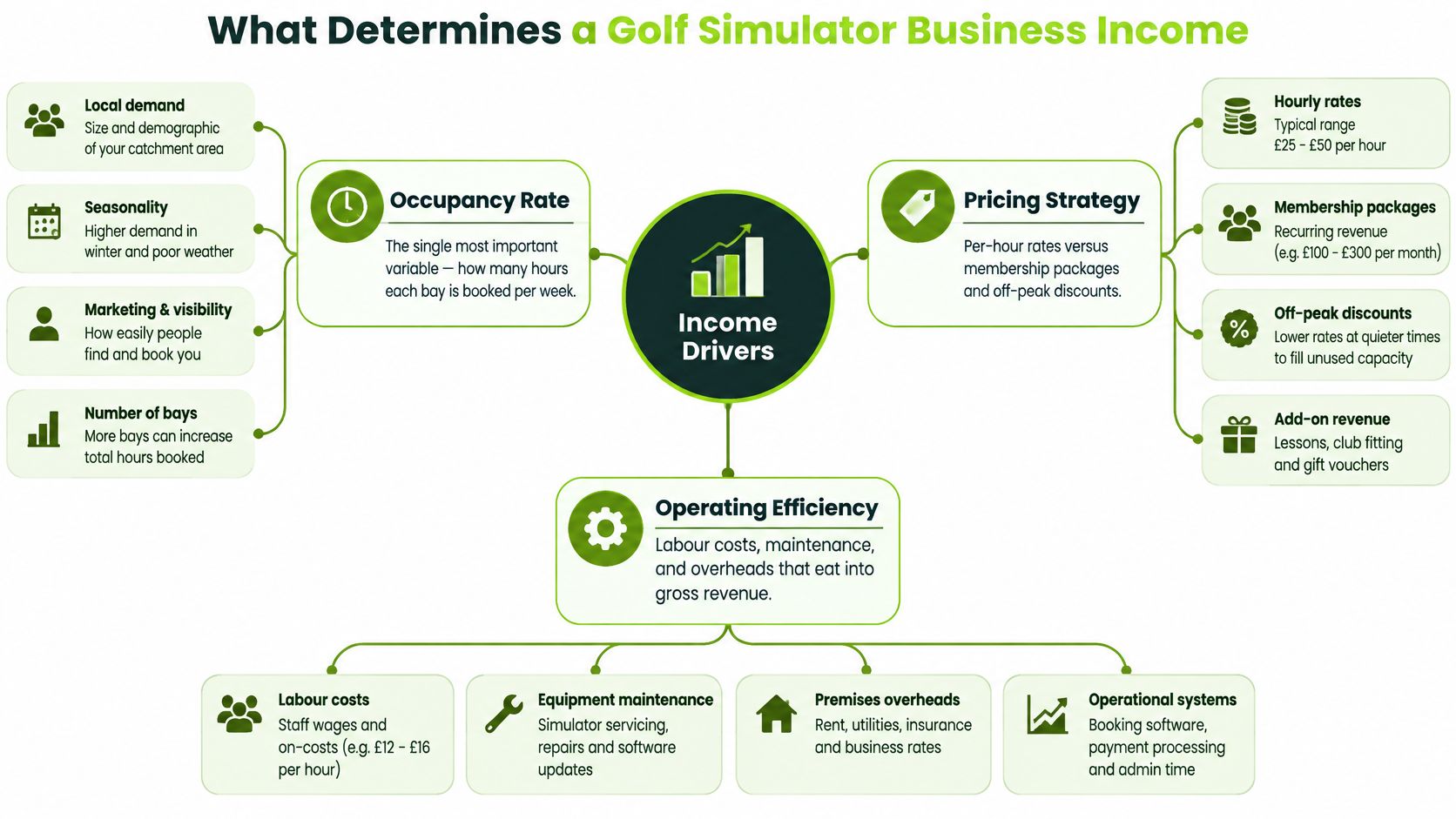
What Determines a Golf Simulator Business Income
Start with a simple formula. Booking revenue equals paid bay-hours multiplied by average realised rate, then you add coaching, memberships, events, and hospitality on top. If either part of that multiplication is weak, the headline price on your website won't save you.
A 2026 UK finance guide to simulator session prices of approximately £25–£60 per hour frames that £39,000 to £93,600 range at 30 paid hours per week before coaching, events, memberships, hospitality, staffing, rent, utilities, finance, maintenance, and tax. That's turnover, not profit, and it isn't a guarantee of payback.
Occupancy Moves the Number More Than Price
Price matters, but utilisation matters more because most costs don't fall when a bay sits empty. Rent, finance payments, insurance, and core staffing continue whether Tuesday morning is full or vacant. A modest lift in paid hours across evenings, weekends, and a few programmed daytime slots can therefore change the result more than a small increase in your peak rate.
That's why you should forecast by daypart, not by week in total. Separate peak evenings and weekends from weekday mornings, school hours, and late evenings. If your model assumes every hour sells at the peak price, it isn't a forecast. It's an aspiration.
Management measure: Track revenue per available bay-hour, not just total takings. It shows whether you're filling capacity or simply charging more for the same busy slots.
Revenue Mix Changes the Risk Profile
Hourly hire is also the most exposed stream. It depends on discretionary bookings week after week, whereas memberships smooth income, coaching fills daytime capacity, and corporate hire can sell several bays at once. Food and beverage then attaches to time already sold, provided your layout and staffing support it.
That mix is similar in logic to a digital driving range, where the technology creates reasons to visit, practise, compete, and stay longer, rather than a single transactional purchase. The commercial question isn't whether a stream sounds attractive. It's whether it uses spare capacity, requires extra staff, or displaces a higher value booking.
- Paid bay-hours: The volume driver you must prove, by day and time.
- Average realised rate: What you collect after member pricing, off-peak discounts, and cancellations.
- Ancillary spend: Coaching, leagues, events, and hospitality that lift value per visit.
- Cost to deliver: Staffing and service levels that rise when you chase certain bookings.
Model those four lines separately from day one. If you combine them into one turnover figure, you'll never know which assumption failed when cash gets tight.
Revenue Streams Beyond Hourly Bay Hire
A UK winter model for one club bay shows what a mixed calendar can produce: £14,000 per month, or £70,000 over five winter months, split across five streams.
| Revenue Stream | Rate | Monthly Income |
|---|---|---|
| Member bookings | £40 per hour | £4,000 |
| Guest bookings | £50 per hour | £3,000 |
| PGA coaching | £50 per hour | £4,000 |
| Leagues and events | Blended | £1,200 |
| Corporate hire | Blended | £1,800 |
| Total | £14,000 |
Treat it as a five-month winter figure. Summer demand and your local market will reshape it.
What the table hides is that every stream bids for the same finite hours. A coaching session at 10am monetises capacity that would otherwise sit empty. The identical session at 7pm on a Friday may push out a group booking that would have added food and drink spend on top. The rate column tells you what a stream earns per hour; it says nothing about what that slot was worth.
Where Yield Is Won or Lost
Membership design decides more of your peak yield than operators usually expect. If you are growing indoor golf membership, be explicit about what members receive at peak times. Unlimited peak access fills your best slots at your lowest realised rate and can crowd out guests and groups. Capped peak hours, off-peak inclusion, and guest privileges protect yield better, provided the offer still feels fair.
Pricing should follow demand across the day. Reported UK market rates of around £30 to £40 per hour in quieter periods and £50 or more at peak in major cities show why a flat rate undercharges Friday evening and overcharges Tuesday morning. Venues outside London and the city centres will often need lower starting points, so copy the logic of your local leisure competitors rather than a national headline.
Hospitality only pays if you operate it. A bay beside a closed clubhouse kitchen captures nothing, while staffing, a simple menu, seating, and longer booking slots are what turn a practice visit into a social occasion.
Five revenue lines share one calendar, so model the bay as a single constrained schedule. Sum the streams as if each could fill the same hours, and the forecast overstates what the venue can earn.
Startup and Operating Costs You Need to Model
Build the model backward from what the venue costs to run. The equipment invoice is the wrong place to start. One UK supplier estimate puts a four-bay venue startup cost at approximately £200,000 to £300,000 or more, covering equipment, building work, reception facilities, and other fit-out requirements. The same example estimates annual operating expenditure at about £220,000, including approximately £120,000 for a manager and part-time staff and £15,000 for utilities. Two numbers matter there: the capital outlay, and the recurring base that runs whether bays are full or empty.
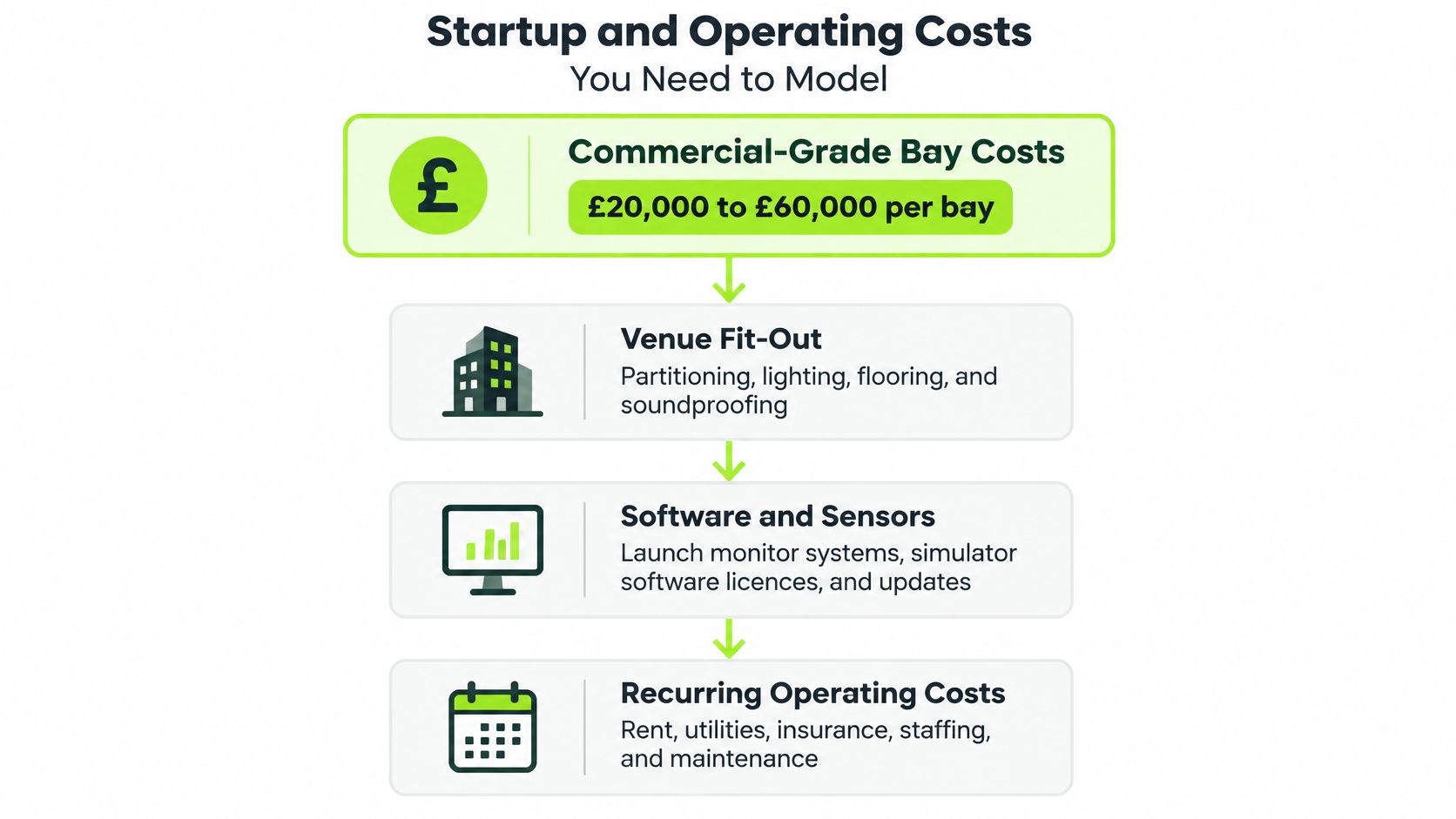
Single bays are cheaper to build, though rarely cheap to justify. One UK view places complete bay costs between £20,000 and £75,000 depending on specification and finish, with the typical commercial-grade figure of around £45,000 covering enclosure, impact screen, projector, launch monitor, turf, and computer as covered earlier. Where your project lands in that range decides how hard the calendar has to work. Price your actual room, ceiling height, and intended experience rather than averaging published figures.
Scale changes the cost base, not just the capital sum. An existing club adding one bay may share reception, toilets, catering, and management with the wider facility, while a leased standalone site carries all of those overheads alone. Two venues earning identical gross bay revenue can produce opposite profit outcomes, which makes comparisons of hire income without cost structure attached close to meaningless.
The recurring side deserves the same scrutiny as the fit-out. Software licensing runs £600 to £2,000 annually per bay on the UK finance guidance cited earlier, before you check whether course libraries, updates, and support sit inside that figure. Screens, projector lamps, mat wear, balls, cleaning, payment processing, insurance, licences, and marketing all recur.
| Cost type | Typical contents | Why it matters |
|---|---|---|
| Fixed | Rent or internal room charge, core staffing, insurance, software, finance payments, business rates | Falls due even at zero bookings |
| Semi-variable | Casual event labour, utilities, cleaning, hospitality staffing, coaching commissions | Rises with bookings and event volume |
| Replacement reserve | Screens, turf, projector components, computers, launch monitor servicing | Lumpy and easy to underfund |
| Working capital | Cash while memberships and corporate bookings build | Most exposed if you open outside winter |
Gross bay revenue isn't profit, and operating surplus isn't owner income. Finance costs, tax, depreciation, and your own time still need to be accounted for.
Model everything monthly. Annual totals hide the months where weak utilisation meets unchanged rent and staffing, and those are the months that create cash pressure. Once fixed monthly cost is pinned down, the equipment invoice fades into the background and a sharper question takes over: how many sold bay-hours does that base require each month?
Standalone Venue Versus Club-Integrated Model
Which income should be allowed to carry the fixed cost: the bay invoice alone, or the wider customer the bay creates? That choice sets the hurdle before any sensitivity model is run.
The demand pool is broad. England recorded 5.3 million people taking part in off-course golf experiences, spanning driving ranges, simulators, and Topgolf-style venues, while the same reporting puts English club membership at 750,071 in 2025, up 2.66% year on year. Off-course reach is several times larger than the membership base, so the opportunity is real, but reach is not the same as captured revenue.
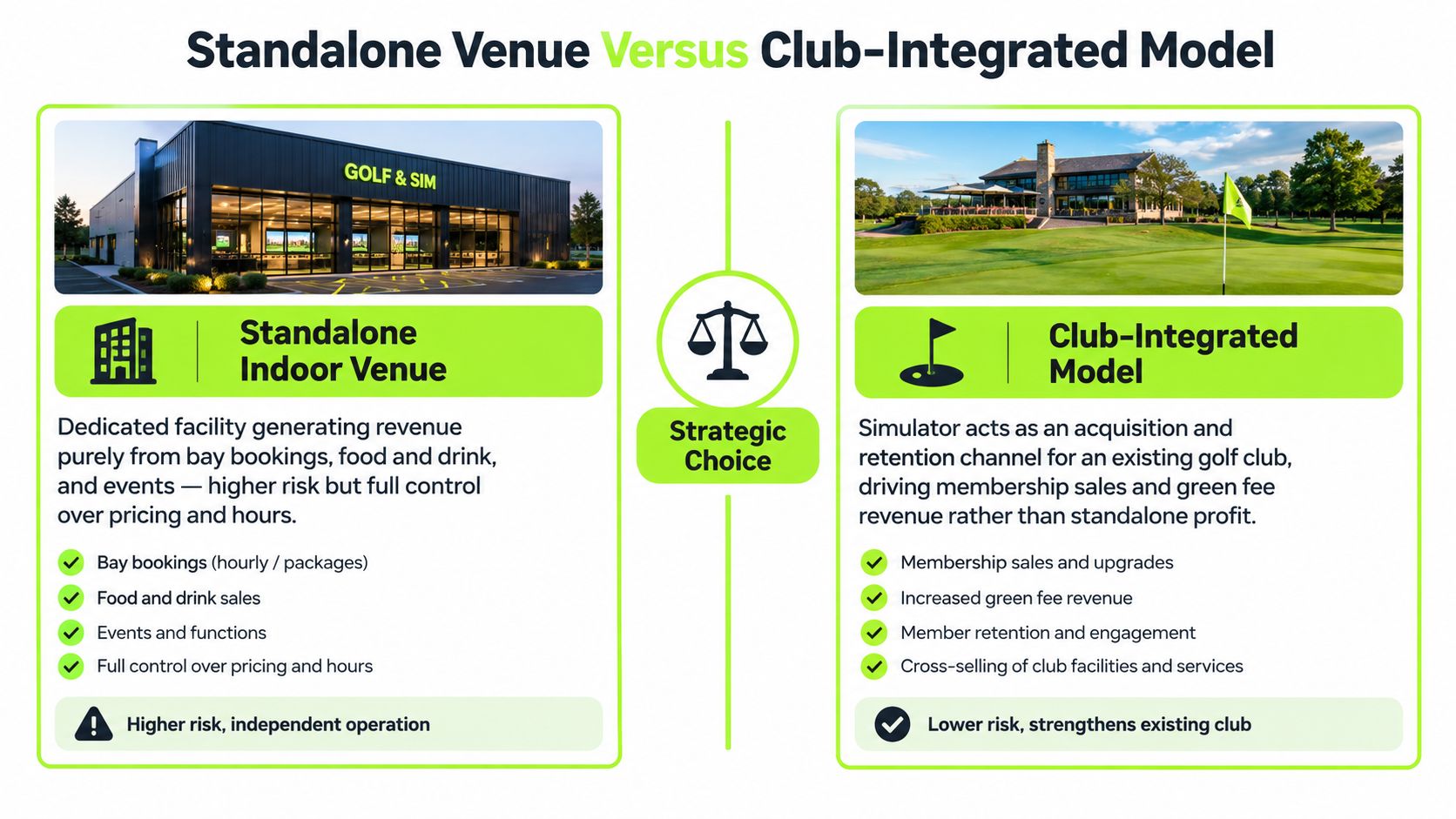
Take a standalone site with two bays, a bar, evening leagues, and corporate slots. Rent, core staff, finance, software, insurance, and marketing all sit inside the simulator business, so the model has to clear its monthly fixed base from hourly hire plus repeat food, event, membership, and league income. Pricing freedom is greater, programming freedom is greater, and so is exposure when a wet March, a quiet August, or a weak corporate season lands in the same quarter. A plan that only balances under winter demand is a seasonal surplus wearing an annual coat.
For break-even bay-hours, that means the standalone denominator is unforgiving: fixed monthly cost divided by contribution per sold bay-hour, after the actual share of ancillary spend is counted rather than hoped for. If extra food and event income needs casual labour, the contribution per visit falls as volume rises. The model improves when leagues, coaching diaries, and group products convert idle off-peak hours into scheduled demand.
Inside a club, the accounting is looser and easier to get wrong. A bay can protect winter engagement, give coaches inventory, keep societies coming when the course is unplayable, and introduce visitors who later buy lessons, indoor membership, guest green fees, or full membership. That value sits beside subscriptions, green fees, and clubhouse margin, which is why understanding how golf clubs make money changes the test from hourly hire to member lifetime value.
The danger is attribution by mood. A club should still tag first-time simulator visitors, repeat bookings, conversion into coaching or membership, and the catering spend attached to those visits. If the wider value cannot be measured, it should not be used to soften the bay-level hurdle.
The decision rule is strict either way. Standalone venues need simulator-led cash to clear fixed cost without relying on unpriced goodwill. Clubs can accept a blended return, provided the lifetime-value claim survives tracking, renewal data, and an honest look at which bookings would have happened anyway.
Realistic Revenue Scenarios by Utilisation
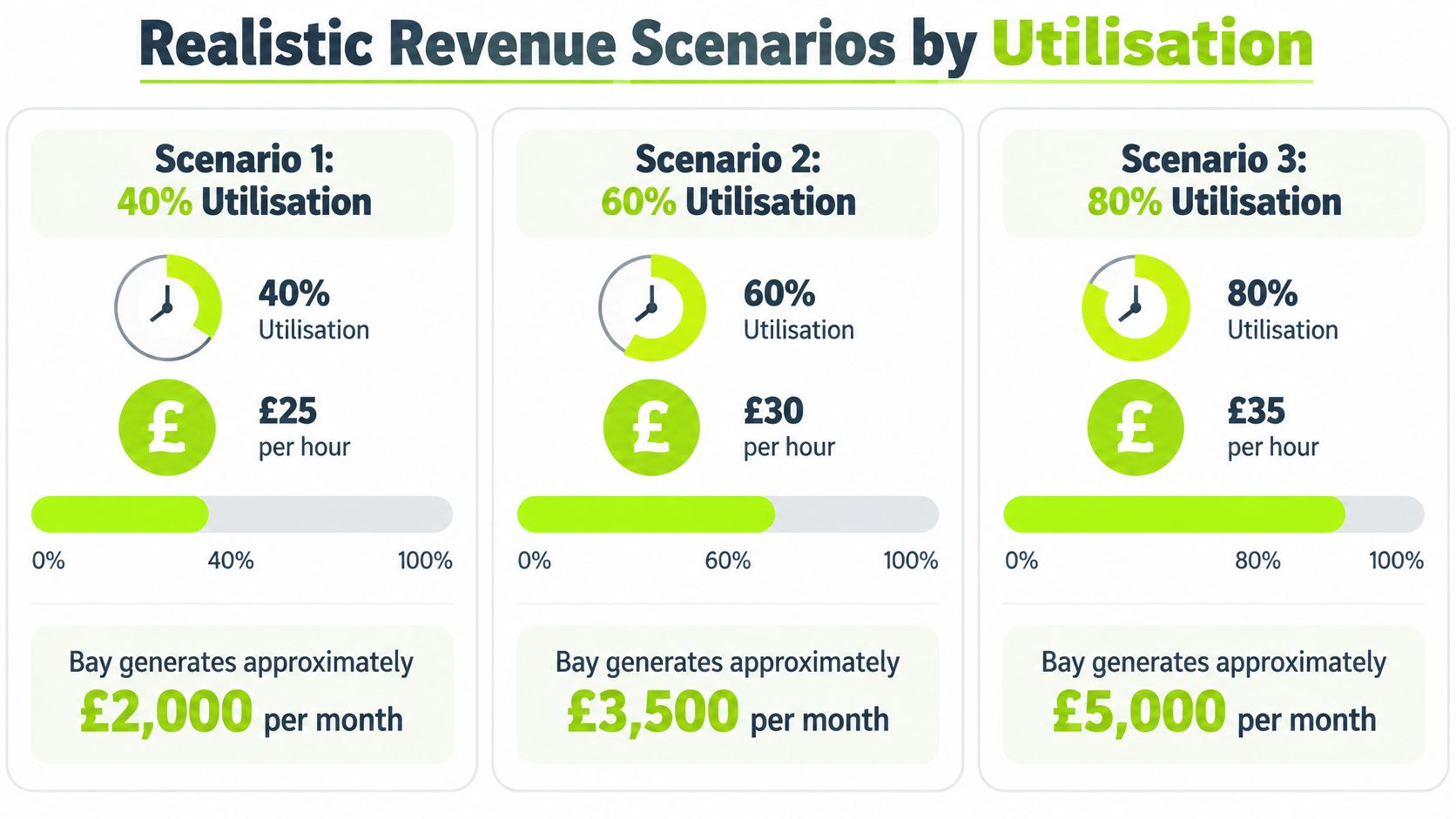
Sensitivity analysis is where optimism meets arithmetic. Instead of asking what a bay could make if everything goes well, test what happens at utilisation levels you might achieve in your first year, including quiet weekdays and summer.
A UK industry estimate modelling a bay at £25 per hour and 40% utilisation at approximately £36,500 rises to £50,188 at 55% utilisation and £63,875 at 70%. At £40 per hour, the equivalent figures are approximately £58,400, £80,300, and £102,200. Those are booking revenue scenarios, not profit, and they assume you can sustain both the rate and the utilisation.
Read the Spread, Not the Top Line
Notice what the table in that scenario really tells you. Moving utilisation has the same commercial effect as moving price, but the operational work is different. Higher utilisation comes from programming, partnerships, leagues, coaching diaries, and repeatable group products. Higher price comes from location, experience quality, demand pressure, and not discounting your best slots.
You also need to define utilisation consistently. Is your denominator every hour you're open, or only commercially saleable hours? A venue open long hours will report lower utilisation than a club bay open for a shorter, curated diary, even if both sell the same paid hours. Paid bay-hours and revenue per available bay-hour are harder to manipulate.
Build Three Cases Before You Commit
- Downside case: Lower weekday sales, cancellations, and a soft summer, with peak slots carrying the model.
- Base case: Achievable programming in place, a realistic member and guest mix, and seasonal variation shown monthly.
- Upside case: Strong leagues, coaching, and corporate demand, but only where named demand exists.
For operators running simulators across a club, a range, and perhaps a second site, consistent reporting by location and daypart becomes essential, which is where structured analytics for multi-location businesses can help you compare like with like rather than relying on venue anecdotes. If GolfRep is supporting that commercial planning, the useful work is the same: define the KPI, assign ownership in the CRM, and review paid hours weekly.
Don't let a four-bay illustrative gross revenue figure do your thinking for you. Scenario examples can imply a large operating surplus before finance, tax, and depreciation, but your rent, labour model, and local demand decide whether anything like that survives contact with reality. If your downside case can't service its fixed costs, reduce bays, share overhead, stage the investment, or don't proceed.
How to Calculate Break-Even Bay-Hours
Break-even is the calculation most missing from UK simulator discussions. It answers a practical question you can manage every week: how many paid hours must we sell this month before we stop losing money?
Start with this formula. Monthly fixed costs divided by average realised rate per paid hour equals break-even bay-hours. Use realised rate, not your highest advertised price, because member sessions, off-peak offers, coaching splits, and refunds all reduce what you collect.
Work Through It in Five Steps
- List monthly fixed costs: Include rent, core staffing, software, insurance, finance payments, utilities baseline, rates, and marketing you can't switch off.
- Add a replacement allowance: Put money aside monthly for screens, turf, projector wear, and computer replacement instead of treating them as surprises.
- Calculate realised rate: Divide actual booking revenue by paid bay-hours for a recent period, or model your expected member, guest, peak, and off-peak mix.
- Divide costs by rate: This gives total break-even bay-hours. Divide again by number of bays to get the target per bay.
- Convert to a weekly diary target: Spread the hours across peak, off-peak, coaching, and events so managers can see where the hours must come from.
Then test capacity. If break-even requires more prime-time hours than exist, the model fails even if the monthly total looks plausible. You can't sell the same Saturday afternoon hour twice, and filling Tuesday at a discount may not close a gap created by weak peak yield.
Stress-Test the Diary, Not Just the Spreadsheet
Reduce paid hours for cancellations, maintenance closures, staff absence, and seasonal dips. Then ask which costs flex if demand falls. Can you shorten opening hours in summer, consolidate bookings into fewer bays, or use coaching and leagues to anchor quieter days? If staffing stays fixed while hours shrink, your margin disappears quickly.
- Weekly KPI set: Paid bay-hours by daypart, average realised rate, cancellation level, and revenue per available bay-hour.
- Pricing decision rule: Discount only slots you repeatedly fail to sell, and attach a programme or product rather than cutting price alone.
- Capacity decision rule: If peak sells out but off-peak stays empty, you don't automatically need another bay. You need better off-peak products first.
Decision rule: Don't approve the investment until the base case clears break-even with headroom and the downside case shows exactly which costs you would cut or which cash reserve you would use.
That discipline turns a revenue estimate into a management system. Your team stops debating whether the simulator feels busy and starts managing the specific hours that determine cash flow.
The Bottom Line for UK Operators
A simulator business can make good money, but there's no credible single UK profit figure you can lift into your own plan. The range is wide because location, overhead, programming, and revenue mix change the result bay by bay.
The market context still supports serious investigation. A UK golf industry summary reporting approximately 14% of courses with indoor practice facilities in 2023 means roughly 86–87% of courses were not yet offering that service at the time of measurement. That underpenetration creates room for clubs and independent venues, but it doesn't guarantee local demand in your catchment.
Your decision should rest on three tests. First, can you sell enough paid bay-hours by daypart to clear break-even in a downside month, not just a strong winter? Second, does your mix of coaching, memberships, leagues, corporate hire, and hospitality use spare capacity without adding costs faster than income? Third, if you're a club, can you prove repeat visits and conversion into wider revenue rather than assuming goodwill will appear?
If those answers are evidenced, priced properly, and reviewed weekly, a simulator can be a durable commercial asset. If they're based on headline hourly rates and full occupancy, you're not looking at income. You're looking at risk with better lighting.
If you'd like help modelling break-even bay-hours, simulator pricing, and the membership or coaching journey that should sit around your bays, GolfRep works with UK clubs and indoor facilities to identify the current commercial constraint and improve it step by step. Visit us to discuss how your existing capacity, customer data, and follow-up systems could turn first simulator visits into repeat, measurable revenue.
Ready to tap into our proven growth system?