Golf Club Membership Recruitment Playbook

Most golf clubs still treat membership recruitment as a lead-generation exercise. They ask an agency for more enquiries, publish another joining offer, or increase paid social spend, then wonder why the membership secretary is chasing prospects from a spreadsheet weeks later.
That diagnosis is wrong. The central problem is usually conversion, not demand. UK clubs continue to attract prospective golfers, but many lose them through weak positioning, delayed replies, vague visits, and follow-up that depends on one busy person remembering what happened.
England Golf reported more than 730,000 golf-club members across 1,735 clubs in England in 2025, while the average member age fell to 54.99 years from 56.18 previously. England Golf membership figures point to a large, changing market. The opportunity is real. Clubs need a reliable system for turning interest into visits, visits into decisions, and decisions into signed membership.
Why Most Membership Recruitment Falls Short
The popular advice is to generate more enquiries. That sounds sensible until you inspect what happens after the form submission. A club can have strong green-fee income, visible visitor traffic, and a full diary of society bookings while still reporting that “there's no interest” in membership. Often, the prospects are there. The handover between enquiry and contract is broken.
The UK club data supports a more disciplined view. The 2023/24 Hillier Hopkins survey found that 24% of clubs had more leavers than joiners, despite an average of 73 joiners per members' club, up from 70 in 2022. The survey report makes the point indirectly. Raw acquisition doesn't prove healthy recruitment. Net movement does.
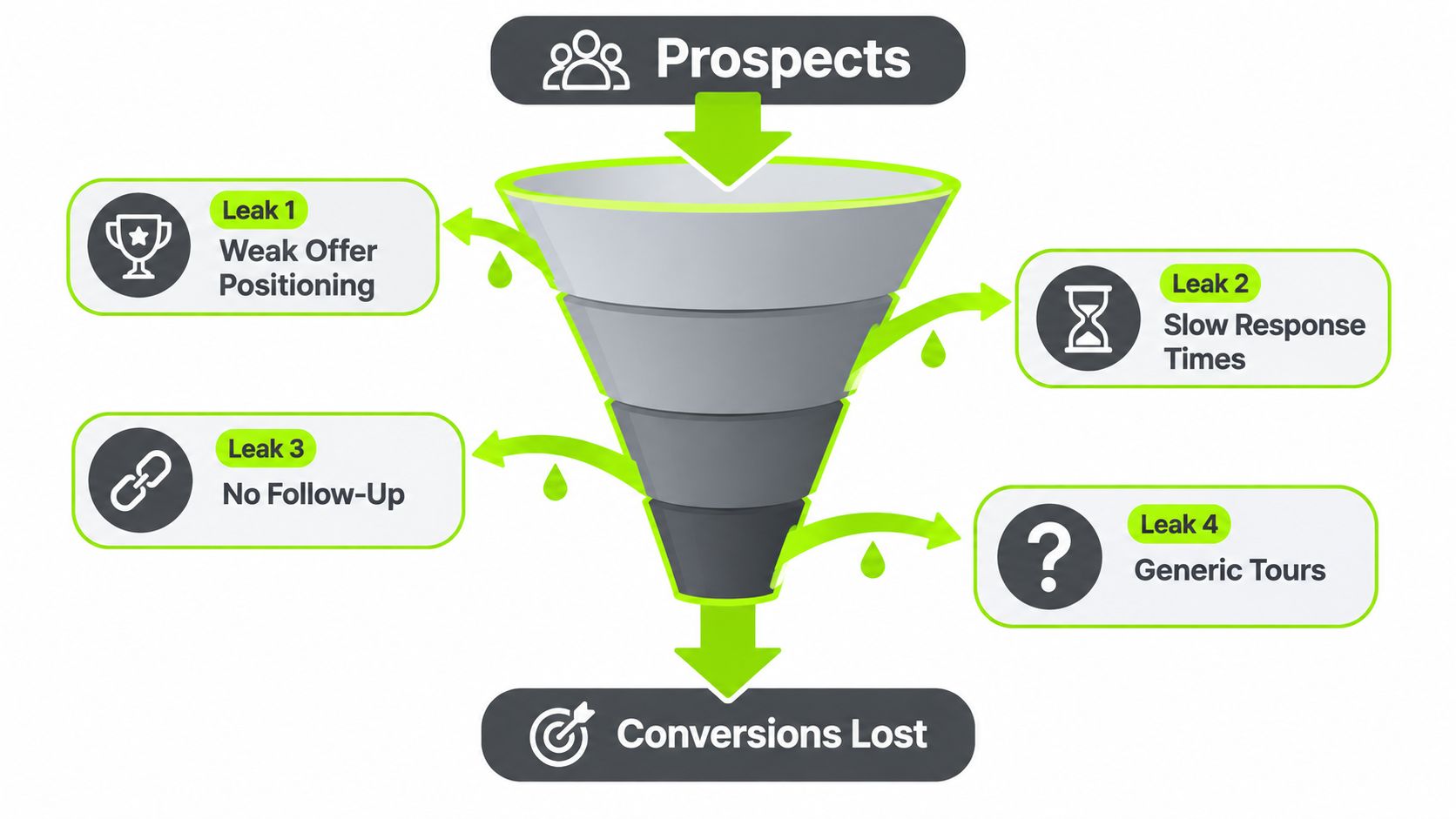
The four leaks inside the funnel
- Weak offer positioning: “Join our club” is not a compelling reason to act. A returning golfer, a parent, and a corporate buyer need different explanations of value.
- Slow response times: The prospect often contacts several clubs. A late reply makes the club look disorganised before anyone has discussed the course.
- Unstructured qualification: Staff collect a name and phone number, but not playing intent, location, timing, current club status, or the barrier preventing a decision.
- Inconsistent follow-up: A prospect visits, says they'll think about it, and disappears into an inbox. Nobody owns the next action.
Practical rule: If a club can't show where every enquiry sits, who owns it, and what happens next, it doesn't have a recruitment pipeline. It has a pile of opportunities.
GolfRep's approach is a closed-loop operating system. Segment the audiences, match each one to an offer, send traffic to focused landing pages, qualify immediately, respond quickly, run a structured visit, and track the outcome in a CRM. The general manager, membership secretary, PGA professional, and growth partner should be able to see the same journey.
That system matters because waiting lists aren't a dependable substitute for acquisition. The Hillier Hopkins 2023 survey found that the share of clubs with waiting lists fell from 52% to 46%, while the average list shortened from 61 to 51 people. The annual survey findings show why passive demand signals can mislead. A club needs to earn the decision, not assume scarcity will do the selling.
Defining the Audiences Worth Recruiting
A club shouldn't market one generic membership to everyone within driving distance. The right audience depends on urgency, familiarity with the club, playing frequency, and the friction that has stopped the person joining before.
Start with the groups closest to a decision.
Segment the market by intent and fit
| Segment | Priority | Primary Message Angle | Likely Entry Offer |
|---|---|---|---|
| Lapsed members | Highest | Return to a familiar club with a simpler route back | Rejoin conversation or hosted trial |
| Active social golfers | Highest | Move from flexible visits to dependable access and community | Hosted round or flexible entry membership |
| Relocating families | Medium | One club for family golf, juniors, and social connection | Family trial or junior-led introduction |
| Young professionals nearby | Medium | Convenient golf, social events, and weekday flexibility | Flexible or weekday membership |
| Corporate hospitality buyers | Medium | Turn guest golf and client hosting into a repeatable club relationship | Corporate trial or weekday package |
| Downsizing retirees | Medium | Daytime access, companionship, and structured club life | Social, flexible, or full membership discussion |
A lapsed member has already accepted the course, the club's standards, and the basic idea of membership. The trigger might be a changed work pattern, improved finances, children becoming more independent, or renewed interest in playing. The objection is usually practical, not ideological. They may remember an old joining process, inconvenient tee access, or a previous reason for leaving. The message should acknowledge that history rather than pretend the person is a cold lead.
An active social golfer is another priority. This golfer already spends money on golf and understands the value of playing, but may believe membership is too restrictive or expensive. Show the difference between occasional access and a consistent place to play, practise, compete, and meet people. Don't lead with discounts. Lead with fit.
Build around the trigger
Relocating families need reassurance about juniors, school-age participation, and social integration. Young professionals need clarity on weekday access, evening events, and how quickly they can meet other members. Corporate buyers care about dependable hosting, service, and a credible setting for relationships.
The club should also use flexible pathways for golfers who aren't ready for full membership. England Golf reported 72,921 iGolf subscribers and 12,562 iPlay users in 2025, and more than 24,000 iGolf subscribers had progressed into club membership overall, including 9,600 during 2025. The participation and progression figures indicate a practical bridge between casual play and full membership.
For a deeper framework on structuring these groups, use market segmentation for golf clubs. The first campaigns should normally target lapsed members and active social golfers. Their intent is already visible. Once the club can respond, qualify, host, and follow up consistently, expand into colder local audiences.
Building the Acquisition Channel Mix
A channel is useful only if it delivers the right prospect and gives the club a way to measure what happens next. Clubs often argue about whether Facebook, Google, email, or partnerships work. The better question is which channel produces qualified visits at an acceptable cost, then creates signed members after the visit.
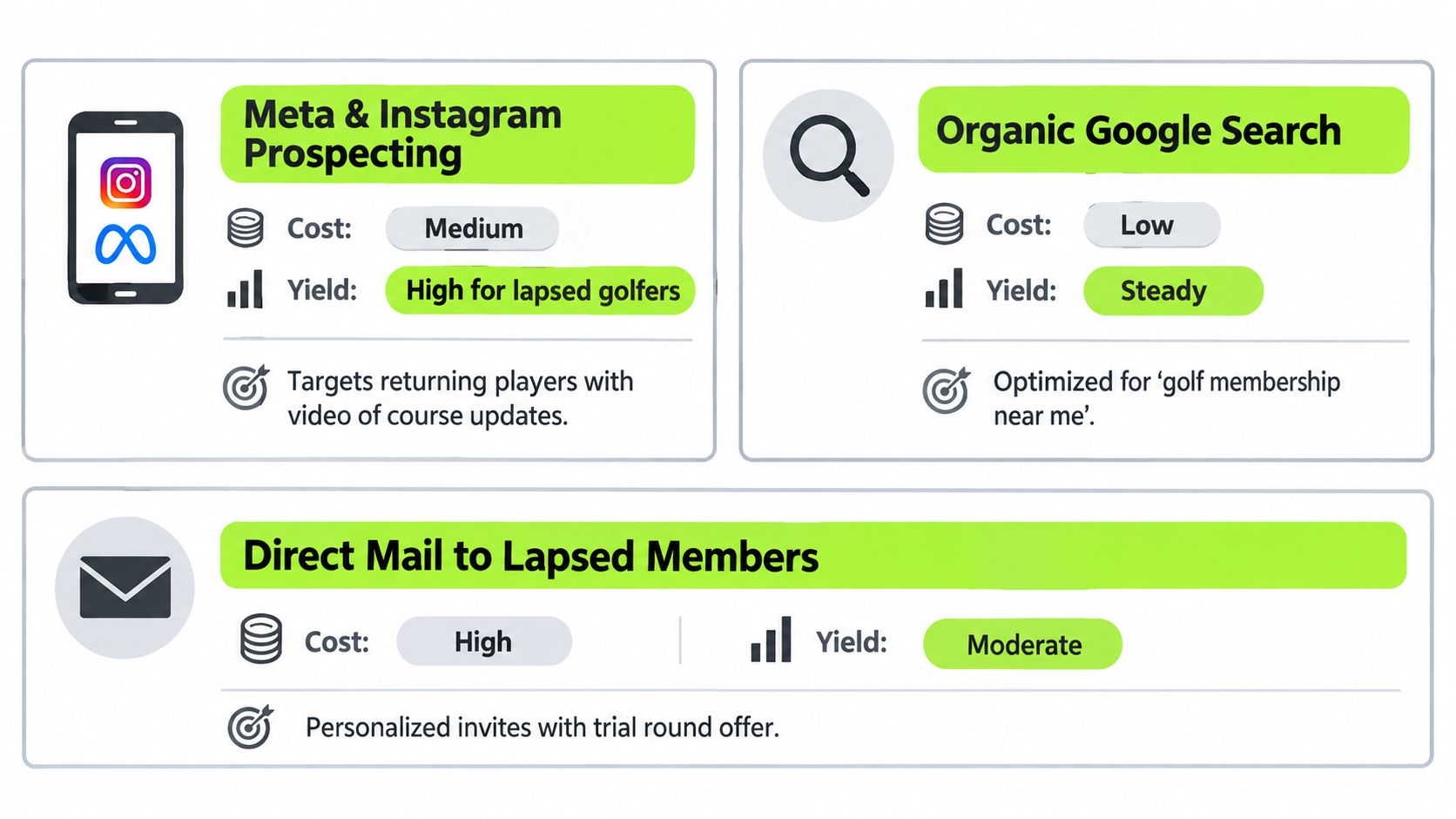
Use paid channels for intent and reach
Meta and Instagram prospecting work well for lapsed golfers and active players within a sensible local radius. Use course footage, clubhouse activity, member events, and a clear entry offer. Don't run a generic brand advert and expect the audience to infer why it should join.
Google Search captures active intent around searches such as golf membership near me, joining a golf club, or flexible golf membership. Performance Max can extend reach, but only when conversion tracking is clean. If every form completion is treated as equal, the campaign will optimise towards cheap, weak enquiries.
YouTube pre-roll can support competitor searches with a short course or clubhouse walkthrough. LinkedIn has a narrower role. Use it for corporate buyers, local employers, and young professionals rather than trying to make it carry the entire membership programme.
Make organic activity do useful work
- Local search: Build pages around the club's location, membership categories, junior golf, flexible access, and visitor-to-member pathways.
- Video: Show arrival, parking, practice facilities, clubhouse spaces, playing routes, and the social experience. Prospects want to know what a visit feels like.
- Database re-engagement: Send personal, useful invitations to lapsed members and past visitors. A generic newsletter won't restart a dormant relationship.
- Local partnerships: Estate agents, employers, hotels, schools, and golf retailers can introduce people at the moment their circumstances change.
- Member referrals: Give members a tracked reason to introduce a friend, then record the source and eventual outcome. An untracked recommendation is goodwill, not a measurable channel.
Don't accept invented media benchmarks from agencies. Costs vary by geography, audience, creative, season, and competition. Build a test budget, record the cost per qualified enquiry and booked visit, then judge the channel by signed membership and retention rather than clicks.
A club starting from zero should establish local search, database reactivation, referral tracking, and one paid prospecting channel first. A club with a functioning pipeline can add intent search, video, corporate outreach, and retargeting. The weighting should follow evidence from the club's own CRM, not a fashionable channel list.
Designing the Offer, Landing Page and Qualifying Form
The landing page is the club's first membership salesperson. It works outside office hours, answers the prospect's initial questions, and decides whether the visitor takes the next step or returns to search results.
Give each audience one primary offer. A complimentary round with a host can work for an experienced golfer who needs to judge course fit. A trial month or flexible entry route may suit someone who worries about commitment. The club should choose the offer based on the barrier, not on whatever promotion is easiest to publish.
Build the page around one decision
The hero section should name the audience and the outcome. “A welcoming golf club for returning Manchester golfers” is more useful than “Membership available now.” Follow with three to five specific proof points, such as playing access, practice facilities, junior provision, social events, location, or the way new members are introduced.
Remove distractions. Paid traffic should land on a dedicated URL with navigation reduced or removed, one clear call to action, and tracking that identifies the source. A person arriving from a lapsed-member email shouldn't see the same message as a cold visitor from a search advert.
The form needs enough detail to support a good conversation, but not so much that it becomes an application. Useful fields include:
- Playing background: handicap range or general playing level.
- Current status: member, visitor, lapsed member, or not currently playing.
- Location: postcode or nearby area.
- Timing: intended start month.
- Membership fit: full, flexible, junior, family, social, or corporate interest.
- Contact preference: phone, email, SMS, or WhatsApp where appropriate.
A qualifying form isn't designed to reject people harshly. It helps the club route enquiries properly. Someone outside the normal catchment may need a different conversation from a local golfer ready to visit this week.
The form should prepare the follow-up, not replace it.
Show the next step immediately after submission. Confirm what will happen, identify the person responsible, and offer a visit time where possible. That small piece of certainty reduces the gap between interest and action.
Instant Qualification and Speed-to-Lead Workflows
The first five minutes after an enquiry deserve more attention than another round of creative testing. A UK lead-response study reported that only 9.8% of firms replied within five minutes, while 15.9% never replied at all. The lead-response study recommends a first-hour response, ideally within the first five minutes.
Golf clubs often lose leads because the enquiry lands in a shared inbox. The membership secretary sees it between meetings, the PGA professional assumes the office will call, and the prospect receives a reply after they've already spoken to another club.
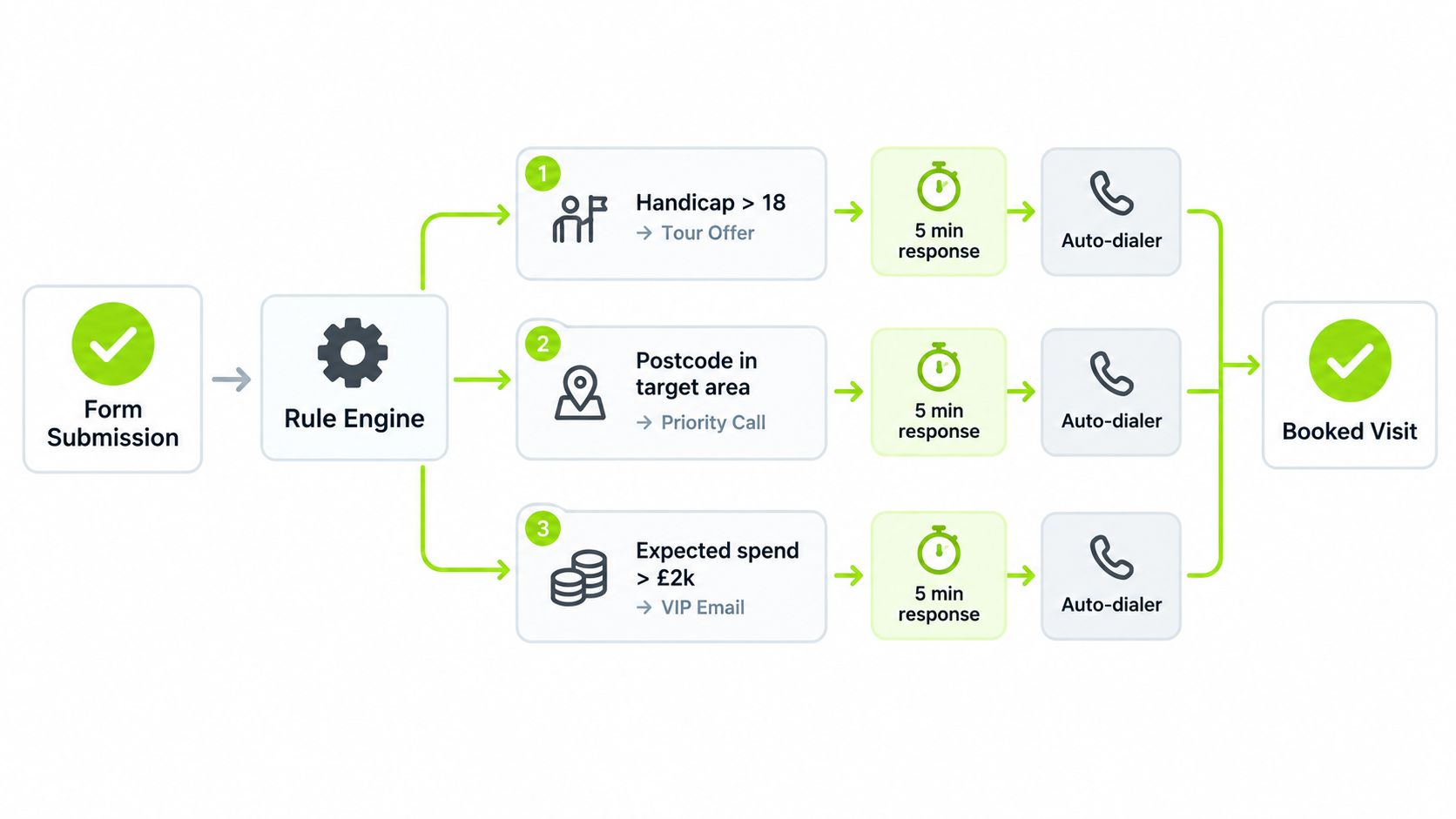
Route each enquiry by useful rules
A simple rule engine can score an enquiry using:
- Handicap or playing level
- Postcode and travel distance
- Expected start date
- Membership category
- Budget or stated price sensitivity
- Preferred contact method
Hot leads should reach a named duty manager through SMS or WhatsApp, with the prospect's details already visible. Cooler leads can enter a short nurture sequence containing a course video, relevant membership information, member stories, and an invitation to a member-for-a-day event.
The first reply should sound human:
“Hi Sarah, it's James from the membership team at the club. Thanks for getting in touch. I've seen that you're returning to regular golf and are looking to start soon. I can show you the course and talk through the flexible options. Would a weekday morning or early evening suit you better?”
The rota matters. Cover evenings, weekends, staff holidays, and competition days. If nobody can call, automation should acknowledge the enquiry, set expectations, and offer a booking link. It shouldn't pretend that a generic email is a completed sales process.
For practical guidance on structuring marketing automation workflow tips, focus on triggers, ownership, timing, and failure handling. GolfRep can also be used as one CRM option for organising membership enquiries, assigning them to staff, and tracking the journey from first contact to booked visit and outcome. Clubs using any platform should log the result consistently as Booked, Follow-up, Lost, or Refer-to-Friends, with a reason code.
Use lead qualification automation for golf clubs to formalise the decision rules. The technology isn't the strategy. Ownership is.
From Booked Visit to Signed Member
Sarah is a returning golfer in Manchester. She has played occasionally since leaving her previous club, but now wants regular access. She submits a form, selects a hosted visit, and receives a confirmation that names the person who'll meet her.
The visit shouldn't be an unstructured walk around the clubhouse. It should help Sarah decide whether the club fits her playing life.
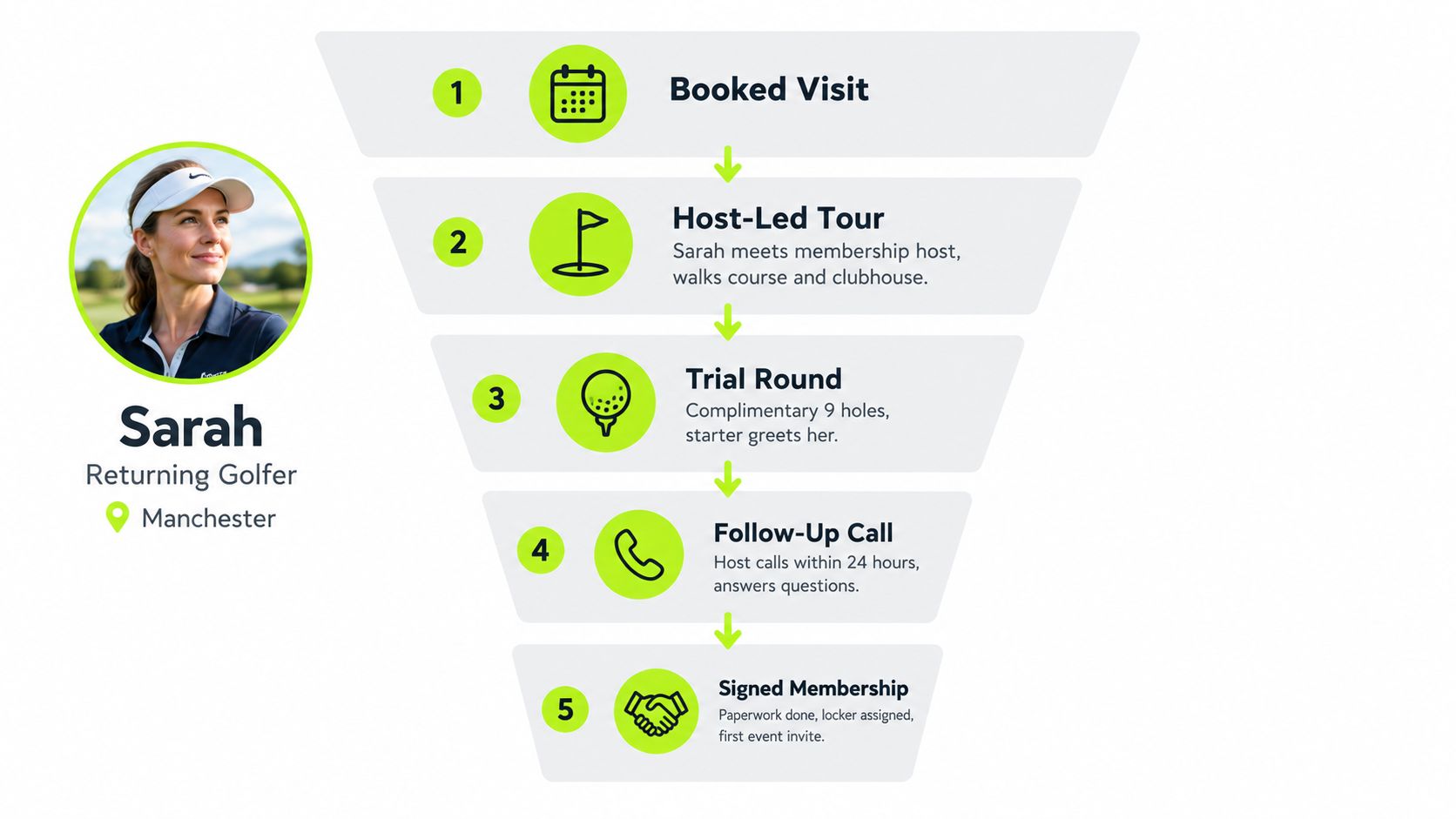
Give the host a real sequence
The pre-arrival SMS should be short:
“Hi Sarah, James here from the club. I'll meet you by reception at 10am tomorrow. We'll walk through the clubhouse, play a couple of quiet holes, and have a coffee afterwards. Bring your clubs if you'd like to play.”
The host should ask questions before presenting membership. “What has brought you back to regular golf?” “What frustrated you about your previous arrangement?” “When would you normally play?” “Would you be joining mainly for golf, competition, or meeting people?” These questions uncover the motivation and the objection.
The walkthrough should include the clubhouse and a couple of holes with a playing host. Keep the conversation natural, but make sure the prospect sees the practical experience, not only the condition of the fairways. Back in the clubhouse, use a printed proposal with a simple comparison.
| Membership option | Best suited to | Explain clearly |
|---|---|---|
| Full membership | Regular golfers seeking broad access | Playing rights, competitions, community |
| Flexible membership | Variable schedules or cautious returners | Included access, restrictions, upgrade route |
| Social or family membership | Members prioritising community or family use | Clubhouse, events, juniors, playing add-ons |
Anchor the comparison with the club's actual prices. Don't hide fees until the final stage. End with a soft close and a deposit link on the host's iPad: “Based on what you've told me, this looks like the most suitable route. Would you like to secure it today, or would you prefer me to send the proposal so you can consider it?”
One UK club reportedly moved from 18% visit-to-sign-up to 41% after standardising this playbook, assigning one named closer to every visit, and collecting the deposit on an iPad before the guest left. That case-study claim is provided in the recruitment brief and should be treated as a club-reported example, not a universal benchmark.
If Sarah leaves undecided, the closer calls within 24 hours, answers the remaining questions, and confirms the next action. A second follow-up should address the specific objection, not repeat “just checking in.” Later contact can include an event invitation or relevant member introduction.
KPIs, Reporting and the Optimisation Loop
A recruitment dashboard should separate activity from commercial movement. Leading indicators show whether the process is functioning now. Lagging indicators show whether the club is producing members who stay.
Track enquiries, response time, qualification rate, booked visits, show rate, visit-to-sign rate, cost per member, leavers, and membership value. The 2024/25 Hillier Hopkins survey found that members' clubs averaged 75 joiners in 2024, while average leavers rose to 56, up from 50 in the prior reporting cycle. The survey data reinforces the need to measure net movement, not just acquisition.
| KPI | Definition | Target (UK club) | Reporting frequency |
|---|---|---|---|
| Enquiries | New identifiable membership prospects | Set from capacity and staffing | Weekly |
| Speed to lead | Time from form submission to first human response | Within the first hour, with an operational aim of five minutes | Daily and weekly |
| Booked visits | Qualified prospects with a confirmed appointment | Improve month by month | Weekly |
| Show rate | Attended visits divided by booked visits | Improve through reminders and clear expectations | Weekly |
| Visit-to-sign rate | Signed members divided by attended visits | Establish a baseline, then improve | Weekly |
| Cost per member | Attributed spend divided by signed members | Compare by channel and offer | Monthly |
| Leavers | Members leaving during the period | Keep below joiner volume | Monthly |
| Net member movement | Joiners minus leavers | Positive by category | Monthly |
These targets should be set against the club's capacity and historic baseline. Don't copy a generic benchmark into a board report and call it strategy.
Run a short optimisation rhythm
Every Monday, review the previous week's source, offer, response time, booked visits, show rate, and close rate. Mid-month, change one underperforming stage, such as the form, reminder message, tour structure, or follow-up. At month end, give the committee a board-ready report showing what to stop, start, and double.
A club should stop channels that create volume without qualified visits. Start tests where the evidence shows friction. Double down on offers that produce attended visits and members who remain engaged. For broader practical ideas on how to boost sales conversions, apply the principle to the club's actual stages rather than chasing a single headline conversion rate.
Use how to measure marketing effectiveness to connect spend with booked visits, signed members, and recurring revenue. Golf club membership recruitment becomes predictable when every stage has an owner, every outcome has a reason, and every month produces a decision.
GolfRep helps UK golf clubs build membership pipelines that combine lead generation, instant qualification, structured follow-up, and CRM visibility from first enquiry to signed member. Visit GolfRep to discuss a practical recruitment system for your club, including the audiences, offers, workflows, and reporting needed to convert more of the interest you already receive.
Ready to tap into our proven growth system?